FACULTY OF NURSING, RAMA UNIVERSITY
PRESENTATION ON
CELL DIVISION AND CELL CYCLE
Submitted To-
PRINCIPAL
Dr. JASMI MANU
HOD Obstetrics & Gynaecological Nursing
Faculty Of Nursing
Rama University, Kanpur.
Submitted By-
Mrs. Akanksha Trivedi
MSC Nursing 1st yr
Faculty Of Nursing
Rama University, Kanpur
INTRODUCTION-
 Cell division is the process by which a parent cell divides into two or more daughter
cells. Cell division usually occurs as part of a larger cell cycle.
 In cell division the cell that is dividing is called the PARENT CELL. The parent cell
divides into two daughter cells and the process then repeats in what is called the cell
cycle.
 It’s the process by which a cell divides to form two new cells.
 Human body is continuously facing injury and truma. Thus the injured cells or last
tissues are constantly replaced through a process of regeneration and repair.
DEFINITIONS-
 CELL DIVISION-
“The division of the cell into two daughter cells with the same genetic material.”
OR
“Cell division is a crucial biological process for the creation of daughter cells from
parent cell aimed at growth, development and reproduction.”
 CELL CYCLE
“A cell cycle is a series of events that taken place in a cell as it grows and divides”
 Cell division is integral part of cell cycle.
TYPES OF CELL DIVISION-
There are two types of cell division or cell reproduction in organism-
1. PROKARYOTES ( Bacteria)
a) Binary fission
2. EUKARYOTES
a) Mitosis
b) Meiosis
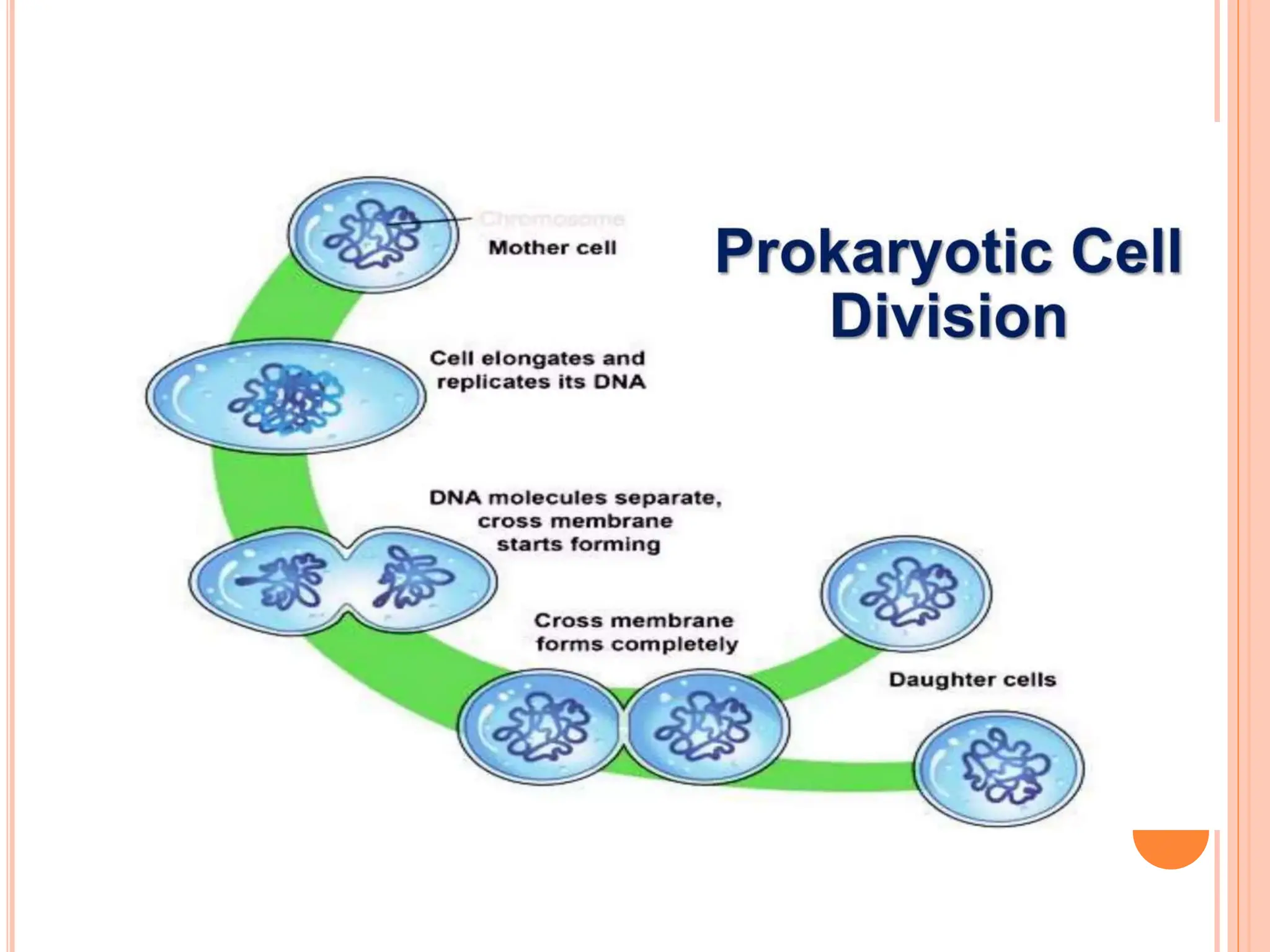
PROKARYOTIC CELL DIVISION-
BINARY FISSION-
 There 3 major steps-
 DNA replication- DNA is copied resulting into two identical chromosomes.
 Chromosome segregation- separates chromosome and move towards end
(poles) of the cells.
 Cytokinesis (separation)- cytoplasm divides forming two cells.
 Each new daughter cell is genetically identical to parent cells.
EUKARYOTIC CELL DIVISION-
 Cell division that results in two daughter cells each having the same number
and kind of chromosomes as the parents cell.
MITOSIS
NUCLEAR
DIVISION
CYTOKINESIS
MEIOSIS
MEIOSIS I
MEIOSIS II
MITOSIS-
 Mitosis is a process where a single cell divides into two identical daughter cells (cell
division). Facts.
 Mitosis is the process by which a cell replicates its chromosomes and then segregates
them, producing two identical nuclei in preparation for cell division..
 There are mainly two division-
1. MITOSIS ( NUCLEAR DIVISION)-
a. Prophase
b. Metaphase
c. Anaphase
d. Telophase
2. CYTOKINESIS- Cytoplasm Divided Forming Two New Daughter Cells.
 Each Daughter Cells Is Genetically Identical To Parents.
CONT-
Prophase-
 The nuclear membrane disapear
 Formation of two centrioles and move to opposite poles of the cell
 Spindle forms from the centrioles located at two opposite poles.
Metaphase-
 Chromosomes moves to the equatorial plate of the cell which is the
middle of the cell between the poles.
 Spindles grow and attach to the kinetochore ( in centromere) of each
sister chromatid.
CONT-
Anaphase-
 Spindles start to shorten pulling the chromatids.
 The centromere splits, detaching the two sister chromatids.
 Spindles fibers pull the separated chromatid to their respective pole.
 Separated sister chromatids are now called chromosomes.
Telophase-
 Nuclear membrane forms again surrounding the chromatid which have moved to the two ploes.
 Spindles fibres disappear.
 A cleavage furrow appears in middle cells
 The cell into two daughter cells.
MEIOSIS-
 Meiosis is a process of cell division by which the number of chromosomes
per cell is halved during the division.
 Ovary or testes to produce gamets. Fusion of the ovum and sperm restore
the diploid number of chromosomes in the fertilised ovum.
 The cell enter the cell cycle. After completion of G2 phase the cell enters
meiosis.
Meiosis consist two successive division-
1. First meiosis
2. Second meiotic division.
FIRST MEIOTIC DIVISION/MEIOSIS I
1. Prophase 1
 Lepototene
 Zygotene
 Pachytene
 Diplotene
 diakinesis
2. Metaphase 1
3. Anaphase 1
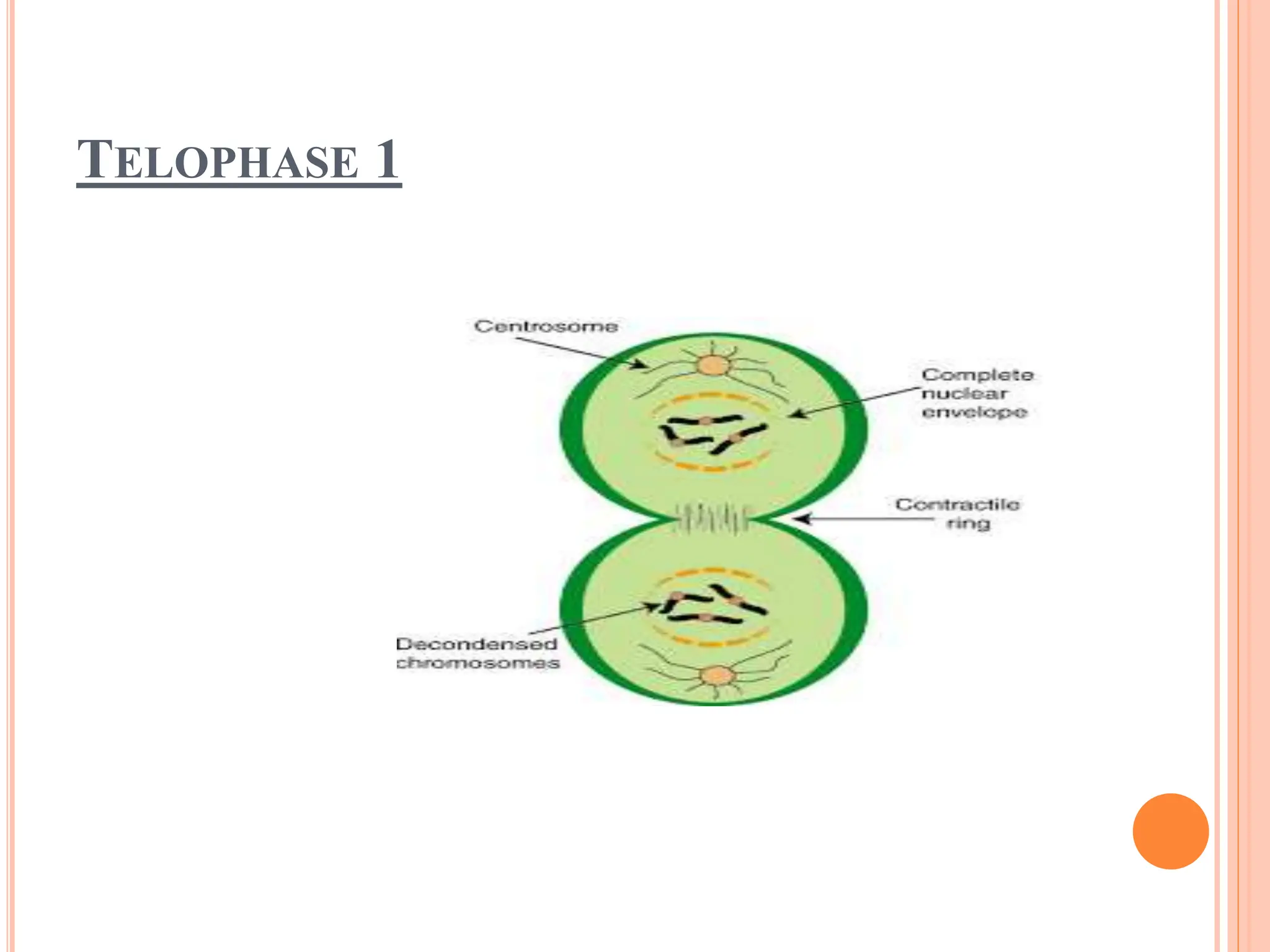
4. Telophase 1
PROPHASE 1
METAPHASE 1
ANAPHASE 1
TELOPHASE 1
SECOND MEIOTIC DIVISION/ MEIOSIS 2
 The second meiotic division follows the first meiotic division without any
gap
( interphase) .
1. Prophase 2
2. Metaphase 2
3. Anaphase 2
4. Telophase 2
Results of meiosis four haploid cells with one copy of the each chromosomes.
PROPHASE 2
METAPHASE 2
ANAPHASE 2
TELOPHASE 2
CONTI-
THE DIFFERENCE BETWEEN MITOSIS AND
MEIOSIS
Mitotic Meiosis
Number of division 1 2
Number of daughter cells 2 4
Chromosomes Same as parents Half of the parents
Genetically identically Yes No
Where Somatic cells Germs cells
When Throughout the life At the sexual maturity
Role Growth and repair Sexual reproduction
THE CELL CYCLE-
 The sequence of the events from the time a cell first arises as a result
of the cell division untill the time when that cell itself divides.
The consists the period of
 Growth and development (G1 PHASE)
 DNA replication (S PHASE)
 Preparation for division (G2 PHASE)
 Cell division. ( MEIOTIC/ M PHASE )
SUMMARY
 There are two types of cell division: mitosis and meiosis. Most of
the time when people refer to “cell division,” they mean mitosis, the
process of making new body cells. Meiosis is the type of cell
division that creates egg and sperm cells. Mitosis is a fundamental
process for life. Cell division usually occurs as part of a larger cell
cycle. All cells reproduce by splitting into two, where each parental
cell gives rise to two daughter cells.
 A cell cycle is a series of events that takes place in a cell as it grows
and divides. A cell spends most of its time in what is called
interphase, and during this time it grows, replicates its
chromosomes, and prepares for cell division.
CONCLUSION
 At the conclusion of the cycle, each parent cell produces two
genetically identical daughter cells that may undergo a cycle of
replication. Roughly 90 percent of the cell cycle is spent in
interphase. Interphase is comprised of three main steps: the first gap
phase, the synthesis phase, and the second gap phase.
 Cell Division can be simply defined as the process that results in two
daughter cells, each with the same number of chromosomes as the
parent cell. The chromosomes are duplicated first, and then the cell
divides
ASSIGNMENT-
 Write down the cell cycle.
BIBLIOGRAPHY-
 “Mandal AK Shramana Chaudhary”, “ Comprehensive Textbook of
pahthology, clinical pathology, genetic” first edition 2016, published by
Avichal publication company; page no 198-201.
 “ Gerard J Tortora”, “ principles of anatomy and physiology”, 1st edition
published by jaypee publication; page no 92-94.
 “ Anne Waugh and Alison Grant”, “ Anatomy and physiology”, 12th edition
page no-104-105.
 https://www.vedantu.com/biology/cell-division
 https://www.slideshare.net/Wabworld/the-cell-cycle-and-cell-division
CELL CYCLE.pptx Akanksha trivedi Rama University kanpur

CELL CYCLE.pptx Akanksha trivedi Rama University kanpur

  • 1.
    FACULTY OF NURSING,RAMA UNIVERSITY PRESENTATION ON CELL DIVISION AND CELL CYCLE Submitted To- PRINCIPAL Dr. JASMI MANU HOD Obstetrics & Gynaecological Nursing Faculty Of Nursing Rama University, Kanpur. Submitted By- Mrs. Akanksha Trivedi MSC Nursing 1st yr Faculty Of Nursing Rama University, Kanpur
  • 2.
    INTRODUCTION-  Cell divisionis the process by which a parent cell divides into two or more daughter cells. Cell division usually occurs as part of a larger cell cycle.  In cell division the cell that is dividing is called the PARENT CELL. The parent cell divides into two daughter cells and the process then repeats in what is called the cell cycle.  It’s the process by which a cell divides to form two new cells.  Human body is continuously facing injury and truma. Thus the injured cells or last tissues are constantly replaced through a process of regeneration and repair.
  • 3.
    DEFINITIONS-  CELL DIVISION- “Thedivision of the cell into two daughter cells with the same genetic material.” OR “Cell division is a crucial biological process for the creation of daughter cells from parent cell aimed at growth, development and reproduction.”  CELL CYCLE “A cell cycle is a series of events that taken place in a cell as it grows and divides”  Cell division is integral part of cell cycle.
  • 4.
    TYPES OF CELLDIVISION- There are two types of cell division or cell reproduction in organism- 1. PROKARYOTES ( Bacteria) a) Binary fission 2. EUKARYOTES a) Mitosis b) Meiosis
  • 5.
    PROKARYOTIC CELL DIVISION- BINARYFISSION-  There 3 major steps-  DNA replication- DNA is copied resulting into two identical chromosomes.  Chromosome segregation- separates chromosome and move towards end (poles) of the cells.  Cytokinesis (separation)- cytoplasm divides forming two cells.  Each new daughter cell is genetically identical to parent cells.
  • 7.
    EUKARYOTIC CELL DIVISION- Cell division that results in two daughter cells each having the same number and kind of chromosomes as the parents cell. MITOSIS NUCLEAR DIVISION CYTOKINESIS MEIOSIS MEIOSIS I MEIOSIS II
  • 8.
    MITOSIS-  Mitosis isa process where a single cell divides into two identical daughter cells (cell division). Facts.  Mitosis is the process by which a cell replicates its chromosomes and then segregates them, producing two identical nuclei in preparation for cell division..  There are mainly two division- 1. MITOSIS ( NUCLEAR DIVISION)- a. Prophase b. Metaphase c. Anaphase d. Telophase 2. CYTOKINESIS- Cytoplasm Divided Forming Two New Daughter Cells.  Each Daughter Cells Is Genetically Identical To Parents.
  • 10.
    CONT- Prophase-  The nuclearmembrane disapear  Formation of two centrioles and move to opposite poles of the cell  Spindle forms from the centrioles located at two opposite poles. Metaphase-  Chromosomes moves to the equatorial plate of the cell which is the middle of the cell between the poles.  Spindles grow and attach to the kinetochore ( in centromere) of each sister chromatid.
  • 11.
    CONT- Anaphase-  Spindles startto shorten pulling the chromatids.  The centromere splits, detaching the two sister chromatids.  Spindles fibers pull the separated chromatid to their respective pole.  Separated sister chromatids are now called chromosomes. Telophase-  Nuclear membrane forms again surrounding the chromatid which have moved to the two ploes.  Spindles fibres disappear.  A cleavage furrow appears in middle cells  The cell into two daughter cells.
  • 12.
    MEIOSIS-  Meiosis isa process of cell division by which the number of chromosomes per cell is halved during the division.  Ovary or testes to produce gamets. Fusion of the ovum and sperm restore the diploid number of chromosomes in the fertilised ovum.  The cell enter the cell cycle. After completion of G2 phase the cell enters meiosis. Meiosis consist two successive division- 1. First meiosis 2. Second meiotic division.
  • 13.
    FIRST MEIOTIC DIVISION/MEIOSISI 1. Prophase 1  Lepototene  Zygotene  Pachytene  Diplotene  diakinesis 2. Metaphase 1 3. Anaphase 1 4. Telophase 1
  • 14.
  • 15.
  • 16.
  • 17.
  • 18.
    SECOND MEIOTIC DIVISION/MEIOSIS 2  The second meiotic division follows the first meiotic division without any gap ( interphase) . 1. Prophase 2 2. Metaphase 2 3. Anaphase 2 4. Telophase 2 Results of meiosis four haploid cells with one copy of the each chromosomes.
  • 19.
  • 20.
  • 21.
  • 22.
  • 23.
  • 24.
    THE DIFFERENCE BETWEENMITOSIS AND MEIOSIS Mitotic Meiosis Number of division 1 2 Number of daughter cells 2 4 Chromosomes Same as parents Half of the parents Genetically identically Yes No Where Somatic cells Germs cells When Throughout the life At the sexual maturity Role Growth and repair Sexual reproduction
  • 25.
    THE CELL CYCLE- The sequence of the events from the time a cell first arises as a result of the cell division untill the time when that cell itself divides. The consists the period of  Growth and development (G1 PHASE)  DNA replication (S PHASE)  Preparation for division (G2 PHASE)  Cell division. ( MEIOTIC/ M PHASE )
  • 27.
    SUMMARY  There aretwo types of cell division: mitosis and meiosis. Most of the time when people refer to “cell division,” they mean mitosis, the process of making new body cells. Meiosis is the type of cell division that creates egg and sperm cells. Mitosis is a fundamental process for life. Cell division usually occurs as part of a larger cell cycle. All cells reproduce by splitting into two, where each parental cell gives rise to two daughter cells.  A cell cycle is a series of events that takes place in a cell as it grows and divides. A cell spends most of its time in what is called interphase, and during this time it grows, replicates its chromosomes, and prepares for cell division.
  • 28.
    CONCLUSION  At theconclusion of the cycle, each parent cell produces two genetically identical daughter cells that may undergo a cycle of replication. Roughly 90 percent of the cell cycle is spent in interphase. Interphase is comprised of three main steps: the first gap phase, the synthesis phase, and the second gap phase.  Cell Division can be simply defined as the process that results in two daughter cells, each with the same number of chromosomes as the parent cell. The chromosomes are duplicated first, and then the cell divides
  • 29.
  • 30.
    BIBLIOGRAPHY-  “Mandal AKShramana Chaudhary”, “ Comprehensive Textbook of pahthology, clinical pathology, genetic” first edition 2016, published by Avichal publication company; page no 198-201.  “ Gerard J Tortora”, “ principles of anatomy and physiology”, 1st edition published by jaypee publication; page no 92-94.  “ Anne Waugh and Alison Grant”, “ Anatomy and physiology”, 12th edition page no-104-105.  https://www.vedantu.com/biology/cell-division  https://www.slideshare.net/Wabworld/the-cell-cycle-and-cell-division