Dr. M.Sridhar / International Journal of Engineering Research and Applications
                   (IJERA)             ISSN: 2248-9622        www.ijera.com
                      Vol. 3, Issue 1, January -February 2013, pp.473-481
 A Speed Control Of Pmbldcm Drive Using Single Stage Pfc Half
                      Bridge Converter

                        Dr. M.Sridhar, H.O.D, Sayed Baji Shaik
                     Department of EEE, GIET, RAJAHMUNDRY

Abstract
         In this paper, a buck half-bridge DC-          conditioners      mostly have a single-phase
DC converter is used as a single-stage power            induction motor to drive the compressor in
factor correction (PFC) converter for feeding           „on/off‟ control mode. This results in increased
a voltage source inverter (VSI) based                   losses due to frequent „on/off‟ operation with
permanent magnet brushless DC motor                     increased mechanical and electrical stresses on
(PMBLDCM) drive. The front end of this PFC              the motor, thereby poor           efficiency    and
converter is a diode bridge rectifier (DBR) fed         reduced life of the motor. Moreover, the
from single-phase        AC      mains.     The         temperature of the air conditioned zone is
PMBLDCM is used to drive a compressor                   regulated in a hysteresis band. Therefore, improved
load of an air conditioner through a three-             efficiency of the Air-Con system will certainly
phase VSI fed from a controlled DC link                 reduce the cost of living and energy demand to
voltage. The speed of the compressor is                 cope-up with ever increasing power crisis.
controlled to achieve energy conservation using                   A PMBLDCM which is a kind of three-
a concept of the voltage control at DC link             phase synchronous motor          with     permanent
proportional     to the desired speed of the            magnets (PMs) on the rotor and trapezoidal
PMBLDCM. Therefore the VSI is operated                  back EMF waveform, operates on electronic
only as an electronic commutator of the                 commutation accomplished by            solid state
PMBLDCM. The stator current             of   the        switches. It is powered through a three-phase
PMBLDCM during step change of reference                 voltage source inverter (VSI) which is fed from
speed is controlled by a rate limiter for the           single-phase AC supply using a diode bridge
reference voltage at DC link. The proposed              rectifier (DBR) followed by smoothening DC
PMBLDCM drive with voltage control based                link capacitor. The compressor exerts constant
PFC converter is designed, modeled and its              torque (i.e. rated torque) on the PMBLDCM and
performance is       simulated     in    Matlab-        is operated in speed control mode to improve the
Simulink       environment     for     an    air        efficiency of the Air-Con system.
conditioner compressor driven through a 1.5
kW,      1500     rpm PMBLDC motor. The                          Since, the back-emf of the PMBLDCM is
evaluation results of the proposed speed                proportional to the motor speed and the developed
control      scheme     are     presented     to        torque is proportional to its phase current [1-4],
demonstrate an improved efficiency of the               therefore, a constant torque is maintained by a
proposed drive system with PFC feature in               constant current in the stator winding of the
wide range of the speed and an input AC                 PMBLDCM whereas the speed can be controlled
voltage.                                                by varying the terminal voltage of the motor.
                                                        Based on this logic, a speed control scheme is
IndexTerms—        PFC,      PMBLDCM,         Air       proposed in this paper which uses a reference
conditioner, Buck Half- bridge converter, Voltage       voltage at DC link proportional to the desired
control, VSI.                                           speed of the PMBLDC motor. However, the
                                                        control     of    VSI     is only for electronic
1. Introduction                                         commutation which is based on the rotor
          PERMANENT magnet brushless dc                 position signals of the PMBLDC motor.
motors (PMBLDCM) are preferred motors for a
compressor of an air-conditioning (Air con) system                The PMBLDCM drive, fed from a single-
due to its features like high efficiency, wide speed    phase AC mains through a diode bridge rectifier
range and low maintenance requirements [1-4].           (DBR) followed by a DC link capacitor, suffers
The operation of the compressor with the speed          from power quality (PQ) disturbances such as
control results in an improved efficiency of the        poor power factor (PF), increased total harmonic
system while maintaining the temperature in the         distortion (THD) of current at input AC mains and
air-conditioned zone at       the     set   reference   its high crest factor (CF). It is mainly due to
consistently. Whereas, the existing air                 uncontrolled charging of the DC link capacitor


                                                                                             473 | P a g e
Dr. M.Sridhar / International Journal of Engineering Research and Applications
                   (IJERA)             ISSN: 2248-9622        www.ijera.com
                      Vol. 3, Issue 1, January -February 2013, pp.473-481
which results in a pulsed current waveform having     sensors for voltage and current signals. Moreover,
a peak value higher than the amplitude of the         the rotor position signals are used to generate
fundamental input current       at   AC    mains.     the switching quence for the VSI as an
Moreover, the PQ standards for low power              electronic commutator of the PMBLDC motor.
equipments such as IEC 61000-3-2 [5],                 Therefore, rotor-position information is required
emphasize on low harmonic contents and near           only at the commutation points, e.g., every
unity power factor current to be drawn from AC        60°electrical in the three- phase [1-4]. The rotor
mains by these motors. Therefore, use of a power      position of PMBLDCM is sensed using Hall effect
factor correction (PFC)        topology amongst       position sensors and used to generate switching
various available topologies [6-14] is almost         sequence for the VSI as shown in Table-I.
inevitable for a PMBLDCM drive.
                                                               The DC link voltage is controlled by a
          Most of the existing systems use a boost    half-bridge buck DC-DC converter based on the
converter for PFC as the front-end converter and an   duty ratio (D) of the converter. For a fast and
isolated DC-DC converter to produce desired           effective control with reduced size of magnetics
output voltage constituting a two-stage PFC drive     and filters, a high switching frequency is used;
[7-8]. The DC-DC converter used in the second         however, the switching frequency (fs) is limited
stage is usually a        flyback    or     forward   by the switching device used, operating power
converter for low power applications and a            level and switching losses of the device. Metal
full-bridge    converter     for   higher     power   oxide field effect transistors (MOSFETs) are
applications. However, these two stage PFC            used as the switching device for high switching
converters have high cost and complexity in           frequency in the proposed PFC converter.
implementing       two       separate switch-mode     However, insulated gate bipolar transistors
converters, therefore a single stage converter        (IGBTs) are used in VSI bridge feeding
combining the PFC and voltage regulation at DC        PMBLDCM, to reduce the switching stress, as it
link is more in demand. The single-stage PFC          operates at lower frequency compared to PFC
converters operate with only one controller to        switches.
regulate the DC link voltage along with the power
factor correction. The absence of a second                      The PFC control scheme uses a current
controller has a greater impact on the performance    control loop inside the speed control loop with
of single-stage PFC converters and requires a         current multiplier approach which operates in
design to operate over a much wider range of          continuous conduction mode (CCM) with average
operating conditions.                                 current control. The control loop begins with the
                                                      comparison of sensed DC link voltage with a
         For the proposed voltage controlled          voltage equivalent to the reference speed. The
drive, a half-bridge buck DC-DC converter is          resultant voltage error is passed through a
selected because of its high power handling           proportional-integral (PI) controller to give the
capacity as compared to the single switch             modulating current signal. This signal is multiplied
converters. Moreover, it has switching losses         with a unit template of input AC voltage and
comparable to the single switch converters as         compared with DC current sensed after the DBR.
only one switch is in operation at any instant of     The resultant current error is amplified and
time. It can be operated as a single-stage power      compared with saw-tooth carrier wave of fixed
factor corrected (PFC) converter when connected       frequency (fs) in unipolar scheme (as shown in
between the VSI and the DBR fed from single-          Fig.2) to generate the PWM pulses for the half-
phase AC mains, besides controlling the voltage at    bridge converter. For the current control of the
DC link for the desired speed of the Air-Con          PMBLDCM during step change of the reference
compressor. A detailed modeling, design and           voltage due to the change in the reference speed,
performance evaluation of the proposed drive          a voltage gradient less than 800 V/s               is
are presented for an air conditioner compressor       introduced for the change of DC link voltage,
driven by a PMBLDC motor of 1.5 kW, 1500 rpm          which      ensures the stator current of the
rating.                                               PMBLDCM within the specified limits (i.e. double
                                                      the rated current).
2. PROPOSED SPEED CONTROL
SCHEME OF PMBLDC MOTOR FOR
AIR CONDITIONER
        The proposed speed control scheme (as
shown in Fig. 1) controls reference voltage at
DC link as an equivalent reference speed,
thereby replaces the conventional control of the
motor speed and a stator current involving various

                                                                                            474 | P a g e
Dr. M.Sridhar / International Journal of Engineering Research and Applications
                  (IJERA)             ISSN: 2248-9622        www.ijera.com
                     Vol. 3, Issue 1, January -February 2013, pp.473-481
                                                       buck half-bridge converter. The inductance (Lo)
                                                       of the ripple filter restricts the inductor peak to
                                                       peak ripple current (ΔILo) within specified
                                                       value for the given switching frequency (fs),
                                                       whereas, the capacitance (Cd) is calculated for a
                                                       specified ripple in the output voltage (ΔVCd) [7-
                                                       8]. The output filter inductor and capacitor are
                                                       given as,

                                                       Lo= (0.5-D)Vdc/{fs(ΔILo) }        (3)
                                                       Cd=Io/(2ωΔVCd)            (4)
                                                       The PFC converter is designed for a base DC link
                                                       voltage of Vdc = 400 V at Vin = 198 V from Vs
                                                       = 220 Vrms. The turns ratio of the high frequency
                                                       transformer (N2/N1) is taken as 6:1 to maintain
                                                       the desired DC link voltage at low input AC
                                                       voltages typically at 170V. Other design data are
                                                       fs = 40 kHz, Io = 4 A, ΔVCd= 4 V (1% of Vdc),
                                                       ΔILo= 0.8 A (20% of Io). The design parameters
Figure 1. Control schematic of Proposed Bridge-
                                                       are calculated as Lo=2.0 mH, Cd=1600 µF.
buck PFC converter fed PMBLDCM drive
                                                       TABLE I. VSI SWITCHING SEQUENCE
3. DESIGN OF PFC BUCK HALF-                            BASED ON THE HALL EFFECT SENSOR
BRIDGE    CONVERTER   BASED                            SIGNALS
PMBLDCM DRIVE
         The proposed PFC buck half-bridge                Ha H b      Hc Ea Eb Ec S1 S2 S3 S4 S5               S6
converter is designed for a PMBLDCM drive                 0    0      0    0    0     0   0 0 0 0 0            0
with main considerations on PQ constraints at             0    0      1    0    -1 +1 0 0 0 1 1                0
AC mains and allowable ripple in DC link                  0    1      0    -1 +1 0        0 1 1 0 0            0
voltage. The DC link voltage of the PFC converter         0    1      1    -1 0       +1 0 1 0 0 1             0
is given as,                                              1    0      0    +1 0       -1 1 0 0 0 0             1
                                                          1    0      1    +1 -1 0        1 0 0 1 0            0
Vdc = 2 (N2/N1) Vin D and N2= N21=N22                (1) where 1 1,
                                                          1     N     N21, 0 22 +1 -1 0 of0turns in 0 0
                                                                      0    N      are number   1    primary,   secondary upp
                                                                                                               1
where N1, N21, N22      are number of turns in            1    1      1    0    0     0   0 0 0 0 0            0
primary, secondary upper and lower windings of
the high frequency (HF) isolation transformer,
respectively.                                          4.MODELING OF               THE     PROPOSED
                                                       PMBLDCM DRIVE
                                                                The main components of the proposed
                                                       PMBLDCM drive are the PFC converter and
                                                       PMBLDCM drive, which are modeled by
                                                       mathematical equations and the complete drive is
                                                       represented as a combination of these models.

                                                       A. PFC Converter
                                                                The modeling of the PFC converter
                                                       consists of the modeling of a speed controller, a
                                                       reference current generator and a PWM controller
Figure 2.   PWM control of the buck half-bridge        as given below.
converter
                                                       1)      Speed Controller: The speed controller,
Vin is the average output of the DBR for a given       the prime component of this control scheme, is a
AC input voltage (Vs) related as,                      proportional-integral (PI) controller which closely
                                                       tracks the reference speed as an equivalent
Vin = 2√2Vs/π                                          reference voltage. If at kth
                                                      (2)                                 instant of time,
         A ripple filter is designed to reduce the       * (k) is reference DC link voltage, V (k) is
                                                       V dc                                       dc
ripples introduced in the output voltage due to        sensed DC link voltage then the voltage error
high switching frequency for constant of the

                                                                                            475 | P a g e
Dr. M.Sridhar / International Journal of Engineering Research and Applications
                   (IJERA)             ISSN: 2248-9622        www.ijera.com
                      Vol. 3, Issue 1, January -February 2013, pp.473-481
Ve(k) is calculated as,                                    2) Voltage Source Inverter: Fig. 3 shows an
Ve(k) =V*dc(k)-Vdc(k)                           (5)        equivalent circuit of a VSI fed PMBLDCM. The
The PI controller gives desired control                    output of VSI to be fed to phase „a‟ of the
signal    after processing this voltage error. The         PMBLDC motor is given
output of the controller Ic(k) at kth instant is given     vao = (Vdc/2)          for S1 = 1                       (11)
as,                                                        vao = (-Vdc/2)         for S2 = 1                       (12)
                                                           vao = 0                for S1 = 0, and S2 = 0           (13)
Ic   (k) = Ic     (k-1) + Kp{Ve(k) – Ve(k-1)} +
KiVe(k)                                                    van = vao – vno                                         (14)
                                                (6)
where Kp       and Ki      are the proportional and        where vao, vbo, vco, and vno are voltages of the
integral gains of the PI controller.                       three-phases and neutral point (n) with respect to
                                                           virtual mid-point of the DC link voltage shown as
2)      Reference Current Generator: The                   „o‟ in Fig. 3. The voltages van, vbn, vcn are
reference input current of the PFC converter is            voltages of three-phases with respect to neutral
denoted by idc* and given as,                              point (n) and Vdc      is the DC link voltage. S= 1
i*dc = Ic (k) uVs                   (7)                    and 0 represent „on‟ and
                                                           „off‟ position of respective IGBTs of the VSI and
where uVs is the unit template of the voltage
                                                           considered in a similar way for other IGBTs of the
at input AC
                                                           VSI i.e. S3- S6.
mains, calculated as,

uVs=vd/Vsm;vd = |vs|; vs= Vsm sin ωt     (8)               Using similar logic vbo, vco, vbn, vcn are
                                                           generated for other two phases of the VSI feeding
where Vsm is the amplitude of the voltage and ω
                                                           PMBLDC motor.
is frequency in rad/sec at AC mains.
                                                           3)         PMBLDC Motor:The PMBLDCM is
3)       PWM Controller:The reference input
                                                           represented in the form of a set of differential
current of the buck half-bridge converter (idc*) is        equations [3] given as,
compared with its sensed current (idc) to generate         van = Ria + pλa +ean                     (15)
the current error Δidc=(idc* - idc). This current          vbn = Rib + pλb +ebn                            (16)
error is amplified by gain kdc and compared with           vcn = Ric + pλc +ecn                            (17)
fixed frequency (fs) saw-tooth carrier waveform            where p is a differential operator (d/dt), ia, ib, ic
md(t) (as shown in Fig.2) in unipolar switching            are three-phase
mode [7] to get the switching signals for the
MOSFETs of the PFC buck half-bridge
converter as,
If        kdc Δidc       > md (t) then SA = 1
else SA = 0                                              (9)

If      -kdc Δidc > md (t)
then SB = 1 else SB = 0 (10) where SA, SB
are upper and lower switches of the half-bridge
converter as shown in Fig. 1 and their values              Figure 3.Equivalent Circuit of a VSI fed
„1‟ and „0‟ represent „on‟ and „off‟ position of the       PMBLDCM Drive
respective MOSFET of the PFC converter.                    The flux linkages are represented as,
                                                           λa = Lia - M (ib + ic)                       (18)
B. PMBLDCM Drive                                           λb = Lib - M (ia + ic)                       (19)
The PMBLDCM drive          consists of  an
electronic commutator, a VSI and a PMBLDC                  λc = Lic - M (ib + ia)                       (20)
motor.                                                     where L is self-inductance/phase, M is mutual
                                                           inductance of motor winding/phase. Since the
1)    Electronic Commutator: The electronic                PMBLDCM has no neutral connection, therefore,
commutator uses signals from Hall effect position          ia + ib + ic = 0                             (21)
sensors to generate the switching sequence for the          From Eqs. (14-21) the voltage between neutral
voltage source inverter based on the logic given           terminal (n) and mid-point of the DC link (o) is
in Table I.                                                given as,
                                                           vno={vao+vbo+vco–(ean+ebn+ecn)}/3               (22)
                                                           From Eqs. (18-21), the flux linkages are given as,

                                                                                                 476 | P a g e
Dr. M.Sridhar / International Journal of Engineering Research and Applications
                   (IJERA)             ISSN: 2248-9622        www.ijera.com
                      Vol. 3, Issue 1, January -February 2013, pp.473-481
λa = (L+M) ia,       λb = (L+M) ib,                       DC link voltage. The detailed data of the motor
 λc = (L+M) ic,                              (23)         and simulation parameters are given in
                                                          Appendix. The performance of the proposed
From Eqs. (15-17 and 23), the current                     PFC drive is evaluated on the basis of
derivatives in generalized state space form is given      various parameters such as          total harmonic
as,                                                       distortion (THDi) and the crest factor (CF) of
                                                          the current at input AC mains, displacement
pix = (vxn - ix R – exn)/(L+M)              (24)          power factor (DPF), power factor (PF) and
where x represents phase a, b or c.                       efficiency of the drive system (ηdrive) at different
                                                          speeds of the motor. Moreover, these parameters
The      developed electromagnetic torque,Te              are also evaluated for variable input AC voltage
in the PMBLDCM is given as,                               at DC link voltage of 416 V which is equivalent
                                                          to the rated speed (1500 rpm) of the
Te = (ean ia + ebn ib +ecn ic)/ ω           (25)          PMBLDCM. The results are shown in Figs. 4-9
where ω is motor speed in rad/sec,                        and Tables II- III       to     demonstrate      the
                                                          effectiveness    of    the    proposed PMBLDCM
The back emfs may be expressed as a function              drive in a wide range of speed and input AC
of rotor position (θ) as,                                 voltage.

exn= Kb fx(θ) ω                                           A.     Performance during Starting
                                                                     The performance of the proposed
(26) where x can be phase a, b or c and accordingly
                                                           PMBLDCM drive fed from 220 V AC mains
fx(θ) represents function of rotor position with a
                                                           during starting at rated torque and 900 rpm speed
maximum value ±1, identical to trapezoidal                 is shown in Fig. 4a. A rate limiter of 800 V/s is
induced emf given as,                                      introduced in the reference voltage to limit the
fa(θ) = 1                                                  starting current of the motor as well as the
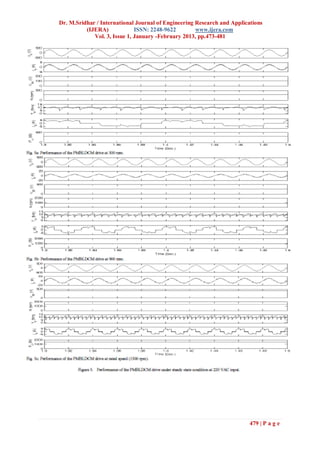
          for 0 < θ < 2π/3                    (27)         charging current of the DC link capacitor. The PI
    fa(θ) = {(6/ π)( π- θ)}-1                              controller closely tracks the reference speed so that
for 2π/3 < θ < π                     (28)                  the motor attains reference speed smoothly within
    fa(θ) = -1      for π < θ < 5π/3          (29)         0.35 sec while keeping the stator current within
fa(θ) = {(6/π)(θ -2π)}+1 for 5π/3 < θ < 2π             (30)the desired limits (θ) and fc(θ) are similar to The with a
                                                            The functions fb i.e. double the rated value. fa(θ)
phase difference of 120º and 240º respectively.            current (is) waveform at input AC mains is in
Therefore, the electromagnetic torque is expressed         phase      with    the     supply     voltage    (vs)
as,                                                        demonstrating nearly unity power factor during the
Te = Kb{fa(θ) ia + fb(θ) ib+ fc(θ) ic}         (31)        starting.
The mechanical equation of motion in speed
derivative form is given as,                              B. Performance under Speed Control
                                                          Figs. 4-6 show the performance of the
pω = (P/2) (Te-T L-Bω)/(J)                     (32)       proposed PMBLDCM drive under the speed
The derivative of the rotor position angle is given       control
as, pθ = ω                              (33) where
P is no. poles, T L is load torque in Nm, J is
moment of inertia in kg-m2 and B is friction
coefficient in Nms/Rad.

These equations (15-33) represent the dynamic
model of the PMBLDC motor.

5.PERFORMANCE EVALUATION                        OF
PROPOSED PFC DRIVE
         The proposed PMBLDCM drive is
modeled in Matlab- Simulink environment and
evaluated for an air conditioning compressor
load. The compressor load is considered as a
constant torque load equal to rated torque with
the speed control required by air conditioning
system. A 1.5 kW rating PMBLDCM is used to
drive the air conditioner compressor, speed of
which is controlled effectively by controlling the

                                                                                               477 | P a g e
Dr. M.Sridhar / International Journal of Engineering Research and Applications
          (IJERA)             ISSN: 2248-9622        www.ijera.com
             Vol. 3, Issue 1, January -February 2013, pp.473-481


                                                                         478 | P a g e
Dr. M.Sridhar / International Journal of Engineering Research and Applications
          (IJERA)             ISSN: 2248-9622        www.ijera.com
             Vol. 3, Issue 1, January -February 2013, pp.473-481


                                                                         479 | P a g e
Dr. M.Sridhar / International Journal of Engineering Research and Applications
                   (IJERA)             ISSN: 2248-9622        www.ijera.com
                      Vol. 3, Issue 1, January -February 2013, pp.473-481
at constant rated torque (9.55 Nm) and 220 V AC
mains supply voltage. These results are
categorized as performance during transient and
steady state conditions.
1)     Transient Condition: Figs. 4b-c show the
performance of the drive during the speed control
of the compressor. The reference speed is changed
from 900 rpm to 1500 rpm for the rated load             Fig. 6a. DC link voltage with speed Fig.6b.
performance of the compressor; from 900 rpm             Efficiency with load
to                                                      Figure 6.     Performance of the proposed PFC
300 rpm for performance of the compressor at            drive under speed control at rated torque and 220
light load. It is observed that the speed control is    VAC
fast and smooth in           either direction    i.e.
acceleration or retardation with power factor
maintained at nearly unity value. Moreover, the
stator current of PMBLDCM is within the
allowed limit (twice the rated current) due to
the introduction of a rate limiter in the
reference voltage.
2)      Steady      State   Condition:The     speed
control of the PMBLDCM driven compressor
under steady state condition is carried out for
different speeds and the results are shown in Figs.     Fig. 7a. THD of current at AC mains Fig. 7b. DPF
5-6 and Table-II to demonstrate the effectiveness       and PF
of the proposed drive in wide speed range.              Figure 7. PQ parameters of PMBLDCM drive
Figs.5a-c show voltage (vs) and current (is)            under speed control at rated torque and 220 VAC
waveforms at AC mains, DC link voltage (Vdc),           input
speed     of      the    motor     (N),   developed
electromagnetic torque of the motor (T e), the
stator current of the PMBLDC motor for phase
„a‟ (Ia), and shaft power output (Po) at 300
rpm, 900 rpm and 1500 rpm speeds. Fig. 6a
shows linear relation between motor speed and
DC link voltage. Since the reference speed is
decided by the reference voltage at DC link, it
is observed that the control of the reference DC
link voltage controls the speed of the motor
instantaneously. Fig.
                                                        Figure 8. Current waveform at AC mains and its
6b shows the improved efficiency of the drive
                                                        harmonic spectra of the PMBLDCM drive under
system (ηdrive)
                                                        steady state condition at rated torque and 220 VAC
in wide range of the motor speed.
C. Power Quality Performance                            TABLE III.   VARIATION     OF PQ
The performance of the proposed PMBLDCM                 PARAMETERS WITH INPUT AC VOLTAGE
drive in terms of various PQ parameters such as         (VS) AT 1500 RPM (416 VDC)
THDi, CF, DPF, PF is summarized in Table-II
and shown in Figs. 7-8. Nearly unity power factor         VAC   THDi    DPF       PF       CF     Is     ηdrive
(PF) and reduced THD of AC mains current are              (V)   (%)                               (A)    (%)
observed in wide speed range of the PMBLDCM               170   2.88    0.9999    0.9995   1.41   10.4   84.9
as shown in Figs. 7a-b. The THD of AC mains               180   2.59    0.9999    0.9996   1.41   9.7    85.8
current remains less than 5% along with nearly
                                                          190   2.40    0.9999    0.9996   1.41   9.2    86.3
unity PF in wide range of speed as well as load as
shown in Table-II and Figs. 8a-c.                         200   2.26    0.9999    0.9996   1.41   8.6    87.2
                                                          210   2.14    0.9999    0.9997   1.41   8.2    87.6
                                                          220   2.09    0.9999    0.9997   1.41   7.7    88.1
                                                          230   2.07    0.9999    0.9997   1.41   7.4    88.2
                                                          240   2.02    1.0000    0.9998   1.41   7.1    88.4
                                                          250   1.99    1.0000    0.9998   1.41   6.8    88.7
                                                          260   2.01    1.0000    0.9998   1.41   6.5    88.7
                                                          270   2.01    1.0000    0.9998   1.41   6.2    89.0

                                                                                            480 | P a g e
Dr. M.Sridhar / International Journal of Engineering Research and Applications
               (IJERA)             ISSN: 2248-9622        www.ijera.com
                  Vol. 3, Issue 1, January -February 2013, pp.473-481
6.CONCLUSION                                            IEEE Trans. Industrial Electron., vol. 50,
         A new speed control strategy of a                    no. 5, pp. 962 – 981, oct. 2003.
PMBLDCM drive is validated for a compressor            [7]    N. Mohan, T. M. Undeland and W. P.
load of an air conditioner which uses the                     Robbins,           “Power      Electronics:
reference speed as an equivalent reference voltage            Converters, Applications and Design,”
at DC link. The speed control is directly                     John Wiley, USA, 1995.
proportional to the voltage control at DC link.        [8]    A. I. Pressman,          Switching Power
The rate limiter introduced in the reference                  Supply Design, McGraw Hill, New Yor
voltage at DC link effectively limits the                     k, 1998.
motor current within the desired value during the      [9]    P.J. Wolfs, “A current-sourced DC-DC
transient condition (starting and speed control).             converter      derived via the duality
The additional PFC feature to the proposed drive              principle     from      the    half-bridge
ensures nearly unity PF in wide range of speed                converter,” IEEE Trans. Ind. Electron.,
and input AC voltage. Moreover, power quality                 vol. 40, no. 1, pp. 139 – 144, Feb. 1993.
parameters of the proposed PMBLDCM drive are           [10]   J.Y. Lee, G.W. Moon and M.J. Youn,
in conformity to an International standard IEC                “Design of a power-factor- correction
61000-3-2 [5]. The proposed drive has                         converter      based     on     half-bridge
demonstrated good speed control with energy                   topology,” IEEE Trans. Ind. Electron.,
efficient operation of the drive system in the                vol. 46, no. 4, pp.710 – 723, Aug 1999.
wide range of speed and input AC voltage. The          [11]   J. Sebastian, A. Fernandez, P.J.
proposed drive has been found as a promising                  Villegas, M.M. Hernando and J.M.
candidate for a PMBLDCM driving Air-Con                       Lopera, “Improved active input current
load in 1-2 kW power range.                                   shapers       for      converters      with
                                                              symmetrically driven transformer,” IEEE
APPENDIX                                                      Trans. Ind. Appl., vol. 37, no. 2, pp. 592
        Rated Power: 1.5 kW, rated speed:                     – 600, March-April 2001.
1500 rpm, rated current: 4.0 A, rated torque:          [12]   A. Fernandez, J. Sebastian, M.M.
9.55 Nm, number of poles: 4, stator resistance                Hernando and P. Villegas, “Small
(R):    2.8     Ω/ph.,     inductance (L+M):                  signal modelling of a half bridge
5.21mH/ph., back EMF constant (Kb): 0.615                     converter with an active input current
                                                              shaper,” in Proc. IEEE PESC, 2002,
Vsec/rad, inertia (J): 0.013 Kg- m2. Source                   vol.1, pp.159 – 164.
impedance (Zs): 0.03 pu, switching frequency           [13]   S.K. Han, H.K. Yoon, G.W. Moon,
of PFC switch (fs) = 40 kHz, capacitors (C1=                  M.J. Youn, Y.H. Kim and K.H. Lee,
C2): 15nF, PI speed controller gains (Kp): 0.145,             “A new active clamping zero-voltage
(Ki): 1.45.                                                   switching PWM current-fed half-bridge
                                                              converter,” IEEE Trans. Power Electron.,
                                                              vol. 20, no. 6, pp. 1271 – 1279, Nov.
REFERENCES
                                                              2005.
  [1]   T. Kenjo and S. Nagamori, Permanent
                                                       [14]   R.T.Bascope,                  L.D.Bezerra,
        Magnet      Brushless     DC    Motors,
                                                              G.V.T.Bascope,          D.S.      Oliveira,
        Clarendon Press, oxford, 1985.
                                                              C.G.C. Branco, and L.H.C. Barreto,
  [2]   T.    J.   Sokira     and   W.    Jaffe,
                                                              “High frequency isolation on-line UPS
        Brushless DC Motors: Electronic
                                                              system for low power applications,” in
        Commutation and Control, Tab Books
                                                              Proc. IEEE APEC’08, 2008, pp.1296 –
        USA, 1989.
                                                              1302.
  [3]   J. R. Hendershort and T. J. E. Miller,
        Design of Brushless Permanent- Magnet
        Motors, Clarendon Press, Oxford, 1994.
  [4]   J. F. Gieras and M. Wing, Permanent
        Magnet Motor Technology – Design
        and Application, Marcel Dekker Inc.,
        New York, 2002.
  [5]   Limits for Harmonic Current Emissions
        (Equipment input current ≤16 A per
        phase), International Standard IEC
        61000-3-2, 2000.
  [6]   B. Singh, B. N. Singh, A. Chandra, K.
        Al-Haddad, A. Pandey and D. P. Kothari,
        “A review of single-phase improved
        power quality AC-DC converters,”

                                                                                          481 | P a g e

Bs31473481

  • 1.
    Dr. M.Sridhar /International Journal of Engineering Research and Applications (IJERA) ISSN: 2248-9622 www.ijera.com Vol. 3, Issue 1, January -February 2013, pp.473-481 A Speed Control Of Pmbldcm Drive Using Single Stage Pfc Half Bridge Converter Dr. M.Sridhar, H.O.D, Sayed Baji Shaik Department of EEE, GIET, RAJAHMUNDRY Abstract In this paper, a buck half-bridge DC- conditioners mostly have a single-phase DC converter is used as a single-stage power induction motor to drive the compressor in factor correction (PFC) converter for feeding „on/off‟ control mode. This results in increased a voltage source inverter (VSI) based losses due to frequent „on/off‟ operation with permanent magnet brushless DC motor increased mechanical and electrical stresses on (PMBLDCM) drive. The front end of this PFC the motor, thereby poor efficiency and converter is a diode bridge rectifier (DBR) fed reduced life of the motor. Moreover, the from single-phase AC mains. The temperature of the air conditioned zone is PMBLDCM is used to drive a compressor regulated in a hysteresis band. Therefore, improved load of an air conditioner through a three- efficiency of the Air-Con system will certainly phase VSI fed from a controlled DC link reduce the cost of living and energy demand to voltage. The speed of the compressor is cope-up with ever increasing power crisis. controlled to achieve energy conservation using A PMBLDCM which is a kind of three- a concept of the voltage control at DC link phase synchronous motor with permanent proportional to the desired speed of the magnets (PMs) on the rotor and trapezoidal PMBLDCM. Therefore the VSI is operated back EMF waveform, operates on electronic only as an electronic commutator of the commutation accomplished by solid state PMBLDCM. The stator current of the switches. It is powered through a three-phase PMBLDCM during step change of reference voltage source inverter (VSI) which is fed from speed is controlled by a rate limiter for the single-phase AC supply using a diode bridge reference voltage at DC link. The proposed rectifier (DBR) followed by smoothening DC PMBLDCM drive with voltage control based link capacitor. The compressor exerts constant PFC converter is designed, modeled and its torque (i.e. rated torque) on the PMBLDCM and performance is simulated in Matlab- is operated in speed control mode to improve the Simulink environment for an air efficiency of the Air-Con system. conditioner compressor driven through a 1.5 kW, 1500 rpm PMBLDC motor. The Since, the back-emf of the PMBLDCM is evaluation results of the proposed speed proportional to the motor speed and the developed control scheme are presented to torque is proportional to its phase current [1-4], demonstrate an improved efficiency of the therefore, a constant torque is maintained by a proposed drive system with PFC feature in constant current in the stator winding of the wide range of the speed and an input AC PMBLDCM whereas the speed can be controlled voltage. by varying the terminal voltage of the motor. Based on this logic, a speed control scheme is IndexTerms— PFC, PMBLDCM, Air proposed in this paper which uses a reference conditioner, Buck Half- bridge converter, Voltage voltage at DC link proportional to the desired control, VSI. speed of the PMBLDC motor. However, the control of VSI is only for electronic 1. Introduction commutation which is based on the rotor PERMANENT magnet brushless dc position signals of the PMBLDC motor. motors (PMBLDCM) are preferred motors for a compressor of an air-conditioning (Air con) system The PMBLDCM drive, fed from a single- due to its features like high efficiency, wide speed phase AC mains through a diode bridge rectifier range and low maintenance requirements [1-4]. (DBR) followed by a DC link capacitor, suffers The operation of the compressor with the speed from power quality (PQ) disturbances such as control results in an improved efficiency of the poor power factor (PF), increased total harmonic system while maintaining the temperature in the distortion (THD) of current at input AC mains and air-conditioned zone at the set reference its high crest factor (CF). It is mainly due to consistently. Whereas, the existing air uncontrolled charging of the DC link capacitor 473 | P a g e
  • 2.
    Dr. M.Sridhar /International Journal of Engineering Research and Applications (IJERA) ISSN: 2248-9622 www.ijera.com Vol. 3, Issue 1, January -February 2013, pp.473-481 which results in a pulsed current waveform having sensors for voltage and current signals. Moreover, a peak value higher than the amplitude of the the rotor position signals are used to generate fundamental input current at AC mains. the switching quence for the VSI as an Moreover, the PQ standards for low power electronic commutator of the PMBLDC motor. equipments such as IEC 61000-3-2 [5], Therefore, rotor-position information is required emphasize on low harmonic contents and near only at the commutation points, e.g., every unity power factor current to be drawn from AC 60°electrical in the three- phase [1-4]. The rotor mains by these motors. Therefore, use of a power position of PMBLDCM is sensed using Hall effect factor correction (PFC) topology amongst position sensors and used to generate switching various available topologies [6-14] is almost sequence for the VSI as shown in Table-I. inevitable for a PMBLDCM drive. The DC link voltage is controlled by a Most of the existing systems use a boost half-bridge buck DC-DC converter based on the converter for PFC as the front-end converter and an duty ratio (D) of the converter. For a fast and isolated DC-DC converter to produce desired effective control with reduced size of magnetics output voltage constituting a two-stage PFC drive and filters, a high switching frequency is used; [7-8]. The DC-DC converter used in the second however, the switching frequency (fs) is limited stage is usually a flyback or forward by the switching device used, operating power converter for low power applications and a level and switching losses of the device. Metal full-bridge converter for higher power oxide field effect transistors (MOSFETs) are applications. However, these two stage PFC used as the switching device for high switching converters have high cost and complexity in frequency in the proposed PFC converter. implementing two separate switch-mode However, insulated gate bipolar transistors converters, therefore a single stage converter (IGBTs) are used in VSI bridge feeding combining the PFC and voltage regulation at DC PMBLDCM, to reduce the switching stress, as it link is more in demand. The single-stage PFC operates at lower frequency compared to PFC converters operate with only one controller to switches. regulate the DC link voltage along with the power factor correction. The absence of a second The PFC control scheme uses a current controller has a greater impact on the performance control loop inside the speed control loop with of single-stage PFC converters and requires a current multiplier approach which operates in design to operate over a much wider range of continuous conduction mode (CCM) with average operating conditions. current control. The control loop begins with the comparison of sensed DC link voltage with a For the proposed voltage controlled voltage equivalent to the reference speed. The drive, a half-bridge buck DC-DC converter is resultant voltage error is passed through a selected because of its high power handling proportional-integral (PI) controller to give the capacity as compared to the single switch modulating current signal. This signal is multiplied converters. Moreover, it has switching losses with a unit template of input AC voltage and comparable to the single switch converters as compared with DC current sensed after the DBR. only one switch is in operation at any instant of The resultant current error is amplified and time. It can be operated as a single-stage power compared with saw-tooth carrier wave of fixed factor corrected (PFC) converter when connected frequency (fs) in unipolar scheme (as shown in between the VSI and the DBR fed from single- Fig.2) to generate the PWM pulses for the half- phase AC mains, besides controlling the voltage at bridge converter. For the current control of the DC link for the desired speed of the Air-Con PMBLDCM during step change of the reference compressor. A detailed modeling, design and voltage due to the change in the reference speed, performance evaluation of the proposed drive a voltage gradient less than 800 V/s is are presented for an air conditioner compressor introduced for the change of DC link voltage, driven by a PMBLDC motor of 1.5 kW, 1500 rpm which ensures the stator current of the rating. PMBLDCM within the specified limits (i.e. double the rated current). 2. PROPOSED SPEED CONTROL SCHEME OF PMBLDC MOTOR FOR AIR CONDITIONER The proposed speed control scheme (as shown in Fig. 1) controls reference voltage at DC link as an equivalent reference speed, thereby replaces the conventional control of the motor speed and a stator current involving various 474 | P a g e
  • 3.
    Dr. M.Sridhar /International Journal of Engineering Research and Applications (IJERA) ISSN: 2248-9622 www.ijera.com Vol. 3, Issue 1, January -February 2013, pp.473-481 buck half-bridge converter. The inductance (Lo) of the ripple filter restricts the inductor peak to peak ripple current (ΔILo) within specified value for the given switching frequency (fs), whereas, the capacitance (Cd) is calculated for a specified ripple in the output voltage (ΔVCd) [7- 8]. The output filter inductor and capacitor are given as, Lo= (0.5-D)Vdc/{fs(ΔILo) } (3) Cd=Io/(2ωΔVCd) (4) The PFC converter is designed for a base DC link voltage of Vdc = 400 V at Vin = 198 V from Vs = 220 Vrms. The turns ratio of the high frequency transformer (N2/N1) is taken as 6:1 to maintain the desired DC link voltage at low input AC voltages typically at 170V. Other design data are fs = 40 kHz, Io = 4 A, ΔVCd= 4 V (1% of Vdc), ΔILo= 0.8 A (20% of Io). The design parameters Figure 1. Control schematic of Proposed Bridge- are calculated as Lo=2.0 mH, Cd=1600 µF. buck PFC converter fed PMBLDCM drive TABLE I. VSI SWITCHING SEQUENCE 3. DESIGN OF PFC BUCK HALF- BASED ON THE HALL EFFECT SENSOR BRIDGE CONVERTER BASED SIGNALS PMBLDCM DRIVE The proposed PFC buck half-bridge Ha H b Hc Ea Eb Ec S1 S2 S3 S4 S5 S6 converter is designed for a PMBLDCM drive 0 0 0 0 0 0 0 0 0 0 0 0 with main considerations on PQ constraints at 0 0 1 0 -1 +1 0 0 0 1 1 0 AC mains and allowable ripple in DC link 0 1 0 -1 +1 0 0 1 1 0 0 0 voltage. The DC link voltage of the PFC converter 0 1 1 -1 0 +1 0 1 0 0 1 0 is given as, 1 0 0 +1 0 -1 1 0 0 0 0 1 1 0 1 +1 -1 0 1 0 0 1 0 0 Vdc = 2 (N2/N1) Vin D and N2= N21=N22 (1) where 1 1, 1 N N21, 0 22 +1 -1 0 of0turns in 0 0 0 N are number 1 primary, secondary upp 1 where N1, N21, N22 are number of turns in 1 1 1 0 0 0 0 0 0 0 0 0 primary, secondary upper and lower windings of the high frequency (HF) isolation transformer, respectively. 4.MODELING OF THE PROPOSED PMBLDCM DRIVE The main components of the proposed PMBLDCM drive are the PFC converter and PMBLDCM drive, which are modeled by mathematical equations and the complete drive is represented as a combination of these models. A. PFC Converter The modeling of the PFC converter consists of the modeling of a speed controller, a reference current generator and a PWM controller Figure 2. PWM control of the buck half-bridge as given below. converter 1) Speed Controller: The speed controller, Vin is the average output of the DBR for a given the prime component of this control scheme, is a AC input voltage (Vs) related as, proportional-integral (PI) controller which closely tracks the reference speed as an equivalent Vin = 2√2Vs/π reference voltage. If at kth (2) instant of time, A ripple filter is designed to reduce the * (k) is reference DC link voltage, V (k) is V dc dc ripples introduced in the output voltage due to sensed DC link voltage then the voltage error high switching frequency for constant of the 475 | P a g e
  • 4.
    Dr. M.Sridhar /International Journal of Engineering Research and Applications (IJERA) ISSN: 2248-9622 www.ijera.com Vol. 3, Issue 1, January -February 2013, pp.473-481 Ve(k) is calculated as, 2) Voltage Source Inverter: Fig. 3 shows an Ve(k) =V*dc(k)-Vdc(k) (5) equivalent circuit of a VSI fed PMBLDCM. The The PI controller gives desired control output of VSI to be fed to phase „a‟ of the signal after processing this voltage error. The PMBLDC motor is given output of the controller Ic(k) at kth instant is given vao = (Vdc/2) for S1 = 1 (11) as, vao = (-Vdc/2) for S2 = 1 (12) vao = 0 for S1 = 0, and S2 = 0 (13) Ic (k) = Ic (k-1) + Kp{Ve(k) – Ve(k-1)} + KiVe(k) van = vao – vno (14) (6) where Kp and Ki are the proportional and where vao, vbo, vco, and vno are voltages of the integral gains of the PI controller. three-phases and neutral point (n) with respect to virtual mid-point of the DC link voltage shown as 2) Reference Current Generator: The „o‟ in Fig. 3. The voltages van, vbn, vcn are reference input current of the PFC converter is voltages of three-phases with respect to neutral denoted by idc* and given as, point (n) and Vdc is the DC link voltage. S= 1 i*dc = Ic (k) uVs (7) and 0 represent „on‟ and „off‟ position of respective IGBTs of the VSI and where uVs is the unit template of the voltage considered in a similar way for other IGBTs of the at input AC VSI i.e. S3- S6. mains, calculated as, uVs=vd/Vsm;vd = |vs|; vs= Vsm sin ωt (8) Using similar logic vbo, vco, vbn, vcn are generated for other two phases of the VSI feeding where Vsm is the amplitude of the voltage and ω PMBLDC motor. is frequency in rad/sec at AC mains. 3) PMBLDC Motor:The PMBLDCM is 3) PWM Controller:The reference input represented in the form of a set of differential current of the buck half-bridge converter (idc*) is equations [3] given as, compared with its sensed current (idc) to generate van = Ria + pλa +ean (15) the current error Δidc=(idc* - idc). This current vbn = Rib + pλb +ebn (16) error is amplified by gain kdc and compared with vcn = Ric + pλc +ecn (17) fixed frequency (fs) saw-tooth carrier waveform where p is a differential operator (d/dt), ia, ib, ic md(t) (as shown in Fig.2) in unipolar switching are three-phase mode [7] to get the switching signals for the MOSFETs of the PFC buck half-bridge converter as, If kdc Δidc > md (t) then SA = 1 else SA = 0 (9) If -kdc Δidc > md (t) then SB = 1 else SB = 0 (10) where SA, SB are upper and lower switches of the half-bridge converter as shown in Fig. 1 and their values Figure 3.Equivalent Circuit of a VSI fed „1‟ and „0‟ represent „on‟ and „off‟ position of the PMBLDCM Drive respective MOSFET of the PFC converter. The flux linkages are represented as, λa = Lia - M (ib + ic) (18) B. PMBLDCM Drive λb = Lib - M (ia + ic) (19) The PMBLDCM drive consists of an electronic commutator, a VSI and a PMBLDC λc = Lic - M (ib + ia) (20) motor. where L is self-inductance/phase, M is mutual inductance of motor winding/phase. Since the 1) Electronic Commutator: The electronic PMBLDCM has no neutral connection, therefore, commutator uses signals from Hall effect position ia + ib + ic = 0 (21) sensors to generate the switching sequence for the From Eqs. (14-21) the voltage between neutral voltage source inverter based on the logic given terminal (n) and mid-point of the DC link (o) is in Table I. given as, vno={vao+vbo+vco–(ean+ebn+ecn)}/3 (22) From Eqs. (18-21), the flux linkages are given as, 476 | P a g e
  • 5.
    Dr. M.Sridhar /International Journal of Engineering Research and Applications (IJERA) ISSN: 2248-9622 www.ijera.com Vol. 3, Issue 1, January -February 2013, pp.473-481 λa = (L+M) ia, λb = (L+M) ib, DC link voltage. The detailed data of the motor λc = (L+M) ic, (23) and simulation parameters are given in Appendix. The performance of the proposed From Eqs. (15-17 and 23), the current PFC drive is evaluated on the basis of derivatives in generalized state space form is given various parameters such as total harmonic as, distortion (THDi) and the crest factor (CF) of the current at input AC mains, displacement pix = (vxn - ix R – exn)/(L+M) (24) power factor (DPF), power factor (PF) and where x represents phase a, b or c. efficiency of the drive system (ηdrive) at different speeds of the motor. Moreover, these parameters The developed electromagnetic torque,Te are also evaluated for variable input AC voltage in the PMBLDCM is given as, at DC link voltage of 416 V which is equivalent to the rated speed (1500 rpm) of the Te = (ean ia + ebn ib +ecn ic)/ ω (25) PMBLDCM. The results are shown in Figs. 4-9 where ω is motor speed in rad/sec, and Tables II- III to demonstrate the effectiveness of the proposed PMBLDCM The back emfs may be expressed as a function drive in a wide range of speed and input AC of rotor position (θ) as, voltage. exn= Kb fx(θ) ω A. Performance during Starting The performance of the proposed (26) where x can be phase a, b or c and accordingly PMBLDCM drive fed from 220 V AC mains fx(θ) represents function of rotor position with a during starting at rated torque and 900 rpm speed maximum value ±1, identical to trapezoidal is shown in Fig. 4a. A rate limiter of 800 V/s is induced emf given as, introduced in the reference voltage to limit the fa(θ) = 1 starting current of the motor as well as the for 0 < θ < 2π/3 (27) charging current of the DC link capacitor. The PI fa(θ) = {(6/ π)( π- θ)}-1 controller closely tracks the reference speed so that for 2π/3 < θ < π (28) the motor attains reference speed smoothly within fa(θ) = -1 for π < θ < 5π/3 (29) 0.35 sec while keeping the stator current within fa(θ) = {(6/π)(θ -2π)}+1 for 5π/3 < θ < 2π (30)the desired limits (θ) and fc(θ) are similar to The with a The functions fb i.e. double the rated value. fa(θ) phase difference of 120º and 240º respectively. current (is) waveform at input AC mains is in Therefore, the electromagnetic torque is expressed phase with the supply voltage (vs) as, demonstrating nearly unity power factor during the Te = Kb{fa(θ) ia + fb(θ) ib+ fc(θ) ic} (31) starting. The mechanical equation of motion in speed derivative form is given as, B. Performance under Speed Control Figs. 4-6 show the performance of the pω = (P/2) (Te-T L-Bω)/(J) (32) proposed PMBLDCM drive under the speed The derivative of the rotor position angle is given control as, pθ = ω (33) where P is no. poles, T L is load torque in Nm, J is moment of inertia in kg-m2 and B is friction coefficient in Nms/Rad. These equations (15-33) represent the dynamic model of the PMBLDC motor. 5.PERFORMANCE EVALUATION OF PROPOSED PFC DRIVE The proposed PMBLDCM drive is modeled in Matlab- Simulink environment and evaluated for an air conditioning compressor load. The compressor load is considered as a constant torque load equal to rated torque with the speed control required by air conditioning system. A 1.5 kW rating PMBLDCM is used to drive the air conditioner compressor, speed of which is controlled effectively by controlling the 477 | P a g e
  • 6.
    Dr. M.Sridhar /International Journal of Engineering Research and Applications (IJERA) ISSN: 2248-9622 www.ijera.com Vol. 3, Issue 1, January -February 2013, pp.473-481 478 | P a g e
  • 7.
    Dr. M.Sridhar /International Journal of Engineering Research and Applications (IJERA) ISSN: 2248-9622 www.ijera.com Vol. 3, Issue 1, January -February 2013, pp.473-481 479 | P a g e
  • 8.
    Dr. M.Sridhar /International Journal of Engineering Research and Applications (IJERA) ISSN: 2248-9622 www.ijera.com Vol. 3, Issue 1, January -February 2013, pp.473-481 at constant rated torque (9.55 Nm) and 220 V AC mains supply voltage. These results are categorized as performance during transient and steady state conditions. 1) Transient Condition: Figs. 4b-c show the performance of the drive during the speed control of the compressor. The reference speed is changed from 900 rpm to 1500 rpm for the rated load Fig. 6a. DC link voltage with speed Fig.6b. performance of the compressor; from 900 rpm Efficiency with load to Figure 6. Performance of the proposed PFC 300 rpm for performance of the compressor at drive under speed control at rated torque and 220 light load. It is observed that the speed control is VAC fast and smooth in either direction i.e. acceleration or retardation with power factor maintained at nearly unity value. Moreover, the stator current of PMBLDCM is within the allowed limit (twice the rated current) due to the introduction of a rate limiter in the reference voltage. 2) Steady State Condition:The speed control of the PMBLDCM driven compressor under steady state condition is carried out for different speeds and the results are shown in Figs. Fig. 7a. THD of current at AC mains Fig. 7b. DPF 5-6 and Table-II to demonstrate the effectiveness and PF of the proposed drive in wide speed range. Figure 7. PQ parameters of PMBLDCM drive Figs.5a-c show voltage (vs) and current (is) under speed control at rated torque and 220 VAC waveforms at AC mains, DC link voltage (Vdc), input speed of the motor (N), developed electromagnetic torque of the motor (T e), the stator current of the PMBLDC motor for phase „a‟ (Ia), and shaft power output (Po) at 300 rpm, 900 rpm and 1500 rpm speeds. Fig. 6a shows linear relation between motor speed and DC link voltage. Since the reference speed is decided by the reference voltage at DC link, it is observed that the control of the reference DC link voltage controls the speed of the motor instantaneously. Fig. Figure 8. Current waveform at AC mains and its 6b shows the improved efficiency of the drive harmonic spectra of the PMBLDCM drive under system (ηdrive) steady state condition at rated torque and 220 VAC in wide range of the motor speed. C. Power Quality Performance TABLE III. VARIATION OF PQ The performance of the proposed PMBLDCM PARAMETERS WITH INPUT AC VOLTAGE drive in terms of various PQ parameters such as (VS) AT 1500 RPM (416 VDC) THDi, CF, DPF, PF is summarized in Table-II and shown in Figs. 7-8. Nearly unity power factor VAC THDi DPF PF CF Is ηdrive (PF) and reduced THD of AC mains current are (V) (%) (A) (%) observed in wide speed range of the PMBLDCM 170 2.88 0.9999 0.9995 1.41 10.4 84.9 as shown in Figs. 7a-b. The THD of AC mains 180 2.59 0.9999 0.9996 1.41 9.7 85.8 current remains less than 5% along with nearly 190 2.40 0.9999 0.9996 1.41 9.2 86.3 unity PF in wide range of speed as well as load as shown in Table-II and Figs. 8a-c. 200 2.26 0.9999 0.9996 1.41 8.6 87.2 210 2.14 0.9999 0.9997 1.41 8.2 87.6 220 2.09 0.9999 0.9997 1.41 7.7 88.1 230 2.07 0.9999 0.9997 1.41 7.4 88.2 240 2.02 1.0000 0.9998 1.41 7.1 88.4 250 1.99 1.0000 0.9998 1.41 6.8 88.7 260 2.01 1.0000 0.9998 1.41 6.5 88.7 270 2.01 1.0000 0.9998 1.41 6.2 89.0 480 | P a g e
  • 9.
    Dr. M.Sridhar /International Journal of Engineering Research and Applications (IJERA) ISSN: 2248-9622 www.ijera.com Vol. 3, Issue 1, January -February 2013, pp.473-481 6.CONCLUSION IEEE Trans. Industrial Electron., vol. 50, A new speed control strategy of a no. 5, pp. 962 – 981, oct. 2003. PMBLDCM drive is validated for a compressor [7] N. Mohan, T. M. Undeland and W. P. load of an air conditioner which uses the Robbins, “Power Electronics: reference speed as an equivalent reference voltage Converters, Applications and Design,” at DC link. The speed control is directly John Wiley, USA, 1995. proportional to the voltage control at DC link. [8] A. I. Pressman, Switching Power The rate limiter introduced in the reference Supply Design, McGraw Hill, New Yor voltage at DC link effectively limits the k, 1998. motor current within the desired value during the [9] P.J. Wolfs, “A current-sourced DC-DC transient condition (starting and speed control). converter derived via the duality The additional PFC feature to the proposed drive principle from the half-bridge ensures nearly unity PF in wide range of speed converter,” IEEE Trans. Ind. Electron., and input AC voltage. Moreover, power quality vol. 40, no. 1, pp. 139 – 144, Feb. 1993. parameters of the proposed PMBLDCM drive are [10] J.Y. Lee, G.W. Moon and M.J. Youn, in conformity to an International standard IEC “Design of a power-factor- correction 61000-3-2 [5]. The proposed drive has converter based on half-bridge demonstrated good speed control with energy topology,” IEEE Trans. Ind. Electron., efficient operation of the drive system in the vol. 46, no. 4, pp.710 – 723, Aug 1999. wide range of speed and input AC voltage. The [11] J. Sebastian, A. Fernandez, P.J. proposed drive has been found as a promising Villegas, M.M. Hernando and J.M. candidate for a PMBLDCM driving Air-Con Lopera, “Improved active input current load in 1-2 kW power range. shapers for converters with symmetrically driven transformer,” IEEE APPENDIX Trans. Ind. Appl., vol. 37, no. 2, pp. 592 Rated Power: 1.5 kW, rated speed: – 600, March-April 2001. 1500 rpm, rated current: 4.0 A, rated torque: [12] A. Fernandez, J. Sebastian, M.M. 9.55 Nm, number of poles: 4, stator resistance Hernando and P. Villegas, “Small (R): 2.8 Ω/ph., inductance (L+M): signal modelling of a half bridge 5.21mH/ph., back EMF constant (Kb): 0.615 converter with an active input current shaper,” in Proc. IEEE PESC, 2002, Vsec/rad, inertia (J): 0.013 Kg- m2. Source vol.1, pp.159 – 164. impedance (Zs): 0.03 pu, switching frequency [13] S.K. Han, H.K. Yoon, G.W. Moon, of PFC switch (fs) = 40 kHz, capacitors (C1= M.J. Youn, Y.H. Kim and K.H. Lee, C2): 15nF, PI speed controller gains (Kp): 0.145, “A new active clamping zero-voltage (Ki): 1.45. switching PWM current-fed half-bridge converter,” IEEE Trans. Power Electron., vol. 20, no. 6, pp. 1271 – 1279, Nov. REFERENCES 2005. [1] T. Kenjo and S. Nagamori, Permanent [14] R.T.Bascope, L.D.Bezerra, Magnet Brushless DC Motors, G.V.T.Bascope, D.S. Oliveira, Clarendon Press, oxford, 1985. C.G.C. Branco, and L.H.C. Barreto, [2] T. J. Sokira and W. Jaffe, “High frequency isolation on-line UPS Brushless DC Motors: Electronic system for low power applications,” in Commutation and Control, Tab Books Proc. IEEE APEC’08, 2008, pp.1296 – USA, 1989. 1302. [3] J. R. Hendershort and T. J. E. Miller, Design of Brushless Permanent- Magnet Motors, Clarendon Press, Oxford, 1994. [4] J. F. Gieras and M. Wing, Permanent Magnet Motor Technology – Design and Application, Marcel Dekker Inc., New York, 2002. [5] Limits for Harmonic Current Emissions (Equipment input current ≤16 A per phase), International Standard IEC 61000-3-2, 2000. [6] B. Singh, B. N. Singh, A. Chandra, K. Al-Haddad, A. Pandey and D. P. Kothari, “A review of single-phase improved power quality AC-DC converters,” 481 | P a g e