TROPICAL RAINFOREST
      Normally it is
      located near the                                                                              “
      equator.
                                                                                                    Survival
     For example
     Central America,
                                                                                                    of the
     Amazon, Southern
     Asia, Africe and
                                                                                                    Tallest
     Nothern Australia.                                                                             ”

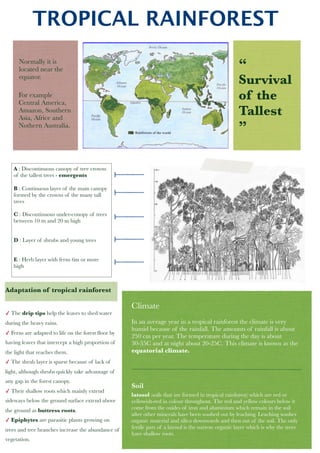
   A : Discontinuous canopy of tree crowns
   of the tallest trees - emergents

   B : Continuous layer of the main canopy
   formed by the crowns of the many tall
   trees

   C : Discontinuous under-conopy of trees
   between 10 m and 20 m high


   D : Layer of shrubs and young trees


   E : Herb layer with ferns 6m or more
   high


Adaptation of tropical rainforest

                                                    Climate
✓ The drip tips help the leaves to shed water
during the heavy rains.                             In an average year in a tropical rainforest the climate is very
                                                    humid because of the rainfall. The amounts of rainfall is about
✓ Ferns are adapted to life on the forest floor by
                                                    250 cm per year. The temperature during the day is about
having leaves that intercept a high proportion of   30-35C and at night about 20-25C. This climate is known as the
the light that reaches them.                        equatorial climate.
✓ The shrub layer is sparse because of lack of
light, although shrubs quickly take advantage of
any gap in the forest canopy.
                                                    Soil
✓ Their shallow roots which mainly extend
                                                    latosol (soils that are formed in tropical rainforest) which are red or
sideways below the ground surface extend above      yellowish-red in colour throughout. The red and yellow colours below it
the ground as buttress roots.                       come from the oxides of iron and aluminium which remain in the soil
                                                    after other minerals have been washed out by leaching. Leaching washes
✓ Epiphytes are parasitic plants growing on         organic material and silica downwards and then out of the soil. The only
trees and tree branches increase the abundance of   fertile part of a latosol is the narrow organic layer which is why the trees
                                                    have shallow roots.
vegetation.

BS tropical rainforest poster

  • 1.
    TROPICAL RAINFOREST Normally it is located near the “ equator. Survival For example Central America, of the Amazon, Southern Asia, Africe and Tallest Nothern Australia. ” A : Discontinuous canopy of tree crowns of the tallest trees - emergents B : Continuous layer of the main canopy formed by the crowns of the many tall trees C : Discontinuous under-conopy of trees between 10 m and 20 m high D : Layer of shrubs and young trees E : Herb layer with ferns 6m or more high Adaptation of tropical rainforest Climate ✓ The drip tips help the leaves to shed water during the heavy rains. In an average year in a tropical rainforest the climate is very humid because of the rainfall. The amounts of rainfall is about ✓ Ferns are adapted to life on the forest floor by 250 cm per year. The temperature during the day is about having leaves that intercept a high proportion of 30-35C and at night about 20-25C. This climate is known as the the light that reaches them. equatorial climate. ✓ The shrub layer is sparse because of lack of light, although shrubs quickly take advantage of any gap in the forest canopy. Soil ✓ Their shallow roots which mainly extend latosol (soils that are formed in tropical rainforest) which are red or sideways below the ground surface extend above yellowish-red in colour throughout. The red and yellow colours below it the ground as buttress roots. come from the oxides of iron and aluminium which remain in the soil after other minerals have been washed out by leaching. Leaching washes ✓ Epiphytes are parasitic plants growing on organic material and silica downwards and then out of the soil. The only trees and tree branches increase the abundance of fertile part of a latosol is the narrow organic layer which is why the trees have shallow roots. vegetation.