

Development and Application of a Web- 
Based Post-Construction Stormwater 
www.ContechES.com 
BMP Feasibility Screening Tool 
Vaikko Allen, CPSWQ, LEED-AP 
Director Stormwater Regulatory Management 
Contech Engineered Solutions 
vallen@conteches.com
www.ContechES.com
www.ContechES.com
www.ContechES.com
www.ContechES.com 
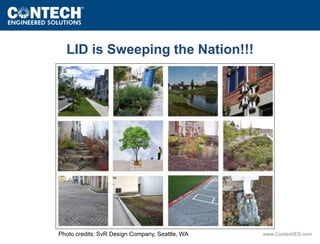
LID is Sweeping the Nation!!! 
Photo credits: SvR Design Company, Seattle, WA
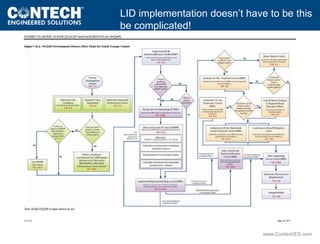
LID implementation doesn’t have to be this 
be complicated! 
www.ContechES.com
www.ContechES.com 
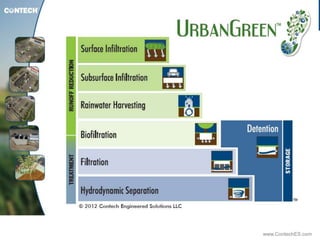
LID Design Hierarchy
www.ContechES.com 
LID Site Planner – Purpose 
 A fast, easy to use tool that follows a Low Impact Development 
(LID) design approach and is consistent with regulations that 
prioritize Green Infrastructure 
 Helps minimize the cost and delay of redesigns by prompting 
users to consider a wide range of common site constraints 
early in the design process 
 Captures specific site conditions precluding the use of 
infeasible BMPs 
 Allows flexibility to select flow through treatment controls 
where runoff reduction is not feasible 
 Provides a summary report with links to design guides, 
standard details and specifications for stormwater 
management approaches that are likely to be feasible and 
approved on the project
LID Site Planner – Core Functionality 
www.ContechES.com 
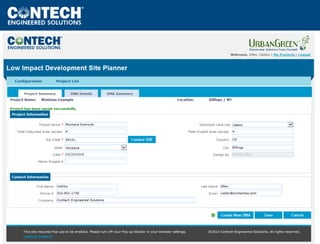
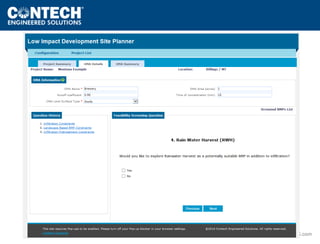
 Collect site information 
o Project name, project location, total disturbed area, total project area, 
dominant land use 
 Divide site into discrete drainage management areas 
(DMA) with dominant land surface types 
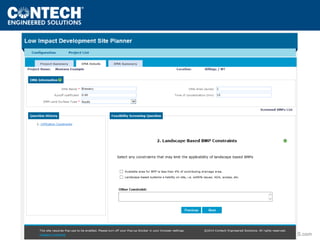
 Apply screening questions to identify feasible BMPs for 
each DMA 
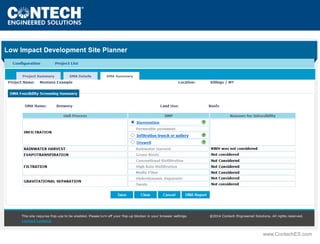
 Capture and report constraints precluding more favorable 
BMPs 
 Summarize feasible BMPs and provide links to standard 
specifications and typical drawings
www.ContechES.com 
BMPs represented 
Dominant Unit Process BMP 
INFILTRATION Bioretention 
INFILTRATION Permeable pavement 
INFILTRATION Infiltration trench or gallery 
INFILTRATION Drywell 
RAINWATER HARVEST Rainwater Harvest 
EVAPOTRANSPIRATION Green Roofs 
FILTRATION Conventional Biofiltration 
FILTRATION High Rate Biofiltration 
FILTRATION Media Filter 
GRAVITATIONAL SEPARATION Swale 
GRAVITATIONAL SEPARATION Hydrodynamic Separator
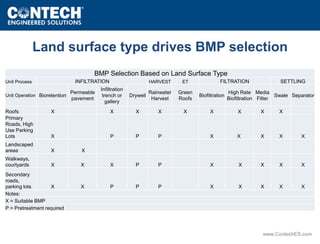
Land surface type drives BMP selection 
Considering LEED benefits and O&M concerns, Rainwater 
Harvesting and Green Roof priority may be reversed 
www.ContechES.com 
BMP Selection Based on Land Surface Type 
Unit Process INFILTRATION HARVEST ET FILTRATION SETTLING 
Unit Operation Bioretention 
Permeable 
pavement 
Infiltration 
trench or 
gallery 
Drywell 
Rainwater 
Harvest 
Green 
Roofs 
Biofiltration 
High Rate 
Biofiltration 
Media 
Filter 
Swale Separator 
Roofs X X X X X X X X X 
Primary 
Roads, High 
Use Parking 
Lots X P P P X X X X X 
Landscaped 
areas X X 
Walkways, 
courtyards X X X P P X X X X X 
Secondary 
roads, 
parking lots X X P P P X X X X X 
Notes: 
X = Suitable BMP 
P = Pretreatment required
BMP Feasibility Criteria Sources 
 Orange County - 2011 Technical Guidance Document 
 Ventura County – 2011 Technical Guidance Manual 
 Delaware article 3.06.2 – Post construction BMP standards 
www.ContechES.com 
and specifications 
 2009 MD Stormwater Design Manual, Chapter 3 - 
Performance criteria for urban BMP design 
 2012 Stormwater Management Manual for Western 
Washington 
 WEF MOP 23 – Design of Urban Stormwater Controls
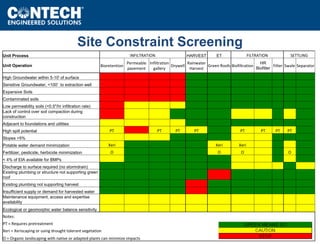
Site Constraint Screening 
Unit Process INFILTRATION HARVEST ET FILTRATION SETTLING 
www.ContechES.com 
Unit Operation Bioretention 
Permeable 
pavement 
Infiltration 
gallery 
Drywell 
Rainwater 
Harvest 
Green Roofs Biofiltration 
HR 
Biofilter 
Filter Swale Separator 
High Groundwater within 5-10' of surface 
Sensitive Groundwater, <100' to extraction well 
Expansive Soils 
Contaminated soils 
Low permeability soils (<0.5"/hr infiltration rate) 
Lack of control over soil compaction during 
construction 
Adjacent to foundations and utilities 
High spill potential PT PT PT PT PT PT PT PT 
Slopes >5% 
Potable water demand minimization Xeri Xeri Xeri 
Fertilizer, pesticide, herbicide minimization O O O O 
< 4% of EIA available for BMPs 
Discharge to surface required (no stormdrain) 
Existing plumbing or structure not supporting green 
roof 
Existing plumbing not supporting harvest 
Insufficient supply or demand for harvested water 
Maintenance equipment, access and expertise 
availability 
Ecological or geomorphic water balance sensitivity 
Notes: 
PT = Requires pretreatment 
Xeri = Xeriscaping or using drought tolerant vegetation 
O = Organic landscaping with native or adapted plants can minimize impacts
www.ContechES.com 
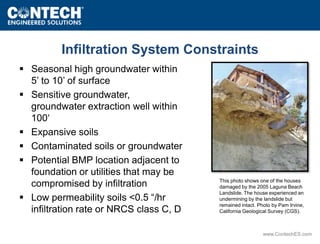
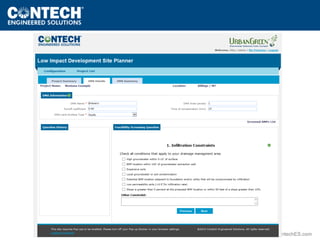
Infiltration System Constraints 
 Seasonal high groundwater within 
5’ to 10’ of surface 
 Sensitive groundwater, 
groundwater extraction well within 
100‘ 
 Expansive soils 
 Contaminated soils or groundwater 
 Potential BMP location adjacent to 
foundation or utilities that may be 
compromised by infiltration 
 Low permeability soils <0.5 “/hr 
infiltration rate or NRCS class C, D 
This photo shows one of the houses 
damaged by the 2005 Laguna Beach 
Landslide. The house experienced an 
undermining by the landslide but 
remained intact. Photo by Pam Irvine, 
California Geological Survey (CGS).
www.ContechES.com 
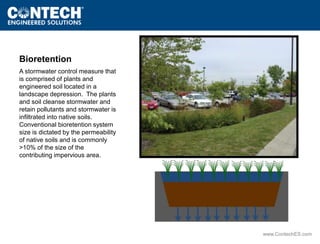
Bioretention 
A stormwater control measure that 
is comprised of plants and 
engineered soil located in a 
landscape depression. The plants 
and soil cleanse stormwater and 
retain pollutants and stormwater is 
infiltrated into native soils. 
Conventional bioretention system 
size is dictated by the permeability 
of native soils and is commonly 
>10% of the size of the 
contributing impervious area.
www.ContechES.com 
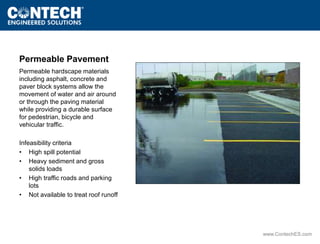
Permeable Pavement 
Permeable hardscape materials 
including asphalt, concrete and 
paver block systems allow the 
movement of water and air around 
or through the paving material 
while providing a durable surface 
for pedestrian, bicycle and 
vehicular traffic. 
Infeasibility criteria 
• High spill potential 
• Heavy sediment and gross 
solids loads 
• High traffic roads and parking 
lots 
• Not available to treat roof runoff
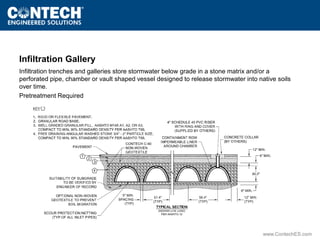
Infiltration Gallery 
Infiltration trenches and galleries store stormwater below grade in a stone matrix and/or a 
perforated pipe, chamber or vault shaped vessel designed to release stormwater into native soils 
over time. 
Pretreatment Required 
www.ContechES.com
www.ContechES.com 
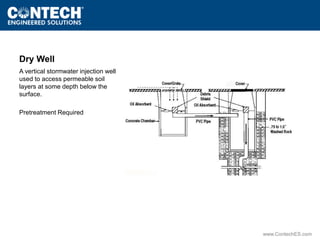
Dry Well 
A vertical stormwater injection well 
used to access permeable soil 
layers at some depth below the 
surface. 
Pretreatment Required
www.ContechES.com 
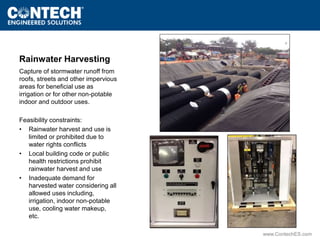
Rainwater Harvesting 
Capture of stormwater runoff from 
roofs, streets and other impervious 
areas for beneficial use as 
irrigation or for other non-potable 
indoor and outdoor uses. 
Feasibility constraints: 
• Rainwater harvest and use is 
limited or prohibited due to 
water rights conflicts 
• Local building code or public 
health restrictions prohibit 
rainwater harvest and use 
• Inadequate demand for 
harvested water considering all 
allowed uses including, 
irrigation, indoor non-potable 
use, cooling water makeup, 
etc.
www.ContechES.com 
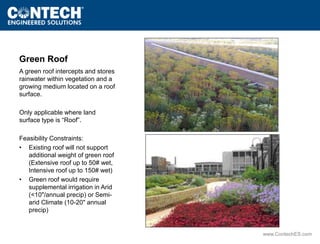
Green Roof 
A green roof intercepts and stores 
rainwater within vegetation and a 
growing medium located on a roof 
surface. 
Only applicable where land 
surface type is “Roof”. 
Feasibility Constraints: 
• Existing roof will not support 
additional weight of green roof 
(Extensive roof up to 50# wet, 
Intensive roof up to 150# wet) 
• Green roof would require 
supplemental irrigation in Arid 
(<10"/annual precip) or Semi-arid 
Climate (10-20" annual 
precip)
www.ContechES.com 
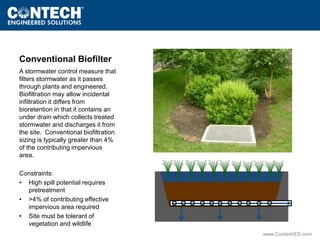
Conventional Biofilter 
A stormwater control measure that 
filters stormwater as it passes 
through plants and engineered. 
Biofiltration may allow incidental 
infiltration it differs from 
bioretention in that it contains an 
under drain which collects treated 
stormwater and discharges it from 
the site. Conventional biofiltration 
sizing is typically greater than 4% 
of the contributing impervious 
area. 
Constraints: 
• High spill potential requires 
pretreatment 
• >4% of contributing effective 
impervious area required 
• Site must be tolerant of 
vegetation and wildlife
www.ContechES.com 
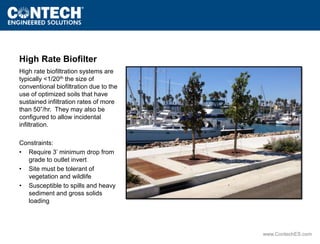
High Rate Biofilter 
High rate biofiltration systems are 
typically <1/20th the size of 
conventional biofiltration due to the 
use of optimized soils that have 
sustained infiltration rates of more 
than 50”/hr. They may also be 
configured to allow incidental 
infiltration. 
Constraints: 
• Require 3’ minimum drop from 
grade to outlet invert 
• Site must be tolerant of 
vegetation and wildlife 
• Susceptible to spills and heavy 
sediment and gross solids 
loading
www.ContechES.com 
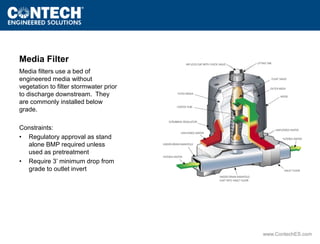
Media Filter 
Media filters use a bed of 
engineered media without 
vegetation to filter stormwater prior 
to discharge downstream. They 
are commonly installed below 
grade. 
Constraints: 
• Regulatory approval as stand 
alone BMP required unless 
used as pretreatment 
• Require 3’ minimum drop from 
grade to outlet invert
www.ContechES.com 
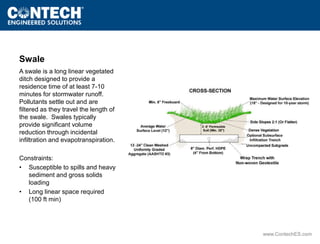
Swale 
A swale is a long linear vegetated 
ditch designed to provide a 
residence time of at least 7-10 
minutes for stormwater runoff. 
Pollutants settle out and are 
filtered as they travel the length of 
the swale. Swales typically 
provide significant volume 
reduction through incidental 
infiltration and evapotranspiration. 
Constraints: 
• Susceptible to spills and heavy 
sediment and gross solids 
loading 
• Long linear space required 
(100 ft min)
www.ContechES.com 
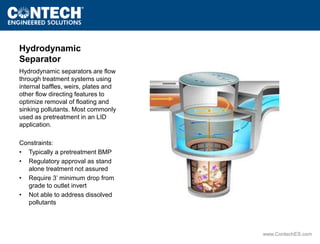
Hydrodynamic 
Separator 
Hydrodynamic separators are flow 
through treatment systems using 
internal baffles, weirs, plates and 
other flow directing features to 
optimize removal of floating and 
sinking pollutants. Most commonly 
used as pretreatment in an LID 
application. 
Constraints: 
• Typically a pretreatment BMP 
• Regulatory approval as stand 
alone treatment not assured 
• Require 3’ minimum drop from 
grade to outlet invert 
• Not able to address dissolved 
pollutants
Confidentiality 
 Users can save and retrieve an unlimited number of their own 
www.ContechES.com 
projects 
 Users cannot view others projects 
 Basic login information auto-populated on new projects 
 Contech support is available on request 
o Where assistance is requested, questions directed to a local resource 
based on project zip code or user information 
 If requested, Contech can review project details and can assist 
with feasibility screening and stormwater plan development
www.ContechES.com 
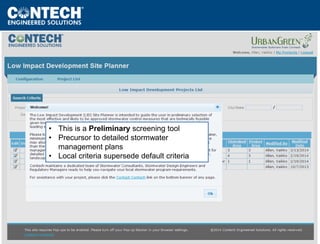
Demonstration 
• This is a Preliminary screening tool 
• Precursor to detailed stormwater 
management plans 
• Local criteria supersede default criteria
www.ContechES.com 
Demonstration
www.ContechES.com 
Demonstration
www.ContechES.com 
Demonstration
www.ContechES.com 
Demonstration
www.ContechES.com 
Demonstration
www.ContechES.com 
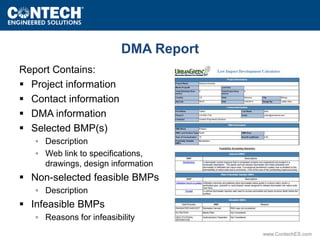
Report Contains: 
 Project information 
 Contact information 
 DMA information 
 Selected BMP(s) 
DMA Report 
◦ Description 
◦ Web link to specifications, 
drawings, design information 
 Non-selected feasible BMPs 
◦ Description 
 Infeasible BMPs 
◦ Reasons for infeasibility
www.ContechES.com

Low Impact Developement Site Planner

  • 1.
    Development and Applicationof a Web- Based Post-Construction Stormwater www.ContechES.com BMP Feasibility Screening Tool Vaikko Allen, CPSWQ, LEED-AP Director Stormwater Regulatory Management Contech Engineered Solutions vallen@conteches.com
  • 2.
  • 3.
  • 4.
  • 5.
    www.ContechES.com LID isSweeping the Nation!!! Photo credits: SvR Design Company, Seattle, WA
  • 6.
    LID implementation doesn’thave to be this be complicated! www.ContechES.com
  • 7.
  • 8.
    www.ContechES.com LID SitePlanner – Purpose  A fast, easy to use tool that follows a Low Impact Development (LID) design approach and is consistent with regulations that prioritize Green Infrastructure  Helps minimize the cost and delay of redesigns by prompting users to consider a wide range of common site constraints early in the design process  Captures specific site conditions precluding the use of infeasible BMPs  Allows flexibility to select flow through treatment controls where runoff reduction is not feasible  Provides a summary report with links to design guides, standard details and specifications for stormwater management approaches that are likely to be feasible and approved on the project
  • 9.
    LID Site Planner– Core Functionality www.ContechES.com  Collect site information o Project name, project location, total disturbed area, total project area, dominant land use  Divide site into discrete drainage management areas (DMA) with dominant land surface types  Apply screening questions to identify feasible BMPs for each DMA  Capture and report constraints precluding more favorable BMPs  Summarize feasible BMPs and provide links to standard specifications and typical drawings
  • 10.
    www.ContechES.com BMPs represented Dominant Unit Process BMP INFILTRATION Bioretention INFILTRATION Permeable pavement INFILTRATION Infiltration trench or gallery INFILTRATION Drywell RAINWATER HARVEST Rainwater Harvest EVAPOTRANSPIRATION Green Roofs FILTRATION Conventional Biofiltration FILTRATION High Rate Biofiltration FILTRATION Media Filter GRAVITATIONAL SEPARATION Swale GRAVITATIONAL SEPARATION Hydrodynamic Separator
  • 11.
    Land surface typedrives BMP selection Considering LEED benefits and O&M concerns, Rainwater Harvesting and Green Roof priority may be reversed www.ContechES.com BMP Selection Based on Land Surface Type Unit Process INFILTRATION HARVEST ET FILTRATION SETTLING Unit Operation Bioretention Permeable pavement Infiltration trench or gallery Drywell Rainwater Harvest Green Roofs Biofiltration High Rate Biofiltration Media Filter Swale Separator Roofs X X X X X X X X X Primary Roads, High Use Parking Lots X P P P X X X X X Landscaped areas X X Walkways, courtyards X X X P P X X X X X Secondary roads, parking lots X X P P P X X X X X Notes: X = Suitable BMP P = Pretreatment required
  • 12.
    BMP Feasibility CriteriaSources  Orange County - 2011 Technical Guidance Document  Ventura County – 2011 Technical Guidance Manual  Delaware article 3.06.2 – Post construction BMP standards www.ContechES.com and specifications  2009 MD Stormwater Design Manual, Chapter 3 - Performance criteria for urban BMP design  2012 Stormwater Management Manual for Western Washington  WEF MOP 23 – Design of Urban Stormwater Controls
  • 13.
    Site Constraint Screening Unit Process INFILTRATION HARVEST ET FILTRATION SETTLING www.ContechES.com Unit Operation Bioretention Permeable pavement Infiltration gallery Drywell Rainwater Harvest Green Roofs Biofiltration HR Biofilter Filter Swale Separator High Groundwater within 5-10' of surface Sensitive Groundwater, <100' to extraction well Expansive Soils Contaminated soils Low permeability soils (<0.5"/hr infiltration rate) Lack of control over soil compaction during construction Adjacent to foundations and utilities High spill potential PT PT PT PT PT PT PT PT Slopes >5% Potable water demand minimization Xeri Xeri Xeri Fertilizer, pesticide, herbicide minimization O O O O < 4% of EIA available for BMPs Discharge to surface required (no stormdrain) Existing plumbing or structure not supporting green roof Existing plumbing not supporting harvest Insufficient supply or demand for harvested water Maintenance equipment, access and expertise availability Ecological or geomorphic water balance sensitivity Notes: PT = Requires pretreatment Xeri = Xeriscaping or using drought tolerant vegetation O = Organic landscaping with native or adapted plants can minimize impacts
  • 14.
    www.ContechES.com Infiltration SystemConstraints  Seasonal high groundwater within 5’ to 10’ of surface  Sensitive groundwater, groundwater extraction well within 100‘  Expansive soils  Contaminated soils or groundwater  Potential BMP location adjacent to foundation or utilities that may be compromised by infiltration  Low permeability soils <0.5 “/hr infiltration rate or NRCS class C, D This photo shows one of the houses damaged by the 2005 Laguna Beach Landslide. The house experienced an undermining by the landslide but remained intact. Photo by Pam Irvine, California Geological Survey (CGS).
  • 15.
    www.ContechES.com Bioretention Astormwater control measure that is comprised of plants and engineered soil located in a landscape depression. The plants and soil cleanse stormwater and retain pollutants and stormwater is infiltrated into native soils. Conventional bioretention system size is dictated by the permeability of native soils and is commonly >10% of the size of the contributing impervious area.
  • 16.
    www.ContechES.com Permeable Pavement Permeable hardscape materials including asphalt, concrete and paver block systems allow the movement of water and air around or through the paving material while providing a durable surface for pedestrian, bicycle and vehicular traffic. Infeasibility criteria • High spill potential • Heavy sediment and gross solids loads • High traffic roads and parking lots • Not available to treat roof runoff
  • 17.
    Infiltration Gallery Infiltrationtrenches and galleries store stormwater below grade in a stone matrix and/or a perforated pipe, chamber or vault shaped vessel designed to release stormwater into native soils over time. Pretreatment Required www.ContechES.com
  • 18.
    www.ContechES.com Dry Well A vertical stormwater injection well used to access permeable soil layers at some depth below the surface. Pretreatment Required
  • 19.
    www.ContechES.com Rainwater Harvesting Capture of stormwater runoff from roofs, streets and other impervious areas for beneficial use as irrigation or for other non-potable indoor and outdoor uses. Feasibility constraints: • Rainwater harvest and use is limited or prohibited due to water rights conflicts • Local building code or public health restrictions prohibit rainwater harvest and use • Inadequate demand for harvested water considering all allowed uses including, irrigation, indoor non-potable use, cooling water makeup, etc.
  • 20.
    www.ContechES.com Green Roof A green roof intercepts and stores rainwater within vegetation and a growing medium located on a roof surface. Only applicable where land surface type is “Roof”. Feasibility Constraints: • Existing roof will not support additional weight of green roof (Extensive roof up to 50# wet, Intensive roof up to 150# wet) • Green roof would require supplemental irrigation in Arid (<10"/annual precip) or Semi-arid Climate (10-20" annual precip)
  • 21.
    www.ContechES.com Conventional Biofilter A stormwater control measure that filters stormwater as it passes through plants and engineered. Biofiltration may allow incidental infiltration it differs from bioretention in that it contains an under drain which collects treated stormwater and discharges it from the site. Conventional biofiltration sizing is typically greater than 4% of the contributing impervious area. Constraints: • High spill potential requires pretreatment • >4% of contributing effective impervious area required • Site must be tolerant of vegetation and wildlife
  • 22.
    www.ContechES.com High RateBiofilter High rate biofiltration systems are typically <1/20th the size of conventional biofiltration due to the use of optimized soils that have sustained infiltration rates of more than 50”/hr. They may also be configured to allow incidental infiltration. Constraints: • Require 3’ minimum drop from grade to outlet invert • Site must be tolerant of vegetation and wildlife • Susceptible to spills and heavy sediment and gross solids loading
  • 23.
    www.ContechES.com Media Filter Media filters use a bed of engineered media without vegetation to filter stormwater prior to discharge downstream. They are commonly installed below grade. Constraints: • Regulatory approval as stand alone BMP required unless used as pretreatment • Require 3’ minimum drop from grade to outlet invert
  • 24.
    www.ContechES.com Swale Aswale is a long linear vegetated ditch designed to provide a residence time of at least 7-10 minutes for stormwater runoff. Pollutants settle out and are filtered as they travel the length of the swale. Swales typically provide significant volume reduction through incidental infiltration and evapotranspiration. Constraints: • Susceptible to spills and heavy sediment and gross solids loading • Long linear space required (100 ft min)
  • 25.
    www.ContechES.com Hydrodynamic Separator Hydrodynamic separators are flow through treatment systems using internal baffles, weirs, plates and other flow directing features to optimize removal of floating and sinking pollutants. Most commonly used as pretreatment in an LID application. Constraints: • Typically a pretreatment BMP • Regulatory approval as stand alone treatment not assured • Require 3’ minimum drop from grade to outlet invert • Not able to address dissolved pollutants
  • 26.
    Confidentiality  Userscan save and retrieve an unlimited number of their own www.ContechES.com projects  Users cannot view others projects  Basic login information auto-populated on new projects  Contech support is available on request o Where assistance is requested, questions directed to a local resource based on project zip code or user information  If requested, Contech can review project details and can assist with feasibility screening and stormwater plan development
  • 27.
    www.ContechES.com Demonstration •This is a Preliminary screening tool • Precursor to detailed stormwater management plans • Local criteria supersede default criteria
  • 28.
  • 29.
  • 30.
  • 31.
  • 32.
  • 33.
    www.ContechES.com Report Contains:  Project information  Contact information  DMA information  Selected BMP(s) DMA Report ◦ Description ◦ Web link to specifications, drawings, design information  Non-selected feasible BMPs ◦ Description  Infeasible BMPs ◦ Reasons for infeasibility
  • 34.

Editor's Notes

  • #3 Ever feel like you’ve been doing something competently and then you see someone else do it totally differently and you’re like wow. That’s different. And cool. And definitely creative. Maybe a little uncomfortable…
  • #5 hadoukening
  • #6 When there’s a new trend, learn about it, what are the rules, what’s the objective
  • #9 You must demonstrate that runoff reduction BMPs are infeasible before you are allowed to use biofiltration. If biofiltration isn’t feasible, you’ll have to participate in an alternative compliance program. Detention requirements have been replaced by “Hydromodification” requirements. They may be met in part or in full using retention BMPs. Additional detention controls will probably be required where biofiltration or treatment controls are used.
  • #14 BMPs listed along the top of the table in order of regulatory preference. Land surface type determines pollutant load characteristics and therefore BMP applicability. For example Green roofs are for Select the most preferred BMP for the catchment’s dominant land use for initial screening.
  • #16 BMPs are screened for suitability based on site constraints in order of preference Where constraints prohibit the use of a preferred BMP, those constraints are noted The recommended BMP is the most effective BMP that is technically feasible
  • #24 7% area based on 6” ponding depth and a 0.5” storm. Rate based system at 5”/hr soils and 0.2”/hr rainfall intensity
  • #39 Hogwarting