Testing for Everyone
Mažvydas Skuodas @ Helis LT
Testers Myths
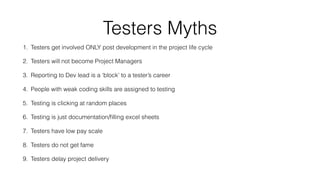
1. Testers get involved ONLY post development in the project life cycle
2. Testers will not become Project Managers
3. Reporting to Dev lead is a ‘block’ to a tester’s career
4. People with weak coding skills are assigned to testing
5. Testing is clicking at random places
6. Testing is just documentation/filling excel sheets
7. Testers have low pay scale
8. Testers do not get fame
9. Testers delay project delivery
Testers Myths
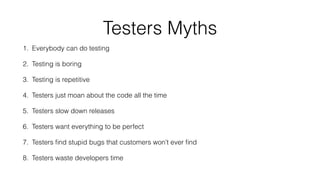
1. Everybody can do testing
2. Testing is boring
3. Testing is repetitive
4. Testers just moan about the code all the time
5. Testers slow down releases
6. Testers want everything to be perfect
7. Testers find stupid bugs that customers won’t ever find
8. Testers waste developers time
to Test - Take measures to check the quality,
performance, or reliability of (something),
especially before putting it into widespread
use or practice.
Tester Became QA
Quality Assurance
Programers loves tests
(most) Programers hates to write tests
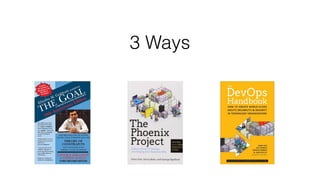
3 Ways
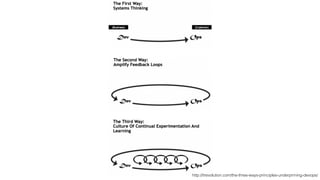
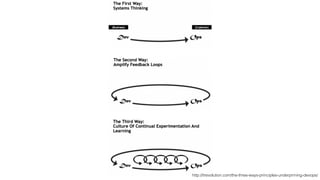
1st Way
• The First Way enables fast left-to-right flow of work from Development to
Operations to the customer.
• In order to maximize flow, we need to:
• make work visible,
• reduce our batch sizes and intervals of work,
• build in quality by preventing defects from being passed to downstream
work centers
• and constantly optimize for the global goals.
2nd Way
• The Second Way enables the fast and constant flow of feedback
from right to left at all stages of our value stream.
• It requires that we:
• amplify feedback to prevent problems from happening again
• or enable faster detection and recovery.
3rd Way
• The Third Way enables the creation of a generative, high-trust
culture that supports a dynamic, disciplined, and scientific
approach to experimentation and risk-taking, facilitating the creation
of organizational learning, both from our successes and failures.
1st: Reduce Lead time

2nd: Feedback

3rd: Learn and improve
http://itrevolution.com/the-three-ways-principles-underpinning-devops/
Tests provide instant feedback
The Experiment - A scientific procedure
undertaken to make a discovery,

test a hypothesis, or demonstrate a known fact.
http://itrevolution.com/the-three-ways-principles-underpinning-devops/
Games and Fun
What defines a game are the goal,
the rules, the feedback system, and
voluntary participation.
Gamers want to play the game. They want to
explore and learn and improve. They are
volunteering for unnecessary hard work - and they
genuinely care about the outcome of their effort
Exploratory testing
In high feedback games, the state of being
intensely engaged may ultimately be more
pleasurable then even the satisfaction of winning
Testing Tips
Step by step go up the hill..
QA Should find nothing
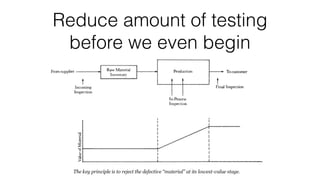
Reduce amount of testing
before we even begin
Don’t make programs look “buggy”
- show them how to improve them
Engagement - let them build
better stuff.
And Finally
Test is about Feedback,

and everybody needs feedback.
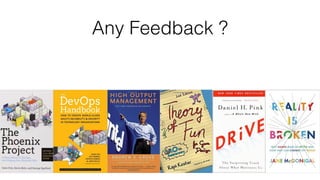
Any Feedback ?

Testing for everyone

  • 1.
  • 2.
    Testers Myths 1. Testersget involved ONLY post development in the project life cycle 2. Testers will not become Project Managers 3. Reporting to Dev lead is a ‘block’ to a tester’s career 4. People with weak coding skills are assigned to testing 5. Testing is clicking at random places 6. Testing is just documentation/filling excel sheets 7. Testers have low pay scale 8. Testers do not get fame 9. Testers delay project delivery
  • 3.
    Testers Myths 1. Everybodycan do testing 2. Testing is boring 3. Testing is repetitive 4. Testers just moan about the code all the time 5. Testers slow down releases 6. Testers want everything to be perfect 7. Testers find stupid bugs that customers won’t ever find 8. Testers waste developers time
  • 4.
    to Test -Take measures to check the quality, performance, or reliability of (something), especially before putting it into widespread use or practice.
  • 5.
  • 6.
  • 7.
  • 8.
  • 9.
    1st Way • TheFirst Way enables fast left-to-right flow of work from Development to Operations to the customer. • In order to maximize flow, we need to: • make work visible, • reduce our batch sizes and intervals of work, • build in quality by preventing defects from being passed to downstream work centers • and constantly optimize for the global goals.
  • 10.
    2nd Way • TheSecond Way enables the fast and constant flow of feedback from right to left at all stages of our value stream. • It requires that we: • amplify feedback to prevent problems from happening again • or enable faster detection and recovery.
  • 11.
    3rd Way • TheThird Way enables the creation of a generative, high-trust culture that supports a dynamic, disciplined, and scientific approach to experimentation and risk-taking, facilitating the creation of organizational learning, both from our successes and failures.
  • 12.
    1st: Reduce Leadtime
 2nd: Feedback
 3rd: Learn and improve
  • 13.
  • 14.
  • 15.
    The Experiment -A scientific procedure undertaken to make a discovery,
 test a hypothesis, or demonstrate a known fact.
  • 16.
  • 18.
  • 19.
    What defines agame are the goal, the rules, the feedback system, and voluntary participation.
  • 20.
    Gamers want toplay the game. They want to explore and learn and improve. They are volunteering for unnecessary hard work - and they genuinely care about the outcome of their effort
  • 21.
  • 22.
    In high feedbackgames, the state of being intensely engaged may ultimately be more pleasurable then even the satisfaction of winning
  • 23.
  • 24.
    Step by stepgo up the hill..
  • 25.
  • 26.
    Reduce amount oftesting before we even begin
  • 27.
    Don’t make programslook “buggy” - show them how to improve them
  • 28.
    Engagement - letthem build better stuff.
  • 29.
  • 30.
    Test is aboutFeedback,
 and everybody needs feedback.
  • 31.