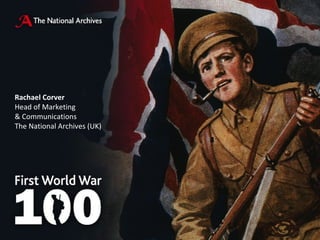
Rachael Corver 
Head of Marketing 
& Communications 
The National Archives (UK)
First World War, the media and the National Archives 
• About us and our First World War programme 
• What we can offer the media 
• What we seek from the media 
• What we’ve learned from the centenary so far
Q: What do these people have in common?
A: They all have records in the National Archives 
11 million ‘records’ 
Based in Kew, South 
West London 
The official archives of 
the UK state 
1,000 years of public records 
Available onsite and online 
WWW.nationalarchives.gov.uk 
Over 2 million visits per month 
One of the largest First World War 
collections in the world
Our First World War collection: 
from War Office to western front 
Generals survey the trenches 
‘The Big Four’ in 1919 British ‘Tommies’ eat their rations
Technology: designs, policy and early use
‘British’ records cover more than the UK 
Battle of Tanga, Africa, November 1914 
1.5 million Indians served
Sykes-Picot map of Middle East, 1916
Belgian First World War refugees in Richmond 
(L) Pelabon munitions factory in Twickenham, Richmond upon Thames 
(R)First World War era Belgian shops in St Margaret's, Richmond upon Thames 
Our MH8 series covers hundreds of thousands of refugees who spent the war 
in Britain then returned to Belgium
First World War 100: 2014-2019 
• Opening up the records – digitisation, cataloguing, online 
• Unit War diaries (1.5 million pages) 
• Operation War Diary 
• Partnerships 
• Volunteer projects 
• Public talks and events 
• Schools programme 
• Web resources 
• Media
www.operationwardiary.org crowdsourcing for 
archives
Our media objectives 
• Raise awareness of our collection and of our institution 
• Increase understanding of the value of archives 
• Market our First World War 100 programme 
• Encourage new archive users 
• Attract international users online 
• Recruit volunteers for archive projects especially crowdsourcing 
• Build new partnerships especially with media
War Diaries launch: 
January 2014 
Quotes and personal passages helped 
bring them to life- radio and tv dramatise 
them 
An ‘official’ rather than a personal history 
But we still found plenty of ‘human 
interest’
Launching First World War 100: unit war diaries 
Most successful media launch in our history 
Beginning of our busiest ever six months 
•447 media clips 
•BBC Breakfast, BBC News 24 
•BBC World Service 
•Channel 4 News 
•ITV News 
•Sky News 
•BBC Radio 4 
•ITV Good Morning Britain 
Our website and call centre under pressure
Archive projects with personal stories 
worked well for the media 
It helps if you are first with 
a topic.
Images can make the story… 
…but finding and 
digitising them takes time 
and effort
Quirky stories kept our war diaries in the media
International media 
Tailored stories to international media 
Europe: Irish Times 
US: New York Times, Huffington Post, Harpers Bazaar, NPR Radio 
ABC World News 
Asia: Times of India, Japan Times, Asian Age, South China Morning 
Post 
Middle East: Gulf News, Arab News, Al Jazeera 
Australasia: New Zealand Herald, Sydney Morning Herald, The Age
Personal stories: so what happened next? 
“The archivists found the case of John Gordon Shallis, a 19- 
year-old carpenter, particularly moving. His mother had 
broken her leg in a fall soon after learning that her first and 
second sons had died in the war; she was in hospital when 
she learned that the third son was dead too. By the time the 
tribunal sat a fourth had died. Shallis's appeal was allowed.”
Lessons learned 
Not used to the media spotlight – media training, senior buy-in, 
coordination between departments 
Identify the right content – research is steady, meticulous work 
Limited capacity– can’t always say ‘yes’, let the collection lead 
Personal vs official record – manage expectations 
Links between then and now –very important in the media 
Handle with care – families of soldiers still alive 
Get the message right – neither commemoration nor celebration 
Media and fragile documents don’t mix – limit access and create 
dedicated filming space 
Increased media = increased enquiries about everything - consider effects 
of a successful programme on wider institution
Beyond First World War 
• Increased media across the board – press cuttings bill have tripled 
• New archive users and visitors – records broken for document downloads 
• Media has supported volunteer recruitment 
• Partnerships - higher profile means more open doors 
• New media relationships - good foundation to build on
Nationalarchives.gov.uk 
@UkNationalArchives 
Facebook.com/The NationalArchives 
Rachael.corver@nationalarchives.gsi.gov.uk

Groot Onderhoud IV, 14 oktober 2014 | Rachael Corver, First World War 100

  • 1.
    Rachael Corver Headof Marketing & Communications The National Archives (UK)
  • 2.
    First World War,the media and the National Archives • About us and our First World War programme • What we can offer the media • What we seek from the media • What we’ve learned from the centenary so far
  • 3.
    Q: What dothese people have in common?
  • 4.
    A: They allhave records in the National Archives 11 million ‘records’ Based in Kew, South West London The official archives of the UK state 1,000 years of public records Available onsite and online WWW.nationalarchives.gov.uk Over 2 million visits per month One of the largest First World War collections in the world
  • 5.
    Our First WorldWar collection: from War Office to western front Generals survey the trenches ‘The Big Four’ in 1919 British ‘Tommies’ eat their rations
  • 6.
  • 7.
    ‘British’ records covermore than the UK Battle of Tanga, Africa, November 1914 1.5 million Indians served
  • 8.
    Sykes-Picot map ofMiddle East, 1916
  • 11.
    Belgian First WorldWar refugees in Richmond (L) Pelabon munitions factory in Twickenham, Richmond upon Thames (R)First World War era Belgian shops in St Margaret's, Richmond upon Thames Our MH8 series covers hundreds of thousands of refugees who spent the war in Britain then returned to Belgium
  • 12.
    First World War100: 2014-2019 • Opening up the records – digitisation, cataloguing, online • Unit War diaries (1.5 million pages) • Operation War Diary • Partnerships • Volunteer projects • Public talks and events • Schools programme • Web resources • Media
  • 13.
  • 14.
    Our media objectives • Raise awareness of our collection and of our institution • Increase understanding of the value of archives • Market our First World War 100 programme • Encourage new archive users • Attract international users online • Recruit volunteers for archive projects especially crowdsourcing • Build new partnerships especially with media
  • 15.
    War Diaries launch: January 2014 Quotes and personal passages helped bring them to life- radio and tv dramatise them An ‘official’ rather than a personal history But we still found plenty of ‘human interest’
  • 16.
    Launching First WorldWar 100: unit war diaries Most successful media launch in our history Beginning of our busiest ever six months •447 media clips •BBC Breakfast, BBC News 24 •BBC World Service •Channel 4 News •ITV News •Sky News •BBC Radio 4 •ITV Good Morning Britain Our website and call centre under pressure
  • 17.
    Archive projects withpersonal stories worked well for the media It helps if you are first with a topic.
  • 18.
    Images can makethe story… …but finding and digitising them takes time and effort
  • 19.
    Quirky stories keptour war diaries in the media
  • 20.
    International media Tailoredstories to international media Europe: Irish Times US: New York Times, Huffington Post, Harpers Bazaar, NPR Radio ABC World News Asia: Times of India, Japan Times, Asian Age, South China Morning Post Middle East: Gulf News, Arab News, Al Jazeera Australasia: New Zealand Herald, Sydney Morning Herald, The Age
  • 21.
    Personal stories: sowhat happened next? “The archivists found the case of John Gordon Shallis, a 19- year-old carpenter, particularly moving. His mother had broken her leg in a fall soon after learning that her first and second sons had died in the war; she was in hospital when she learned that the third son was dead too. By the time the tribunal sat a fourth had died. Shallis's appeal was allowed.”
  • 22.
    Lessons learned Notused to the media spotlight – media training, senior buy-in, coordination between departments Identify the right content – research is steady, meticulous work Limited capacity– can’t always say ‘yes’, let the collection lead Personal vs official record – manage expectations Links between then and now –very important in the media Handle with care – families of soldiers still alive Get the message right – neither commemoration nor celebration Media and fragile documents don’t mix – limit access and create dedicated filming space Increased media = increased enquiries about everything - consider effects of a successful programme on wider institution
  • 23.
    Beyond First WorldWar • Increased media across the board – press cuttings bill have tripled • New archive users and visitors – records broken for document downloads • Media has supported volunteer recruitment • Partnerships - higher profile means more open doors • New media relationships - good foundation to build on
  • 24.
    Nationalarchives.gov.uk @UkNationalArchives Facebook.com/TheNationalArchives Rachael.corver@nationalarchives.gsi.gov.uk