Media timeline 
Steph Webb
Magazines
Types of magazines 
• Consumer: Magazines targeting general reading 
audiences who are sections of the general public with 
individual/specific interests. 
• Trade and Professional: Magazines targeting people 
working in trades, businesses and professional fields. 
• House Organ: Published by for-profit and not-for-profit 
organizations such as companies, special interest groups 
for their customers, employees, clients and members.
Types of circulation 
• Paid circulation: The magazine is sold to readers for a 
price, either on a per-issue basis or by subscription, 
where an annual fee is paid and issues are sent by mail to 
readers. 
• Free circulation: There is no cover price and issues are 
given away. 
• Controlled circulation: Usually industry-based 
publications distributed only to qualifying readers, often 
for free and determined by some form of survey – this 
was the most popular use of circulation prior to the 
development of the web 2.0.
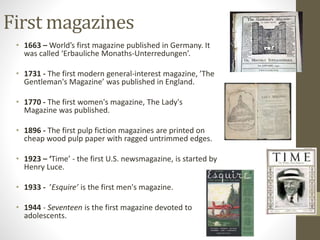
First magazines 
• 1663 – World’s first magazine published in Germany. It 
was called ‘Erbauliche Monaths-Unterredungen’. 
• 1731 - The first modern general-interest magazine, ’The 
Gentleman's Magazine’ was published in England. 
• 1770 - The first women's magazine, The Lady's 
Magazine was published. 
• 1896 - The first pulp fiction magazines are printed on 
cheap wood pulp paper with ragged untrimmed edges. 
• 1923 – ‘Time’ - the first U.S. newsmagazine, is started by 
Henry Luce. 
• 1933 - ’Esquire’ is the first men's magazine. 
• 1944 - Seventeen is the first magazine devoted to 
adolescents.
Posters
Development of the poster 
• The Poster was one of the earliest forms of advertisement and 
began to develop as a medium for visual communication in 
the early 19th century. 
• The poster quickly spread around the world and became a 
staple of the graphic design trade. 
• They were used to promote various political parties, recruit 
soldiers, advertise products and spread ideas to the general 
public. 
• Even with the popularity of the internet posters are still being 
created every single day for all sorts of reasons.
Birth of the poster 
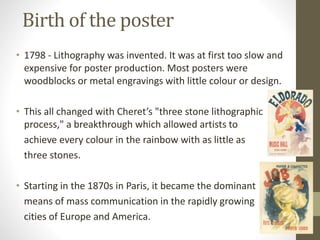
• 1798 - Lithography was invented. It was at first too slow and 
expensive for poster production. Most posters were 
woodblocks or metal engravings with little colour or design. 
• This all changed with Cheret’s "three stone lithographic 
process," a breakthrough which allowed artists to 
achieve every colour in the rainbow with as little as 
three stones. 
• Starting in the 1870s in Paris, it became the dominant 
means of mass communication in the rapidly growing 
cities of Europe and America.
Helping out 
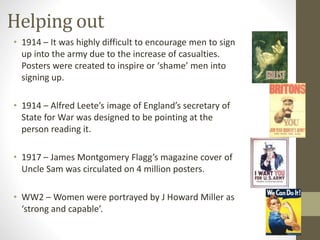
• 1914 – It was highly difficult to encourage men to sign 
up into the army due to the increase of casualties. 
Posters were created to inspire or ‘shame’ men into 
signing up. 
• 1914 – Alfred Leete’s image of England’s secretary of 
State for War was designed to be pointing at the 
person reading it. 
• 1917 – James Montgomery Flagg’s magazine cover of 
Uncle Sam was circulated on 4 million posters. 
• WW2 – Women were portrayed by J Howard Miller as 
‘strong and capable’.
Posters in today’s time 
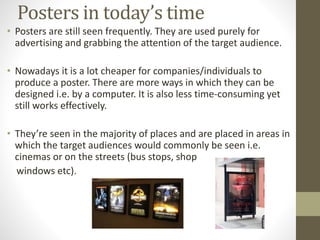
• Posters are still seen frequently. They are used purely for 
advertising and grabbing the attention of the target audience. 
• Nowadays it is a lot cheaper for companies/individuals to 
produce a poster. There are more ways in which they can be 
designed i.e. by a computer. It is also less time-consuming yet 
still works effectively. 
• They’re seen in the majority of places and are placed in areas in 
which the target audiences would commonly be seen i.e. 
cinemas or on the streets (bus stops, shop 
windows etc).

Media timeline ancillary

  • 1.
  • 2.
  • 3.
    Types of magazines • Consumer: Magazines targeting general reading audiences who are sections of the general public with individual/specific interests. • Trade and Professional: Magazines targeting people working in trades, businesses and professional fields. • House Organ: Published by for-profit and not-for-profit organizations such as companies, special interest groups for their customers, employees, clients and members.
  • 4.
    Types of circulation • Paid circulation: The magazine is sold to readers for a price, either on a per-issue basis or by subscription, where an annual fee is paid and issues are sent by mail to readers. • Free circulation: There is no cover price and issues are given away. • Controlled circulation: Usually industry-based publications distributed only to qualifying readers, often for free and determined by some form of survey – this was the most popular use of circulation prior to the development of the web 2.0.
  • 5.
    First magazines •1663 – World’s first magazine published in Germany. It was called ‘Erbauliche Monaths-Unterredungen’. • 1731 - The first modern general-interest magazine, ’The Gentleman's Magazine’ was published in England. • 1770 - The first women's magazine, The Lady's Magazine was published. • 1896 - The first pulp fiction magazines are printed on cheap wood pulp paper with ragged untrimmed edges. • 1923 – ‘Time’ - the first U.S. newsmagazine, is started by Henry Luce. • 1933 - ’Esquire’ is the first men's magazine. • 1944 - Seventeen is the first magazine devoted to adolescents.
  • 6.
  • 7.
    Development of theposter • The Poster was one of the earliest forms of advertisement and began to develop as a medium for visual communication in the early 19th century. • The poster quickly spread around the world and became a staple of the graphic design trade. • They were used to promote various political parties, recruit soldiers, advertise products and spread ideas to the general public. • Even with the popularity of the internet posters are still being created every single day for all sorts of reasons.
  • 8.
    Birth of theposter • 1798 - Lithography was invented. It was at first too slow and expensive for poster production. Most posters were woodblocks or metal engravings with little colour or design. • This all changed with Cheret’s "three stone lithographic process," a breakthrough which allowed artists to achieve every colour in the rainbow with as little as three stones. • Starting in the 1870s in Paris, it became the dominant means of mass communication in the rapidly growing cities of Europe and America.
  • 9.
    Helping out •1914 – It was highly difficult to encourage men to sign up into the army due to the increase of casualties. Posters were created to inspire or ‘shame’ men into signing up. • 1914 – Alfred Leete’s image of England’s secretary of State for War was designed to be pointing at the person reading it. • 1917 – James Montgomery Flagg’s magazine cover of Uncle Sam was circulated on 4 million posters. • WW2 – Women were portrayed by J Howard Miller as ‘strong and capable’.
  • 10.
    Posters in today’stime • Posters are still seen frequently. They are used purely for advertising and grabbing the attention of the target audience. • Nowadays it is a lot cheaper for companies/individuals to produce a poster. There are more ways in which they can be designed i.e. by a computer. It is also less time-consuming yet still works effectively. • They’re seen in the majority of places and are placed in areas in which the target audiences would commonly be seen i.e. cinemas or on the streets (bus stops, shop windows etc).