Academic, Public and Popular
History
Associate Professor Michelle Arrow,
Macquarie University
Headstart to Extension 2015
Outline
1. Defining the fields and their purposes
2. Who are their intended audiences?
3. How do different historians communicate?
4. Controversies
5. An ANZAC case study
But first….
All historians are interested in the ‘whole human past’
(Curthoys and McGrath, How to Write History that People
Want to Read)
History is ‘a continuous process of interaction between the
historian and his facts, an unending dialogue between the
present and the past.’
(E.H. Carr, What is History?)
Histories will differ according to their purpose and audience…
And also…
• Academic, Public and Popular history are
discrete categories
• BUT – they also overlap
• Many historians work across these categories
as well as within them
• Many academic historians conduct analysis of
popular histories
• Public history is an academic discipline as well
as a practice
What is Academic History?
• Academic historians aim to create new
knowledge about the past – to innovate, to push
the discipline further
• They seek to construct historical interpretations
or arguments about the past
– New archival sources
– Application of new theories to the past (eg
postcolonial, gender etc)
– New approaches to the kinds of sources used (eg
social history, cultural history, gender history)
Defining Academic History
• Academic historians take part in a scholarly
conversation with historians, both past and present
• Publishing in specialised, peer-reviewed outlets –
academic journals, scholarly presses
• What does ‘peer-review’ mean? – evaluation of
academic work by others working in the same field
• See this explainer:
https://theconversation.com/explainer-what-is-peer-
review-27797
• (Windschuttle – did not submit work to peer review)
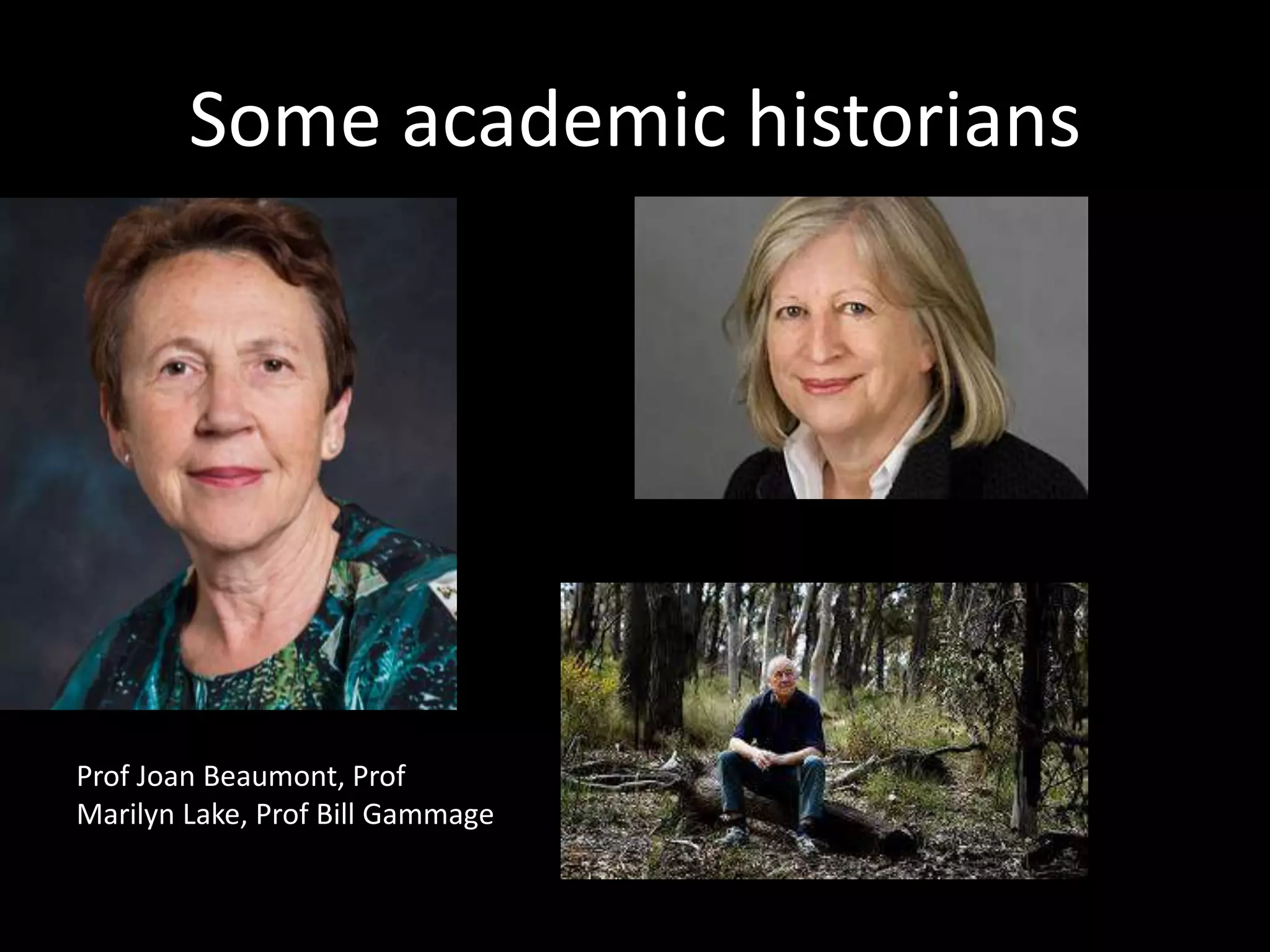
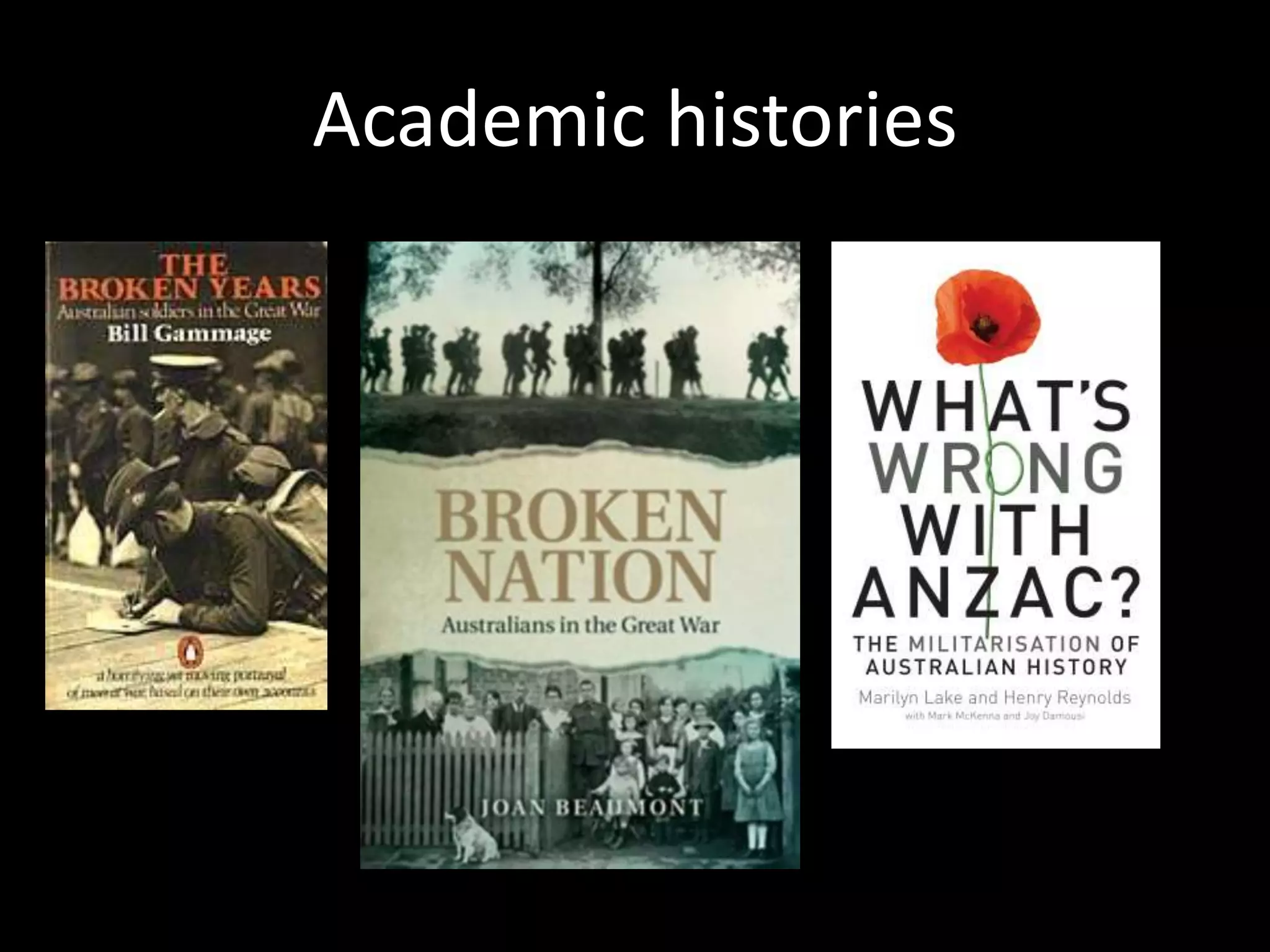
Some academic historians
Prof Joan Beaumont, Prof
Marilyn Lake, Prof Bill Gammage
What is Public History?
• Public historians seek to interpret the past for broader
public understanding, usually with an emphasis on primary
sources and especially material culture
• Public history involves historical research, analysis and
presentation ‘with some degree of explicit application to
the needs of contemporary life’ (The Public Historian
editorial policy)
• National Council of Public History (USA): ‘public history
describes the many and diverse ways in which history is put
to work in the world’ http://ncph.org/what-is-public-
history/about-the-field/
• Hilda Kean ‘public history [is] … a practice which has the
capacity for involving people as well as nations and
communities in the creation of their own histories.’
(The Public History Reader, Kean and Martin (eds) 2013)
• ‘Public history not only reflects the history of the
community it seeks to serve, but the very history of that
community will shape the nuances of what is understood as
public history by that community.’ (Dr Robin McLachlan)
http://www.publichistory.org/what_is/definition.html
• ”[Michael Frisch] contends that what differentiates public
history from academic history is its focus on audience."
(Stephen L. Reckon, "Doing Public History: A Look at the How, but Especially
the Why," American Quarterly Volume 45, Issue 1 (March 1993): 188.)
• Public historians work with and for the general public.
• Public history is still underpinned by historical research but
its audience is wider than academic history
• public historians work in museums, galleries, archives
interpretive sites, commemorative plaques, reenactments,
heritage assessments, the media (documentaries etc), and
public policy.
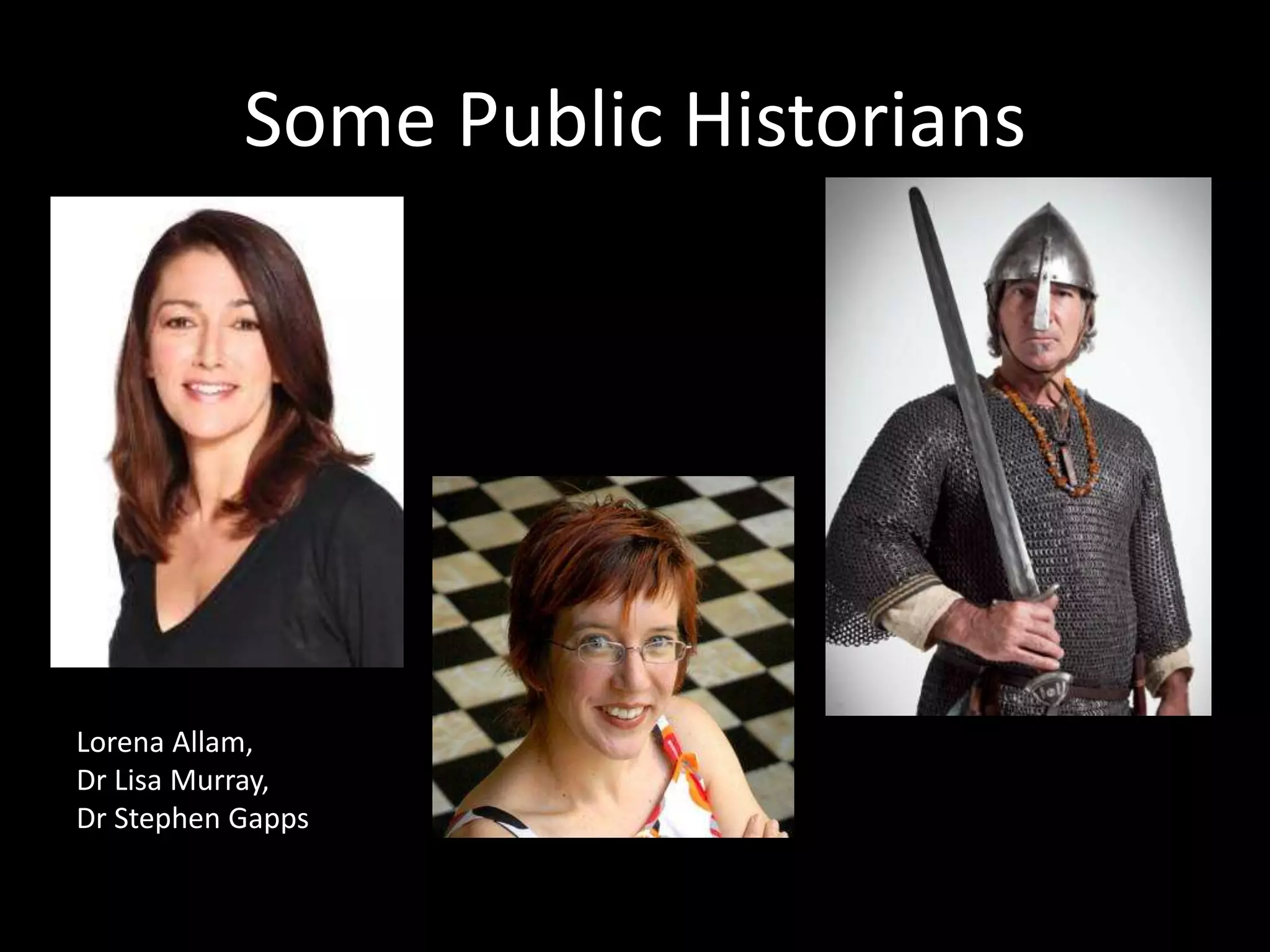
Some Public Historians
Lorena Allam,
Dr Lisa Murray,
Dr Stephen Gapps
What is Popular History?
• The forms and practices through which history is transmitted in culture
(Jerome de Groot), often via popular culture
• Can take a huge variety of forms – political discourse can be a form of
popular history, everyday understandings of the past are a form of popular
history
• Is much more driven by interests of the audience (hence dominance of
military history as a subject of popular histories)
• Popular histories can be commodities – part of a history ‘marketplace’:
popular history books (including those for children), docudramas,
historical films, novels, videogames, documentaries, television programs
(including reality TV eg. 1940s house), experiences, social media eg
facebook pages
Defining Popular History
• Probably the place where most people find out about the
past: history as entertainment, history as leisure
• Popular history is history that seeks first to entertain, to tell
compelling narratives about the past for a broad audience
• ‘Popular history is history, simply in a different form to that
of its academic counterparts’. Elizabeth Norton,
http://www.historymatters.group.shef.ac.uk/popular-vs-
academic-history/
• Where are the limits of this category?
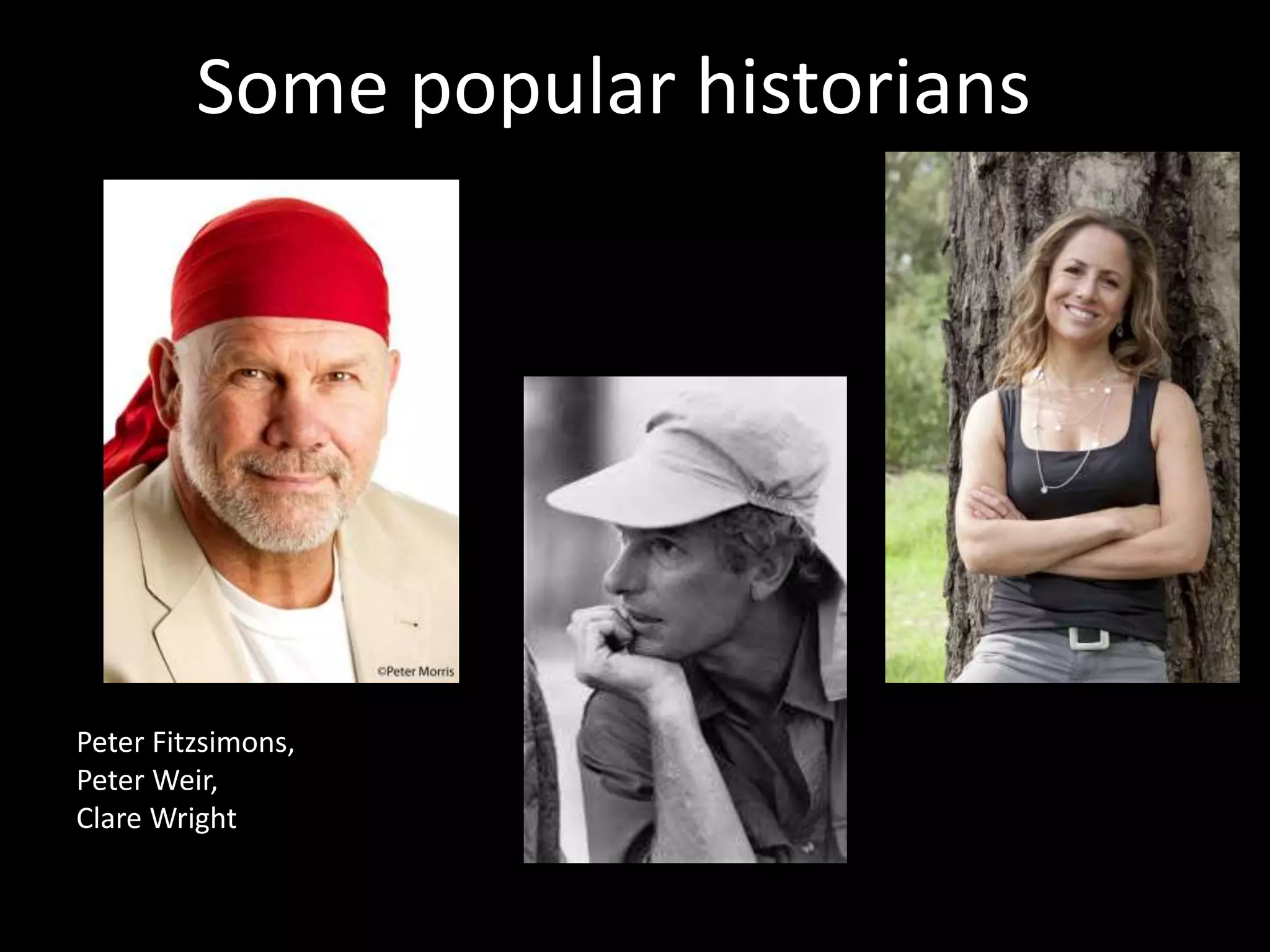
Some popular historians
Peter Fitzsimons,
Peter Weir
Clare Wright (a rare
academic historian who
‘crosses over’ into
public and popular
realms)
2. Who are their audiences?
2.1. Academic Historians
• Academic Historians: most seek to speak to other
academics; publish in journals (available only through
subscriptions); audiences for their books tend to be small
(500-2000 copies)
• Historians publish in different journals depending on who
they want to ‘speak’ to
• Selecting your topic means you are selecting your audience
• Some communicate their work more broadly: as expert
‘taking heads’ for the media, writing for websites that
‘translate’ academic research like theconversation.com
(see: https://theconversation.com/au/topics/writing-
history)
Results from the surveys Australians and the Past (Paul Ashton and Paula Hamilton, published in ACH: Australian Cultural History 22,
2003) and The Presence of the Past: Popular Uses of History in American Life (Roy Rosenzweig and David Thelen, 1998 Colombia
University Press)
Historical activities undertaken by participants
in the last 12 months (could list more than one)
US Aust
Looked at photographs with family or friends 91% 88%
Taken photographs or videos to preserve
memories
83 74
Watched movies or television programs about
the past
81 84
Attended family/school reunion 64 56
Visited museums or historic sites 57 55
Read books about the past 53 56
Participated in hobbies relating to the past 39 33
Conducted genealogical research 36 69
Written a journal or diary 29 25
Participated in a group devoted to studying or
preserving the past
20 15
Results from the surveys Australians and the Past (Paul Ashton and Paula Hamilton, published in ACH: Australian Cultural History 22,
2003) and The Presence of the Past: Popular Uses of History in American Life (Roy Rosenzweig and David Thelen, 1998 Colombia
University Press)
Trustworthiness of sources of information
about the past
Aust (%)
Museums 56
Academic historians 33
Family stories 23
Non-fiction books 20
Eye-witnesses 16
newspapers 15
High-school teachers 14
Historical movies/TV 12
Radio programs 7
Media figures 3
Politicians -39 (!)
2.2 Public Historians
• Public Historians: audiences include the general public,
government, policy advisors, community groups,
children, schools, parents.
• Accountability is slightly different – most public
historians work for governments, cultural institutions
dependent on government funding, or commissions
• Public historians have to demonstrate they are
reaching certain audiences (and generating new ones)
to guarantee funding, etc
2.3 Popular Historians
• Popular Historians seek to communicate to a
general audience, but perhaps in more emotional
ways than public historians
• Popular historians want to engage with story-
telling, to inspire passion, anger, nationalism,
sentimentality
• Many popular histories are aimed at audiences
often neglected by academic histories: family
historians, women, children
3. How do these historians
communicate?
3.1 Academic historians
• Academic historians: primarily though the written
word. Writing tends to be formal, favours
argument over engaging emotions, footnotes!
• Academic historians also write newspaper
articles, give public lectures and conference
papers, and teach to communicate their research
Academic histories
3.2. Public Historians
• Public Historians can communicate their work in
a range of forms: apps, walking tours, public
lectures, radio features, museum displays,
interpretations of historical artefacts, public
programs, live tweeting historical events (eg.
#Dismissal1975), events (eg Jacqui Newling @
Sydney Living Museums ‘the cook and the
curator’ blog
http://blogs.hht.net.au/cook/about/ )
• usually connected to institutions in some way
Public histories
3.3. Popular Historians
• Popular historians: can communicate through non-
fiction and fiction (and tend to blur the lines between
the two)
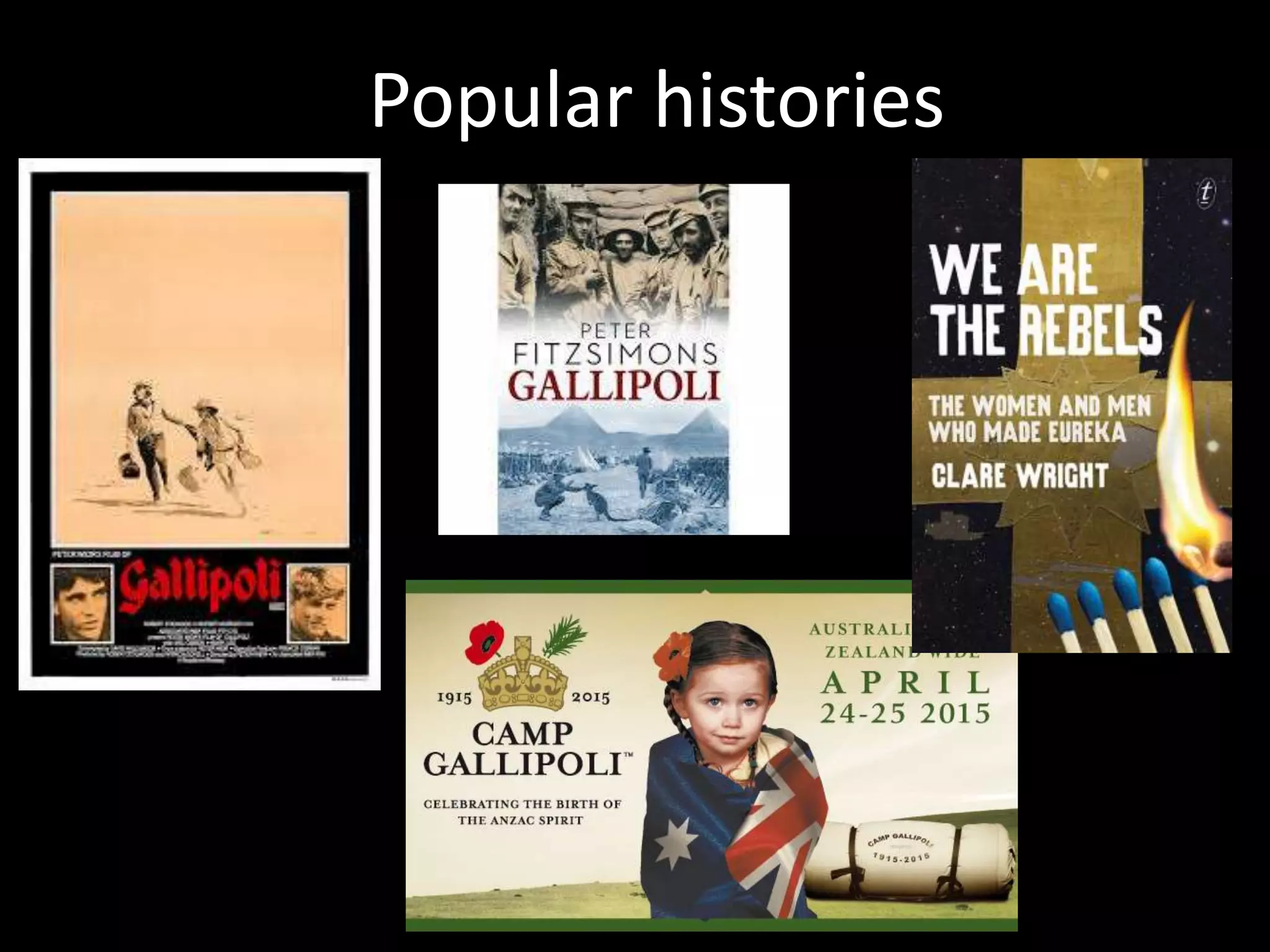
• Popular history events like ‘Camp Gallipoli’ –
communicating an historical narrative
• Popular historical narratives appear in many places in
our culture, from film, television, social media, books
for children, history ‘blockbusters’ (eg Peter Fitzsimons
has sold more than 250 000 copies of his book Kokoda)
Popular histories
4. Controversies
• Some suspicion and resentment exists between
academic, public and popular historians – but all
are locked in a symbiotic relationship
• Historical understanding in Australia is produced
by the interplay between public, popular and
academic history (as ‘Australians and the Past’
survey, and Anna Clark’s work on ‘ordinary
people’s history’ shows)
Points of debate
• Does popular history ‘dumb down’ history, reducing the
past’s complexity for the sake of entertainment?
• Does it reduce the past to a set of tidy stories rather than
uncomfortable truths?
• Does it mislead audiences through falsifying the past (eg.
historical films)?
• (for a critique of popular history see:
http://www.theguardian.com/commentisfree/2008/aug/26
/history.celebrity)
• A great critique of The Imitation Game
http://www.theguardian.com/film/2014/nov/20/the-
imitation-game-invents-new-slander-to-insult-alan-turing-
reel-history
Points of debate
• Yet – public and popular histories can
introduce an audience to the past, and make
them curious to discover more (which might
bring audiences to academic and public
histories)
• They can resonate in a charged political
moment and raise awareness of the history of
present day injustice (eg Selma, Rabbit Proof
Fence, The Secret River)
R: Scene from Selma (2015)
Below: students from Howard
University protest the shooting
death of Michael Brown at the
hands of police in Ferguson,
Missouri, August 2014
http://www.hlntv.com/article/2014/08/14/ferguson-dont-shoot-
howard-university
http://blacklivesmatter.com
Amy Davidson on Selma
http://www.newyorker.com/ne
ws/amy-davidson/selma-fair-l-b-
j?mbid=social_facebook
Academic and Popular Histories
• Popular historians are often subject of scorn and criticism from academics
and vice versa
• Popular histories are usually built on the work of academic historians
• Paul Ham: ‘’Let us not assume, of course, that academic historians want
their work to be read. Many do not. Many seem to harbour an abhorrence
of mass approval. To be popular in certain ivory towers is the kiss of death.
They have little to fear in this regard. The deadening verbosity and
sprawling sentences of the worst examples of academic writing render
them incomprehensible to the mortal reader.[…] most academic historians
presume to judge popular history as if they know best, and almost always
according to their faculty's standards.’
• http://www.smh.com.au/entertainment/books/human-factors-20140320-
353nd.html
Academic and Popular Histories
• Academic historian Paula Michaels:
• ‘the path of popular history is closed to most historians
because of the very subjects of their investigation. No
amount of finesse with the written word would have
put my first book, on the history of medicine and
public health in Soviet Kazakhstan, on the shelves of
Dymock’s. The publishing of popular history is driven
not by how scholars write, but by what readers are
willing to buy.’
• https://theconversation.com/what-is-academic-
history-for-24795
5. An ANZAC case study
• Historians are interested in public and popular
histories for the meanings they attach to the
past (and then to see people’s reactions)
• Anzac day this year offered a chance to
observe this process up close…
Anzac Live, social media avatars
communicating their experiences in ‘real
time’
ANZAC 2015
• How did all of these competing forms of history
produce the meaning of Anzac Day 2015?
• Australians sharply rejected what they perceived
to be attempts to commercialise Anzac (Zoo
Weekly, Camp Gallipoli, ‘Fresh in our memories’
etc)
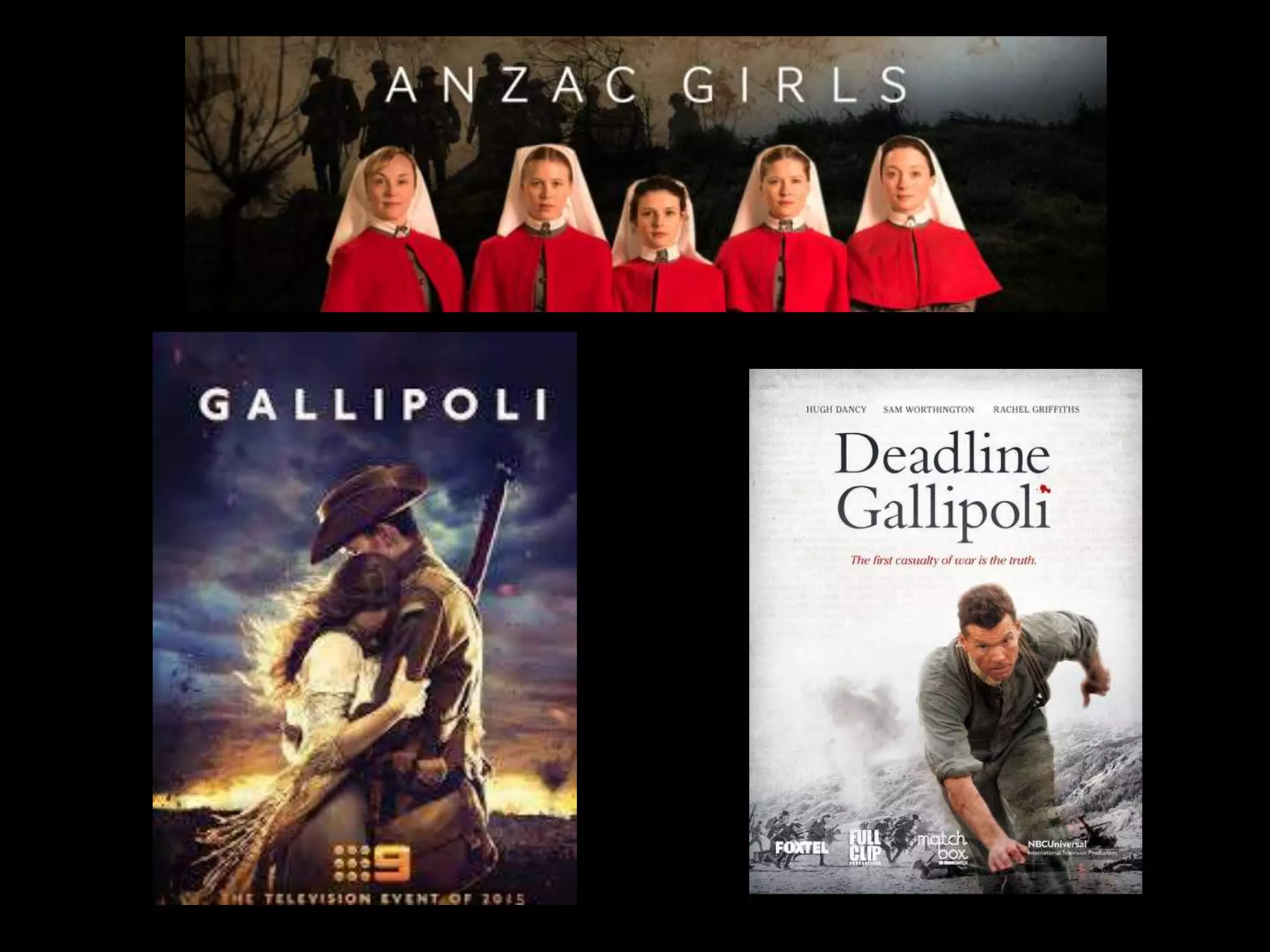
• Also failed to watch the drama series that offered
new takes on the Gallipoli story (compared to
Weir’s Gallipoli – his film has set the template)
ANZAC 2015
• Yet people turned out in record numbers to Dawn
services and marches
• Academic historians raised questions about our
obsession with Gallipoli and these were given
voice in documentary productions
• Many historians suggest that our affection for
Anzac is closely tied to family history, to the
emotional meaning of the day (fed by popular
histories)
• Social media avatars etc fostered emotional
connections with the past
• Public, popular and academic histories play very different
roles in our culture
• All produce different kinds of historical meaning and
understanding (we should try to work out what kinds of
understanding they produce, and on their own terms)
• Academic historians contribute to these fields in many
different ways
• The intellectual advances of academic historians do shift
popular understandings of history – but it can take a long
time!
• Academic historians need to be able to communicate with
different audiences – but not always and not necessarily at
the same time
Questions?
I am happy to email a copy of these slides to you if you
are interested (just be sure to attribute them correctly if
you use them) –
Email:
Michelle.Arrow@mq.edu.au
My research & teaching profile:
http://www.mq.edu.au/about_us/faculties_and_departm
ents/faculty_of_arts/mhpir/staff/staff/dr_michelle_arrow
/
Further Reading:
• Jerome de Groot, Consuming History (2009)
• Ann Curthoys and Ann McGrath, How to Write
History that People want to Read (2009)
• Hilda Kean and Paul Martin, The Public History
Reader (2013)
• Anna Clark ‘Ordinary people’s history’, History
Australia, 9 (1), 2012
• Jorma Kalela, Making History: the Historian
and Uses of the Past (2012)

HTA day talk M Arrow

  • 1.
    Academic, Public andPopular History Associate Professor Michelle Arrow, Macquarie University Headstart to Extension 2015
  • 2.
    Outline 1. Defining thefields and their purposes 2. Who are their intended audiences? 3. How do different historians communicate? 4. Controversies 5. An ANZAC case study
  • 3.
    But first…. All historiansare interested in the ‘whole human past’ (Curthoys and McGrath, How to Write History that People Want to Read) History is ‘a continuous process of interaction between the historian and his facts, an unending dialogue between the present and the past.’ (E.H. Carr, What is History?) Histories will differ according to their purpose and audience…
  • 4.
    And also… • Academic,Public and Popular history are discrete categories • BUT – they also overlap • Many historians work across these categories as well as within them • Many academic historians conduct analysis of popular histories • Public history is an academic discipline as well as a practice
  • 5.
    What is AcademicHistory? • Academic historians aim to create new knowledge about the past – to innovate, to push the discipline further • They seek to construct historical interpretations or arguments about the past – New archival sources – Application of new theories to the past (eg postcolonial, gender etc) – New approaches to the kinds of sources used (eg social history, cultural history, gender history)
  • 6.
    Defining Academic History •Academic historians take part in a scholarly conversation with historians, both past and present • Publishing in specialised, peer-reviewed outlets – academic journals, scholarly presses • What does ‘peer-review’ mean? – evaluation of academic work by others working in the same field • See this explainer: https://theconversation.com/explainer-what-is-peer- review-27797 • (Windschuttle – did not submit work to peer review)
  • 7.
    Some academic historians ProfJoan Beaumont, Prof Marilyn Lake, Prof Bill Gammage
  • 8.
    What is PublicHistory? • Public historians seek to interpret the past for broader public understanding, usually with an emphasis on primary sources and especially material culture • Public history involves historical research, analysis and presentation ‘with some degree of explicit application to the needs of contemporary life’ (The Public Historian editorial policy) • National Council of Public History (USA): ‘public history describes the many and diverse ways in which history is put to work in the world’ http://ncph.org/what-is-public- history/about-the-field/
  • 9.
    • Hilda Kean‘public history [is] … a practice which has the capacity for involving people as well as nations and communities in the creation of their own histories.’ (The Public History Reader, Kean and Martin (eds) 2013) • ‘Public history not only reflects the history of the community it seeks to serve, but the very history of that community will shape the nuances of what is understood as public history by that community.’ (Dr Robin McLachlan) http://www.publichistory.org/what_is/definition.html
  • 10.
    • ”[Michael Frisch]contends that what differentiates public history from academic history is its focus on audience." (Stephen L. Reckon, "Doing Public History: A Look at the How, but Especially the Why," American Quarterly Volume 45, Issue 1 (March 1993): 188.) • Public historians work with and for the general public. • Public history is still underpinned by historical research but its audience is wider than academic history • public historians work in museums, galleries, archives interpretive sites, commemorative plaques, reenactments, heritage assessments, the media (documentaries etc), and public policy.
  • 11.
    Some Public Historians LorenaAllam, Dr Lisa Murray, Dr Stephen Gapps
  • 12.
    What is PopularHistory? • The forms and practices through which history is transmitted in culture (Jerome de Groot), often via popular culture • Can take a huge variety of forms – political discourse can be a form of popular history, everyday understandings of the past are a form of popular history • Is much more driven by interests of the audience (hence dominance of military history as a subject of popular histories) • Popular histories can be commodities – part of a history ‘marketplace’: popular history books (including those for children), docudramas, historical films, novels, videogames, documentaries, television programs (including reality TV eg. 1940s house), experiences, social media eg facebook pages
  • 13.
    Defining Popular History •Probably the place where most people find out about the past: history as entertainment, history as leisure • Popular history is history that seeks first to entertain, to tell compelling narratives about the past for a broad audience • ‘Popular history is history, simply in a different form to that of its academic counterparts’. Elizabeth Norton, http://www.historymatters.group.shef.ac.uk/popular-vs- academic-history/ • Where are the limits of this category?
  • 14.
    Some popular historians PeterFitzsimons, Peter Weir Clare Wright (a rare academic historian who ‘crosses over’ into public and popular realms)
  • 15.
    2. Who aretheir audiences? 2.1. Academic Historians • Academic Historians: most seek to speak to other academics; publish in journals (available only through subscriptions); audiences for their books tend to be small (500-2000 copies) • Historians publish in different journals depending on who they want to ‘speak’ to • Selecting your topic means you are selecting your audience • Some communicate their work more broadly: as expert ‘taking heads’ for the media, writing for websites that ‘translate’ academic research like theconversation.com (see: https://theconversation.com/au/topics/writing- history)
  • 16.
    Results from thesurveys Australians and the Past (Paul Ashton and Paula Hamilton, published in ACH: Australian Cultural History 22, 2003) and The Presence of the Past: Popular Uses of History in American Life (Roy Rosenzweig and David Thelen, 1998 Colombia University Press) Historical activities undertaken by participants in the last 12 months (could list more than one) US Aust Looked at photographs with family or friends 91% 88% Taken photographs or videos to preserve memories 83 74 Watched movies or television programs about the past 81 84 Attended family/school reunion 64 56 Visited museums or historic sites 57 55 Read books about the past 53 56 Participated in hobbies relating to the past 39 33 Conducted genealogical research 36 69 Written a journal or diary 29 25 Participated in a group devoted to studying or preserving the past 20 15
  • 17.
    Results from thesurveys Australians and the Past (Paul Ashton and Paula Hamilton, published in ACH: Australian Cultural History 22, 2003) and The Presence of the Past: Popular Uses of History in American Life (Roy Rosenzweig and David Thelen, 1998 Colombia University Press) Trustworthiness of sources of information about the past Aust (%) Museums 56 Academic historians 33 Family stories 23 Non-fiction books 20 Eye-witnesses 16 newspapers 15 High-school teachers 14 Historical movies/TV 12 Radio programs 7 Media figures 3 Politicians -39 (!)
  • 18.
    2.2 Public Historians •Public Historians: audiences include the general public, government, policy advisors, community groups, children, schools, parents. • Accountability is slightly different – most public historians work for governments, cultural institutions dependent on government funding, or commissions • Public historians have to demonstrate they are reaching certain audiences (and generating new ones) to guarantee funding, etc
  • 19.
    2.3 Popular Historians •Popular Historians seek to communicate to a general audience, but perhaps in more emotional ways than public historians • Popular historians want to engage with story- telling, to inspire passion, anger, nationalism, sentimentality • Many popular histories are aimed at audiences often neglected by academic histories: family historians, women, children
  • 20.
    3. How dothese historians communicate? 3.1 Academic historians • Academic historians: primarily though the written word. Writing tends to be formal, favours argument over engaging emotions, footnotes! • Academic historians also write newspaper articles, give public lectures and conference papers, and teach to communicate their research
  • 21.
  • 22.
    3.2. Public Historians •Public Historians can communicate their work in a range of forms: apps, walking tours, public lectures, radio features, museum displays, interpretations of historical artefacts, public programs, live tweeting historical events (eg. #Dismissal1975), events (eg Jacqui Newling @ Sydney Living Museums ‘the cook and the curator’ blog http://blogs.hht.net.au/cook/about/ ) • usually connected to institutions in some way
  • 23.
  • 24.
    3.3. Popular Historians •Popular historians: can communicate through non- fiction and fiction (and tend to blur the lines between the two) • Popular history events like ‘Camp Gallipoli’ – communicating an historical narrative • Popular historical narratives appear in many places in our culture, from film, television, social media, books for children, history ‘blockbusters’ (eg Peter Fitzsimons has sold more than 250 000 copies of his book Kokoda)
  • 25.
  • 26.
    4. Controversies • Somesuspicion and resentment exists between academic, public and popular historians – but all are locked in a symbiotic relationship • Historical understanding in Australia is produced by the interplay between public, popular and academic history (as ‘Australians and the Past’ survey, and Anna Clark’s work on ‘ordinary people’s history’ shows)
  • 27.
    Points of debate •Does popular history ‘dumb down’ history, reducing the past’s complexity for the sake of entertainment? • Does it reduce the past to a set of tidy stories rather than uncomfortable truths? • Does it mislead audiences through falsifying the past (eg. historical films)? • (for a critique of popular history see: http://www.theguardian.com/commentisfree/2008/aug/26 /history.celebrity) • A great critique of The Imitation Game http://www.theguardian.com/film/2014/nov/20/the- imitation-game-invents-new-slander-to-insult-alan-turing- reel-history
  • 28.
    Points of debate •Yet – public and popular histories can introduce an audience to the past, and make them curious to discover more (which might bring audiences to academic and public histories) • They can resonate in a charged political moment and raise awareness of the history of present day injustice (eg Selma, Rabbit Proof Fence, The Secret River)
  • 29.
    R: Scene fromSelma (2015) Below: students from Howard University protest the shooting death of Michael Brown at the hands of police in Ferguson, Missouri, August 2014 http://www.hlntv.com/article/2014/08/14/ferguson-dont-shoot- howard-university http://blacklivesmatter.com Amy Davidson on Selma http://www.newyorker.com/ne ws/amy-davidson/selma-fair-l-b- j?mbid=social_facebook
  • 30.
    Academic and PopularHistories • Popular historians are often subject of scorn and criticism from academics and vice versa • Popular histories are usually built on the work of academic historians • Paul Ham: ‘’Let us not assume, of course, that academic historians want their work to be read. Many do not. Many seem to harbour an abhorrence of mass approval. To be popular in certain ivory towers is the kiss of death. They have little to fear in this regard. The deadening verbosity and sprawling sentences of the worst examples of academic writing render them incomprehensible to the mortal reader.[…] most academic historians presume to judge popular history as if they know best, and almost always according to their faculty's standards.’ • http://www.smh.com.au/entertainment/books/human-factors-20140320- 353nd.html
  • 31.
    Academic and PopularHistories • Academic historian Paula Michaels: • ‘the path of popular history is closed to most historians because of the very subjects of their investigation. No amount of finesse with the written word would have put my first book, on the history of medicine and public health in Soviet Kazakhstan, on the shelves of Dymock’s. The publishing of popular history is driven not by how scholars write, but by what readers are willing to buy.’ • https://theconversation.com/what-is-academic- history-for-24795
  • 32.
    5. An ANZACcase study • Historians are interested in public and popular histories for the meanings they attach to the past (and then to see people’s reactions) • Anzac day this year offered a chance to observe this process up close…
  • 38.
    Anzac Live, socialmedia avatars communicating their experiences in ‘real time’
  • 42.
    ANZAC 2015 • Howdid all of these competing forms of history produce the meaning of Anzac Day 2015? • Australians sharply rejected what they perceived to be attempts to commercialise Anzac (Zoo Weekly, Camp Gallipoli, ‘Fresh in our memories’ etc) • Also failed to watch the drama series that offered new takes on the Gallipoli story (compared to Weir’s Gallipoli – his film has set the template)
  • 43.
    ANZAC 2015 • Yetpeople turned out in record numbers to Dawn services and marches • Academic historians raised questions about our obsession with Gallipoli and these were given voice in documentary productions • Many historians suggest that our affection for Anzac is closely tied to family history, to the emotional meaning of the day (fed by popular histories) • Social media avatars etc fostered emotional connections with the past
  • 44.
    • Public, popularand academic histories play very different roles in our culture • All produce different kinds of historical meaning and understanding (we should try to work out what kinds of understanding they produce, and on their own terms) • Academic historians contribute to these fields in many different ways • The intellectual advances of academic historians do shift popular understandings of history – but it can take a long time! • Academic historians need to be able to communicate with different audiences – but not always and not necessarily at the same time
  • 45.
    Questions? I am happyto email a copy of these slides to you if you are interested (just be sure to attribute them correctly if you use them) – Email: Michelle.Arrow@mq.edu.au My research & teaching profile: http://www.mq.edu.au/about_us/faculties_and_departm ents/faculty_of_arts/mhpir/staff/staff/dr_michelle_arrow /
  • 46.
    Further Reading: • Jeromede Groot, Consuming History (2009) • Ann Curthoys and Ann McGrath, How to Write History that People want to Read (2009) • Hilda Kean and Paul Martin, The Public History Reader (2013) • Anna Clark ‘Ordinary people’s history’, History Australia, 9 (1), 2012 • Jorma Kalela, Making History: the Historian and Uses of the Past (2012)

Editor's Notes

  • #11 Public historians seek to educate and engage – but entertainment is not their first aim
  • #17 Most people don’t get their historical knowledge or information form academics - ask them how many of these are academic activities
  • #32 Makes the point that all popular works are built on the research of specialists
  • #33 Makes the point that all popular works are built on the research of specialists
  • #34 Historical understanding is produced by the Interplay between academic, public and popular histories Anzac zoo weekly
  • #35 Historical understanding is produced by the Interplay between academic, public and popular histories Anzac zoo weekly
  • #36 Historical understanding is produced by the Interplay between academic, public and popular histories Anzac zoo weekly
  • #37 Historical understanding is produced by the Interplay between academic, public and popular histories Anzac zoo weekly
  • #38 Historical understanding is produced by the Interplay between academic, public and popular histories Anzac zoo weekly
  • #39 Historical understanding is produced by the Interplay between academic, public and popular histories Anzac zoo weekly
  • #40 Historical understanding is produced by the Interplay between academic, public and popular histories Anzac zoo weekly
  • #41 Historical understanding is produced by the Interplay between academic, public and popular histories Anzac zoo weekly
  • #42 Historical understanding is produced by the Interplay between academic, public and popular histories Anzac zoo weekly