©McGraw-Hill Education. All rights reserved. Authorized only for instructor use in the classroom. No reproduction or further distribution permitted without the prior written consent of McGraw-Hill Education.
Society and Culture in
Provincial America
Alan Brinkley, The Unfinished Nation, 8th Edition
©McGraw-Hill Education.
The Colonial Population
– Immigration and natural increase
• Indentured Servitude
– Social problems of indentured servitude
– Growing reliance on slavery
©McGraw-Hill Education.
The Colonial Population (Continued)
• Birth and Death
– Factors in population growth
• Differences in the South
– Toward a balanced sex ratio
• Medicine in the Colonies
– Midwifery
– “Humoralism”
©McGraw-Hill Education.
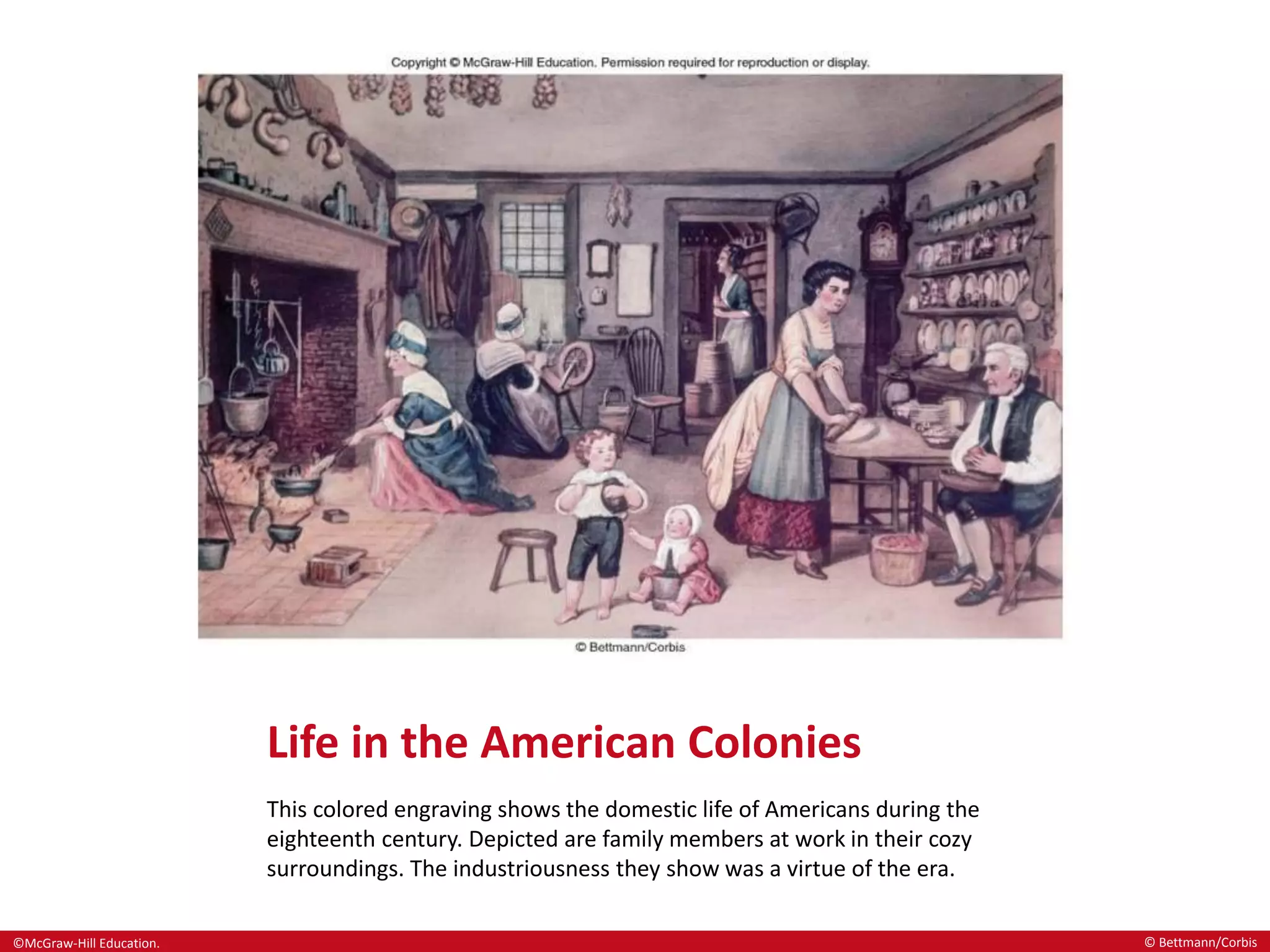
Life in the American Colonies
This colored engraving shows the domestic life of Americans during the
eighteenth century. Depicted are family members at work in their cozy
surroundings. The industriousness they show was a virtue of the era.
© Bettmann/Corbis
©McGraw-Hill Education.
The Colonial Population (Continued, 2)
• Women and Families in the Colonies
– Early marriages
– New England and Chesapeake families compared
©McGraw-Hill Education.
The Colonial Population (Continued, 3)
• The Beginnings of Slavery in English America
– The slave trade
• The “middle passage”
– Surging slave population
– Emergence of a race-based system
– Slave codes
©McGraw-Hill Education.
The Colonial Population (Continued, 4)
• Changing Sources of European Immigration
– Huguenot refugees
– Scotch-Irish
©McGraw-Hill Education.
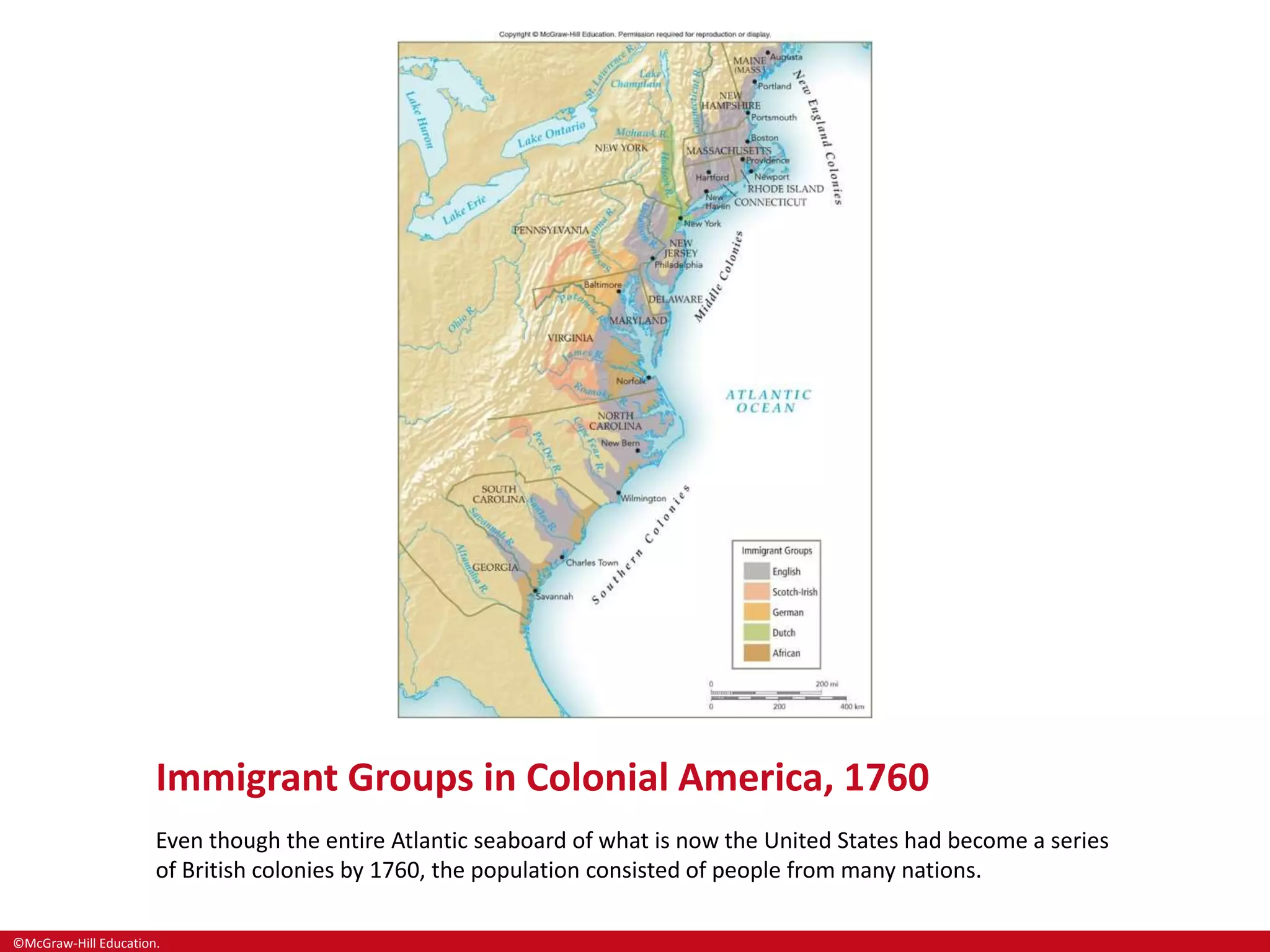
Immigrant Groups in Colonial America, 1760
Even though the entire Atlantic seaboard of what is now the United States had become a series
of British colonies by 1760, the population consisted of people from many nations.
©McGraw-Hill Education.
The Colonial Economies
• The Southern Economy
– Boom-and-bust tobacco economy
– The South’s cash-crop economy
©McGraw-Hill Education.
The Colonial Economies (Continued)
• Northern Economic and Technological Life
– Colonial artisans and entrepreneurs
– Saugus Ironworks
©McGraw-Hill Education.
The Colonial Economies (Continued, 2)
• The Extent and Limits of Technology
– Persistent colonial poverty
– Myth of colonial self-sufficiency
• The Rise of Colonial Commerce
– Obstacles to trade
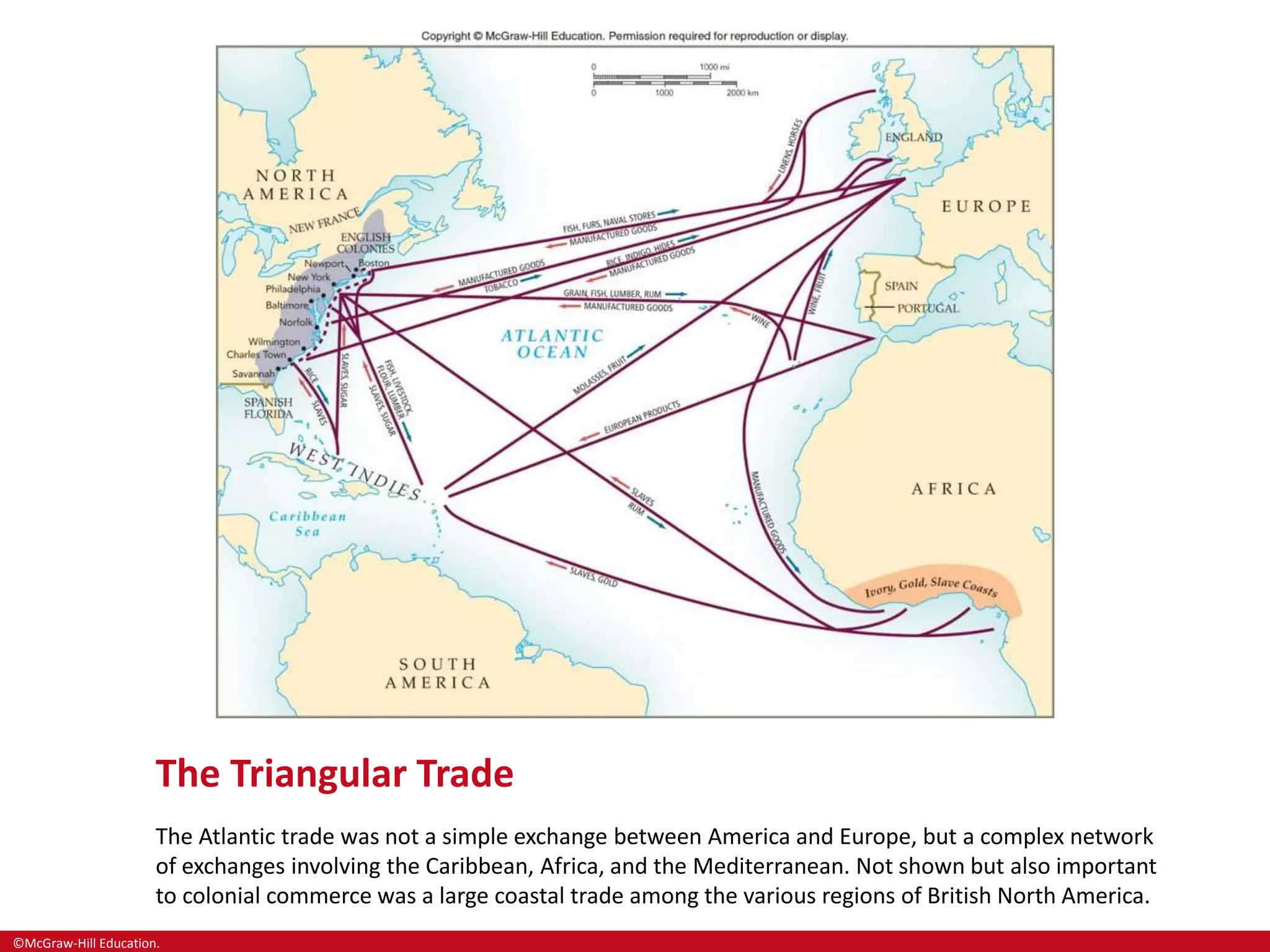
– The triangular trade
– An emerging merchant class
©McGraw-Hill Education.
The Triangular Trade
The Atlantic trade was not a simple exchange between America and Europe, but a complex network
of exchanges involving the Caribbean, Africa, and the Mediterranean. Not shown but also important
to colonial commerce was a large coastal trade among the various regions of British North America.
©McGraw-Hill Education.
The Colonial Economies (Continued, 3)
• The Rise of Consumerism
– Reasons for growing consumerism
– Advertising and agents of urban merchants
– Class differences and consumerism
– New social ideals of refinement
©McGraw-Hill Education.
Patterns of Society
– Social mobility
• Masters and Slaves on the Plantation
– Realities of plantation life
– Slave communities
– Stono Rebellion
©McGraw-Hill Education.
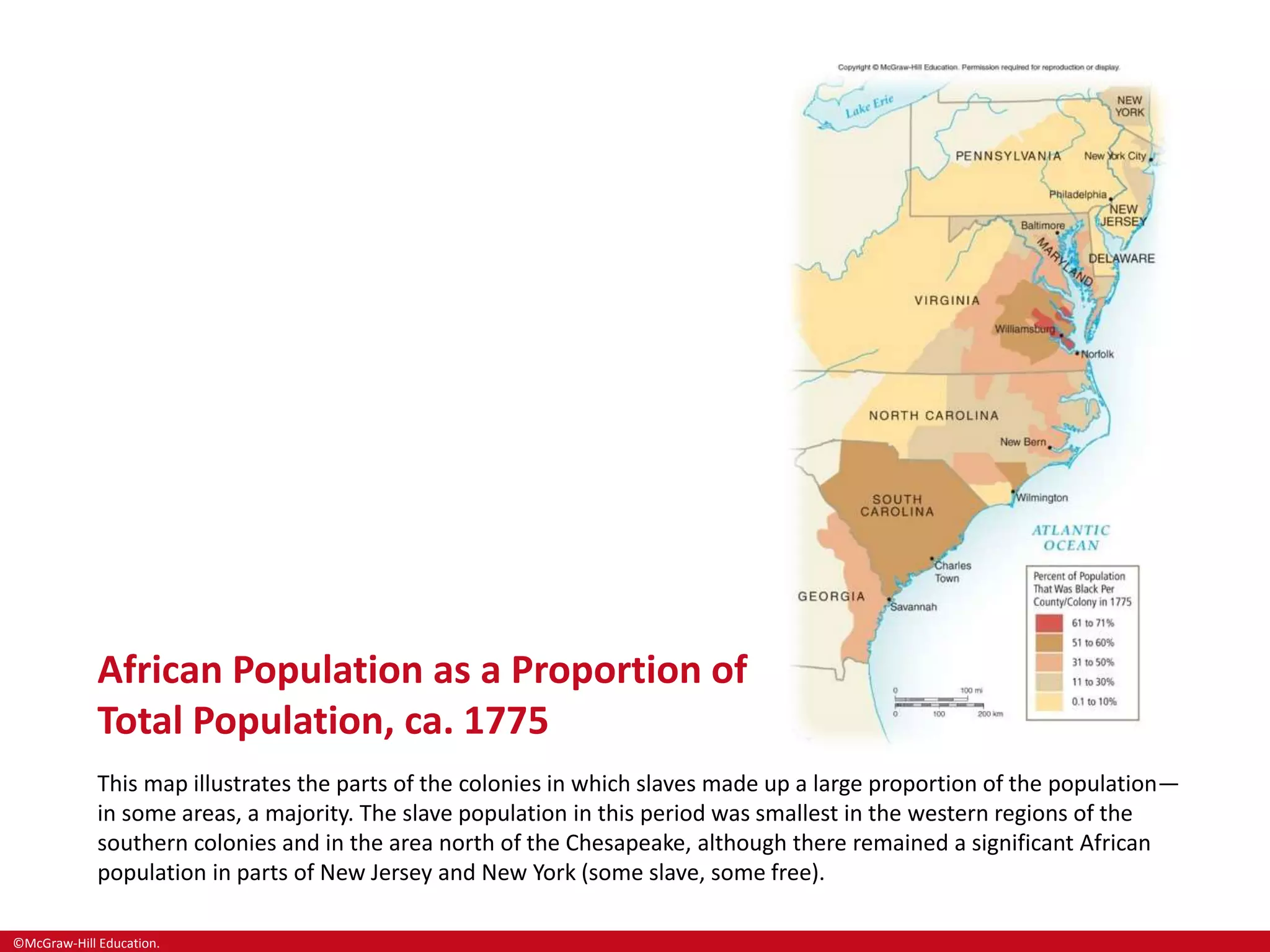
African Population as a Proportion of
Total Population, ca. 1775
This map illustrates the parts of the colonies in which slaves made up a large proportion of the population—
in some areas, a majority. The slave population in this period was smallest in the western regions of the
southern colonies and in the area north of the Chesapeake, although there remained a significant African
population in parts of New Jersey and New York (some slave, some free).
©McGraw-Hill Education.
Patterns of Society (Continued)
• The Puritan Community
– Puritan democracy
– Close-knit communities
– Communal strains and tensions
– Salem witch trials
©McGraw-Hill Education.
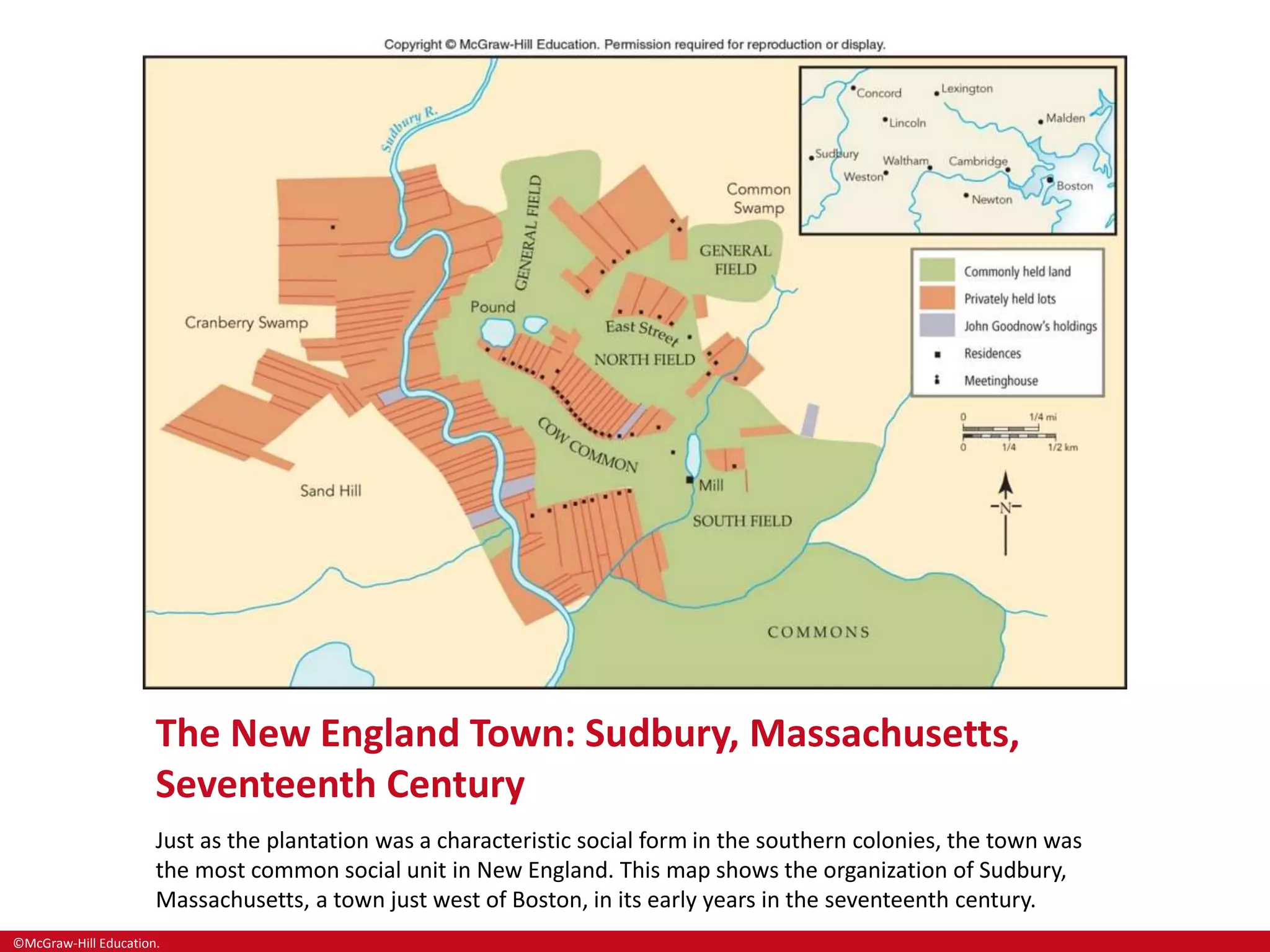
The New England Town: Sudbury, Massachusetts,
Seventeenth Century
Just as the plantation was a characteristic social form in the southern colonies, the town was
the most common social unit in New England. This map shows the organization of Sudbury,
Massachusetts, a town just west of Boston, in its early years in the seventeenth century.
©McGraw-Hill Education.
Patterns of Society (Continued, 2)
• Cities
– Colonial cities
– Taverns and coffeehouses
• Inequality
– Economic stratification
– The cities and the countryside
©McGraw-Hill Education.
Awakenings and Enlightenments
• The Pattern of Religions
– Numerous sects
– Rights of Catholics
– Rights of Jews
– Declining piety
©McGraw-Hill Education.
Awakenings and Enlightenments
(Continued)
• The Great Awakening
– Wesleys, Whitefield, and Edwards
– “New Lights” and “Old Lights”
• The Enlightenment
– “Natural law”
©McGraw-Hill Education.
Awakenings and Enlightenments
(Continued, 2)
• Literacy and Technology
– Almanacs
– First newspaper
©McGraw-Hill Education.
Awakenings and Enlightenments
(Continued, 3)
• Education
– Public schools
– First colleges
• The Spread of Science
– Growing interest
– Scientific societies
– Cotton Mather and vaccines
©McGraw-Hill Education.
Awakenings and Enlightenments
(Continued, 4)
• Concepts of Law and Politics
– John Peter Zenger
– Powerful colonial legislatures
©McGraw-Hill Education.
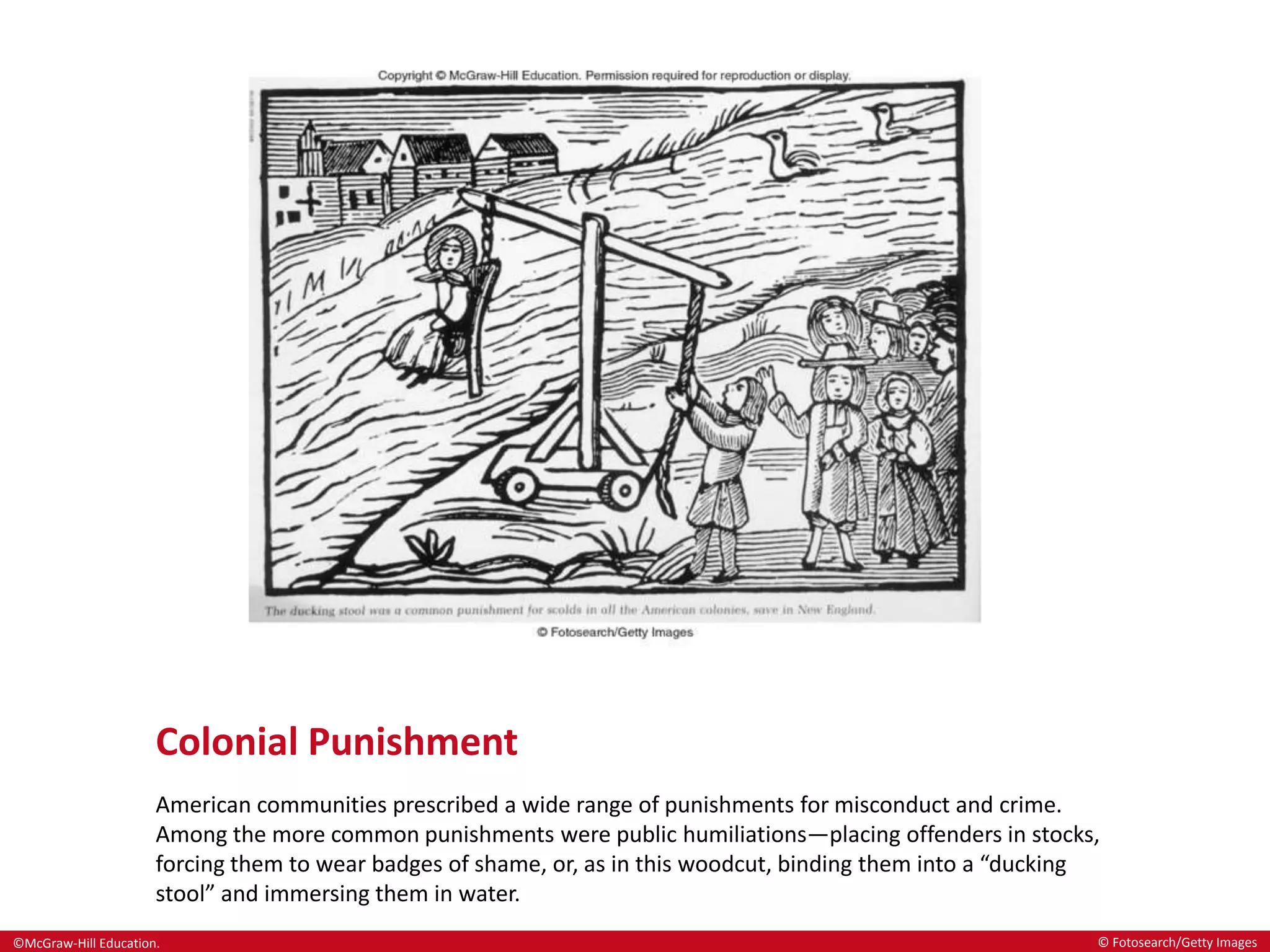
Colonial Punishment
American communities prescribed a wide range of punishments for misconduct and crime.
Among the more common punishments were public humiliations—placing offenders in stocks,
forcing them to wear badges of shame, or, as in this woodcut, binding them into a “ducking
stool” and immersing them in water.
© Fotosearch/Getty Images
©McGraw-Hill Education.
Consider the Source
• Gottlieb Mittelberger,
The Passage of Indentured Servants (1750)
©McGraw-Hill Education.
Debating the Past
• The Origins of Slavery
• The Witchcraft Trials
©McGraw-Hill Education. All rights reserved. Authorized only for instructor use in the classroom. No reproduction or further distribution permitted without the prior written consent of McGraw-Hill Education.
The Unfinished Nation, 8th Edition
Next: Chapter 4
The Empire in Transition

Brinkleybr8 ppt ch03

  • 1.
    ©McGraw-Hill Education. Allrights reserved. Authorized only for instructor use in the classroom. No reproduction or further distribution permitted without the prior written consent of McGraw-Hill Education. Society and Culture in Provincial America Alan Brinkley, The Unfinished Nation, 8th Edition
  • 2.
    ©McGraw-Hill Education. The ColonialPopulation – Immigration and natural increase • Indentured Servitude – Social problems of indentured servitude – Growing reliance on slavery
  • 3.
    ©McGraw-Hill Education. The ColonialPopulation (Continued) • Birth and Death – Factors in population growth • Differences in the South – Toward a balanced sex ratio • Medicine in the Colonies – Midwifery – “Humoralism”
  • 4.
    ©McGraw-Hill Education. Life inthe American Colonies This colored engraving shows the domestic life of Americans during the eighteenth century. Depicted are family members at work in their cozy surroundings. The industriousness they show was a virtue of the era. © Bettmann/Corbis
  • 5.
    ©McGraw-Hill Education. The ColonialPopulation (Continued, 2) • Women and Families in the Colonies – Early marriages – New England and Chesapeake families compared
  • 6.
    ©McGraw-Hill Education. The ColonialPopulation (Continued, 3) • The Beginnings of Slavery in English America – The slave trade • The “middle passage” – Surging slave population – Emergence of a race-based system – Slave codes
  • 7.
    ©McGraw-Hill Education. The ColonialPopulation (Continued, 4) • Changing Sources of European Immigration – Huguenot refugees – Scotch-Irish
  • 8.
    ©McGraw-Hill Education. Immigrant Groupsin Colonial America, 1760 Even though the entire Atlantic seaboard of what is now the United States had become a series of British colonies by 1760, the population consisted of people from many nations.
  • 9.
    ©McGraw-Hill Education. The ColonialEconomies • The Southern Economy – Boom-and-bust tobacco economy – The South’s cash-crop economy
  • 10.
    ©McGraw-Hill Education. The ColonialEconomies (Continued) • Northern Economic and Technological Life – Colonial artisans and entrepreneurs – Saugus Ironworks
  • 11.
    ©McGraw-Hill Education. The ColonialEconomies (Continued, 2) • The Extent and Limits of Technology – Persistent colonial poverty – Myth of colonial self-sufficiency • The Rise of Colonial Commerce – Obstacles to trade – The triangular trade – An emerging merchant class
  • 12.
    ©McGraw-Hill Education. The TriangularTrade The Atlantic trade was not a simple exchange between America and Europe, but a complex network of exchanges involving the Caribbean, Africa, and the Mediterranean. Not shown but also important to colonial commerce was a large coastal trade among the various regions of British North America.
  • 13.
    ©McGraw-Hill Education. The ColonialEconomies (Continued, 3) • The Rise of Consumerism – Reasons for growing consumerism – Advertising and agents of urban merchants – Class differences and consumerism – New social ideals of refinement
  • 14.
    ©McGraw-Hill Education. Patterns ofSociety – Social mobility • Masters and Slaves on the Plantation – Realities of plantation life – Slave communities – Stono Rebellion
  • 15.
    ©McGraw-Hill Education. African Populationas a Proportion of Total Population, ca. 1775 This map illustrates the parts of the colonies in which slaves made up a large proportion of the population— in some areas, a majority. The slave population in this period was smallest in the western regions of the southern colonies and in the area north of the Chesapeake, although there remained a significant African population in parts of New Jersey and New York (some slave, some free).
  • 16.
    ©McGraw-Hill Education. Patterns ofSociety (Continued) • The Puritan Community – Puritan democracy – Close-knit communities – Communal strains and tensions – Salem witch trials
  • 17.
    ©McGraw-Hill Education. The NewEngland Town: Sudbury, Massachusetts, Seventeenth Century Just as the plantation was a characteristic social form in the southern colonies, the town was the most common social unit in New England. This map shows the organization of Sudbury, Massachusetts, a town just west of Boston, in its early years in the seventeenth century.
  • 18.
    ©McGraw-Hill Education. Patterns ofSociety (Continued, 2) • Cities – Colonial cities – Taverns and coffeehouses • Inequality – Economic stratification – The cities and the countryside
  • 19.
    ©McGraw-Hill Education. Awakenings andEnlightenments • The Pattern of Religions – Numerous sects – Rights of Catholics – Rights of Jews – Declining piety
  • 20.
    ©McGraw-Hill Education. Awakenings andEnlightenments (Continued) • The Great Awakening – Wesleys, Whitefield, and Edwards – “New Lights” and “Old Lights” • The Enlightenment – “Natural law”
  • 21.
    ©McGraw-Hill Education. Awakenings andEnlightenments (Continued, 2) • Literacy and Technology – Almanacs – First newspaper
  • 22.
    ©McGraw-Hill Education. Awakenings andEnlightenments (Continued, 3) • Education – Public schools – First colleges • The Spread of Science – Growing interest – Scientific societies – Cotton Mather and vaccines
  • 23.
    ©McGraw-Hill Education. Awakenings andEnlightenments (Continued, 4) • Concepts of Law and Politics – John Peter Zenger – Powerful colonial legislatures
  • 24.
    ©McGraw-Hill Education. Colonial Punishment Americancommunities prescribed a wide range of punishments for misconduct and crime. Among the more common punishments were public humiliations—placing offenders in stocks, forcing them to wear badges of shame, or, as in this woodcut, binding them into a “ducking stool” and immersing them in water. © Fotosearch/Getty Images
  • 25.
    ©McGraw-Hill Education. Consider theSource • Gottlieb Mittelberger, The Passage of Indentured Servants (1750)
  • 26.
    ©McGraw-Hill Education. Debating thePast • The Origins of Slavery • The Witchcraft Trials
  • 27.
    ©McGraw-Hill Education. Allrights reserved. Authorized only for instructor use in the classroom. No reproduction or further distribution permitted without the prior written consent of McGraw-Hill Education. The Unfinished Nation, 8th Edition Next: Chapter 4 The Empire in Transition