Who We Are
• Vision: Manitobans — Working Together as Global Citizens.
• Mission: coalition of organizations committed to:
• Respect, empowerment and self-determination for all peoples
• Sustainable Development
• Global understanding, cooperation and social justice.
public awareness - member interaction - grant administration
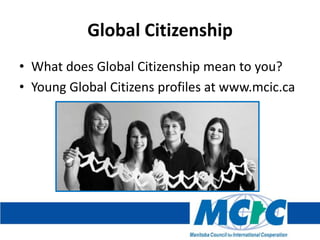
Global Citizenship
• What does Global Citizenship mean to you?
• Young Global Citizens profiles at www.mcic.ca
Cluster 1:
Food & Geography
KL-016: Locate on a world map the continents, major landforms, and major
bodies of water.
KG-032: Identify on a world map the more and less developed nations and
explain why a nation is considered to be more or less developed.
Pre-Conference Activity
Activity De-brief
1. What kinds of foods did we ask you to look
for? Why?
2. Where does most of the food you eat come
from?
3. Who do you think grows most of our food?
4. What is the impact of bringing food from far
away?
Myths About Poverty:

Fact or
Fiction?
Myth Busters: Poverty

Everyone in Africa
is poor
Myth Busters: Poverty

FALSE:
- Africa is home to over 1 Billion People

- Many people in Africa live in large cities with
access to the internet and own cell phones
- 4 countries in Africa are among the 50 richest
countries in the world
- Many people who don’t earn much money are
rich in a number of other ways
Myth Busters: Poverty

Poor people in
Canada are just
lazy
Myth Busters: Poverty

FALSE:
- Most Canadians living in poverty have jobs!

- The working poor work more hours than the
average Canadian
Myth Busters: Poverty

Women are more
likely to experience
poverty than men
Myth Busters: Poverty

TRUE:
- 2/3 of those living in poverty worldwide are
women
- Women are often expected to perform unpaid
work
- Gender discrimination is especially apparent for
transgender people, who are twice as likely to be
living in poverty than the general population
Myth Busters: Poverty

One in five people
live without access
to electricity
Myth Busters: Poverty

TRUE:
- 1.3 Billion people live without electricity
- Access to energy can improve health and
protect the environment
- electricity saves time spent gathering resources,
meaning more time for women to attend school
Myth Busters: Poverty

There is not
enough food in
the world to feed
everybody
Myth Busters: Poverty

FALSE:
- There is enough food on the planet to feed
everyone
- People do not have the land to grow, or the
income to purchase, food – even where there is
lots of food available
- 1/3 of food produced worldwide is wasted
Poverty is not natural. It is man-made
and it can be overcome and eradicated
by the actions of human beings.
And overcoming poverty is not a gesture of charity.
It is an act of justice. It is the protection of a
fundamental human right, the right to dignity
and a decent life.
While poverty persists, there is no true freedom.
– Nelson Mandela
Cluster 3: Ways of Life in
Asia, Africa and Australasia
KL-023 Give examples of the influence of the natural
environment on ways of life in a society of
Asia, Africa, or Australasia.
KI-013 Describe factors that affect health in a society of
Asia, Africa, or Australasia

www.youtube.com/mcicvideo
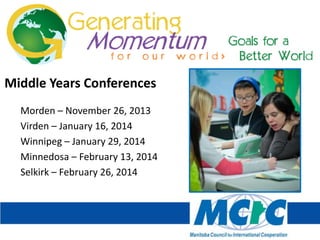
Middle Years Conferences
Morden – November 26, 2013
Virden – January 16, 2014
Winnipeg – January 29, 2014
Minnedosa – February 13, 2014
Selkirk – February 26, 2014
Customized Programs
Current Workshops:
•
•
•
•
•
•

Water
Fair Trade / Child Labour
Play Fair: Fair Trade and Sports
Gender & Education
Global Food Security
Global Faces of Partnership: Moving Beyond
the Charity Model
• Sustainable Development Grant Assistance

Contact us to ask about your needs!
Are You More Concerned
About a Better World
than a 7th Grader?
• Five versions currently available
•
•
•
•
•

Millennium Development Goals
Water
Fair Trade
Food Security
Gender & Education

• Order DIY Kit from MCIC
Fair Trade Challenge

st
31

Starts on October
each year!
www.fairtrademanitoba.ca
Global Citizenship Awards

• Global Citizenship Award for Grade 12 students
• Global Citizenship Educator Award
• Deadline for this year is February 13th 2014
Visit our website at
www.mcic.ca
(204) 987-6420
pe@mcic.ca

Mssta grade 7 slideshow

  • 2.
    Who We Are •Vision: Manitobans — Working Together as Global Citizens. • Mission: coalition of organizations committed to: • Respect, empowerment and self-determination for all peoples • Sustainable Development • Global understanding, cooperation and social justice. public awareness - member interaction - grant administration
  • 3.
    Global Citizenship • Whatdoes Global Citizenship mean to you? • Young Global Citizens profiles at www.mcic.ca
  • 4.
    Cluster 1: Food &Geography KL-016: Locate on a world map the continents, major landforms, and major bodies of water. KG-032: Identify on a world map the more and less developed nations and explain why a nation is considered to be more or less developed.
  • 5.
  • 6.
    Activity De-brief 1. Whatkinds of foods did we ask you to look for? Why? 2. Where does most of the food you eat come from? 3. Who do you think grows most of our food? 4. What is the impact of bringing food from far away?
  • 7.
  • 8.
  • 9.
    Myth Busters: Poverty FALSE: -Africa is home to over 1 Billion People - Many people in Africa live in large cities with access to the internet and own cell phones - 4 countries in Africa are among the 50 richest countries in the world - Many people who don’t earn much money are rich in a number of other ways
  • 10.
    Myth Busters: Poverty Poorpeople in Canada are just lazy
  • 11.
    Myth Busters: Poverty FALSE: -Most Canadians living in poverty have jobs! - The working poor work more hours than the average Canadian
  • 12.
    Myth Busters: Poverty Womenare more likely to experience poverty than men
  • 13.
    Myth Busters: Poverty TRUE: -2/3 of those living in poverty worldwide are women - Women are often expected to perform unpaid work - Gender discrimination is especially apparent for transgender people, who are twice as likely to be living in poverty than the general population
  • 14.
    Myth Busters: Poverty Onein five people live without access to electricity
  • 15.
    Myth Busters: Poverty TRUE: -1.3 Billion people live without electricity - Access to energy can improve health and protect the environment - electricity saves time spent gathering resources, meaning more time for women to attend school
  • 16.
    Myth Busters: Poverty Thereis not enough food in the world to feed everybody
  • 17.
    Myth Busters: Poverty FALSE: -There is enough food on the planet to feed everyone - People do not have the land to grow, or the income to purchase, food – even where there is lots of food available - 1/3 of food produced worldwide is wasted
  • 18.
    Poverty is notnatural. It is man-made and it can be overcome and eradicated by the actions of human beings. And overcoming poverty is not a gesture of charity. It is an act of justice. It is the protection of a fundamental human right, the right to dignity and a decent life. While poverty persists, there is no true freedom. – Nelson Mandela
  • 19.
    Cluster 3: Waysof Life in Asia, Africa and Australasia KL-023 Give examples of the influence of the natural environment on ways of life in a society of Asia, Africa, or Australasia. KI-013 Describe factors that affect health in a society of Asia, Africa, or Australasia www.youtube.com/mcicvideo
  • 20.
    Middle Years Conferences Morden– November 26, 2013 Virden – January 16, 2014 Winnipeg – January 29, 2014 Minnedosa – February 13, 2014 Selkirk – February 26, 2014
  • 21.
    Customized Programs Current Workshops: • • • • • • Water FairTrade / Child Labour Play Fair: Fair Trade and Sports Gender & Education Global Food Security Global Faces of Partnership: Moving Beyond the Charity Model • Sustainable Development Grant Assistance Contact us to ask about your needs!
  • 22.
    Are You MoreConcerned About a Better World than a 7th Grader? • Five versions currently available • • • • • Millennium Development Goals Water Fair Trade Food Security Gender & Education • Order DIY Kit from MCIC
  • 24.
    Fair Trade Challenge st 31 Startson October each year! www.fairtrademanitoba.ca
  • 25.
    Global Citizenship Awards •Global Citizenship Award for Grade 12 students • Global Citizenship Educator Award • Deadline for this year is February 13th 2014
  • 27.
    Visit our websiteat www.mcic.ca (204) 987-6420 pe@mcic.ca

Editor's Notes

  • #2 Hello, and thank you for coming to this session.My name is Kira and I work for the Manitoba Council for International Cooperation as the youth engagement coordinator.My job = provide resources through conferences, workshops for teachers and for students, and to get youth involved in global issues
  • #3 MCIC is... An umbrella for Over 40 membersMission: The Manitoba Council for International Cooperation (MCIC) is a coalition of organizations involved in international development who are committed to:Respect, empowerment and self-determination for all peoples,Development that protects the world’s environment,Global understanding, cooperation and social justice.MCIC’s mission as a coordinating structure is to promote public awareness of international issues, to foster member interaction, and to administer funds for international development.
  • #4 As global citizens, we realize that we are connected to people throughout the world. We understand that our choices here in Manitoba will impact people elsewhere. We try to live our lives everyday choosing acts that will have more positive rather than negative impacts on our community and the world. We recognize that we have power as individuals in our relationships with those around the globe. Some of the ways we can act as global citizens include: - making informed and ethical consumer choices - spend our time in a meaningful and compassionate way – volunteering locally or beyond - being active in democratic processes
  • #7 Snap peas from Guatemala: 50% of children in Guatemala are malnourished.
  • #10 The continent of Africa is home to over 1 billion people, is 3x larger than the United States of America, and is home to 54 countries with very diverse populations. While there are issues of wealth distribution and poverty in some places, much of Africa is a middle class population who have access to the internet, mobile phones, and live in large cities just like other people all over the world. Four countries in Africa are even on the list of the 50 wealthiest countries in the world. (Is this condescending/misleading/necessary/etc.?)Many people in Africa, even those who do not have a lot of money live happy and fulfilling lives. While poverty and extreme poverty are the reality for some people in Africa, there are people living in these conditions all over the world – including right here in Canada.The World Bank, “GDP Data,” http://data.worldbank.org/data-catalog/GDP-ranking-table
  • #12 The majority of Canadians living in poverty are part of a group called “the working poor”. This means that they have jobs, but their wage is not enough to cover the bills they have to pay. This group of people actually work more hours a week than the average Canadian and often have more than one job, but they still find that they can’t make enough money to break out of poverty. Reasons people become homeless or experience poverty include: struggling with mental illness, addictions, or being laid off from their jobs at the wrong time. Human Resources and Social Development Canada, “When Working is not Enough to Escape Poverty: An Analysis of Canada’s Working Poor.” AND Economic Policy Institute. (2002). The state of working class America 2002–03. Washington, DC: AuthorVideo – TJ and Mike??
  • #14 TRUE: More than 2/3rds of those living in poverty worldwide are women. Women are more likely to experience poverty due to a number of factors. Often they are expected to do un-paid jobs such as raising the children or working on the family farm. Sometimes they are even pulled out of school to accomplish these tasks when they are young, meaning they don’t have the education to get a well paying job when they are older. Discrimination still exists in Canada, where women are paid 85 cents for every dollar made by a man. This discrimination can be even more intense for transgender people, who are twice as likely to be living in poverty than the general population. Women, Violence, and Poverty – Breaking out of the Gender Trap. http://www.amnesty.org/en/news-and-updates/feature-stories/women-violence-and-poverty-20091125http://www.statcan.gc.ca/pub/75-001-x/2011001/pdf/11394-eng.pdfNicoSifra Quintana, Centre for American Progress. Poverty in the LGBT Community.
  • #16 TRUE: “1.3 billion people – or about 1 in 5 people – live without access to electricity. While people can live happy and fulfilling lives without electricity, access to electricity can significantly improve people’s quality of life. Using electricity reduces exposure to hazardous materials otherwise used to produce energy – such as the burning of Kerosene for light, which causes thousands of illnesses and deaths every year. When wood no longer needs to be collected for cooking fires, women and children have more time to attend classes and study in the evening.http://www.iea.org/topics/energypoverty/ -http://blogs.worldwatch.org/revolt/a-look-into-the-kerosene-crisis-worldwatch-seeks-to-contribute-to-health-and-energy-access-in-eastern-africa/ - A Look into the Kerosene CrisisKanagawa, Makoto and Tosihiko Nakata. “Assessment of Acess to Electrictyadn the Socio-Economic Impacts in Rural Areas of Developing Countries. 2008. 2017-2018.
  • #18 FALSE: The world produces enough food to feed everyone – the problem is that the food is not distributed equally. World agriculture produces enough to provide everyone in the world with at least 2,790 kilocalories (kcal) per person per day – which is much more than the recommended daily intake.  The principal problem is that many people in the world do not have sufficient land to grow, or income to purchase, enough food. While people around the world are hungry, 1/3 of the food produced every year gets wasted.http://www.fao.org/docrep/015/i2490e/i2490e03a.pdfhttp://www.fao.org/docrep/014/mb060e/mb060e00.pdf FAO 2011 
  • #21 general description, this year’s theme, past themes, ***** GM VIDEO??
  • #22 - My job is to research and compile resources for teachers – if you have something you want to teach, email me!
  • #24 fair trade classroom challenge – sign your class up for the challenge – complete 30 three-minute (or more) activities to complete the challenge
  • #25 Description: There are other ways that you can support fair trade and make a difference. One way is through Fair Trade Manitoba’s ‘One Month Challenge’ which asks Manitobans to only consume fair trade varieties of coffee, tea, and chocolate for one month, starting on Halloween each year. Classrooms can sign up for an educational challenge where they are “fair aware for 3 minutes a day”. And Spend 30 days talking about and learning about Fair Trade.
  • #26 Description: MCIC recognizes the efforts of young Manitobans who are making a difference in their schools and communities by awarding the Global Citizenship Award to graduating grade 12 students each year. Go to www.mcic.ca to find out when the deadline is for the current school year! ** add piece about new teacher/admin award??**
  • #27 Global Students/Global Citizens is a quarterly e-newsletter distributed to hundreds of teachers throughout Manitoba. The newsletter is a way for MCIC and its members to inform teachers about educational opportunities available to them and their students.