Bridge Bearings
ASWINI AMITAV SAHOO
SAGAR KUMAR BEHERA
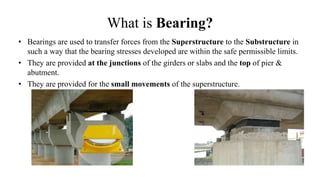
What is Bearing?
• Bearings are used to transfer forces from the Superstructure to the Substructure in
such a way that the bearing stresses developed are within the safe permissible limits.
• They are provided at the junctions of the girders or slabs and the top of pier &
abutment.
• They are provided for the small movements of the superstructure.
Movements in Superstructure
• Translation Movements: These are the displacements in vertical & horizontal directions
due to in-plane or out-of-plane forces like wind and self weight.
• Rotational Movement: These are caused due to moments.
• These movements are caused due to following reasons:
1. Translation movement of Girders in the longitudinal direction due to variations in
temperature.
2. Deflection of the Girder causes Rotational movement at supports.
3. Vertical movements (Translation movements) are generated due to sinking of the support.
4. Movement due to shrinkage & creep of the concrete.
Types of Bearings
• Based on the Function:
1. Fixed Bearing : Permits rotation but prevent expansion.
2. Expansion Bearing : Provide both – Horizontal movements & rotation.
• Selection is based on the type of structure, type of supports and the span length.
• Example:
For a simply supported span is generally provided with the fixed bearing at one
end and expansion bearing at the other support.
For a two span continues girder, a fixed bearing is provided at the centrals support
and expansion bearing at the end support.
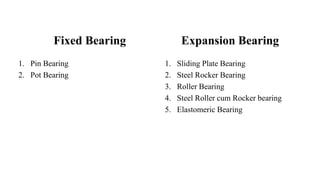
Fixed Bearing
1. Pin Bearing
2. Pot Bearing
Expansion Bearing
1. Sliding Plate Bearing
2. Steel Rocker Bearing
3. Roller Bearing
4. Steel Roller cum Rocker bearing
5. Elastomeric Bearing
Fixed Bearings
1. Pin Bearing
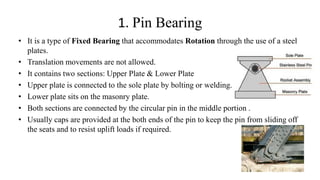
• It is a type of Fixed Bearing that accommodates Rotation through the use of a steel
plates.
• Translation movements are not allowed.
• It contains two sections: Upper Plate & Lower Plate
• Upper plate is connected to the sole plate by bolting or welding.
• Lower plate sits on the masonry plate.
• Both sections are connected by the circular pin in the middle portion .
• Usually caps are provided at the both ends of the pin to keep the pin from sliding off
the seats and to resist uplift loads if required.
2. Pot Bearing
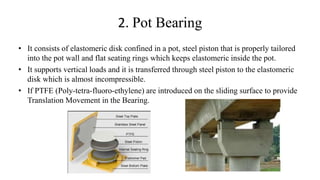
• It consists of elastomeric disk confined in a pot, steel piston that is properly tailored
into the pot wall and flat seating rings which keeps elastomeric inside the pot.
• It supports vertical loads and it is transferred through steel piston to the elastomeric
disk which is almost incompressible.
• If PTFE (Poly-tetra-fluoro-ethylene) are introduced on the sliding surface to provide
Translation Movement in the Bearing.
Expansion Bearing
1. Sliding Plate Bearing
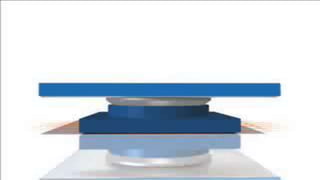
• It utilizes one plane metal plate sliding against another to accommodate translation.
• Sliding bearing surface produces a frictional force that is applied to the
superstructure, substructure and the bearing itself.
• To reduce this frictional force PTFE is often used as a lubricating material.
• PTFE is sometimes referred as a Teflon.
• Current practice is to provide a curved shape to the top plate to reduce the contact
area and friction resistance.
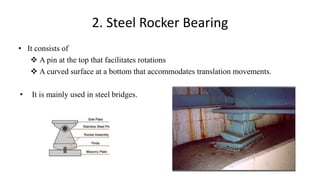
2. Steel Rocker Bearing
• It consists of
 A pin at the top that facilitates rotations
 A curved surface at a bottom that accommodates translation movements.
• It is mainly used in steel bridges.
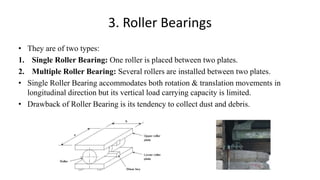
3. Roller Bearings
• They are of two types:
1. Single Roller Bearing: One roller is placed between two plates.
2. Multiple Roller Bearing: Several rollers are installed between two plates.
• Single Roller Bearing accommodates both rotation & translation movements in
longitudinal direction but its vertical load carrying capacity is limited.
• Drawback of Roller Bearing is its tendency to collect dust and debris.
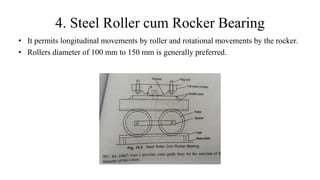
4. Steel Roller cum Rocker Bearing
• It permits longitudinal movements by roller and rotational movements by the rocker.
• Rollers diameter of 100 mm to 150 mm is generally preferred.
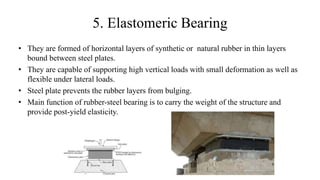
5. Elastomeric Bearing
• They are formed of horizontal layers of synthetic or natural rubber in thin layers
bound between steel plates.
• They are capable of supporting high vertical loads with small deformation as well as
flexible under lateral loads.
• Steel plate prevents the rubber layers from bulging.
• Main function of rubber-steel bearing is to carry the weight of the structure and
provide post-yield elasticity.
Case Study
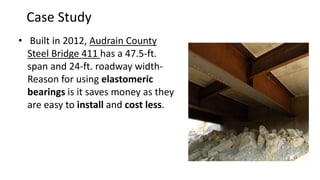
• Built in 2012, Audrain County
Steel Bridge 411 has a 47.5-ft.
span and 24-ft. roadway width-
Reason for using elastomeric
bearings is it saves money as they
are easy to install and cost less.
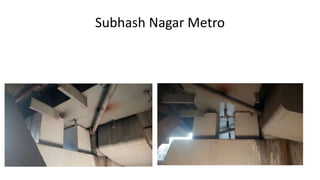
Subhash Nagar Metro
Thank You…

Bridge bea ring

  • 1.
    Bridge Bearings ASWINI AMITAVSAHOO SAGAR KUMAR BEHERA
  • 2.
    What is Bearing? •Bearings are used to transfer forces from the Superstructure to the Substructure in such a way that the bearing stresses developed are within the safe permissible limits. • They are provided at the junctions of the girders or slabs and the top of pier & abutment. • They are provided for the small movements of the superstructure.
  • 3.
    Movements in Superstructure •Translation Movements: These are the displacements in vertical & horizontal directions due to in-plane or out-of-plane forces like wind and self weight. • Rotational Movement: These are caused due to moments. • These movements are caused due to following reasons: 1. Translation movement of Girders in the longitudinal direction due to variations in temperature. 2. Deflection of the Girder causes Rotational movement at supports. 3. Vertical movements (Translation movements) are generated due to sinking of the support. 4. Movement due to shrinkage & creep of the concrete.
  • 4.
    Types of Bearings •Based on the Function: 1. Fixed Bearing : Permits rotation but prevent expansion. 2. Expansion Bearing : Provide both – Horizontal movements & rotation. • Selection is based on the type of structure, type of supports and the span length. • Example: For a simply supported span is generally provided with the fixed bearing at one end and expansion bearing at the other support. For a two span continues girder, a fixed bearing is provided at the centrals support and expansion bearing at the end support.
  • 5.
    Fixed Bearing 1. PinBearing 2. Pot Bearing Expansion Bearing 1. Sliding Plate Bearing 2. Steel Rocker Bearing 3. Roller Bearing 4. Steel Roller cum Rocker bearing 5. Elastomeric Bearing
  • 6.
  • 7.
    1. Pin Bearing •It is a type of Fixed Bearing that accommodates Rotation through the use of a steel plates. • Translation movements are not allowed. • It contains two sections: Upper Plate & Lower Plate • Upper plate is connected to the sole plate by bolting or welding. • Lower plate sits on the masonry plate. • Both sections are connected by the circular pin in the middle portion . • Usually caps are provided at the both ends of the pin to keep the pin from sliding off the seats and to resist uplift loads if required.
  • 8.
    2. Pot Bearing •It consists of elastomeric disk confined in a pot, steel piston that is properly tailored into the pot wall and flat seating rings which keeps elastomeric inside the pot. • It supports vertical loads and it is transferred through steel piston to the elastomeric disk which is almost incompressible. • If PTFE (Poly-tetra-fluoro-ethylene) are introduced on the sliding surface to provide Translation Movement in the Bearing.
  • 10.
  • 11.
    1. Sliding PlateBearing • It utilizes one plane metal plate sliding against another to accommodate translation. • Sliding bearing surface produces a frictional force that is applied to the superstructure, substructure and the bearing itself. • To reduce this frictional force PTFE is often used as a lubricating material. • PTFE is sometimes referred as a Teflon. • Current practice is to provide a curved shape to the top plate to reduce the contact area and friction resistance.
  • 13.
    2. Steel RockerBearing • It consists of  A pin at the top that facilitates rotations  A curved surface at a bottom that accommodates translation movements. • It is mainly used in steel bridges.
  • 14.
    3. Roller Bearings •They are of two types: 1. Single Roller Bearing: One roller is placed between two plates. 2. Multiple Roller Bearing: Several rollers are installed between two plates. • Single Roller Bearing accommodates both rotation & translation movements in longitudinal direction but its vertical load carrying capacity is limited. • Drawback of Roller Bearing is its tendency to collect dust and debris.
  • 15.
    4. Steel Rollercum Rocker Bearing • It permits longitudinal movements by roller and rotational movements by the rocker. • Rollers diameter of 100 mm to 150 mm is generally preferred.
  • 16.
    5. Elastomeric Bearing •They are formed of horizontal layers of synthetic or natural rubber in thin layers bound between steel plates. • They are capable of supporting high vertical loads with small deformation as well as flexible under lateral loads. • Steel plate prevents the rubber layers from bulging. • Main function of rubber-steel bearing is to carry the weight of the structure and provide post-yield elasticity.
  • 18.
    Case Study • Builtin 2012, Audrain County Steel Bridge 411 has a 47.5-ft. span and 24-ft. roadway width- Reason for using elastomeric bearings is it saves money as they are easy to install and cost less.
  • 19.
  • 20.