Welcome
13th International Knowledge Globalization Conference, 2018 IUBAT, Dhaka, Bangladesh
Dr. Md. Altaf Hossain
Principal Scientific Officer
Soil Resource Development Institute (SRDI)
Email: altajolly63@gmail.com
2/24/2018 1SRDI
Effects of Brick kiln on Environmental Pollution and Degradation of Agricultural Land
How Brick Kilns relate to SDGs?
2/24/2018 SRDI 2
1. No Poverty
2. Zero Hunger
3. Good Health and Wellbeing
8. Decent Work and Economic Growth
11. Sustainable Cities and Communities
13. Climate Action
15. Life on Earth
The Sustainable Development Goals (SDGs), otherwise known as the
Global Goals, are a universal call to action to end poverty, protect the
planet and ensure that all people enjoy peace and prosperity.
Rationale of the study
The aim of the study is to assess the effects of brick kiln on surrounding environment as well as crop
fields and homesteads.
It is generally postulated that the brick kilns have detrimental effects on micro-environment of
surrounding area. It is observed those brick kilns are usually built on or near agricultural lands for
utilizing the top soils of area.
Brick kilns are located mostly nearer to densely populated area which is a clear violation of existing
law. Bricks are generally burnt with fuel woods/coal/gas though government has banned the use of
fuel woods. Moreover, chimneys are not constructed as per government specification (i.e. height 30
meter).
As the fumes generate huge temperature, dust and gases especially SO2; which may affect the micro-
environment of the surrounding area of brickfield. Farmers are sometimes forced to sell fertile top
soils of their crop lands due to influential kiln owners.
It is reported that presently around 150 billion bricks are manufactured every year in 6,900 brick kilns
in the country at the cost of about 127 crore cubic feet of topsoil (Daily star, 2016).
SRDI has conducted a study throughout the country in 2005 which revealed damaging effects of brick
kiln on field and horticultural crops as well as on scarce agricultural lands.
Proposed study is undertaken to generate recent data base on brick kiln to assess its impact on2/24/2018 3SRDI
Objectives
1. To study the impact of brick kiln on surrounding crop fields.
2. To study the impact of brickfield on homestead fruit trees.
3. To assess the effect of brick kiln on environmental pollution
degradation of soil resources of agricultural land.
2/24/2018 SRDI 4
 Locating the brick kilns under study in the Upazila Soil and Landform Map (1:50,000).
Collection data on brick kiln such as location (distance from Upazila HQ/ municipality/
residential area; co-ordinates), area, capacity, chimney height, fuel used, source of soil,
etc.
 Collection of land type wise soil samples from adjacent and distant crop fields from at
least 5 brick kilns in a district. In total data on 121 brick kilns have been collected.
 Collection of top soil composite sample and plant samples from damaged plots (if any).
 Collection of data on crops, cropping patters of brick kiln area before conversion.
 Collection of data on crops, growing stages likely to be injured/ damaged by
interviewing the farmers.
 Chemical analysis of the collected soil samples for determining pH, N, P, K, S and Zn
status of the soils to assess economic impact.
 Data processing and report writing.
 Printing and publication of final report.
2/24/2018 5SRDI
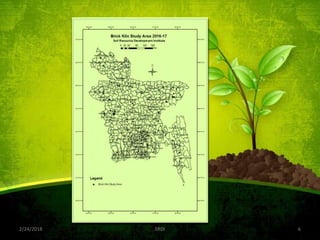
Methodology
2/24/2018 6SRDI
2/24/2018 7SRDI
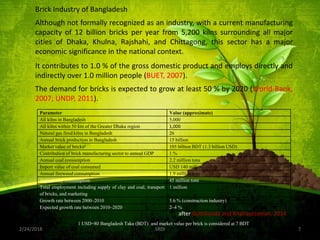
Although not formally recognized as an industry, with a current manufacturing
capacity of 12 billion bricks per year from 5,200 kilns surrounding all major
cities of Dhaka, Khulna, Rajshahi, and Chittagong, this sector has a major
economic significance in the national context.
It contributes to 1.0 % of the gross domestic product and employs directly and
indirectly over 1.0 million people (BUET, 2007).
The demand for bricks is expected to grow at least 50 % by 2020 (World-Bank,
2007; UNDP, 2011).
Parameter Value (approximate)
All kilns in Bangladesh 5,000
All kilns within 50 km of the Greater Dhaka region 1,000
Natural gas fired kilns in Bangladesh 26
Annual brick production in Bangladesh 15 billion
Market value of bricksa 105 billion BDT (1.3 billion USD)
Contribution of brick manufacturing sector to annual GDP 1 %
Annual coal consumption 2.2 million tons
Import value of coal consumed USD 140 million
Annual firewood consumption 1.9 million tons
Annual clay consumption 45 million tons
Total employment including supply of clay and coal, transport
of bricks, and marketing
1 million
Growth rate between 2000–2010 5.6 % (construction industry)
Expected growth rate between 2010–2020 2–4 %
after Guttikunda and Khaliquzzaman, 2014
1 USD=80 Bangladesh Taka (BDT) and market value per brick is considered at 7 BDT
Brick Industry of Bangladesh
2/24/2018 8SRDI
Bangladesh’s brick making sector plays a significant role in the nation’s economy.
It is believed to account for about one percent of GDP and employ (mostly on a seasonal basis)
between one to two million people.
Estimates of the total number of brick-making kilns range from 6,000 to over 10,000.
Kilns documented by the Department of Environment (DoE) numbered 6,791 in September 2014.
Most of these are small-scale seasonal businesses (“traditional kilns”), operating from six to eight
months a year and active mainly from November to April.
Sector considered as one of the top sources of air pollution in the country and a primary cause of
deforestation.
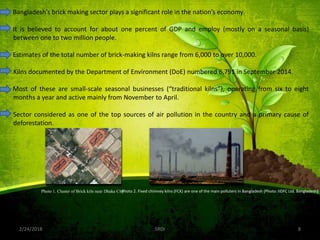
Photo 1. Cluster of Brick kiln near Dhaka CityPhoto 2. Fixed chimney kilns (FCK) are one of the main polluters in Bangladesh (Photo: IIDFC Ltd. Bangladesh)
2/24/2018 9SRDI
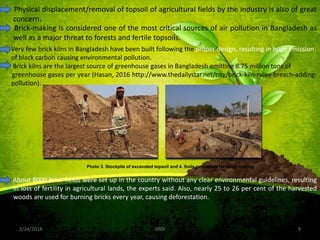
Physical displacement/removal of topsoil of agricultural fields by the industry is also of great
concern.
Photo 3. Stockpile of excavated topsoil and 4. Soils processed for brick making
Brick-making is considered one of the most critical sources of air pollution in Bangladesh as
well as a major threat to forests and fertile topsoils.
Very few brick kilns in Bangladesh have been built following the proper design, resulting in huge emission
of black carbon causing environmental pollution.
Brick kilns are the largest source of greenhouse gases in Bangladesh emitting 8.75 million tons of
greenhouse gases per year (Hasan, 2016 http://www.thedailystar.net/city/brick-kiln-rules-breach-adding-
pollution).
About 8000 brick fields were set up in the country without any clear environmental guidelines, resulting
in loss of fertility in agricultural lands, the experts said. Also, nearly 25 to 26 per cent of the harvested
woods are used for burning bricks every year, causing deforestation.
2/24/2018 SRDI 10
2/24/2018 11SRDI
Results and Discussion
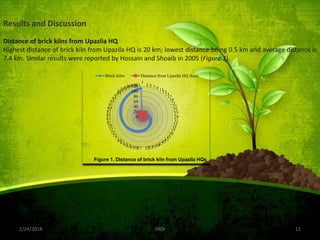
Distance of brick kilns from Upazila HQ
Highest distance of brick kiln from Upazila HQ is 20 km; lowest distance being 0.5 km and average distance is
7.4 km. Similar results were reported by Hossain and Shoaib in 2005 (Figure 1).
0
20
40
60
80
100
120
1
3 5 7 9 1113
15
17
19
21
23
25
27
29
31
33
35
37
39
41
43
45474951535557596163656769
71
73
75
77
79
81
83
85
87
89
91
93
95
97
99
101103105107109111
Brick kilns Distance from Upazila HQ (km)
Figure 1. Distance of brick kiln from Upazila HQs
2/24/2018 12SRDI
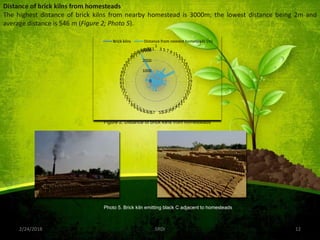
Distance of brick kilns from homesteads
The highest distance of brick kilns from nearby homestead is 3000m; the lowest distance being 2m and
average distance is 546 m (Figure 2; Photo 5).
0
1000
2000
3000
1
3 5 7 9 1113
15
17
19
21
23
25
27
29
31
33
35
37
39
41
43
45474951535557596163656769
71
73
75
77
79
81
83
85
87
89
91
93
95
97
99
101103105107109111
Brick kilns Distance from nearest hometeads (m)
Figure 2. Distance of brick kilns from homesteads
Photo 5. Brick kiln emitting black C adjacent to homesteads
2/24/2018 13SRDI
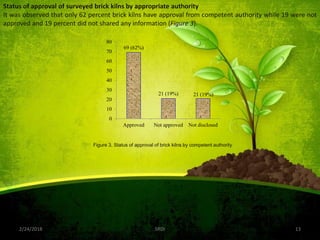
Status of approval of surveyed brick kilns by appropriate authority
It was observed that only 62 percent brick kilns have approval from competent authority while 19 were not
approved and 19 percent did not shared any information (Figure 3).
69 (62%)
21 (19%) 21 (19%)
0
10
20
30
40
50
60
70
80
Approved Not approved Not disclosed
Figure 3. Status of approval of brick kilns by competent authority
2/24/2018 14SRDI
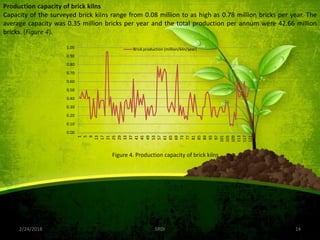
Production capacity of brick kilns
Capacity of the surveyed brick kilns range from 0.08 million to as high as 0.78 million bricks per year. The
average capacity was 0.35 million bricks per year and the total production per annum were 42.66 million
bricks. (Figure 4).
0.00
0.10
0.20
0.30
0.40
0.50
0.60
0.70
0.80
0.90
1.00
1
5
9
13
17
21
25
29
33
37
41
45
49
53
57
61
65
69
73
77
81
85
89
93
97
101
105
109
113
117
121
Brick production (million/kiln/year)
Figure 4. Production capacity of brick kilns
2/24/2018 15SRDI
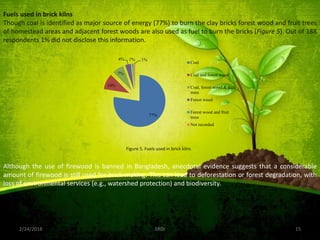
Fuels used in brick kilns
Though coal is identified as major source of energy (77%) to burn the clay bricks forest wood and fruit trees
of homestead areas and adjacent forest woods are also used as fuel to burn the bricks (Figure 5). Out of 188
respondents 1% did not disclose this information.
77%
10%
7%
4% 1% 1%
Coal
Coal and forest wood
Coal, forest wood & fruit
trees
Forest wood
Forest wood and fruit
trees
Not recorded
Figure 5. Fuels used in brick kilns
Although the use of firewood is banned in Bangladesh, anecdotal evidence suggests that a considerable
amount of firewood is still used for brick-making. This can lead to deforestation or forest degradation, with
loss of environmental services (e.g., watershed protection) and biodiversity.
2/24/2018 16SRDI
Impact of brick kiln on land and environment degradation
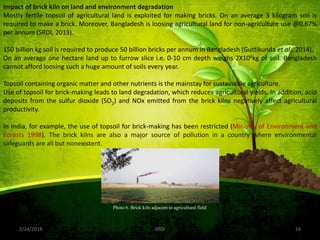
Mostly fertile topsoil of agricultural land is exploited for making bricks. On an average 3 kilogram soil is
required to make a brick. Moreover, Bangladesh is loosing agricultural land for non-agriculture use @0.67%
per annum (SRDI, 2013).
150 billion kg soil is required to produce 50 billion bricks per annum in Bangladesh (Guttikunda et al., 2014).
On an average one hectare land up to furrow slice i.e. 0-10 cm depth weighs 2X10⁶kg of soil. Bangladesh
cannot afford loosing such a huge amount of soils every year.
Topsoil containing organic matter and other nutrients is the mainstay for sustainable agriculture.
Use of topsoil for brick-making leads to land degradation, which reduces agricultural yields. In addition, acid
deposits from the sulfur dioxide (SO2) and NOx emitted from the brick kilns negatively affect agricultural
productivity.
In India, for example, the use of topsoil for brick-making has been restricted (Ministry of Environment and
Forests 1998). The brick kilns are also a major source of pollution in a country where environmental
safeguards are all but nonexistent.
Photo 6. Brick kiln adjacent to agricultural field
2/24/2018 17SRDI
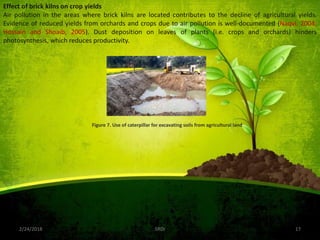
Effect of brick kilns on crop yields
Air pollution in the areas where brick kilns are located contributes to the decline of agricultural yields.
Evidence of reduced yields from orchards and crops due to air pollution is well-documented (Naqvi, 2004;
Hossain and Shoaib, 2005). Dust deposition on leaves of plants (i.e. crops and orchards) hinders
photosynthesis, which reduces productivity.
Figure 7. Use of caterpillar for excavating soils from agricultural land
2/24/2018 SRDI 18
Every year we are loosing 45 thousand tons of nitrogen (N) which is equivalent to 100
thousand tons Urea fertilizer amounting to 64 million BDT (1 $≈80 BDT) for producing 50 billion
bricks.
Organic matter loss per annum is 0.72 million tons for the purpose. This is tremendous loss. As
organic C is the source of energy for soil microbes which are vital for soil health.
Irreversible loss of nutrients and organic matter
2/24/2018 19SRDI
The way forward
In absence of natural sources of stones and pebbles, bricks produced from clay have become the major
construction material in the country.
The brick manufacturers employ approximately 1-2 million workers, mostly unskilled, in brick making.
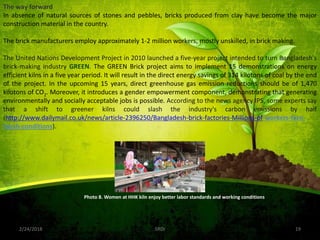
The United Nations Development Project in 2010 launched a five-year project intended to turn Bangladesh's
brick-making industry GREEN. The GREEN Brick project aims to implement 15 demonstrations on energy
efficient kilns in a five year period. It will result in the direct energy savings of 314 kilotons of coal by the end
of the project. In the upcoming 15 years, direct greenhouse gas emission reductions should be of 1,470
kilotons of CO2. Moreover, it introduces a gender empowerment component, demonstrating that generating
environmentally and socially acceptable jobs is possible. According to the news agency IPS, some experts say
that a shift to greener kilns could slash the industry's carbon emissions by half
(http://www.dailymail.co.uk/news/article-2396250/Bangladesh-brick-factories-Millions-of-workers-face-
harsh-conditions).
Photo 8. Women at HHK kiln enjoy better labor standards and working conditions
2/24/2018 20SRDI
Conclusion
Brick making is indispensable for Bangladesh’ economy. Though not formally recognized as an
industry, brick-making is a significant economic activity in Bangladesh (Ministry of Industries 2010).
The country‘s overwhelming dependence on bricks is due to its lack of stones in any sizable quantity
or other alternative building materials at comparable cost.
Outdated brick-production technology and seasonality of kiln operations hinder brick-sector
productivity. FCK technology is more than a century old. The brick sector has largely grown by
replication of existing kilns, with little variation in kiln design or operation.
GOB has amended the law in 2013, regulating the brick sector as per law of the land with strict
enforcement is still needed.
The Government of Bangladesh (GOB) has demonstrated serious commitment to regulate the brick
industry through by prohibiting brick export to India.
Most brick kilns are low energy efficient and are highly polluting. Brick kilns have a negative effect on
agricultural productivity.
The weak financial situation of most kiln operators hinders the adoption of modern technologies.
2/24/2018 SRDI 21
Recommendations
Bangladesh House Building Research Institute (www.hbri.gov.bd) needs to be strengthened and
research findings should be replicated in constructing GOB funded buildings.
Building codes needs to be revisited facilitating at least 50% use of alternate bricks.
Government of Bangladesh should formulate law prohibiting use of fertile topsoil of agricultural
lands for brick making.
Mass awareness needs to be built about FCK polluting the environment as well as degradation
of fertile agricultural lands.
2/24/2018 22SRDI
Thanks for patience hearing

Brick kiln knowledge globalization conference 2018

  • 1.
    Welcome 13th International KnowledgeGlobalization Conference, 2018 IUBAT, Dhaka, Bangladesh Dr. Md. Altaf Hossain Principal Scientific Officer Soil Resource Development Institute (SRDI) Email: altajolly63@gmail.com 2/24/2018 1SRDI Effects of Brick kiln on Environmental Pollution and Degradation of Agricultural Land
  • 2.
    How Brick Kilnsrelate to SDGs? 2/24/2018 SRDI 2 1. No Poverty 2. Zero Hunger 3. Good Health and Wellbeing 8. Decent Work and Economic Growth 11. Sustainable Cities and Communities 13. Climate Action 15. Life on Earth The Sustainable Development Goals (SDGs), otherwise known as the Global Goals, are a universal call to action to end poverty, protect the planet and ensure that all people enjoy peace and prosperity.
  • 3.
    Rationale of thestudy The aim of the study is to assess the effects of brick kiln on surrounding environment as well as crop fields and homesteads. It is generally postulated that the brick kilns have detrimental effects on micro-environment of surrounding area. It is observed those brick kilns are usually built on or near agricultural lands for utilizing the top soils of area. Brick kilns are located mostly nearer to densely populated area which is a clear violation of existing law. Bricks are generally burnt with fuel woods/coal/gas though government has banned the use of fuel woods. Moreover, chimneys are not constructed as per government specification (i.e. height 30 meter). As the fumes generate huge temperature, dust and gases especially SO2; which may affect the micro- environment of the surrounding area of brickfield. Farmers are sometimes forced to sell fertile top soils of their crop lands due to influential kiln owners. It is reported that presently around 150 billion bricks are manufactured every year in 6,900 brick kilns in the country at the cost of about 127 crore cubic feet of topsoil (Daily star, 2016). SRDI has conducted a study throughout the country in 2005 which revealed damaging effects of brick kiln on field and horticultural crops as well as on scarce agricultural lands. Proposed study is undertaken to generate recent data base on brick kiln to assess its impact on2/24/2018 3SRDI
  • 4.
    Objectives 1. To studythe impact of brick kiln on surrounding crop fields. 2. To study the impact of brickfield on homestead fruit trees. 3. To assess the effect of brick kiln on environmental pollution degradation of soil resources of agricultural land. 2/24/2018 SRDI 4
  • 5.
     Locating thebrick kilns under study in the Upazila Soil and Landform Map (1:50,000). Collection data on brick kiln such as location (distance from Upazila HQ/ municipality/ residential area; co-ordinates), area, capacity, chimney height, fuel used, source of soil, etc.  Collection of land type wise soil samples from adjacent and distant crop fields from at least 5 brick kilns in a district. In total data on 121 brick kilns have been collected.  Collection of top soil composite sample and plant samples from damaged plots (if any).  Collection of data on crops, cropping patters of brick kiln area before conversion.  Collection of data on crops, growing stages likely to be injured/ damaged by interviewing the farmers.  Chemical analysis of the collected soil samples for determining pH, N, P, K, S and Zn status of the soils to assess economic impact.  Data processing and report writing.  Printing and publication of final report. 2/24/2018 5SRDI Methodology
  • 6.
  • 7.
    2/24/2018 7SRDI Although notformally recognized as an industry, with a current manufacturing capacity of 12 billion bricks per year from 5,200 kilns surrounding all major cities of Dhaka, Khulna, Rajshahi, and Chittagong, this sector has a major economic significance in the national context. It contributes to 1.0 % of the gross domestic product and employs directly and indirectly over 1.0 million people (BUET, 2007). The demand for bricks is expected to grow at least 50 % by 2020 (World-Bank, 2007; UNDP, 2011). Parameter Value (approximate) All kilns in Bangladesh 5,000 All kilns within 50 km of the Greater Dhaka region 1,000 Natural gas fired kilns in Bangladesh 26 Annual brick production in Bangladesh 15 billion Market value of bricksa 105 billion BDT (1.3 billion USD) Contribution of brick manufacturing sector to annual GDP 1 % Annual coal consumption 2.2 million tons Import value of coal consumed USD 140 million Annual firewood consumption 1.9 million tons Annual clay consumption 45 million tons Total employment including supply of clay and coal, transport of bricks, and marketing 1 million Growth rate between 2000–2010 5.6 % (construction industry) Expected growth rate between 2010–2020 2–4 % after Guttikunda and Khaliquzzaman, 2014 1 USD=80 Bangladesh Taka (BDT) and market value per brick is considered at 7 BDT Brick Industry of Bangladesh
  • 8.
    2/24/2018 8SRDI Bangladesh’s brickmaking sector plays a significant role in the nation’s economy. It is believed to account for about one percent of GDP and employ (mostly on a seasonal basis) between one to two million people. Estimates of the total number of brick-making kilns range from 6,000 to over 10,000. Kilns documented by the Department of Environment (DoE) numbered 6,791 in September 2014. Most of these are small-scale seasonal businesses (“traditional kilns”), operating from six to eight months a year and active mainly from November to April. Sector considered as one of the top sources of air pollution in the country and a primary cause of deforestation. Photo 1. Cluster of Brick kiln near Dhaka CityPhoto 2. Fixed chimney kilns (FCK) are one of the main polluters in Bangladesh (Photo: IIDFC Ltd. Bangladesh)
  • 9.
    2/24/2018 9SRDI Physical displacement/removalof topsoil of agricultural fields by the industry is also of great concern. Photo 3. Stockpile of excavated topsoil and 4. Soils processed for brick making Brick-making is considered one of the most critical sources of air pollution in Bangladesh as well as a major threat to forests and fertile topsoils. Very few brick kilns in Bangladesh have been built following the proper design, resulting in huge emission of black carbon causing environmental pollution. Brick kilns are the largest source of greenhouse gases in Bangladesh emitting 8.75 million tons of greenhouse gases per year (Hasan, 2016 http://www.thedailystar.net/city/brick-kiln-rules-breach-adding- pollution). About 8000 brick fields were set up in the country without any clear environmental guidelines, resulting in loss of fertility in agricultural lands, the experts said. Also, nearly 25 to 26 per cent of the harvested woods are used for burning bricks every year, causing deforestation.
  • 10.
  • 11.
    2/24/2018 11SRDI Results andDiscussion Distance of brick kilns from Upazila HQ Highest distance of brick kiln from Upazila HQ is 20 km; lowest distance being 0.5 km and average distance is 7.4 km. Similar results were reported by Hossain and Shoaib in 2005 (Figure 1). 0 20 40 60 80 100 120 1 3 5 7 9 1113 15 17 19 21 23 25 27 29 31 33 35 37 39 41 43 45474951535557596163656769 71 73 75 77 79 81 83 85 87 89 91 93 95 97 99 101103105107109111 Brick kilns Distance from Upazila HQ (km) Figure 1. Distance of brick kiln from Upazila HQs
  • 12.
    2/24/2018 12SRDI Distance ofbrick kilns from homesteads The highest distance of brick kilns from nearby homestead is 3000m; the lowest distance being 2m and average distance is 546 m (Figure 2; Photo 5). 0 1000 2000 3000 1 3 5 7 9 1113 15 17 19 21 23 25 27 29 31 33 35 37 39 41 43 45474951535557596163656769 71 73 75 77 79 81 83 85 87 89 91 93 95 97 99 101103105107109111 Brick kilns Distance from nearest hometeads (m) Figure 2. Distance of brick kilns from homesteads Photo 5. Brick kiln emitting black C adjacent to homesteads
  • 13.
    2/24/2018 13SRDI Status ofapproval of surveyed brick kilns by appropriate authority It was observed that only 62 percent brick kilns have approval from competent authority while 19 were not approved and 19 percent did not shared any information (Figure 3). 69 (62%) 21 (19%) 21 (19%) 0 10 20 30 40 50 60 70 80 Approved Not approved Not disclosed Figure 3. Status of approval of brick kilns by competent authority
  • 14.
    2/24/2018 14SRDI Production capacityof brick kilns Capacity of the surveyed brick kilns range from 0.08 million to as high as 0.78 million bricks per year. The average capacity was 0.35 million bricks per year and the total production per annum were 42.66 million bricks. (Figure 4). 0.00 0.10 0.20 0.30 0.40 0.50 0.60 0.70 0.80 0.90 1.00 1 5 9 13 17 21 25 29 33 37 41 45 49 53 57 61 65 69 73 77 81 85 89 93 97 101 105 109 113 117 121 Brick production (million/kiln/year) Figure 4. Production capacity of brick kilns
  • 15.
    2/24/2018 15SRDI Fuels usedin brick kilns Though coal is identified as major source of energy (77%) to burn the clay bricks forest wood and fruit trees of homestead areas and adjacent forest woods are also used as fuel to burn the bricks (Figure 5). Out of 188 respondents 1% did not disclose this information. 77% 10% 7% 4% 1% 1% Coal Coal and forest wood Coal, forest wood & fruit trees Forest wood Forest wood and fruit trees Not recorded Figure 5. Fuels used in brick kilns Although the use of firewood is banned in Bangladesh, anecdotal evidence suggests that a considerable amount of firewood is still used for brick-making. This can lead to deforestation or forest degradation, with loss of environmental services (e.g., watershed protection) and biodiversity.
  • 16.
    2/24/2018 16SRDI Impact ofbrick kiln on land and environment degradation Mostly fertile topsoil of agricultural land is exploited for making bricks. On an average 3 kilogram soil is required to make a brick. Moreover, Bangladesh is loosing agricultural land for non-agriculture use @0.67% per annum (SRDI, 2013). 150 billion kg soil is required to produce 50 billion bricks per annum in Bangladesh (Guttikunda et al., 2014). On an average one hectare land up to furrow slice i.e. 0-10 cm depth weighs 2X10⁶kg of soil. Bangladesh cannot afford loosing such a huge amount of soils every year. Topsoil containing organic matter and other nutrients is the mainstay for sustainable agriculture. Use of topsoil for brick-making leads to land degradation, which reduces agricultural yields. In addition, acid deposits from the sulfur dioxide (SO2) and NOx emitted from the brick kilns negatively affect agricultural productivity. In India, for example, the use of topsoil for brick-making has been restricted (Ministry of Environment and Forests 1998). The brick kilns are also a major source of pollution in a country where environmental safeguards are all but nonexistent. Photo 6. Brick kiln adjacent to agricultural field
  • 17.
    2/24/2018 17SRDI Effect ofbrick kilns on crop yields Air pollution in the areas where brick kilns are located contributes to the decline of agricultural yields. Evidence of reduced yields from orchards and crops due to air pollution is well-documented (Naqvi, 2004; Hossain and Shoaib, 2005). Dust deposition on leaves of plants (i.e. crops and orchards) hinders photosynthesis, which reduces productivity. Figure 7. Use of caterpillar for excavating soils from agricultural land
  • 18.
    2/24/2018 SRDI 18 Everyyear we are loosing 45 thousand tons of nitrogen (N) which is equivalent to 100 thousand tons Urea fertilizer amounting to 64 million BDT (1 $≈80 BDT) for producing 50 billion bricks. Organic matter loss per annum is 0.72 million tons for the purpose. This is tremendous loss. As organic C is the source of energy for soil microbes which are vital for soil health. Irreversible loss of nutrients and organic matter
  • 19.
    2/24/2018 19SRDI The wayforward In absence of natural sources of stones and pebbles, bricks produced from clay have become the major construction material in the country. The brick manufacturers employ approximately 1-2 million workers, mostly unskilled, in brick making. The United Nations Development Project in 2010 launched a five-year project intended to turn Bangladesh's brick-making industry GREEN. The GREEN Brick project aims to implement 15 demonstrations on energy efficient kilns in a five year period. It will result in the direct energy savings of 314 kilotons of coal by the end of the project. In the upcoming 15 years, direct greenhouse gas emission reductions should be of 1,470 kilotons of CO2. Moreover, it introduces a gender empowerment component, demonstrating that generating environmentally and socially acceptable jobs is possible. According to the news agency IPS, some experts say that a shift to greener kilns could slash the industry's carbon emissions by half (http://www.dailymail.co.uk/news/article-2396250/Bangladesh-brick-factories-Millions-of-workers-face- harsh-conditions). Photo 8. Women at HHK kiln enjoy better labor standards and working conditions
  • 20.
    2/24/2018 20SRDI Conclusion Brick makingis indispensable for Bangladesh’ economy. Though not formally recognized as an industry, brick-making is a significant economic activity in Bangladesh (Ministry of Industries 2010). The country‘s overwhelming dependence on bricks is due to its lack of stones in any sizable quantity or other alternative building materials at comparable cost. Outdated brick-production technology and seasonality of kiln operations hinder brick-sector productivity. FCK technology is more than a century old. The brick sector has largely grown by replication of existing kilns, with little variation in kiln design or operation. GOB has amended the law in 2013, regulating the brick sector as per law of the land with strict enforcement is still needed. The Government of Bangladesh (GOB) has demonstrated serious commitment to regulate the brick industry through by prohibiting brick export to India. Most brick kilns are low energy efficient and are highly polluting. Brick kilns have a negative effect on agricultural productivity. The weak financial situation of most kiln operators hinders the adoption of modern technologies.
  • 21.
    2/24/2018 SRDI 21 Recommendations BangladeshHouse Building Research Institute (www.hbri.gov.bd) needs to be strengthened and research findings should be replicated in constructing GOB funded buildings. Building codes needs to be revisited facilitating at least 50% use of alternate bricks. Government of Bangladesh should formulate law prohibiting use of fertile topsoil of agricultural lands for brick making. Mass awareness needs to be built about FCK polluting the environment as well as degradation of fertile agricultural lands.
  • 22.