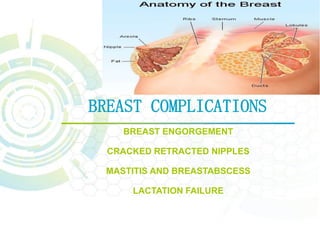
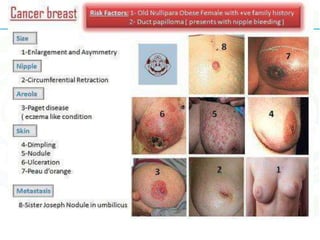
BREAST COMPLICATIONS
BREAST ENGORGEMENT
CRACKED RETRACTED NIPPLES
MASTITIS AND BREASTABSCESS
LACTATION FAILURE
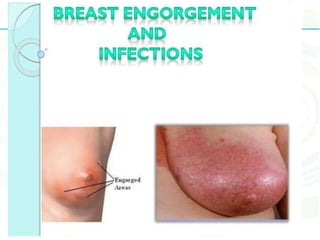
BREAST ENGORGEMENT
Breast engorgement occurs in the mammary
glands due to expansion and pressure
exerted by the synth
What is engorgement?
Engorgement is caused by a build-up of
milk, blood and other fluids in the breast
tissuesis and storage of breast
milk.Breast engorgement is the painful
overfilling of the breasts with milk. This
is usually caused by an imbalance between
milk supply and infant demand.
CAUSES
1. Due to exaggerated normal venous and
lymphatic engorgement of the breasts
which precedes lactation.this is turn
prevents escape of milk from the lacteal
system.
2. ONSET-Usually manifests after the milk
secretion starts.
SYMPTOMS
1. Are swollen, firm, and painful. If
severely engorged, they are very
swollen, hard, shiny, warm, and slightly
lumpy to the touch.
2. May have flattened-out nipples. The dark
area around the nipple, called the
areola , may be very hard. This makes it
difficult for your baby to latch on.
3. Can cause slightly swollen and tender
lymph nodes in your armpits.
PREVENTION
1. Breastfeed your baby frequently, 8-12
times in 24 hours. avoid supplements of
water or formula for the first 3-4
weeks.
2. Exclusive breastfeeding on demand.
3. Feeding in correct position.
4. To avoid prelactal feeds.
TREATMENT
1. To support breast with a binder or brassiere.
2. Frequent suckling and mannual expression of any
remaining milk after each feed.
3. To administer analgesics for pain.
4. The baby should be put to the breast regularly
at frequent intervals.
5. In a severe case gentle use of a breast pump.
6. Gentle hand expression of milk to make the
breast soft so that the infant can latch
on.moist heat and cold compress to relieve
edema.
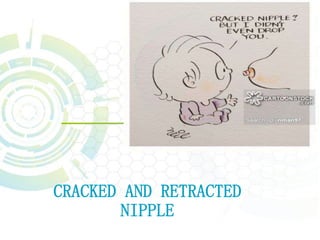
CRACKED AND RETRACTED
NIPPLE
CRACKED AND SORE NIPPLE
Sore nipples are any persistent pain in the nipples that lasts
throughout the entire breastfeeding or hurts between feedings.
Causes-
BABY NOT LATCHING ON PROPERLY- this is the number one
cause of sore nipples
Engorgement that makes the nipple too flat and firm to latch
properly
Early pacifier and bottle usage ,Sucking problems in the baby
Infections in the nipple or breast
Inappropriate nipple care routines or attempting to “toughen
up” the nipples before the baby is born
Improper breastpump usage
TREATMENT
Correct attachment will provide immediate relief from pain and
rapid healing.
Purified lanolin with the mother's milk is applied3 to 4 times a
day to hasten healing.
In severe cases uses breast pump and infant is feed with
expressed milk.
Miconazole lotion is applied over the nipple as well as in the
baby's mouth if there is oral thrush.
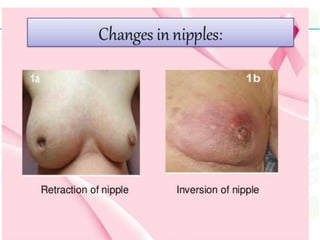
RETRACTED OR FLAT NIPPLE
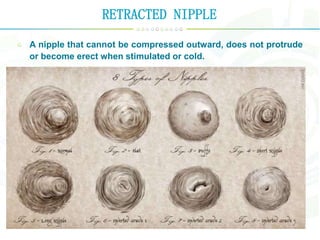
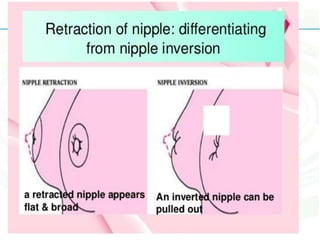
RETRACTED NIPPLE
A nipple that cannot be compressed outward, does not protrude
or become erect when stimulated or cold.
MASTITIS
MASTITIS
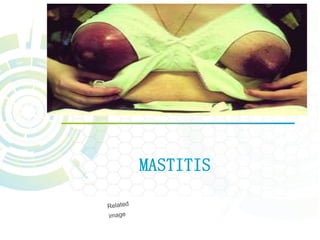
Mastitis (also called mammitis) is the inflammation of breast
tissue. S. aureus is the most common etiological organism
responsible, but S. epidermidis and streptMastitis is
inflammation of tissue in one or both mammary glands inside
the breast.
Mastitis usually affects lactating women - women who are
breastfeeding, producing milk. Hence, it is often referred to as
lactation mastitis.ococci are occasionally isolated as well.
Causes of non-infectious mastitis
The baby is not attaching to the breast properly during feeding.The
baby has difficulties suckling the milk out of the breast.
The baby is being breastfed infrequently.
Milk ducts may be blocked because of pressure on the breast
caused by, for example, tight clothing.
Causes of infectious mastitis
Bacteria do not generally thrive in fresh human milk. However, if
the milk ducts are blocked and the milk stagnates the likelihood of
infection grows. Experts believe that bacteria which exist on the
surface of breast skin enter the breast through small cracks or
breaks in the skin. They also suggest that bacteria in the baby's
mouth may get into the mother's breast during a breastfeed.
Two types of mastitis
There are two types of mastitis: non-infectious mastitis and
infectious mastitis.
Non-infectious mastitis-Non-infectious mastitis is usually
caused by breast milk staying within the breast tissue - milk
stasis - because of a blocked milk duct or a breastfeeding
problem. If left untreated, the milk left in the breast tissue can
become infected, leading to infectious mastitis.
Infectious mastitis-Infectious mastitis is caused by bacterial
infection. It is important to receive treatment immediately to
prevent complications, such as an abscess in the breast.
Symptoms of mastitis
An area of the breast becomes red.
The affected area of the breast hurts when touched.
The affected area feels hot when touched.
A burning sensation in the breast which may be Sometimes,
the following symptoms may also be present:
Anxiety, feeling stressed
Chills, Elevated body temperature, Fatigue
General aches and pains
Shivering there all the time, or only when breastfeeding.
Treatments for mastitis
Mother needs to make sure she is drinking plenty of liquids and
complete bed rest.
Feed the baby more frequently.If mother cannot feed the baby
more frequently, express the milk more often if the breasts feel
full.
Warming the breast before a feed can sometimes make it easier
for the baby to get the milk out.
Proper positioning, handwashing before each feed, cleaning the
nipples aftera nd before each feed and keeping them dry.
wear very loose-fitting clothes until the mastitis has gone. When
it has gone, avoid tight-fitting clothes.
Dicloxacillin is the drug (500mg) every 6 hours orally is started.
Erythromycin is an alternative to patients.
ANTIBIOTIC THERAPY CONTINUED FOR AT LEAST 7 DAYS.
ANALGESICS-Ibuprofen are given for pain.
Complications of mastitis
Recurrence-Women who have had mastitis are more likely to get
it again, compared to other women. In most cases recurrence is
due to late or inadequate treatment.
Abscess-If the mastitis is not treated properly there is a risk that
a collection of pus (abscess) can develop in the breast.
Abscesses usually require surgical draining.
BREAST ABSCESS
A breast abscess is a painful collection of pus that forms in the
breast.
Most abscesses develop just under the skin and are caused by a
bacterial infection.Breast abscesses are painful, swollen lumps
that may also:
be red
feel hot
cause the surrounding skin to swell
cause a fever (high temperature)
Causes of a breast abscess
Most breast abscesses occur as a complication of mastitis,
which is a bacterial infection that causes the breast to become
red and inflamed.
Treating a breast abscess
A breast abscess will need to be drained. Small breast
abscesses can be drained using a needle and syringe. If the
abscess is large, a small incision may be needed to drain the
pus.
For both procedures, a local anaesthetic will usually be given to
numb the skin around the abscess so MOTHER don't feel any
pain or discomfort.
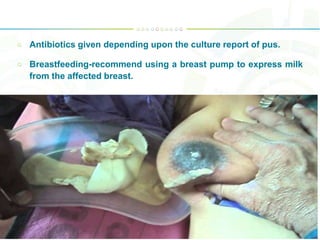
Antibiotics given depending upon the culture report of pus.
Breastfeeding-recommend using a breast pump to express milk
from the affected breast.
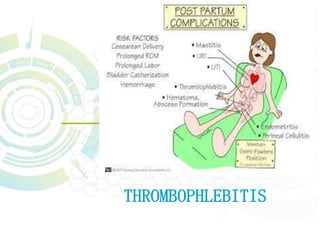
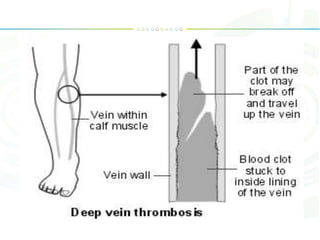
THROMBOPHLEBITIS
DEFINITION
It is a condition which occur when the condition is localised inIn
septic pelvic vein thrombophlebitis, infected blood clots develop in
one or several of the pelvic blood vessels. A thrombus is a blood clot;
phlebitis is an inflammation of a vein. the pelvis.
TYPES OF THROMBOPHLEBITIS-
OVARIAN VEIN THROMBOPHLEBITIS(OVT)
DEEP SEPTIC PELVIC THROMBOPHLEBITIS(DSPT)
What are the Consequences of Septic Pelvic Vein
Thrombophlebitis?
Septic pelvic vein thrombophlebitis is a
potentially dangerous condition. It can lead to the
formation of an abscess (collection of pus) in the
pelvis and infection in a blood clot which travels
from the pelvic vessels to the vessels in the lungs
(septic pulmonary embolization). This latter
disorder may prevent the delivery of sufficient
oxygen to the blood and may result in death.
Signs and Symptoms of Septic Pelvic Vein
Thrombophlebitis?
fever;
abdominal pain, usually localized and restricted to the
side of the affected vein but may spread into the groin,
upper abdomen, or flank;
abdominal bloating and tenderness (most patients do not
want to be touched in the abdomen);
a tender, sausage-shaped mass near the umbilicus
(present in 50 to 70% of patients);
decreased or absent bowel sounds;
nausea,vomitingandincreased pulse rate (tachycardia)
Diagnosis
To be evaluated for suspected septic pelvic vein
thrombophlebitis, you may undergo a CT scan (computerized
tomography) or MRI (magnetic resonance imaging).
An ultrasound examination can also help confirm the diagnosis
but is probably not as sensitive as a CT scan or MRI.
MANAGEMENT
Anti coagulant therapy heparin therapy is started .
It is followed by wafarin orally.
Bed rest-restriction of movement until the clotting time hhas shown
signs of improvement.
Analgesics given
Antibiotics given
Monitor patient for side effect of anticoagulants.
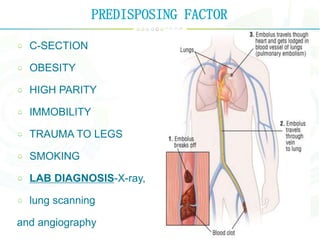
PULMONARY EMBOLISM
A pulmonary embolism (embolus) is a serious, potentially
life-threatening condition. It is due to a blockage in a
blood vessel in the lungs. A pulmonary embolism (PE)
can cause symptoms such as chest pain or
breathlessness but may have no symptoms and be hard
to detect. A massive PE can cause collapse and death.
PE usually happens due to an underlying blood clot in the
leg - deep vein thrombosis (DVT)
PREDISPOSING FACTOR
C-SECTION
OBESITY
HIGH PARITY
IMMOBILITY
TRAUMA TO LEGS
SMOKING
LAB DIAGNOSIS-X-ray,
lung scanning
and angiography
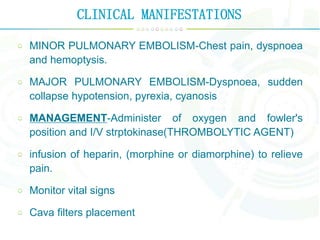
CLINICAL MANIFESTATIONS
MINOR PULMONARY EMBOLISM-Chest pain, dyspnoea
and hemoptysis.
MAJOR PULMONARY EMBOLISM-Dyspnoea, sudden
collapse hypotension, pyrexia, cyanosis
MANAGEMENT-Administer of oxygen and fowler's
position and I/V strptokinase(THROMBOLYTIC AGENT)
infusion of heparin, (morphine or diamorphine) to relieve
pain.
Monitor vital signs
Cava filters placement

Breast complications

  • 1.
    BREAST COMPLICATIONS BREAST ENGORGEMENT CRACKEDRETRACTED NIPPLES MASTITIS AND BREASTABSCESS LACTATION FAILURE
  • 2.
    BREAST ENGORGEMENT Breast engorgementoccurs in the mammary glands due to expansion and pressure exerted by the synth What is engorgement? Engorgement is caused by a build-up of milk, blood and other fluids in the breast tissuesis and storage of breast milk.Breast engorgement is the painful overfilling of the breasts with milk. This is usually caused by an imbalance between milk supply and infant demand.
  • 4.
    CAUSES 1. Due toexaggerated normal venous and lymphatic engorgement of the breasts which precedes lactation.this is turn prevents escape of milk from the lacteal system. 2. ONSET-Usually manifests after the milk secretion starts.
  • 5.
    SYMPTOMS 1. Are swollen,firm, and painful. If severely engorged, they are very swollen, hard, shiny, warm, and slightly lumpy to the touch. 2. May have flattened-out nipples. The dark area around the nipple, called the areola , may be very hard. This makes it difficult for your baby to latch on. 3. Can cause slightly swollen and tender lymph nodes in your armpits.
  • 8.
    PREVENTION 1. Breastfeed yourbaby frequently, 8-12 times in 24 hours. avoid supplements of water or formula for the first 3-4 weeks. 2. Exclusive breastfeeding on demand. 3. Feeding in correct position. 4. To avoid prelactal feeds.
  • 9.
    TREATMENT 1. To supportbreast with a binder or brassiere. 2. Frequent suckling and mannual expression of any remaining milk after each feed. 3. To administer analgesics for pain. 4. The baby should be put to the breast regularly at frequent intervals. 5. In a severe case gentle use of a breast pump. 6. Gentle hand expression of milk to make the breast soft so that the infant can latch on.moist heat and cold compress to relieve edema.
  • 10.
  • 11.
    CRACKED AND SORENIPPLE Sore nipples are any persistent pain in the nipples that lasts throughout the entire breastfeeding or hurts between feedings.
  • 13.
    Causes- BABY NOT LATCHINGON PROPERLY- this is the number one cause of sore nipples Engorgement that makes the nipple too flat and firm to latch properly Early pacifier and bottle usage ,Sucking problems in the baby Infections in the nipple or breast Inappropriate nipple care routines or attempting to “toughen up” the nipples before the baby is born Improper breastpump usage
  • 14.
    TREATMENT Correct attachment willprovide immediate relief from pain and rapid healing. Purified lanolin with the mother's milk is applied3 to 4 times a day to hasten healing. In severe cases uses breast pump and infant is feed with expressed milk. Miconazole lotion is applied over the nipple as well as in the baby's mouth if there is oral thrush.
  • 15.
  • 16.
    RETRACTED NIPPLE A nipplethat cannot be compressed outward, does not protrude or become erect when stimulated or cold.
  • 19.
  • 20.
    MASTITIS Mastitis (also calledmammitis) is the inflammation of breast tissue. S. aureus is the most common etiological organism responsible, but S. epidermidis and streptMastitis is inflammation of tissue in one or both mammary glands inside the breast. Mastitis usually affects lactating women - women who are breastfeeding, producing milk. Hence, it is often referred to as lactation mastitis.ococci are occasionally isolated as well.
  • 21.
    Causes of non-infectiousmastitis The baby is not attaching to the breast properly during feeding.The baby has difficulties suckling the milk out of the breast. The baby is being breastfed infrequently. Milk ducts may be blocked because of pressure on the breast caused by, for example, tight clothing.
  • 22.
    Causes of infectiousmastitis Bacteria do not generally thrive in fresh human milk. However, if the milk ducts are blocked and the milk stagnates the likelihood of infection grows. Experts believe that bacteria which exist on the surface of breast skin enter the breast through small cracks or breaks in the skin. They also suggest that bacteria in the baby's mouth may get into the mother's breast during a breastfeed.
  • 23.
    Two types ofmastitis There are two types of mastitis: non-infectious mastitis and infectious mastitis. Non-infectious mastitis-Non-infectious mastitis is usually caused by breast milk staying within the breast tissue - milk stasis - because of a blocked milk duct or a breastfeeding problem. If left untreated, the milk left in the breast tissue can become infected, leading to infectious mastitis. Infectious mastitis-Infectious mastitis is caused by bacterial infection. It is important to receive treatment immediately to prevent complications, such as an abscess in the breast.
  • 24.
    Symptoms of mastitis Anarea of the breast becomes red. The affected area of the breast hurts when touched. The affected area feels hot when touched. A burning sensation in the breast which may be Sometimes, the following symptoms may also be present: Anxiety, feeling stressed Chills, Elevated body temperature, Fatigue General aches and pains Shivering there all the time, or only when breastfeeding.
  • 25.
    Treatments for mastitis Motherneeds to make sure she is drinking plenty of liquids and complete bed rest. Feed the baby more frequently.If mother cannot feed the baby more frequently, express the milk more often if the breasts feel full. Warming the breast before a feed can sometimes make it easier for the baby to get the milk out. Proper positioning, handwashing before each feed, cleaning the nipples aftera nd before each feed and keeping them dry. wear very loose-fitting clothes until the mastitis has gone. When it has gone, avoid tight-fitting clothes.
  • 26.
    Dicloxacillin is thedrug (500mg) every 6 hours orally is started. Erythromycin is an alternative to patients. ANTIBIOTIC THERAPY CONTINUED FOR AT LEAST 7 DAYS. ANALGESICS-Ibuprofen are given for pain.
  • 27.
    Complications of mastitis Recurrence-Womenwho have had mastitis are more likely to get it again, compared to other women. In most cases recurrence is due to late or inadequate treatment. Abscess-If the mastitis is not treated properly there is a risk that a collection of pus (abscess) can develop in the breast. Abscesses usually require surgical draining.
  • 28.
    BREAST ABSCESS A breastabscess is a painful collection of pus that forms in the breast. Most abscesses develop just under the skin and are caused by a bacterial infection.Breast abscesses are painful, swollen lumps that may also: be red feel hot cause the surrounding skin to swell cause a fever (high temperature)
  • 29.
    Causes of abreast abscess Most breast abscesses occur as a complication of mastitis, which is a bacterial infection that causes the breast to become red and inflamed. Treating a breast abscess A breast abscess will need to be drained. Small breast abscesses can be drained using a needle and syringe. If the abscess is large, a small incision may be needed to drain the pus. For both procedures, a local anaesthetic will usually be given to numb the skin around the abscess so MOTHER don't feel any pain or discomfort.
  • 30.
    Antibiotics given dependingupon the culture report of pus. Breastfeeding-recommend using a breast pump to express milk from the affected breast.
  • 32.
  • 33.
    DEFINITION It is acondition which occur when the condition is localised inIn septic pelvic vein thrombophlebitis, infected blood clots develop in one or several of the pelvic blood vessels. A thrombus is a blood clot; phlebitis is an inflammation of a vein. the pelvis. TYPES OF THROMBOPHLEBITIS- OVARIAN VEIN THROMBOPHLEBITIS(OVT) DEEP SEPTIC PELVIC THROMBOPHLEBITIS(DSPT)
  • 34.
    What are theConsequences of Septic Pelvic Vein Thrombophlebitis? Septic pelvic vein thrombophlebitis is a potentially dangerous condition. It can lead to the formation of an abscess (collection of pus) in the pelvis and infection in a blood clot which travels from the pelvic vessels to the vessels in the lungs (septic pulmonary embolization). This latter disorder may prevent the delivery of sufficient oxygen to the blood and may result in death.
  • 36.
    Signs and Symptomsof Septic Pelvic Vein Thrombophlebitis? fever; abdominal pain, usually localized and restricted to the side of the affected vein but may spread into the groin, upper abdomen, or flank; abdominal bloating and tenderness (most patients do not want to be touched in the abdomen); a tender, sausage-shaped mass near the umbilicus (present in 50 to 70% of patients); decreased or absent bowel sounds; nausea,vomitingandincreased pulse rate (tachycardia)
  • 37.
    Diagnosis To be evaluatedfor suspected septic pelvic vein thrombophlebitis, you may undergo a CT scan (computerized tomography) or MRI (magnetic resonance imaging). An ultrasound examination can also help confirm the diagnosis but is probably not as sensitive as a CT scan or MRI.
  • 38.
    MANAGEMENT Anti coagulant therapyheparin therapy is started . It is followed by wafarin orally. Bed rest-restriction of movement until the clotting time hhas shown signs of improvement. Analgesics given Antibiotics given Monitor patient for side effect of anticoagulants.
  • 39.
    PULMONARY EMBOLISM A pulmonaryembolism (embolus) is a serious, potentially life-threatening condition. It is due to a blockage in a blood vessel in the lungs. A pulmonary embolism (PE) can cause symptoms such as chest pain or breathlessness but may have no symptoms and be hard to detect. A massive PE can cause collapse and death. PE usually happens due to an underlying blood clot in the leg - deep vein thrombosis (DVT)
  • 41.
    PREDISPOSING FACTOR C-SECTION OBESITY HIGH PARITY IMMOBILITY TRAUMATO LEGS SMOKING LAB DIAGNOSIS-X-ray, lung scanning and angiography
  • 42.
    CLINICAL MANIFESTATIONS MINOR PULMONARYEMBOLISM-Chest pain, dyspnoea and hemoptysis. MAJOR PULMONARY EMBOLISM-Dyspnoea, sudden collapse hypotension, pyrexia, cyanosis MANAGEMENT-Administer of oxygen and fowler's position and I/V strptokinase(THROMBOLYTIC AGENT) infusion of heparin, (morphine or diamorphine) to relieve pain. Monitor vital signs Cava filters placement