Complicated puerperium II
UNIT 1
In Females
– Nipple Disorders
– Breast Infections
• Nipple Disorders Classification
• Inverted Nipple
• Retracted Nipple
• Accessory Nipple
Inverted Nipples
• Definition: It is a condition in which nipple
instead of pointing outwards is infracted into
the breast.
Grades of nipple inversion
• There are three grades of nipple inversion, depending
on the degree of inversion and mobility of the nipple:
• Grade 1: A person can easily pull out the nipple, and it
maintains its projection. This grade of inversion causes
no major problems with breastfeeding.
• Grade 2: A person can pull the nipple out, but not as
easily, and the nipple tends to retract. They may find it
difficult to breastfeed.
• Grade 3: A person may not be able to pull out their
nipple. When pressing the nipple outward, it
immediately retracts. Breastfeeding may be very
difficult or impossible.
How to treat an inverted nipple
• A person may wish to change the shape of their nipple due to concerns
about breastfeeding or for aesthetic reasons.
• Hoffman’s technique: This consists of a manual home exercise for drawing
out the nipple. Place the thumbs on either side of the nipple at its base.
Press the thumbs firmly into the breast tissue, and separate them gently.
This should cause the nipple to point outward. The amount of time it stays
out will vary from person to person.
• Suction devices: These represent a noninvasive way to draw out the
nipple.
• Piercings: A piercing may help to keep the nipple in an upright position.
• Cosmetic surgery: Healthcare professionals can use several different
surgical procedures to change the shape of the nipple so that it points
outward.
• In any procedure, the doctor aims to preserve the nipple’s usual sensation,
avoid visible scarring, and maintain the functioning of the breast duct to
enable breastfeeding.
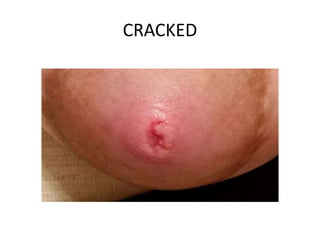
CRACKED
Cracked Nipples
• Definition: It is a condition in which there is a loss of surface epithelium with the
formation of raw area on the nipple along with fissure situated either at the tip or
at the base of the nipple.
• Cause
• Improper hygiene resulting in crust formation
• Retracted nipple
• Trauma
• Due to incorrect breast feeding
• Symptoms
• Painful breastfeeding, it may progress to mastitis
• Prevention
• Maintaining good hygiene practice
• Treatment
• Correct attachment of infant, application of purified lanoline (3-4 times daily), use
of breast pump and shields, analgesics to relieve pain (if severe, application of
antibiotic cream), and biopsy.
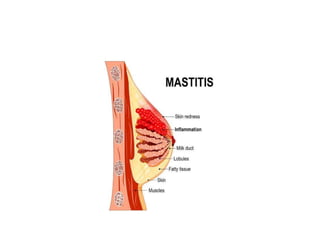
MASTITIS (BREAST INFECTIONS)
• MASTITIS (BREAST INFECTIONS)
• Definition: Mastitis inflammation of tissue is one or both mammary glands
inside the breast.
• Incidence: the incidence of mastitis is 2.5% in lactating and 1% in non-
lactating women.
• MODE OF INFECTIONS
• There are two different types of mastitis depending upon the site of
infection
• 1. Infection that involves the breast parenchymal tissues leading to
cellulitis. The lacteal system remains unaffected.
• 2. Infection gains access through the lactiferous duct leading to
development of primary mammary adenitis.
• Types of mastitis
• Non infective (acute intra mammary mastitis): Usually occurs during first
week or by the end of second week or even after several weeks after
delivery.
• Causes of Non Infective
• Milk stasis
• Unresolved breast engorgement
• Poor feeding technique resulting in milk from one or more
segment of the breast not being efficiently removed by the
baby
• Pressure from fingers or clothing from the mother
• Infective mastitis: The common organisms involved are
Staphylococcus Aureus, S.Epidermidis and Streptococci.
• Causes of infective mastitis
• Damage to the epithelium which allows bacteria to enter the
underlying tissues
• Incorrect attachment of baby to the breast causing trauma to
the nipple
• CLINICAL FEATURES
• SYMPTOMS:
• Generalized malaise and headache
• Fever (102 F or more ) with chills
• Severe pain and tender swelling in one quadrant of the breast
• SIGN:
• Presence of toxic features
• Presence of a wedge shaped swelling on the breast with its apex at
the nipple
• The overlying skin is red, hot and flushed and feels tense and
tender.
• Blocked milk ducts
• PREVENTION
• 1. through hand washing before each feed
• 2. Cleaning the nipples before and after each feed
• 3. Keeping them dry
• TREATMENT-NURSING CARE
• 1. Breast support
• 2. Consuming plenty of oral fluids
• 3. Continuous breast feeding with good attachment
• 4. Unaffected side is nursed first to establish let down
• 5. Infected side is emptied manually with each feed
• 6. Flucloxacillin is the drug of choice or Erythromycin is alternative drug for
patients with allergy to Penicillin
• 7. Antibiotic therapy is continued for 7days
• 8. Analgesics (ibuprofen) are given for pain
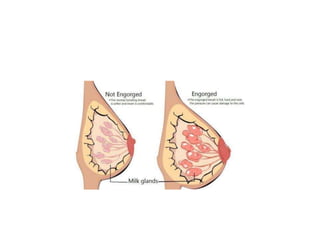
• BREAST ENGORGEMENT
• DEFINTION: It is the swelling of the breast due to an increase in blood and
lymph supply as a precursor to lactation.
• CAUSE
• Baby is not in step with the stage of lactation.
• It is due to exaggerated normal venous and lymphatic engorgement of
breasts which precedes lactation.it involves primiparous women and
women with inelastic breast.
• Debilitating state of the mother
• Early primigravidae
• Failure to suckle the baby regularly
• Depression or anxiety state in the puerperium
• Apprehension to nursing premature baby, who is too weak to suckle
• Painful breast lesions
•
• SYMPTOMS:
• Pain & feeling of tenderness or heaviness in both breast
• Generalized malaise
• Transient rise of temperature
• Painful breast feeding.
• PREVENTION
• Avoid pre lacteal feeds initiate early and unrestricted breast feeding,
• Exclusive breast feeding on demand
• Feeding in correct position.
• MANAGEMENT
• ANTENATAL
• Education regarding the advantages of breast feeding
• Correction of abnormalities like retracted nipples
• Breast hygiene
• Improving the general health status of mother
• ONSET: Usually manifest after milk
secretion starts, 3rd or 4th day postpartum.
• POSTNATAL
• Encourage adequate fluid intake
• Nurse the baby regularly
• Treat painful lesions promptly
• Express residual milk after each feeding
• Drugs like thyroid extract or prolactin are useful.
GENERAL MANAGEMENT
• -To support the breast with a binder or brassiere.
• -Frequent suckling and manual expression of any remaining
milk after each feed
• -Administer analgesics for pain
• -Put baby on breast feed regularly and at frequent intervals
• -Gentle use of breast pump (if severe failing lactation) – this
will reduce the tension in the breast without causing excess
milk production.
• - Gentle hand expression of milk to make the breast soft so
that the infant can latch on
• -Apply moist heat and cold compress to relieve oedema
BREAST ABSCESS
• DEFINITION: Localized collection of pus that forms in the breast is called breast
abscess.
• CAUSES
• Most breast abscesses occur as a complication of mastitis, which is a bacterial
infection that causes the breast to become red and inflamed
• CLINICAL FEATURES
• Flushed breast not responding to antibiotics promptly
• Brawny oedema of the overlying skin
• Marked tenderness with fluctuation
• Swinging temperature
• TREATMENT
• Abscess is drained by radical incision done under general anaesthesia
• Abscess can be also drained by using needle and syringe
• Breast feeding is continued in the uninvolved side
• The infected breast is mechanical pumped every two hours and with every let
down
• Antibiotics given depending upon the culture and sensitivity report of pus
• Antibiotic therapy is given for 7 days
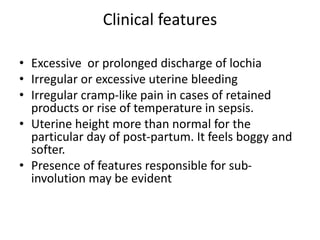
SUB INVOLUTION
• Definition: Sub- involution of the uterus is impaired and deficient involution of the
uterus following delivery when the uterus is not reverted back to the pre-pregnant
both anatomically and physiologically.
• Causes
• Predisposing Factors
• Grand multiparty
• Over-distension of the uterus as in twins and hydraminios
• Maternal ill health
• Caesarean section
• Prolapse of the uterus
• Uterine fibroids
• Baby not sucking
• Aggravating Factors
• Retained products of conception
• Uterine sepsis (Endometritis)
Sub involution
Clinical features
• Excessive or prolonged discharge of lochia
• Irregular or excessive uterine bleeding
• Irregular cramp-like pain in cases of retained
products or rise of temperature in sepsis.
• Uterine height more than normal for the
particular day of post-partum. It feels boggy and
softer.
• Presence of features responsible for sub-
involution may be evident
Management
• Sub-involution is managed by treating the causes.
• Administer antibiotics for sepsis.
• Oxytocin is prescribed to enhance the involution
process by reducing the blood flow to the uterus.
• Exploration of the uterus for retained product of
conception
• Apply pessary in prolapse or retroversion.
• Early ambulation postpartum.
• Daily evaluation of fundal height to document
involution.
WOUND ABSCESS AND HAEMATOMA
• Introduction:
• Wound abscess is a tender mass surrounded by a
coloured area. It is usually painful to touch and
can show up in most places of the body. The most
common sites are armpits, anus or vagina, groin.
It occurs when bacteria gets trapped under the
skin and starts to grow which leads to pus.
Abscess can happen with an insect bite, ingrown
hair, blocked gland, pimple, cyst, or a puncture
wound
Cont
• Definition of terms:
• Laceration: Skin tears with irregular edges and vein bridging.
• Avulsion: Tearing away from supporting structures.
• Ecchymosis/contusion: Blood trapped under the surface of the skin.
• Hematoma: A Tumour like mass of blood trapped under the skin.
• Stab: Incision of the skin with well-defined edges, usually caused by a sharp instrument;
a stab wound is typically deeper than long.
• Cut: An incision of the skin with well-defined edges, usually longer than deep.
• Patterned: Wound representing the outline of the object (e.g. steering wheel) causing
the wound.
• Wound: Is a break in the continuous flow of the mucous membrane of the skin.
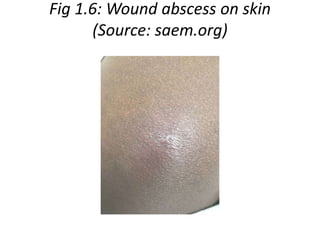
• Abscess: A swollen area within the body tissue, containing an accumulation of pus.
• Abscess: An abscess is the body's way of trying to heal from an infection. Abscesses
form after bacteria, fungi, or other germs enter the body - usually through an open
wound like cut - and cause an infection. When this happens, the body's immune system
is activated and sends out white blood cells to fight the infection.
Fig 1.6: Wound abscess on skin
(Source: saem.org)
Causes
• Skin abscesses are caused by:
• An inflammatory reaction to an infectious process
(bacteria or parasite)
• Substance foreign within the wound.
• Obstructed oil (sebaceous) or sweat glands
• Inflammation of hair follicles on the body or scalp, or
from minor breaks and punctures of the skin.
• Abscesses may also develop after a surgical procedure.
• Microorganisms such as; Staphylococcus aureus.
Signs & Symptoms
• Abscesses are red, swollen, and warm to touch.
• The area becomes hard, firm, and more painful or tender.
• Spontaneous draining or weeping may occur.
• On top of the skin an abscess may look like an unhealed
wound or pimple; under the skin it may create a swollen
bulge.
• In more severe cases, the infection may cause fever and
chills.
• Most abscesses can worsen without treatment and without
adequate incision and drainage. The infection could spread
to deeper tissues and even the bloodstream.
Risk Factors
• Weakened immune system
• Chronic steroid therapy
• Dialysis for kidney failure
• Chemotherapy
• Cancer
• Diabetes
• Sickle cell disease
• Lupus
• HIV/AIDS
• Ulcerative colitis
• Peripheral vascular disease
• Crohn's disease
• Severe trauma
• Severe burns
• Ulcerative colitis
• Alcoholism
• Skin injections from medical procedures, prescription drugs, or tattoos
MANAGEMENT
• Nursing Management
• Apply a warm compress to help the abscess open up and drain.
• Use a wet wash cloth with warm (not hot) water by placing it over
the abscess for several minutes PRN.
• Always wash hands well before and after touching the abscess.
• Medical Management
• Incision and drainage
• Wash hands before and after procedure
• Use sterile equipment
• Drain pus inside a receiver
• Probe wound and pack with sterile dressing
• Apply bandage or adhesive tape
• Discard used instruments.
• Administer Tetanus toxoid if necessary or indicated.
• Give prescribe antibiotics
HAEMATOMA
• Definition:
• Vagina Haematoma: Vagina haematoma is a collection of blood
that pulls in the soft tissue of the vagina or vulva.
• It occurs when nearby blood vessels break due to injury. Blood from
these broken blood vessels can leak into the surrounding tissues.
• Symptoms
• A small vaginal haematoma will not cause any symptoms
• Large haematomas may cause:
• Pain and swelling: a small colored mass may be felt. Similar to a
bruise
• Painful and difficult urination (dysuria) if the mass puts pressure on
the urethra or blocks vagina opening.
• Bulging tissue very large haematomas sometimes extend outside
the vagina.
• Cause
• Falling
• Vigorous sexual intercourse
• High impact sports
• Child birth either due to pressure from pushing or injuries from medical
instruments, including; forceps or vacuum
• Episiotomy
• Nulliparity
• Preeclampsia
• Coagulation disorder
• Multiple gestation
• Trauma to these vessels may also occur because of a compound presentation,
rapid descent, and lacerations, from an operative vaginal delivery including
unrecognized subcutaneous tissue caught in the vacuum cup.
• Vaginal haematomas caused by child birth may not show up until 24 – 48 hours
after birth.
• Diagnosis
• Examination of the vulva and the vagina
• Ultrasound or CT scan to determine size of the haematoma
• Treatment/Management
• The treatment depends on how large they are and whether
they are causing symptoms.
• A small haematoma usually under 5cm is usually
manageable with pain relievers or application of cold
compress (ice pack) to the area to reduce swelling.
• A larger vaginal haematoma may need surgical drain i.e.
Incision & drainage (I&D) very large haematomas or
haematomas located deep in the vagina needs more
extensive surgery.
• POST PARTUM HAEMORRHAGE
• As discussed in complicated midwifery 1
PUEPERIAL PYREXIA
• Introduction:
• Puerperal pyrexia discusses the rise in
temperature in a mother. It is one of the leading
causes of preventable maternal morbidity and
mortality in both developed and underdeveloped
countries.
• Definition: An elevation of temperature to 38oC
(100.4`F) or more occurring on two separate
occasions at 24 hours apart (excluding the first 24
days) following delivery is called puerperal sepsis
• Causes:
• Puerperal sepsis
• Urinary tract infection: cystitis, pyelonephritis
• Breast infection
• Infection of laparotomy wound (caesarean section)
• Inter current infection: acute bronchitis, pneumonia, influenza, acute appendicitis
& enteric fever
• Nursing management
• Barrier nurse
• Hand washing
• Patient placed in Fowlers position to facilitate drainage
• Education of the patient on hand washing and peri-care
• Emotional support
• Check vital signs
• Maintain the fluid intake and output
• Sufficient rest is enforced by analgesics and sedatives
PELVIC ABSESS
• Introduction:
• The pelvic abscess is a life threatening collecting
of infected fluid in the pouch of Douglas, fallopian
tube ovary or parametric tissue. It starts as a
pelvic cellulitis of haematoma spreads to
perimetrial tissue.
• In reproductive age women pelvic abscess most
frequently presents as the progression pf the end
stage of pelvic inflammatory disease, involving
fallopian tube, ovary, and adjacent pelvic organs.
PELVIC ABSESS
• Definition: It is a life threatening post-operative
complications. They may occur weeks after surgery and
mostly have palpable mass in the pelvis.
• Causes: The pelvic abscess is a frequent complication of an
infection of the lower genital tract including pelvic
inflammatory disease.
• Other causes: operative procedures such as hysterectomy,
laparotomy, caesarean section, induced abortion, cancer of
pelvic organs, trauma to the genital tract, Crohne’s disease
complications and diverticulitis.
• Pelvic abscess can be found between the uterus, posterior
fornix and the rectum which sometimes drains
automatically into the rectum.
PATHOPHYSIOLOGY
• The pelvic abscess is a circumscribed collection of infected exudate.
It formed by liquefaction necrosis.
• It develops as a result of an imbalance between host defence
mechanism and insufficient antibiotic coverage in the setting of
bacterial inoculum of high virulence.
• The necrotic tissues are built up around the infective exudate which
formed a thick fibrous wall.
• If the pus does not drain, it will localize the microbes as well as
toxins which could be detrimental to the host and make it more
difficult for antimicrobial agents to penetrate the fibrous
inflammatory capsule and act on it .
• The enzymatic degradation of immunoglobulin's and local release
of complements occurs, which results in persistent pus formation.
• RISK FACTORS:
• Multiple sex partners
• Sexually transmitted infections
• Intrauterine device diabetes
• Low immune system and;
• Preoperative, intraoperative and postoperative procedures
• SIGNS AND SYMPTOMS:
• High grade fever
• General malaise, nausea, vomiting, tachycardia
• Leucocytosis
• Palpable pelvic mass, vaginal bleeding, vaginal discharge or lower
abdominal pain, retention of urine and change in bowel habits
• Physical examination
• Includes; A thorough abdominal, vaginal and
rectal examination.
• Superficial or deep abdominal tenderness on
abdominal palpation may be indicative of
peritonitis.
• Comprehensive Vaginal Examination:
• Consists of; bimanual, vaginal exam, to assess the
size of the uterus, mobility, consistency and
adnexa
• Rectal Exam:
• On rectal exam, tenderness and building of the anterior
rectal wall may be present.
• Diagnosis: Ultrasound (trans vaginal or trans
abdominal)
• Computed tomography (CT and Magnetic Resonance
Imaging ‘MRI’)
• Other Investigations: Include; Full Blood Count (FBC),
Blood culture, exudate culture and sensitivity, wet
mount test of vaginal discharge, and a urine pregnancy
test to rule out an intrauterine and ectopic pregnancy.
• MANAGEMENT/TREATMENT:
• Early recognition
• Diagnosis
• Immediate hospitalization
• Treatment regardless of the size of the abscess
• Combination of parenteral antibiotics (24-48hours) should be
started to treat the mixed aerobic and anaerobic microbes.
Subsequently oral antibiotics are given, after the patient become
afebrile
• General hygiene
• Good nutrition
• SURGICAL MANAGEMENT
• Incision and Drainage by doctor
Complications
• Ectopic pregnancy; the scare tissue from previous
inflammation and infection prevents the fertilized
ovum to implant in the uterus and results the
atopic pregnancy.
• Infertility; Adhesion as a result of abscess and
inflammation causes severe damages to the
fallopian tube and celery epithelium and ovary
resulting in infertility.
• Chronic pelvic pain: this pain is related to scaring
and adhesions from the previous abscess and
infection
• Postoperative and Rehabilitation Care
• Postoperative care is critical in the patient with surgical
abscess removal and drainage. The patient must be
monitored closely in the first 24 hours for any
worsening of the condition. They are at a high risk of
clinical deterioration.
• All patients require strict observation for any sign and
symptoms of sepsis, hemorrhage, and shock. Every
patient's vital signs should be monitored and recorded
periodically. It includes systolic blood pressure, pulse,
temperature, and oxygen saturation.
• The patient's intake and output
• The patient's intake and output should be maintained and recorded,
including the drain. Drain can be removed in a few days after the drainage
become minimal, and the patient improves clinically. Appropriate
analgesia should be given to control post-operative pain.
• Nausea control should be with an anti-nausea medicine as per needed
basis. Woundcare will involve by keeping the dressing dry and clean. The
parenteral antibiotic should be given for the first 24 hours or until the
patient becomes afebrile and then subsequently be changed to oral
antibiotics to complete the Course.
• Deterrence and Patient Education
• The most common cause of pelvic abscess in the women of reproductive
age group is a pelvic inflammatory disease. It is the duty of the provider
either nurse, primary physician or obstetrics /gynaecologist to provide
education to the patient about safe sex, regular use of condoms and
limiting the number of sexual partners especially in adolescents and
teenagers.
ENDOMETRITIS
• Introduction:
• This usually occurs in non-pregnant women or after
giving birth. It causes severe discomfort and other
infection. This topic will explain how this can be
transmitted, the effects and severity of each stage.
• Definition
• It is inflammation of the lining of the uterus.
• Commonly occurs after giving birth or also in non-
pregnant women.
• In addition to endometrium, inflammation may involve
myometrium and occasionally perimetrium
Causes of Endometritis
• Endometritis is caused by infection in the uterus. It can be due to
• -Chlamydia
• -Tuberculosis
• -Gonorrhoea
• -Mix of normal vaginal bacteria.
• It is most likely to occur after miscarriage or childbirth or after C-
section.
• It can be transmitted through following medical procedures:
• -Hysteroscopy
• -Placement of an Intra Uterine Device (IUD))
• -Uterine scrapping
Symptoms
• -Dysmenorrhea
• -Dyspareunia
• -Abnormal vaginal discharge
• -Increased amount
• -Unusual colour, consistency, colour
• -Discomfort with bowel movement (including
Constipation).
• -Fever (range from 37.8 to 40C)
• -General discomfort, uneasiness, or ill feeling (malaise).
• -Pain in lower the abdomen or pelvic region.
• -Pain is typically chronic and crampy
Acute endometritis
• It is characterized by infection. The organisms most
often isolated are because of compromised abortions,
delivery, medical instrumentation and retention of
placental fragments.
• Histologically; Neutrophilic infiltration of the
endometrial tissue is present during the acute
endometritis.
• Clinical presentation includes typical high fever and
purulent vaginal discharge.
• Menstruation after acute endometritis is excessive.
• Most often caused by Staphylococci, Streptococci or
N.gonorrheae.
Chronic endometritis
• Characterized by the presence of plasma cells in the stroma.
• Lymphocytes, eosinophils and even lymphoid follicles can be seen
but in the absence of plasma cells are not enough for a histologic
diagnosis.
• The most common organisms are;
• -Neisseria gonorrhoea
• -Chlamydia
• -Streptococcus Agalactiae
• -Tuberculosis
• -Mycoplasma
• -Various viruses
• Patients suffering from chronic endometritis may have an
underlying cancer of the cervix or the endometrium.
VENOUS THROMBOSIS (Deep Vein
Thrombosis ‘DVT’)
• Introduction:
• Deep vein thrombosis is a condition which
occurs when circulation to the lower limbs is
disrupted. However, there are treatments to
DVT. With symptoms only appearing in 20-
25% of patients. Deep vein thrombosis
commences in the calf vein and may extend.
Portions may break off leading to pulmonary
embolus
VENOUS THROMBOSIS
• EPHATOGENESIS
• Deep Vein Thrombosis: it is an acute thrombosis of the
deep veins. Deep vein thrombosis DVT is very common in
the western countries, the exact cause is not known.
• The thrombus may commence in the calf vein. Thrombus
extends into the main deep vein, where a portion may
break off to cause pulmonary embolus.
• 5-20% of DVTs may lead to Pulmonary embolism.
• There is aggregation of platelets in value pockets, the area
of maximum stasis or injury. This will lead to activation of
clotting cascade producing fibrin.
• Fibrin production overwhelms the natural anticoagulant or
fibrinolysis system
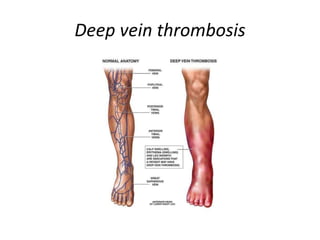
Deep vein thrombosis
• Natural history: A deep vein thrombosis may have the following
fates.
• Complete resolution
• Pulmonary embolism
• Postphlebitic limb (PL) - This is a syndrome of bursting pain in the
limb on exercise and occurs only in 5% cases of asymptomatic DVT
within 5 years.
• SYMPTOMS:
• Asymptomatic in most cases
• Pain
• Swelling or oedema of leg
• Secondary varicose veins
• Lipodermatoscelerosis with or without venous ulcer.
• These symptoms only present in 20-25% patients.
• SIGNS
• Homan’s test: Forcible dorsiflexion of foot results
in severe pain in the calf region
• Mose’s Sign: Tenderness over the calf muscle.
• Phlegmesia Cerulea Dolens: where limb is blue
because even the collateral vessels are occluded
• Phlegmesia Alba Dolens: Collateral vessels are
not occluded and limb is pale.
•
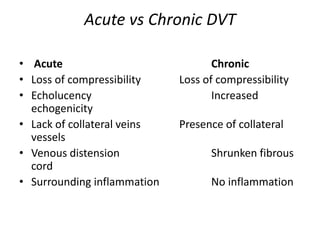
Acute vs Chronic DVT
• Acute Chronic
• Loss of compressibility Loss of compressibility
• Echolucency Increased
echogenicity
• Lack of collateral veins Presence of collateral
vessels
• Venous distension Shrunken fibrous
cord
• Surrounding inflammation No inflammation
INVESTIGATIONS
• Duplex ultrasound examination: It is a good standard for diagnosis.
It has a sensitivity of 95% for proximal DVT but 75% for calf DVT.
• Filling defects in flow and lack of compressibility indicate the
presence of a thrombosis.
• MR Venography
• Ascending venography-it is not routinely done nowadays as it is an
invasive as well as extensive test.
• D-dimer: a fibrin degradation product is increasingly being used as a
screening adjunet. Patients who present in the emergency
departments with an idiopathic thrombosis usually undergo a D-
dimer measurement. If the D-dimer level is increased a duplex
ultrasound examination of the deep veins is performed.
• DIFFERENTIAL DIAGNOSIS
• A calf muscle hematoma’
• A ruptured baker’s cyst
• A thrombosis political aneurysm
• Arterial ischemia
•
•
•
•
Treatment of DVT
•
Fig 1.14: Treatment of DVT
HOW TO PREVENT DVT
PLAMACOLOGIC
Low dose
ultraconated
hepain
Low
molecular
weight
hepain
MEDICAL
Early
ambulation
(start walking
with 24-
48hours)
Put off bed
into chair it
is one of
the most
hetogenic
positions
elastic
stockings
Intemitent
prenatic
compression
device
application
of TED
stockings
TREATMENT DEFINITIVE
• Bed rest and elevation of leg.
• Simple analgesics and sedative.
• Anticoagulation:
• Unfractionated Heparin (UPH): Heparin exerts its anticoagulant effect by inhibiting
thrombin (Factor II) after combing with antithrombin III, which acts as heparin
cofactor. Its effectively can be determined by measuring the clotting time and
activated partial thromboplastin time (APTT).
• Dose: Injection heparin – 10000 units IV bolus with continuous infusion of 30,000 -
45,000 units/day. During heparin therapy activated partial thromboplastin time
should be double the normal value to prevent the propagation of thrombi. Heparin
is given for 7-10 days.
• Low molecular weight heparin (LMWH): Enox apariat 1mg/kg. Subcutantcously
twice daily. LMWH is as effective as or even better than unfractionated heparin.
• Oral anticoagulation: Warfarin, as oral anticoagulant is started 2-3 days before
heparin is withdrawn because of the slow onset time of warfarin.
• Anticoagulation with warfarin is continued for 3-6 months or even longer for 2
years or indefinitely in some patients with coagulation abnormalities such as
antithrombin deficiency or recurrent venous thrombosis. The dosage of warfarin is
maintained by weekly or twice weekly international normalized radio (INR)
estimations.
• THROMBOPHELEBITIS
• Introduction: The inflammation of the vein with a
clot of blood formed inside the inflammation. The
causes are further elaborated in this session.
Thrombophlebitis can be prevented with
immediate measures taken by attending health
care provider and are easily managed with
medication
• DEFINITION: Thrombophlebitis is the
inflammation of a vein with blood clot formed
inside the vein at the side of the inflammation
CAUSES
• In normal pregnancy there is rise in concentration of coagulation
factors 1, VI1, VII1, IX.X, and XII. Plasma fibrinolytic inhibitors
produced by placenta and the level of protein S is marked
decreased.
• Alteration in blood constituents- increased number of platelet &
their adhesiveness.
• Venous stasis is increased due to compression of gravid uterus to
IVC & iliac veins. This stasis causes damage to endothelial cells.
• Thrombophilia are hypercoagulable states in pregnancy that
increase the risk of venous thrombosis
• Other acquired risk factors for thrombosis are advanced age and
parity, operative delivery (10 times more), obesity, anaemia, heart
disease, infection of pelvic cellulitis and trauma to the venous wall.
SIGNS AND SYMPTOMS
• Fever
• Abdominal pain, usually localized and restricted
to the Side of the affected vein but may spread
into the groin, Upper abdomen, or flank
• Abdominal bloating and tenderness
• A tender, sausage-shaped mass near the
umbilicus
• Decreased or absent bowel sounds
• Nausea, vomiting and increased pulse rate
• HOMANS signs-Pain in the calf region
• INVESTIGATIONS
• Doppler ultrasound
• Venography
• Fibrinogen scanning
• CT Scan or MR
PROPHYLACTIC MEASURES
• Avoid pressure behind the knees
• Avoid prolonged sitting
• Avoid constructive clothing
• Avoid crossing the legs
• Never massage the leg
• Apply compression stockings
• Elevate legs including foot of the bed
• Ambulate as soon possible
• Prophylactic anticoagulants therapy should be
started
MANAGEMENT
• Complete bed rest with foot end raised above
heart level
• Analgesics for pain
• Antibiotics therapy
• Anti-coagulants Heparin 150001U /1V 4to 6
hourly for 7-10days should be given
• Apply elastic stockings are fitted on the affected
leg before mobilization
• Venous thrombectomy
PUERPERAL PSYCHOSIS/DEPRESSION
• INTRODUCTION: Child birth is normally a time for rejoicing, but
unfortunately, there is a group of women for whom motherhood
has a dark sis, they are about one or two in a thousand new
mothers who require admission to a mental hospital for a first
episode of post-partum psychosis or for a recurrence of affective
(puerperal or non-puerperal) or for the problems associated with
pre-existing psychiatric disorder that are complicated by the needs
and demands of a young infant, In addition, for every hospitalized
and psychotic mother, there at least a hundred in the community
suffering from non-psychotic depressions, many of whom have
begun soon after the birth of the baby.
• DEFINITION: Puerperal mental disorders or psychoses may be
defined as the development of certain mental illnesses six weeks
after having a baby or giving birth to a baby. Thus, puerperal
psychosis means a serious mental illness, developing in a woman
shortly after she has given birth
The Aetiology of Puerperal psychosis
• Experts or professionals are not exactly sure why
postpartum psychosis happens. However, they do
offer a variety of explanations for the disorder,
with a woman’s changing hormones being at the
top of the list. Other possible reasons or
contributing factors include a lack social and
emotional support; a low sense of self-esteem
due to a woman’s postpartum appearance;
feeling inadequate as a mother; feeling isolated
and alone; having financial problems and
undergoing a major life change such as loss of
employment, moving or starting a new job.
Cont
• There are also other known precipitating or contributory factors
such as:
• 1. Mental illness before pregnancy.
• 2. A history of mental illness, including postpartum depression, in
the family.
• 3. Postpartum mental disorder after an earlier pregnancy.
• 4. Conflict in the marriage, particularly in some cultures where the
husband my demand the wife to deliver a particular sex or poor
social support from friends and family.
• 5. Pregnancy loss, such as miscarriage or stillbirth.
• 6. The risk of major depression after a miscarriage is high for
women who are childless. It occurs even in women who were
unhappy about being pregnant. And also the risk for developing
depression after miscarriage is highest within the first few months.
The Prevalence of Postpartum
Psychosis
• 1. Postpartum depression occurs in about 10-15% of
women in the general population Postpartum depression
occurs most frequently in the first 4 months following
delivery, but can occur anytime in the year. Postpartum
depression is not different from any depression that can
occur at any other time in a woman's life.
• 2. During the postpartum period, up to 85% of women
experience type of mood disturbance. For most women,
symptoms are transient and relatively mild (i.e. postpartum
blues). However, 10-15% of women experience a more
disabling and persistent form depression and 0.1-0.2% of
women experience postpartum psychosis
• Pathophysiology
• Hormonal factors:
• Levels of oestrogen, progesterone and cortisol fall
dramatically within 48 hours after delivery.
• Women with postpartum depression do not differ
significantly from non-depressed women with regard
to levels of oestrogen, progesterone, prolactin and
cortisol or in the degree to which these hormone levels
change. However, affected individuals may be
abnormally sensitive to changes in the hormonal milieu
and may develop depressive symptom when treated
with exogenous oestrogen or progesterone.
• Psychological factors:
• a. Women who report inadequate social support, marital discord or
dissatisfaction or recent negative or unwanted life events are more likely
to experience postpartum depression.
• b. No consistent association between obstetric factors and risk for
postpartum depression is apparent.
• 3. Biologic vulnerability:
• a. There is evidence of linkage to chromosome. Women with prior history
of depression or family history of a mood disorder are at an increased risk
for postpartum depression. Women with a previous history of postpartum
depression or psychosis have up to 90% risk of recurrence.
• b. These are world-wide disorders. Their incidence has been carefully
measured by state-of-the-art epidemiological studies, and is somewhat
less than 1/1,000 deliveries. They are more common in first time mothers.
Menstrual psychosis is an important clue to the cause. Molecular genetic
studies suggest that there is a specific heritable factor.
• Types of Puerperal Psychosis.
• Postpartum (or puerperal) psychosis is a term
that covers a group of mental illnesses with
the sudden onset of psychotic symptoms
following childbirth. In this group, there are at
least a dozen organic psychoses, which are
described under "Organic pre- and
postpartum psychoses” group of psychotic
symptoms.
The Features of Mood Disturbances
after Childbirth
• There are 3 types of mood disturbance after childbirth.
Blues:
• Puerperal psychosis is one of these, but it is certainly the rarest or less common.
The most common (at least 1 in every 2 women) is the "blues ", which happens
usually about 2-4 days after delivery. Women feel tearful and upset and are very
sensitive about their baby, problems, with breastfeeding and other people's
comments. With support and reassurance things generally settle down within 1-2
days, and women feel completely well (provided, for instance, they are getting
enough sleep and support).
• In contrast, puerperal psychosis resembles a rapidly evolving manic or mixed
episode with symptoms, such as restlessness, insomnia, irritability, rapidly shifting
depression or elated mood and disorganized behaviour. The mother may have
delusional beliefs that relate to the infant (for example, the baby is defective or
dying, or the infant is Satan or God), or she may have auditory hallucinations that
instruct her to harm herself or her infant. Risks of infanticide and suicide are high
among women with untreated postpartum psychosis.
2. The Manic Phase:
• Within about 4 to 14 days after the baby is born, it becomes clear to
everyone that something is seriously wrong with the new mother.
• The Woman may be very irritable and begin to believe things that are
obviously not true.
• These are called delusions fixed false beliefs that may be harmless but can
sometimes lead to the woman harming herself, her infant or even others.
• This may also be because she believes that she is hearing voices (auditory
hallucinations) or seeing sentences or ideas.
• She could be quite elated or confused and her moods may vary within a
very short time. If she is prevented from doing what she wants, she may
become very aggressive and abusive in a way that is quite out of character.
Frequently, affected women will deny that there is anything wrong with
them and refuse to stop what they are doing, despite knowing that other
people find their strange or out of character.
• During this phase, a new mother’s behaviour may seem quite confused
and forgetful.
• This, of course will make her very disorganized at a time when she is trying
to learn new skills for her baby. This can very quickly become a very
upsetting situation.
• 3. The Depressed Phase:
• After days or sometimes several weeks, depending on
factors such treatment, the manic phase may stop suddenly
as it began and the woman may become extremely
depressed. Just like with Post-Natal Depression (PND), her
mood is very depressed. She severely lacks energy, does
not want to sleep or eat, may begin to think of killing
herself (and/or sometimes her baby) and her concentration
is very poor. She may just sit around and it is hard to have a
conversation with her. She is usually very tearful and hates
herself. She feels hopeless helpless and worthless,
especially as a mother. She has very little energy to do
anything and may stop caring for herself in her usual way.
• Signs of postpartum psychosis are unique or relative to
each client but the most common ones include:
• 1. Hallucination
• 2. Illogical thoughts
• 3. Refusing to eat
• 4. Extreme feelings of anxiety and agitation
• 5. There may be suicidal or homicidal thoughts
• 6. Confusion
• 7. Rigidity or extreme flexibility of the limbs
• 8. Delusions
• 9. Insomnia.
Treatment
• The treatment usually consists of the following:
• The mother will usually be admitted to hospital. If at all possible,
this will be to a specialist mother and baby unit, where the mother
is treated by a team of specialists with knowledge of, and interest
in, postnatal mental illness. If such a unit is not available, she may
be admitted to an acute or general psychiatric ward.
• 1. Most Women will need an antipsychotic medication
• 2. She will often also need tablets to stabilize her moods (mood
stabilizers) such as lithium or other drugs sometimes injections,
which will calm her down, slow her thinking and help her get back
in touch with reality.
• 3. If she is in the depressed stage of the illness, antidepressants are
often used.
• 4. Hormonal Therapy: There is a great deal of controversy still surrounding the
efficacy of hormonal treatment for postnatal illness. It is generally not thought to
be effective in treating puerperal psychosis. Hormone replacement may, however,
have a role to play in preventing puerperal psychosis and experimental trials are
currently being conducted on oestrogen prophylaxis.
• 5. Psychotherapy/Occupational Therapies: Once the woman's condition has been
successfully stabilized, she is likely to be offered additional therapies aimed at
helping her to re-establish control over her life. These may include relaxation
classes, individual or group psychotherapy and occupational therapy.
• 6. Electro Convulsive Therapy (ECT):
• a) Sometimes women are so unwell that ECT will be recommended. This can sound
very alarming indeed, but it is only recommended when the illness (sometimes the
manic phase but more commonly the depressed phase. Is really severe and other
methods of treatment are medications are failing or not working.
• b. It is an extremely successful treatment, which may work out when medications
are failing or not working quickly enough. If this treatment is recommended, staff
should explain the procedure in detail about how it works, and the risks and
benefits, usually involving the woman herself and her main support person/s in
the decision.
General Management
• 1. Women often need some assistance with looking after their
babies safely and keeping themselves safe and cared for as well.
• 2. Sleep is a real problem for women suffering from puerperal
psychosis and is an essential part of getting well. Therefore,
healthcare workers must ensure that the client sleeps well.
• 3. In some cases, women appear to deteriorate when they are
admitted to hospital and this happens for several reasons. It may be
that the lack of sleep is beginning to have more effect or that the
woman is irritated by the restrictions of being the hospital. It can
also be the natural progression of the illnesses. In some cases, the
women cannot understand that they are unwell, and that their
anger is quite obvious. The health professional must through
interviews try to find out the cause or causes of the client’s
problems and assist her.
•
Management at Hospital and Home
• 1. Most women need to be treated in the hospital, and
are likely to be hospitalised for 2-3 weeks.
• 2. When she is discharged home, a woman will still
need to take her medication, often for 6-12 months.
This should be discussed with her and her family
before discharge. Generally, a woman will need to
continue to see her general practitioner; a psychiatrist
and perhaps a mental health nurse after discharge who
will monitor her medication and help to determine the
length of time that she needs to stay on it. She may
also continue to get help with her baby at primary
health care centre if the condition can be managed at
the centre.
• 3. Breastfeeding in women treated with lithium should be
pursued with caution because lithium is secreted at high
levels in breast milk and may cause significant toxicity in
the nursing infant. If the breastfed infant is exposed to
lithium in the breast milk, periodic monitoring of lithium
levels and thyroid function is indicated.
• 4 Breastfeeding in premature infants or in those with
hepatic insufficiency that may have difficulty metabolizing
medications present in breast milk should be avoided. As
mentioned above, lithium is secreted at high levels in
breast milk and may cause significant toxicity in the nursing
infant. If the breastfed infant is exposed to lithium in the
breast milk, periodic monitoring of lithium levels and
thyroid function is indicated.
• The Husband and the Family Roles
• It is very important for partners and other immediate family
members be informed and be available for support. Other family
members to be informed and be available for support. Other family
members, parents and other children in the family may also find the
situation tough in the early stages of the illness when a woman is
for first time after the birth of a first child, which makes things very
hard for the new family. The new father may find his partner
suddenly unwell and not able to come home and he may find the
separation from his partner and child very difficult to adjust. He
may also need support from family, friends or professionals. Getting
more information about the condition can be very helpful in coming
to terms with what is going on, even though it is clear that it is a
difficult time.
The Effect of the Illness on Babies and
Families
• When a woman is really unwell, at first she may be at risk of deliberately
harming her baby because of some unusual belief she has related to her
illness.
• In the early days of her illness, the medical staff should keep a very close
eye on her so that she does not harm her baby.
• A Woman may also neglect her infant because she is very excited and
restless. She may intend to do the right things to her baby but cannot do
so because she is not organized enough and lacks concentration.
• The staff, therefore, will need to be very involved in helping her to care for
her and the baby’s needs.
• When a woman is depressed, she may find it difficult to have enough
energy to look after her baby properly and may need some help at this
stage, too. Sometimes these safety factors are adequately addressed,
follow-up studies have shown also interfere with her care of her baby. In
addition, there may be risks associated with breast feeding on tablets.
• The woman, her family and the doctors must discuss the risk vs. benefits
of medication with breastfeeding, so that everyone has enough
information to understand the best choices for each situation. In the long
term, when these safety factors are adequately addressed, follow up
studies have shown that the babies grow up without any major
consequences of their mother’s illness.
POST NATAL DEPRESSION
• Post natal depression has an incidence of at least 1: 10
with a further similar figure developing considerable
emotional distress.
• Onset tends to be gradual, developing after the second
postnatal week, often coinciding with the reduction in
professional involvement. The condition may last for 3-
6 months and in some cases it will persist throughout
the first year of the baby’s life. Such depression is
disabling for the mother and causes considerable
disruption of family life and maternal-child
relationship. There is some evidence that depression in
the mother has an adverse effect upon her baby’s
performance in developmental tests.
Causes
• Postnatal depression is a reactive illness.
• Its causes are complex but possibly provoked by demand overload.
The dramatic fall in the circulating hormones progesterone and
oestrogen following expulsion of the placenta have been proposed
as causative with a potential link between severe ‘maternal blues’
and later development of depression.
• Studies involving 120 primiparous women concluded that they
could not support the progestin theory.
• It was however found that a link between lowered evening cortisol
levels from before delivery until 10 days postpartum in women
diagnosed as depressed at 6 weeks,.
• Women’s own perceptions of cause commonly included the
demands of motherhood, lack of support and loss of personal
freedom
RECOGNITION
• Awareness of body language and knowledge of the individual (woman) may help
midwife to identify the potential risk.
• The woman may complain of numerous indefinable physical symptoms or appear
overanxious about her baby in spite of evidence that her baby is well and thriving.
• The baby may be irritable or show signs of failing to thrive as a response to or
effect of the condition of the mother.
• Early signs:
• Anxiety and worries about the baby
• Feeling of inability to coop
• Feeling overwhelmed by the demands of motherhood
• Having a new baby may lead to sleep disturbance
• Feeling of sadness, inadequacy, worthlessness.
• Loss of appetite
• Low self-esteem
• Persistent lowered mode
• Loss of enjoyment and spontaneity
• Severe Depressive Illness
• Severe (PND): Onset is insidious and often starts slowly in
the first 2-3 weeks postpartum. Generally, starts usually
when midwife care, family care, support from partner, and
friends are curtailed.
• Aetiology - unclear
• Risk factors - family history of severe affective disorder
• Family history of depressive illness
• History of developing depressive illness in the last trimester
of pregnancy
• Loss of previous infant (including stillbirth)
• Conception through IVF
Clinical Features
• 'Somatic syndrome' of broken sleep and early morning waking up, unstable mood,
loss of appetite and weight, slowing of mental functioning, impaired
concentration.
• Biological syndrome' of sleep disturbance, of waking early in the morning; the
woman will feel most depressed and her symptoms will be worst at the start of the
day
• Impaired concentration, disturbed thought processes, indecisiveness and an
inability to cope with everyday life
• Emotional detachment and profound lowering of mood
• Loss of ability to feel pleasure (anhedonia) feelings of guilt, incompetence and of
being a 'bad' mother
• In approximately one-third of women, distressing intrusive obsessional thoughts
and ruminations
• Commonly extreme anxiety and even panic attacks
• Impaired appetite and weight loss
• In a small number, a depressive psychosis and morbid, delusional thoughts and
hallucinations.
• Management
• Prompt identification for referral by specialist and mental team.
• Psychological & social support and active listening, cognitive
behavioral therapy and interpersonal psychotherapy.
• Pharmacological treatment: Give antidepressants, not necessary if
patient is breastfeeding.
• Prognosis
• With appropriate management, postnatal depression should
improve within weeks and recover by the time the infant is 6
months old. However, untreated there may be prolonged morbidity.
This, particularly in the presence of continuing social adversity, has
been demonstrated to have an adverse effect not only on the
mother/infant relationship but also on the later social, emotional
and cognitive development of the child.
Relationship with the baby
• Severe depressive symptomatology, particularly when combined with panic and
obsessional phenomena can have a profound effect on the relationship with the
baby, in many, but by no means all women.
• Most women who suffer from severe postnatal depression maintain high
standards of physical care for their infants.
• However, many are frightened of their own feelings and thoughts and few gain
any pleasure or joy from their infant.
• Most affected women feel a deep sense of guilt and incompetence and doubt
whether they are caring for their infant properly.
• Normal infant behaviour is frequently misinterpreted as confirming their poor
views of their own abilities. While a fear of harming the baby is commonplace,
overt hostility and aggressive behaviour towards the infant extremely uncommon.
• It should be remembered that the majority of mothers who harm small babies are
not suffering from a serious mental illness.
• The speedy resolution of maternal illness usually results in a normal mother-infant
relationship.
• However, prolonged chronic depressive illness can interfere with attachment and
social and cognitive development in the longer term particularly when combined
with social of and mental problems
• Mild postnatal depressive illness
• This is the commonest condition following childbirth, affecting up to 10%
of all women postpartum. It is in fact no commoner after childbirth than
among other non-child bearing women of the same age.
• Risk factors
• Some women who suffer from this condition will be vulnerable by virtue
of previous mental health problems or psychosocial adversity,
unsatisfactory marital or other relationships or inadequate social support.
Others may be older, educated and married for a long time, perhaps with
problems conceiving, previous obstetric loss or high levels of anxiety
during pregnancy. Unrealistically high expectations of themselves and
motherhood and consequent disappointment are commonplace. Also
common are stressful life events such as moving house, family
bereavement, a sick baby, experience of special care baby units and other
such events that detract from the expected pleasure and harmony of this
stage of life.
Clinical features
• The condition has an insidious onset in the days and weeks
following childbirth but usually presents after first 3 months
postpartum.
• The symptoms are variable, but the mother is usually tearful, feels
that she has difficulty coping and complains of irritability and a lack
of satisfaction and pleasure with motherhood.
• Symptoms of anxiety and a sense of loneliness and isolation and
dissatisfaction with the quality of important relationships are
common.
• Affected mothers frequently have good days and bad days and are
often better in company and anxious when alone.
• The full biological (somatic subtype) syndrome of the more severe
depressive illness is usually absent.
• However difficulty getting to sleep and appetite difficulties, both
over-eating and under-eating, is common.
• Relationship with the baby: Dissatisfaction with motherhood and a sense of the
baby being problematic are often central to this condition, particularly when
compounded by difficulty in meeting the needs of older children.
• Lack of pleasure in the baby, combined with anxiety and irritability, can lead to a
vicious circle of a fractious and unsettled baby, misinterpreted by its mother as
critical and resentful of her and thus a deteriorating relationship between them.
However, it should also be remembered that the direction of causality is not
always mother to infant.
• Some infants are very unsettled in the first few months of their life. A baby who is
difficult to feed and cries constantly during the day or is difficult to settle at night
can just as often be the cause of a mild postnatal depressive illness as the result of
it. Even mild illnesses, particularly when combined with socio-economic
deprivation and high levels of social adversity can lead to longer-term problems
with mother-infant relationships and subsequent social and cognitive
development of the child.
• A very small minority of sufferers from this condition may experience such marked
irritability and even overt hostility towards their baby that the infant is at risk of
being injured.
• Management: Early detection and treatment is essential for both mother
and baby. For the milder cases, a combination of psychological and social
support and active listening from a health visitor will suffice. For others
treatments, such as cognitive behavioral psychotherapy and interpersonal
psychotherapy are as, if not more effective, than antidepressants as
outlined in Antenatal and Postnatal Mental Health guidelines.
• Prognosis: With appropriate management, postnatal depression should
improve within weeks and recover by the time the infant is 6 months old.
However, untreated there may be prolonged morbidity. This, particularly
in the presence of continuing social adversity, has been demonstrated to
have an adverse effect not only on the mother/infant relationship but also
on the later social, emotional and cognitive development of the child.
• Breastfeeding: There is no evidence that breastfeeding increases the risk
of developing significant depressive illness, nor that its cessation improves
depressive illness. Continuing breastfeeding may protect the infant from
the effects or maternal depression and improve self-esteem.
Risk factors for mild
• Antenatal depression
• History of previous postnatal depression
• Quality of psychosocial support
• Stressful life events
• Stress related to child care
• Postnatal blues'
• Quality of relationship with partner
• Antenatal anxiety
•
•
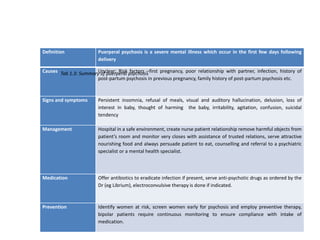
Definition Puerperal psychosis is a severe mental illness which occur in the first few days following
delivery
Causes Unclear; Risk factors –first pregnancy, poor relationship with partner, infection, history of
post-partum psychosis in previous pregnancy, family history of post-partum psychosis etc.
Signs and symptoms Persistent insomnia, refusal of meals, visual and auditory hallucination, delusion, loss of
interest in baby, thought of harming the baby, irritability, agitation, confusion, suicidal
tendency
Management Hospital in a safe environment, create nurse patient relationship remove harmful objects from
patient’s room and monitor very closes with assistance of trusted relations, serve attractive
nourishing food and always persuade patient to eat, counselling and referral to a psychiatric
specialist or a mental health specialist.
Medication Offer antibiotics to eradicate infection if present, serve anti-psychotic drugs as ordered by the
Dr (eg Librium), electroconvulsive therapy is done if indicated.
Prevention Identify women at risk, screen women early for psychosis and employ preventive therapy,
bipolar patients require continuous monitoring to ensure compliance with intake of
medication.
Tab 1.3: Summary of puerperal psychosis
SHOCK
• INTRODUCTION: Shock is a failure of cardio vascular system
to deliver enough oxygen & nutrients to meet cellular
metabolic needs. Shock may develop rapidly or slowly all
the system of the body included; in this shock condition the
body will struggle to survive then the haemostatic
mechanism (coagulation or blood clotting) will occur it
provide blood circulation. The remedy is to stop
haemorrhage if shock is due to haemorrhage
• Definition SHOCK
• Shock is a complex syndrome involving a reduction in blood
flow to the tissues with resulting dysfunction of organs and
cells. It entails progressive collapse of the circulatory
system and, if left untreated, can result in death
• Classification of shock:
• Hypovolemic shock
• Cardiogenic Shock
• Distributive shock
• Obstructive Shock (rare)
•
• Hypovolemic shock: This is the most common type of shock
• -Insufficient circulating volume which could be non-haemorrhagic or
haemorrhagic.
• - Non-haemorrhagic: vomiting, diarrhoea, bowel obstruction, pancreatitis,
burns, dehydration.
• - Haemorrhagic: GI bleed, ectopic pregnancy, ante/postpartum bleeding.
• Signs and Symptoms
• Hypotension, tachycardia, oliguria,
• Cardiogenic Shock: Failure of the heart to pump
effectively
• 1. Due to damage to the heart muscle
• 2. Large myocardial infarction
• 3. Arrhythmias (too fast or too slow)
• 4. Cardiomyopathy
• 5. Congestive heart failure (CHF)
• 6. Cardiac valve problems
• 7. Septal defects
• 8. Aortic stenosis
• Signs and Symptoms
• Dyspnoea
• Heart rate (decreased)
• Low BP
• Oliguria
• Distributive shock
• Similar to hypovolemic shock – insufficient intravascular volume of
blood or "relative" hypervolemia - result of dilation of all blood
vessels so the "tank" is much larger
• Distributive shock examples
• Anaphylactic shock
• -Severe reaction to an allergen, antigen, drug or foreign protein,
releasing histamine causing widespread vasodilation, hypotension
and increased capillary permeability
• Neurogenic shock: Rarest form of shock.
• -Trauma to spinal cord resulting in loss of autonomic and motor
reflexes below injury level. Vessel walls relax uncontrolled,
decreasing peripheral vascular resistance, result vasodilation and
hypotension
• Obstructive Shock
• Mechanical block to heart's outflow
• Pulmonary embolus
• Cardiac tamponade
• Tension pneumothorax
• Psychogenic shock
• Immediately follows sudden fright
• Eg bad news, severe pain (blow to the testes
• Haemorrhagic shock
• It is one of the commonest forms of hypovolemic shock
• Hypovolemic leads to decreased preload which leads to increased sympathetic
activity and vasoconstriction
• Vasoconstriction leads to decreased mean aarterial pressure and ischemia which
ultimately leads to multi organ failure-ARDS, HEPATIC FAILURE,STRESS,GI
BLEEDING.RENAL FAILURE
• Ischemia leads to myocardial insufficiency and severe decrease in Systemic
Vascular Resistance and finally death
• STAGES OF SHOCK
• An initial non-progressive stage: during which reflex
compensatory mechanisms are activated and vital
organ perfusion, is maintained. The reduction in fluid
or blood decreases the venous return to the heart. The
ventricles of the heart are inadequately filled, causing a
reduction in stroke volume and cardiac output. As
cardiac output and venous return fall, the blood
pressure is reduced. The drop in blood pressure
decreases the supply of oxygen to the tissues and cell
function is affected.
• Compensatory stage; the drop in cardiac output produces a response
from the sympathetic nervous system through the activation of receptors
in the aorta and carotid arteries. Blood is redistributed to the vital organs.
Vessels in the gastrointestinal tract, kidneys, skin and lungs constrict. This
response is seen by the skin becoming pale and cool. Peristalsis slows,
urinary output is reduced and exchange of gas in the lungs is impaired as
blood flow diminishes. The heart rate increases in an attempt to improve
cardiac output and blood pressure. The pupils of the eyes dilate. The
sweat glands are stimulated and the skin becomes moist and clammy.
Adrenaline (epinephrine) is released from the adrenal medulla and
aldosterone from the adrenal cortex. Antidiuretic hormone (ADH) is
secreted from the posterior lobe of the pituitary. Their combined effect is
to cause vasoconstriction, an increased cardiac output and a decrease in
urinary output. Venous return to the heart will increase but, unless the
fluid loss is replaced, will not be sustained.
• A progressive stage: characterized by tissue hypoperfusion
and on set of worsening circulatory and metabolic
derangement, including acidosis. The progressive stage
leads to multisystem failure. Compensatory mechanisms
begin to fail, with vital organs lacking adequate perfusion.
Volume depletion causes a further fall in blood pressure
and cardiac output. The coronary arteries suffer lack of
supply. Peripheral circulation is poor, with weak or absent
pulses.
• An irreversible stage: in which cellular and tissue injury is
so severe that even if the hemodynamic defects are
corrected, survival is not possible. The irreversible stage of
shock leads to multisystem failure and cell destruction are
irreparable. Death ensues.
• Effect of Shock On Organs And Systems
• The human body is able to compensate for loss of up to 10% of fluid
volume, principally by vasoconstriction. When that loss reaches 20-
25%, however, the compensatory mechanisms begin to decline and
fail. In pregnancy the plasma volume increases, as does the red cell
mass. The increase is not proportionate, but allows a healthy
pregnant woman to sustain significant blood loss at birth as the
plasma volume is reduced with little disturbance to normal
haemodynamic.
• In a woman who has not had a healthy increase in plasma volume,
or has sustained an antepartum haemorrhage a much lower blood
loss is required to have a pathological effect on the body and its
systems. Individual organs are affected as follows:
• Brain: The level of consciousness deteriorates as cerebral blood
flow is compromised. The mother will become increasingly
unresponsive. She may not respond to verbal stimuli and there is a
gradual reduction in the response elicited from painful stimulation
• Lungs: Gas exchange is impaired as the physiological dead space
increases within the lungs. Levels of carbon dioxide rise and arterial
oxygen levels fall. Ischemia within the lungs alters the production of
surfactant and, as a result of this, the alveoli collapse. Oedema in
the lungs, due to increased permeability, exacerbates the existing
problem of diffusion of oxygen. Atelectasis oedema and reduced
compliance impair ventilation and gaseous exchange, leading
ultimately to respiratory failure. This is known as adult respiratory
distress syndrome (ARDSS).
• Kidneys: The renal tubules become ischaemic owing to the
reduction in blood supply. As the kidneys fail, urine output falls to
less than 20 ml per hour. The body does not excrete waste products
such as urea and creatinine, so levels of these in the blood rise.
• Gastrointestinal tract: The gut becomes ischaemic and its ability to
function as a barrier against infection wanes. Gram negative
bacteria are able to enter the circulation.
• Liver: Drug and hormone metabolism ceases, as does the
conjugation of bilirubin. Unconjugated bilirubin builds up and
jaundice develops. Protection from infection is further reduced as
the liver fails to act as a filter. Metabolism of waste products does
not occur, so there is a build-up of lactic acid and ammonia in the
blood. Death of hepatic cells releases liver enzymes into the
circulation.
• Management
• Urgent resuscitation is needed to prevent the mothers’
condition deteriorating and causing irreversible
damage. The priorities are to:
• 1. Call for help - Shock is a progressive condition and
delay in correcting hypovolaemia can lead ultimately to
maternal death.
• 2. Maintain the airway - if the mother is severely
collapsed she should be turned on to her side and 40%
oxygen administered at a rate of 4-6 litres per minute.
• If she is unconscious an airway should be inserted.
• 3. Replace fluids - two Wide-bore intravenous cannulas should be inserted to
enable fluids and drugs to be administered swiftly. Blood should be taken for cross
matching prior to commencing intravenous fluids. A crystalloid solution such as
Hartmann's or Ringer's lactate is given until the woman's condition has improved.
• A systematic review of the evidence found that colloids were not associated with
any difference in survival and were more expensive than crystalloids. Crystalloids
are, however, associated with loss of fluid to the tissues, and therefore to maintain
the intravascular volume colloids are recommended after 2 litres of crystalloid
have been infused. No more than 1000-1500 ml of colloid such as Gelofusine or
Haemocel should be given in a 24 hour period. Packed red cells and fresh frozen
plasma are infused when the condition of the woman is stable and these are
available.
• 4. Warmth - it is important to keep the woman warm but not over warmed or
warmed too quickly as this will cause peripheral vasodilatation and result in
hypotension
• 5. Arrest haemorrhage - the source of the bleeding needs to be identified and
stopped. Any underlying condition needs to be managed appropriately.
• Assessment of Clinical Condition
• Once the mother's immediate condition is stable, the midwife
should assess her condition constantly. An interprofessional team
approach to management should be adopted to ensure that the
correct level of expertise is available. A clear protocol for the
management of shock should be used, with the midwife fully aware
of key personnel required.
• Hypovolemic shock in pregnancy will reduce placental perfusion
and oxygenation to the fetus. This will result in fetal distress and
possibly death. Where maternal shock is caused by antepartum
factors, the midwife should determine whether the fetal heart is
present, but as swift and aggressive treatment may be required to
save the mother's life this should be the first priority.
Clinical observations for the mother
in shock
• 1. Assessment of level of consciousness should be undertaken in
association with the Glasgow coma score. This is a reliable,
objective tool for measuring coma, using eye opening motor
response and verbal response. A total of 15 points can be achieved,
and one of less than 12 is cause for concern. Any signs of
restlessness or confusion should be noted.
• 2. Respiratory rate, depth and pattern - pulse oximetry and blood
gases will be taken to assess respiratory status. Humidified oxygen
will be used if oxygen therapy is to be maintained for some time
• 3. Monitoring of blood pressure should be continuous, or at least
every 30 minutes, with note taken of any dropping blood pressure.
• 4. Cardiac rhythm will be monitored continuously.
• 5. Urine output is measured hourly, using an indwelling catheter.
• 6. Skin colour, core and peripheral temperature are assessed hourly.
• 7. Haemodynamic measures of pressure in the right (atriumcentral venous
pressure) are taken to monitor infusion rate and quantities. The fluid
balance is maintained accurately.
• 8. The mother is observed for the Occurrence of further bleeding,
including oozing from a wound or puncture sites.
• 9. Haemoglobin and haematocrit are measured to assess the degree of
blood loss.
• 10. The mother is likely to be nursed flat in the acute stages of shock.
Clinical assessment will also include review of pressure areas, with
positional changes made as necessary to prevent deterioration. A lateral
tilt should be maintained to prevent aortacaval compression if a gravid
uterus is likely to compress the major vessels.
• Detailed observation charts should be accurately maintained. The extent
of the mother's illness may require her transfer to a critical care unit.
Key points for hypovolemic shock
• Call for help
• Gain venous access and insert two wide-bore
cannula
• Immediate rapid infusion of fluid is needed to
correct loss
• Identify the source of bleeding and control
temporarily if necessary
• Assess for coagulopathy and correct
• Manage the underlying condition
LIFE SUPPORT MEASURES
• Basic life support refers to the maintenance of an airway and
support for breathing, without any specialist equipment other than
possibly a pharyngeal airway. Before starting any resuscitation,
assessment of any risk to the care and the patient is needed. The
space available, size of patient and her condition may place those
undertaking resuscitation in danger of injury. Slide sheets should be
available to move patients. The position of the patient may result in
the midwife being unable to undertake chest compression or
ventilation effectively and cause personal injury as a result of
twisting, or straining back muscles
• The basic principles are:
• A-airway
• B-breathing
• C- circulation.
• 1. The level of consciousness is established by shaking the woman's
shoulders and enquiring whether she can hear.
• 2. Assistance is called for by ringing the emergency bell or asking the
partner to call for help and then return to the midwife who must remain
with the woman.
• 3. The woman is laid flat, removing pillows. A pregnant woman should be
further positioned with a left lateral tilt to prevent aortocaval
compression. This can be achieved by the use of pillows or a wedge under
the right side.
• 4. The head is tilted back and the chin lifted upwards to improve the
patency of the airway
• 5. The airway is cleared of any mucus or vomit. Any well-fitting dentures
are left in place.
• 6. The chest is observed for signs of respiratory effort. The midwife listens
for breathing sounds and feels for breath being exhaled from the mouth
and nose. An oropharyngeal airway of the correct size is inserted if
available.
• 7. If no breathing is detected, the midwife will pinch the nose closed, take a deep
breath in and exhale into the woman's mouth, so that her chest can be seen to
rise. The air is then allowed to escape and the chest should be observed to fall.
She repeats this to achieve two effective breaths. If after five attempts the woman
remains unresponsive the signs of circulation should be assessed.
• 8. The midwife should quickly check for a carotid pulse. If there is no pulse,
external chest compression is needed. The xiphisternum is located. The hands are
placed palm downwards one on top of the other with the fingers interlinked. The
heel of the lower hand is positioned on the lower two-thirds of the sternum.
• With arms straight, the midwife leans on to the sternum, depressing it 4-5 cm, and
releases it slowly at the same rate as compression. The action should be repeated
100 times a minute. The midwife may need to kneel over the woman or find
something to stand on to ensure that she is suitably positioned to carry out
resuscitation. The surface under the woman must be firm for the manoeuvre to
succeed
• 9. Chest compression and rescue breathing should be continued until help arrives
and until those experienced in resuscitation are able to take over. A rate of 15
chest compression to 2 breaths is carried on if only one person is present; if two
people are available the rate is 15 compressions to 2 breaths
Septic shock
• Introduction:
• Septic shock is when an overwhelming infection develops. It is reported to
be that caused by beta haemolytic Streptococcus pyrogenes. This is a
Gram positive organism, responding to intravenous antibiotics, specifically
those that are penicillin based.
• Definition: An infection of the genital tract which occurs as a complication
of delivery.
• In the general population, infections from Gram negative organisms such
as Escherichia coli, Proteus or Pseudomonas pyocyaneus are predominant,
which are common pathogens in the female genital tract. The placental
site is the main point of entry for an infection associated with pregnancy
and childbirth. This may occur following prolonged rupture of fetal
membranes, obstetric trauma, and septic abortion or in the presence of
retained placental tissue. Endotoxins present in the organisms release
Components that trigger the body's immune response culminating in
multiple organ failure
PREDISPOSING FACTORS
• ANTE PARTUM
• Malnutrition & anaemia
• Pre-eclampsia
• Pre mature rupture of membranes
• Chronic debilitating illness
• Sexual intercourse
• INTRAPARTUM FACTORS
• Sepsis during internal examination
• Dehydration & keto-acidosis
• Traumatic operative delivery
• Hemorrhage
• Cerclage in presence of rupture membrane
• Intra amniotic infusion
• Water birth
• Placenta praevia
• POST PARTUM
• Post caesarean delivery (endometritis)
• Urinary tract infection
• Toxic shock syndrome
• Necrotising fascitis
• Prolonged rupture of membranes
• Retained products of conception
Clinical Features
• The body responds to septic shock in the following way.
• The primary responses to the infection are alterations in the peripheral circulation.
• Cells damaged by the infecting organism release histamine and enzymes that contribute to
vasodilatation and increased permeability of the capillaries.
• Mediators are also produced that have the opposite action and cause vasoconstriction.
• The overall response, however, is one of vasodilatation, which reduces the systemic vascular
resistance. Cardiac output remains elevated.
• Vasodilatation and continued hypotension lead to kidney damage, with reduced glomerular
filtration, acute tubular necrosis and oliguria. Acute Respiratory Distress Syndrome (ARDS) occurs in
many cases; DIC is also a feature of septic shock
• The mother may present with a sudden onset of tachycardia, pyrexia, rigors, tachycardia, pallor,
clamminess, peripheral shutdown, systemic inflammation, oliguria, fever or hypothermia and
tachypnoea.
• The mother may also exhibit a change in her mental state (confusion). Signs of shock, including
hypotension, develop in septic shock as the condition takes hold.
• Hemorrhage may be present. This could be a direct result of events due to childbearing, but it
occurs in septic shock because of DIC.
• Multisystem organ failure will result as an effect of the continued hypotension and myocardial
depression. Failure of the liver, brain and respiratory systems follows, and death ensues.
INVESTIGATIONS
• Obtain the history
• Clinical examination
• Investigations include-
• Urine culture
• Blood culture
• Vaginal swabs for culture
Management
• This is based on preventing further deterioration by restoring
circulatory volume and eradication of the infection.
• Replacement of fluid volume will restore perfusion of the vital
organs.
• Satisfactory oxygenation is also needed. Measures are needed to
identify the source of infection and to protect against reinfection by
maintaining high standards of care in clinical procedures.
• Infusion sites and indwelling catheters should be checked for signs
of contamination and changed as appropriate.
• Rigorous treatment with intravenous antibiotics, after blood
cultures should be taken to halt the illness.
• Retained products of conception can be detected on ultrasound,
and these can then be removed.
PROPHYLAXIS NURSING
MANAGEMENT
• Some measures are undertaken before, during
and postpartum period.
• Antenatal period-
• To detect and eradicate the septic focus.
• To maintain or improve the health status like
haemoglobin level, prevent preeclampsia.
• Should take care about personal hygiene
•
INTRANATAL PERIOD
• The delivery should be conducted taking full surgical asepsis.
• The patient is instructed not to touch the vulva during labour
• Excessive blood loss should be replaced promptly prophylactic
antbiotics
• Use caps, mask, gowns, and gloves when working in delivery rooms.
• Use sterilized equipment within control dates.
• Wash hands meticulously (staff).
• Correct breaks in sterile techniques immediately.
• Limit unnecessary vaginal exams during labour which increases the
chances of introducing organisms from the rectum and vagina into
the uterus
POSTPARTUM PERIOD
• Aseptic precautions should be taken during perineal
care.
• Too many visitors should not be allowed.
• Sterilized pads should be used and changed.
• Instruct the patient on hand washing and cleansing her
perineum from front to back.
• Restrict personnel with respiratory infections from
working with patients.
• Early ambulation postpartum.
• Daily evaluation of fundal height to document
involution
Nursing Care of Puerperal Infection
• -Isolation, if possible, the removal of the patient from the maternity ward
or barrier nurse.
• -Meticulous hand washing.
• -Patient placed in Fowler's position to facilitate drainage.
• -Re-education of the patient on hand washing and peri-care.
• Emotional support since the patient be prevented from rooming in with
her infant while her temperature is elevated.
• -Check the vital signs.
• -Maintain the fluid intake and output.
• -Anaemia should be corrected by blood transfusion.
• -Sufficient rest is enforced by analgesics and sedatives.
• MEDICAL TREATMENT:
• Ampicillin 500mg,I/M
• Cefuroxime 750mg.I/V
• Metronidazole 0.5gm,I/V

Copy1-Complicated puerperium II-2.pptx

  • 1.
  • 2.
    In Females – NippleDisorders – Breast Infections • Nipple Disorders Classification • Inverted Nipple • Retracted Nipple • Accessory Nipple
  • 3.
    Inverted Nipples • Definition:It is a condition in which nipple instead of pointing outwards is infracted into the breast.
  • 4.
    Grades of nippleinversion • There are three grades of nipple inversion, depending on the degree of inversion and mobility of the nipple: • Grade 1: A person can easily pull out the nipple, and it maintains its projection. This grade of inversion causes no major problems with breastfeeding. • Grade 2: A person can pull the nipple out, but not as easily, and the nipple tends to retract. They may find it difficult to breastfeed. • Grade 3: A person may not be able to pull out their nipple. When pressing the nipple outward, it immediately retracts. Breastfeeding may be very difficult or impossible.
  • 5.
    How to treatan inverted nipple • A person may wish to change the shape of their nipple due to concerns about breastfeeding or for aesthetic reasons. • Hoffman’s technique: This consists of a manual home exercise for drawing out the nipple. Place the thumbs on either side of the nipple at its base. Press the thumbs firmly into the breast tissue, and separate them gently. This should cause the nipple to point outward. The amount of time it stays out will vary from person to person. • Suction devices: These represent a noninvasive way to draw out the nipple. • Piercings: A piercing may help to keep the nipple in an upright position. • Cosmetic surgery: Healthcare professionals can use several different surgical procedures to change the shape of the nipple so that it points outward. • In any procedure, the doctor aims to preserve the nipple’s usual sensation, avoid visible scarring, and maintain the functioning of the breast duct to enable breastfeeding.
  • 6.
  • 7.
    Cracked Nipples • Definition:It is a condition in which there is a loss of surface epithelium with the formation of raw area on the nipple along with fissure situated either at the tip or at the base of the nipple. • Cause • Improper hygiene resulting in crust formation • Retracted nipple • Trauma • Due to incorrect breast feeding • Symptoms • Painful breastfeeding, it may progress to mastitis • Prevention • Maintaining good hygiene practice • Treatment • Correct attachment of infant, application of purified lanoline (3-4 times daily), use of breast pump and shields, analgesics to relieve pain (if severe, application of antibiotic cream), and biopsy.
  • 9.
    MASTITIS (BREAST INFECTIONS) •MASTITIS (BREAST INFECTIONS) • Definition: Mastitis inflammation of tissue is one or both mammary glands inside the breast. • Incidence: the incidence of mastitis is 2.5% in lactating and 1% in non- lactating women. • MODE OF INFECTIONS • There are two different types of mastitis depending upon the site of infection • 1. Infection that involves the breast parenchymal tissues leading to cellulitis. The lacteal system remains unaffected. • 2. Infection gains access through the lactiferous duct leading to development of primary mammary adenitis. • Types of mastitis • Non infective (acute intra mammary mastitis): Usually occurs during first week or by the end of second week or even after several weeks after delivery.
  • 10.
    • Causes ofNon Infective • Milk stasis • Unresolved breast engorgement • Poor feeding technique resulting in milk from one or more segment of the breast not being efficiently removed by the baby • Pressure from fingers or clothing from the mother • Infective mastitis: The common organisms involved are Staphylococcus Aureus, S.Epidermidis and Streptococci. • Causes of infective mastitis • Damage to the epithelium which allows bacteria to enter the underlying tissues • Incorrect attachment of baby to the breast causing trauma to the nipple
  • 11.
    • CLINICAL FEATURES •SYMPTOMS: • Generalized malaise and headache • Fever (102 F or more ) with chills • Severe pain and tender swelling in one quadrant of the breast • SIGN: • Presence of toxic features • Presence of a wedge shaped swelling on the breast with its apex at the nipple • The overlying skin is red, hot and flushed and feels tense and tender. • Blocked milk ducts
  • 12.
    • PREVENTION • 1.through hand washing before each feed • 2. Cleaning the nipples before and after each feed • 3. Keeping them dry • TREATMENT-NURSING CARE • 1. Breast support • 2. Consuming plenty of oral fluids • 3. Continuous breast feeding with good attachment • 4. Unaffected side is nursed first to establish let down • 5. Infected side is emptied manually with each feed • 6. Flucloxacillin is the drug of choice or Erythromycin is alternative drug for patients with allergy to Penicillin • 7. Antibiotic therapy is continued for 7days • 8. Analgesics (ibuprofen) are given for pain
  • 14.
    • BREAST ENGORGEMENT •DEFINTION: It is the swelling of the breast due to an increase in blood and lymph supply as a precursor to lactation. • CAUSE • Baby is not in step with the stage of lactation. • It is due to exaggerated normal venous and lymphatic engorgement of breasts which precedes lactation.it involves primiparous women and women with inelastic breast. • Debilitating state of the mother • Early primigravidae • Failure to suckle the baby regularly • Depression or anxiety state in the puerperium • Apprehension to nursing premature baby, who is too weak to suckle • Painful breast lesions •
  • 16.
    • SYMPTOMS: • Pain& feeling of tenderness or heaviness in both breast • Generalized malaise • Transient rise of temperature • Painful breast feeding. • PREVENTION • Avoid pre lacteal feeds initiate early and unrestricted breast feeding, • Exclusive breast feeding on demand • Feeding in correct position. • MANAGEMENT • ANTENATAL • Education regarding the advantages of breast feeding • Correction of abnormalities like retracted nipples • Breast hygiene • Improving the general health status of mother
  • 17.
    • ONSET: Usuallymanifest after milk secretion starts, 3rd or 4th day postpartum. • POSTNATAL • Encourage adequate fluid intake • Nurse the baby regularly • Treat painful lesions promptly • Express residual milk after each feeding • Drugs like thyroid extract or prolactin are useful.
  • 18.
    GENERAL MANAGEMENT • -Tosupport the breast with a binder or brassiere. • -Frequent suckling and manual expression of any remaining milk after each feed • -Administer analgesics for pain • -Put baby on breast feed regularly and at frequent intervals • -Gentle use of breast pump (if severe failing lactation) – this will reduce the tension in the breast without causing excess milk production. • - Gentle hand expression of milk to make the breast soft so that the infant can latch on • -Apply moist heat and cold compress to relieve oedema
  • 19.
    BREAST ABSCESS • DEFINITION:Localized collection of pus that forms in the breast is called breast abscess. • CAUSES • Most breast abscesses occur as a complication of mastitis, which is a bacterial infection that causes the breast to become red and inflamed • CLINICAL FEATURES • Flushed breast not responding to antibiotics promptly • Brawny oedema of the overlying skin • Marked tenderness with fluctuation • Swinging temperature • TREATMENT • Abscess is drained by radical incision done under general anaesthesia • Abscess can be also drained by using needle and syringe • Breast feeding is continued in the uninvolved side • The infected breast is mechanical pumped every two hours and with every let down • Antibiotics given depending upon the culture and sensitivity report of pus • Antibiotic therapy is given for 7 days
  • 20.
    SUB INVOLUTION • Definition:Sub- involution of the uterus is impaired and deficient involution of the uterus following delivery when the uterus is not reverted back to the pre-pregnant both anatomically and physiologically. • Causes • Predisposing Factors • Grand multiparty • Over-distension of the uterus as in twins and hydraminios • Maternal ill health • Caesarean section • Prolapse of the uterus • Uterine fibroids • Baby not sucking • Aggravating Factors • Retained products of conception • Uterine sepsis (Endometritis)
  • 21.
  • 22.
    Clinical features • Excessiveor prolonged discharge of lochia • Irregular or excessive uterine bleeding • Irregular cramp-like pain in cases of retained products or rise of temperature in sepsis. • Uterine height more than normal for the particular day of post-partum. It feels boggy and softer. • Presence of features responsible for sub- involution may be evident
  • 23.
    Management • Sub-involution ismanaged by treating the causes. • Administer antibiotics for sepsis. • Oxytocin is prescribed to enhance the involution process by reducing the blood flow to the uterus. • Exploration of the uterus for retained product of conception • Apply pessary in prolapse or retroversion. • Early ambulation postpartum. • Daily evaluation of fundal height to document involution.
  • 24.
    WOUND ABSCESS ANDHAEMATOMA • Introduction: • Wound abscess is a tender mass surrounded by a coloured area. It is usually painful to touch and can show up in most places of the body. The most common sites are armpits, anus or vagina, groin. It occurs when bacteria gets trapped under the skin and starts to grow which leads to pus. Abscess can happen with an insect bite, ingrown hair, blocked gland, pimple, cyst, or a puncture wound
  • 25.
    Cont • Definition ofterms: • Laceration: Skin tears with irregular edges and vein bridging. • Avulsion: Tearing away from supporting structures. • Ecchymosis/contusion: Blood trapped under the surface of the skin. • Hematoma: A Tumour like mass of blood trapped under the skin. • Stab: Incision of the skin with well-defined edges, usually caused by a sharp instrument; a stab wound is typically deeper than long. • Cut: An incision of the skin with well-defined edges, usually longer than deep. • Patterned: Wound representing the outline of the object (e.g. steering wheel) causing the wound. • Wound: Is a break in the continuous flow of the mucous membrane of the skin. • Abscess: A swollen area within the body tissue, containing an accumulation of pus. • Abscess: An abscess is the body's way of trying to heal from an infection. Abscesses form after bacteria, fungi, or other germs enter the body - usually through an open wound like cut - and cause an infection. When this happens, the body's immune system is activated and sends out white blood cells to fight the infection.
  • 26.
    Fig 1.6: Woundabscess on skin (Source: saem.org)
  • 27.
    Causes • Skin abscessesare caused by: • An inflammatory reaction to an infectious process (bacteria or parasite) • Substance foreign within the wound. • Obstructed oil (sebaceous) or sweat glands • Inflammation of hair follicles on the body or scalp, or from minor breaks and punctures of the skin. • Abscesses may also develop after a surgical procedure. • Microorganisms such as; Staphylococcus aureus.
  • 28.
    Signs & Symptoms •Abscesses are red, swollen, and warm to touch. • The area becomes hard, firm, and more painful or tender. • Spontaneous draining or weeping may occur. • On top of the skin an abscess may look like an unhealed wound or pimple; under the skin it may create a swollen bulge. • In more severe cases, the infection may cause fever and chills. • Most abscesses can worsen without treatment and without adequate incision and drainage. The infection could spread to deeper tissues and even the bloodstream.
  • 29.
    Risk Factors • Weakenedimmune system • Chronic steroid therapy • Dialysis for kidney failure • Chemotherapy • Cancer • Diabetes • Sickle cell disease • Lupus • HIV/AIDS • Ulcerative colitis • Peripheral vascular disease • Crohn's disease • Severe trauma • Severe burns • Ulcerative colitis • Alcoholism • Skin injections from medical procedures, prescription drugs, or tattoos
  • 30.
    MANAGEMENT • Nursing Management •Apply a warm compress to help the abscess open up and drain. • Use a wet wash cloth with warm (not hot) water by placing it over the abscess for several minutes PRN. • Always wash hands well before and after touching the abscess. • Medical Management • Incision and drainage • Wash hands before and after procedure • Use sterile equipment • Drain pus inside a receiver • Probe wound and pack with sterile dressing • Apply bandage or adhesive tape • Discard used instruments. • Administer Tetanus toxoid if necessary or indicated. • Give prescribe antibiotics
  • 31.
    HAEMATOMA • Definition: • VaginaHaematoma: Vagina haematoma is a collection of blood that pulls in the soft tissue of the vagina or vulva. • It occurs when nearby blood vessels break due to injury. Blood from these broken blood vessels can leak into the surrounding tissues. • Symptoms • A small vaginal haematoma will not cause any symptoms • Large haematomas may cause: • Pain and swelling: a small colored mass may be felt. Similar to a bruise • Painful and difficult urination (dysuria) if the mass puts pressure on the urethra or blocks vagina opening. • Bulging tissue very large haematomas sometimes extend outside the vagina.
  • 32.
    • Cause • Falling •Vigorous sexual intercourse • High impact sports • Child birth either due to pressure from pushing or injuries from medical instruments, including; forceps or vacuum • Episiotomy • Nulliparity • Preeclampsia • Coagulation disorder • Multiple gestation • Trauma to these vessels may also occur because of a compound presentation, rapid descent, and lacerations, from an operative vaginal delivery including unrecognized subcutaneous tissue caught in the vacuum cup. • Vaginal haematomas caused by child birth may not show up until 24 – 48 hours after birth.
  • 33.
    • Diagnosis • Examinationof the vulva and the vagina • Ultrasound or CT scan to determine size of the haematoma • Treatment/Management • The treatment depends on how large they are and whether they are causing symptoms. • A small haematoma usually under 5cm is usually manageable with pain relievers or application of cold compress (ice pack) to the area to reduce swelling. • A larger vaginal haematoma may need surgical drain i.e. Incision & drainage (I&D) very large haematomas or haematomas located deep in the vagina needs more extensive surgery.
  • 34.
    • POST PARTUMHAEMORRHAGE • As discussed in complicated midwifery 1
  • 35.
    PUEPERIAL PYREXIA • Introduction: •Puerperal pyrexia discusses the rise in temperature in a mother. It is one of the leading causes of preventable maternal morbidity and mortality in both developed and underdeveloped countries. • Definition: An elevation of temperature to 38oC (100.4`F) or more occurring on two separate occasions at 24 hours apart (excluding the first 24 days) following delivery is called puerperal sepsis
  • 36.
    • Causes: • Puerperalsepsis • Urinary tract infection: cystitis, pyelonephritis • Breast infection • Infection of laparotomy wound (caesarean section) • Inter current infection: acute bronchitis, pneumonia, influenza, acute appendicitis & enteric fever • Nursing management • Barrier nurse • Hand washing • Patient placed in Fowlers position to facilitate drainage • Education of the patient on hand washing and peri-care • Emotional support • Check vital signs • Maintain the fluid intake and output • Sufficient rest is enforced by analgesics and sedatives
  • 37.
    PELVIC ABSESS • Introduction: •The pelvic abscess is a life threatening collecting of infected fluid in the pouch of Douglas, fallopian tube ovary or parametric tissue. It starts as a pelvic cellulitis of haematoma spreads to perimetrial tissue. • In reproductive age women pelvic abscess most frequently presents as the progression pf the end stage of pelvic inflammatory disease, involving fallopian tube, ovary, and adjacent pelvic organs.
  • 38.
    PELVIC ABSESS • Definition:It is a life threatening post-operative complications. They may occur weeks after surgery and mostly have palpable mass in the pelvis. • Causes: The pelvic abscess is a frequent complication of an infection of the lower genital tract including pelvic inflammatory disease. • Other causes: operative procedures such as hysterectomy, laparotomy, caesarean section, induced abortion, cancer of pelvic organs, trauma to the genital tract, Crohne’s disease complications and diverticulitis. • Pelvic abscess can be found between the uterus, posterior fornix and the rectum which sometimes drains automatically into the rectum.
  • 39.
    PATHOPHYSIOLOGY • The pelvicabscess is a circumscribed collection of infected exudate. It formed by liquefaction necrosis. • It develops as a result of an imbalance between host defence mechanism and insufficient antibiotic coverage in the setting of bacterial inoculum of high virulence. • The necrotic tissues are built up around the infective exudate which formed a thick fibrous wall. • If the pus does not drain, it will localize the microbes as well as toxins which could be detrimental to the host and make it more difficult for antimicrobial agents to penetrate the fibrous inflammatory capsule and act on it . • The enzymatic degradation of immunoglobulin's and local release of complements occurs, which results in persistent pus formation.
  • 40.
    • RISK FACTORS: •Multiple sex partners • Sexually transmitted infections • Intrauterine device diabetes • Low immune system and; • Preoperative, intraoperative and postoperative procedures • SIGNS AND SYMPTOMS: • High grade fever • General malaise, nausea, vomiting, tachycardia • Leucocytosis • Palpable pelvic mass, vaginal bleeding, vaginal discharge or lower abdominal pain, retention of urine and change in bowel habits
  • 41.
    • Physical examination •Includes; A thorough abdominal, vaginal and rectal examination. • Superficial or deep abdominal tenderness on abdominal palpation may be indicative of peritonitis. • Comprehensive Vaginal Examination: • Consists of; bimanual, vaginal exam, to assess the size of the uterus, mobility, consistency and adnexa
  • 42.
    • Rectal Exam: •On rectal exam, tenderness and building of the anterior rectal wall may be present. • Diagnosis: Ultrasound (trans vaginal or trans abdominal) • Computed tomography (CT and Magnetic Resonance Imaging ‘MRI’) • Other Investigations: Include; Full Blood Count (FBC), Blood culture, exudate culture and sensitivity, wet mount test of vaginal discharge, and a urine pregnancy test to rule out an intrauterine and ectopic pregnancy.
  • 43.
    • MANAGEMENT/TREATMENT: • Earlyrecognition • Diagnosis • Immediate hospitalization • Treatment regardless of the size of the abscess • Combination of parenteral antibiotics (24-48hours) should be started to treat the mixed aerobic and anaerobic microbes. Subsequently oral antibiotics are given, after the patient become afebrile • General hygiene • Good nutrition • SURGICAL MANAGEMENT • Incision and Drainage by doctor
  • 44.
    Complications • Ectopic pregnancy;the scare tissue from previous inflammation and infection prevents the fertilized ovum to implant in the uterus and results the atopic pregnancy. • Infertility; Adhesion as a result of abscess and inflammation causes severe damages to the fallopian tube and celery epithelium and ovary resulting in infertility. • Chronic pelvic pain: this pain is related to scaring and adhesions from the previous abscess and infection
  • 45.
    • Postoperative andRehabilitation Care • Postoperative care is critical in the patient with surgical abscess removal and drainage. The patient must be monitored closely in the first 24 hours for any worsening of the condition. They are at a high risk of clinical deterioration. • All patients require strict observation for any sign and symptoms of sepsis, hemorrhage, and shock. Every patient's vital signs should be monitored and recorded periodically. It includes systolic blood pressure, pulse, temperature, and oxygen saturation.
  • 46.
    • The patient'sintake and output • The patient's intake and output should be maintained and recorded, including the drain. Drain can be removed in a few days after the drainage become minimal, and the patient improves clinically. Appropriate analgesia should be given to control post-operative pain. • Nausea control should be with an anti-nausea medicine as per needed basis. Woundcare will involve by keeping the dressing dry and clean. The parenteral antibiotic should be given for the first 24 hours or until the patient becomes afebrile and then subsequently be changed to oral antibiotics to complete the Course. • Deterrence and Patient Education • The most common cause of pelvic abscess in the women of reproductive age group is a pelvic inflammatory disease. It is the duty of the provider either nurse, primary physician or obstetrics /gynaecologist to provide education to the patient about safe sex, regular use of condoms and limiting the number of sexual partners especially in adolescents and teenagers.
  • 47.
    ENDOMETRITIS • Introduction: • Thisusually occurs in non-pregnant women or after giving birth. It causes severe discomfort and other infection. This topic will explain how this can be transmitted, the effects and severity of each stage. • Definition • It is inflammation of the lining of the uterus. • Commonly occurs after giving birth or also in non- pregnant women. • In addition to endometrium, inflammation may involve myometrium and occasionally perimetrium
  • 48.
    Causes of Endometritis •Endometritis is caused by infection in the uterus. It can be due to • -Chlamydia • -Tuberculosis • -Gonorrhoea • -Mix of normal vaginal bacteria. • It is most likely to occur after miscarriage or childbirth or after C- section. • It can be transmitted through following medical procedures: • -Hysteroscopy • -Placement of an Intra Uterine Device (IUD)) • -Uterine scrapping
  • 49.
    Symptoms • -Dysmenorrhea • -Dyspareunia •-Abnormal vaginal discharge • -Increased amount • -Unusual colour, consistency, colour • -Discomfort with bowel movement (including Constipation). • -Fever (range from 37.8 to 40C) • -General discomfort, uneasiness, or ill feeling (malaise). • -Pain in lower the abdomen or pelvic region. • -Pain is typically chronic and crampy
  • 50.
    Acute endometritis • Itis characterized by infection. The organisms most often isolated are because of compromised abortions, delivery, medical instrumentation and retention of placental fragments. • Histologically; Neutrophilic infiltration of the endometrial tissue is present during the acute endometritis. • Clinical presentation includes typical high fever and purulent vaginal discharge. • Menstruation after acute endometritis is excessive. • Most often caused by Staphylococci, Streptococci or N.gonorrheae.
  • 51.
    Chronic endometritis • Characterizedby the presence of plasma cells in the stroma. • Lymphocytes, eosinophils and even lymphoid follicles can be seen but in the absence of plasma cells are not enough for a histologic diagnosis. • The most common organisms are; • -Neisseria gonorrhoea • -Chlamydia • -Streptococcus Agalactiae • -Tuberculosis • -Mycoplasma • -Various viruses • Patients suffering from chronic endometritis may have an underlying cancer of the cervix or the endometrium.
  • 52.
    VENOUS THROMBOSIS (DeepVein Thrombosis ‘DVT’) • Introduction: • Deep vein thrombosis is a condition which occurs when circulation to the lower limbs is disrupted. However, there are treatments to DVT. With symptoms only appearing in 20- 25% of patients. Deep vein thrombosis commences in the calf vein and may extend. Portions may break off leading to pulmonary embolus
  • 53.
    VENOUS THROMBOSIS • EPHATOGENESIS •Deep Vein Thrombosis: it is an acute thrombosis of the deep veins. Deep vein thrombosis DVT is very common in the western countries, the exact cause is not known. • The thrombus may commence in the calf vein. Thrombus extends into the main deep vein, where a portion may break off to cause pulmonary embolus. • 5-20% of DVTs may lead to Pulmonary embolism. • There is aggregation of platelets in value pockets, the area of maximum stasis or injury. This will lead to activation of clotting cascade producing fibrin. • Fibrin production overwhelms the natural anticoagulant or fibrinolysis system
  • 54.
  • 55.
    • Natural history:A deep vein thrombosis may have the following fates. • Complete resolution • Pulmonary embolism • Postphlebitic limb (PL) - This is a syndrome of bursting pain in the limb on exercise and occurs only in 5% cases of asymptomatic DVT within 5 years. • SYMPTOMS: • Asymptomatic in most cases • Pain • Swelling or oedema of leg • Secondary varicose veins • Lipodermatoscelerosis with or without venous ulcer. • These symptoms only present in 20-25% patients.
  • 56.
    • SIGNS • Homan’stest: Forcible dorsiflexion of foot results in severe pain in the calf region • Mose’s Sign: Tenderness over the calf muscle. • Phlegmesia Cerulea Dolens: where limb is blue because even the collateral vessels are occluded • Phlegmesia Alba Dolens: Collateral vessels are not occluded and limb is pale. •
  • 57.
    Acute vs ChronicDVT • Acute Chronic • Loss of compressibility Loss of compressibility • Echolucency Increased echogenicity • Lack of collateral veins Presence of collateral vessels • Venous distension Shrunken fibrous cord • Surrounding inflammation No inflammation
  • 58.
    INVESTIGATIONS • Duplex ultrasoundexamination: It is a good standard for diagnosis. It has a sensitivity of 95% for proximal DVT but 75% for calf DVT. • Filling defects in flow and lack of compressibility indicate the presence of a thrombosis. • MR Venography • Ascending venography-it is not routinely done nowadays as it is an invasive as well as extensive test. • D-dimer: a fibrin degradation product is increasingly being used as a screening adjunet. Patients who present in the emergency departments with an idiopathic thrombosis usually undergo a D- dimer measurement. If the D-dimer level is increased a duplex ultrasound examination of the deep veins is performed.
  • 59.
    • DIFFERENTIAL DIAGNOSIS •A calf muscle hematoma’ • A ruptured baker’s cyst • A thrombosis political aneurysm • Arterial ischemia • • • •
  • 60.
    Treatment of DVT • Fig1.14: Treatment of DVT HOW TO PREVENT DVT PLAMACOLOGIC Low dose ultraconated hepain Low molecular weight hepain MEDICAL Early ambulation (start walking with 24- 48hours) Put off bed into chair it is one of the most hetogenic positions elastic stockings Intemitent prenatic compression device application of TED stockings
  • 61.
    TREATMENT DEFINITIVE • Bedrest and elevation of leg. • Simple analgesics and sedative. • Anticoagulation: • Unfractionated Heparin (UPH): Heparin exerts its anticoagulant effect by inhibiting thrombin (Factor II) after combing with antithrombin III, which acts as heparin cofactor. Its effectively can be determined by measuring the clotting time and activated partial thromboplastin time (APTT). • Dose: Injection heparin – 10000 units IV bolus with continuous infusion of 30,000 - 45,000 units/day. During heparin therapy activated partial thromboplastin time should be double the normal value to prevent the propagation of thrombi. Heparin is given for 7-10 days. • Low molecular weight heparin (LMWH): Enox apariat 1mg/kg. Subcutantcously twice daily. LMWH is as effective as or even better than unfractionated heparin. • Oral anticoagulation: Warfarin, as oral anticoagulant is started 2-3 days before heparin is withdrawn because of the slow onset time of warfarin. • Anticoagulation with warfarin is continued for 3-6 months or even longer for 2 years or indefinitely in some patients with coagulation abnormalities such as antithrombin deficiency or recurrent venous thrombosis. The dosage of warfarin is maintained by weekly or twice weekly international normalized radio (INR) estimations.
  • 62.
    • THROMBOPHELEBITIS • Introduction:The inflammation of the vein with a clot of blood formed inside the inflammation. The causes are further elaborated in this session. Thrombophlebitis can be prevented with immediate measures taken by attending health care provider and are easily managed with medication • DEFINITION: Thrombophlebitis is the inflammation of a vein with blood clot formed inside the vein at the side of the inflammation
  • 63.
    CAUSES • In normalpregnancy there is rise in concentration of coagulation factors 1, VI1, VII1, IX.X, and XII. Plasma fibrinolytic inhibitors produced by placenta and the level of protein S is marked decreased. • Alteration in blood constituents- increased number of platelet & their adhesiveness. • Venous stasis is increased due to compression of gravid uterus to IVC & iliac veins. This stasis causes damage to endothelial cells. • Thrombophilia are hypercoagulable states in pregnancy that increase the risk of venous thrombosis • Other acquired risk factors for thrombosis are advanced age and parity, operative delivery (10 times more), obesity, anaemia, heart disease, infection of pelvic cellulitis and trauma to the venous wall.
  • 64.
    SIGNS AND SYMPTOMS •Fever • Abdominal pain, usually localized and restricted to the Side of the affected vein but may spread into the groin, Upper abdomen, or flank • Abdominal bloating and tenderness • A tender, sausage-shaped mass near the umbilicus • Decreased or absent bowel sounds • Nausea, vomiting and increased pulse rate • HOMANS signs-Pain in the calf region
  • 65.
    • INVESTIGATIONS • Dopplerultrasound • Venography • Fibrinogen scanning • CT Scan or MR
  • 66.
    PROPHYLACTIC MEASURES • Avoidpressure behind the knees • Avoid prolonged sitting • Avoid constructive clothing • Avoid crossing the legs • Never massage the leg • Apply compression stockings • Elevate legs including foot of the bed • Ambulate as soon possible • Prophylactic anticoagulants therapy should be started
  • 67.
    MANAGEMENT • Complete bedrest with foot end raised above heart level • Analgesics for pain • Antibiotics therapy • Anti-coagulants Heparin 150001U /1V 4to 6 hourly for 7-10days should be given • Apply elastic stockings are fitted on the affected leg before mobilization • Venous thrombectomy
  • 68.
    PUERPERAL PSYCHOSIS/DEPRESSION • INTRODUCTION:Child birth is normally a time for rejoicing, but unfortunately, there is a group of women for whom motherhood has a dark sis, they are about one or two in a thousand new mothers who require admission to a mental hospital for a first episode of post-partum psychosis or for a recurrence of affective (puerperal or non-puerperal) or for the problems associated with pre-existing psychiatric disorder that are complicated by the needs and demands of a young infant, In addition, for every hospitalized and psychotic mother, there at least a hundred in the community suffering from non-psychotic depressions, many of whom have begun soon after the birth of the baby. • DEFINITION: Puerperal mental disorders or psychoses may be defined as the development of certain mental illnesses six weeks after having a baby or giving birth to a baby. Thus, puerperal psychosis means a serious mental illness, developing in a woman shortly after she has given birth
  • 69.
    The Aetiology ofPuerperal psychosis • Experts or professionals are not exactly sure why postpartum psychosis happens. However, they do offer a variety of explanations for the disorder, with a woman’s changing hormones being at the top of the list. Other possible reasons or contributing factors include a lack social and emotional support; a low sense of self-esteem due to a woman’s postpartum appearance; feeling inadequate as a mother; feeling isolated and alone; having financial problems and undergoing a major life change such as loss of employment, moving or starting a new job.
  • 70.
    Cont • There arealso other known precipitating or contributory factors such as: • 1. Mental illness before pregnancy. • 2. A history of mental illness, including postpartum depression, in the family. • 3. Postpartum mental disorder after an earlier pregnancy. • 4. Conflict in the marriage, particularly in some cultures where the husband my demand the wife to deliver a particular sex or poor social support from friends and family. • 5. Pregnancy loss, such as miscarriage or stillbirth. • 6. The risk of major depression after a miscarriage is high for women who are childless. It occurs even in women who were unhappy about being pregnant. And also the risk for developing depression after miscarriage is highest within the first few months.
  • 71.
    The Prevalence ofPostpartum Psychosis • 1. Postpartum depression occurs in about 10-15% of women in the general population Postpartum depression occurs most frequently in the first 4 months following delivery, but can occur anytime in the year. Postpartum depression is not different from any depression that can occur at any other time in a woman's life. • 2. During the postpartum period, up to 85% of women experience type of mood disturbance. For most women, symptoms are transient and relatively mild (i.e. postpartum blues). However, 10-15% of women experience a more disabling and persistent form depression and 0.1-0.2% of women experience postpartum psychosis
  • 72.
    • Pathophysiology • Hormonalfactors: • Levels of oestrogen, progesterone and cortisol fall dramatically within 48 hours after delivery. • Women with postpartum depression do not differ significantly from non-depressed women with regard to levels of oestrogen, progesterone, prolactin and cortisol or in the degree to which these hormone levels change. However, affected individuals may be abnormally sensitive to changes in the hormonal milieu and may develop depressive symptom when treated with exogenous oestrogen or progesterone.
  • 73.
    • Psychological factors: •a. Women who report inadequate social support, marital discord or dissatisfaction or recent negative or unwanted life events are more likely to experience postpartum depression. • b. No consistent association between obstetric factors and risk for postpartum depression is apparent. • 3. Biologic vulnerability: • a. There is evidence of linkage to chromosome. Women with prior history of depression or family history of a mood disorder are at an increased risk for postpartum depression. Women with a previous history of postpartum depression or psychosis have up to 90% risk of recurrence. • b. These are world-wide disorders. Their incidence has been carefully measured by state-of-the-art epidemiological studies, and is somewhat less than 1/1,000 deliveries. They are more common in first time mothers. Menstrual psychosis is an important clue to the cause. Molecular genetic studies suggest that there is a specific heritable factor.
  • 74.
    • Types ofPuerperal Psychosis. • Postpartum (or puerperal) psychosis is a term that covers a group of mental illnesses with the sudden onset of psychotic symptoms following childbirth. In this group, there are at least a dozen organic psychoses, which are described under "Organic pre- and postpartum psychoses” group of psychotic symptoms.
  • 75.
    The Features ofMood Disturbances after Childbirth • There are 3 types of mood disturbance after childbirth. Blues: • Puerperal psychosis is one of these, but it is certainly the rarest or less common. The most common (at least 1 in every 2 women) is the "blues ", which happens usually about 2-4 days after delivery. Women feel tearful and upset and are very sensitive about their baby, problems, with breastfeeding and other people's comments. With support and reassurance things generally settle down within 1-2 days, and women feel completely well (provided, for instance, they are getting enough sleep and support). • In contrast, puerperal psychosis resembles a rapidly evolving manic or mixed episode with symptoms, such as restlessness, insomnia, irritability, rapidly shifting depression or elated mood and disorganized behaviour. The mother may have delusional beliefs that relate to the infant (for example, the baby is defective or dying, or the infant is Satan or God), or she may have auditory hallucinations that instruct her to harm herself or her infant. Risks of infanticide and suicide are high among women with untreated postpartum psychosis.
  • 76.
    2. The ManicPhase: • Within about 4 to 14 days after the baby is born, it becomes clear to everyone that something is seriously wrong with the new mother. • The Woman may be very irritable and begin to believe things that are obviously not true. • These are called delusions fixed false beliefs that may be harmless but can sometimes lead to the woman harming herself, her infant or even others. • This may also be because she believes that she is hearing voices (auditory hallucinations) or seeing sentences or ideas. • She could be quite elated or confused and her moods may vary within a very short time. If she is prevented from doing what she wants, she may become very aggressive and abusive in a way that is quite out of character. Frequently, affected women will deny that there is anything wrong with them and refuse to stop what they are doing, despite knowing that other people find their strange or out of character. • During this phase, a new mother’s behaviour may seem quite confused and forgetful. • This, of course will make her very disorganized at a time when she is trying to learn new skills for her baby. This can very quickly become a very upsetting situation.
  • 77.
    • 3. TheDepressed Phase: • After days or sometimes several weeks, depending on factors such treatment, the manic phase may stop suddenly as it began and the woman may become extremely depressed. Just like with Post-Natal Depression (PND), her mood is very depressed. She severely lacks energy, does not want to sleep or eat, may begin to think of killing herself (and/or sometimes her baby) and her concentration is very poor. She may just sit around and it is hard to have a conversation with her. She is usually very tearful and hates herself. She feels hopeless helpless and worthless, especially as a mother. She has very little energy to do anything and may stop caring for herself in her usual way.
  • 78.
    • Signs ofpostpartum psychosis are unique or relative to each client but the most common ones include: • 1. Hallucination • 2. Illogical thoughts • 3. Refusing to eat • 4. Extreme feelings of anxiety and agitation • 5. There may be suicidal or homicidal thoughts • 6. Confusion • 7. Rigidity or extreme flexibility of the limbs • 8. Delusions • 9. Insomnia.
  • 79.
    Treatment • The treatmentusually consists of the following: • The mother will usually be admitted to hospital. If at all possible, this will be to a specialist mother and baby unit, where the mother is treated by a team of specialists with knowledge of, and interest in, postnatal mental illness. If such a unit is not available, she may be admitted to an acute or general psychiatric ward. • 1. Most Women will need an antipsychotic medication • 2. She will often also need tablets to stabilize her moods (mood stabilizers) such as lithium or other drugs sometimes injections, which will calm her down, slow her thinking and help her get back in touch with reality. • 3. If she is in the depressed stage of the illness, antidepressants are often used.
  • 80.
    • 4. HormonalTherapy: There is a great deal of controversy still surrounding the efficacy of hormonal treatment for postnatal illness. It is generally not thought to be effective in treating puerperal psychosis. Hormone replacement may, however, have a role to play in preventing puerperal psychosis and experimental trials are currently being conducted on oestrogen prophylaxis. • 5. Psychotherapy/Occupational Therapies: Once the woman's condition has been successfully stabilized, she is likely to be offered additional therapies aimed at helping her to re-establish control over her life. These may include relaxation classes, individual or group psychotherapy and occupational therapy. • 6. Electro Convulsive Therapy (ECT): • a) Sometimes women are so unwell that ECT will be recommended. This can sound very alarming indeed, but it is only recommended when the illness (sometimes the manic phase but more commonly the depressed phase. Is really severe and other methods of treatment are medications are failing or not working. • b. It is an extremely successful treatment, which may work out when medications are failing or not working quickly enough. If this treatment is recommended, staff should explain the procedure in detail about how it works, and the risks and benefits, usually involving the woman herself and her main support person/s in the decision.
  • 81.
    General Management • 1.Women often need some assistance with looking after their babies safely and keeping themselves safe and cared for as well. • 2. Sleep is a real problem for women suffering from puerperal psychosis and is an essential part of getting well. Therefore, healthcare workers must ensure that the client sleeps well. • 3. In some cases, women appear to deteriorate when they are admitted to hospital and this happens for several reasons. It may be that the lack of sleep is beginning to have more effect or that the woman is irritated by the restrictions of being the hospital. It can also be the natural progression of the illnesses. In some cases, the women cannot understand that they are unwell, and that their anger is quite obvious. The health professional must through interviews try to find out the cause or causes of the client’s problems and assist her. •
  • 82.
    Management at Hospitaland Home • 1. Most women need to be treated in the hospital, and are likely to be hospitalised for 2-3 weeks. • 2. When she is discharged home, a woman will still need to take her medication, often for 6-12 months. This should be discussed with her and her family before discharge. Generally, a woman will need to continue to see her general practitioner; a psychiatrist and perhaps a mental health nurse after discharge who will monitor her medication and help to determine the length of time that she needs to stay on it. She may also continue to get help with her baby at primary health care centre if the condition can be managed at the centre.
  • 83.
    • 3. Breastfeedingin women treated with lithium should be pursued with caution because lithium is secreted at high levels in breast milk and may cause significant toxicity in the nursing infant. If the breastfed infant is exposed to lithium in the breast milk, periodic monitoring of lithium levels and thyroid function is indicated. • 4 Breastfeeding in premature infants or in those with hepatic insufficiency that may have difficulty metabolizing medications present in breast milk should be avoided. As mentioned above, lithium is secreted at high levels in breast milk and may cause significant toxicity in the nursing infant. If the breastfed infant is exposed to lithium in the breast milk, periodic monitoring of lithium levels and thyroid function is indicated.
  • 84.
    • The Husbandand the Family Roles • It is very important for partners and other immediate family members be informed and be available for support. Other family members to be informed and be available for support. Other family members, parents and other children in the family may also find the situation tough in the early stages of the illness when a woman is for first time after the birth of a first child, which makes things very hard for the new family. The new father may find his partner suddenly unwell and not able to come home and he may find the separation from his partner and child very difficult to adjust. He may also need support from family, friends or professionals. Getting more information about the condition can be very helpful in coming to terms with what is going on, even though it is clear that it is a difficult time.
  • 85.
    The Effect ofthe Illness on Babies and Families • When a woman is really unwell, at first she may be at risk of deliberately harming her baby because of some unusual belief she has related to her illness. • In the early days of her illness, the medical staff should keep a very close eye on her so that she does not harm her baby. • A Woman may also neglect her infant because she is very excited and restless. She may intend to do the right things to her baby but cannot do so because she is not organized enough and lacks concentration. • The staff, therefore, will need to be very involved in helping her to care for her and the baby’s needs. • When a woman is depressed, she may find it difficult to have enough energy to look after her baby properly and may need some help at this stage, too. Sometimes these safety factors are adequately addressed, follow-up studies have shown also interfere with her care of her baby. In addition, there may be risks associated with breast feeding on tablets. • The woman, her family and the doctors must discuss the risk vs. benefits of medication with breastfeeding, so that everyone has enough information to understand the best choices for each situation. In the long term, when these safety factors are adequately addressed, follow up studies have shown that the babies grow up without any major consequences of their mother’s illness.
  • 86.
    POST NATAL DEPRESSION •Post natal depression has an incidence of at least 1: 10 with a further similar figure developing considerable emotional distress. • Onset tends to be gradual, developing after the second postnatal week, often coinciding with the reduction in professional involvement. The condition may last for 3- 6 months and in some cases it will persist throughout the first year of the baby’s life. Such depression is disabling for the mother and causes considerable disruption of family life and maternal-child relationship. There is some evidence that depression in the mother has an adverse effect upon her baby’s performance in developmental tests.
  • 87.
    Causes • Postnatal depressionis a reactive illness. • Its causes are complex but possibly provoked by demand overload. The dramatic fall in the circulating hormones progesterone and oestrogen following expulsion of the placenta have been proposed as causative with a potential link between severe ‘maternal blues’ and later development of depression. • Studies involving 120 primiparous women concluded that they could not support the progestin theory. • It was however found that a link between lowered evening cortisol levels from before delivery until 10 days postpartum in women diagnosed as depressed at 6 weeks,. • Women’s own perceptions of cause commonly included the demands of motherhood, lack of support and loss of personal freedom
  • 88.
    RECOGNITION • Awareness ofbody language and knowledge of the individual (woman) may help midwife to identify the potential risk. • The woman may complain of numerous indefinable physical symptoms or appear overanxious about her baby in spite of evidence that her baby is well and thriving. • The baby may be irritable or show signs of failing to thrive as a response to or effect of the condition of the mother. • Early signs: • Anxiety and worries about the baby • Feeling of inability to coop • Feeling overwhelmed by the demands of motherhood • Having a new baby may lead to sleep disturbance • Feeling of sadness, inadequacy, worthlessness. • Loss of appetite • Low self-esteem • Persistent lowered mode • Loss of enjoyment and spontaneity
  • 89.
    • Severe DepressiveIllness • Severe (PND): Onset is insidious and often starts slowly in the first 2-3 weeks postpartum. Generally, starts usually when midwife care, family care, support from partner, and friends are curtailed. • Aetiology - unclear • Risk factors - family history of severe affective disorder • Family history of depressive illness • History of developing depressive illness in the last trimester of pregnancy • Loss of previous infant (including stillbirth) • Conception through IVF
  • 90.
    Clinical Features • 'Somaticsyndrome' of broken sleep and early morning waking up, unstable mood, loss of appetite and weight, slowing of mental functioning, impaired concentration. • Biological syndrome' of sleep disturbance, of waking early in the morning; the woman will feel most depressed and her symptoms will be worst at the start of the day • Impaired concentration, disturbed thought processes, indecisiveness and an inability to cope with everyday life • Emotional detachment and profound lowering of mood • Loss of ability to feel pleasure (anhedonia) feelings of guilt, incompetence and of being a 'bad' mother • In approximately one-third of women, distressing intrusive obsessional thoughts and ruminations • Commonly extreme anxiety and even panic attacks • Impaired appetite and weight loss • In a small number, a depressive psychosis and morbid, delusional thoughts and hallucinations.
  • 91.
    • Management • Promptidentification for referral by specialist and mental team. • Psychological & social support and active listening, cognitive behavioral therapy and interpersonal psychotherapy. • Pharmacological treatment: Give antidepressants, not necessary if patient is breastfeeding. • Prognosis • With appropriate management, postnatal depression should improve within weeks and recover by the time the infant is 6 months old. However, untreated there may be prolonged morbidity. This, particularly in the presence of continuing social adversity, has been demonstrated to have an adverse effect not only on the mother/infant relationship but also on the later social, emotional and cognitive development of the child.
  • 92.
    Relationship with thebaby • Severe depressive symptomatology, particularly when combined with panic and obsessional phenomena can have a profound effect on the relationship with the baby, in many, but by no means all women. • Most women who suffer from severe postnatal depression maintain high standards of physical care for their infants. • However, many are frightened of their own feelings and thoughts and few gain any pleasure or joy from their infant. • Most affected women feel a deep sense of guilt and incompetence and doubt whether they are caring for their infant properly. • Normal infant behaviour is frequently misinterpreted as confirming their poor views of their own abilities. While a fear of harming the baby is commonplace, overt hostility and aggressive behaviour towards the infant extremely uncommon. • It should be remembered that the majority of mothers who harm small babies are not suffering from a serious mental illness. • The speedy resolution of maternal illness usually results in a normal mother-infant relationship. • However, prolonged chronic depressive illness can interfere with attachment and social and cognitive development in the longer term particularly when combined with social of and mental problems
  • 93.
    • Mild postnataldepressive illness • This is the commonest condition following childbirth, affecting up to 10% of all women postpartum. It is in fact no commoner after childbirth than among other non-child bearing women of the same age. • Risk factors • Some women who suffer from this condition will be vulnerable by virtue of previous mental health problems or psychosocial adversity, unsatisfactory marital or other relationships or inadequate social support. Others may be older, educated and married for a long time, perhaps with problems conceiving, previous obstetric loss or high levels of anxiety during pregnancy. Unrealistically high expectations of themselves and motherhood and consequent disappointment are commonplace. Also common are stressful life events such as moving house, family bereavement, a sick baby, experience of special care baby units and other such events that detract from the expected pleasure and harmony of this stage of life.
  • 94.
    Clinical features • Thecondition has an insidious onset in the days and weeks following childbirth but usually presents after first 3 months postpartum. • The symptoms are variable, but the mother is usually tearful, feels that she has difficulty coping and complains of irritability and a lack of satisfaction and pleasure with motherhood. • Symptoms of anxiety and a sense of loneliness and isolation and dissatisfaction with the quality of important relationships are common. • Affected mothers frequently have good days and bad days and are often better in company and anxious when alone. • The full biological (somatic subtype) syndrome of the more severe depressive illness is usually absent. • However difficulty getting to sleep and appetite difficulties, both over-eating and under-eating, is common.
  • 95.
    • Relationship withthe baby: Dissatisfaction with motherhood and a sense of the baby being problematic are often central to this condition, particularly when compounded by difficulty in meeting the needs of older children. • Lack of pleasure in the baby, combined with anxiety and irritability, can lead to a vicious circle of a fractious and unsettled baby, misinterpreted by its mother as critical and resentful of her and thus a deteriorating relationship between them. However, it should also be remembered that the direction of causality is not always mother to infant. • Some infants are very unsettled in the first few months of their life. A baby who is difficult to feed and cries constantly during the day or is difficult to settle at night can just as often be the cause of a mild postnatal depressive illness as the result of it. Even mild illnesses, particularly when combined with socio-economic deprivation and high levels of social adversity can lead to longer-term problems with mother-infant relationships and subsequent social and cognitive development of the child. • A very small minority of sufferers from this condition may experience such marked irritability and even overt hostility towards their baby that the infant is at risk of being injured.
  • 96.
    • Management: Earlydetection and treatment is essential for both mother and baby. For the milder cases, a combination of psychological and social support and active listening from a health visitor will suffice. For others treatments, such as cognitive behavioral psychotherapy and interpersonal psychotherapy are as, if not more effective, than antidepressants as outlined in Antenatal and Postnatal Mental Health guidelines. • Prognosis: With appropriate management, postnatal depression should improve within weeks and recover by the time the infant is 6 months old. However, untreated there may be prolonged morbidity. This, particularly in the presence of continuing social adversity, has been demonstrated to have an adverse effect not only on the mother/infant relationship but also on the later social, emotional and cognitive development of the child. • Breastfeeding: There is no evidence that breastfeeding increases the risk of developing significant depressive illness, nor that its cessation improves depressive illness. Continuing breastfeeding may protect the infant from the effects or maternal depression and improve self-esteem.
  • 97.
    Risk factors formild • Antenatal depression • History of previous postnatal depression • Quality of psychosocial support • Stressful life events • Stress related to child care • Postnatal blues' • Quality of relationship with partner • Antenatal anxiety • •
  • 98.
    Definition Puerperal psychosisis a severe mental illness which occur in the first few days following delivery Causes Unclear; Risk factors –first pregnancy, poor relationship with partner, infection, history of post-partum psychosis in previous pregnancy, family history of post-partum psychosis etc. Signs and symptoms Persistent insomnia, refusal of meals, visual and auditory hallucination, delusion, loss of interest in baby, thought of harming the baby, irritability, agitation, confusion, suicidal tendency Management Hospital in a safe environment, create nurse patient relationship remove harmful objects from patient’s room and monitor very closes with assistance of trusted relations, serve attractive nourishing food and always persuade patient to eat, counselling and referral to a psychiatric specialist or a mental health specialist. Medication Offer antibiotics to eradicate infection if present, serve anti-psychotic drugs as ordered by the Dr (eg Librium), electroconvulsive therapy is done if indicated. Prevention Identify women at risk, screen women early for psychosis and employ preventive therapy, bipolar patients require continuous monitoring to ensure compliance with intake of medication. Tab 1.3: Summary of puerperal psychosis
  • 99.
    SHOCK • INTRODUCTION: Shockis a failure of cardio vascular system to deliver enough oxygen & nutrients to meet cellular metabolic needs. Shock may develop rapidly or slowly all the system of the body included; in this shock condition the body will struggle to survive then the haemostatic mechanism (coagulation or blood clotting) will occur it provide blood circulation. The remedy is to stop haemorrhage if shock is due to haemorrhage • Definition SHOCK • Shock is a complex syndrome involving a reduction in blood flow to the tissues with resulting dysfunction of organs and cells. It entails progressive collapse of the circulatory system and, if left untreated, can result in death
  • 100.
    • Classification ofshock: • Hypovolemic shock • Cardiogenic Shock • Distributive shock • Obstructive Shock (rare) • • Hypovolemic shock: This is the most common type of shock • -Insufficient circulating volume which could be non-haemorrhagic or haemorrhagic. • - Non-haemorrhagic: vomiting, diarrhoea, bowel obstruction, pancreatitis, burns, dehydration. • - Haemorrhagic: GI bleed, ectopic pregnancy, ante/postpartum bleeding. • Signs and Symptoms • Hypotension, tachycardia, oliguria,
  • 101.
    • Cardiogenic Shock:Failure of the heart to pump effectively • 1. Due to damage to the heart muscle • 2. Large myocardial infarction • 3. Arrhythmias (too fast or too slow) • 4. Cardiomyopathy • 5. Congestive heart failure (CHF) • 6. Cardiac valve problems • 7. Septal defects • 8. Aortic stenosis
  • 102.
    • Signs andSymptoms • Dyspnoea • Heart rate (decreased) • Low BP • Oliguria
  • 103.
    • Distributive shock •Similar to hypovolemic shock – insufficient intravascular volume of blood or "relative" hypervolemia - result of dilation of all blood vessels so the "tank" is much larger • Distributive shock examples • Anaphylactic shock • -Severe reaction to an allergen, antigen, drug or foreign protein, releasing histamine causing widespread vasodilation, hypotension and increased capillary permeability • Neurogenic shock: Rarest form of shock. • -Trauma to spinal cord resulting in loss of autonomic and motor reflexes below injury level. Vessel walls relax uncontrolled, decreasing peripheral vascular resistance, result vasodilation and hypotension
  • 104.
    • Obstructive Shock •Mechanical block to heart's outflow • Pulmonary embolus • Cardiac tamponade • Tension pneumothorax • Psychogenic shock • Immediately follows sudden fright • Eg bad news, severe pain (blow to the testes • Haemorrhagic shock • It is one of the commonest forms of hypovolemic shock • Hypovolemic leads to decreased preload which leads to increased sympathetic activity and vasoconstriction • Vasoconstriction leads to decreased mean aarterial pressure and ischemia which ultimately leads to multi organ failure-ARDS, HEPATIC FAILURE,STRESS,GI BLEEDING.RENAL FAILURE • Ischemia leads to myocardial insufficiency and severe decrease in Systemic Vascular Resistance and finally death
  • 105.
    • STAGES OFSHOCK • An initial non-progressive stage: during which reflex compensatory mechanisms are activated and vital organ perfusion, is maintained. The reduction in fluid or blood decreases the venous return to the heart. The ventricles of the heart are inadequately filled, causing a reduction in stroke volume and cardiac output. As cardiac output and venous return fall, the blood pressure is reduced. The drop in blood pressure decreases the supply of oxygen to the tissues and cell function is affected.
  • 106.
    • Compensatory stage;the drop in cardiac output produces a response from the sympathetic nervous system through the activation of receptors in the aorta and carotid arteries. Blood is redistributed to the vital organs. Vessels in the gastrointestinal tract, kidneys, skin and lungs constrict. This response is seen by the skin becoming pale and cool. Peristalsis slows, urinary output is reduced and exchange of gas in the lungs is impaired as blood flow diminishes. The heart rate increases in an attempt to improve cardiac output and blood pressure. The pupils of the eyes dilate. The sweat glands are stimulated and the skin becomes moist and clammy. Adrenaline (epinephrine) is released from the adrenal medulla and aldosterone from the adrenal cortex. Antidiuretic hormone (ADH) is secreted from the posterior lobe of the pituitary. Their combined effect is to cause vasoconstriction, an increased cardiac output and a decrease in urinary output. Venous return to the heart will increase but, unless the fluid loss is replaced, will not be sustained.
  • 107.
    • A progressivestage: characterized by tissue hypoperfusion and on set of worsening circulatory and metabolic derangement, including acidosis. The progressive stage leads to multisystem failure. Compensatory mechanisms begin to fail, with vital organs lacking adequate perfusion. Volume depletion causes a further fall in blood pressure and cardiac output. The coronary arteries suffer lack of supply. Peripheral circulation is poor, with weak or absent pulses. • An irreversible stage: in which cellular and tissue injury is so severe that even if the hemodynamic defects are corrected, survival is not possible. The irreversible stage of shock leads to multisystem failure and cell destruction are irreparable. Death ensues.
  • 108.
    • Effect ofShock On Organs And Systems • The human body is able to compensate for loss of up to 10% of fluid volume, principally by vasoconstriction. When that loss reaches 20- 25%, however, the compensatory mechanisms begin to decline and fail. In pregnancy the plasma volume increases, as does the red cell mass. The increase is not proportionate, but allows a healthy pregnant woman to sustain significant blood loss at birth as the plasma volume is reduced with little disturbance to normal haemodynamic. • In a woman who has not had a healthy increase in plasma volume, or has sustained an antepartum haemorrhage a much lower blood loss is required to have a pathological effect on the body and its systems. Individual organs are affected as follows:
  • 109.
    • Brain: Thelevel of consciousness deteriorates as cerebral blood flow is compromised. The mother will become increasingly unresponsive. She may not respond to verbal stimuli and there is a gradual reduction in the response elicited from painful stimulation • Lungs: Gas exchange is impaired as the physiological dead space increases within the lungs. Levels of carbon dioxide rise and arterial oxygen levels fall. Ischemia within the lungs alters the production of surfactant and, as a result of this, the alveoli collapse. Oedema in the lungs, due to increased permeability, exacerbates the existing problem of diffusion of oxygen. Atelectasis oedema and reduced compliance impair ventilation and gaseous exchange, leading ultimately to respiratory failure. This is known as adult respiratory distress syndrome (ARDSS).
  • 110.
    • Kidneys: Therenal tubules become ischaemic owing to the reduction in blood supply. As the kidneys fail, urine output falls to less than 20 ml per hour. The body does not excrete waste products such as urea and creatinine, so levels of these in the blood rise. • Gastrointestinal tract: The gut becomes ischaemic and its ability to function as a barrier against infection wanes. Gram negative bacteria are able to enter the circulation. • Liver: Drug and hormone metabolism ceases, as does the conjugation of bilirubin. Unconjugated bilirubin builds up and jaundice develops. Protection from infection is further reduced as the liver fails to act as a filter. Metabolism of waste products does not occur, so there is a build-up of lactic acid and ammonia in the blood. Death of hepatic cells releases liver enzymes into the circulation.
  • 111.
    • Management • Urgentresuscitation is needed to prevent the mothers’ condition deteriorating and causing irreversible damage. The priorities are to: • 1. Call for help - Shock is a progressive condition and delay in correcting hypovolaemia can lead ultimately to maternal death. • 2. Maintain the airway - if the mother is severely collapsed she should be turned on to her side and 40% oxygen administered at a rate of 4-6 litres per minute. • If she is unconscious an airway should be inserted.
  • 112.
    • 3. Replacefluids - two Wide-bore intravenous cannulas should be inserted to enable fluids and drugs to be administered swiftly. Blood should be taken for cross matching prior to commencing intravenous fluids. A crystalloid solution such as Hartmann's or Ringer's lactate is given until the woman's condition has improved. • A systematic review of the evidence found that colloids were not associated with any difference in survival and were more expensive than crystalloids. Crystalloids are, however, associated with loss of fluid to the tissues, and therefore to maintain the intravascular volume colloids are recommended after 2 litres of crystalloid have been infused. No more than 1000-1500 ml of colloid such as Gelofusine or Haemocel should be given in a 24 hour period. Packed red cells and fresh frozen plasma are infused when the condition of the woman is stable and these are available. • 4. Warmth - it is important to keep the woman warm but not over warmed or warmed too quickly as this will cause peripheral vasodilatation and result in hypotension • 5. Arrest haemorrhage - the source of the bleeding needs to be identified and stopped. Any underlying condition needs to be managed appropriately.
  • 113.
    • Assessment ofClinical Condition • Once the mother's immediate condition is stable, the midwife should assess her condition constantly. An interprofessional team approach to management should be adopted to ensure that the correct level of expertise is available. A clear protocol for the management of shock should be used, with the midwife fully aware of key personnel required. • Hypovolemic shock in pregnancy will reduce placental perfusion and oxygenation to the fetus. This will result in fetal distress and possibly death. Where maternal shock is caused by antepartum factors, the midwife should determine whether the fetal heart is present, but as swift and aggressive treatment may be required to save the mother's life this should be the first priority.
  • 114.
    Clinical observations forthe mother in shock • 1. Assessment of level of consciousness should be undertaken in association with the Glasgow coma score. This is a reliable, objective tool for measuring coma, using eye opening motor response and verbal response. A total of 15 points can be achieved, and one of less than 12 is cause for concern. Any signs of restlessness or confusion should be noted. • 2. Respiratory rate, depth and pattern - pulse oximetry and blood gases will be taken to assess respiratory status. Humidified oxygen will be used if oxygen therapy is to be maintained for some time • 3. Monitoring of blood pressure should be continuous, or at least every 30 minutes, with note taken of any dropping blood pressure. • 4. Cardiac rhythm will be monitored continuously. • 5. Urine output is measured hourly, using an indwelling catheter.
  • 115.
    • 6. Skincolour, core and peripheral temperature are assessed hourly. • 7. Haemodynamic measures of pressure in the right (atriumcentral venous pressure) are taken to monitor infusion rate and quantities. The fluid balance is maintained accurately. • 8. The mother is observed for the Occurrence of further bleeding, including oozing from a wound or puncture sites. • 9. Haemoglobin and haematocrit are measured to assess the degree of blood loss. • 10. The mother is likely to be nursed flat in the acute stages of shock. Clinical assessment will also include review of pressure areas, with positional changes made as necessary to prevent deterioration. A lateral tilt should be maintained to prevent aortacaval compression if a gravid uterus is likely to compress the major vessels. • Detailed observation charts should be accurately maintained. The extent of the mother's illness may require her transfer to a critical care unit.
  • 116.
    Key points forhypovolemic shock • Call for help • Gain venous access and insert two wide-bore cannula • Immediate rapid infusion of fluid is needed to correct loss • Identify the source of bleeding and control temporarily if necessary • Assess for coagulopathy and correct • Manage the underlying condition
  • 117.
    LIFE SUPPORT MEASURES •Basic life support refers to the maintenance of an airway and support for breathing, without any specialist equipment other than possibly a pharyngeal airway. Before starting any resuscitation, assessment of any risk to the care and the patient is needed. The space available, size of patient and her condition may place those undertaking resuscitation in danger of injury. Slide sheets should be available to move patients. The position of the patient may result in the midwife being unable to undertake chest compression or ventilation effectively and cause personal injury as a result of twisting, or straining back muscles • The basic principles are: • A-airway • B-breathing • C- circulation.
  • 118.
    • 1. Thelevel of consciousness is established by shaking the woman's shoulders and enquiring whether she can hear. • 2. Assistance is called for by ringing the emergency bell or asking the partner to call for help and then return to the midwife who must remain with the woman. • 3. The woman is laid flat, removing pillows. A pregnant woman should be further positioned with a left lateral tilt to prevent aortocaval compression. This can be achieved by the use of pillows or a wedge under the right side. • 4. The head is tilted back and the chin lifted upwards to improve the patency of the airway • 5. The airway is cleared of any mucus or vomit. Any well-fitting dentures are left in place. • 6. The chest is observed for signs of respiratory effort. The midwife listens for breathing sounds and feels for breath being exhaled from the mouth and nose. An oropharyngeal airway of the correct size is inserted if available.
  • 119.
    • 7. Ifno breathing is detected, the midwife will pinch the nose closed, take a deep breath in and exhale into the woman's mouth, so that her chest can be seen to rise. The air is then allowed to escape and the chest should be observed to fall. She repeats this to achieve two effective breaths. If after five attempts the woman remains unresponsive the signs of circulation should be assessed. • 8. The midwife should quickly check for a carotid pulse. If there is no pulse, external chest compression is needed. The xiphisternum is located. The hands are placed palm downwards one on top of the other with the fingers interlinked. The heel of the lower hand is positioned on the lower two-thirds of the sternum. • With arms straight, the midwife leans on to the sternum, depressing it 4-5 cm, and releases it slowly at the same rate as compression. The action should be repeated 100 times a minute. The midwife may need to kneel over the woman or find something to stand on to ensure that she is suitably positioned to carry out resuscitation. The surface under the woman must be firm for the manoeuvre to succeed • 9. Chest compression and rescue breathing should be continued until help arrives and until those experienced in resuscitation are able to take over. A rate of 15 chest compression to 2 breaths is carried on if only one person is present; if two people are available the rate is 15 compressions to 2 breaths
  • 120.
    Septic shock • Introduction: •Septic shock is when an overwhelming infection develops. It is reported to be that caused by beta haemolytic Streptococcus pyrogenes. This is a Gram positive organism, responding to intravenous antibiotics, specifically those that are penicillin based. • Definition: An infection of the genital tract which occurs as a complication of delivery. • In the general population, infections from Gram negative organisms such as Escherichia coli, Proteus or Pseudomonas pyocyaneus are predominant, which are common pathogens in the female genital tract. The placental site is the main point of entry for an infection associated with pregnancy and childbirth. This may occur following prolonged rupture of fetal membranes, obstetric trauma, and septic abortion or in the presence of retained placental tissue. Endotoxins present in the organisms release Components that trigger the body's immune response culminating in multiple organ failure
  • 121.
    PREDISPOSING FACTORS • ANTEPARTUM • Malnutrition & anaemia • Pre-eclampsia • Pre mature rupture of membranes • Chronic debilitating illness • Sexual intercourse
  • 122.
    • INTRAPARTUM FACTORS •Sepsis during internal examination • Dehydration & keto-acidosis • Traumatic operative delivery • Hemorrhage • Cerclage in presence of rupture membrane • Intra amniotic infusion • Water birth • Placenta praevia
  • 123.
    • POST PARTUM •Post caesarean delivery (endometritis) • Urinary tract infection • Toxic shock syndrome • Necrotising fascitis • Prolonged rupture of membranes • Retained products of conception
  • 124.
    Clinical Features • Thebody responds to septic shock in the following way. • The primary responses to the infection are alterations in the peripheral circulation. • Cells damaged by the infecting organism release histamine and enzymes that contribute to vasodilatation and increased permeability of the capillaries. • Mediators are also produced that have the opposite action and cause vasoconstriction. • The overall response, however, is one of vasodilatation, which reduces the systemic vascular resistance. Cardiac output remains elevated. • Vasodilatation and continued hypotension lead to kidney damage, with reduced glomerular filtration, acute tubular necrosis and oliguria. Acute Respiratory Distress Syndrome (ARDS) occurs in many cases; DIC is also a feature of septic shock • The mother may present with a sudden onset of tachycardia, pyrexia, rigors, tachycardia, pallor, clamminess, peripheral shutdown, systemic inflammation, oliguria, fever or hypothermia and tachypnoea. • The mother may also exhibit a change in her mental state (confusion). Signs of shock, including hypotension, develop in septic shock as the condition takes hold. • Hemorrhage may be present. This could be a direct result of events due to childbearing, but it occurs in septic shock because of DIC. • Multisystem organ failure will result as an effect of the continued hypotension and myocardial depression. Failure of the liver, brain and respiratory systems follows, and death ensues.
  • 125.
    INVESTIGATIONS • Obtain thehistory • Clinical examination • Investigations include- • Urine culture • Blood culture • Vaginal swabs for culture
  • 126.
    Management • This isbased on preventing further deterioration by restoring circulatory volume and eradication of the infection. • Replacement of fluid volume will restore perfusion of the vital organs. • Satisfactory oxygenation is also needed. Measures are needed to identify the source of infection and to protect against reinfection by maintaining high standards of care in clinical procedures. • Infusion sites and indwelling catheters should be checked for signs of contamination and changed as appropriate. • Rigorous treatment with intravenous antibiotics, after blood cultures should be taken to halt the illness. • Retained products of conception can be detected on ultrasound, and these can then be removed.
  • 127.
    PROPHYLAXIS NURSING MANAGEMENT • Somemeasures are undertaken before, during and postpartum period. • Antenatal period- • To detect and eradicate the septic focus. • To maintain or improve the health status like haemoglobin level, prevent preeclampsia. • Should take care about personal hygiene •
  • 128.
    INTRANATAL PERIOD • Thedelivery should be conducted taking full surgical asepsis. • The patient is instructed not to touch the vulva during labour • Excessive blood loss should be replaced promptly prophylactic antbiotics • Use caps, mask, gowns, and gloves when working in delivery rooms. • Use sterilized equipment within control dates. • Wash hands meticulously (staff). • Correct breaks in sterile techniques immediately. • Limit unnecessary vaginal exams during labour which increases the chances of introducing organisms from the rectum and vagina into the uterus
  • 129.
    POSTPARTUM PERIOD • Asepticprecautions should be taken during perineal care. • Too many visitors should not be allowed. • Sterilized pads should be used and changed. • Instruct the patient on hand washing and cleansing her perineum from front to back. • Restrict personnel with respiratory infections from working with patients. • Early ambulation postpartum. • Daily evaluation of fundal height to document involution
  • 130.
    Nursing Care ofPuerperal Infection • -Isolation, if possible, the removal of the patient from the maternity ward or barrier nurse. • -Meticulous hand washing. • -Patient placed in Fowler's position to facilitate drainage. • -Re-education of the patient on hand washing and peri-care. • Emotional support since the patient be prevented from rooming in with her infant while her temperature is elevated. • -Check the vital signs. • -Maintain the fluid intake and output. • -Anaemia should be corrected by blood transfusion. • -Sufficient rest is enforced by analgesics and sedatives. • MEDICAL TREATMENT: • Ampicillin 500mg,I/M • Cefuroxime 750mg.I/V • Metronidazole 0.5gm,I/V