Climate Change Expert Group www.oecd.org/env/cc/ccxg.htm
Long-term low greenhouse
gas emission development
strategies
CCXG Global Forum on the Environment
and Climate Change
13-14 September 2016
2 Climate Change Expert Group
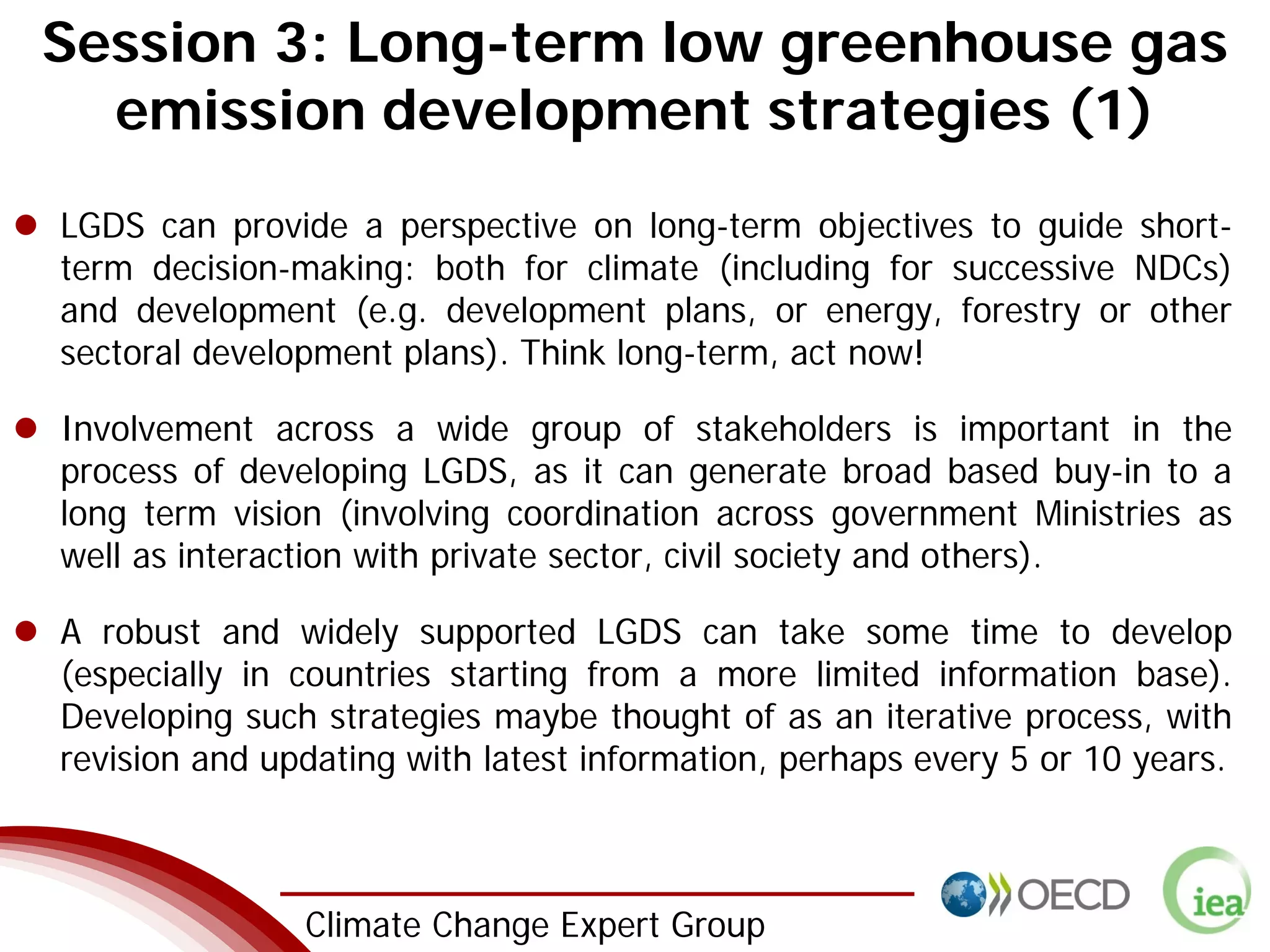
Session 3: Long-term low greenhouse gas
emission development strategies (1)
 LGDS can provide a perspective on long-term objectives to guide short-
term decision-making: both for climate (including for successive NDCs)
and development (e.g. development plans, or energy, forestry or other
sectoral development plans). Think long-term, act now!
 Involvement across a wide group of stakeholders is important in the
process of developing LGDS, as it can generate broad based buy-in to a
long term vision (involving coordination across government Ministries as
well as interaction with private sector, civil society and others).
 A robust and widely supported LGDS can take some time to develop
(especially in countries starting from a more limited information base).
Developing such strategies maybe thought of as an iterative process, with
revision and updating with latest information, perhaps every 5 or 10 years.
3 Climate Change Expert Group
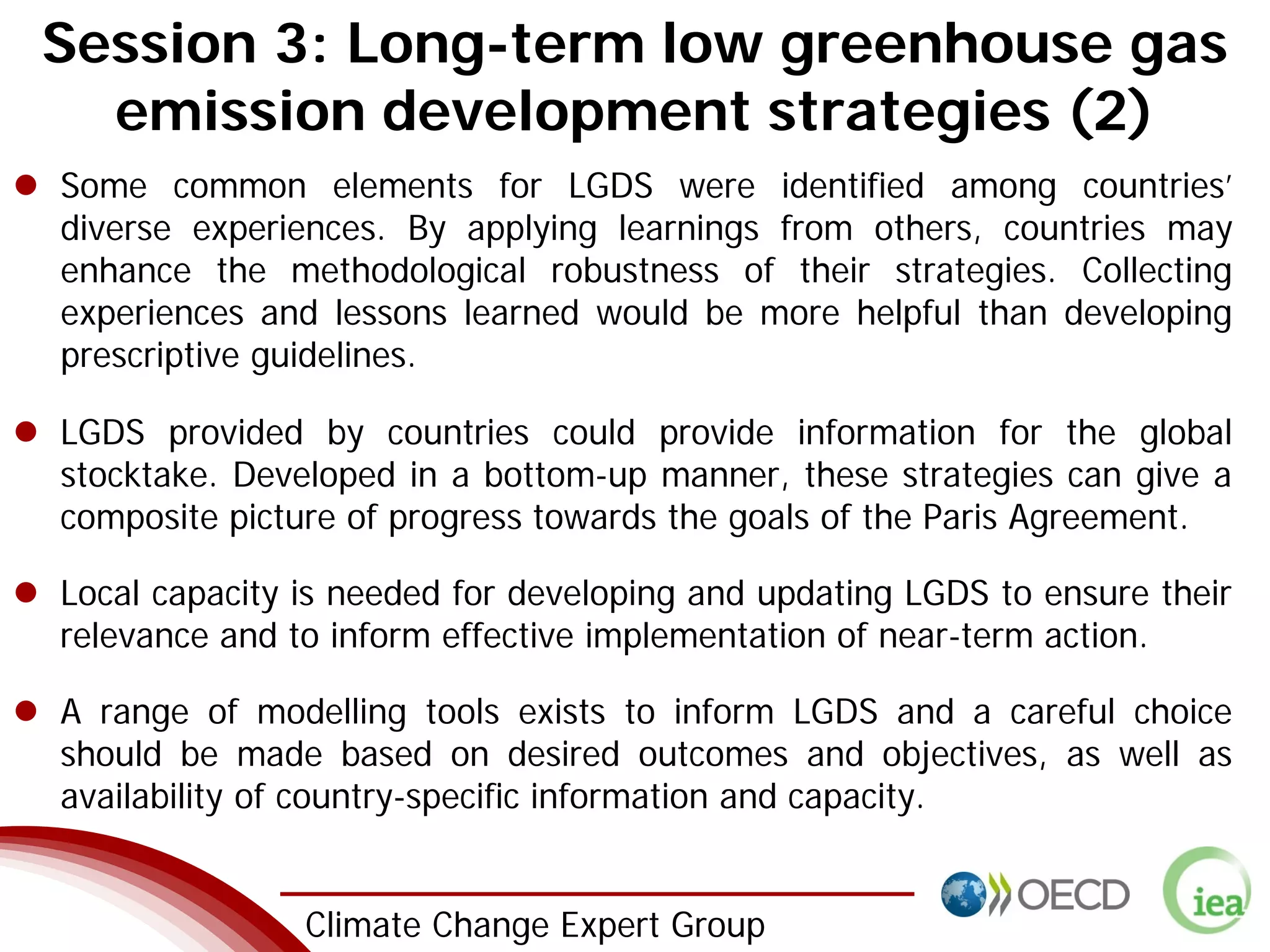
Session 3: Long-term low greenhouse gas
emission development strategies (2)
 Some common elements for LGDS were identified among countries’
diverse experiences. By applying learnings from others, countries may
enhance the methodological robustness of their strategies. Collecting
experiences and lessons learned would be more helpful than developing
prescriptive guidelines.
 LGDS provided by countries could provide information for the global
stocktake. Developed in a bottom-up manner, these strategies can give a
composite picture of progress towards the goals of the Paris Agreement.
 Local capacity is needed for developing and updating LGDS to ensure their
relevance and to inform effective implementation of near-term action.
 A range of modelling tools exists to inform LGDS and a careful choice
should be made based on desired outcomes and objectives, as well as
availability of country-specific information and capacity.

Breakout 3 summary points CCXG GF September 2016

  • 1.
    Climate Change ExpertGroup www.oecd.org/env/cc/ccxg.htm Long-term low greenhouse gas emission development strategies CCXG Global Forum on the Environment and Climate Change 13-14 September 2016
  • 2.
    2 Climate ChangeExpert Group Session 3: Long-term low greenhouse gas emission development strategies (1)  LGDS can provide a perspective on long-term objectives to guide short- term decision-making: both for climate (including for successive NDCs) and development (e.g. development plans, or energy, forestry or other sectoral development plans). Think long-term, act now!  Involvement across a wide group of stakeholders is important in the process of developing LGDS, as it can generate broad based buy-in to a long term vision (involving coordination across government Ministries as well as interaction with private sector, civil society and others).  A robust and widely supported LGDS can take some time to develop (especially in countries starting from a more limited information base). Developing such strategies maybe thought of as an iterative process, with revision and updating with latest information, perhaps every 5 or 10 years.
  • 3.
    3 Climate ChangeExpert Group Session 3: Long-term low greenhouse gas emission development strategies (2)  Some common elements for LGDS were identified among countries’ diverse experiences. By applying learnings from others, countries may enhance the methodological robustness of their strategies. Collecting experiences and lessons learned would be more helpful than developing prescriptive guidelines.  LGDS provided by countries could provide information for the global stocktake. Developed in a bottom-up manner, these strategies can give a composite picture of progress towards the goals of the Paris Agreement.  Local capacity is needed for developing and updating LGDS to ensure their relevance and to inform effective implementation of near-term action.  A range of modelling tools exists to inform LGDS and a careful choice should be made based on desired outcomes and objectives, as well as availability of country-specific information and capacity.