François Bianco, July 10, 2007 Break junction - p. 1/35
Break junction for molecular electronics
using electromigration
François Bianco
Introduction
q Outline
q Idea and History
q Realization
Electromigration process
Conductance quantization
Experimental setup
Results
Conclusion
François Bianco, July 10, 2007 Break junction - p. 2/35
Introduction
Introduction
q Outline
q Idea and History
q Realization
Electromigration process
Conductance quantization
Experimental setup
Results
Conclusion
François Bianco, July 10, 2007 Break junction - p. 3/35
Outline
1. Long terms goal and interest of molecular electronics
2. Electromigration process
3. Breaking phases
4. Quantization of the conductance
5. Experimental setup
6. Results
s Conductance quantization
s Electromigration process
s Gap size
s Critical power
s Feedback algorithm
7. Conclusion
Introduction
q Outline
q Idea and History
q Realization
Electromigration process
Conductance quantization
Experimental setup
Results
Conclusion
François Bianco, July 10, 2007 Break junction - p. 4/35
Idea and History
Idea
s Use molecule as building block for passive and active
electronic components
s Extend the Moore’s law beyond the foreseen limit of common
silicon electronics
s Access to new quantum effects
History
s 1940 first theoretical explanation of charge transfer in
molecules
s 1988 theoretical single-molecule field-effect transistor
s 1997 first measurement of a single molecule conductance
Introduction
q Outline
q Idea and History
q Realization
Electromigration process
Conductance quantization
Experimental setup
Results
Conclusion
François Bianco, July 10, 2007 Break junction - p. 5/35
Realization
The first problem arising is the fabrication of molecular-scale
electrical contacts. The use of:
s Scanning tunneling microscope manipulation
s Atomic force microscope manipulation
s Mechanical break junction
s or Electromigration break junction
allows one to reach nanometer-spaced electrodes.
Introduction
Electromigration process
q History
q Description
q Forces
q Diffusion
q Activation energy
q Joule Heating
Conductance quantization
Experimental setup
Results
Conclusion
François Bianco, July 10, 2007 Break junction - p. 6/35
Electromigration process
Introduction
Electromigration process
q History
q Description
q Forces
q Diffusion
q Activation energy
q Joule Heating
Conductance quantization
Experimental setup
Results
Conclusion
François Bianco, July 10, 2007 Break junction - p. 7/35
History
s Failure mechanism of small wires and electronics
s Discovered more than 100 years ago by Gerardin a French
scientist
s Became practical only in the 60s for electronics design
s 1968 James R. Black wrote his famous equation describing
the mean time before failure due to electromigration3
(CC-BY-SA) Patrick-Emil Zörner
Introduction
Electromigration process
q History
q Description
q Forces
q Diffusion
q Activation energy
q Joule Heating
Conductance quantization
Experimental setup
Results
Conclusion
François Bianco, July 10, 2007 Break junction - p. 8/35
Description
Electromigration (EM) is the ion mass flux driven by a high
electrical current density.
s Due to collisions between the moving electrons and the ions
s Two types of failure:
x Open circuit
x Short circuit
Introduction
Electromigration process
q History
q Description
q Forces
q Diffusion
q Activation energy
q Joule Heating
Conductance quantization
Experimental setup
Results
Conclusion
François Bianco, July 10, 2007 Break junction - p. 9/35
Forces
There is two forces acting on the ions
s Electrostatics force due to the applied voltage Fe
s Electron wind due to the momentum transfer from the
electrons to the ions Fp
F = Fe − Fp. = Z∗
eE (1)
Introduction
Electromigration process
q History
q Description
q Forces
q Diffusion
q Activation energy
q Joule Heating
Conductance quantization
Experimental setup
Results
Conclusion
François Bianco, July 10, 2007 Break junction - p. 10/35
Diffusion
The migration of ions takes place where the symmetry is
broken like at:
s the grain boundaries
s the surface
s or within the lattice at high temperature
Introduction
Electromigration process
q History
q Description
q Forces
q Diffusion
q Activation energy
q Joule Heating
Conductance quantization
Experimental setup
Results
Conclusion
François Bianco, July 10, 2007 Break junction - p. 11/35
Activation energy
Only the activated ions could participate to the diffusion, this is
reflected by the temperature dependent diffusion coefficient:
D = D0e
−EA
kT (2)
where EA is the activation energy.
Introduction
Electromigration process
q History
q Description
q Forces
q Diffusion
q Activation energy
q Joule Heating
Conductance quantization
Experimental setup
Results
Conclusion
François Bianco, July 10, 2007 Break junction - p. 12/35
Joule Heating
The power dissipated in the junction
P∗
=
v∗2
Rj
. (3)
increase the local temperature accelerating the process by
feedback mechanisms.
Introduction
Electromigration process
Conductance quantization
q Quantization (1)
q Quantization (2)
q Breaking phases
Experimental setup
Results
Conclusion
François Bianco, July 10, 2007 Break junction - p. 13/35
Conductance quantization
Introduction
Electromigration process
Conductance quantization
q Quantization (1)
q Quantization (2)
q Breaking phases
Experimental setup
Results
Conclusion
François Bianco, July 10, 2007 Break junction - p. 14/35
Quantization (1)
To get a theoretical explanation of the quantization use the
following steps
1. Solve the Schrödinger’s equation
2. Assumption translation symmetry in y direction
3. Separate the wavefunction
4. Plug the wavefunction into the current density
Contribution to the current density of the electron in mode nky
jnky = −e
1
L
|χn(x, z)|2
ρ
ky
m∗
ey
v
(4)
ρ charge carrier density, v the group velocity
Introduction
Electromigration process
Conductance quantization
q Quantization (1)
q Quantization (2)
q Breaking phases
Experimental setup
Results
Conclusion
François Bianco, July 10, 2007 Break junction - p. 15/35
Quantization (2)
The total current is the sum over ky and n.
s Cross section determines the boundaries conditions
s Use the Pauli Exclusion Principle
s Possible n bellow the Fermi energy in the wire
s Conductance shows plateaus at integer multiples of the
conductance quantum G0 = 2e2
h .
Introduction
Electromigration process
Conductance quantization
q Quantization (1)
q Quantization (2)
q Breaking phases
Experimental setup
Results
Conclusion
François Bianco, July 10, 2007 Break junction - p. 16/35
Breaking phases
1. Bulk regime -> continuous resistance (diffusive regime)
2. Intermediate steps
3. QPC -> discrete resistance due to the size reduction
Introduction
Electromigration process
Conductance quantization
Experimental setup
q Fabrication
q Geometry and sizes
q Four point measurement
q Feedback algorithm
Results
Conclusion
François Bianco, July 10, 2007 Break junction - p. 17/35
Experimental setup
Introduction
Electromigration process
Conductance quantization
Experimental setup
q Fabrication
q Geometry and sizes
q Four point measurement
q Feedback algorithm
Results
Conclusion
François Bianco, July 10, 2007 Break junction - p. 18/35
Fabrication
s The junctions (d)
–> EBM
s The connection pads
–> Photolithography
Introduction
Electromigration process
Conductance quantization
Experimental setup
q Fabrication
q Geometry and sizes
q Four point measurement
q Feedback algorithm
Results
Conclusion
François Bianco, July 10, 2007 Break junction - p. 19/35
Geometry and sizes
The connectors are designed for minimizing the resistance for
the voltage pads.
We build two junctions with two different geometries:
s Wire
s Bowtie
Device Geometry Length (nm) Width (nm) Thickness (nm)
1 & 2 wire 500 70 30
3 & 4 wire 500 75 30
7 & 8 wire 400 80 30
02 bowtie - 100 30
Introduction
Electromigration process
Conductance quantization
Experimental setup
q Fabrication
q Geometry and sizes
q Four point measurement
q Feedback algorithm
Results
Conclusion
François Bianco, July 10, 2007 Break junction - p. 20/35
Four point measurement
Objective: reduce the error for the resistance measurement
Introduction
Electromigration process
Conductance quantization
Experimental setup
q Fabrication
q Geometry and sizes
q Four point measurement
q Feedback algorithm
Results
Conclusion
François Bianco, July 10, 2007 Break junction - p. 21/35
Feedback algorithm
Goals:
s EM in a controlled fashion
s to reach the latest conductance plateau
s and avoid a runaway of the EM
Implementation:
s Apply voltage ramps
s Control the evolution with different feedback mechanisms
x Resistance dR
x Normalized conductance G/G0
x Normalized breaking rate 1
R
∂R
∂t
Introduction
Electromigration process
Conductance quantization
Experimental setup
Results
q Electromigration
q Quantization
q Statistical occurence
q Gaps sizes
q Gaps sizes SEM (1)
q Gaps sizes SEM (2)
q Critical power (1)
q Critical power (2)
q Power feedback
Conclusion
François Bianco, July 10, 2007 Break junction - p. 22/35
Results
Introduction
Electromigration process
Conductance quantization
Experimental setup
Results
q Electromigration
q Quantization
q Statistical occurence
q Gaps sizes
q Gaps sizes SEM (1)
q Gaps sizes SEM (2)
q Critical power (1)
q Critical power (2)
q Power feedback
Conclusion
François Bianco, July 10, 2007 Break junction - p. 23/35
Electromigration
A->B : ohmic response
B->C : controlled breaking
C : break point
Introduction
Electromigration process
Conductance quantization
Experimental setup
Results
q Electromigration
q Quantization
q Statistical occurence
q Gaps sizes
q Gaps sizes SEM (1)
q Gaps sizes SEM (2)
q Critical power (1)
q Critical power (2)
q Power feedback
Conclusion
François Bianco, July 10, 2007 Break junction - p. 24/35
Quantization
Instabilities:
fluctuation between allowed atomic arrangements
Introduction
Electromigration process
Conductance quantization
Experimental setup
Results
q Electromigration
q Quantization
q Statistical occurence
q Gaps sizes
q Gaps sizes SEM (1)
q Gaps sizes SEM (2)
q Critical power (1)
q Critical power (2)
q Power feedback
Conclusion
François Bianco, July 10, 2007 Break junction - p. 25/35
Statistical occurence
8 measurements were added
Non-integer value due to:
s To small number of measured junction8
s Occurrence of non-integer value in Gold?
Introduction
Electromigration process
Conductance quantization
Experimental setup
Results
q Electromigration
q Quantization
q Statistical occurence
q Gaps sizes
q Gaps sizes SEM (1)
q Gaps sizes SEM (2)
q Critical power (1)
q Critical power (2)
q Power feedback
Conclusion
François Bianco, July 10, 2007 Break junction - p. 26/35
Gaps sizes
The sizes were approximated from SEM pictures.
Size Number Yield
< 10 nm 7 23%
10 − 20 nm 5 17%
20 − 50 nm 1 7%
Low yields:
Feedback take too long to detect the break point (0.1 to 1 s)
Reorganization of the atoms the surface
Introduction
Electromigration process
Conductance quantization
Experimental setup
Results
q Electromigration
q Quantization
q Statistical occurence
q Gaps sizes
q Gaps sizes SEM (1)
q Gaps sizes SEM (2)
q Critical power (1)
q Critical power (2)
q Power feedback
Conclusion
François Bianco, July 10, 2007 Break junction - p. 27/35
Gaps sizes SEM (1)
Introduction
Electromigration process
Conductance quantization
Experimental setup
Results
q Electromigration
q Quantization
q Statistical occurence
q Gaps sizes
q Gaps sizes SEM (1)
q Gaps sizes SEM (2)
q Critical power (1)
q Critical power (2)
q Power feedback
Conclusion
François Bianco, July 10, 2007 Break junction - p. 28/35
Gaps sizes SEM (2)
Introduction
Electromigration process
Conductance quantization
Experimental setup
Results
q Electromigration
q Quantization
q Statistical occurence
q Gaps sizes
q Gaps sizes SEM (1)
q Gaps sizes SEM (2)
q Critical power (1)
q Critical power (2)
q Power feedback
Conclusion
François Bianco, July 10, 2007 Break junction - p. 29/35
Critical power (1)
v∗
=
P∗
G(1 − GRs)
(5)
s Rs approximated as
the start resistance
s fitting parameter P∗
s use least-square
algorithm
Introduction
Electromigration process
Conductance quantization
Experimental setup
Results
q Electromigration
q Quantization
q Statistical occurence
q Gaps sizes
q Gaps sizes SEM (1)
q Gaps sizes SEM (2)
q Critical power (1)
q Critical power (2)
q Power feedback
Conclusion
François Bianco, July 10, 2007 Break junction - p. 30/35
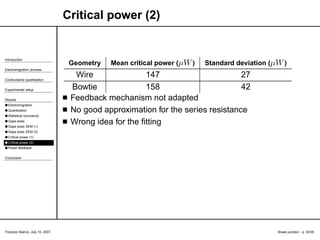
Critical power (2)
Geometry Mean critical power (µW) Standard deviation (µW)
Wire 147 27
Bowtie 158 42
s Feedback mechanism not adapted
s No good approximation for the series resistance
s Wrong idea for the fitting
Introduction
Electromigration process
Conductance quantization
Experimental setup
Results
q Electromigration
q Quantization
q Statistical occurence
q Gaps sizes
q Gaps sizes SEM (1)
q Gaps sizes SEM (2)
q Critical power (1)
q Critical power (2)
q Power feedback
Conclusion
François Bianco, July 10, 2007 Break junction - p. 31/35
Power feedback
Feedback do not step down the voltage at a constant value :
Conclusion:
Feedback only prevents a runaway EM but is not able to detect
it.
Introduction
Electromigration process
Conductance quantization
Experimental setup
Results
Conclusion
q Summary
q References
q Questions ?
François Bianco, July 10, 2007 Break junction - p. 32/35
Conclusion
Introduction
Electromigration process
Conductance quantization
Experimental setup
Results
Conclusion
q Summary
q References
q Questions ?
François Bianco, July 10, 2007 Break junction - p. 33/35
Summary
Break junction
s EM process observed
s Quantization of
conductance seen
Feedback
s Need to detect sooner the
break point
s No able to detect the EM
but avoid a runaway of the
process
Introduction
Electromigration process
Conductance quantization
Experimental setup
Results
Conclusion
q Summary
q References
q Questions ?
François Bianco, July 10, 2007 Break junction - p. 34/35
References
1. Wikipedia
2. (CC-BY-SA) Patrick-Emil Zörner
Introduction
Electromigration process
Conductance quantization
Experimental setup
Results
Conclusion
q Summary
q References
q Questions ?
François Bianco, July 10, 2007 Break junction - p. 35/35
Questions ?
Science has explained nothing; the more we know the more
fantastic the world becomes and the profounder the
surrounding darkness. [Aldous Leonard Huxley]
The important thing is not to stop questioning. [Albert Einstein]

Breakjunction for molecular contacting

  • 1.
    François Bianco, July10, 2007 Break junction - p. 1/35 Break junction for molecular electronics using electromigration François Bianco
  • 2.
    Introduction q Outline q Ideaand History q Realization Electromigration process Conductance quantization Experimental setup Results Conclusion François Bianco, July 10, 2007 Break junction - p. 2/35 Introduction
  • 3.
    Introduction q Outline q Ideaand History q Realization Electromigration process Conductance quantization Experimental setup Results Conclusion François Bianco, July 10, 2007 Break junction - p. 3/35 Outline 1. Long terms goal and interest of molecular electronics 2. Electromigration process 3. Breaking phases 4. Quantization of the conductance 5. Experimental setup 6. Results s Conductance quantization s Electromigration process s Gap size s Critical power s Feedback algorithm 7. Conclusion
  • 4.
    Introduction q Outline q Ideaand History q Realization Electromigration process Conductance quantization Experimental setup Results Conclusion François Bianco, July 10, 2007 Break junction - p. 4/35 Idea and History Idea s Use molecule as building block for passive and active electronic components s Extend the Moore’s law beyond the foreseen limit of common silicon electronics s Access to new quantum effects History s 1940 first theoretical explanation of charge transfer in molecules s 1988 theoretical single-molecule field-effect transistor s 1997 first measurement of a single molecule conductance
  • 5.
    Introduction q Outline q Ideaand History q Realization Electromigration process Conductance quantization Experimental setup Results Conclusion François Bianco, July 10, 2007 Break junction - p. 5/35 Realization The first problem arising is the fabrication of molecular-scale electrical contacts. The use of: s Scanning tunneling microscope manipulation s Atomic force microscope manipulation s Mechanical break junction s or Electromigration break junction allows one to reach nanometer-spaced electrodes.
  • 6.
    Introduction Electromigration process q History qDescription q Forces q Diffusion q Activation energy q Joule Heating Conductance quantization Experimental setup Results Conclusion François Bianco, July 10, 2007 Break junction - p. 6/35 Electromigration process
  • 7.
    Introduction Electromigration process q History qDescription q Forces q Diffusion q Activation energy q Joule Heating Conductance quantization Experimental setup Results Conclusion François Bianco, July 10, 2007 Break junction - p. 7/35 History s Failure mechanism of small wires and electronics s Discovered more than 100 years ago by Gerardin a French scientist s Became practical only in the 60s for electronics design s 1968 James R. Black wrote his famous equation describing the mean time before failure due to electromigration3 (CC-BY-SA) Patrick-Emil Zörner
  • 8.
    Introduction Electromigration process q History qDescription q Forces q Diffusion q Activation energy q Joule Heating Conductance quantization Experimental setup Results Conclusion François Bianco, July 10, 2007 Break junction - p. 8/35 Description Electromigration (EM) is the ion mass flux driven by a high electrical current density. s Due to collisions between the moving electrons and the ions s Two types of failure: x Open circuit x Short circuit
  • 9.
    Introduction Electromigration process q History qDescription q Forces q Diffusion q Activation energy q Joule Heating Conductance quantization Experimental setup Results Conclusion François Bianco, July 10, 2007 Break junction - p. 9/35 Forces There is two forces acting on the ions s Electrostatics force due to the applied voltage Fe s Electron wind due to the momentum transfer from the electrons to the ions Fp F = Fe − Fp. = Z∗ eE (1)
  • 10.
    Introduction Electromigration process q History qDescription q Forces q Diffusion q Activation energy q Joule Heating Conductance quantization Experimental setup Results Conclusion François Bianco, July 10, 2007 Break junction - p. 10/35 Diffusion The migration of ions takes place where the symmetry is broken like at: s the grain boundaries s the surface s or within the lattice at high temperature
  • 11.
    Introduction Electromigration process q History qDescription q Forces q Diffusion q Activation energy q Joule Heating Conductance quantization Experimental setup Results Conclusion François Bianco, July 10, 2007 Break junction - p. 11/35 Activation energy Only the activated ions could participate to the diffusion, this is reflected by the temperature dependent diffusion coefficient: D = D0e −EA kT (2) where EA is the activation energy.
  • 12.
    Introduction Electromigration process q History qDescription q Forces q Diffusion q Activation energy q Joule Heating Conductance quantization Experimental setup Results Conclusion François Bianco, July 10, 2007 Break junction - p. 12/35 Joule Heating The power dissipated in the junction P∗ = v∗2 Rj . (3) increase the local temperature accelerating the process by feedback mechanisms.
  • 13.
    Introduction Electromigration process Conductance quantization qQuantization (1) q Quantization (2) q Breaking phases Experimental setup Results Conclusion François Bianco, July 10, 2007 Break junction - p. 13/35 Conductance quantization
  • 14.
    Introduction Electromigration process Conductance quantization qQuantization (1) q Quantization (2) q Breaking phases Experimental setup Results Conclusion François Bianco, July 10, 2007 Break junction - p. 14/35 Quantization (1) To get a theoretical explanation of the quantization use the following steps 1. Solve the Schrödinger’s equation 2. Assumption translation symmetry in y direction 3. Separate the wavefunction 4. Plug the wavefunction into the current density Contribution to the current density of the electron in mode nky jnky = −e 1 L |χn(x, z)|2 ρ ky m∗ ey v (4) ρ charge carrier density, v the group velocity
  • 15.
    Introduction Electromigration process Conductance quantization qQuantization (1) q Quantization (2) q Breaking phases Experimental setup Results Conclusion François Bianco, July 10, 2007 Break junction - p. 15/35 Quantization (2) The total current is the sum over ky and n. s Cross section determines the boundaries conditions s Use the Pauli Exclusion Principle s Possible n bellow the Fermi energy in the wire s Conductance shows plateaus at integer multiples of the conductance quantum G0 = 2e2 h .
  • 16.
    Introduction Electromigration process Conductance quantization qQuantization (1) q Quantization (2) q Breaking phases Experimental setup Results Conclusion François Bianco, July 10, 2007 Break junction - p. 16/35 Breaking phases 1. Bulk regime -> continuous resistance (diffusive regime) 2. Intermediate steps 3. QPC -> discrete resistance due to the size reduction
  • 17.
    Introduction Electromigration process Conductance quantization Experimentalsetup q Fabrication q Geometry and sizes q Four point measurement q Feedback algorithm Results Conclusion François Bianco, July 10, 2007 Break junction - p. 17/35 Experimental setup
  • 18.
    Introduction Electromigration process Conductance quantization Experimentalsetup q Fabrication q Geometry and sizes q Four point measurement q Feedback algorithm Results Conclusion François Bianco, July 10, 2007 Break junction - p. 18/35 Fabrication s The junctions (d) –> EBM s The connection pads –> Photolithography
  • 19.
    Introduction Electromigration process Conductance quantization Experimentalsetup q Fabrication q Geometry and sizes q Four point measurement q Feedback algorithm Results Conclusion François Bianco, July 10, 2007 Break junction - p. 19/35 Geometry and sizes The connectors are designed for minimizing the resistance for the voltage pads. We build two junctions with two different geometries: s Wire s Bowtie Device Geometry Length (nm) Width (nm) Thickness (nm) 1 & 2 wire 500 70 30 3 & 4 wire 500 75 30 7 & 8 wire 400 80 30 02 bowtie - 100 30
  • 20.
    Introduction Electromigration process Conductance quantization Experimentalsetup q Fabrication q Geometry and sizes q Four point measurement q Feedback algorithm Results Conclusion François Bianco, July 10, 2007 Break junction - p. 20/35 Four point measurement Objective: reduce the error for the resistance measurement
  • 21.
    Introduction Electromigration process Conductance quantization Experimentalsetup q Fabrication q Geometry and sizes q Four point measurement q Feedback algorithm Results Conclusion François Bianco, July 10, 2007 Break junction - p. 21/35 Feedback algorithm Goals: s EM in a controlled fashion s to reach the latest conductance plateau s and avoid a runaway of the EM Implementation: s Apply voltage ramps s Control the evolution with different feedback mechanisms x Resistance dR x Normalized conductance G/G0 x Normalized breaking rate 1 R ∂R ∂t
  • 22.
    Introduction Electromigration process Conductance quantization Experimentalsetup Results q Electromigration q Quantization q Statistical occurence q Gaps sizes q Gaps sizes SEM (1) q Gaps sizes SEM (2) q Critical power (1) q Critical power (2) q Power feedback Conclusion François Bianco, July 10, 2007 Break junction - p. 22/35 Results
  • 23.
    Introduction Electromigration process Conductance quantization Experimentalsetup Results q Electromigration q Quantization q Statistical occurence q Gaps sizes q Gaps sizes SEM (1) q Gaps sizes SEM (2) q Critical power (1) q Critical power (2) q Power feedback Conclusion François Bianco, July 10, 2007 Break junction - p. 23/35 Electromigration A->B : ohmic response B->C : controlled breaking C : break point
  • 24.
    Introduction Electromigration process Conductance quantization Experimentalsetup Results q Electromigration q Quantization q Statistical occurence q Gaps sizes q Gaps sizes SEM (1) q Gaps sizes SEM (2) q Critical power (1) q Critical power (2) q Power feedback Conclusion François Bianco, July 10, 2007 Break junction - p. 24/35 Quantization Instabilities: fluctuation between allowed atomic arrangements
  • 25.
    Introduction Electromigration process Conductance quantization Experimentalsetup Results q Electromigration q Quantization q Statistical occurence q Gaps sizes q Gaps sizes SEM (1) q Gaps sizes SEM (2) q Critical power (1) q Critical power (2) q Power feedback Conclusion François Bianco, July 10, 2007 Break junction - p. 25/35 Statistical occurence 8 measurements were added Non-integer value due to: s To small number of measured junction8 s Occurrence of non-integer value in Gold?
  • 26.
    Introduction Electromigration process Conductance quantization Experimentalsetup Results q Electromigration q Quantization q Statistical occurence q Gaps sizes q Gaps sizes SEM (1) q Gaps sizes SEM (2) q Critical power (1) q Critical power (2) q Power feedback Conclusion François Bianco, July 10, 2007 Break junction - p. 26/35 Gaps sizes The sizes were approximated from SEM pictures. Size Number Yield < 10 nm 7 23% 10 − 20 nm 5 17% 20 − 50 nm 1 7% Low yields: Feedback take too long to detect the break point (0.1 to 1 s) Reorganization of the atoms the surface
  • 27.
    Introduction Electromigration process Conductance quantization Experimentalsetup Results q Electromigration q Quantization q Statistical occurence q Gaps sizes q Gaps sizes SEM (1) q Gaps sizes SEM (2) q Critical power (1) q Critical power (2) q Power feedback Conclusion François Bianco, July 10, 2007 Break junction - p. 27/35 Gaps sizes SEM (1)
  • 28.
    Introduction Electromigration process Conductance quantization Experimentalsetup Results q Electromigration q Quantization q Statistical occurence q Gaps sizes q Gaps sizes SEM (1) q Gaps sizes SEM (2) q Critical power (1) q Critical power (2) q Power feedback Conclusion François Bianco, July 10, 2007 Break junction - p. 28/35 Gaps sizes SEM (2)
  • 29.
    Introduction Electromigration process Conductance quantization Experimentalsetup Results q Electromigration q Quantization q Statistical occurence q Gaps sizes q Gaps sizes SEM (1) q Gaps sizes SEM (2) q Critical power (1) q Critical power (2) q Power feedback Conclusion François Bianco, July 10, 2007 Break junction - p. 29/35 Critical power (1) v∗ = P∗ G(1 − GRs) (5) s Rs approximated as the start resistance s fitting parameter P∗ s use least-square algorithm
  • 30.
    Introduction Electromigration process Conductance quantization Experimentalsetup Results q Electromigration q Quantization q Statistical occurence q Gaps sizes q Gaps sizes SEM (1) q Gaps sizes SEM (2) q Critical power (1) q Critical power (2) q Power feedback Conclusion François Bianco, July 10, 2007 Break junction - p. 30/35 Critical power (2) Geometry Mean critical power (µW) Standard deviation (µW) Wire 147 27 Bowtie 158 42 s Feedback mechanism not adapted s No good approximation for the series resistance s Wrong idea for the fitting
  • 31.
    Introduction Electromigration process Conductance quantization Experimentalsetup Results q Electromigration q Quantization q Statistical occurence q Gaps sizes q Gaps sizes SEM (1) q Gaps sizes SEM (2) q Critical power (1) q Critical power (2) q Power feedback Conclusion François Bianco, July 10, 2007 Break junction - p. 31/35 Power feedback Feedback do not step down the voltage at a constant value : Conclusion: Feedback only prevents a runaway EM but is not able to detect it.
  • 32.
    Introduction Electromigration process Conductance quantization Experimentalsetup Results Conclusion q Summary q References q Questions ? François Bianco, July 10, 2007 Break junction - p. 32/35 Conclusion
  • 33.
    Introduction Electromigration process Conductance quantization Experimentalsetup Results Conclusion q Summary q References q Questions ? François Bianco, July 10, 2007 Break junction - p. 33/35 Summary Break junction s EM process observed s Quantization of conductance seen Feedback s Need to detect sooner the break point s No able to detect the EM but avoid a runaway of the process
  • 34.
    Introduction Electromigration process Conductance quantization Experimentalsetup Results Conclusion q Summary q References q Questions ? François Bianco, July 10, 2007 Break junction - p. 34/35 References 1. Wikipedia 2. (CC-BY-SA) Patrick-Emil Zörner
  • 35.
    Introduction Electromigration process Conductance quantization Experimentalsetup Results Conclusion q Summary q References q Questions ? François Bianco, July 10, 2007 Break junction - p. 35/35 Questions ? Science has explained nothing; the more we know the more fantastic the world becomes and the profounder the surrounding darkness. [Aldous Leonard Huxley] The important thing is not to stop questioning. [Albert Einstein]