Breaking the trap: CGIAR
experiences in resilience research
Alain Vidal
Resilience 2014, Montpellier
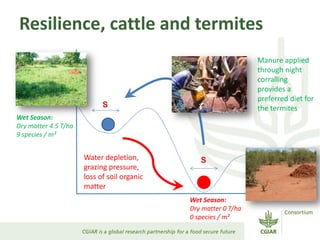
Resilience, cattle and termites
S
SWater depletion,
grazing pressure,
loss of soil organic
matter
Manure applied
through night
corralling
provides a
preferred diet for
the termites
Wet Season:
Dry matter 4.5 T/ha
9 species / m²
Wet Season:
Dry matter 0 T/ha
0 species / m²
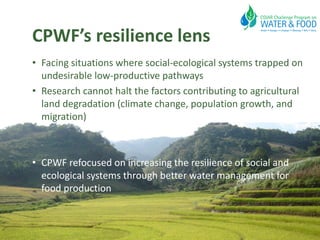
CPWF’s resilience lens
• Facing situations where social-ecological systems trapped on
undesirable low-productive pathways
• Research cannot halt the factors contributing to agricultural
land degradation (climate change, population growth, and
migration)
• CPWF refocused on increasing the resilience of social and
ecological systems through better water management for
food production
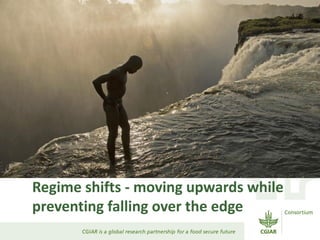
Regime shifts - moving upwards while
preventing falling over the edge
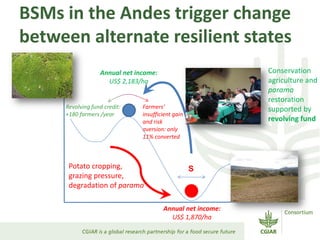
BSMs in the Andes trigger change
between alternate resilient states
S
Annual net income:
US$ 2,183/ha
Annual net income:
US$ 1,870/ha
Conservation
agriculture and
paramo
restoration
supported by
revolving fund
Farmers‘
insufficient gain
and risk
aversion: only
11% converted
Revolving fund credit:
+180 farmers /year
Potato cropping,
grazing pressure,
degradation of paramo
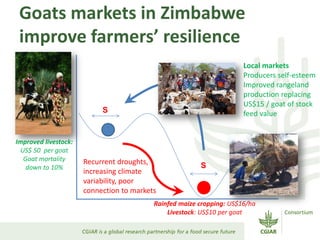
Goats markets in Zimbabwe
improve farmers’ resilience
S
SRecurrent droughts,
increasing climate
variability, poor
connection to markets
Improved livestock:
US$ 50 per goat
Goat mortality
down to 10%
Rainfed maize cropping: US$16/ha
Livestock: US$10 per goat
Local markets
Producers self-esteem
Improved rangeland
production replacing
US$15 / goat of stock
feed value
Fair enough but…
How about traps ?
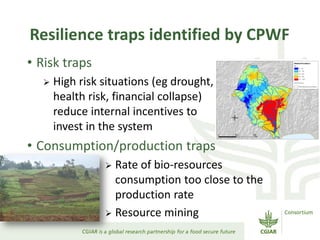
Resilience traps identified by CPWF
• Risk traps
 High risk situations (eg drought,
health risk, financial collapse)
reduce internal incentives to
invest in the system
• Consumption/production traps
 Rate of bio-resources
consumption too close to the
production rate
 Resource mining
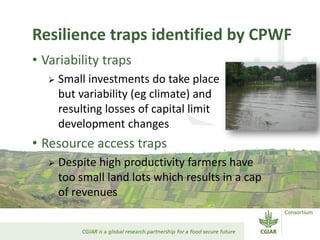
Resilience traps identified by CPWF
• Variability traps
 Small investments do take place
but variability (eg climate) and
resulting losses of capital limit
development changes
• Resource access traps
 Despite high productivity farmers have
too small land lots which results in a cap
of revenues
Resilience traps identified by CPWF
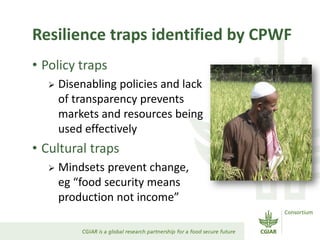
• Policy traps
 Disenabling policies and lack
of transparency prevents
markets and resources being
used effectively
• Cultural traps
 Mindsets prevent change,
eg “food security means
production not income”
Concluding questions
• Are we ready to test how resilience thinking
could help stop digging and identify
pathways to sustainable intensification?
• Has anyone been successful
using a ‘resilience lens’ to
get an ecosystem and/or a
poor community out of any
of these traps?

Breaking the trap: CGIAR experiences in resilience research

  • 1.
    Breaking the trap:CGIAR experiences in resilience research Alain Vidal Resilience 2014, Montpellier
  • 2.
    Resilience, cattle andtermites S SWater depletion, grazing pressure, loss of soil organic matter Manure applied through night corralling provides a preferred diet for the termites Wet Season: Dry matter 4.5 T/ha 9 species / m² Wet Season: Dry matter 0 T/ha 0 species / m²
  • 3.
    CPWF’s resilience lens •Facing situations where social-ecological systems trapped on undesirable low-productive pathways • Research cannot halt the factors contributing to agricultural land degradation (climate change, population growth, and migration) • CPWF refocused on increasing the resilience of social and ecological systems through better water management for food production
  • 4.
    Regime shifts -moving upwards while preventing falling over the edge
  • 5.
    BSMs in theAndes trigger change between alternate resilient states S Annual net income: US$ 2,183/ha Annual net income: US$ 1,870/ha Conservation agriculture and paramo restoration supported by revolving fund Farmers‘ insufficient gain and risk aversion: only 11% converted Revolving fund credit: +180 farmers /year Potato cropping, grazing pressure, degradation of paramo
  • 6.
    Goats markets inZimbabwe improve farmers’ resilience S SRecurrent droughts, increasing climate variability, poor connection to markets Improved livestock: US$ 50 per goat Goat mortality down to 10% Rainfed maize cropping: US$16/ha Livestock: US$10 per goat Local markets Producers self-esteem Improved rangeland production replacing US$15 / goat of stock feed value
  • 7.
  • 8.
    Resilience traps identifiedby CPWF • Risk traps  High risk situations (eg drought, health risk, financial collapse) reduce internal incentives to invest in the system • Consumption/production traps  Rate of bio-resources consumption too close to the production rate  Resource mining
  • 9.
    Resilience traps identifiedby CPWF • Variability traps  Small investments do take place but variability (eg climate) and resulting losses of capital limit development changes • Resource access traps  Despite high productivity farmers have too small land lots which results in a cap of revenues
  • 10.
    Resilience traps identifiedby CPWF • Policy traps  Disenabling policies and lack of transparency prevents markets and resources being used effectively • Cultural traps  Mindsets prevent change, eg “food security means production not income”
  • 11.
    Concluding questions • Arewe ready to test how resilience thinking could help stop digging and identify pathways to sustainable intensification? • Has anyone been successful using a ‘resilience lens’ to get an ecosystem and/or a poor community out of any of these traps?