Breaking Down Information Silos

        Chris L. Waller, Ph.D.
Information Silos
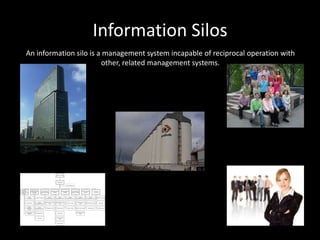
An information silo is a management system incapable of reciprocal operation with
                        other, related management systems.
Information Silo Causes
• Technology
  – Enterprise data systems are too rigid, slow, prone to
    outages, hard to use…
• Process
  – Legacy processes don’t factor in the need for
    information sharing (the technologies didn’t exist)…
• People
  – People are not properly incentivized for collaborative
    work and lack trust…
Information Silo Effects
•   Limits productivity
•   Stifles creativity
•   Hampers innovation
•   Inhibits collaboration
•   <Fill in the blank with your favorite pejorative
    expression>
Information Silo Solutions
• Provide technologies that support information
  sharing processes and reward collaborative
  behaviors (people).
Information Integration Technologies
               (Life Sciences)
•   Standard Data Models (CDISC, etc.)
•   Standard RDB Platforms (Oracle, etc.)
•   Standard Ontologies (W3C, etc.)
•   Semantic Platforms (IOInformatics, etc.)
•   All of the above (Open PHACTS)
Collaboration Platforms
     (Life Sciences)
Collaborative Business Culture
Why Don’t People Collaborate (Share Information)?

•   Not knowing the answer.
•   Unclear or uncomfortable roles.
•   Too much talking, not enough doing.
•   Information (over)sharing.
•   Fear of fighting.
•   More work.
•   More hugs than decisions.
•   It's hard to know who to praise and who to blame.

      http://blogs.hbr.org/cs/2011/12/eight_dangers_of_collaboration.html
Collaborative Business Culture
• 10% of Senior HR Execs and 39% of Employees
  Believe that their Companies Effectively
  Encourage Collaboration
• Mutual Trust (Lack of) is a Significant Barrier
  to Collaboration
  – 31% of Developed Market R&D Staff Trust
    Emerging Market Colleagues
  – 22% of Emerging Market R&D Staff Trust
    Developed Market Colleagues

       Source: Research and Technology Executive Council Research
Stimulating Information Sharing (NIH/FDA)
                                             Reports > Harnessing the Potential of Data Mining and Inform ation Sharing                                             12/ 9/ 11 10:17 AM


                                              Home > About FDA > Reports, Manuals, & Forms > Reports

                                              About FDA
                                              Harnessing the Potential of Data Mining and Information Sharing
With the establishment of NCATS in the        Previous Section: Expedited Drug Development Pathway 1


fall of 2011, NIH aims to reengineer the     FDA currently houses the largest known
                                              As noted in PCAST’s Report to the President on Health Information Technology, IT has the potential to transform healthcare and—
                                              through innovative capabilities—improve safety and efficiency in the development of new tools for medicine, support new clinical
                                              studies for particular interventions that work for different patients, and transform the sharing of health and research data.


translation process by bringing together     repository of clinical data (all of which is de-
                                              FDA currently houses the largest known repository of clinical data (all of which is de-identified to protect patients’ privacy),
                                              including all the safety, efficacy, and performance information that has been submitted to the Agency for new products, as well as
                                              an increasing volume of post-market safety surveillance data. The ability to integrate and analyze these data could revolutionize
                                              the development of new patient treatments and allow us to address fundamental scientific questions about how different types of


expertise from the public and private        identified to protect patients’
                                              patients respond to therapy. It would also provide an enhanced knowledge of disease parameters— such as meaningful measures
                                              of disease progression and biomarkers of safety and drug responses that can only be gained by analyses of large, pooled data sets
                                              — and would allow a determination of ineffective products earlier in the development process.


sectors in an atmosphere of collaboration    privacy), including all the safety, efficacy, and
                                              Additionally, the ability to share information in a public forum about why products fail, without compromising proprietary
                                              information, presents the potential to save companies millions of dollars by preventing duplication of failure. FDA sometimes sees
                                              applications from multiple companies for the same or similar products. Although we may have reason to believe that such a


and precompetitive transparency.             performance information that has been
                                              product is likely to fail or that trial design endpoints will not provide necessary information based on a previous application from
                                              another company, we are currently unable to share this information. As a result, companies may pour resources into the
                                              development of products that FDA knows could be dead ends.

                                             submitted to the Agency for new products, as
                                              To harness the potential of information sharing and data mining, FDA is rebuilding its IT and data analytic capabilities and
                                              establishing science enclaves that will allow for the analysis of large, complex datasets while maintaining proprietary data

Through partnerships that capitalize on       protections and protecting patients’ information.

                                             well a an increasing volume of post-market
                                              Scientific Computing and the Science Enclaves at FDA

our respective                                Historically, the vast majority of FDA de-identified clinical trial data has gone un-mined because of the inability to combine data

                                             safety surveillance data. The ability to
                                              from disparate sources and the lack of computing power and tools to perform such complex analyses. However the advent of new
                                              technologies, such as the ability to convert data from flat files or other formats like paper into data that can be placed in flexible
                                              relational database models, dramatic increases in supercomputing power, and the development of new mathematical tools and
strengths, NIH, academia, philanthropy, p    integrate and analyze these data could
                                              approaches for analyzing large integrated data sets, has radically changed this situation. Furthermore, innovations in
                                              computational methods, including many available as open-source, have created an explosion of statistical and mathematical
                                              models that can be exploited to mine data in numerous ways to enable scientists to analyze large complex biological and clinical

atient advocates, and the private sector      data sets.
                                             revolutionize the development of new
                                              The FDA scientific computing model provides an environment where communities of scientists, known as enclaves, can come
                                              together to analyze large, integrated data sets and address important questions confronting clinical medicine. These communities

can take full advantage of the promise of    patient treatments and allow us to address
                                              will be project-based and driven by a specific set of questions that will be asked of a dataset. Each enclave is defined by its
                                              participants, datasets, and sets of interrogations to be performed on the data. Enclaves may be comprised of internal FDA
                                              scientists and reviewers working together or outside collaborators working with FDA scientists under an appropriate set of security

translational science to deliver solutions    controls to protect the sensitive and proprietary data of patients and sponsors, respectively. Engagement of industry sponsors as
                                             fundamental scientific questions about how
                                              part of community building will be vigorously pursued, leveraging expertise from the companies that submitted the data in a
                                              public-private partnership model.

to the millions of people who await new       The scientific computing environment will also provide a dedicated infrastructure for application development and software testing
                                             different types of patients respond to
                                              for FDA scientists and reviewers. This will allow FDA staff to develop new applications to improve review, monitoring, and business
                                              processes in an environment separate from where regulatory review data is assessed. Additionally, the scientific computing

and better ways to detect, treat, and pre-    environment will be used to evaluate novel software developed outside of FDA and to rapidly incorporate innovative developments

                                             therapy.
                                              in support of FDA regulatory reviews. This ability to “test drive” new applications outside the regulatory review environment has
                                              the potential to shorten traditional FDA development cycles and facilitate the adoption of new software that can enhance quality,
                                              efficiency, and accuracy of FDA regulatory reviews, as well as streamline the adaptation of new higher-powered analytical tools
vent disease.                                 into FDA review and research efforts.


                                             http:/ / www.fda.gov/ AboutFDA/ ReportsManualsForm s/ Reports/ ucm 274442.htm                                                 Page 1 of 3
Stimulating Information Sharing (NHS, EU)

                                               Horizon 2020 is the financial instrument
                                               implementing the Innovation Union, a
                                               Europe 2020 flagship initiative aimed at
 Prime minister David Cameron has              securing Europe's global competitiveness.
 announced a package of measures
 designed to boost the UK's life sciences
 industry. These include a £180 million fund
 to support innovation and plans to allow      This conference will explore how EU
 healthcare companies access to NHS            funding can promote economically and
 patient records to support research.          socially sustainable innovation models with
                                               the aim of more openness, easier
                                               accessibility and higher result-oriented
                                               efficiency.
Caveats


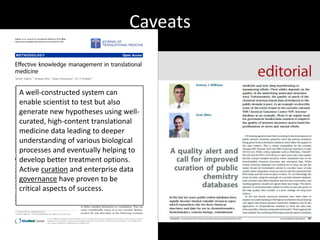
A well-constructed system can
enable scientist to test but also
generate new hypotheses using well-
curated, high-content translational
medicine data leading to deeper
understanding of various biological
processes and eventually helping to
develop better treatment options.
Active curation and enterprise data
governance have proven to be
critical aspects of success.
The Future: Virtual Life Sciences
• Forrester has identified three themes driving the
  future of collaboration and information sharing
  technology
  – The global, mobile workforce
     • 62% of workforce works outside an office at some point (this
       number is growing)
  – Mobility driven consumerization
     • Cloud-based collaboration solutions are being used in
       conjunction with numerous devices
  – The principle of “any”
     • Need to connect anybody, anytime, anywhere on any device
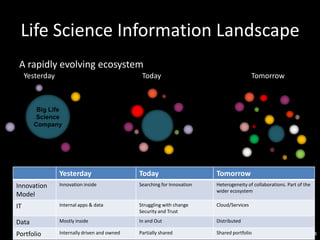
Life Science Information Landscape
 A rapidly evolving ecosystem
     Yesterday                                  Today                                      Tomorrow


        Big Life
       Science
       Company


                 Yesterday                     Today                      Tomorrow
Innovation       Innovation inside             Searching for Innovation   Heterogeneity of collaborations. Part of the
                                                                          wider ecosystem
Model
IT               Internal apps & data          Struggling with change     Cloud/Services
                                               Security and Trust

Data             Mostly inside                 In and Out                 Distributed

Portfolio        Internally driven and owned   Partially shared           Shared portfolio                               14
The Evolving Life Sciences Ecosystem
 Evolving paradigm for the discovery of medicines (Collaborative)
      A vision that points towards open innovation and collaborations
      Open research model to collectively share scientific expertise
 Enhance speed of drug discovery beyond individual resource capabilities (Speed)
      Limited research budgets and capabilities driving greater shared resources
      Goal to see all partners succeed by accelerating the SCIENCE
 Synergize Pfizer’s strengths with Research Partners (Knowledge)
      Pair Pfizer’s design, cutting edge tools, synthetic excellence with research partners (academics, not-for-
        profits, venture capitalists, or biotechs) to develop break through science, novel targets, and indications of unmet
        medical need
 Current example of academic and not-for-profits partners (Discover and Publish)
      Drive to publish in top journal with science receiving high visibility and interest

                                                                   Body clock mouse study suggests new drug potential
                                                                   Mon, Aug 23 2010
                                                                   By Kate Kelland
                                                                   LONDON (Reuters) - Scientists have used experimental drugs being developed
                                                                   by Pfizer to reset and restart the body clock of mice in a lab and say their work
                                                                   may offer clues on a range of human disorders, from jetlag to bipolar disorder.

                                                                                         a few months ago we entered into a collaboration with
                                                                                         the giant pharmaceutical industry Pfizer to test some of
                                                                                         their leading molecules for potential relevance to HD.


Contacts:
  Travis Wager (travis.t.wager@pfizer.com)
  Paul Galatsis (paul.galatsis@pfizer.com)
Public-Private Partnerships
• What is your view on Public-Private
  Partnerships (and Consortia in general)?
  – Is your organization willing to participate and
    share information?
  – What information types do (would) you share
  – What types do (would) you not share?
Collaboration and Information Sharing
              Barometer
• Does your company..
  – …motivate and link innovation efforts by
    identifying and routinely communicating key areas
    for innovation activity?
  – …have a strategy that allows for geographically
    dispersed staff to access the resources necessary
    to collaborate and share information?
  – …have tools that support rapid collaboration, such
    as data sharing and analysis or crowdsourcing
    platforms?
Technology
• Will the current technologies be sufficient for
  the “big data” needs (both horizontal and
  vertical) that are emerging as the information
  silos are integrated?
Thank You
• Chris L. Waller, Ph.D.
• http://www.linkedin.com/in/wallerc

Breaking Down Information Silos

  • 1.
    Breaking Down InformationSilos Chris L. Waller, Ph.D.
  • 2.
    Information Silos An informationsilo is a management system incapable of reciprocal operation with other, related management systems.
  • 3.
    Information Silo Causes •Technology – Enterprise data systems are too rigid, slow, prone to outages, hard to use… • Process – Legacy processes don’t factor in the need for information sharing (the technologies didn’t exist)… • People – People are not properly incentivized for collaborative work and lack trust…
  • 4.
    Information Silo Effects • Limits productivity • Stifles creativity • Hampers innovation • Inhibits collaboration • <Fill in the blank with your favorite pejorative expression>
  • 5.
    Information Silo Solutions •Provide technologies that support information sharing processes and reward collaborative behaviors (people).
  • 6.
    Information Integration Technologies (Life Sciences) • Standard Data Models (CDISC, etc.) • Standard RDB Platforms (Oracle, etc.) • Standard Ontologies (W3C, etc.) • Semantic Platforms (IOInformatics, etc.) • All of the above (Open PHACTS)
  • 7.
    Collaboration Platforms (Life Sciences)
  • 8.
    Collaborative Business Culture WhyDon’t People Collaborate (Share Information)? • Not knowing the answer. • Unclear or uncomfortable roles. • Too much talking, not enough doing. • Information (over)sharing. • Fear of fighting. • More work. • More hugs than decisions. • It's hard to know who to praise and who to blame. http://blogs.hbr.org/cs/2011/12/eight_dangers_of_collaboration.html
  • 9.
    Collaborative Business Culture •10% of Senior HR Execs and 39% of Employees Believe that their Companies Effectively Encourage Collaboration • Mutual Trust (Lack of) is a Significant Barrier to Collaboration – 31% of Developed Market R&D Staff Trust Emerging Market Colleagues – 22% of Emerging Market R&D Staff Trust Developed Market Colleagues Source: Research and Technology Executive Council Research
  • 10.
    Stimulating Information Sharing(NIH/FDA) Reports > Harnessing the Potential of Data Mining and Inform ation Sharing 12/ 9/ 11 10:17 AM Home > About FDA > Reports, Manuals, & Forms > Reports About FDA Harnessing the Potential of Data Mining and Information Sharing With the establishment of NCATS in the Previous Section: Expedited Drug Development Pathway 1 fall of 2011, NIH aims to reengineer the FDA currently houses the largest known As noted in PCAST’s Report to the President on Health Information Technology, IT has the potential to transform healthcare and— through innovative capabilities—improve safety and efficiency in the development of new tools for medicine, support new clinical studies for particular interventions that work for different patients, and transform the sharing of health and research data. translation process by bringing together repository of clinical data (all of which is de- FDA currently houses the largest known repository of clinical data (all of which is de-identified to protect patients’ privacy), including all the safety, efficacy, and performance information that has been submitted to the Agency for new products, as well as an increasing volume of post-market safety surveillance data. The ability to integrate and analyze these data could revolutionize the development of new patient treatments and allow us to address fundamental scientific questions about how different types of expertise from the public and private identified to protect patients’ patients respond to therapy. It would also provide an enhanced knowledge of disease parameters— such as meaningful measures of disease progression and biomarkers of safety and drug responses that can only be gained by analyses of large, pooled data sets — and would allow a determination of ineffective products earlier in the development process. sectors in an atmosphere of collaboration privacy), including all the safety, efficacy, and Additionally, the ability to share information in a public forum about why products fail, without compromising proprietary information, presents the potential to save companies millions of dollars by preventing duplication of failure. FDA sometimes sees applications from multiple companies for the same or similar products. Although we may have reason to believe that such a and precompetitive transparency. performance information that has been product is likely to fail or that trial design endpoints will not provide necessary information based on a previous application from another company, we are currently unable to share this information. As a result, companies may pour resources into the development of products that FDA knows could be dead ends. submitted to the Agency for new products, as To harness the potential of information sharing and data mining, FDA is rebuilding its IT and data analytic capabilities and establishing science enclaves that will allow for the analysis of large, complex datasets while maintaining proprietary data Through partnerships that capitalize on protections and protecting patients’ information. well a an increasing volume of post-market Scientific Computing and the Science Enclaves at FDA our respective Historically, the vast majority of FDA de-identified clinical trial data has gone un-mined because of the inability to combine data safety surveillance data. The ability to from disparate sources and the lack of computing power and tools to perform such complex analyses. However the advent of new technologies, such as the ability to convert data from flat files or other formats like paper into data that can be placed in flexible relational database models, dramatic increases in supercomputing power, and the development of new mathematical tools and strengths, NIH, academia, philanthropy, p integrate and analyze these data could approaches for analyzing large integrated data sets, has radically changed this situation. Furthermore, innovations in computational methods, including many available as open-source, have created an explosion of statistical and mathematical models that can be exploited to mine data in numerous ways to enable scientists to analyze large complex biological and clinical atient advocates, and the private sector data sets. revolutionize the development of new The FDA scientific computing model provides an environment where communities of scientists, known as enclaves, can come together to analyze large, integrated data sets and address important questions confronting clinical medicine. These communities can take full advantage of the promise of patient treatments and allow us to address will be project-based and driven by a specific set of questions that will be asked of a dataset. Each enclave is defined by its participants, datasets, and sets of interrogations to be performed on the data. Enclaves may be comprised of internal FDA scientists and reviewers working together or outside collaborators working with FDA scientists under an appropriate set of security translational science to deliver solutions controls to protect the sensitive and proprietary data of patients and sponsors, respectively. Engagement of industry sponsors as fundamental scientific questions about how part of community building will be vigorously pursued, leveraging expertise from the companies that submitted the data in a public-private partnership model. to the millions of people who await new The scientific computing environment will also provide a dedicated infrastructure for application development and software testing different types of patients respond to for FDA scientists and reviewers. This will allow FDA staff to develop new applications to improve review, monitoring, and business processes in an environment separate from where regulatory review data is assessed. Additionally, the scientific computing and better ways to detect, treat, and pre- environment will be used to evaluate novel software developed outside of FDA and to rapidly incorporate innovative developments therapy. in support of FDA regulatory reviews. This ability to “test drive” new applications outside the regulatory review environment has the potential to shorten traditional FDA development cycles and facilitate the adoption of new software that can enhance quality, efficiency, and accuracy of FDA regulatory reviews, as well as streamline the adaptation of new higher-powered analytical tools vent disease. into FDA review and research efforts. http:/ / www.fda.gov/ AboutFDA/ ReportsManualsForm s/ Reports/ ucm 274442.htm Page 1 of 3
  • 11.
    Stimulating Information Sharing(NHS, EU) Horizon 2020 is the financial instrument implementing the Innovation Union, a Europe 2020 flagship initiative aimed at Prime minister David Cameron has securing Europe's global competitiveness. announced a package of measures designed to boost the UK's life sciences industry. These include a £180 million fund to support innovation and plans to allow This conference will explore how EU healthcare companies access to NHS funding can promote economically and patient records to support research. socially sustainable innovation models with the aim of more openness, easier accessibility and higher result-oriented efficiency.
  • 12.
    Caveats A well-constructed systemcan enable scientist to test but also generate new hypotheses using well- curated, high-content translational medicine data leading to deeper understanding of various biological processes and eventually helping to develop better treatment options. Active curation and enterprise data governance have proven to be critical aspects of success.
  • 13.
    The Future: VirtualLife Sciences • Forrester has identified three themes driving the future of collaboration and information sharing technology – The global, mobile workforce • 62% of workforce works outside an office at some point (this number is growing) – Mobility driven consumerization • Cloud-based collaboration solutions are being used in conjunction with numerous devices – The principle of “any” • Need to connect anybody, anytime, anywhere on any device
  • 14.
    Life Science InformationLandscape A rapidly evolving ecosystem Yesterday Today Tomorrow Big Life Science Company Yesterday Today Tomorrow Innovation Innovation inside Searching for Innovation Heterogeneity of collaborations. Part of the wider ecosystem Model IT Internal apps & data Struggling with change Cloud/Services Security and Trust Data Mostly inside In and Out Distributed Portfolio Internally driven and owned Partially shared Shared portfolio 14
  • 15.
    The Evolving LifeSciences Ecosystem  Evolving paradigm for the discovery of medicines (Collaborative)  A vision that points towards open innovation and collaborations  Open research model to collectively share scientific expertise  Enhance speed of drug discovery beyond individual resource capabilities (Speed)  Limited research budgets and capabilities driving greater shared resources  Goal to see all partners succeed by accelerating the SCIENCE  Synergize Pfizer’s strengths with Research Partners (Knowledge)  Pair Pfizer’s design, cutting edge tools, synthetic excellence with research partners (academics, not-for- profits, venture capitalists, or biotechs) to develop break through science, novel targets, and indications of unmet medical need  Current example of academic and not-for-profits partners (Discover and Publish)  Drive to publish in top journal with science receiving high visibility and interest Body clock mouse study suggests new drug potential Mon, Aug 23 2010 By Kate Kelland LONDON (Reuters) - Scientists have used experimental drugs being developed by Pfizer to reset and restart the body clock of mice in a lab and say their work may offer clues on a range of human disorders, from jetlag to bipolar disorder. a few months ago we entered into a collaboration with the giant pharmaceutical industry Pfizer to test some of their leading molecules for potential relevance to HD. Contacts:  Travis Wager (travis.t.wager@pfizer.com)  Paul Galatsis (paul.galatsis@pfizer.com)
  • 16.
    Public-Private Partnerships • Whatis your view on Public-Private Partnerships (and Consortia in general)? – Is your organization willing to participate and share information? – What information types do (would) you share – What types do (would) you not share?
  • 17.
    Collaboration and InformationSharing Barometer • Does your company.. – …motivate and link innovation efforts by identifying and routinely communicating key areas for innovation activity? – …have a strategy that allows for geographically dispersed staff to access the resources necessary to collaborate and share information? – …have tools that support rapid collaboration, such as data sharing and analysis or crowdsourcing platforms?
  • 18.
    Technology • Will thecurrent technologies be sufficient for the “big data” needs (both horizontal and vertical) that are emerging as the information silos are integrated?
  • 19.
    Thank You • ChrisL. Waller, Ph.D. • http://www.linkedin.com/in/wallerc