Creating a Roadmap to
Clinical Trial Efficiency
Managing a clinical trial of any size and complexity
requires efficient trial management. Yet for the
past three decades, life sciences companies have
built and then continuously added to inefficient
processes, often cobbling together critical system
support functions. At the same time, the business
environment and regulatory factors have made
the clinical trial landscape progressively more
complex. A focus on outsourcing partnerships,
in addition to a significant number of mergers
and acquisitions over the last 10 years, has
added to this complexity. In 2011 alone, despite
uncertainties on both economic and regulatory
fronts, over $200 billion in healthcare related M&A
deals were announced.1
Simultaneously, health authorities are demanding
better, faster disclosure of data. In September
2012, the U.S. Secretary of Health and Human
Services delegated its clinical trial monitoring
authority to the U.S. Food and Drug Administration
(FDA). Though the full implications of this change
are not yet known, increased GCP inspections
and more stringent compliance requirements are
expected. Drug development teams are also faced
with ensuring smart strategies for the emerging
challenges, including mobile health, social
media, electronic health record data, genomics
information and the tsunami of big data.
In order to meet these challenges, life sciences
companies must improve the efficiency of
internal clinical management processes, reduce
manual reporting and human intervention, and
provide better visibility across the clinical trial
landscape. Conducting a clinical architecture
assessment allows companies to get a full picture
of see what current systems and processes they
have, understand what is working, and more
importantly critically identify the gaps of what is
not working and what is missing. It provides the
team with a path roadmap forward to synchronized
improvement in both improving their systems and
their operations, enabling effective change in the
near and long term. When these two facets of
systems and operations are optimized and in sync,
the resulting improvements are greater than the
sum of optimizing each individually.
Value Envisioned. Value Delivered.
1.800.462.5582  ■ www.consultparagon.com
Clinical Trial Management:
Maximizing Existing Assets
Clinical trial management is becoming ever
more complex. In order to meet the challenges
of today and those of tomorrow, clinical
trial management processes must evolve.
Fortunately, evolution does not equate to
vast new technology systems. In fact, many
companies already possess the key pieces
of technology required. Improvements are
simply a matter of leveraging those technology
capabilities more effectively.
Executive Summary
1
1
Healthcare and Life Sciences Group, Mergersand Acquisitions, 2011 Year in Review, Sullivan & Cromwell LLP,
http:/www.sullcrom com/files/upload/Healthcare
Introduction
Developing a drug, biologic, or device is a costly
undertaking. On average, the drug development
process takes more than 10 years and $1 billion
dollars.2
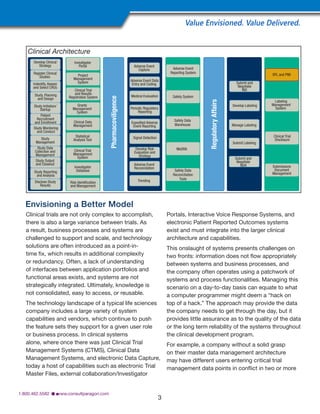
About 85 percent of therapies fail in early
clinical trials, and of those that survive through to
the last step before regulatory approval, only half
are approved.3
(see figure 1)
But success is not solely dependent on the quality
of the investigational product. Experts suggest a
significant number of high viability products are
being lost to outdated and impractical clinical trial
designs and the lack of a streamlined, integrated
approach to trial management.
The high numbers of mergers and acquisitions
that have taken place in the industry have played
a significant role in creating dysfunctional trial
management processes. Clinical trials, under
any circumstances, involve a tangle of players
and systems. But as M&As occur, the companies
involved often inherit a mix of disparate technology
and clinical trial business processes in addition to
their own. Rather than use the changing business
environment as an opportunity to holistically review
and integrate such processes and systems, many
companies manage the new jumble of disjointed
processes and systems as best they can.
Meanwhile, a number of external pressures
challenge the feasibility of clinical trial “business
as usual.” The economic landscape has changed
dramatically in the last 10 years. Life sciences
companies no longer generate the high levels of
revenue they commanded in the early 2000s. Not
only are they faced with increasing throughput to
stay solvent, in many cases they have been forced
to reduce headcount as well.
The evolving and multifaceted landscape of
compliance requirements adds additional strain. For
one example, global health authorities such as the
FDA now require companies to submit public data
about ongoing and past clinical trials. However, a
2012 analysis of the FDA data set on clinical trials
found that much of that data is missing. In fact,
only 22 percent of completed trials reported results
within a year, as required.4
Given the increasingly challenging business and
regulatory environment, life sciences companies
must evolve their clinical trials processes and
improve efficiency with fewer resources.
7.5% Make it to Approval
15% Survive Development
85% of All Drugs Fail
During the Development Stage
15%
7.5%
85%
2
Figure 1
2
Translational Research: 4 ways to fix the clinical trial, Nature.com, September 2011,
http://www.nature.com/news/2011/110928full/477526a html
3
Translational Research: 4 ways to fix the clinical trial, Nature.com, September 2011,
http://www.nature.com/news/2011/110928full/477526a.html
4
Compliance with mandatory reporting of clinical trial results on ClinicalTrials.gov: cross sectional study, BMJ Group, January
2012, http://www.bmj.com/content/344/bmjd7373 pdf%2Bhtml
Clinical trials are not only complex to accomplish,
there is also a large variance between trials. As
a result, business processes and systems are
challenged to support and scale, and technology
solutions are often introduced as a point-in-
time fix, which results in additional complexity
or redundancy. Often, a lack of understanding
of interfaces between application portfolios and
functional areas exists, and systems are not
strategically integrated. Ultimately, knowledge is
not consolidated, easy to access, or reusable.
The technology landscape of a typical life sciences
company includes a large variety of system
capabilities and vendors, which continue to push
the feature sets they support for a given user role
or business process. In clinical systems
alone, where once there was just Clinical Trial
Management Systems (CTMS), Clinical Data
Management Systems, and electronic Data Capture,
today a host of capabilities such as electronic Trial
Master Files, external collaboration/Investigator
Portals, Interactive Voice Response Systems, and
electronic Patient Reported Outcomes systems
exist and must integrate into the larger clinical
architecture and capabilities.
This onslaught of systems presents challenges on
two fronts: information does not flow appropriately
between systems and business processes, and
the company often operates using a patchwork of
systems and process functionalities. Managing this
scenario on a day-to-day basis can equate to what
a computer programmer might deem a “hack on
top of a hack.” The approach may provide the data
the company needs to get through the day, but it
provides little assurance as to the quality of the data
or the long term reliability of the systems throughout
the clinical development program.
For example, a company without a solid grasp
on their master data management architecture
may have different users entering critical trial
management data points in conflict in two or more
Value Envisioned. Value Delivered.
3
1.800.462.5582  ■ www.consultparagon.com
Study, Planning
and Design
Develop Clinical
Strategy
Investigator
Portal
Indentify, Assess
and Select CROs
Project
Management
System
Clinical Trial
and Results
Registration System
Grants
Management
System
Clinical Data
Management
Statistical
Analysis Tool
Clinical Trial
Management
System
Register Clinical
Studies
Investigator
Database
Study Initiation/
Startup
Risk Identification
and Management
PharmacoviligencePatient
Recruitment
and Enrollment
Trending
Expedited Adverse
Event Reporting
Signal Detection
Develop Risk
Evaluation and
Strategy
Study Monitoring
and Conduct
Adverse Event
Reconciliation
Periodic Regulatory
Reporting
Medical Evaluation
Adverse Event Data
Entry and Coding
Adverse Event
Capture Adverse Event
Reporting System
Safety System
Safety Data
Warehouse
MeDRA
Safety Data
Reconciliation
Tools
RegulatoryAffairs
SPL and PIM
Submissions
Document
Management
Study Output
and Closeout
Study Data
Collection and
Management
Study
Management
Study Reporting
and Analysis
Disclose Study
Results
Submit and
Negotiate
NDA
Submit Labeling
Manage Labeling
Develop Labeling
Submit and
Negotiate
IND
Labeling
Management
System
Clinical Trial
Disclosure
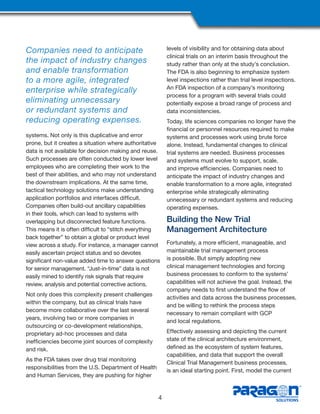
Clinical Architecture
Envisioning a Better Model
systems. Not only is this duplicative and error
prone, but it creates a situation where authoritative
data is not available for decision making and reuse.
Such processes are often conducted by lower level
employees who are completing their work to the
best of their abilities, and who may not understand
the downstream implications. At the same time,
tactical technology solutions make understanding
application portfolios and interfaces difficult.
Companies often build-out ancillary capabilities
in their tools, which can lead to systems with
overlapping but disconnected feature functions.
This means it is often difficult to “stitch everything
back together” to obtain a global or product level
view across a study. For instance, a manager cannot
easily ascertain project status and so devotes
significant non-value added time to answer questions
for senior management. “Just-in-time” data is not
easily mined to identify risk signals that require
review, analysis and potential corrective actions.
Not only does this complexity present challenges
within the company, but as clinical trials have
become more collaborative over the last several
years, involving two or more companies in
outsourcing or co-development relationships,
proprietary ad-hoc processes and data
inefficiencies become joint sources of complexity
and risk.
As the FDA takes over drug trial monitoring
responsibilities from the U.S. Department of Health
and Human Services, they are pushing for higher
levels of visibility and for obtaining data about
clinical trials on an interim basis throughout the
study rather than only at the study’s conclusion.
The FDA is also beginning to emphasize system
level inspections rather than trial level inspections.
An FDA inspection of a company’s monitoring
process for a program with several trials could
potentially expose a broad range of process and
data inconsistencies.
Today, life sciences companies no longer have the
financial or personnel resources required to make
systems and processes work using brute force
alone. Instead, fundamental changes to clinical
trial systems are needed. Business processes
and systems must evolve to support, scale,
and improve efficiencies. Companies need to
anticipate the impact of industry changes and
enable transformation to a more agile, integrated
enterprise while strategically eliminating
unnecessary or redundant systems and reducing
operating expenses.
Building the New Trial
Management Architecture
Fortunately, a more efficient, manageable, and
maintainable trial management process
is possible. But simply adopting new
clinical management technologies and forcing
business processes to conform to the systems’
capabilities will not achieve the goal. Instead, the
company needs to first understand the flow of
activities and data across the business processes,
and be willing to rethink the process steps
necessary to remain compliant with GCP
and local regulations.
Effectively assessing and depicting the current
state of the clinical architecture environment,
defined as the ecosystem of system features,
capabilities, and data that support the overall
Clinical Trial Management business processes,
is an ideal starting point. First, model the current
4
Companies need to anticipate
the impact of industry changes
and enable transformation
to a more agile, integrated
enterprise while strategically
eliminating unnecessary
or redundant systems and
reducing operating expenses.
Value Envisioned. Value Delivered.
state by defining the business capabilities needed
to conduct a clinical trial. These include activities
such as site monitoring, project management,
supplies management, content management,
and site interactions, for example. Some activities
are functional and will stretch across multiple
processes, while others are specific to a given
process. For example, clinical trial processes
result in regulated content that requires control, so
content management is a core process that would
be mapped to multiple business processes.
Once business processes are identified, examine
how data moves through the process. Which
business processes are most manually intensive?
Where do hand-offs occur between roles?
Finally, define the user communities and the
information they require to support business
processes. Define the data users’ need, which
systems and business processes they must interact
with, and determine the most efficient and cost
effective way to provide that data.
Next, map findings back to current scenarios and
determine priorities. What are the most critical
capabilities? If content management affects 60%
of the processes and is also manually intensive,
for example, it is assigned a high impact score.
Evaluating what the business can handle from a
change standpoint is also taken into consideration.
Determine which parts of the business are most
open to transformation and tie that into the
prioritization. In other words, just because content
management is high on the capability priority list
does not automatically mean it is the right choice for
the business today. All project dependencies must
be considered before prioritization is complete.
As dots are connected, a roadmap begins to
appear, and the processes emerge that need to
be examined and re-engineered most urgently.
From here, the company can take action on an
implementable, practical capability roadmap.
Conclusion
Without thorough insight into current processes
and technologies, a company cannot effectively
change the current state or be prepared for
a dynamic future state. A clinical architecture
assessment delivers insight into applications and
their interface with business/operations processes.
It s and provides a dynamic, graphical view into
the current portfolio of systems and delivers .
Additionally, it provides visibility into potential
bottlenecks, demonstrating how data moves
through a diverse application portfolio, and shows
how proposed changes to the flow affect all areas
of clinical architecture. Finally, a roadmap provides
a manageable, structured path to improvement
that is feasible in the current environment, enabling
transformation to a more agile, integrated, and
compliant enterprise and allows for the strategic
elimination of unnecessary or redundant systems to
significantly reduce operating expenses. In addition
concert with IT improvements, the to improving
the IT side of the equation, following the roadmap
helps ensure that the business/operations team
is operating within a framework that puts them
in a position to succeed…being more efficient
and delivering results today, and prepared for the
changes to come in the clinical trials of tomorrow.
5
1.800.462.5582  ■ www.consultparagon.com
6
About Paragon Solutions:
Paragon Solutions is an advisory consulting
and systems integration firm that specializes in
enterprise information management to help clients
leverage information assets for better business
results. The company does this through its industry
practices, solution accelerators and specialized
technology competencies that help clients achieve
operational efficiency, business scalability, and
regulatory compliance.
Paragon works with businesses that are focused
in a few key industries − communications, financial
services, healthcare, insurance, and life sciences.
The industry-focused practices
work with Paragon’s competency groups to address
today’s client concerns in Process Optimization,
Information Management, and Information Insight.
For more information, please visit the Paragon
website at www.consultparagon.com, or call
1.800.462.5582.
Corporate Headquarters – Cranford, NJ
Chicago • Boston • New York • Philadelphia
London • Bangalore, India
Copyright ©2013 Paragon Solutions is a registered
trademark of Paragon Solutions, Inc.
https://www.facebook.com/paragonsolutions
https://twitter.com/consultparagon
http://www.linkedin.com/company/paragon

Creating a roadmap to clinical trial efficiency

  • 1.
    Creating a Roadmapto Clinical Trial Efficiency
  • 2.
    Managing a clinicaltrial of any size and complexity requires efficient trial management. Yet for the past three decades, life sciences companies have built and then continuously added to inefficient processes, often cobbling together critical system support functions. At the same time, the business environment and regulatory factors have made the clinical trial landscape progressively more complex. A focus on outsourcing partnerships, in addition to a significant number of mergers and acquisitions over the last 10 years, has added to this complexity. In 2011 alone, despite uncertainties on both economic and regulatory fronts, over $200 billion in healthcare related M&A deals were announced.1 Simultaneously, health authorities are demanding better, faster disclosure of data. In September 2012, the U.S. Secretary of Health and Human Services delegated its clinical trial monitoring authority to the U.S. Food and Drug Administration (FDA). Though the full implications of this change are not yet known, increased GCP inspections and more stringent compliance requirements are expected. Drug development teams are also faced with ensuring smart strategies for the emerging challenges, including mobile health, social media, electronic health record data, genomics information and the tsunami of big data. In order to meet these challenges, life sciences companies must improve the efficiency of internal clinical management processes, reduce manual reporting and human intervention, and provide better visibility across the clinical trial landscape. Conducting a clinical architecture assessment allows companies to get a full picture of see what current systems and processes they have, understand what is working, and more importantly critically identify the gaps of what is not working and what is missing. It provides the team with a path roadmap forward to synchronized improvement in both improving their systems and their operations, enabling effective change in the near and long term. When these two facets of systems and operations are optimized and in sync, the resulting improvements are greater than the sum of optimizing each individually. Value Envisioned. Value Delivered. 1.800.462.5582  ■ www.consultparagon.com Clinical Trial Management: Maximizing Existing Assets Clinical trial management is becoming ever more complex. In order to meet the challenges of today and those of tomorrow, clinical trial management processes must evolve. Fortunately, evolution does not equate to vast new technology systems. In fact, many companies already possess the key pieces of technology required. Improvements are simply a matter of leveraging those technology capabilities more effectively. Executive Summary 1 1 Healthcare and Life Sciences Group, Mergersand Acquisitions, 2011 Year in Review, Sullivan & Cromwell LLP, http:/www.sullcrom com/files/upload/Healthcare
  • 3.
    Introduction Developing a drug,biologic, or device is a costly undertaking. On average, the drug development process takes more than 10 years and $1 billion dollars.2 About 85 percent of therapies fail in early clinical trials, and of those that survive through to the last step before regulatory approval, only half are approved.3 (see figure 1) But success is not solely dependent on the quality of the investigational product. Experts suggest a significant number of high viability products are being lost to outdated and impractical clinical trial designs and the lack of a streamlined, integrated approach to trial management. The high numbers of mergers and acquisitions that have taken place in the industry have played a significant role in creating dysfunctional trial management processes. Clinical trials, under any circumstances, involve a tangle of players and systems. But as M&As occur, the companies involved often inherit a mix of disparate technology and clinical trial business processes in addition to their own. Rather than use the changing business environment as an opportunity to holistically review and integrate such processes and systems, many companies manage the new jumble of disjointed processes and systems as best they can. Meanwhile, a number of external pressures challenge the feasibility of clinical trial “business as usual.” The economic landscape has changed dramatically in the last 10 years. Life sciences companies no longer generate the high levels of revenue they commanded in the early 2000s. Not only are they faced with increasing throughput to stay solvent, in many cases they have been forced to reduce headcount as well. The evolving and multifaceted landscape of compliance requirements adds additional strain. For one example, global health authorities such as the FDA now require companies to submit public data about ongoing and past clinical trials. However, a 2012 analysis of the FDA data set on clinical trials found that much of that data is missing. In fact, only 22 percent of completed trials reported results within a year, as required.4 Given the increasingly challenging business and regulatory environment, life sciences companies must evolve their clinical trials processes and improve efficiency with fewer resources. 7.5% Make it to Approval 15% Survive Development 85% of All Drugs Fail During the Development Stage 15% 7.5% 85% 2 Figure 1 2 Translational Research: 4 ways to fix the clinical trial, Nature.com, September 2011, http://www.nature.com/news/2011/110928full/477526a html 3 Translational Research: 4 ways to fix the clinical trial, Nature.com, September 2011, http://www.nature.com/news/2011/110928full/477526a.html 4 Compliance with mandatory reporting of clinical trial results on ClinicalTrials.gov: cross sectional study, BMJ Group, January 2012, http://www.bmj.com/content/344/bmjd7373 pdf%2Bhtml
  • 4.
    Clinical trials arenot only complex to accomplish, there is also a large variance between trials. As a result, business processes and systems are challenged to support and scale, and technology solutions are often introduced as a point-in- time fix, which results in additional complexity or redundancy. Often, a lack of understanding of interfaces between application portfolios and functional areas exists, and systems are not strategically integrated. Ultimately, knowledge is not consolidated, easy to access, or reusable. The technology landscape of a typical life sciences company includes a large variety of system capabilities and vendors, which continue to push the feature sets they support for a given user role or business process. In clinical systems alone, where once there was just Clinical Trial Management Systems (CTMS), Clinical Data Management Systems, and electronic Data Capture, today a host of capabilities such as electronic Trial Master Files, external collaboration/Investigator Portals, Interactive Voice Response Systems, and electronic Patient Reported Outcomes systems exist and must integrate into the larger clinical architecture and capabilities. This onslaught of systems presents challenges on two fronts: information does not flow appropriately between systems and business processes, and the company often operates using a patchwork of systems and process functionalities. Managing this scenario on a day-to-day basis can equate to what a computer programmer might deem a “hack on top of a hack.” The approach may provide the data the company needs to get through the day, but it provides little assurance as to the quality of the data or the long term reliability of the systems throughout the clinical development program. For example, a company without a solid grasp on their master data management architecture may have different users entering critical trial management data points in conflict in two or more Value Envisioned. Value Delivered. 3 1.800.462.5582  ■ www.consultparagon.com Study, Planning and Design Develop Clinical Strategy Investigator Portal Indentify, Assess and Select CROs Project Management System Clinical Trial and Results Registration System Grants Management System Clinical Data Management Statistical Analysis Tool Clinical Trial Management System Register Clinical Studies Investigator Database Study Initiation/ Startup Risk Identification and Management PharmacoviligencePatient Recruitment and Enrollment Trending Expedited Adverse Event Reporting Signal Detection Develop Risk Evaluation and Strategy Study Monitoring and Conduct Adverse Event Reconciliation Periodic Regulatory Reporting Medical Evaluation Adverse Event Data Entry and Coding Adverse Event Capture Adverse Event Reporting System Safety System Safety Data Warehouse MeDRA Safety Data Reconciliation Tools RegulatoryAffairs SPL and PIM Submissions Document Management Study Output and Closeout Study Data Collection and Management Study Management Study Reporting and Analysis Disclose Study Results Submit and Negotiate NDA Submit Labeling Manage Labeling Develop Labeling Submit and Negotiate IND Labeling Management System Clinical Trial Disclosure Clinical Architecture Envisioning a Better Model
  • 5.
    systems. Not onlyis this duplicative and error prone, but it creates a situation where authoritative data is not available for decision making and reuse. Such processes are often conducted by lower level employees who are completing their work to the best of their abilities, and who may not understand the downstream implications. At the same time, tactical technology solutions make understanding application portfolios and interfaces difficult. Companies often build-out ancillary capabilities in their tools, which can lead to systems with overlapping but disconnected feature functions. This means it is often difficult to “stitch everything back together” to obtain a global or product level view across a study. For instance, a manager cannot easily ascertain project status and so devotes significant non-value added time to answer questions for senior management. “Just-in-time” data is not easily mined to identify risk signals that require review, analysis and potential corrective actions. Not only does this complexity present challenges within the company, but as clinical trials have become more collaborative over the last several years, involving two or more companies in outsourcing or co-development relationships, proprietary ad-hoc processes and data inefficiencies become joint sources of complexity and risk. As the FDA takes over drug trial monitoring responsibilities from the U.S. Department of Health and Human Services, they are pushing for higher levels of visibility and for obtaining data about clinical trials on an interim basis throughout the study rather than only at the study’s conclusion. The FDA is also beginning to emphasize system level inspections rather than trial level inspections. An FDA inspection of a company’s monitoring process for a program with several trials could potentially expose a broad range of process and data inconsistencies. Today, life sciences companies no longer have the financial or personnel resources required to make systems and processes work using brute force alone. Instead, fundamental changes to clinical trial systems are needed. Business processes and systems must evolve to support, scale, and improve efficiencies. Companies need to anticipate the impact of industry changes and enable transformation to a more agile, integrated enterprise while strategically eliminating unnecessary or redundant systems and reducing operating expenses. Building the New Trial Management Architecture Fortunately, a more efficient, manageable, and maintainable trial management process is possible. But simply adopting new clinical management technologies and forcing business processes to conform to the systems’ capabilities will not achieve the goal. Instead, the company needs to first understand the flow of activities and data across the business processes, and be willing to rethink the process steps necessary to remain compliant with GCP and local regulations. Effectively assessing and depicting the current state of the clinical architecture environment, defined as the ecosystem of system features, capabilities, and data that support the overall Clinical Trial Management business processes, is an ideal starting point. First, model the current 4 Companies need to anticipate the impact of industry changes and enable transformation to a more agile, integrated enterprise while strategically eliminating unnecessary or redundant systems and reducing operating expenses.
  • 6.
    Value Envisioned. ValueDelivered. state by defining the business capabilities needed to conduct a clinical trial. These include activities such as site monitoring, project management, supplies management, content management, and site interactions, for example. Some activities are functional and will stretch across multiple processes, while others are specific to a given process. For example, clinical trial processes result in regulated content that requires control, so content management is a core process that would be mapped to multiple business processes. Once business processes are identified, examine how data moves through the process. Which business processes are most manually intensive? Where do hand-offs occur between roles? Finally, define the user communities and the information they require to support business processes. Define the data users’ need, which systems and business processes they must interact with, and determine the most efficient and cost effective way to provide that data. Next, map findings back to current scenarios and determine priorities. What are the most critical capabilities? If content management affects 60% of the processes and is also manually intensive, for example, it is assigned a high impact score. Evaluating what the business can handle from a change standpoint is also taken into consideration. Determine which parts of the business are most open to transformation and tie that into the prioritization. In other words, just because content management is high on the capability priority list does not automatically mean it is the right choice for the business today. All project dependencies must be considered before prioritization is complete. As dots are connected, a roadmap begins to appear, and the processes emerge that need to be examined and re-engineered most urgently. From here, the company can take action on an implementable, practical capability roadmap. Conclusion Without thorough insight into current processes and technologies, a company cannot effectively change the current state or be prepared for a dynamic future state. A clinical architecture assessment delivers insight into applications and their interface with business/operations processes. It s and provides a dynamic, graphical view into the current portfolio of systems and delivers . Additionally, it provides visibility into potential bottlenecks, demonstrating how data moves through a diverse application portfolio, and shows how proposed changes to the flow affect all areas of clinical architecture. Finally, a roadmap provides a manageable, structured path to improvement that is feasible in the current environment, enabling transformation to a more agile, integrated, and compliant enterprise and allows for the strategic elimination of unnecessary or redundant systems to significantly reduce operating expenses. In addition concert with IT improvements, the to improving the IT side of the equation, following the roadmap helps ensure that the business/operations team is operating within a framework that puts them in a position to succeed…being more efficient and delivering results today, and prepared for the changes to come in the clinical trials of tomorrow. 5 1.800.462.5582  ■ www.consultparagon.com
  • 7.
    6 About Paragon Solutions: ParagonSolutions is an advisory consulting and systems integration firm that specializes in enterprise information management to help clients leverage information assets for better business results. The company does this through its industry practices, solution accelerators and specialized technology competencies that help clients achieve operational efficiency, business scalability, and regulatory compliance. Paragon works with businesses that are focused in a few key industries − communications, financial services, healthcare, insurance, and life sciences. The industry-focused practices work with Paragon’s competency groups to address today’s client concerns in Process Optimization, Information Management, and Information Insight. For more information, please visit the Paragon website at www.consultparagon.com, or call 1.800.462.5582. Corporate Headquarters – Cranford, NJ Chicago • Boston • New York • Philadelphia London • Bangalore, India Copyright ©2013 Paragon Solutions is a registered trademark of Paragon Solutions, Inc. https://www.facebook.com/paragonsolutions https://twitter.com/consultparagon http://www.linkedin.com/company/paragon