Precompetitive
Collaborations
October 26, 2010
1
2
Precompetitive
 Refers to standards, data, or processes that are
common across an industry and where the
adoption, use, or prosecution of which provides
no competitive advantage relative to peers.
3
Precompetitive Mission Statement
 Foster collaborations between pharmaceutical,
biotechnology, technology, academic, and
government organizations in precompetitive
space to develop and promote the use of
standards, identify partnerships, and transfer
technology in order to drive greater process
efficiency and lower costs.
4
Role Description (CW 2009)
 The role consists of three primary elements:
– (1) the definition and promotion of industry standards (e.g., data models,
APIs, processes, etc.) across the Research and Development and Medical
continuum through participation on various non-profit entities (Pistoia
Alliance, Inc.) and consortia (Clinical Research Information Exchange);
– (2) proactive pursuit of pre/non-competitive collaborative application or
technology development opportunities (e.g., industry partners
collaborating with a vendor on the development of the next generation life
sciences electronic notebook), and
– (3) identification and cultivation of opportunities to generate revenue by
monetizing our portfolio of products and services (e.g., divestment and/or
licensing of Pfizer-developed applications).
5
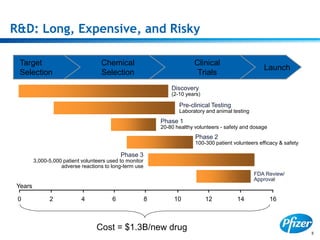
R&D: Long, Expensive, and Risky
1614121086420
Years
Cost = $1.3B/new drug
Target
Selection
Chemical
Selection
Clinical
Trials
Launch
Discovery
(2-10 years)
Pre-clinical Testing
Laboratory and animal testing
Phase 1
20-80 healthy volunteers - safety and dosage
Phase 2
100-300 patient volunteers efficacy & safety
Phase 3
3,000-5,000 patient volunteers used to monitor
adverse reactions to long-term use
FDA Review/
Approval
6
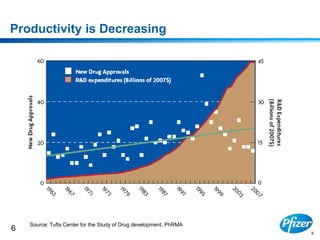
Productivity is Decreasing
6
Source: Tufts Center for the Study of Drug development, PhRMA
7
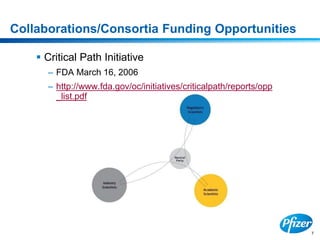
Collaborations/Consortia Funding Opportunities
 Critical Path Initiative
– FDA March 16, 2006
– http://www.fda.gov/oc/initiatives/criticalpath/reports/opp
_list.pdf
8
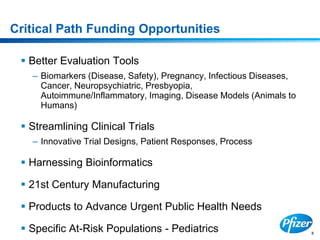
Critical Path Funding Opportunities
 Better Evaluation Tools
– Biomarkers (Disease, Safety), Pregnancy, Infectious Diseases,
Cancer, Neuropsychiatric, Presbyopia,
Autoimmune/Inflammatory, Imaging, Disease Models (Animals to
Humans)
 Streamlining Clinical Trials
– Innovative Trial Designs, Patient Responses, Process
 Harnessing Bioinformatics
 21st Century Manufacturing
 Products to Advance Urgent Public Health Needs
 Specific At-Risk Populations - Pediatrics
9
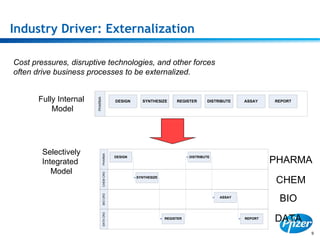
Industry Driver: Externalization
DATACROBIOCROCHEMCROPHARMA
REGISTER
DESIGN
ASSAY
REPORT
DISTRIBUTE
SYNTHESIZE
PHARMA
CHEM
BIO
DATA
PHARMA DISTRIBUTEREGISTER ASSAYSYNTHESIZE REPORTDESIGN
Selectively
Integrated
Model
Fully Internal
Model
Cost pressures, disruptive technologies, and other forces
often drive business processes to be externalized.
10
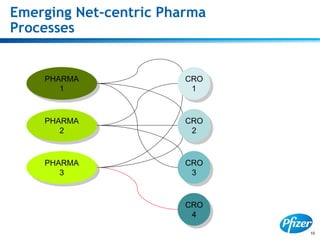
Emerging Net-centric Pharma
Processes
PHARMA
1
CRO
2
CRO
1
CRO
3
PHARMA
2
PHARMA
3
CRO
4
11
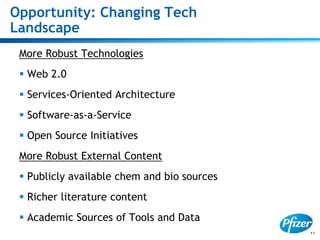
Opportunity: Changing Tech
Landscape
More Robust Technologies
 Web 2.0
 Services-Oriented Architecture
 Software-as-a-Service
 Open Source Initiatives
More Robust External Content
 Publicly available chem and bio sources
 Richer literature content
 Academic Sources of Tools and Data
12
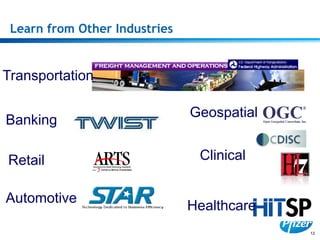
Learn from Other Industries
Transportation
Geospatial
Automotive
ClinicalRetail
Banking
Healthcare
13
Collaborations in the Research Space
 Industry Collaboration Groups
– Enlight Biosciences
 For-profit, Scientific technology development
 http://www.enlightbio.com/content/areas-of-interest/
– PRISM (Pharmaceutical Information Systems Management ) Forum
 Discussion group –stale since 2004
 http://www.prismforum.org/charter.htm
– OMG (Object Management Group/Life Sciences Research)
 Open, NFP, Basic specifications
 http://www.omg.org/lsr/ - stale since 2005
– W3C (World Wide Web Consortium)
 Open, NFP, Basic specs “to lead the web to its full potential”
 http://www.w3.org/
– DCMI (Dublin Core Metadata Initiative)
 Open, NFP, Develops metadata standards
 http://dublincore.org/about/
– PRIME
14
Pistoia Description and Purpose
 The primary purpose of the (Pistoia) Alliance is
to streamline non-competitive elements of the
life science workflow by the specification of
common standards, business terms,
relationships and processes
 Goals
– to allow this framework to encompass/support most
pre-competitive work between the organisations
– to support life science workflow prior to submission
– to work with other Standards organisations
15
15
Phase III
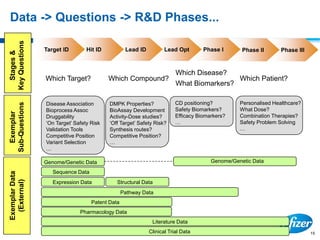
Data -> Questions -> R&D Phases...
Phase IIPhase ILead OptLead IDHit IDTarget ID
Which Target? Which Compound?
Which Disease?
What Biomarkers?
Which Patient?
Disease Association
Bioprocess Assoc
Druggability
‘On Target’ Safety Risk
Validation Tools
Competitive Position
Variant Selection
…
DMPK Properties?
BioAssay Development
Activity-Dose studies?
‘Off Target’ Safety Risk?
Synthesis routes?
Competitive Position?
…
CD positioning?
Safety Biomarkers?
Efficacy Biomarkers?
…
Personalised Healthcare?
What Dose?
Combination Therapies?
Safety Problem Solving
…
Genome/Genetic Data
Sequence Data
Expression Data
Genome/Genetic Data
Pathway Data
Patent Data
Pharmacology Data
Literature Data
Clinical Trial Data
ExemplarData
(External)
Exemplar
Sub-Questions
Stages&
KeyQuestions
Structural Data
16
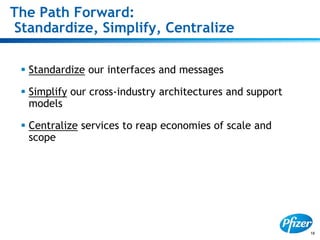
The Path Forward:
Standardize, Simplify, Centralize
 Standardize our interfaces and messages
 Simplify our cross-industry architectures and support
models
 Centralize services to reap economies of scale and
scope
17
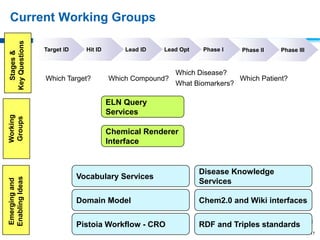
Phase III
Current Working Groups
Phase IIPhase ILead OptLead IDHit IDTarget ID
Which Target? Which Compound?
Which Disease?
What Biomarkers?
Which Patient?
Stages&
KeyQuestions
ELN Query
Services
Working
Groups
Emergingand
EnablingIdeas
Chemical Renderer
Interface
Domain Model
Pistoia Workflow - CRO
Chem2.0 and Wiki interfaces
RDF and Triples standards
Vocabulary Services
Disease Knowledge
Services
18
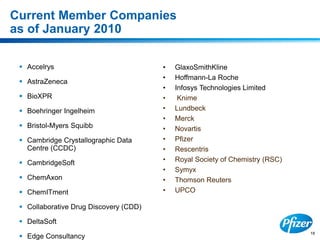
Current Member Companies
as of January 2010
 Accelrys
 AstraZeneca
 BioXPR
 Boehringer Ingelheim
 Bristol-Myers Squibb
 Cambridge Crystallographic Data
Centre (CCDC)
 CambridgeSoft
 ChemAxon
 ChemITment
 Collaborative Drug Discovery (CDD)
 DeltaSoft
 Edge Consultancy
• GlaxoSmithKline
• Hoffmann-La Roche
• Infosys Technologies Limited
• Knime
• Lundbeck
• Merck
• Novartis
• Pfizer
• Rescentris
• Royal Society of Chemistry (RSC)
• Symyx
• Thomson Reuters
• UPCO
19
20
Summary of the Work
 Model End Points
– Permeability (RRCK)
– Human Liver Microsomal Stability (HLM)
– Pg-p substrate Efflux (MDR)
– Molecular Properties such as LogD
– DDI CYP 450 Cocktail models (4)
– Herg/Dofetilide
– Solubility
– BBB
– ALT
– others…
21
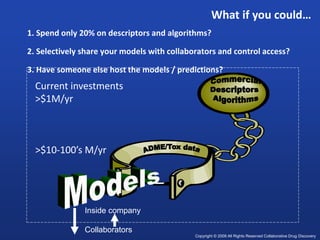
1. Spend only 20% on descriptors and algorithms?
2. Selectively share your models with collaborators and control access?
3. Have someone else host the models / predictions?
What if you could…
Copyright © 2009 All Rights Reserved Collaborative Drug Discovery
Inside company
Collaborators
Current investments
>$1M/yr
>$10-100’s M/yr
22
Collaborations in the Clinical Space
 Clinical Data Interchange Standards Consortium (CDISC) Production Standards:
– The Study Data Tabulation Model (SDTM) for the regulatory submission of Case Report
Tabulations, including the Standard for the Exchange of Nonclinical Data (SEND).
– The Analysis Data Model (ADaM) for the regulatory submission of analysis datasets.
– The Operational Data Model (ODM) for the transfer of case report form data.
– The Laboratory Model (LAB) for the transfer of clinical laboratory data, including
pharmacogenomics.
– The Biomedical Integrated Research Domain Group (BRIDG) model.
– The Case Report Tabulation – Data Definition Specification (define.xml).
– The Terminology standard containing terminology that supports all CDISC standards.
– The Glossary standard providing common meanings for terms used within clinical research.
 Those standards being developed are:
– The Protocol Representation Group developing machine-readable medical research protocol
standards including the Trial Design model shared with SDTM.
– The Clinical Data Acquisition Standards Harmonisation (CDASH) developing data acquisition
standards.
23
Partnership to Advance Clinical electronic
Research (PACeR)
 A Partnership between leading pharmaceutical
companies, health technology vendors, New York-based
academic medical centers, standards organizations, and
regulators collaborating to build an advanced clinical
research capability enabled by the re-purposing of
electronic clinical care data
24
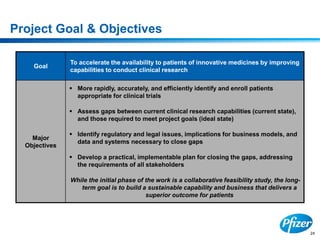
Goal
To accelerate the availability to patients of innovative medicines by improving
capabilities to conduct clinical research
Major
Objectives
 More rapidly, accurately, and efficiently identify and enroll patients
appropriate for clinical trials
 Assess gaps between current clinical research capabilities (current state),
and those required to meet project goals (ideal state)
 Identify regulatory and legal issues, implications for business models, and
data and systems necessary to close gaps
 Develop a practical, implementable plan for closing the gaps, addressing
the requirements of all stakeholders
While the initial phase of the work is a collaborative feasibility study, the long-
term goal is to build a sustainable capability and business that delivers a
superior outcome for patients
Project Goal & Objectives
25
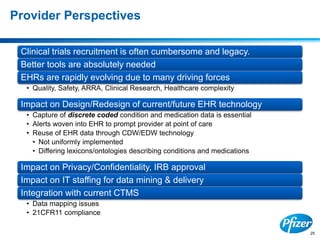
Provider Perspectives
Clinical trials recruitment is often cumbersome and legacy.
Better tools are absolutely needed
EHRs are rapidly evolving due to many driving forces
• Quality, Safety, ARRA, Clinical Research, Healthcare complexity
Impact on Design/Redesign of current/future EHR technology
• Capture of discrete coded condition and medication data is essential
• Alerts woven into EHR to prompt provider at point of care
• Reuse of EHR data through CDW/EDW technology
• Not uniformly implemented
• Differing lexicons/ontologies describing conditions and medications
Impact on Privacy/Confidentiality, IRB approval
Impact on IT staffing for data mining & delivery
Integration with current CTMS
• Data mapping issues
• 21CFR11 compliance
26
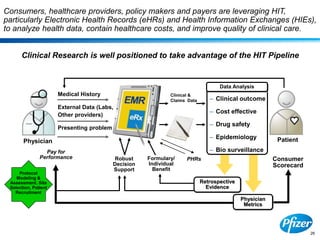
Consumer
Scorecard
Physician
Pay for
Performance
Patient
Medical History
External Data (Labs,
Other providers)
Presenting problem
Retrospective
Evidence
Physician
Metrics
Formulary/
Individual
Benefit
Robust
Decision
Support
– Clinical outcome
– Cost effective
– Drug safety
– Epidemiology
– Bio surveillance
Clinical &
Claims Data
Data Analysis
Protocol
Modeling &
Assessment, Site
Selection, Patient
Recruitment
PHRs
Consumers, healthcare providers, policy makers and payers are leveraging HIT,
particularly Electronic Health Records (eHRs) and Health Information Exchanges (HIEs),
to analyze health data, contain healthcare costs, and improve quality of clinical care.
Clinical Research is well positioned to take advantage of the HIT Pipeline
27
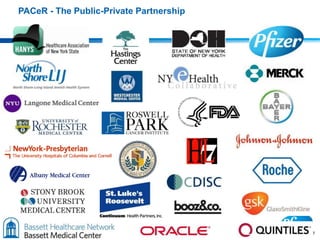
PACeR - The Public-Private Partnership
28
29
Discussion Questions
 What are the barriers to precompetitive collaborations in
research, development, commercial, medical, etc.
arenas?
 What are the factors that are stimulating precompetitive
collaborations?
 What is the “tipping point” and how far away is it?
 More…
30
Thanks

Precompetitive Collaborations

  • 1.
  • 2.
    2 Precompetitive  Refers tostandards, data, or processes that are common across an industry and where the adoption, use, or prosecution of which provides no competitive advantage relative to peers.
  • 3.
    3 Precompetitive Mission Statement Foster collaborations between pharmaceutical, biotechnology, technology, academic, and government organizations in precompetitive space to develop and promote the use of standards, identify partnerships, and transfer technology in order to drive greater process efficiency and lower costs.
  • 4.
    4 Role Description (CW2009)  The role consists of three primary elements: – (1) the definition and promotion of industry standards (e.g., data models, APIs, processes, etc.) across the Research and Development and Medical continuum through participation on various non-profit entities (Pistoia Alliance, Inc.) and consortia (Clinical Research Information Exchange); – (2) proactive pursuit of pre/non-competitive collaborative application or technology development opportunities (e.g., industry partners collaborating with a vendor on the development of the next generation life sciences electronic notebook), and – (3) identification and cultivation of opportunities to generate revenue by monetizing our portfolio of products and services (e.g., divestment and/or licensing of Pfizer-developed applications).
  • 5.
    5 R&D: Long, Expensive,and Risky 1614121086420 Years Cost = $1.3B/new drug Target Selection Chemical Selection Clinical Trials Launch Discovery (2-10 years) Pre-clinical Testing Laboratory and animal testing Phase 1 20-80 healthy volunteers - safety and dosage Phase 2 100-300 patient volunteers efficacy & safety Phase 3 3,000-5,000 patient volunteers used to monitor adverse reactions to long-term use FDA Review/ Approval
  • 6.
    6 Productivity is Decreasing 6 Source:Tufts Center for the Study of Drug development, PhRMA
  • 7.
    7 Collaborations/Consortia Funding Opportunities Critical Path Initiative – FDA March 16, 2006 – http://www.fda.gov/oc/initiatives/criticalpath/reports/opp _list.pdf
  • 8.
    8 Critical Path FundingOpportunities  Better Evaluation Tools – Biomarkers (Disease, Safety), Pregnancy, Infectious Diseases, Cancer, Neuropsychiatric, Presbyopia, Autoimmune/Inflammatory, Imaging, Disease Models (Animals to Humans)  Streamlining Clinical Trials – Innovative Trial Designs, Patient Responses, Process  Harnessing Bioinformatics  21st Century Manufacturing  Products to Advance Urgent Public Health Needs  Specific At-Risk Populations - Pediatrics
  • 9.
    9 Industry Driver: Externalization DATACROBIOCROCHEMCROPHARMA REGISTER DESIGN ASSAY REPORT DISTRIBUTE SYNTHESIZE PHARMA CHEM BIO DATA PHARMADISTRIBUTEREGISTER ASSAYSYNTHESIZE REPORTDESIGN Selectively Integrated Model Fully Internal Model Cost pressures, disruptive technologies, and other forces often drive business processes to be externalized.
  • 10.
  • 11.
    11 Opportunity: Changing Tech Landscape MoreRobust Technologies  Web 2.0  Services-Oriented Architecture  Software-as-a-Service  Open Source Initiatives More Robust External Content  Publicly available chem and bio sources  Richer literature content  Academic Sources of Tools and Data
  • 12.
    12 Learn from OtherIndustries Transportation Geospatial Automotive ClinicalRetail Banking Healthcare
  • 13.
    13 Collaborations in theResearch Space  Industry Collaboration Groups – Enlight Biosciences  For-profit, Scientific technology development  http://www.enlightbio.com/content/areas-of-interest/ – PRISM (Pharmaceutical Information Systems Management ) Forum  Discussion group –stale since 2004  http://www.prismforum.org/charter.htm – OMG (Object Management Group/Life Sciences Research)  Open, NFP, Basic specifications  http://www.omg.org/lsr/ - stale since 2005 – W3C (World Wide Web Consortium)  Open, NFP, Basic specs “to lead the web to its full potential”  http://www.w3.org/ – DCMI (Dublin Core Metadata Initiative)  Open, NFP, Develops metadata standards  http://dublincore.org/about/ – PRIME
  • 14.
    14 Pistoia Description andPurpose  The primary purpose of the (Pistoia) Alliance is to streamline non-competitive elements of the life science workflow by the specification of common standards, business terms, relationships and processes  Goals – to allow this framework to encompass/support most pre-competitive work between the organisations – to support life science workflow prior to submission – to work with other Standards organisations
  • 15.
    15 15 Phase III Data ->Questions -> R&D Phases... Phase IIPhase ILead OptLead IDHit IDTarget ID Which Target? Which Compound? Which Disease? What Biomarkers? Which Patient? Disease Association Bioprocess Assoc Druggability ‘On Target’ Safety Risk Validation Tools Competitive Position Variant Selection … DMPK Properties? BioAssay Development Activity-Dose studies? ‘Off Target’ Safety Risk? Synthesis routes? Competitive Position? … CD positioning? Safety Biomarkers? Efficacy Biomarkers? … Personalised Healthcare? What Dose? Combination Therapies? Safety Problem Solving … Genome/Genetic Data Sequence Data Expression Data Genome/Genetic Data Pathway Data Patent Data Pharmacology Data Literature Data Clinical Trial Data ExemplarData (External) Exemplar Sub-Questions Stages& KeyQuestions Structural Data
  • 16.
    16 The Path Forward: Standardize,Simplify, Centralize  Standardize our interfaces and messages  Simplify our cross-industry architectures and support models  Centralize services to reap economies of scale and scope
  • 17.
    17 Phase III Current WorkingGroups Phase IIPhase ILead OptLead IDHit IDTarget ID Which Target? Which Compound? Which Disease? What Biomarkers? Which Patient? Stages& KeyQuestions ELN Query Services Working Groups Emergingand EnablingIdeas Chemical Renderer Interface Domain Model Pistoia Workflow - CRO Chem2.0 and Wiki interfaces RDF and Triples standards Vocabulary Services Disease Knowledge Services
  • 18.
    18 Current Member Companies asof January 2010  Accelrys  AstraZeneca  BioXPR  Boehringer Ingelheim  Bristol-Myers Squibb  Cambridge Crystallographic Data Centre (CCDC)  CambridgeSoft  ChemAxon  ChemITment  Collaborative Drug Discovery (CDD)  DeltaSoft  Edge Consultancy • GlaxoSmithKline • Hoffmann-La Roche • Infosys Technologies Limited • Knime • Lundbeck • Merck • Novartis • Pfizer • Rescentris • Royal Society of Chemistry (RSC) • Symyx • Thomson Reuters • UPCO
  • 19.
  • 20.
    20 Summary of theWork  Model End Points – Permeability (RRCK) – Human Liver Microsomal Stability (HLM) – Pg-p substrate Efflux (MDR) – Molecular Properties such as LogD – DDI CYP 450 Cocktail models (4) – Herg/Dofetilide – Solubility – BBB – ALT – others…
  • 21.
    21 1. Spend only20% on descriptors and algorithms? 2. Selectively share your models with collaborators and control access? 3. Have someone else host the models / predictions? What if you could… Copyright © 2009 All Rights Reserved Collaborative Drug Discovery Inside company Collaborators Current investments >$1M/yr >$10-100’s M/yr
  • 22.
    22 Collaborations in theClinical Space  Clinical Data Interchange Standards Consortium (CDISC) Production Standards: – The Study Data Tabulation Model (SDTM) for the regulatory submission of Case Report Tabulations, including the Standard for the Exchange of Nonclinical Data (SEND). – The Analysis Data Model (ADaM) for the regulatory submission of analysis datasets. – The Operational Data Model (ODM) for the transfer of case report form data. – The Laboratory Model (LAB) for the transfer of clinical laboratory data, including pharmacogenomics. – The Biomedical Integrated Research Domain Group (BRIDG) model. – The Case Report Tabulation – Data Definition Specification (define.xml). – The Terminology standard containing terminology that supports all CDISC standards. – The Glossary standard providing common meanings for terms used within clinical research.  Those standards being developed are: – The Protocol Representation Group developing machine-readable medical research protocol standards including the Trial Design model shared with SDTM. – The Clinical Data Acquisition Standards Harmonisation (CDASH) developing data acquisition standards.
  • 23.
    23 Partnership to AdvanceClinical electronic Research (PACeR)  A Partnership between leading pharmaceutical companies, health technology vendors, New York-based academic medical centers, standards organizations, and regulators collaborating to build an advanced clinical research capability enabled by the re-purposing of electronic clinical care data
  • 24.
    24 Goal To accelerate theavailability to patients of innovative medicines by improving capabilities to conduct clinical research Major Objectives  More rapidly, accurately, and efficiently identify and enroll patients appropriate for clinical trials  Assess gaps between current clinical research capabilities (current state), and those required to meet project goals (ideal state)  Identify regulatory and legal issues, implications for business models, and data and systems necessary to close gaps  Develop a practical, implementable plan for closing the gaps, addressing the requirements of all stakeholders While the initial phase of the work is a collaborative feasibility study, the long- term goal is to build a sustainable capability and business that delivers a superior outcome for patients Project Goal & Objectives
  • 25.
    25 Provider Perspectives Clinical trialsrecruitment is often cumbersome and legacy. Better tools are absolutely needed EHRs are rapidly evolving due to many driving forces • Quality, Safety, ARRA, Clinical Research, Healthcare complexity Impact on Design/Redesign of current/future EHR technology • Capture of discrete coded condition and medication data is essential • Alerts woven into EHR to prompt provider at point of care • Reuse of EHR data through CDW/EDW technology • Not uniformly implemented • Differing lexicons/ontologies describing conditions and medications Impact on Privacy/Confidentiality, IRB approval Impact on IT staffing for data mining & delivery Integration with current CTMS • Data mapping issues • 21CFR11 compliance
  • 26.
    26 Consumer Scorecard Physician Pay for Performance Patient Medical History ExternalData (Labs, Other providers) Presenting problem Retrospective Evidence Physician Metrics Formulary/ Individual Benefit Robust Decision Support – Clinical outcome – Cost effective – Drug safety – Epidemiology – Bio surveillance Clinical & Claims Data Data Analysis Protocol Modeling & Assessment, Site Selection, Patient Recruitment PHRs Consumers, healthcare providers, policy makers and payers are leveraging HIT, particularly Electronic Health Records (eHRs) and Health Information Exchanges (HIEs), to analyze health data, contain healthcare costs, and improve quality of clinical care. Clinical Research is well positioned to take advantage of the HIT Pipeline
  • 27.
    27 PACeR - ThePublic-Private Partnership
  • 28.
  • 29.
    29 Discussion Questions  Whatare the barriers to precompetitive collaborations in research, development, commercial, medical, etc. arenas?  What are the factors that are stimulating precompetitive collaborations?  What is the “tipping point” and how far away is it?  More…
  • 30.