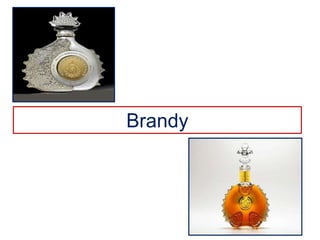
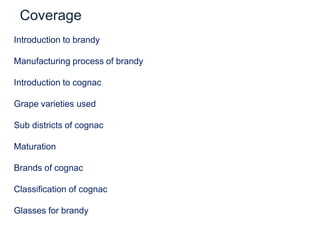
Brandy
Coverage
Introduction to brandy
Manufacturing process of brandy
Introduction to cognac
Grape varieties used
Sub districts of cognac
Maturation
Brands of cognac
Classification of cognac
Glasses for brandy
Learning needs
To understand the brandies and there detailed
concepts
Introduction to brandy
Obtained by distillation of fermented
grape juice(wine)
No other spirit is added
Must not be distilled above 86 to 94.8
percent of alcohol
Introduction to brandy
Matured for at least for 6 months in
oak casks
Either consumed neat to a measure of
30 or 60 ml or with hot water
Said to have medicinal properties
Manufacturing process of brandy
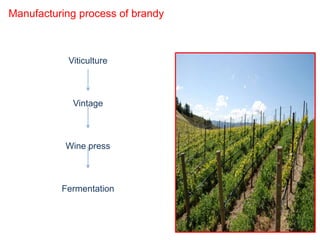
Viticulture
Vintage
Wine press
Fermentation
Racking
Finning
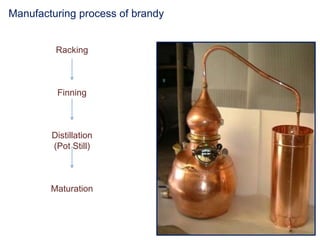
Distillation
(Pot Still)
Maturation
Manufacturing process of brandy
Cognac
Best brandy in the world
Comes from cognac district of
France
Soil type in district is chalky
Triple distilled by law
Cognac
Matured for at least one year in the
district
Appellation cognac can be
embedded by different marks
Age of cognac refers to age in
cask before bottling
Cognac doest improve after
bottling
Manufacturing process of Cognac
Viticulture:
The grapes are harvested in
chalky soil
Manufacturing process of Cognac
Vintage:
Vineyards are picked in one go
Manufacturing process of Cognac
Wine press:
Grapes are pressed several times
Marc is the must obtained from second
pressing
Manufacturing process of Cognac
Fermentation:
Fermented for seven to ten days
Wine produced is acidic and
harsh
Best cognacs are made from
unpalatable wines
Manufacturing process of Cognac
Racking and finning:
Purification by transferring in
barrels or by using different finning
agents
Lees , grapes skin and dead yeast
are removed
Manufacturing process of Cognac
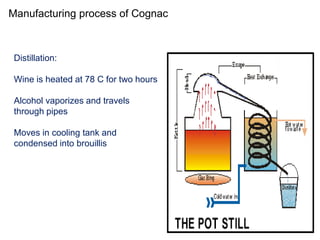
Distillation:
Pot still distillation is done
Copper pots are used for distillation
Must get completed by 31st march of
the year following the harvest
Done under French excise
supervision
Manufacturing process of Cognac
Distillation:
Wine is heated at 78 C for two hours
Alcohol vaporizes and travels
through pipes
Moves in cooling tank and
condensed into brouillis
Manufacturing process of Cognac
Distillation:
Brouillis contains alcohol, water,
flavourings and other trace
elements
Brouillis is almost 30% of the total
quantity of wine
Similarly three lots of brouillis are
collected
Manufacturing process of Cognac
Distillation:
Later on put in clean pot still and
redistilled
This second distillation takes around
10 hours
First distillation is called foreshot,tete
or head which is discarded
Manufacturing process of Cognac
Distillation:
Second distilled is heart or bonne
chauffe is used
Approximately nine casks of wines are
used to produce one cask of bonne
chauffe
Third distilled is called tail or queue
discarded
Distilled water added to bring down the
level of alcohol
Manufacturing process of Cognac
Maturation:
Bonne chauffe is matured in limousin
cask
Highly porous wood with tannin
content
Obtained from limousine tree
Balances acidity level of cognac
Manufacturing process of Cognac
Maturation:
2 to 3 % evaporation annually
Evaporated amount is called angels
share
Minimum maturation is for 5 years
Manufacturing process of Cognac
Maturation:
Spirit is colourless
Coloured with little caramel
Should have as 72% alcohol by
volume and not more than that
Will only mature while in casks
Sub-districts of Cognac
According to merit the districts
are:
Grande Champagne
Petite Champagne
Le Borderies
Fins Bois
Bons Bois
Bois Ordinaires
Bois a terroir
Brands of Cognac
J & F Martell
Jas Hennessy
Courvoisier
Bisquit
Camus
Brands of Cognac
Remi Martin
Remi Marquis
Sauvion
Hine
Metaxa
Classification on basis of Age
VS cognac (Very Superior)
Aged for minimum 3 to 5 years
May be drunk neat or can be
consumed with mixture (usually hot
water) or used in cocktails
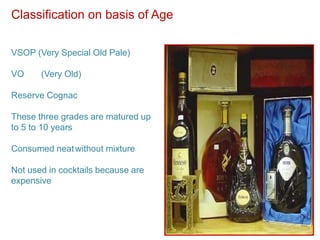
VSOP (Very Special Old Pale)
VO (Very Old)
Reserve Cognac
These three grades are matured up
to 5 to 10 years
Consumed neatwithout mixture
Not used in cocktails because are
expensive
Classification on basis of Age
XO (Extra Old)
Cordon Bleu
Centeur
Antique
These grades are matured up to 20 to
40 years
Consumed neatwithout mixture
Not used in cocktails because are
expensive
Glasses Used
Brandy Balloon
Glasses Used
Brandy Sniffer
Glasses Used
Brandy Goblet
Glasses Used
Glass is holded from the body using
single or both hands
Have peculiar shape with broad body
and narrow rim
Narrow rim keep the brandy warm for
longer period of time
Another high class
product from grapes

Brandyppt.pptx

  • 1.
  • 2.
    Coverage Introduction to brandy Manufacturingprocess of brandy Introduction to cognac Grape varieties used Sub districts of cognac Maturation Brands of cognac Classification of cognac Glasses for brandy
  • 3.
    Learning needs To understandthe brandies and there detailed concepts
  • 4.
    Introduction to brandy Obtainedby distillation of fermented grape juice(wine) No other spirit is added Must not be distilled above 86 to 94.8 percent of alcohol
  • 5.
    Introduction to brandy Maturedfor at least for 6 months in oak casks Either consumed neat to a measure of 30 or 60 ml or with hot water Said to have medicinal properties
  • 6.
    Manufacturing process ofbrandy Viticulture Vintage Wine press Fermentation
  • 7.
  • 8.
    Cognac Best brandy inthe world Comes from cognac district of France Soil type in district is chalky Triple distilled by law
  • 9.
    Cognac Matured for atleast one year in the district Appellation cognac can be embedded by different marks Age of cognac refers to age in cask before bottling Cognac doest improve after bottling
  • 10.
    Manufacturing process ofCognac Viticulture: The grapes are harvested in chalky soil
  • 11.
    Manufacturing process ofCognac Vintage: Vineyards are picked in one go
  • 12.
    Manufacturing process ofCognac Wine press: Grapes are pressed several times Marc is the must obtained from second pressing
  • 13.
    Manufacturing process ofCognac Fermentation: Fermented for seven to ten days Wine produced is acidic and harsh Best cognacs are made from unpalatable wines
  • 14.
    Manufacturing process ofCognac Racking and finning: Purification by transferring in barrels or by using different finning agents Lees , grapes skin and dead yeast are removed
  • 15.
    Manufacturing process ofCognac Distillation: Pot still distillation is done Copper pots are used for distillation Must get completed by 31st march of the year following the harvest Done under French excise supervision
  • 16.
    Manufacturing process ofCognac Distillation: Wine is heated at 78 C for two hours Alcohol vaporizes and travels through pipes Moves in cooling tank and condensed into brouillis
  • 17.
    Manufacturing process ofCognac Distillation: Brouillis contains alcohol, water, flavourings and other trace elements Brouillis is almost 30% of the total quantity of wine Similarly three lots of brouillis are collected
  • 18.
    Manufacturing process ofCognac Distillation: Later on put in clean pot still and redistilled This second distillation takes around 10 hours First distillation is called foreshot,tete or head which is discarded
  • 19.
    Manufacturing process ofCognac Distillation: Second distilled is heart or bonne chauffe is used Approximately nine casks of wines are used to produce one cask of bonne chauffe Third distilled is called tail or queue discarded Distilled water added to bring down the level of alcohol
  • 20.
    Manufacturing process ofCognac Maturation: Bonne chauffe is matured in limousin cask Highly porous wood with tannin content Obtained from limousine tree Balances acidity level of cognac
  • 21.
    Manufacturing process ofCognac Maturation: 2 to 3 % evaporation annually Evaporated amount is called angels share Minimum maturation is for 5 years
  • 22.
    Manufacturing process ofCognac Maturation: Spirit is colourless Coloured with little caramel Should have as 72% alcohol by volume and not more than that Will only mature while in casks
  • 23.
    Sub-districts of Cognac Accordingto merit the districts are: Grande Champagne Petite Champagne Le Borderies Fins Bois Bons Bois Bois Ordinaires Bois a terroir
  • 24.
    Brands of Cognac J& F Martell Jas Hennessy Courvoisier Bisquit Camus
  • 25.
    Brands of Cognac RemiMartin Remi Marquis Sauvion Hine Metaxa
  • 26.
    Classification on basisof Age VS cognac (Very Superior) Aged for minimum 3 to 5 years May be drunk neat or can be consumed with mixture (usually hot water) or used in cocktails
  • 27.
    VSOP (Very SpecialOld Pale) VO (Very Old) Reserve Cognac These three grades are matured up to 5 to 10 years Consumed neatwithout mixture Not used in cocktails because are expensive Classification on basis of Age
  • 28.
    Classification on basisof Age XO (Extra Old) Cordon Bleu Centeur Antique These grades are matured up to 20 to 40 years Consumed neatwithout mixture Not used in cocktails because are expensive
  • 29.
  • 30.
  • 31.
  • 32.
    Glasses Used Glass isholded from the body using single or both hands Have peculiar shape with broad body and narrow rim Narrow rim keep the brandy warm for longer period of time
  • 33.