BRAND GUIDELINES
By Alina Haq
What are brand guidelines?
 Brand Guidelines (also commonly referred to as “brand standards”,
“style guide” or “brand book”) are essentially a set of rules that explain how
your brand works. These guidelines typically include basic information
such as: An overview of your brand's history, vision, personality and key
values
1. An overview of your brand’s history, vision, personality and key values.
2. Brand message or mission statement – including examples of ‘tone of
voice’.
3. Logo usage – where and how to use your logo including minimum sizes,
spacing and what not to do with it.
4. Colour palette – showing your primary and secondary colour palettes with
colour breakdowns for print, screen and web.
5. Type style – showing the specific font that you use and details of the font
family and default fonts for web use.
6. Image style/photography – examples of image style and photographs that
work with the brand.
7. Business card and letterhead design – examples of how the logo and font
are used for standard company literature.
Brand Identity
 A brand's visual identity is the overall look of its
communications. Effective visual brand identity
is achieved by the consistent use of particular
visual elements to create distinction, such as
specific fonts, colors, and graphic elements.
 Brand identity is different to brand image, which is
what consumers actually think. It is constructed by
the business itself. A negative gap between brand
identity and brand image means a company is out
of touch with market sentiment, which will make
selling its products more difficult. The brand image
held by consumers can reach a point at which a
business or product has to rebrand itself or risk
not bringing in sales.
Logo
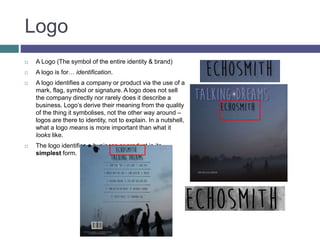
 A Logo (The symbol of the entire identity & brand)
 A logo is for… identification.
 A logo identifies a company or product via the use of a
mark, flag, symbol or signature. A logo does not sell
the company directly nor rarely does it describe a
business. Logo’s derive their meaning from the quality
of the thing it symbolises, not the other way around –
logos are there to identity, not to explain. In a nutshell,
what a logo means is more important than what it
looks like.
 The logo identifies a business or product in its
simplest form.
Typeface
 Moon flower
Colour
 Colour is an important consideration in your brand identity system. Colours have a significant
impact on people’s emotional state. They also have been shown to impact people’s ability to
concentrate and learn. They have a wide variety of specific mental associations. In fact, the
effects are physiological, psychological, and sociological.
 Colours also have a functional impact on readability, eye-strain, ability to attract attention, ability
to be seen at night, etc. This is important in choosing colours for signing, website pages, prints
ads, and other marketing media.
 Colours are an important part of any brand identity system. Testing the affect of a new brand
identity system’s colours is well advised. It is important to consider that colour associations will
vary by individual, and especially culture, due to the cultural context and previous experiences
with the colours. All of the impacts of colours are equally true of music, scents and sounds.
C=0, M=0, Y=0, K=100 C=0, M=0, Y=0, K=0

Brand Guidelines

  • 1.
  • 2.
    What are brandguidelines?  Brand Guidelines (also commonly referred to as “brand standards”, “style guide” or “brand book”) are essentially a set of rules that explain how your brand works. These guidelines typically include basic information such as: An overview of your brand's history, vision, personality and key values 1. An overview of your brand’s history, vision, personality and key values. 2. Brand message or mission statement – including examples of ‘tone of voice’. 3. Logo usage – where and how to use your logo including minimum sizes, spacing and what not to do with it. 4. Colour palette – showing your primary and secondary colour palettes with colour breakdowns for print, screen and web. 5. Type style – showing the specific font that you use and details of the font family and default fonts for web use. 6. Image style/photography – examples of image style and photographs that work with the brand. 7. Business card and letterhead design – examples of how the logo and font are used for standard company literature.
  • 3.
    Brand Identity  Abrand's visual identity is the overall look of its communications. Effective visual brand identity is achieved by the consistent use of particular visual elements to create distinction, such as specific fonts, colors, and graphic elements.  Brand identity is different to brand image, which is what consumers actually think. It is constructed by the business itself. A negative gap between brand identity and brand image means a company is out of touch with market sentiment, which will make selling its products more difficult. The brand image held by consumers can reach a point at which a business or product has to rebrand itself or risk not bringing in sales.
  • 4.
    Logo  A Logo(The symbol of the entire identity & brand)  A logo is for… identification.  A logo identifies a company or product via the use of a mark, flag, symbol or signature. A logo does not sell the company directly nor rarely does it describe a business. Logo’s derive their meaning from the quality of the thing it symbolises, not the other way around – logos are there to identity, not to explain. In a nutshell, what a logo means is more important than what it looks like.  The logo identifies a business or product in its simplest form.
  • 5.
  • 6.
    Colour  Colour isan important consideration in your brand identity system. Colours have a significant impact on people’s emotional state. They also have been shown to impact people’s ability to concentrate and learn. They have a wide variety of specific mental associations. In fact, the effects are physiological, psychological, and sociological.  Colours also have a functional impact on readability, eye-strain, ability to attract attention, ability to be seen at night, etc. This is important in choosing colours for signing, website pages, prints ads, and other marketing media.  Colours are an important part of any brand identity system. Testing the affect of a new brand identity system’s colours is well advised. It is important to consider that colour associations will vary by individual, and especially culture, due to the cultural context and previous experiences with the colours. All of the impacts of colours are equally true of music, scents and sounds. C=0, M=0, Y=0, K=100 C=0, M=0, Y=0, K=0