


Consumer First – Brand
Second
Sohan Babu Khatri - Introduction
Professional Engagements:
• CEO – Three H Management Pvt. Ltd
• Director of Board – White Space Pvt. Ltd. (Threadpaints.com,
Butta.us)
Adjunct Faculty:
• Ace Insititute of Management
• Ace International Business School
• Global College International
Background:
• Bachelor’s of Civil Engineering (BE Civil) - Pulchowk Campus, Institute of Engineering,
Nepal
• Masters of Business Administration (MBA - Finance and Marketing), Bangalore University,
India
• Certified Financial Manager (CFM), Centre of Financial Management, Bangalore
• Licensed International Financial Analyst (LIFA) - Charter Holder – International Research
Association, Cambridge, Massachusetts
Brands Exist to Serve
Customers,
Not the other way around.
But you’d never know that from
the way Brands are Managed
What do we want ?
• Growing the Lifetime Value of Customer
Relationship
• Building loyalty and Retention
• Cross selling related goods and services
• Broadening Offerings to fulfill more
customer’s Needs
• Adding Customer Equity
But are we acting in Customer
focused way or Brand focused
way ?
Brand Management still trumps
Customer Management in most
large companies and the focus is
increasingly incompatible with
Growth
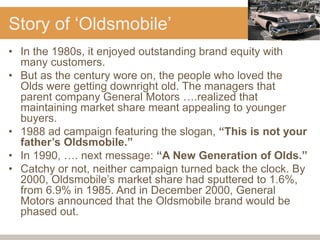
Story of ‘Oldsmobile’
• In the 1980s, it enjoyed outstanding brand equity with
many customers.
• But as the century wore on, the people who loved the
Olds were getting downright old. The managers that
parent company General Motors ….realized that
maintaining market share meant appealing to younger
buyers.
• 1988 ad campaign featuring the slogan, “This is not your
father’s Oldsmobile.”
• In 1990, …. next message: “A New Generation of Olds.”
• Catchy or not, neither campaign turned back the clock. By
2000, Oldsmobile’s market share had sputtered to 1.6%,
from 6.9% in 1985. And in December 2000, General
Motors announced that the Oldsmobile brand would be
phased out.
• Why did General Motors spend so many years
and so much money trying to reposition and
refurbish such a tired image?
• Why not instead move younger buyers along a
path of less resistance, toward another of the
brands in GM’s stable—or even launch a wholly
new brand geared to their tastes?
• Cultivating the customers, even at the expense
of the brand, would surely have been the path to
profits.
Brands are the raison d’être ?
Or
Consumers are the raison
d’être ?
Brand should be in the service
of the larger goal: growing
customer equity
• This doesn’t mean that brand becomes
unimportant.
• Compelling brand images remain essential to
winning and keeping customers’ trade.
• But it does mean fundamentally changing
how management thinks about the goals,
roles, and metrics associated with a well-
managed brand.
To what extent does your
brand excel at delivering the
benefits that consumers truly
desire?
George Clinton
• Let’s take an example from the entertainment world, courtesy of
songwriter and performer George Clinton.
• Known as one of the founders of funk, Clinton in the 1970s sought the
attention of two different segments of record buyers—mainstream
listeners, who liked vocal soul music with horns, and progressive
listeners, who liked harder-edged funk.
• Clinton knew that his band was accomplished enough to play both kinds
of music, but he realized that alternating between the styles would
muddy the band’s image and serve neither audience well. The solution
was simple.
• The same group of musicians, essentially, recorded and performed under
two different band names: Parliament, when the music was aimed at
popular tastes, and Funkadelic, when it was edgier.
• Both bands were very successful, even though some Parliament fans
would never listen to Funkadelic and vice versa.
• The point is that Clinton did not try to make his original brand a big
tent by stretching it to accommodate the tastes of very different
markets. His branding reflected his customers’ identities instead of
his band members’.
HONDA
• That kind of thinking led to Honda’s development and
marketing of the Acura Legend in the United States.
• The same car was introduced in most other countries,
including Japan, as the Honda Legend.
• But the company had good reason to think it would not
succeed using that name Stateside.
• In the 1980s, U.S. buyers, much more than their
counterparts elsewhere, associated the Honda brand with
economy cars. They expected and trusted the company to
provide inexpensive, dependable—if not very exciting—
cars.
• Rather than work to change that image (which served the
company well with other models), management decided to
launch a new brand. “Acura” had no positive equity
established with upscale buyers, but neither did it have
baggage to overcome.
Learn | Consult | Research
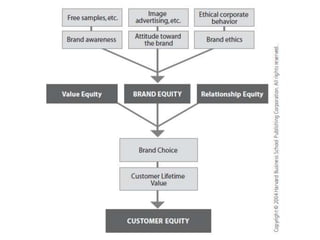
CUSTOMER EQUITY
Brand Equity (BE)
• The sum of customers’ assessments of a
brand’s intangible qualities, positive or
negative.
Customer-Based Brand Equity
• “The differential effect that brand
knowledge has on consumer response
to the marketing of that brand.”
Keller, 1993
• A brand has positive customer-based brand equity when
consumers react more favorably to a product and the
way it is marketed when the brand is identified than
when it is not (say, when the product is attributed to a
fictitious name or is unnamed).
• Thus, customers might be more accepting
of
– a new brand extension for a brand with
positive customer-based brand equity,
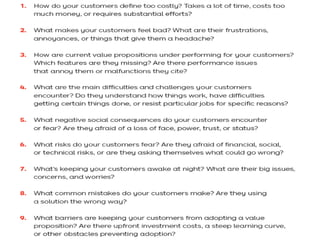
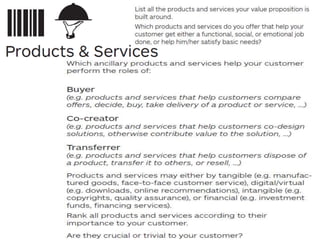
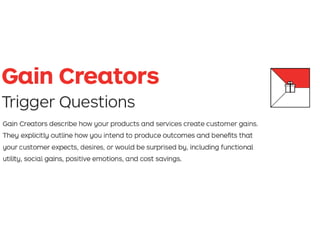
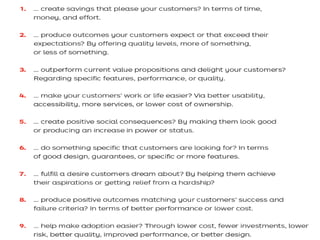
– less sensitive to price increases and
– withdrawal of advertising support, or
– more willing to seek the brand in a new
distribution channel.
CLV (Customer Lifetime Value)
• The net profit a company accrues
from transactions with a given
customer during the time that the
customer has a relationship with the
company.
Customer Equity (CE)
• The sum of the lifetime values of all
the firm’s customers, across all the
firm’s brands
And though the two (BE and CE)
often move in concert, it is
important to remember that
acting in the best interests of
brand equity isn’t necessarily the
same as acting in the best
interests of customer equity.
A CASE
• Suppose we have a customer—let’s call her Ann—
who tends to favor one of our current brands, Brand
A.
• To the extent that Ann values Brand A above and
beyond the objective value of the product’s attributes,
we can say that it has positive brand equity for her.
• If Brand A’s equity increases in her eyes, Ann is likely
to buy it more frequently and perhaps in higher
volume per purchase.
• This of course increases Ann’s lifetime value to the
company.
• But what happens if Ann grows tired of Brand A?
Or if the brand ceases to resonate with her?
…..
• If we manage the customer relationship
properly, we can introduce Ann to another of
our brands that is a better match with her
sensibilities.
• In fact, we should be willing to do whatever is
necessary with our brands (including
replacing them with new ones) to maintain
our customer relationships.
• Our attitude should be that brands come
and go—but customers like Ann must
remain.
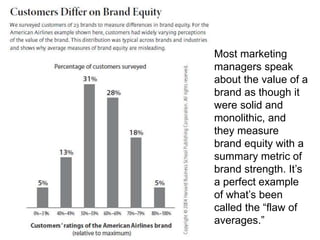
The Value of a Brand Depends
on the Customer
Most marketing
managers speak
about the value of a
brand as though it
were solid and
monolithic, and
they measure
brand equity with a
summary metric of
brand strength. It’s
a perfect example
of what’s been
called the “flaw of
averages.”
Defining that value as the
average would lead to actions
that weren’t right for many
customers.
Make brand decisions
subservient to decisions about
customer relationships.
Build brands around customer
segments, not the other way
around.
Make your brands as narrow
as possible.
Plan brand extensions based
on customer needs, not
component similarities.
Develop the capability and the
mind-set to hand off
customers to other brands in
the company.
Brand managers need to know
their customers well enough
to tell when it’s time to hand
them off.
Take no heroic measures.
Know well - At what point would
you cut your losses and invest in
a new one?
If brand managers control the
resources, they will persist too
long with a brand that has lost
its punch.
Change how you measure
brand equity.
Learn | Consult | Research
Understanding Customers
Understand “Consumer Behavior”
 It blends the elements of
– Psychology,
– Sociology &
– Economics.
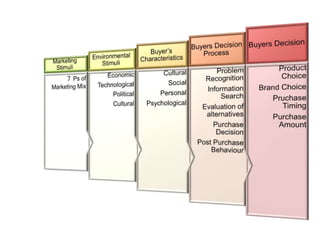
Stages:
Post Purchase Evaluation
Satisfaction vs Dissatisfaction
Actual Purchase
Time , Access and Reference
Purchase Decision
Choosing Alternative Product Features
Evaluation of Alternatives
Criteria for Evaluation Rank Alternatives or Resume Search
Information Search
Internal Search External Search
Problem Recognition [Awareness of Need]
Desired State Actual State
What marketers need to do ?
Post Purchase Evaluation
After sales communication After sales service Customer lifetime value
Actual Purchase
Design moment of truth
Purchase Decision
Communicate Product Features Design easy process
Evaluation of Alternatives
Help consumers with information Influence by framing alternatives
Information Search
Impress consumers intensely Be present in all sources of information
Problem Recognition [Awareness of Need]
Communicate Need Sell solution
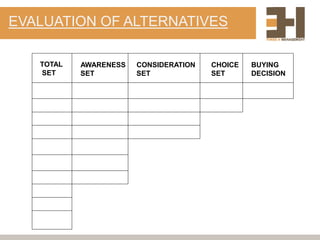
EVALUATION OF ALTERNATIVES
TOTAL
SET
AWARENESS
SET
CONSIDERATION
SET
CHOICE
SET
BUYING
DECISION
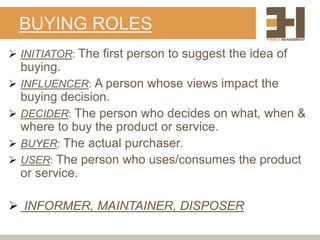
BUYING ROLES
 INITIATOR: The first person to suggest the idea of
buying.
 INFLUENCER: A person whose views impact the
buying decision.
 DECIDER: The person who decides on what, when &
where to buy the product or service.
 BUYER: The actual purchaser.
 USER: The person who uses/consumes the product
or service.
 INFORMER, MAINTAINER, DISPOSER
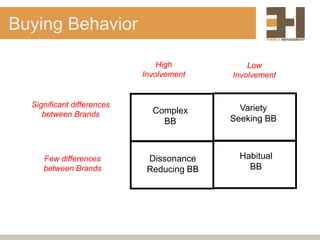
Buying Behavior
Complex
BB
Variety
Seeking BB
Dissonance
Reducing BB
Habitual
BB
High
Involvement
Low
Involvement
Significant differences
between Brands
Few differences
between Brands
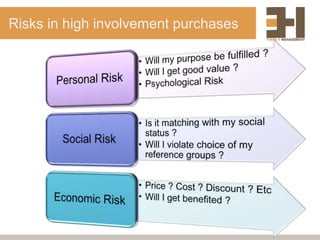
Risks in high involvement purchases
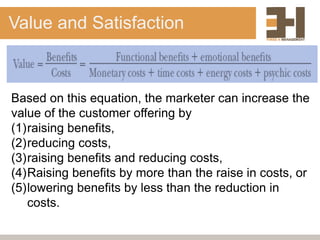
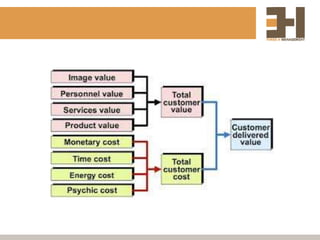
Value and Satisfaction
Based on this equation, the marketer can increase the
value of the customer offering by
(1)raising benefits,
(2)reducing costs,
(3)raising benefits and reducing costs,
(4)Raising benefits by more than the raise in costs, or
(5)lowering benefits by less than the reduction in
costs.
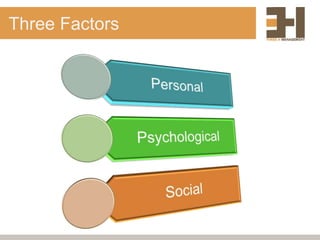
Three Factors
Personal Factors
• Unique to a particular person.
• Demographic Factors: Sex, Race, Age, Family
Lifecycle Stage, Income, Employment etc.
• Who in the family is responsible for the decision
making.
• Young people purchase things for different reasons
than older people.
Psychological Factors
a) Motives
b) Perception
c) Ability and Knowledge
d) Attitudes
e) Personality
f) Lifestyles
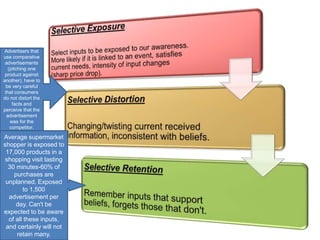
Advertisers that
use comparative
advertisements
(pitching one
product against
another), have to
be very careful
that consumers
do not distort the
facts and
perceive that the
advertisement
was for the
competitor.
Average supermarket
shopper is exposed to
17,000 products in a
shopping visit lasting
30 minutes-60% of
purchases are
unplanned. Exposed
to 1,500
advertisement per
day. Can't be
expected to be aware
of all these inputs,
and certainly will not
retain many.
Social Factors
• Consumer wants, learning, motives etc. are
influenced by
a) Opinion leaders,
b) Person's family,
c) Reference groups,
d) Social class and
e) Culture.
Learn | Consult | Research
Example - Wine Purchase
Behaviour
Intrinsic and Extrinsic Cues
• When a product has a high proportion of
attributes that can only be assessed during
consumption (experience attributes) as with
wine (Chaney 2000), then the ability of
consumers to assess quality prior to
purchase is severely impaired, and
consumers will fall back on extrinsic cues in
the assessment of quality (Speed 1998).
….
• The attributes that signal quality to consumers can be divided
into intrinsic and extrinsic,
• Gabbott (1991) identifies that wine consumers utilize both
intrinsic and extrinsic cues to aid in the choice process.
• Extrinsic cues are lower level cues that can be changed
without changing the product (e.g. price, packaging, self
location, brand name), while intrinsic cues are higher-level
cues directly related to the product.
• Intrinsic cues, perceptions of the product itself, are subject to
perceptual bias.
• Wine quality is based on perceptions, such as price,
recommendations of friends or experts, or the label.
…..
• Lockshin and Rhodus (1993), found that
quality perceptions of wine were based on
intrinsic cues, such as grape variety,
alcohol content and wine style, which
relate to the product itself and the
processing method as well as on extrinsic
cues, including price, packaging, labelling
and brand name, which can be altered
without actually changing the product.
• Price is an important cue for quality when few other cues are
available (Speed 1998), when the product cannot be
evaluated, or when the perceived risk of making a wrong
choice is high (Cox and Rich 1967; Dodds and Monroe
1985; Monroe and Krishnan 1985; Zeithaml 1988; Mitchell
and Greatorex, 1988; 1989).
• While it is presumed that consumers would conduct a search
for information prior to their purchase, research suggests
that consumers use only a small amount of the information
available to make a decision, (Foxall 1983, Olshavshy and
Grambois 1979, Lockshin 2000)
• Chaney (2000), found that there is a very
little external search effort undertaken
prior to entering the store to purchase
wine, with the two highest ranked
information sources in her study, being
point of sale material and labels, but these
were found to rate at only the somewhat
important level.
• Lockshin (2000) highlights the fact that
brand name acts a surrogate for a number
of attributes including quality and acts as a
short cut, in dealing with risk and providing
product cues.
Taste
• When asked why they chose a particular wine,
Koewn and Casey (1995) found that the taste of the
wine was a dominating factor for wine consumers.
• Thompson and Vourvachis (1995) found that taste
was the most highly correlated attribute relating to
wine choice and noted that this was to be expected
as it is frequently found to be the key attitudinal
factor in studies of wine choice.
• The taste of the wine represents one of the major
perceived risks presented by Mitchell and
Greatorex (1988), they found that the taste of the
wine was the risk that concerned consumers most.
Brand
• As noted above, brand is another extrinsic attribute used in
wine choice.
• Brands are the sum total of all the images that people have
in their heads about a particular company; brands represent
promises made regarding what we can be expected from a
product, service, or company (Gordon 2002).
• Generally, brands are becoming globalized, but the wine
industry provides an interesting example of global branding
in the context of a plethora of brand names.
….
• Gluckman (1990) postulates that consumers do not have a
clear understanding of branding in the wine market.
Specifically, consumers tend to infer the same status to
generic types - grape and region - as they do to specific
brands.
• Mitchell and Greatorex (1989) highlight the positive
correlation between risk and access to information. They
state that the participants in the experiment with less
information cannot differentiate between many wines.
Therefore the taste of the wine is not as important as the
taste of the wine when associated with brand name and
image.
• Judica and Perkins (1995) discuss how champagne users
link brand name to a sophisticated image. With this in mind
many wine producers use ‘society gatherings’ frequented by
the affluent segment of society to build up the prestigious
image of their brand (O’Neill, 2000)
• Beverland, (1999, 2000) suggests that Australian wineries
are using wine tourism, to provide opportunities to build
brand loyalty at the cellar door.
• While Madonna (1999) gives an American perspective
identifying that more than half the wineries in California’s
Napa Valley have identified tourism as a key marketing
activity. Wine tourism is seen as a brand differentiator.
Price
• Accumulated theoretical and empirical evidence suggests
that wine prices depend on quality, reputation and objective
characteristics (Oczkowski 2001).
• Koewn and Casey (1995) found that pricing was extremely
important to all respondents, in a study of wine purchasing
influences.
• Similarly, in a study conducted by Jenster and Jenster (1993)
price was an overriding criterion in making the purchase
decision among European wine consumers.
…
• Generally, price is an important cue to quality when
there are few other cues available, when the
product cannot be evaluated before purchase, and
when there is some degree of risk of making a
wrong choice
• It has been found that the reputation of the
producer and objective wine trait measures such as
the wine’s year of vintage, region from which the
grapes were sourced and the grape variety are
significantly related to price (Combris et al 1997,
2000, Landon and Smith 1998, Oczkowski 2001).
Origin
• Batt et al (2000) found that the origin of the wine
was the third most important variable influencing
consumers’ decision to purchase wine in Australia.
• It was particularly important for those who
purchased wine by variety and more so for males
than females.
• In a Spanish study it was found that the region of
production and the vintage year are the main
determinants of market price (Angulo et al 2000).
• Skuras and Vakrou (2002) and Wade (1999) also
suggest that there is a correlation between the
region and the price of wine.
Packaging
• In wine marketing, packaging and labels assume undeniable influence
with packaging forming an integral part of any wine's promotion and
consumption (Thomas 2000, Charters et al 2000).
• Labels provide the key recognition factor through their shape, colour,
and position as well as the information offered (Jennings and Wood
1994).
• Wine labels help to establish a winery’s image and define brands
(Fowler 2000).
• Gluckman (1986) identified that consumers perceive the wine labels as
one of their primary sources of information, both for specific choices
and as a means of increasing general product knowledge.
..
• Shaw, Keeghan and Hall’s (1999) findings suggest
that not enough attention is made on back labels to
the taste of the wine and how it is made.
• Charters et al (2000) found that the majority of wine
purchasers read back labels in making their
purchase decisions, identifying that the most useful
aspects of the label were the simple descriptions of
the tastes and smells of the wines.
Quality
• Quality is a characteristic of the wine that is both difficult to
define and to communicate.
• The level of quality required may vary upon a variety of
circumstances including the consumption occasion (Quester
and Smart 1998).
• The quality of wine however is difficult to evaluate
objectively.
• The quality of wine is generally recognised to depend upon
subjective sensory evaluations and therefore, cannot be
easily or precisely measured, (Oczkowski 2001).
• Groves et al (2000) suggest that wine quality is composed of
hedonistic and aesthetic components of wine consumption.
These are the felt experiences resulting from the pleasure of
drinking wine.
….
• Landon and Smith (1998) suggest that given the incomplete
information on quality, consumers rely heavily on both
individual firm-reputation based on the past quality of the
firm’s output and collective or group reputation indicators
and characteristics that allow consumers to segment firms
into groups with differing average qualities to predict current
product quality.
• To help deal with that uncertainty, quality-conscious
consumers process various perceived signals of quality,
mainly of an extrinsic nature, such as price, producer, brand,
vintage, region, awards, ratings and recommendations
(Lockshin et al 2000).
Situation
• The key finding from Hall and Lockshin (2000) was that the
above factors themselves are related to the situation where
the consumer intends to drink the wine.
• These ‘attributes’ are related in consumer’s minds to the
‘consequences’ they produce (Guttman 1982). For example
high price was important, when a consumer was purchasing
wine in order to impress a business associate or to celebrate
a special anniversary.
• Low price was important, for example, when the
consequence was to relax at home by oneself, or for
entertaining at an informal party or BBQ. Different
consumption situations amplified or muted the importance of
different wine attributes.
Perceived Risk
• Perceived risk is also a factor, which affects consumers'
decision making when they are considering a product
purchase.
• Risks include, social, financial, functional and physical
aspects of a product (Mitchell and Greatorex 1989). Many
wine purchases involve risk-aversion (eg. Spawton, 1991;
Mitchell and Greatorex, 1989; Gluckman, 1990).
• Examples of these risks include functional risk, such as the
taste of the wine; social risks by perhaps being embarrassed
in front of family and friends; financial risk in the cost of the
wine and physical risk in terms of risking a pending hangover
the following morning.
…..
• Gluckman (1990) contends that the act of
purchasing wines is clouded with insecurity.
Mitchell and Greatorex (1989) and Spawton
(1991) discuss risk-reduction strategies in the
purchase of wines.
• These include, selecting a known brand,
recommendations, advice from retail assistants,
undertaking wine appreciation education, pricing,
packaging and labelling, getting reassurance
through trials such as tastings and samples.
Involvement
• Involvement is a motivational and goal-
directed emotional state that determines
the personal relevance of a purchase
decision to a buyer (Rothschild 1984).
• The model proposed by Lockshin et al.
(1997) suggested three dimensions of
involvement: product involvement, brand
involvement and purchase involvement.
….
• Wine purchase behaviour is a complicated issue in that the level of
knowledge is a significant factor dictating the processes undergone by
the consumers (Gluckman 1990).
• Involvement has been linked to wine purchase (Lockshin et al 1997;
Quester and Smart 1998), where high and low involvement wine buyers
have been shown to behave differently (Lockshin and Spawton 2001) on
factors such as price, region and grape variety, (Zaichkowsky 1988;
Quester and Smart 1998), consumption situation, (Quester and Smart
1998), medals and ratings (Lockshin 2001) and quantity consumed
(Goldsmith et al 1998).
• Higher involved consumers utilise more information and are interested in
learning more, while low involvement consumers tend to simplify their
choices and use risk reduction strategies.
Learn | Consult | Research
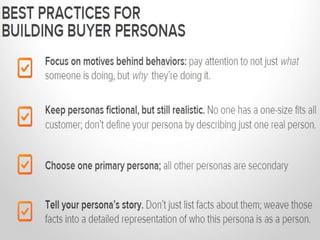
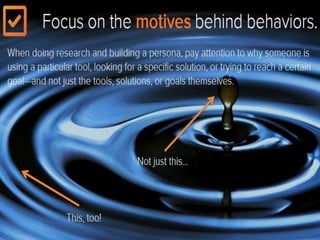
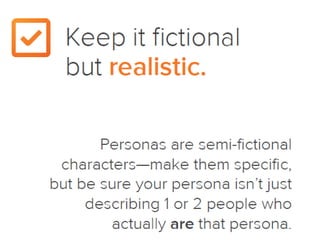
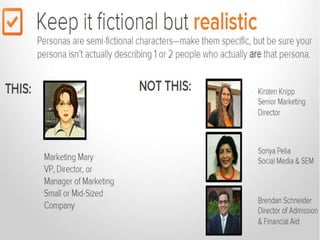
Understand Consumer Persona
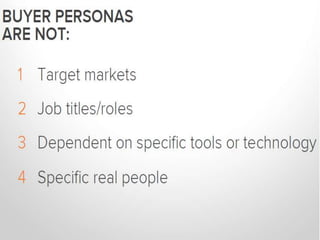
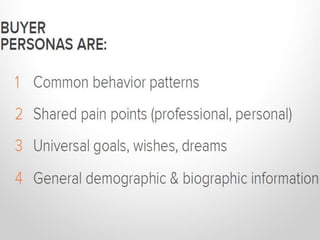
What Are Buyer Personas?
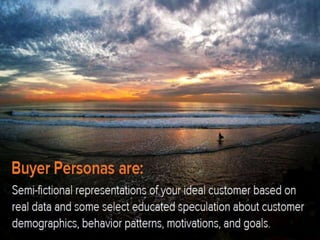
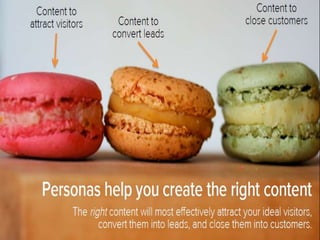
• Buyer personas are fictional, generalized representations of your
ideal customers. They help you understand your customers (and
prospective customers) better, and make it easier for you to tailor
content to the specific needs, behaviors, and concerns of different
groups.
• The strongest buyer personas are based on market research as
well as on insights you gather from your actual customer base
(through surveys, interviews, etc.). Depending on your business,
you could have as few as one or two personas, or as many as 10
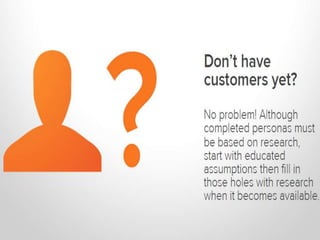
or 20. (Note: If you’re new to personas, start small! You can always
develop more personas later if needed.)
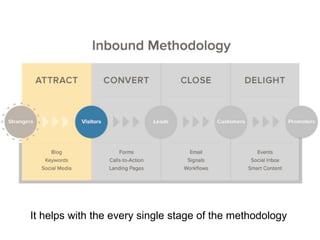
It helps with the every single stage of the methodology
What Are Negative Personas?
• Whereas a buyer persona is a representation of an ideal
customer, a negative -- or “exclusionary” -- persona is a
representation of who you don’t want as a customer.
• This could include, for example, professionals who are
too advanced for your product or service, students who
are only engaging with your content for
research/knowledge, or potential customers who are just
too expensive to acquire (because of a low average sale
price, their propensity to churn, or their unlikeliness to
purchase again from your company.)
How Can You Use Personas?
• At the most basic level, personas allow you to personalize or
target your marketing for different segments of your audience. For
example, instead of sending the same lead nurturing emails to
everyone in your database, you can segment by buyer persona
and tailor your messaging according to what you know about
those different personas.
• If you take the time to create negative personas, you’ll have the
added advantage of being able to segment out the “bad apples”
from the rest of your contacts, which can help you achieve a lower
cost-per-lead and cost-per-customer (and see higher sales
productivity).
How Do You Create Buyer
Personas?
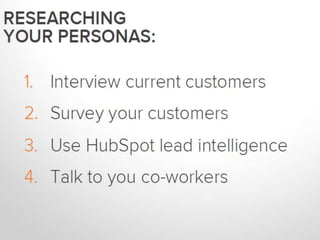
• Buyer personas are created through research, surveys,
and interviews of your target audience. That includes a
mix of customers, prospects, and those outside of your
contact database who might align with your target
audience.
• Here are some practical methods for gathering the
information you need to develop personas:
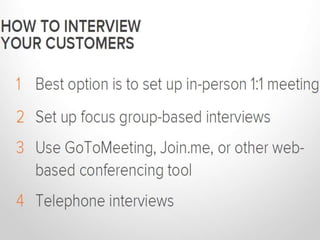
• Interview customers either in person or over the phone to
discover what they like about your product or service.
……
• Look through your contacts database to uncover trends about how
certain leads or customers find and consume your content.
• When creating forms to use on your website, use form fields that capture
important persona information. (For example, if all of your personas vary
based on company size, ask each lead for information about company size on
your forms. You could also gather information on what forms of social media
your leads use by asking a question about social media accounts.)
• Take into consideration your sales team's feedback on the leads they
are interacting with most. (What types of sales cycles does your sales team
work with? What generalizations can they make about the different types of
customers you serve best?)
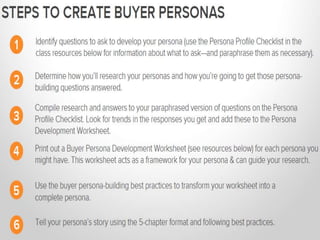
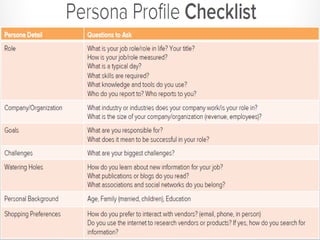
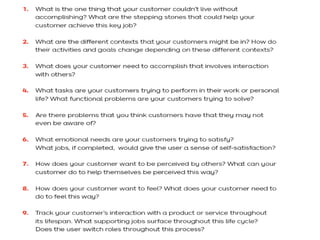
1. Identify questions to ask to
develop your persona (use the
Persona Profile Checklist in the
class resources below for
information about what to ask—
and paraphrase them as
necessary).
2. Determine how you’ll research
your personas and how you’re
going to get those
persona-building
questions answered.
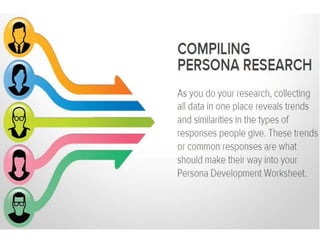
3. Compile research and answers
to your paraphrased version of
questions on the Persona
Profile Checklist. Look for trends
in the responses you get and add
these to the Persona
Development Worksheet.
4. Print out a Buyer Persona
Development Worksheet (see
resources below) for each
persona you
might have. This worksheet acts
as a framework for your persona
& can guide your research.
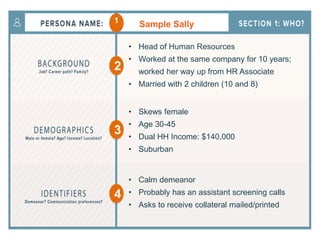
Sample Sally
• Head of Human Resources
• Worked at the same company for 10 years;
worked her way up from HR Associate
• Married with 2 children (10 and 8)
• Skews female
• Age 30-45
• Dual HH Income: $140,000
• Suburban
• Calm demeanor
• Probably has an assistant screening calls
• Asks to receive collateral mailed/printed
1
2
3
4
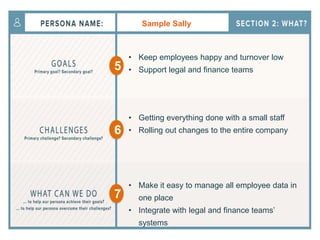
Sample Sally
• Keep employees happy and turnover low
• Support legal and finance teams
• Getting everything done with a small staff
• Rolling out changes to the entire company
• Make it easy to manage all employee data in
one place
• Integrate with legal and finance teams’
systems
5
6
7
Sample Sally
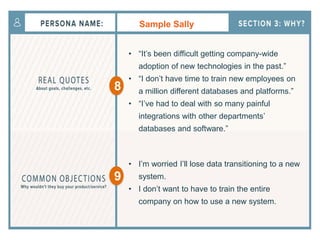
• “It’s been difficult getting company-wide
adoption of new technologies in the past.”
• “I don’t have time to train new employees on
a million different databases and platforms.”
• “I’ve had to deal with so many painful
integrations with other departments’
databases and software.”
• I’m worried I’ll lose data transitioning to a new
system.
• I don’t want to have to train the entire
company on how to use a new system.
8
9
Sample Sally
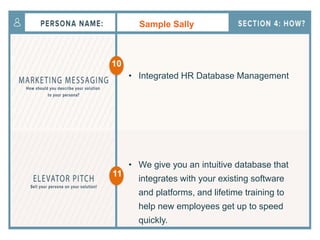
• Integrated HR Database Management
• We give you an intuitive database that
integrates with your existing software
and platforms, and lifetime training to
help new employees get up to speed
quickly.
10
11
Your Turn
[you type here]
• [you type here]
• [you type here]
• [you type here]
[you type here]
• [you type here]
• [you type here]
• [you type here]
[you type here]
• [you type here]
• [you type here]
[you type here]
• [you type here]
• [you type here]
[you type here]
• [you type here]
• [you type here]
• [you type here]
[you type here]
• [you type here]
• [you type here]
• [you type here]
[you type here]
• [you type here]
• [you type here]
[you type here]
• [you type here]
• [you type here]
[you type here]
• [you type here]
• [you type here]
• [you type here]
[you type here]
• [you type here]
• [you type here]
• [you type here]
[you type here]
• [you type here]
• [you type here]
[you type here]
• [you type here]
• [you type here]
5. Use the buyer persona-
building best practices to
transform your worksheet into a
complete persona.
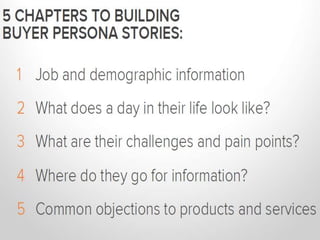
6. Tell your persona’s story using
the 5-chapter format and
following best practices.
Example
References
• https://blog.hubspot.com/blog/tabid/6307/bid/30907/
9-Questions-You-Need-to-Ask-When-Developing-Buyer-
Personas.aspx#sm.0000kkusgyntucwc10w4szh8886ue
• https://offers.hubspot.com/free-template-creating-
buyer-personas
• https://blog.hubspot.com/blog/tabid/6307/bid/33491/
Everything-Marketers-Need-to-Research-Create-
Detailed-Buyer-Personas-
Template.aspx#sm.0000kkusgyntucwc10w4szh8886ue
Learn | Consult | Research
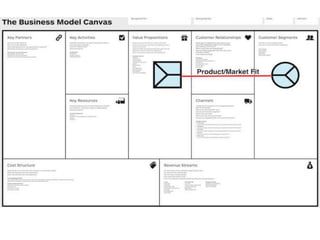
Value Proposition – Product-Market
Fit
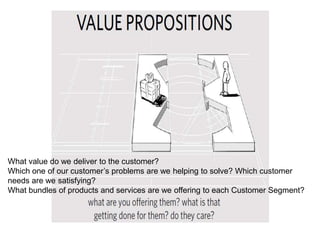
What value do we deliver to the customer?
Which one of our customer’s problems are we helping to solve? Which customer
needs are we satisfying?
What bundles of products and services are we offering to each Customer Segment?
Value Propositions
• The Value Proposition is the reason why
customers turn to one company over
another.
• It solves a customer problem or satisfies a
customer need.
• Value Proposition is an aggregation, or
bundle, of benefits that a company offers
customers.
A Value Proposition creates value for a Customer
Segment through a distinct mix of elements
catering to that segment’s needs.
Values may be quantitative
(e.g. price, speed of service) or qualitative
(e.g. design, customer experience).
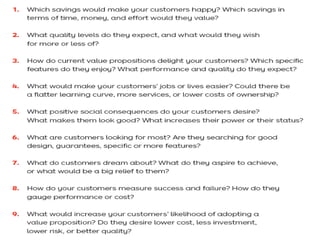
Some possible elements of value
• Newness / Novelty
• Performance
• Customization
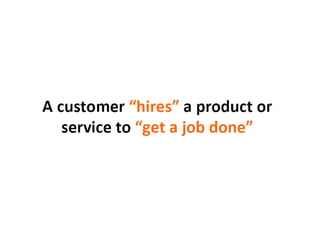
• Getting the Job Done
• Design
• Brand / Status
• Price
• Cost Reduction
• Risk Reduction
• Accessibility
• Convenience /
Usability
Sohan B. Khatri
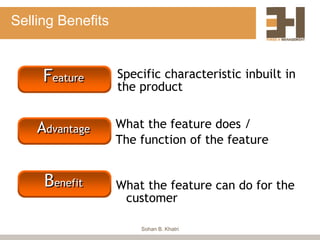
Selling Benefits
Feature
Advantage
Benefit
Specific characteristic inbuilt in
the product
What the feature does /
The function of the feature
What the feature can do for the
customer
Sohan B. Khatri
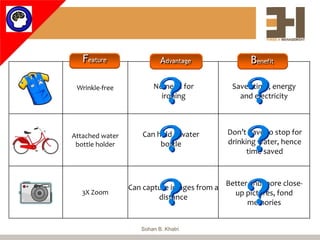
Wrinkle-free
Attached water
bottle holder
3X Zoom
Feature Advantage Benefit
Can hold a water
bottle
No need for
ironing
Saves time, energy
and electricity
Don’t have to stop for
drinking water, hence
time saved
Better and more close-
up pictures, fond
memories
Can capture images from a
distance
Sohan B. Khatri
Designing VALUE PROPOSITION
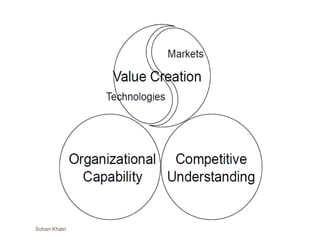
Three Foundations of Successful
Venture
Sohan Khatri
Sohan Khatri
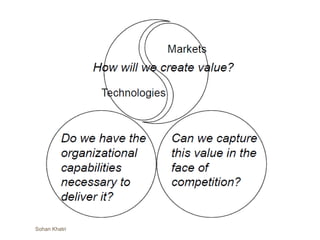
…. Answering these three questions
Sohan Khatri
Sohan Khatri
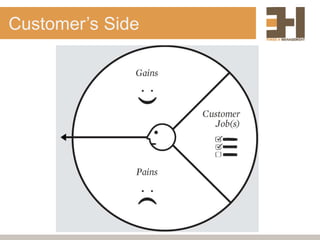
Customer’s Side
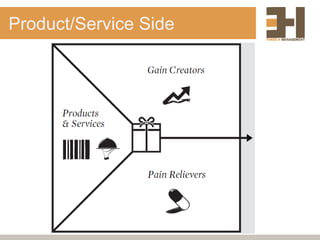
Product/Service Side
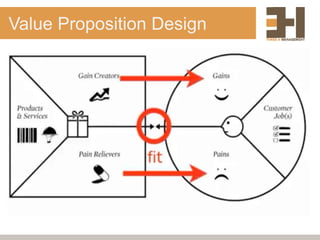
Value Proposition Design
References
• https://www.youtube.com/watch?v=F9aG_8CwSM
M
• https://www.youtube.com/watch?v=aN36EcTE54Q
• https://www.youtube.com/watch?v=D254suPMpw
Y
• https://www.youtube.com/watch?v=TwgfGRWRIio
• https://www.youtube.com/watch?v=T3oQpSLpzVk
Learn | Consult | Research
THE END

Brand Equity Vs Consumer Equity

  • 1.
    Consumer First –Brand Second
  • 3.
    Sohan Babu Khatri- Introduction Professional Engagements: • CEO – Three H Management Pvt. Ltd • Director of Board – White Space Pvt. Ltd. (Threadpaints.com, Butta.us) Adjunct Faculty: • Ace Insititute of Management • Ace International Business School • Global College International Background: • Bachelor’s of Civil Engineering (BE Civil) - Pulchowk Campus, Institute of Engineering, Nepal • Masters of Business Administration (MBA - Finance and Marketing), Bangalore University, India • Certified Financial Manager (CFM), Centre of Financial Management, Bangalore • Licensed International Financial Analyst (LIFA) - Charter Holder – International Research Association, Cambridge, Massachusetts
  • 4.
    Brands Exist toServe Customers, Not the other way around. But you’d never know that from the way Brands are Managed
  • 5.
    What do wewant ? • Growing the Lifetime Value of Customer Relationship • Building loyalty and Retention • Cross selling related goods and services • Broadening Offerings to fulfill more customer’s Needs • Adding Customer Equity
  • 6.
    But are weacting in Customer focused way or Brand focused way ? Brand Management still trumps Customer Management in most large companies and the focus is increasingly incompatible with Growth
  • 7.
    Story of ‘Oldsmobile’ •In the 1980s, it enjoyed outstanding brand equity with many customers. • But as the century wore on, the people who loved the Olds were getting downright old. The managers that parent company General Motors ….realized that maintaining market share meant appealing to younger buyers. • 1988 ad campaign featuring the slogan, “This is not your father’s Oldsmobile.” • In 1990, …. next message: “A New Generation of Olds.” • Catchy or not, neither campaign turned back the clock. By 2000, Oldsmobile’s market share had sputtered to 1.6%, from 6.9% in 1985. And in December 2000, General Motors announced that the Oldsmobile brand would be phased out.
  • 8.
    • Why didGeneral Motors spend so many years and so much money trying to reposition and refurbish such a tired image? • Why not instead move younger buyers along a path of less resistance, toward another of the brands in GM’s stable—or even launch a wholly new brand geared to their tastes? • Cultivating the customers, even at the expense of the brand, would surely have been the path to profits.
  • 9.
    Brands are theraison d’être ? Or Consumers are the raison d’être ?
  • 10.
    Brand should bein the service of the larger goal: growing customer equity
  • 11.
    • This doesn’tmean that brand becomes unimportant. • Compelling brand images remain essential to winning and keeping customers’ trade. • But it does mean fundamentally changing how management thinks about the goals, roles, and metrics associated with a well- managed brand.
  • 12.
    To what extentdoes your brand excel at delivering the benefits that consumers truly desire?
  • 13.
    George Clinton • Let’stake an example from the entertainment world, courtesy of songwriter and performer George Clinton. • Known as one of the founders of funk, Clinton in the 1970s sought the attention of two different segments of record buyers—mainstream listeners, who liked vocal soul music with horns, and progressive listeners, who liked harder-edged funk. • Clinton knew that his band was accomplished enough to play both kinds of music, but he realized that alternating between the styles would muddy the band’s image and serve neither audience well. The solution was simple. • The same group of musicians, essentially, recorded and performed under two different band names: Parliament, when the music was aimed at popular tastes, and Funkadelic, when it was edgier. • Both bands were very successful, even though some Parliament fans would never listen to Funkadelic and vice versa. • The point is that Clinton did not try to make his original brand a big tent by stretching it to accommodate the tastes of very different markets. His branding reflected his customers’ identities instead of his band members’.
  • 14.
    HONDA • That kindof thinking led to Honda’s development and marketing of the Acura Legend in the United States. • The same car was introduced in most other countries, including Japan, as the Honda Legend. • But the company had good reason to think it would not succeed using that name Stateside. • In the 1980s, U.S. buyers, much more than their counterparts elsewhere, associated the Honda brand with economy cars. They expected and trusted the company to provide inexpensive, dependable—if not very exciting— cars. • Rather than work to change that image (which served the company well with other models), management decided to launch a new brand. “Acura” had no positive equity established with upscale buyers, but neither did it have baggage to overcome.
  • 15.
    Learn | Consult| Research CUSTOMER EQUITY
  • 16.
    Brand Equity (BE) •The sum of customers’ assessments of a brand’s intangible qualities, positive or negative.
  • 17.
    Customer-Based Brand Equity •“The differential effect that brand knowledge has on consumer response to the marketing of that brand.” Keller, 1993 • A brand has positive customer-based brand equity when consumers react more favorably to a product and the way it is marketed when the brand is identified than when it is not (say, when the product is attributed to a fictitious name or is unnamed).
  • 18.
    • Thus, customersmight be more accepting of – a new brand extension for a brand with positive customer-based brand equity, – less sensitive to price increases and – withdrawal of advertising support, or – more willing to seek the brand in a new distribution channel.
  • 19.
    CLV (Customer LifetimeValue) • The net profit a company accrues from transactions with a given customer during the time that the customer has a relationship with the company.
  • 20.
    Customer Equity (CE) •The sum of the lifetime values of all the firm’s customers, across all the firm’s brands
  • 21.
    And though thetwo (BE and CE) often move in concert, it is important to remember that acting in the best interests of brand equity isn’t necessarily the same as acting in the best interests of customer equity.
  • 22.
    A CASE • Supposewe have a customer—let’s call her Ann— who tends to favor one of our current brands, Brand A. • To the extent that Ann values Brand A above and beyond the objective value of the product’s attributes, we can say that it has positive brand equity for her. • If Brand A’s equity increases in her eyes, Ann is likely to buy it more frequently and perhaps in higher volume per purchase. • This of course increases Ann’s lifetime value to the company. • But what happens if Ann grows tired of Brand A? Or if the brand ceases to resonate with her?
  • 23.
    ….. • If wemanage the customer relationship properly, we can introduce Ann to another of our brands that is a better match with her sensibilities. • In fact, we should be willing to do whatever is necessary with our brands (including replacing them with new ones) to maintain our customer relationships. • Our attitude should be that brands come and go—but customers like Ann must remain.
  • 24.
    The Value ofa Brand Depends on the Customer
  • 25.
    Most marketing managers speak aboutthe value of a brand as though it were solid and monolithic, and they measure brand equity with a summary metric of brand strength. It’s a perfect example of what’s been called the “flaw of averages.”
  • 26.
    Defining that valueas the average would lead to actions that weren’t right for many customers.
  • 27.
    Make brand decisions subservientto decisions about customer relationships.
  • 28.
    Build brands aroundcustomer segments, not the other way around.
  • 29.
    Make your brandsas narrow as possible.
  • 30.
    Plan brand extensionsbased on customer needs, not component similarities.
  • 31.
    Develop the capabilityand the mind-set to hand off customers to other brands in the company.
  • 32.
    Brand managers needto know their customers well enough to tell when it’s time to hand them off.
  • 33.
    Take no heroicmeasures. Know well - At what point would you cut your losses and invest in a new one?
  • 34.
    If brand managerscontrol the resources, they will persist too long with a brand that has lost its punch.
  • 35.
    Change how youmeasure brand equity.
  • 37.
    Learn | Consult| Research Understanding Customers
  • 38.
    Understand “Consumer Behavior” It blends the elements of – Psychology, – Sociology & – Economics.
  • 40.
    Stages: Post Purchase Evaluation Satisfactionvs Dissatisfaction Actual Purchase Time , Access and Reference Purchase Decision Choosing Alternative Product Features Evaluation of Alternatives Criteria for Evaluation Rank Alternatives or Resume Search Information Search Internal Search External Search Problem Recognition [Awareness of Need] Desired State Actual State
  • 41.
    What marketers needto do ? Post Purchase Evaluation After sales communication After sales service Customer lifetime value Actual Purchase Design moment of truth Purchase Decision Communicate Product Features Design easy process Evaluation of Alternatives Help consumers with information Influence by framing alternatives Information Search Impress consumers intensely Be present in all sources of information Problem Recognition [Awareness of Need] Communicate Need Sell solution
  • 42.
  • 43.
    BUYING ROLES  INITIATOR:The first person to suggest the idea of buying.  INFLUENCER: A person whose views impact the buying decision.  DECIDER: The person who decides on what, when & where to buy the product or service.  BUYER: The actual purchaser.  USER: The person who uses/consumes the product or service.  INFORMER, MAINTAINER, DISPOSER
  • 44.
    Buying Behavior Complex BB Variety Seeking BB Dissonance ReducingBB Habitual BB High Involvement Low Involvement Significant differences between Brands Few differences between Brands
  • 45.
    Risks in highinvolvement purchases
  • 46.
    Value and Satisfaction Basedon this equation, the marketer can increase the value of the customer offering by (1)raising benefits, (2)reducing costs, (3)raising benefits and reducing costs, (4)Raising benefits by more than the raise in costs, or (5)lowering benefits by less than the reduction in costs.
  • 47.
  • 48.
    Personal Factors • Uniqueto a particular person. • Demographic Factors: Sex, Race, Age, Family Lifecycle Stage, Income, Employment etc. • Who in the family is responsible for the decision making. • Young people purchase things for different reasons than older people.
  • 49.
    Psychological Factors a) Motives b)Perception c) Ability and Knowledge d) Attitudes e) Personality f) Lifestyles
  • 50.
    Advertisers that use comparative advertisements (pitchingone product against another), have to be very careful that consumers do not distort the facts and perceive that the advertisement was for the competitor. Average supermarket shopper is exposed to 17,000 products in a shopping visit lasting 30 minutes-60% of purchases are unplanned. Exposed to 1,500 advertisement per day. Can't be expected to be aware of all these inputs, and certainly will not retain many.
  • 51.
    Social Factors • Consumerwants, learning, motives etc. are influenced by a) Opinion leaders, b) Person's family, c) Reference groups, d) Social class and e) Culture.
  • 52.
    Learn | Consult| Research Example - Wine Purchase Behaviour
  • 53.
    Intrinsic and ExtrinsicCues • When a product has a high proportion of attributes that can only be assessed during consumption (experience attributes) as with wine (Chaney 2000), then the ability of consumers to assess quality prior to purchase is severely impaired, and consumers will fall back on extrinsic cues in the assessment of quality (Speed 1998).
  • 54.
    …. • The attributesthat signal quality to consumers can be divided into intrinsic and extrinsic, • Gabbott (1991) identifies that wine consumers utilize both intrinsic and extrinsic cues to aid in the choice process. • Extrinsic cues are lower level cues that can be changed without changing the product (e.g. price, packaging, self location, brand name), while intrinsic cues are higher-level cues directly related to the product. • Intrinsic cues, perceptions of the product itself, are subject to perceptual bias. • Wine quality is based on perceptions, such as price, recommendations of friends or experts, or the label.
  • 55.
    ….. • Lockshin andRhodus (1993), found that quality perceptions of wine were based on intrinsic cues, such as grape variety, alcohol content and wine style, which relate to the product itself and the processing method as well as on extrinsic cues, including price, packaging, labelling and brand name, which can be altered without actually changing the product.
  • 56.
    • Price isan important cue for quality when few other cues are available (Speed 1998), when the product cannot be evaluated, or when the perceived risk of making a wrong choice is high (Cox and Rich 1967; Dodds and Monroe 1985; Monroe and Krishnan 1985; Zeithaml 1988; Mitchell and Greatorex, 1988; 1989). • While it is presumed that consumers would conduct a search for information prior to their purchase, research suggests that consumers use only a small amount of the information available to make a decision, (Foxall 1983, Olshavshy and Grambois 1979, Lockshin 2000)
  • 57.
    • Chaney (2000),found that there is a very little external search effort undertaken prior to entering the store to purchase wine, with the two highest ranked information sources in her study, being point of sale material and labels, but these were found to rate at only the somewhat important level.
  • 58.
    • Lockshin (2000)highlights the fact that brand name acts a surrogate for a number of attributes including quality and acts as a short cut, in dealing with risk and providing product cues.
  • 59.
    Taste • When askedwhy they chose a particular wine, Koewn and Casey (1995) found that the taste of the wine was a dominating factor for wine consumers. • Thompson and Vourvachis (1995) found that taste was the most highly correlated attribute relating to wine choice and noted that this was to be expected as it is frequently found to be the key attitudinal factor in studies of wine choice. • The taste of the wine represents one of the major perceived risks presented by Mitchell and Greatorex (1988), they found that the taste of the wine was the risk that concerned consumers most.
  • 60.
    Brand • As notedabove, brand is another extrinsic attribute used in wine choice. • Brands are the sum total of all the images that people have in their heads about a particular company; brands represent promises made regarding what we can be expected from a product, service, or company (Gordon 2002). • Generally, brands are becoming globalized, but the wine industry provides an interesting example of global branding in the context of a plethora of brand names.
  • 61.
    …. • Gluckman (1990)postulates that consumers do not have a clear understanding of branding in the wine market. Specifically, consumers tend to infer the same status to generic types - grape and region - as they do to specific brands. • Mitchell and Greatorex (1989) highlight the positive correlation between risk and access to information. They state that the participants in the experiment with less information cannot differentiate between many wines. Therefore the taste of the wine is not as important as the taste of the wine when associated with brand name and image.
  • 62.
    • Judica andPerkins (1995) discuss how champagne users link brand name to a sophisticated image. With this in mind many wine producers use ‘society gatherings’ frequented by the affluent segment of society to build up the prestigious image of their brand (O’Neill, 2000) • Beverland, (1999, 2000) suggests that Australian wineries are using wine tourism, to provide opportunities to build brand loyalty at the cellar door. • While Madonna (1999) gives an American perspective identifying that more than half the wineries in California’s Napa Valley have identified tourism as a key marketing activity. Wine tourism is seen as a brand differentiator.
  • 63.
    Price • Accumulated theoreticaland empirical evidence suggests that wine prices depend on quality, reputation and objective characteristics (Oczkowski 2001). • Koewn and Casey (1995) found that pricing was extremely important to all respondents, in a study of wine purchasing influences. • Similarly, in a study conducted by Jenster and Jenster (1993) price was an overriding criterion in making the purchase decision among European wine consumers.
  • 64.
    … • Generally, priceis an important cue to quality when there are few other cues available, when the product cannot be evaluated before purchase, and when there is some degree of risk of making a wrong choice • It has been found that the reputation of the producer and objective wine trait measures such as the wine’s year of vintage, region from which the grapes were sourced and the grape variety are significantly related to price (Combris et al 1997, 2000, Landon and Smith 1998, Oczkowski 2001).
  • 65.
    Origin • Batt etal (2000) found that the origin of the wine was the third most important variable influencing consumers’ decision to purchase wine in Australia. • It was particularly important for those who purchased wine by variety and more so for males than females. • In a Spanish study it was found that the region of production and the vintage year are the main determinants of market price (Angulo et al 2000). • Skuras and Vakrou (2002) and Wade (1999) also suggest that there is a correlation between the region and the price of wine.
  • 66.
    Packaging • In winemarketing, packaging and labels assume undeniable influence with packaging forming an integral part of any wine's promotion and consumption (Thomas 2000, Charters et al 2000). • Labels provide the key recognition factor through their shape, colour, and position as well as the information offered (Jennings and Wood 1994). • Wine labels help to establish a winery’s image and define brands (Fowler 2000). • Gluckman (1986) identified that consumers perceive the wine labels as one of their primary sources of information, both for specific choices and as a means of increasing general product knowledge.
  • 67.
    .. • Shaw, Keeghanand Hall’s (1999) findings suggest that not enough attention is made on back labels to the taste of the wine and how it is made. • Charters et al (2000) found that the majority of wine purchasers read back labels in making their purchase decisions, identifying that the most useful aspects of the label were the simple descriptions of the tastes and smells of the wines.
  • 68.
    Quality • Quality isa characteristic of the wine that is both difficult to define and to communicate. • The level of quality required may vary upon a variety of circumstances including the consumption occasion (Quester and Smart 1998). • The quality of wine however is difficult to evaluate objectively. • The quality of wine is generally recognised to depend upon subjective sensory evaluations and therefore, cannot be easily or precisely measured, (Oczkowski 2001). • Groves et al (2000) suggest that wine quality is composed of hedonistic and aesthetic components of wine consumption. These are the felt experiences resulting from the pleasure of drinking wine.
  • 69.
    …. • Landon andSmith (1998) suggest that given the incomplete information on quality, consumers rely heavily on both individual firm-reputation based on the past quality of the firm’s output and collective or group reputation indicators and characteristics that allow consumers to segment firms into groups with differing average qualities to predict current product quality. • To help deal with that uncertainty, quality-conscious consumers process various perceived signals of quality, mainly of an extrinsic nature, such as price, producer, brand, vintage, region, awards, ratings and recommendations (Lockshin et al 2000).
  • 70.
    Situation • The keyfinding from Hall and Lockshin (2000) was that the above factors themselves are related to the situation where the consumer intends to drink the wine. • These ‘attributes’ are related in consumer’s minds to the ‘consequences’ they produce (Guttman 1982). For example high price was important, when a consumer was purchasing wine in order to impress a business associate or to celebrate a special anniversary. • Low price was important, for example, when the consequence was to relax at home by oneself, or for entertaining at an informal party or BBQ. Different consumption situations amplified or muted the importance of different wine attributes.
  • 71.
    Perceived Risk • Perceivedrisk is also a factor, which affects consumers' decision making when they are considering a product purchase. • Risks include, social, financial, functional and physical aspects of a product (Mitchell and Greatorex 1989). Many wine purchases involve risk-aversion (eg. Spawton, 1991; Mitchell and Greatorex, 1989; Gluckman, 1990). • Examples of these risks include functional risk, such as the taste of the wine; social risks by perhaps being embarrassed in front of family and friends; financial risk in the cost of the wine and physical risk in terms of risking a pending hangover the following morning.
  • 72.
    ….. • Gluckman (1990)contends that the act of purchasing wines is clouded with insecurity. Mitchell and Greatorex (1989) and Spawton (1991) discuss risk-reduction strategies in the purchase of wines. • These include, selecting a known brand, recommendations, advice from retail assistants, undertaking wine appreciation education, pricing, packaging and labelling, getting reassurance through trials such as tastings and samples.
  • 73.
    Involvement • Involvement isa motivational and goal- directed emotional state that determines the personal relevance of a purchase decision to a buyer (Rothschild 1984). • The model proposed by Lockshin et al. (1997) suggested three dimensions of involvement: product involvement, brand involvement and purchase involvement.
  • 74.
    …. • Wine purchasebehaviour is a complicated issue in that the level of knowledge is a significant factor dictating the processes undergone by the consumers (Gluckman 1990). • Involvement has been linked to wine purchase (Lockshin et al 1997; Quester and Smart 1998), where high and low involvement wine buyers have been shown to behave differently (Lockshin and Spawton 2001) on factors such as price, region and grape variety, (Zaichkowsky 1988; Quester and Smart 1998), consumption situation, (Quester and Smart 1998), medals and ratings (Lockshin 2001) and quantity consumed (Goldsmith et al 1998). • Higher involved consumers utilise more information and are interested in learning more, while low involvement consumers tend to simplify their choices and use risk reduction strategies.
  • 75.
    Learn | Consult| Research Understand Consumer Persona
  • 77.
    What Are BuyerPersonas? • Buyer personas are fictional, generalized representations of your ideal customers. They help you understand your customers (and prospective customers) better, and make it easier for you to tailor content to the specific needs, behaviors, and concerns of different groups. • The strongest buyer personas are based on market research as well as on insights you gather from your actual customer base (through surveys, interviews, etc.). Depending on your business, you could have as few as one or two personas, or as many as 10 or 20. (Note: If you’re new to personas, start small! You can always develop more personas later if needed.)
  • 80.
    It helps withthe every single stage of the methodology
  • 83.
    What Are NegativePersonas? • Whereas a buyer persona is a representation of an ideal customer, a negative -- or “exclusionary” -- persona is a representation of who you don’t want as a customer. • This could include, for example, professionals who are too advanced for your product or service, students who are only engaging with your content for research/knowledge, or potential customers who are just too expensive to acquire (because of a low average sale price, their propensity to churn, or their unlikeliness to purchase again from your company.)
  • 84.
    How Can YouUse Personas? • At the most basic level, personas allow you to personalize or target your marketing for different segments of your audience. For example, instead of sending the same lead nurturing emails to everyone in your database, you can segment by buyer persona and tailor your messaging according to what you know about those different personas. • If you take the time to create negative personas, you’ll have the added advantage of being able to segment out the “bad apples” from the rest of your contacts, which can help you achieve a lower cost-per-lead and cost-per-customer (and see higher sales productivity).
  • 85.
    How Do YouCreate Buyer Personas? • Buyer personas are created through research, surveys, and interviews of your target audience. That includes a mix of customers, prospects, and those outside of your contact database who might align with your target audience. • Here are some practical methods for gathering the information you need to develop personas: • Interview customers either in person or over the phone to discover what they like about your product or service.
  • 86.
    …… • Look throughyour contacts database to uncover trends about how certain leads or customers find and consume your content. • When creating forms to use on your website, use form fields that capture important persona information. (For example, if all of your personas vary based on company size, ask each lead for information about company size on your forms. You could also gather information on what forms of social media your leads use by asking a question about social media accounts.) • Take into consideration your sales team's feedback on the leads they are interacting with most. (What types of sales cycles does your sales team work with? What generalizations can they make about the different types of customers you serve best?)
  • 89.
    1. Identify questionsto ask to develop your persona (use the Persona Profile Checklist in the class resources below for information about what to ask— and paraphrase them as necessary).
  • 92.
    2. Determine howyou’ll research your personas and how you’re going to get those persona-building questions answered.
  • 99.
    3. Compile researchand answers to your paraphrased version of questions on the Persona Profile Checklist. Look for trends in the responses you get and add these to the Persona Development Worksheet.
  • 102.
    4. Print outa Buyer Persona Development Worksheet (see resources below) for each persona you might have. This worksheet acts as a framework for your persona & can guide your research.
  • 103.
    Sample Sally • Headof Human Resources • Worked at the same company for 10 years; worked her way up from HR Associate • Married with 2 children (10 and 8) • Skews female • Age 30-45 • Dual HH Income: $140,000 • Suburban • Calm demeanor • Probably has an assistant screening calls • Asks to receive collateral mailed/printed 1 2 3 4
  • 104.
    Sample Sally • Keepemployees happy and turnover low • Support legal and finance teams • Getting everything done with a small staff • Rolling out changes to the entire company • Make it easy to manage all employee data in one place • Integrate with legal and finance teams’ systems 5 6 7
  • 105.
    Sample Sally • “It’sbeen difficult getting company-wide adoption of new technologies in the past.” • “I don’t have time to train new employees on a million different databases and platforms.” • “I’ve had to deal with so many painful integrations with other departments’ databases and software.” • I’m worried I’ll lose data transitioning to a new system. • I don’t want to have to train the entire company on how to use a new system. 8 9
  • 106.
    Sample Sally • IntegratedHR Database Management • We give you an intuitive database that integrates with your existing software and platforms, and lifetime training to help new employees get up to speed quickly. 10 11
  • 107.
  • 108.
    [you type here] •[you type here] • [you type here] • [you type here]
  • 109.
    [you type here] •[you type here] • [you type here] • [you type here]
  • 110.
    [you type here] •[you type here] • [you type here]
  • 111.
    [you type here] •[you type here] • [you type here]
  • 112.
    [you type here] •[you type here] • [you type here] • [you type here]
  • 113.
    [you type here] •[you type here] • [you type here] • [you type here]
  • 114.
    [you type here] •[you type here] • [you type here]
  • 115.
    [you type here] •[you type here] • [you type here]
  • 116.
    [you type here] •[you type here] • [you type here] • [you type here]
  • 117.
    [you type here] •[you type here] • [you type here] • [you type here]
  • 118.
    [you type here] •[you type here] • [you type here]
  • 119.
    [you type here] •[you type here] • [you type here]
  • 120.
    5. Use thebuyer persona- building best practices to transform your worksheet into a complete persona.
  • 127.
    6. Tell yourpersona’s story using the 5-chapter format and following best practices.
  • 129.
  • 140.
    References • https://blog.hubspot.com/blog/tabid/6307/bid/30907/ 9-Questions-You-Need-to-Ask-When-Developing-Buyer- Personas.aspx#sm.0000kkusgyntucwc10w4szh8886ue • https://offers.hubspot.com/free-template-creating- buyer-personas •https://blog.hubspot.com/blog/tabid/6307/bid/33491/ Everything-Marketers-Need-to-Research-Create- Detailed-Buyer-Personas- Template.aspx#sm.0000kkusgyntucwc10w4szh8886ue
  • 141.
    Learn | Consult| Research Value Proposition – Product-Market Fit
  • 142.
    What value dowe deliver to the customer? Which one of our customer’s problems are we helping to solve? Which customer needs are we satisfying? What bundles of products and services are we offering to each Customer Segment?
  • 144.
    Value Propositions • TheValue Proposition is the reason why customers turn to one company over another. • It solves a customer problem or satisfies a customer need. • Value Proposition is an aggregation, or bundle, of benefits that a company offers customers.
  • 145.
    A Value Propositioncreates value for a Customer Segment through a distinct mix of elements catering to that segment’s needs. Values may be quantitative (e.g. price, speed of service) or qualitative (e.g. design, customer experience).
  • 147.
    Some possible elementsof value • Newness / Novelty • Performance • Customization • Getting the Job Done • Design • Brand / Status • Price • Cost Reduction • Risk Reduction • Accessibility • Convenience / Usability
  • 148.
  • 149.
    Selling Benefits Feature Advantage Benefit Specific characteristicinbuilt in the product What the feature does / The function of the feature What the feature can do for the customer Sohan B. Khatri
  • 150.
    Wrinkle-free Attached water bottle holder 3XZoom Feature Advantage Benefit Can hold a water bottle No need for ironing Saves time, energy and electricity Don’t have to stop for drinking water, hence time saved Better and more close- up pictures, fond memories Can capture images from a distance Sohan B. Khatri
  • 152.
  • 153.
    Three Foundations ofSuccessful Venture Sohan Khatri
  • 154.
  • 155.
    …. Answering thesethree questions Sohan Khatri
  • 156.
  • 159.
  • 160.
  • 161.
  • 173.
    References • https://www.youtube.com/watch?v=F9aG_8CwSM M • https://www.youtube.com/watch?v=aN36EcTE54Q •https://www.youtube.com/watch?v=D254suPMpw Y • https://www.youtube.com/watch?v=TwgfGRWRIio • https://www.youtube.com/watch?v=T3oQpSLpzVk
  • 174.
    Learn | Consult| Research THE END

Editor's Notes

  • #18 12
  • #151 Give 4-5 minutes to complete exercise in WB Click to reveal the answers. Tell them that now we will look at car-related examples Move to next slide