Brain-Inspired Computation based on Spiking Neural
Networks
Nikola Kasabov
FIEEE, FRSNZ, FINNS, FIITP NZ
Professor of Knowledge Engineering, KEDRI,
Auckland University of Technology
George Moore Chair of Data Analytics, Ulster
University, UK
Honorary Professor Teesside University UK and ABI
the University of Auckland
Doctor Honoris Causa Obuda University Budapest
nkasabov@aut.ac.nz
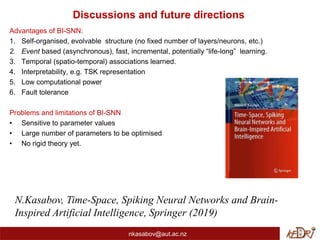
N. Kasabov, Time-Space, Spiking Neural Networks and Brain-Inspired Artificial
Intelligence, Springer (2019)
nkasabov@aut.ac.nz
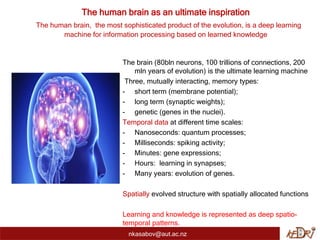
The brain (80bln neurons, 100 trillions of connections, 200
mln years of evolution) is the ultimate learning machine
Three, mutually interacting, memory types:
- short term (membrane potential);
- long term (synaptic weights);
- genetic (genes in the nuclei).
Temporal data at different time scales:
- Nanoseconds: quantum processes;
- Milliseconds: spiking activity;
- Minutes: gene expressions;
- Hours: learning in synapses;
- Many years: evolution of genes.
Spatially evolved structure with spatially allocated functions
Learning and knowledge is represented as deep spatio-
temporal patterns.
The human brain as an ultimate inspiration
The human brain, the most sophisticated product of the evolution, is a deep learning
machine for information processing based on learned knowledge
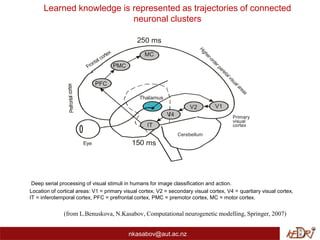
Learned knowledge is represented as trajectories of connected
neuronal clusters
Deep serial processing of visual stimuli in humans for image classification and action.
Location of cortical areas: V1 = primary visual cortex, V2 = secondary visual cortex, V4 = quartiary visual cortex,
IT = inferotemporal cortex, PFC = prefrontal cortex, PMC = premotor cortex, MC = motor cortex.
(from L.Benuskova, N.Kasabov, Computational neurogenetic modelling, Springer, 2007)
nkasabov@aut.ac.nz
Thalamus
Pr
ef
ron
ta
l
co
rte
x
Frontal cortex
Eye
H
i
g
h
e
r
-
o
r
d
e
r
p
a
r
i
e
t
a
l
v
i
s
u
a
l
a
r
e
a
s
Primary
visual
cortex
Cerebellum
IT
150 ms
250 ms
V4
V2 V1
MC
PMC
PFC
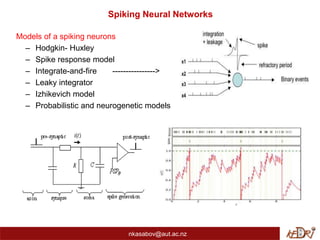
Spiking Neural Networks
Models of a spiking neurons
– Hodgkin- Huxley
– Spike response model
– Integrate-and-fire ---------------->
– Leaky integrator
– Izhikevich model
– Probabilistic and neurogenetic models
nkasabov@aut.ac.nz
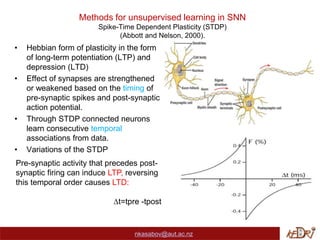
Methods for unsupervised learning in SNN
Spike-Time Dependent Plasticity (STDP)
(Abbott and Nelson, 2000).
• Hebbian form of plasticity in the form
of long-term potentiation (LTP) and
depression (LTD)
• Effect of synapses are strengthened
or weakened based on the timing of
pre-synaptic spikes and post-synaptic
action potential.
• Through STDP connected neurons
learn consecutive temporal
associations from data.
• Variations of the STDP
Pre-synaptic activity that precedes post-
synaptic firing can induce LTP, reversing
this temporal order causes LTD:
∆t=tpre -tpost
nkasabov@aut.ac.nz
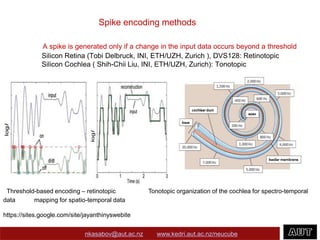
Spike encoding methods
A spike is generated only if a change in the input data occurs beyond a threshold
Silicon Retina (Tobi Delbruck, INI, ETH/UZH, Zurich ), DVS128: Retinotopic
Silicon Cochlea ( Shih-Chii Liu, INI, ETH/UZH, Zurich): Tonotopic
nkasabov@aut.ac.nz www.kedri.aut.ac.nz/neucube
Threshold-based encoding – retinotopic Tonotopic organization of the cochlea for spectro-temporal
data mapping for spatio-temporal data
https://sites.google.com/site/jayanthinyswebite
Methods for supervised learning in SNN
Rank order (RO) learning rule (Thorpe et al, 1998)
nkasabov@aut.ac.nz
)
(
order j
ji m
w 








else
fired
if
0
)
(
)
(
|
)
(
order
t
j
f
j
j
i
ji
i m
w
t
u
PSP max (T) = SUM [(m order (j(t)) wj,i(t)], for j=1,2.., k; t=1,2,...,T;
PSPTh=C. PSPmax (T)
- Earlier coming spikes are more important (carry more information)
- Early spiking can be achieved, depending on the parameter C.
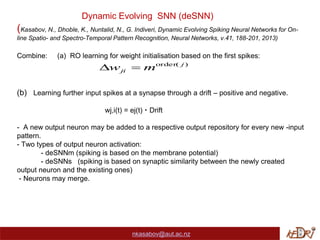
Dynamic Evolving SNN (deSNN)
(Kasabov, N., Dhoble, K., Nuntalid, N., G. Indiveri, Dynamic Evolving Spiking Neural Networks for On-
line Spatio- and Spectro-Temporal Pattern Recognition, Neural Networks, v.41, 188-201, 2013)
Combine: (a) RO learning for weight initialisation based on the first spikes:
(b) Learning further input spikes at a synapse through a drift – positive and negative.
wj,i(t) = ej(t)・Drift
- A new output neuron may be added to a respective output repository for every new -input
pattern.
- Two types of output neuron activation:
- deSNNm (spiking is based on the membrane potential)
- deSNNs (spiking is based on synaptic similarity between the newly created
output neuron and the existing ones)
- Neurons may merge.
)
(
order j
ji m
w 

nkasabov@aut.ac.nz
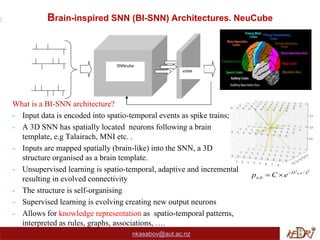
Brain-inspired SNN (BI-SNN) Architectures. NeuCube
nkasabov@aut.ac.nz
eSNN
SNNcube
2
,
2
/
,

b
a
D
b
a e
C
p 


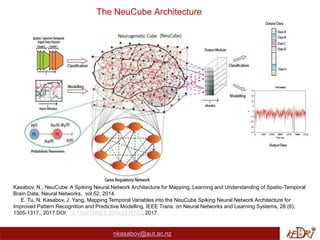
What is a BI-SNN architecture?
- Input data is encoded into spatio-temporal events as spike trains;
- A 3D SNN has spatially located neurons following a brain
template, e.g Talairach, MNI etc. .
- Inputs are mapped spatially (brain-like) into the SNN, a 3D
structure organised as a brain template.
- Unsupervised learning is spatio-temporal, adaptive and incremental
resulting in evolved connectivity
- The structure is self-organising
- Supervised learning is evolving creating new output neurons
- Allows for knowledge representation as spatio-temporal patterns,
interpreted as rules, graphs, associations, ….
The NeuCube Architecture
nkasabov@aut.ac.nz
Kasabov, N., NeuCube: A Spiking Neural Network Architecture for Mapping, Learning and Understanding of Spatio-Temporal
Brain Data, Neural Networks, vol.52, 2014.
E. Tu, N. Kasabov, J. Yang, Mapping Temporal Variables into the NeuCube Spiking Neural Network Architecture for
Improved Pattern Recognition and Predictive Modelling, IEEE Trans. on Neural Networks and Learning Systems, 28 (6),
1305-1317,, 2017 DOI: 10.1109/TNNLS.2016.2536742, 2017.
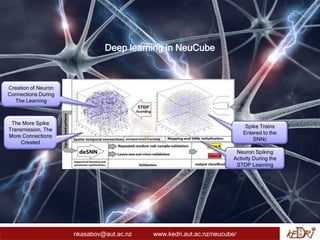
Deep learning in NeuCube
Spike Trains
Entered to the
SNNc
Neuron Spiking
Activity During the
STDP Learning
Creation of Neuron
Connections During
The Learning
The More Spike
Transmission, The
More Connections
Created
nkasabov@aut.ac.nz www.kedri.aut.ac.nz/neucube/
nkasabov@aut.ac.nz
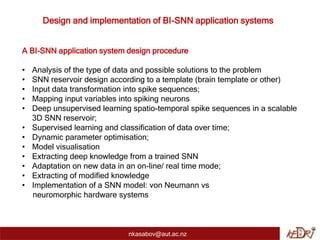
Design and implementation of BI-SNN application systems
A BI-SNN application system design procedure
• Analysis of the type of data and possible solutions to the problem
• SNN reservoir design according to a template (brain template or other)
• Input data transformation into spike sequences;
• Mapping input variables into spiking neurons
• Deep unsupervised learning spatio-temporal spike sequences in a scalable
3D SNN reservoir;
• Supervised learning and classification of data over time;
• Dynamic parameter optimisation;
• Model visualisation
• Extracting deep knowledge from a trained SNN
• Adaptation on new data in an on-line/ real time mode;
• Extracting of modified knowledge
• Implementation of a SNN model: von Neumann vs
neuromorphic hardware systems
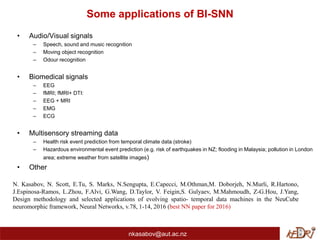
Some applications of BI-SNN
• Audio/Visual signals
– Speech, sound and music recognition
– Moving object recognition
– Odour recognition
• Biomedical signals
– EEG
– fMRI; fMRI+ DTI:
– EEG + MRI
– EMG
– ECG
• Multisensory streaming data
– Health risk event prediction from temporal climate data (stroke)
– Hazardous environmental event prediction (e.g. risk of earthquakes in NZ; flooding in Malaysia; pollution in London
area; extreme weather from satellite images)
• Other
nkasabov@aut.ac.nz
N. Kasabov, N. Scott, E.Tu, S. Marks, N.Sengupta, E.Capecci, M.Othman,M. Doborjeh, N.Murli, R.Hartono,
J.Espinosa-Ramos, L.Zhou, F.Alvi, G.Wang, D.Taylor, V. Feigin,S. Gulyaev, M.Mahmoudh, Z-G.Hou, J.Yang,
Design methodology and selected applications of evolving spatio- temporal data machines in the NeuCube
neuromorphic framework, Neural Networks, v.78, 1-14, 2016 (best NN paper for 2016)
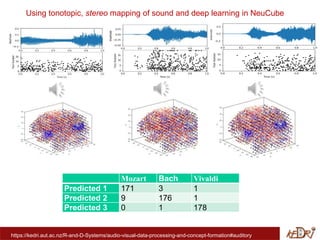
Using tonotopic, stereo mapping of sound and deep learning in NeuCube
Mozart Bach Vivaldi
Predicted 1 171 3 1
Predicted 2 9 176 1
Predicted 3 0 1 178
https://kedri.aut.ac.nz/R-and-D-Systems/audio-visual-data-processing-and-concept-formation#auditory
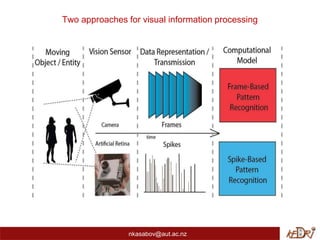
Two approaches for visual information processing
nkasabov@aut.ac.nz
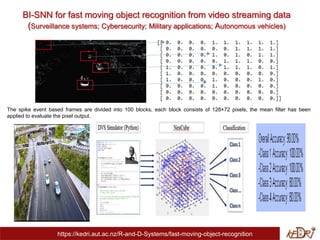
BI-SNN for fast moving object recognition from video streaming data
(Surveillance systems; Cybersecurity; Military applications; Autonomous vehicles)
https://kedri.aut.ac.nz/R-and-D-Systems/fast-moving-object-recognition
The spike event based frames are divided into 100 blocks, each block consists of 128×72 pixels, the mean filter has been
applied to evaluate the pixel output.
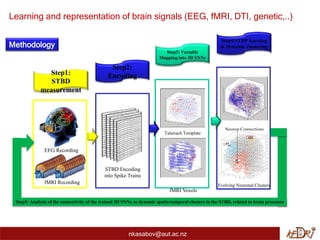
EEG Recording
fMRI Recording
Step1:
STBD
measurement
Step2:
Encoding
STBD Encoding
into Spike Trains
Step3: Variable
Mapping into 3D SNNc
Talairach Template
fMRI Voxels
Step4:STDP learning
& Dynamic clustering
Neuron Connections
Evolving Neuronal Clusters
Step5: Analysis of the connectivity of the trained 3D SNNc as dynamic spatio-temporal clusters in the STBD, related to brain processes
Learning and representation of brain signals (EEG, fMRI, DTI, genetic,..)
Methodology
nkasabov@aut.ac.nz
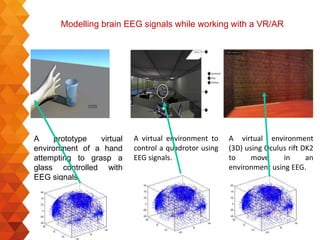
Modelling brain EEG signals while working with a VR/AR
A prototype virtual
environment of a hand
attempting to grasp a
glass controlled with
EEG signals.
A virtual environment to
control a quadrotor using
EEG signals.
A virtual environment
(3D) using Oculus rift DK2
to move in an
environment using EEG.
Seismic data modelling for earthquake prediction
N. Kasabov, N. Scott, E.Tu, S. Marks, N.Sengupta, E.Capecci, M.Othman,M. Doborjeh, N.Murli,R.Hartono, J.Espinosa-Ramos, L.Zhou, F.Alvi, G.Wang,
D.Taylor, V. Feigin,S. Gulyaev, M.Mahmoudh, Z-G.Hou, J.Yang, Design methodology and selected applications of evolving spatio- temporal data machines
in the NeuCube neuromorphic framework, Neural Networks, v.78, 1-14, 2016. http://dx.doi.org/10.1016/j.neunet.2015.09.011.
nkasabov@aut.ac.nz
Measure NeuCube SVM MLP
1h ahead 91.36% 65% 60%
6h ahead 83% 53% 47%
12h ahead 75% 43% 46%
Predicting risk for earthquakes, tsunami, land slides, floods – how early and how accurate?
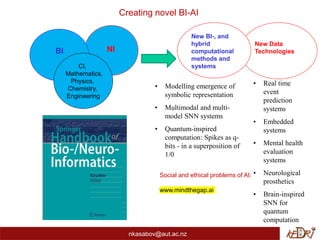
Creating novel BI-AI
nkasabov@aut.ac.nz
NI
BI
CI,
Mathematics,
Physics,
Chemistry,
Engineering
New Data
Technologies
New BI-, and
hybrid
computational
methods and
systems
• Modelling emergence of
symbolic representation
• Multimodal and multi-
model SNN systems
• Quantum-inspired
computation: Spikes as q-
bits - in a superposition of
1/0
• Real time
event
prediction
systems
• Embedded
systems
• Mental health
evaluation
systems
• Neurological
prosthetics
• Brain-inspired
SNN for
quantum
computation
Social and ethical problems of AI:
www.mindthegap.ai
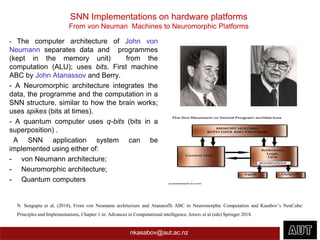
SNN Implementations on hardware platforms
From von Neuman Machines to Neuromorphic Platforms
- The computer architecture of John von
Neumann separates data and programmes
(kept in the memory unit) from the
computation (ALU); uses bits. First machine
ABC by John Atanassov and Berry.
- A Neuromorphic architecture integrates the
data, the programme and the computation in a
SNN structure, similar to how the brain works;
uses spikes (bits at times).
- A quantum computer uses q-bits (bits in a
superposition) .
A SNN application system can be
implemented using either of:
- von Neumann architecture;
- Neuromorphic architecture;
- Quantum computers
nkasabov@aut.ac.nz
N. Sengupta et al, (2018), From von Neumann architecture and Atanasoffs ABC to Neuromorphic Computation and Kasabov’s NeuCube:
Principles and Implementations, Chapter 1 in: Advances in Computational intelligence, Jotzov et al (eds) Springer 2018.
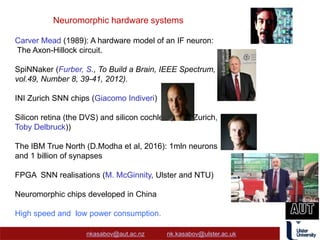
Neuromorphic hardware systems
Carver Mead (1989): A hardware model of an IF neuron:
The Axon-Hillock circuit.
SpiNNaker (Furber, S., To Build a Brain, IEEE Spectrum,
vol.49, Number 8, 39-41, 2012).
INI Zurich SNN chips (Giacomo Indiveri)
Silicon retina (the DVS) and silicon cochlea (ETH, Zurich,
Toby Delbruck))
The IBM True North (D.Modha et al, 2016): 1mln neurons
and 1 billion of synapses
FPGA SNN realisations (M. McGinnity, Ulster and NTU)
Neuromorphic chips developed in China
High speed and low power consumption.
nkasabov@aut.ac.nz nk.kasabov@ulster.ac.uk
Discussions and future directions
Advantages of BI-SNN:
1. Self-organised, evolvable structure (no fixed number of layers/neurons, etc.)
2. Event based (asynchronous), fast, incremental, potentially “life-long” learning.
3. Temporal (spatio-temporal) associations learned.
4. Interpretability, e.g. TSK representation
5. Low computational power
6. Fault tolerance
Problems and limitations of BI-SNN
• Sensitive to parameter values
• Large number of parameters to be optimised
• No rigid theory yet.
nkasabov@aut.ac.nz
N.Kasabov, Time-Space, Spiking Neural Networks and Brain-
Inspired Artificial Intelligence, Springer (2019)
nkasabov@aut.ac.nz
nkasabov@aut.ac.nz
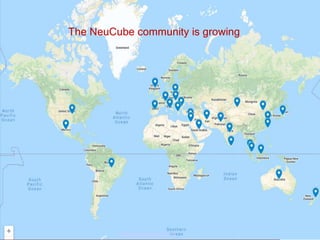
The NeuCube community is growing

  Brain-Inspired Computation based on Spiking Neural Networks

  • 1.
    Brain-Inspired Computation basedon Spiking Neural Networks Nikola Kasabov FIEEE, FRSNZ, FINNS, FIITP NZ Professor of Knowledge Engineering, KEDRI, Auckland University of Technology George Moore Chair of Data Analytics, Ulster University, UK Honorary Professor Teesside University UK and ABI the University of Auckland Doctor Honoris Causa Obuda University Budapest nkasabov@aut.ac.nz N. Kasabov, Time-Space, Spiking Neural Networks and Brain-Inspired Artificial Intelligence, Springer (2019)
  • 2.
    nkasabov@aut.ac.nz The brain (80blnneurons, 100 trillions of connections, 200 mln years of evolution) is the ultimate learning machine Three, mutually interacting, memory types: - short term (membrane potential); - long term (synaptic weights); - genetic (genes in the nuclei). Temporal data at different time scales: - Nanoseconds: quantum processes; - Milliseconds: spiking activity; - Minutes: gene expressions; - Hours: learning in synapses; - Many years: evolution of genes. Spatially evolved structure with spatially allocated functions Learning and knowledge is represented as deep spatio- temporal patterns. The human brain as an ultimate inspiration The human brain, the most sophisticated product of the evolution, is a deep learning machine for information processing based on learned knowledge
  • 3.
    Learned knowledge isrepresented as trajectories of connected neuronal clusters Deep serial processing of visual stimuli in humans for image classification and action. Location of cortical areas: V1 = primary visual cortex, V2 = secondary visual cortex, V4 = quartiary visual cortex, IT = inferotemporal cortex, PFC = prefrontal cortex, PMC = premotor cortex, MC = motor cortex. (from L.Benuskova, N.Kasabov, Computational neurogenetic modelling, Springer, 2007) nkasabov@aut.ac.nz Thalamus Pr ef ron ta l co rte x Frontal cortex Eye H i g h e r - o r d e r p a r i e t a l v i s u a l a r e a s Primary visual cortex Cerebellum IT 150 ms 250 ms V4 V2 V1 MC PMC PFC
  • 4.
    Spiking Neural Networks Modelsof a spiking neurons – Hodgkin- Huxley – Spike response model – Integrate-and-fire ----------------> – Leaky integrator – Izhikevich model – Probabilistic and neurogenetic models nkasabov@aut.ac.nz
  • 5.
    Methods for unsupervisedlearning in SNN Spike-Time Dependent Plasticity (STDP) (Abbott and Nelson, 2000). • Hebbian form of plasticity in the form of long-term potentiation (LTP) and depression (LTD) • Effect of synapses are strengthened or weakened based on the timing of pre-synaptic spikes and post-synaptic action potential. • Through STDP connected neurons learn consecutive temporal associations from data. • Variations of the STDP Pre-synaptic activity that precedes post- synaptic firing can induce LTP, reversing this temporal order causes LTD: ∆t=tpre -tpost nkasabov@aut.ac.nz
  • 6.
    Spike encoding methods Aspike is generated only if a change in the input data occurs beyond a threshold Silicon Retina (Tobi Delbruck, INI, ETH/UZH, Zurich ), DVS128: Retinotopic Silicon Cochlea ( Shih-Chii Liu, INI, ETH/UZH, Zurich): Tonotopic nkasabov@aut.ac.nz www.kedri.aut.ac.nz/neucube Threshold-based encoding – retinotopic Tonotopic organization of the cochlea for spectro-temporal data mapping for spatio-temporal data https://sites.google.com/site/jayanthinyswebite
  • 7.
    Methods for supervisedlearning in SNN Rank order (RO) learning rule (Thorpe et al, 1998) nkasabov@aut.ac.nz ) ( order j ji m w          else fired if 0 ) ( ) ( | ) ( order t j f j j i ji i m w t u PSP max (T) = SUM [(m order (j(t)) wj,i(t)], for j=1,2.., k; t=1,2,...,T; PSPTh=C. PSPmax (T) - Earlier coming spikes are more important (carry more information) - Early spiking can be achieved, depending on the parameter C.
  • 8.
    Dynamic Evolving SNN(deSNN) (Kasabov, N., Dhoble, K., Nuntalid, N., G. Indiveri, Dynamic Evolving Spiking Neural Networks for On- line Spatio- and Spectro-Temporal Pattern Recognition, Neural Networks, v.41, 188-201, 2013) Combine: (a) RO learning for weight initialisation based on the first spikes: (b) Learning further input spikes at a synapse through a drift – positive and negative. wj,i(t) = ej(t)・Drift - A new output neuron may be added to a respective output repository for every new -input pattern. - Two types of output neuron activation: - deSNNm (spiking is based on the membrane potential) - deSNNs (spiking is based on synaptic similarity between the newly created output neuron and the existing ones) - Neurons may merge. ) ( order j ji m w   nkasabov@aut.ac.nz
  • 9.
    Brain-inspired SNN (BI-SNN)Architectures. NeuCube nkasabov@aut.ac.nz eSNN SNNcube 2 , 2 / ,  b a D b a e C p    What is a BI-SNN architecture? - Input data is encoded into spatio-temporal events as spike trains; - A 3D SNN has spatially located neurons following a brain template, e.g Talairach, MNI etc. . - Inputs are mapped spatially (brain-like) into the SNN, a 3D structure organised as a brain template. - Unsupervised learning is spatio-temporal, adaptive and incremental resulting in evolved connectivity - The structure is self-organising - Supervised learning is evolving creating new output neurons - Allows for knowledge representation as spatio-temporal patterns, interpreted as rules, graphs, associations, ….
  • 10.
    The NeuCube Architecture nkasabov@aut.ac.nz Kasabov,N., NeuCube: A Spiking Neural Network Architecture for Mapping, Learning and Understanding of Spatio-Temporal Brain Data, Neural Networks, vol.52, 2014. E. Tu, N. Kasabov, J. Yang, Mapping Temporal Variables into the NeuCube Spiking Neural Network Architecture for Improved Pattern Recognition and Predictive Modelling, IEEE Trans. on Neural Networks and Learning Systems, 28 (6), 1305-1317,, 2017 DOI: 10.1109/TNNLS.2016.2536742, 2017.
  • 11.
    Deep learning inNeuCube Spike Trains Entered to the SNNc Neuron Spiking Activity During the STDP Learning Creation of Neuron Connections During The Learning The More Spike Transmission, The More Connections Created nkasabov@aut.ac.nz www.kedri.aut.ac.nz/neucube/
  • 12.
    nkasabov@aut.ac.nz Design and implementationof BI-SNN application systems A BI-SNN application system design procedure • Analysis of the type of data and possible solutions to the problem • SNN reservoir design according to a template (brain template or other) • Input data transformation into spike sequences; • Mapping input variables into spiking neurons • Deep unsupervised learning spatio-temporal spike sequences in a scalable 3D SNN reservoir; • Supervised learning and classification of data over time; • Dynamic parameter optimisation; • Model visualisation • Extracting deep knowledge from a trained SNN • Adaptation on new data in an on-line/ real time mode; • Extracting of modified knowledge • Implementation of a SNN model: von Neumann vs neuromorphic hardware systems
  • 13.
    Some applications ofBI-SNN • Audio/Visual signals – Speech, sound and music recognition – Moving object recognition – Odour recognition • Biomedical signals – EEG – fMRI; fMRI+ DTI: – EEG + MRI – EMG – ECG • Multisensory streaming data – Health risk event prediction from temporal climate data (stroke) – Hazardous environmental event prediction (e.g. risk of earthquakes in NZ; flooding in Malaysia; pollution in London area; extreme weather from satellite images) • Other nkasabov@aut.ac.nz N. Kasabov, N. Scott, E.Tu, S. Marks, N.Sengupta, E.Capecci, M.Othman,M. Doborjeh, N.Murli, R.Hartono, J.Espinosa-Ramos, L.Zhou, F.Alvi, G.Wang, D.Taylor, V. Feigin,S. Gulyaev, M.Mahmoudh, Z-G.Hou, J.Yang, Design methodology and selected applications of evolving spatio- temporal data machines in the NeuCube neuromorphic framework, Neural Networks, v.78, 1-14, 2016 (best NN paper for 2016)
  • 14.
    Using tonotopic, stereomapping of sound and deep learning in NeuCube Mozart Bach Vivaldi Predicted 1 171 3 1 Predicted 2 9 176 1 Predicted 3 0 1 178 https://kedri.aut.ac.nz/R-and-D-Systems/audio-visual-data-processing-and-concept-formation#auditory
  • 15.
    Two approaches forvisual information processing nkasabov@aut.ac.nz
  • 16.
    BI-SNN for fastmoving object recognition from video streaming data (Surveillance systems; Cybersecurity; Military applications; Autonomous vehicles) https://kedri.aut.ac.nz/R-and-D-Systems/fast-moving-object-recognition The spike event based frames are divided into 100 blocks, each block consists of 128×72 pixels, the mean filter has been applied to evaluate the pixel output.
  • 17.
    EEG Recording fMRI Recording Step1: STBD measurement Step2: Encoding STBDEncoding into Spike Trains Step3: Variable Mapping into 3D SNNc Talairach Template fMRI Voxels Step4:STDP learning & Dynamic clustering Neuron Connections Evolving Neuronal Clusters Step5: Analysis of the connectivity of the trained 3D SNNc as dynamic spatio-temporal clusters in the STBD, related to brain processes Learning and representation of brain signals (EEG, fMRI, DTI, genetic,..) Methodology nkasabov@aut.ac.nz
  • 18.
    Modelling brain EEGsignals while working with a VR/AR A prototype virtual environment of a hand attempting to grasp a glass controlled with EEG signals. A virtual environment to control a quadrotor using EEG signals. A virtual environment (3D) using Oculus rift DK2 to move in an environment using EEG.
  • 19.
    Seismic data modellingfor earthquake prediction N. Kasabov, N. Scott, E.Tu, S. Marks, N.Sengupta, E.Capecci, M.Othman,M. Doborjeh, N.Murli,R.Hartono, J.Espinosa-Ramos, L.Zhou, F.Alvi, G.Wang, D.Taylor, V. Feigin,S. Gulyaev, M.Mahmoudh, Z-G.Hou, J.Yang, Design methodology and selected applications of evolving spatio- temporal data machines in the NeuCube neuromorphic framework, Neural Networks, v.78, 1-14, 2016. http://dx.doi.org/10.1016/j.neunet.2015.09.011. nkasabov@aut.ac.nz Measure NeuCube SVM MLP 1h ahead 91.36% 65% 60% 6h ahead 83% 53% 47% 12h ahead 75% 43% 46% Predicting risk for earthquakes, tsunami, land slides, floods – how early and how accurate?
  • 20.
    Creating novel BI-AI nkasabov@aut.ac.nz NI BI CI, Mathematics, Physics, Chemistry, Engineering NewData Technologies New BI-, and hybrid computational methods and systems • Modelling emergence of symbolic representation • Multimodal and multi- model SNN systems • Quantum-inspired computation: Spikes as q- bits - in a superposition of 1/0 • Real time event prediction systems • Embedded systems • Mental health evaluation systems • Neurological prosthetics • Brain-inspired SNN for quantum computation Social and ethical problems of AI: www.mindthegap.ai
  • 21.
    SNN Implementations onhardware platforms From von Neuman Machines to Neuromorphic Platforms - The computer architecture of John von Neumann separates data and programmes (kept in the memory unit) from the computation (ALU); uses bits. First machine ABC by John Atanassov and Berry. - A Neuromorphic architecture integrates the data, the programme and the computation in a SNN structure, similar to how the brain works; uses spikes (bits at times). - A quantum computer uses q-bits (bits in a superposition) . A SNN application system can be implemented using either of: - von Neumann architecture; - Neuromorphic architecture; - Quantum computers nkasabov@aut.ac.nz N. Sengupta et al, (2018), From von Neumann architecture and Atanasoffs ABC to Neuromorphic Computation and Kasabov’s NeuCube: Principles and Implementations, Chapter 1 in: Advances in Computational intelligence, Jotzov et al (eds) Springer 2018.
  • 22.
    Neuromorphic hardware systems CarverMead (1989): A hardware model of an IF neuron: The Axon-Hillock circuit. SpiNNaker (Furber, S., To Build a Brain, IEEE Spectrum, vol.49, Number 8, 39-41, 2012). INI Zurich SNN chips (Giacomo Indiveri) Silicon retina (the DVS) and silicon cochlea (ETH, Zurich, Toby Delbruck)) The IBM True North (D.Modha et al, 2016): 1mln neurons and 1 billion of synapses FPGA SNN realisations (M. McGinnity, Ulster and NTU) Neuromorphic chips developed in China High speed and low power consumption. nkasabov@aut.ac.nz nk.kasabov@ulster.ac.uk
  • 23.
    Discussions and futuredirections Advantages of BI-SNN: 1. Self-organised, evolvable structure (no fixed number of layers/neurons, etc.) 2. Event based (asynchronous), fast, incremental, potentially “life-long” learning. 3. Temporal (spatio-temporal) associations learned. 4. Interpretability, e.g. TSK representation 5. Low computational power 6. Fault tolerance Problems and limitations of BI-SNN • Sensitive to parameter values • Large number of parameters to be optimised • No rigid theory yet. nkasabov@aut.ac.nz N.Kasabov, Time-Space, Spiking Neural Networks and Brain- Inspired Artificial Intelligence, Springer (2019)
  • 24.
  • 25.

Editor's Notes