Cognitive Anteater Robotics Lab (CARL)
University of California, Irvine, CA, USA
Michael Beyeler
CARLsim 3
Concepts, Tools, and Applications
December 1, 2016 2
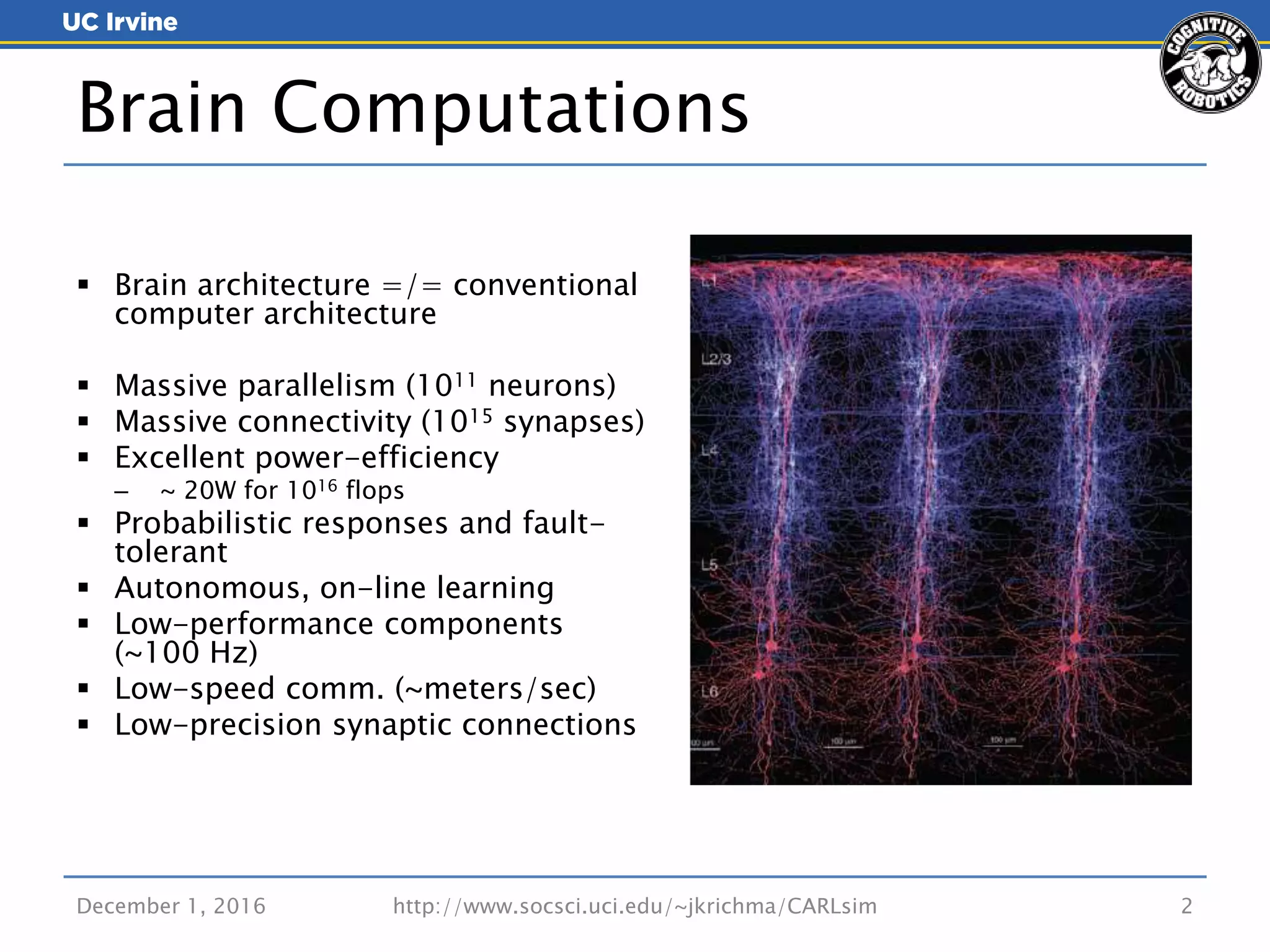
 Brain architecture =/= conventional
computer architecture
 Massive parallelism (1011 neurons)
 Massive connectivity (1015 synapses)
 Excellent power-efficiency
– ~ 20W for 1016 flops
 Probabilistic responses and fault-
tolerant
 Autonomous, on-line learning
 Low-performance components
(~100 Hz)
 Low-speed comm. (~meters/sec)
 Low-precision synaptic connections
Brain Computations
http://www.socsci.uci.edu/~jkrichma/CARLsim
December 1, 2016 http://www.socsci.uci.edu/~jkrichma/CARLsim 3
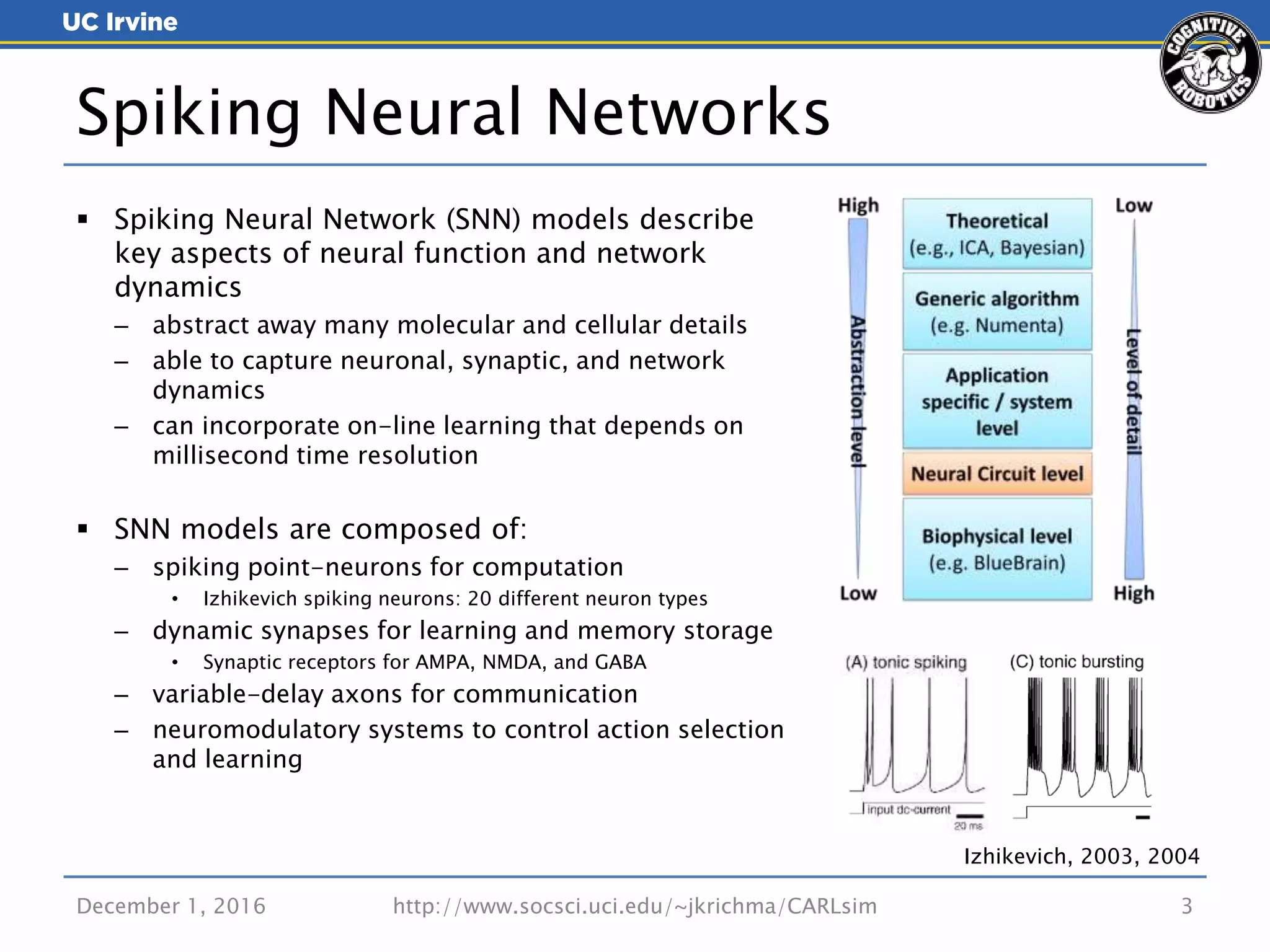
 Spiking Neural Network (SNN) models describe
key aspects of neural function and network
dynamics
– abstract away many molecular and cellular details
– able to capture neuronal, synaptic, and network
dynamics
– can incorporate on-line learning that depends on
millisecond time resolution
 SNN models are composed of:
– spiking point-neurons for computation
• Izhikevich spiking neurons: 20 different neuron types
– dynamic synapses for learning and memory storage
• Synaptic receptors for AMPA, NMDA, and GABA
– variable-delay axons for communication
– neuromodulatory systems to control action selection
and learning
Spiking Neural Networks
Izhikevich, 2003, 2004
December 1, 2016 http://www.socsci.uci.edu/~jkrichma/CARLsim 4
Constructing Functional SNN Models
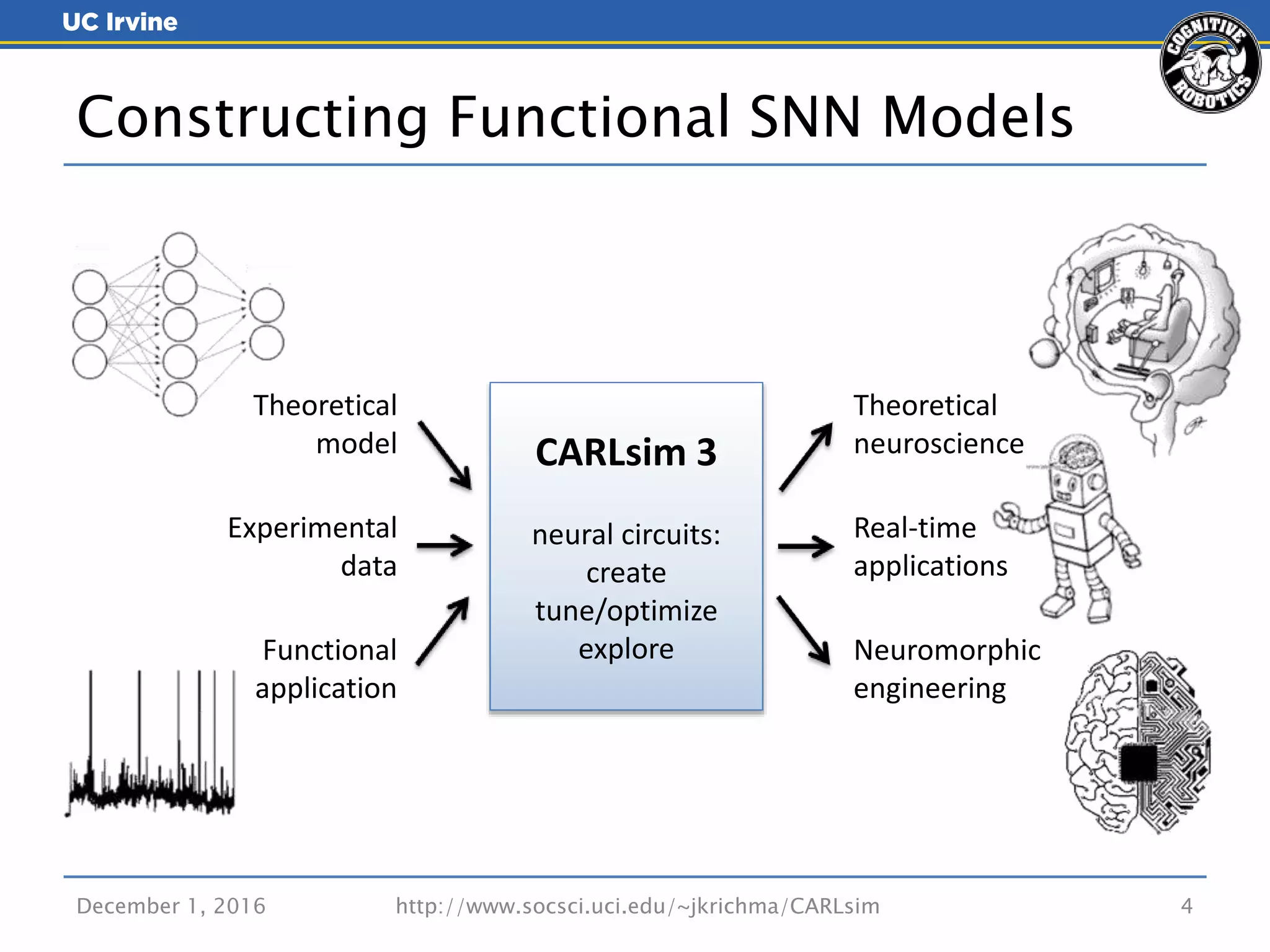
CARLsim 3
neural circuits:
create
tune/optimize
explore
Theoretical
model
Experimental
data
Functional
application
Theoretical
neuroscience
Real-time
applications
Neuromorphic
engineering
 GPU-accelerated spiking neural network simulator
 User-friendly, well documented.
– Runs on Linux, Mac OS X, Windows systems with CUDA SDK.
 Scalable, extendable.
 PyNN-like interface.
 Highly optimized for NVIDIA GPUs.
 Capable of simulating biological detailed neural
models.
 Freely available at:
– http://www.socsci.uci.edu/~jkrichma/CARLsim/
December 1, 2016 http://www.socsci.uci.edu/~jkrichma/CARLsim 5
CARLsim – in a Nutshell
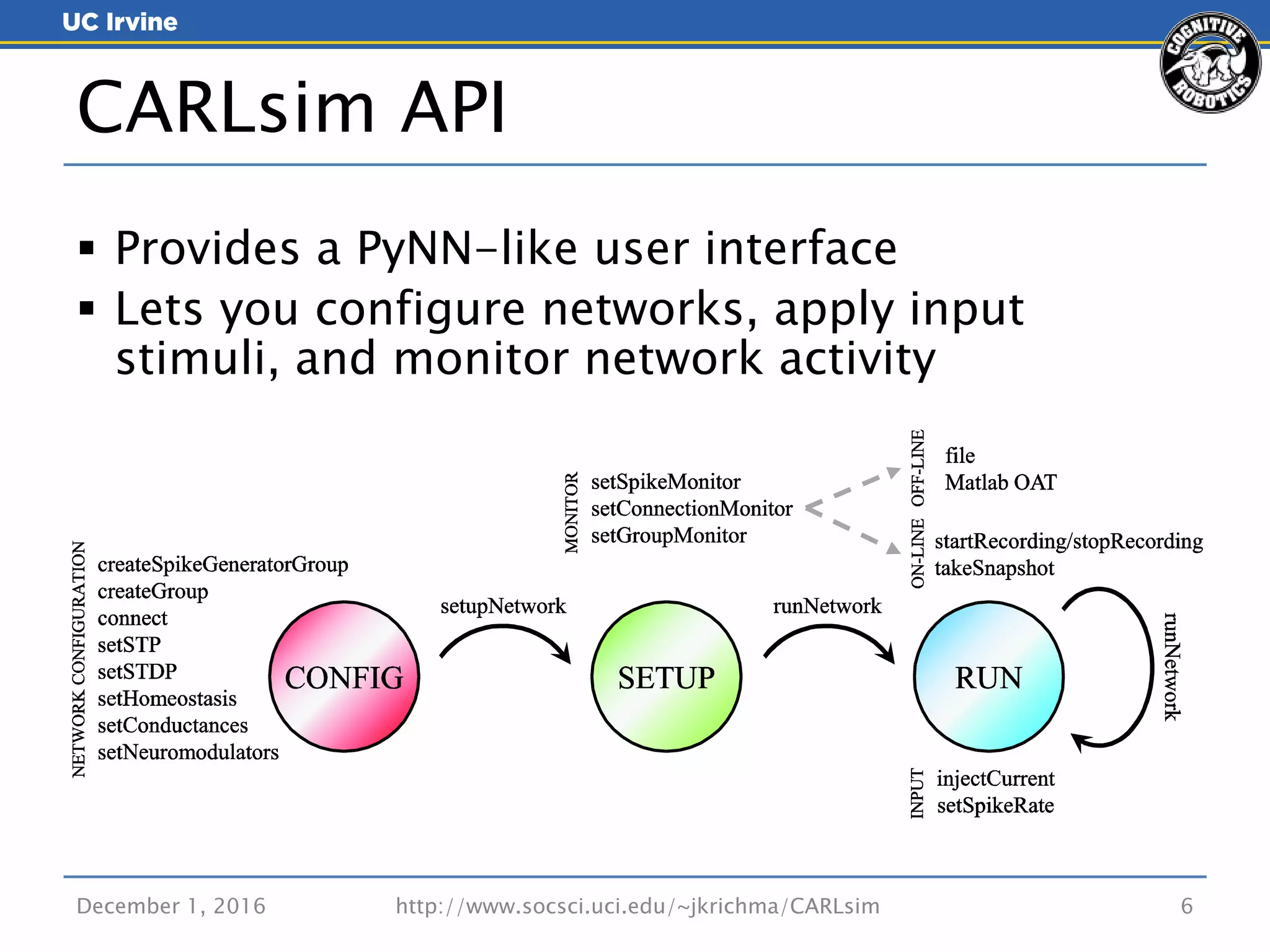
 Provides a PyNN-like user interface
 Lets you configure networks, apply input
stimuli, and monitor network activity
December 1, 2016 http://www.socsci.uci.edu/~jkrichma/CARLsim 6
CARLsim API
December 1, 2016 http://www.socsci.uci.edu/~jkrichma/CARLsim 7
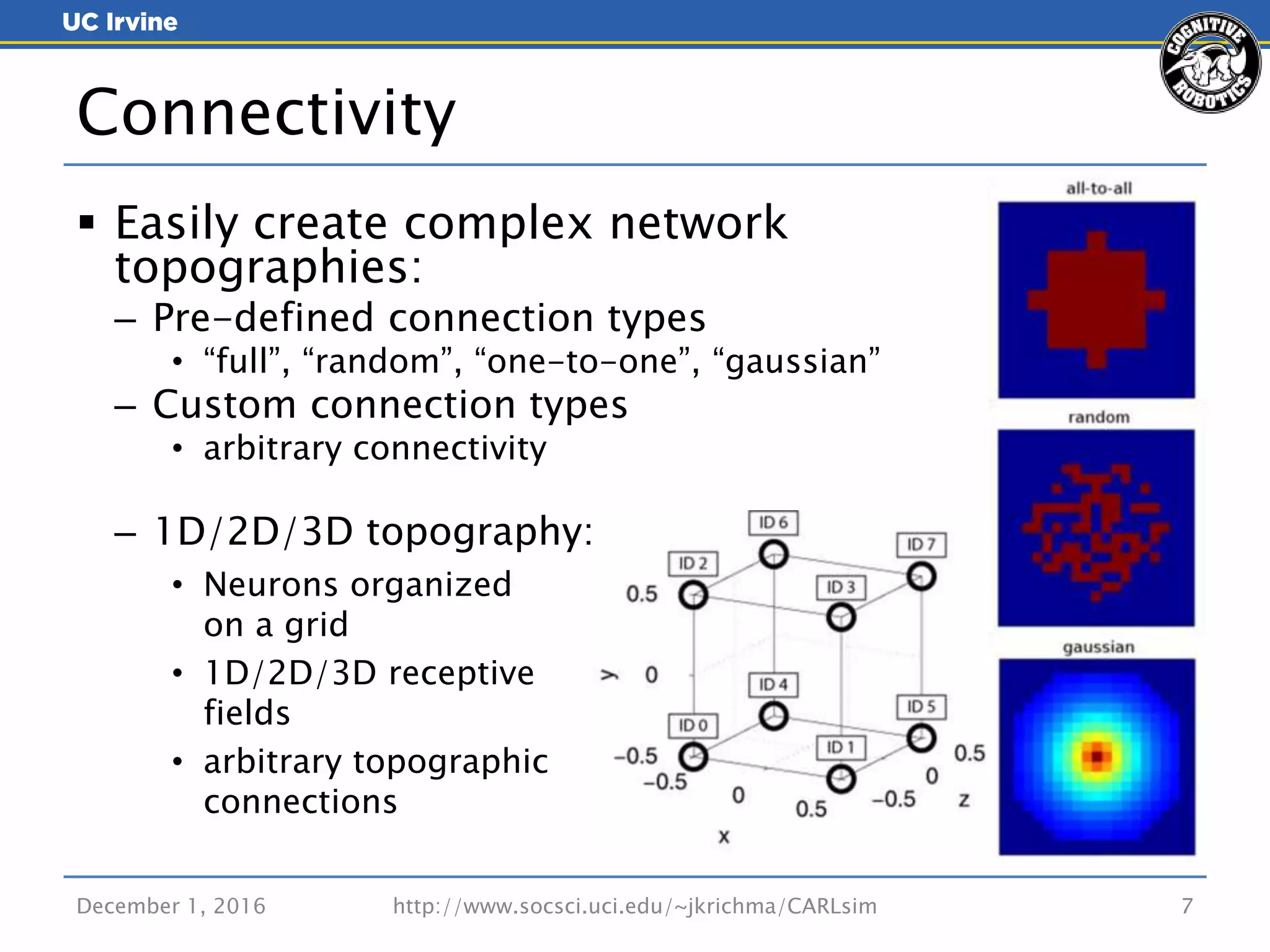
 Easily create complex network
topographies:
– Pre-defined connection types
• “full”, “random”, “one-to-one”, “gaussian”
– Custom connection types
• arbitrary connectivity
– 1D/2D/3D topography:
Connectivity
• Neurons organized
on a grid
• 1D/2D/3D receptive
fields
• arbitrary topographic
connections
December 1, 2016 http://www.socsci.uci.edu/~jkrichma/CARLsim 8
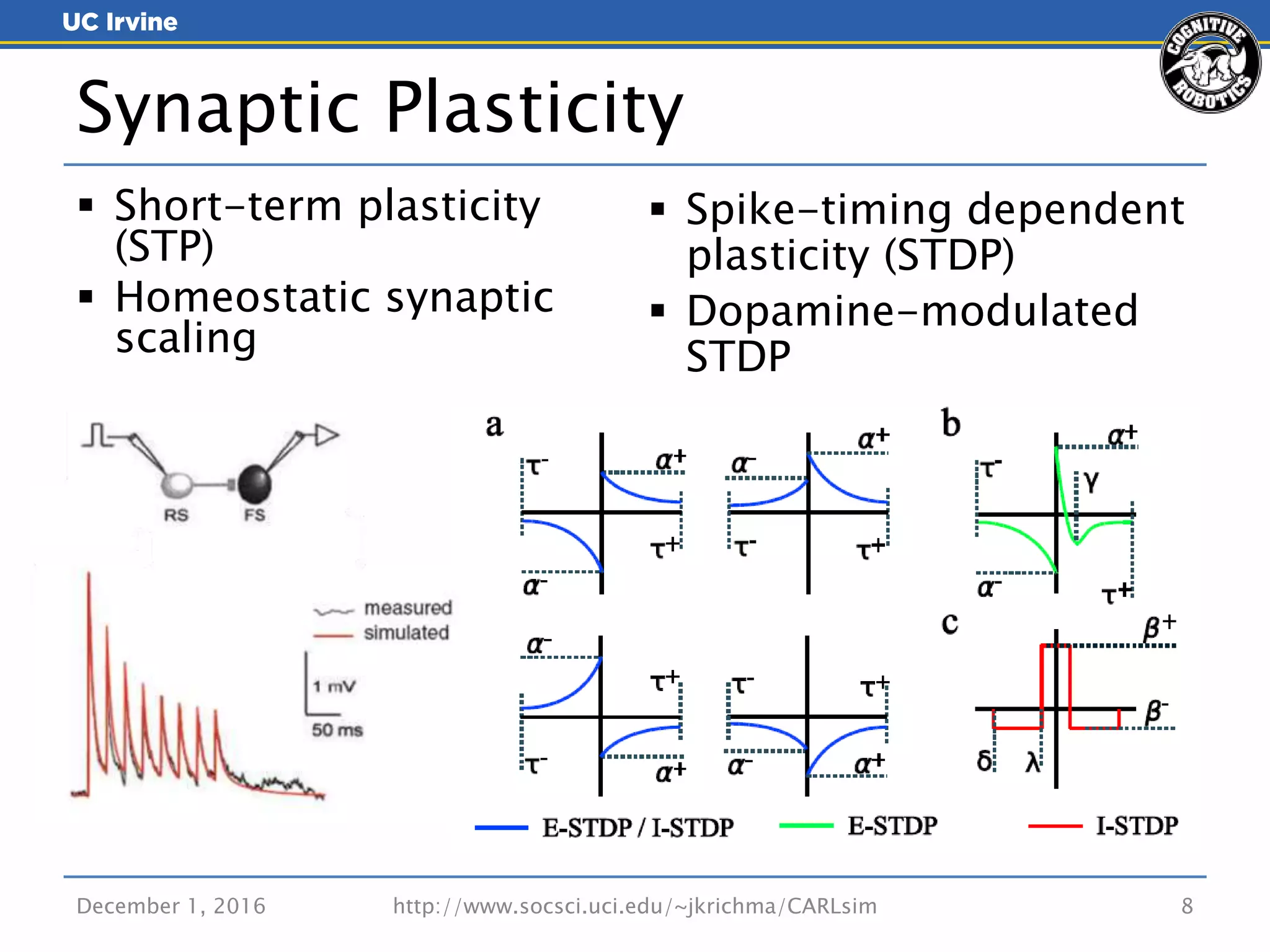
 Short-term plasticity
(STP)
 Homeostatic synaptic
scaling
 Spike-timing dependent
plasticity (STDP)
 Dopamine-modulated
STDP
Synaptic Plasticity
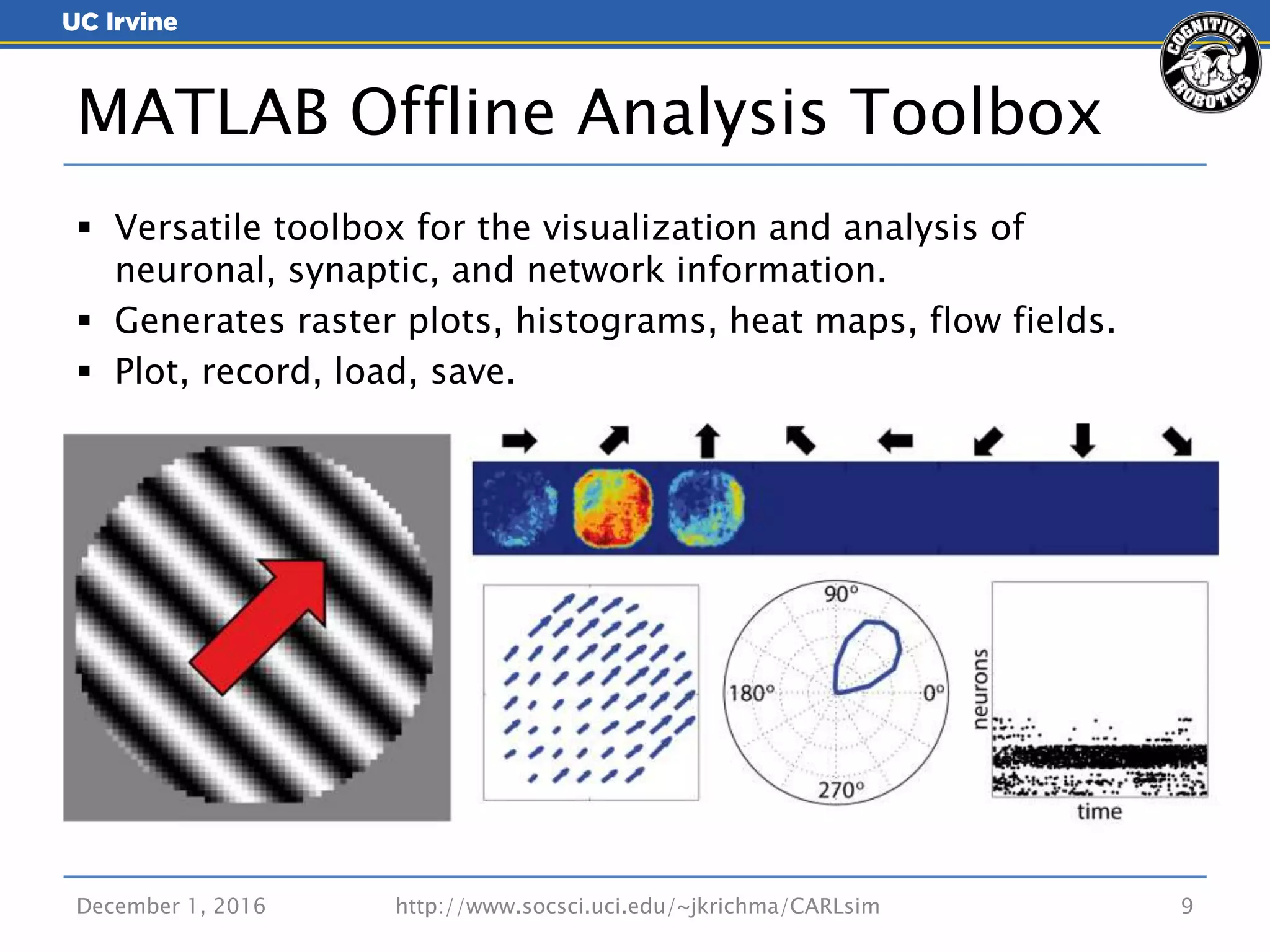
 Versatile toolbox for the visualization and analysis of
neuronal, synaptic, and network information.
 Generates raster plots, histograms, heat maps, flow fields.
 Plot, record, load, save.
December 1, 2016 http://www.socsci.uci.edu/~jkrichma/CARLsim 9
MATLAB Offline Analysis Toolbox
December 1, 2016 http://www.socsci.uci.edu/~jkrichma/CARLsim 10
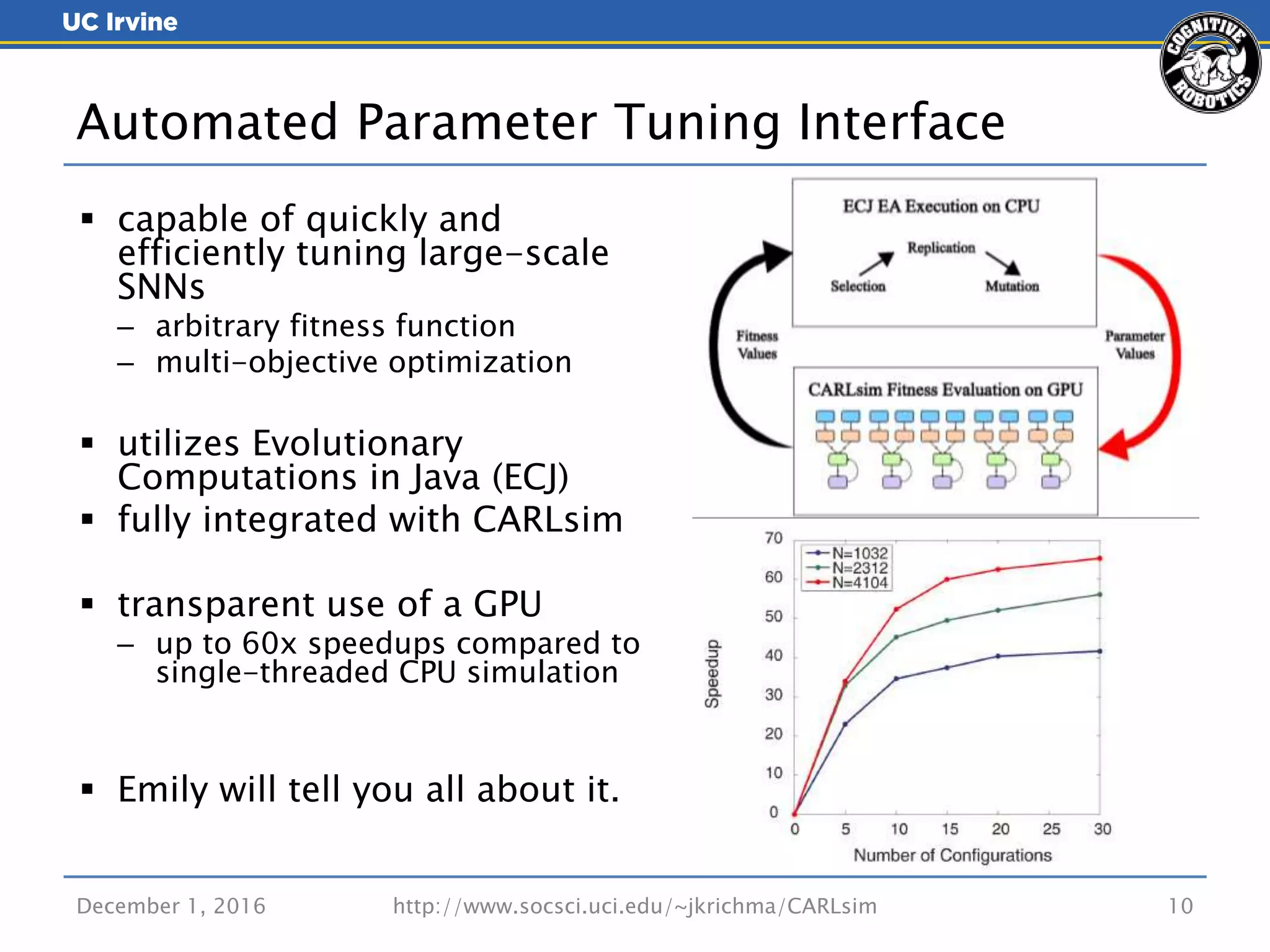
 capable of quickly and
efficiently tuning large-scale
SNNs
– arbitrary fitness function
– multi-objective optimization
 utilizes Evolutionary
Computations in Java (ECJ)
 fully integrated with CARLsim
 transparent use of a GPU
– up to 60x speedups compared to
single-threaded CPU simulation
 Emily will tell you all about it.
Automated Parameter Tuning Interface
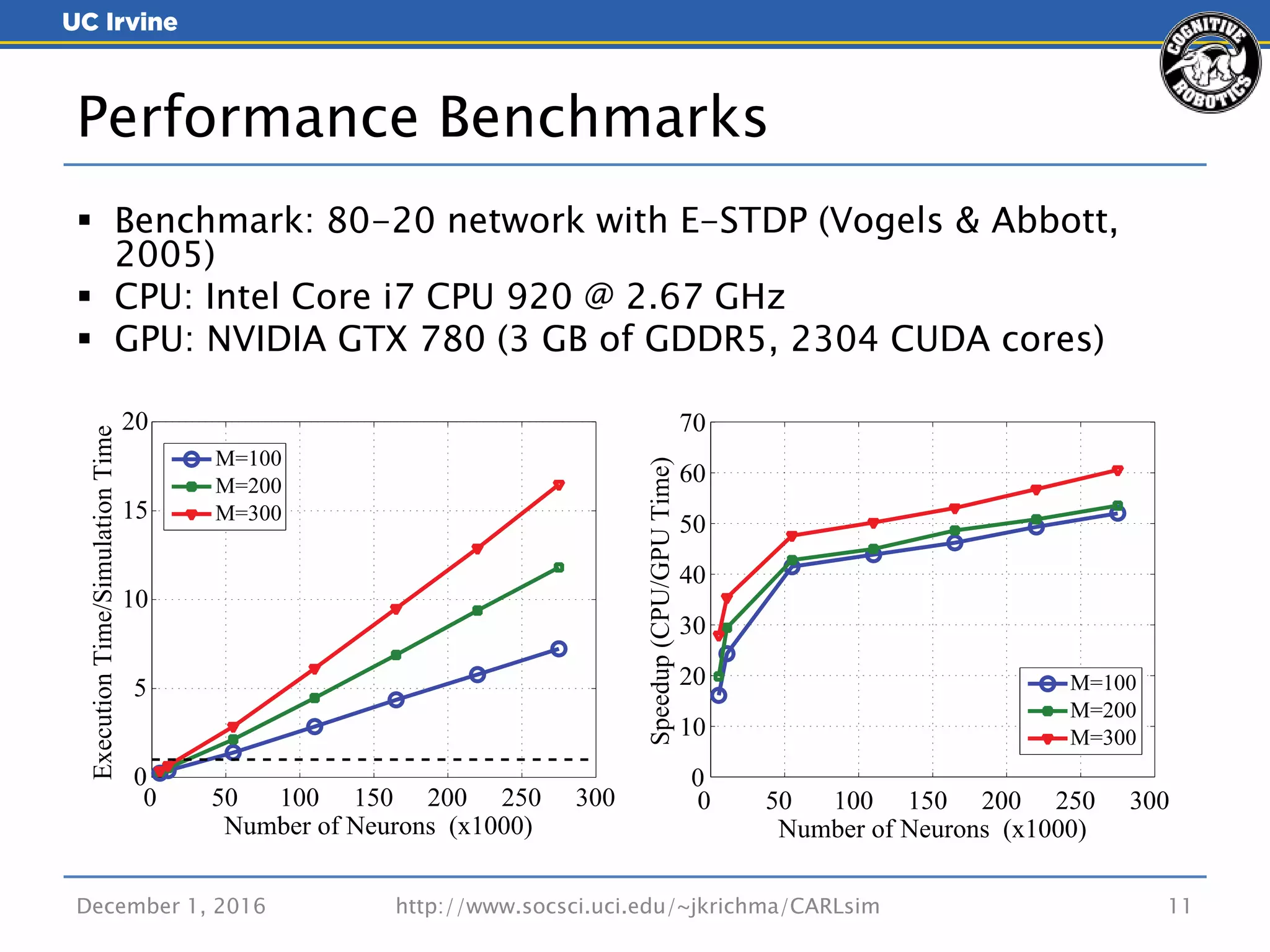
 Benchmark: 80-20 network with E-STDP (Vogels & Abbott,
2005)
 CPU: Intel Core i7 CPU 920 @ 2.67 GHz
 GPU: NVIDIA GTX 780 (3 GB of GDDR5, 2304 CUDA cores)
December 1, 2016 http://www.socsci.uci.edu/~jkrichma/CARLsim 11
Performance Benchmarks
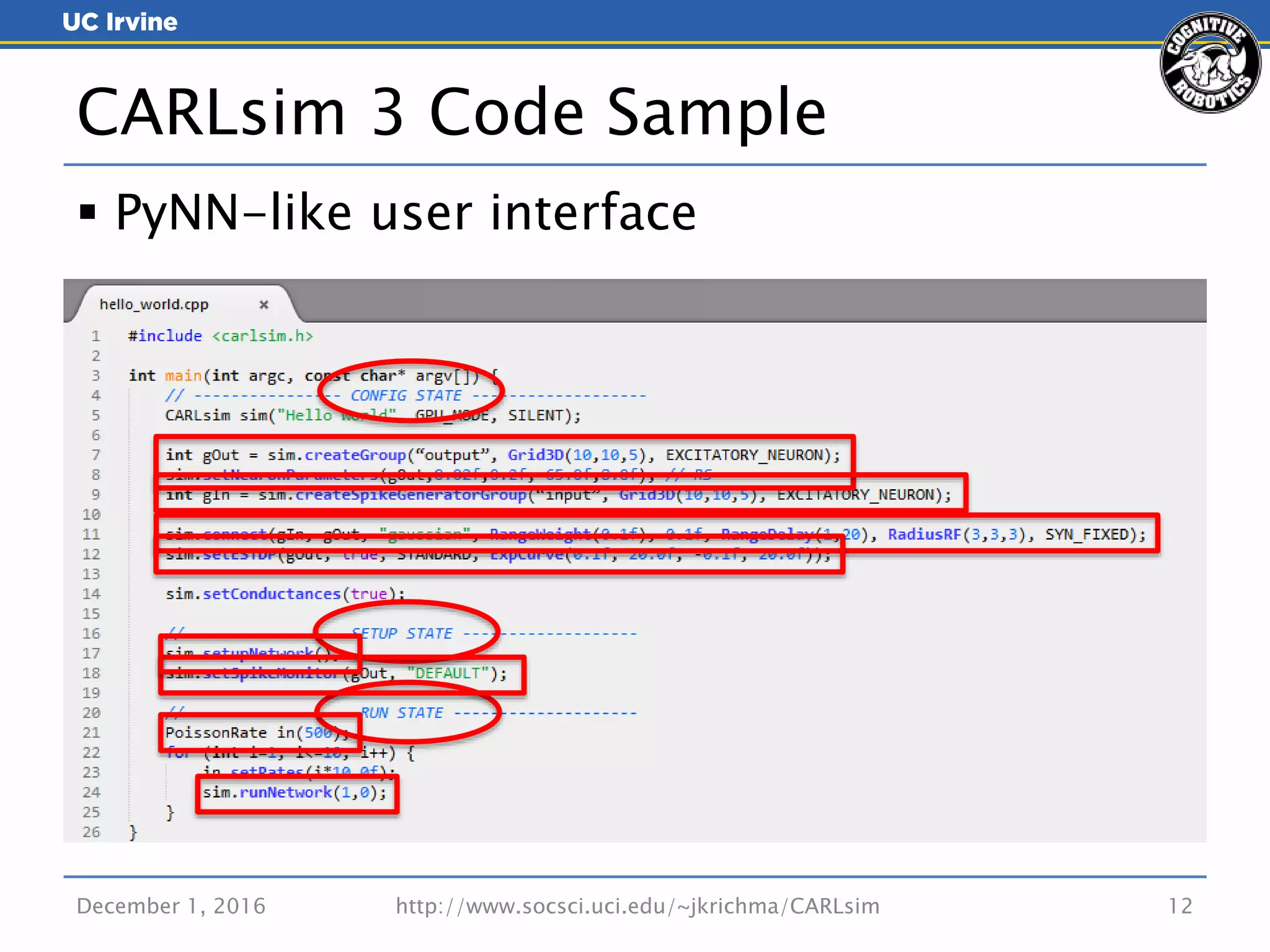
 PyNN-like user interface
December 1, 2016 http://www.socsci.uci.edu/~jkrichma/CARLsim 12
CARLsim 3 Code Sample
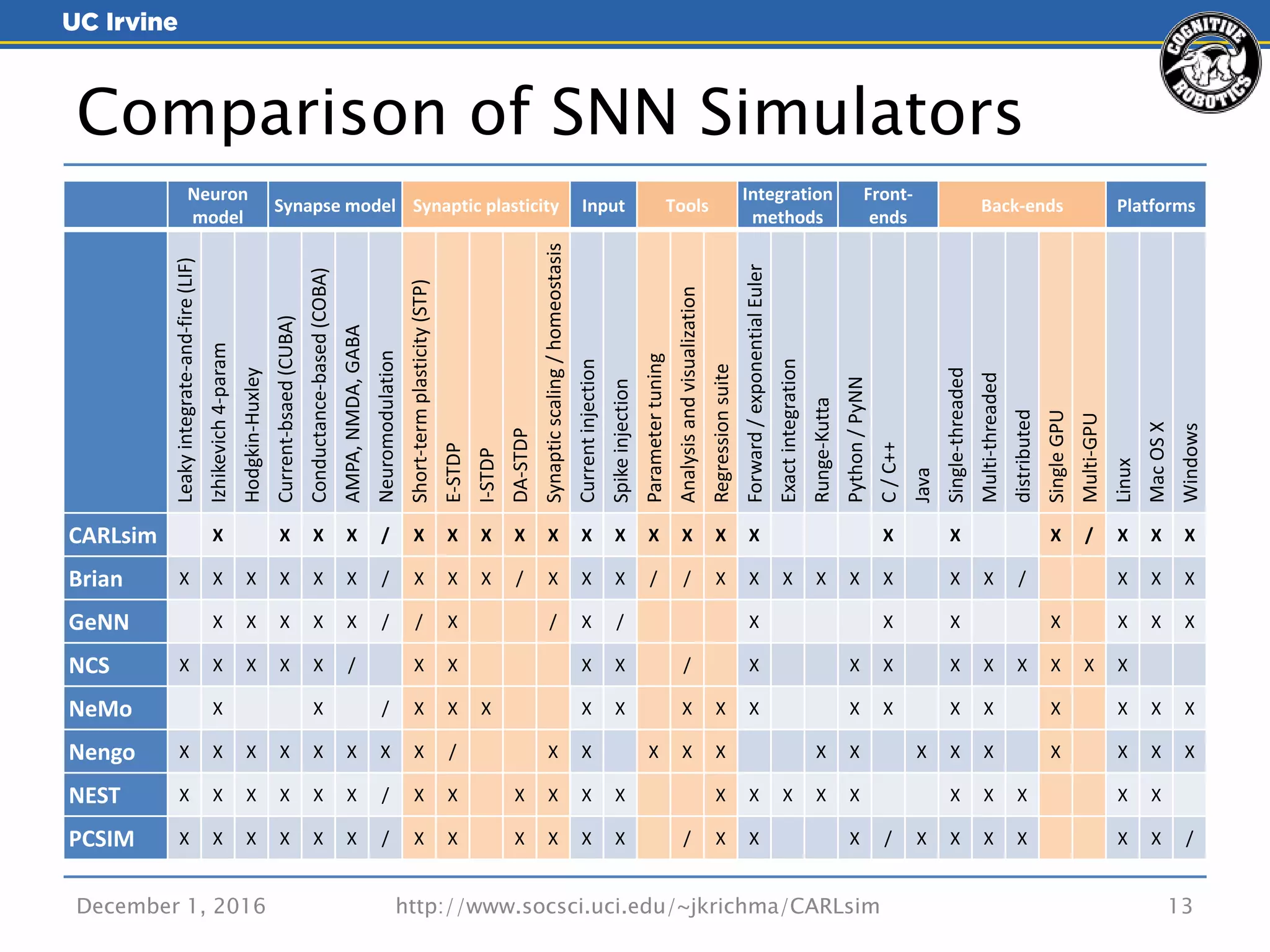
Neuron
model
Synapse model Synaptic plasticity Input Tools
Integration
methods
Front-
ends
Back-ends Platforms
Leakyintegrate-and-fire(LIF)
Izhikevich4-param
Hodgkin-Huxley
Current-bsaed(CUBA)
Conductance-based(COBA)
AMPA,NMDA,GABA
Neuromodulation
Short-termplasticity(STP)
E-STDP
I-STDP
DA-STDP
Synapticscaling/homeostasis
Currentinjection
Spikeinjection
Parametertuning
Analysisandvisualization
Regressionsuite
Forward/exponentialEuler
Exactintegration
Runge-Kutta
Python/PyNN
C/C++
Java
Single-threaded
Multi-threaded
distributed
SingleGPU
Multi-GPU
Linux
MacOSX
Windows
CARLsim X X X X / X X X X X X X X X X X X X X / X X X
Brian X X X X X X / X X X / X X X / / X X X X X X X X / X X X
GeNN X X X X X / / X / X / X X X X X X X
NCS X X X X X / X X X X / X X X X X X X X X
NeMo X X / X X X X X X X X X X X X X X X X
Nengo X X X X X X X X / X X X X X X X X X X X X X X
NEST X X X X X X / X X X X X X X X X X X X X X X X
PCSIM X X X X X X / X X X X X X / X X X / X X X X X X /
December 1, 2016 http://www.socsci.uci.edu/~jkrichma/CARLsim 13
Comparison of SNN Simulators
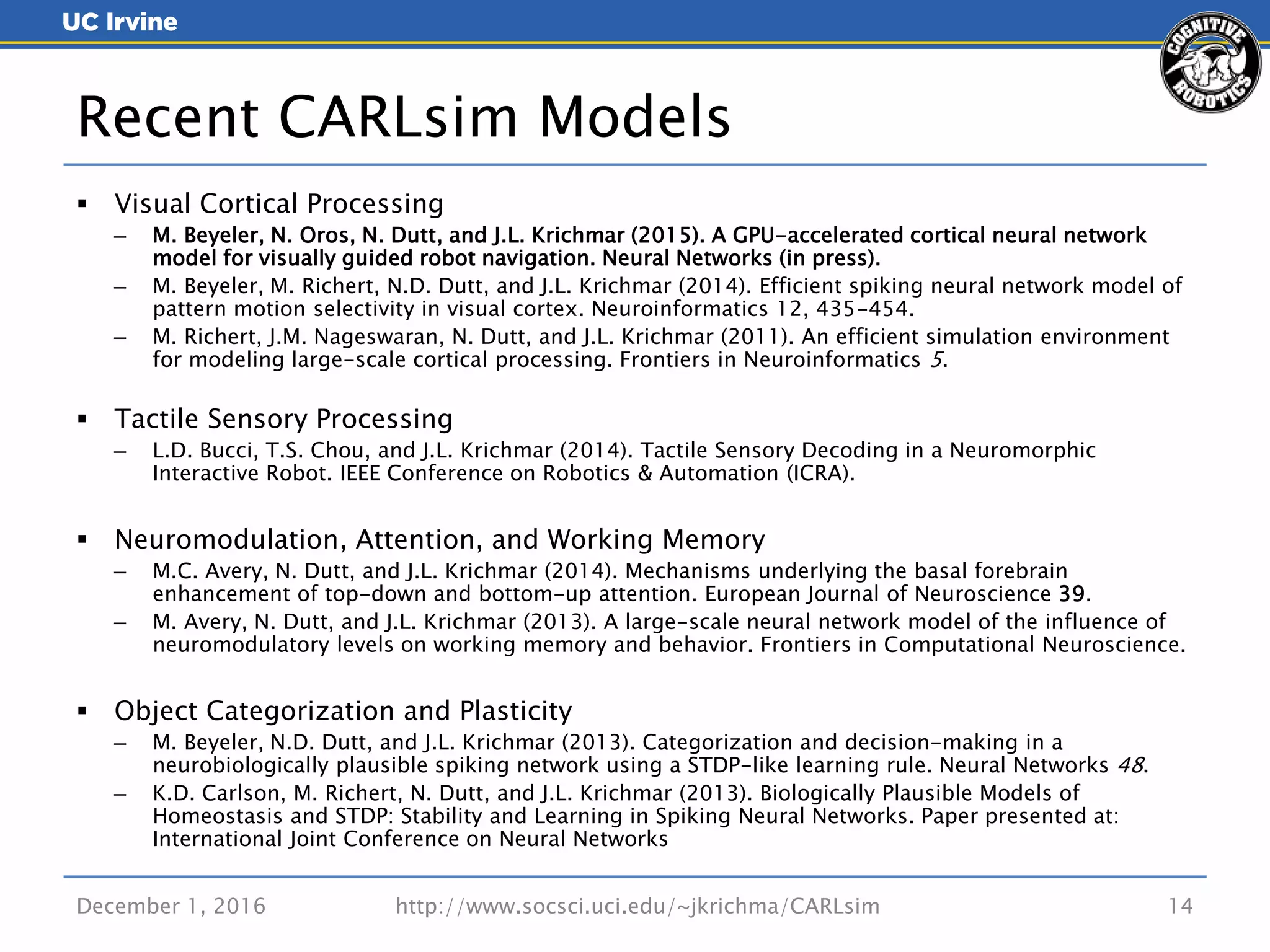
 Visual Cortical Processing
– M. Beyeler, N. Oros, N. Dutt, and J.L. Krichmar (2015). A GPU-accelerated cortical neural network
model for visually guided robot navigation. Neural Networks (in press).
– M. Beyeler, M. Richert, N.D. Dutt, and J.L. Krichmar (2014). Efficient spiking neural network model of
pattern motion selectivity in visual cortex. Neuroinformatics 12, 435-454.
– M. Richert, J.M. Nageswaran, N. Dutt, and J.L. Krichmar (2011). An efficient simulation environment
for modeling large-scale cortical processing. Frontiers in Neuroinformatics 5.
 Tactile Sensory Processing
– L.D. Bucci, T.S. Chou, and J.L. Krichmar (2014). Tactile Sensory Decoding in a Neuromorphic
Interactive Robot. IEEE Conference on Robotics & Automation (ICRA).
 Neuromodulation, Attention, and Working Memory
– M.C. Avery, N. Dutt, and J.L. Krichmar (2014). Mechanisms underlying the basal forebrain
enhancement of top-down and bottom-up attention. European Journal of Neuroscience 39.
– M. Avery, N. Dutt, and J.L. Krichmar (2013). A large-scale neural network model of the influence of
neuromodulatory levels on working memory and behavior. Frontiers in Computational Neuroscience.
 Object Categorization and Plasticity
– M. Beyeler, N.D. Dutt, and J.L. Krichmar (2013). Categorization and decision-making in a
neurobiologically plausible spiking network using a STDP-like learning rule. Neural Networks 48.
– K.D. Carlson, M. Richert, N. Dutt, and J.L. Krichmar (2013). Biologically Plausible Models of
Homeostasis and STDP: Stability and Learning in Spiking Neural Networks. Paper presented at:
International Joint Conference on Neural Networks
December 1, 2016 http://www.socsci.uci.edu/~jkrichma/CARLsim 14
Recent CARLsim Models
December 1, 2016 15
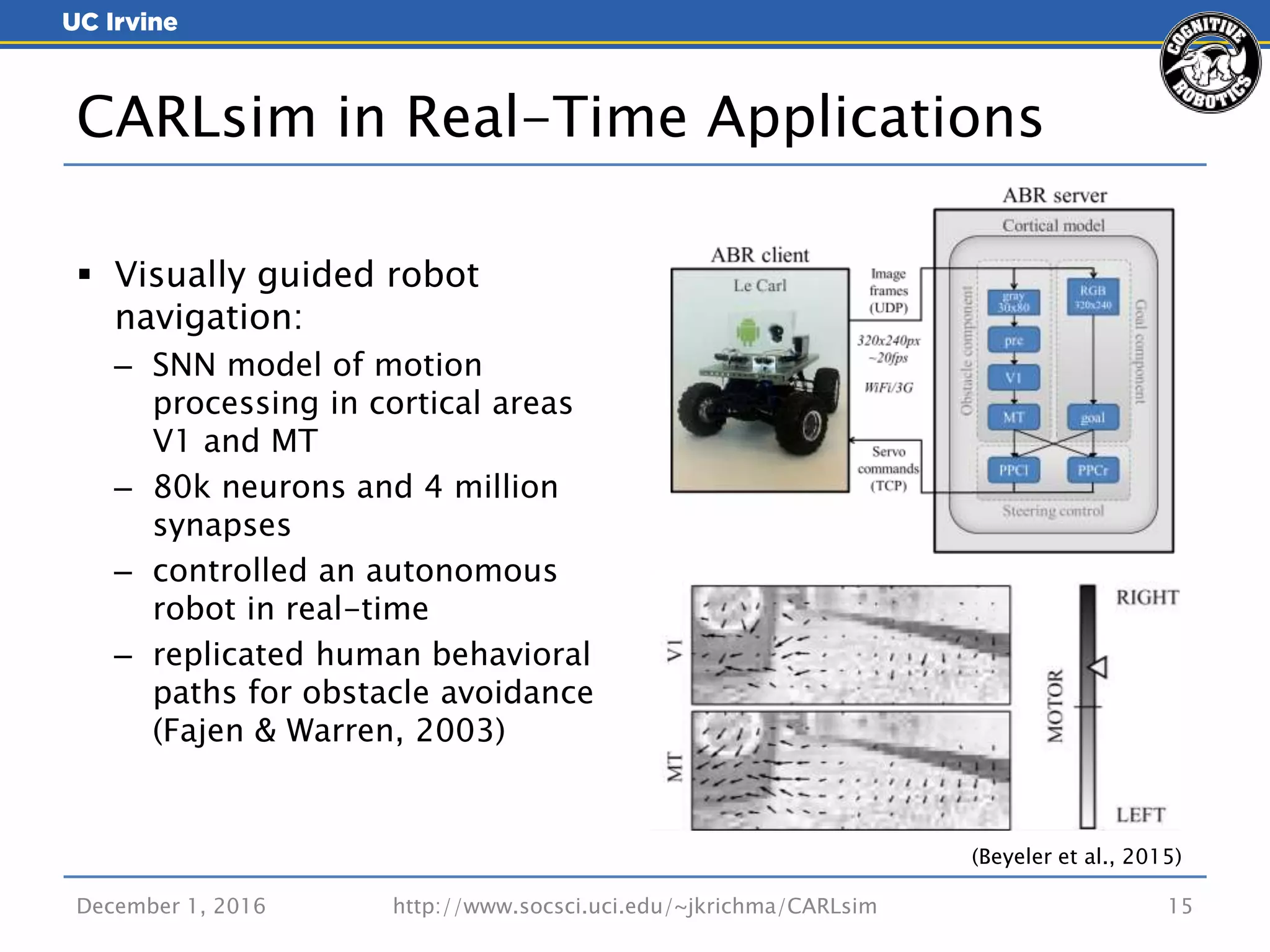
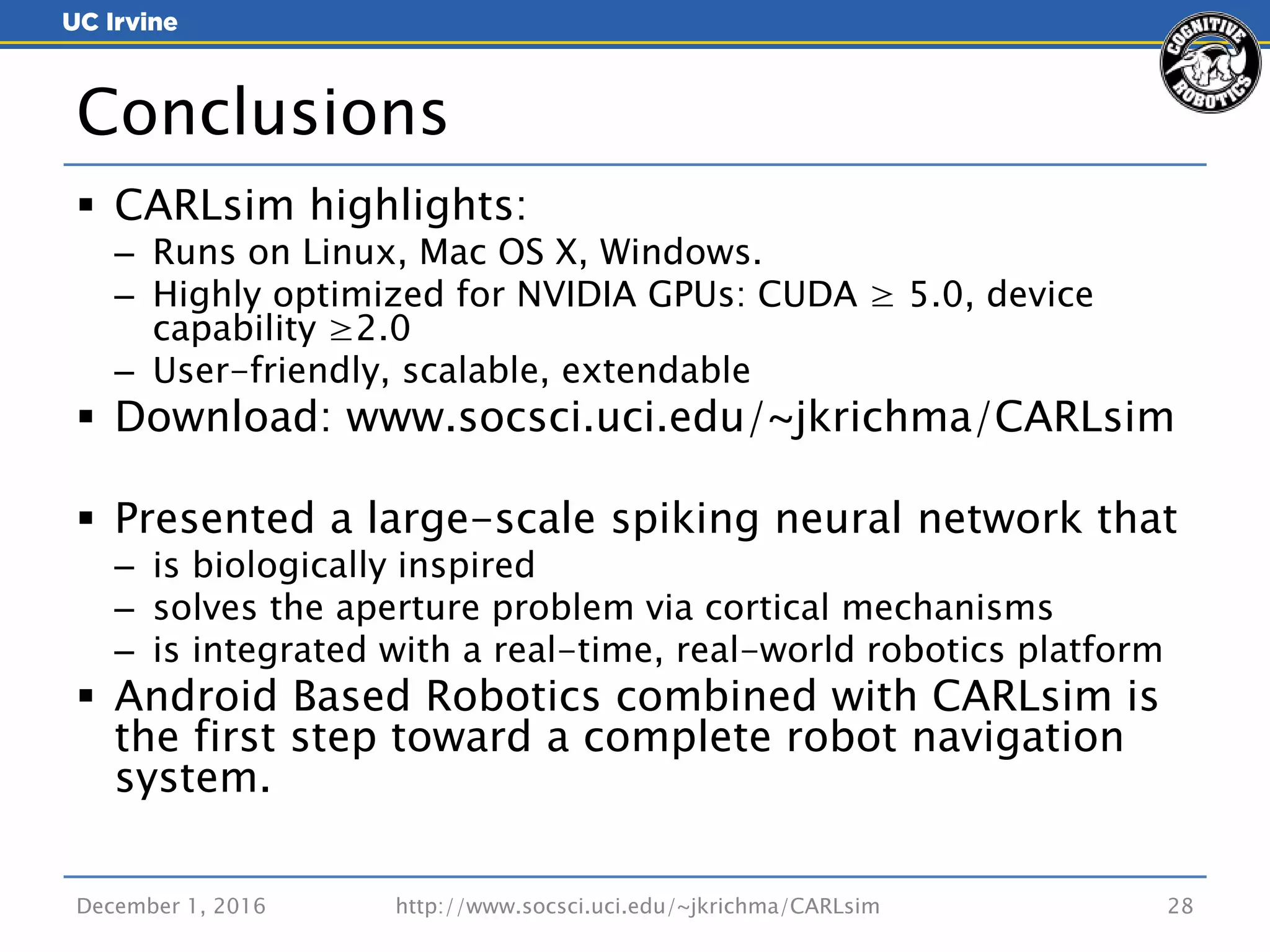
 Visually guided robot
navigation:
– SNN model of motion
processing in cortical areas
V1 and MT
– 80k neurons and 4 million
synapses
– controlled an autonomous
robot in real-time
– replicated human behavioral
paths for obstacle avoidance
(Fajen & Warren, 2003)
CARLsim in Real-Time Applications
(Beyeler et al., 2015)
http://www.socsci.uci.edu/~jkrichma/CARLsim
December 1, 2016 16
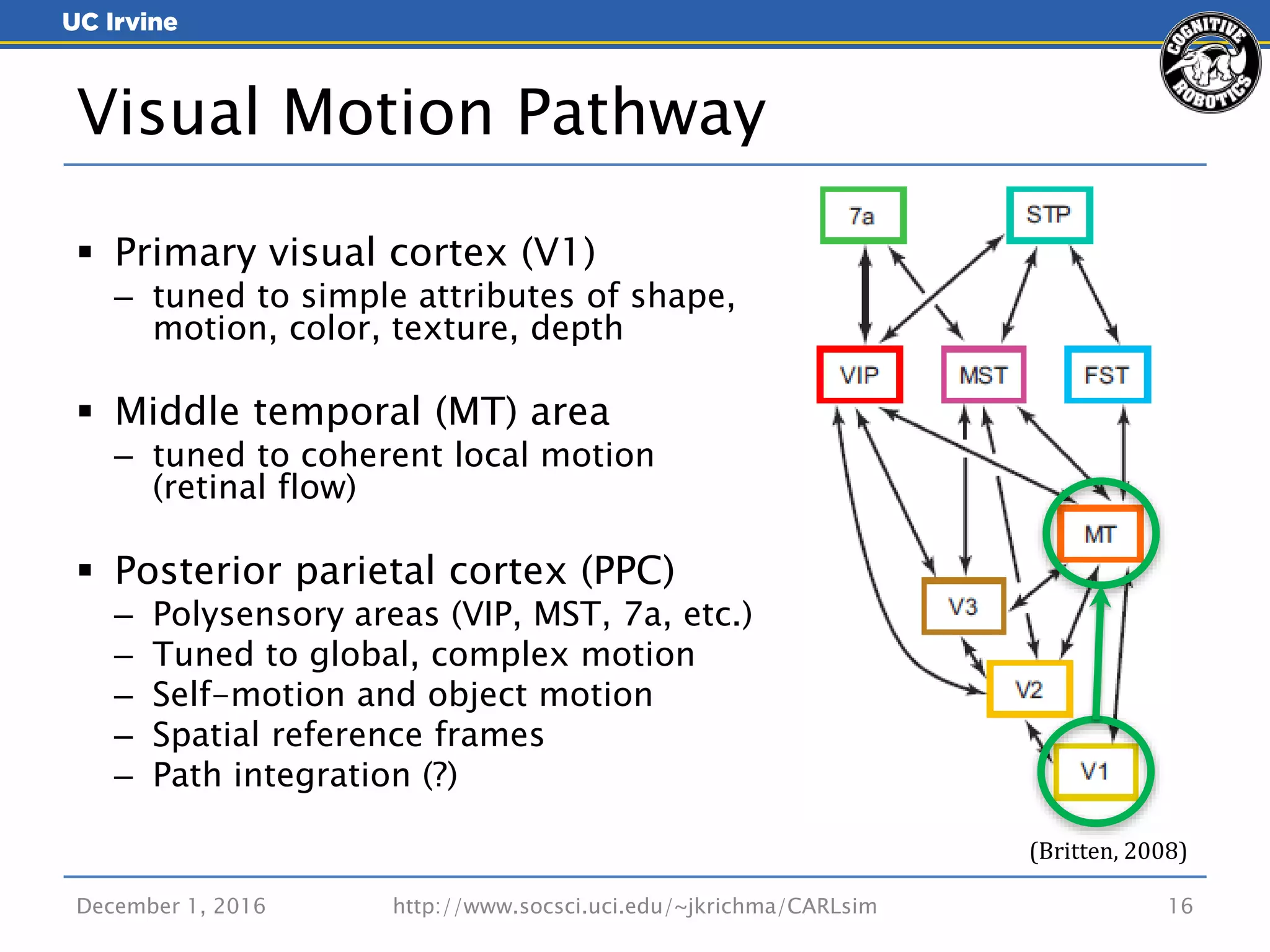
 Primary visual cortex (V1)
– tuned to simple attributes of shape,
motion, color, texture, depth
 Middle temporal (MT) area
– tuned to coherent local motion
(retinal flow)
 Posterior parietal cortex (PPC)
– Polysensory areas (VIP, MST, 7a, etc.)
– Tuned to global, complex motion
– Self-motion and object motion
– Spatial reference frames
– Path integration (?)
Visual Motion Pathway
(Britten, 2008)
http://www.socsci.uci.edu/~jkrichma/CARLsim
December 1, 2016 17
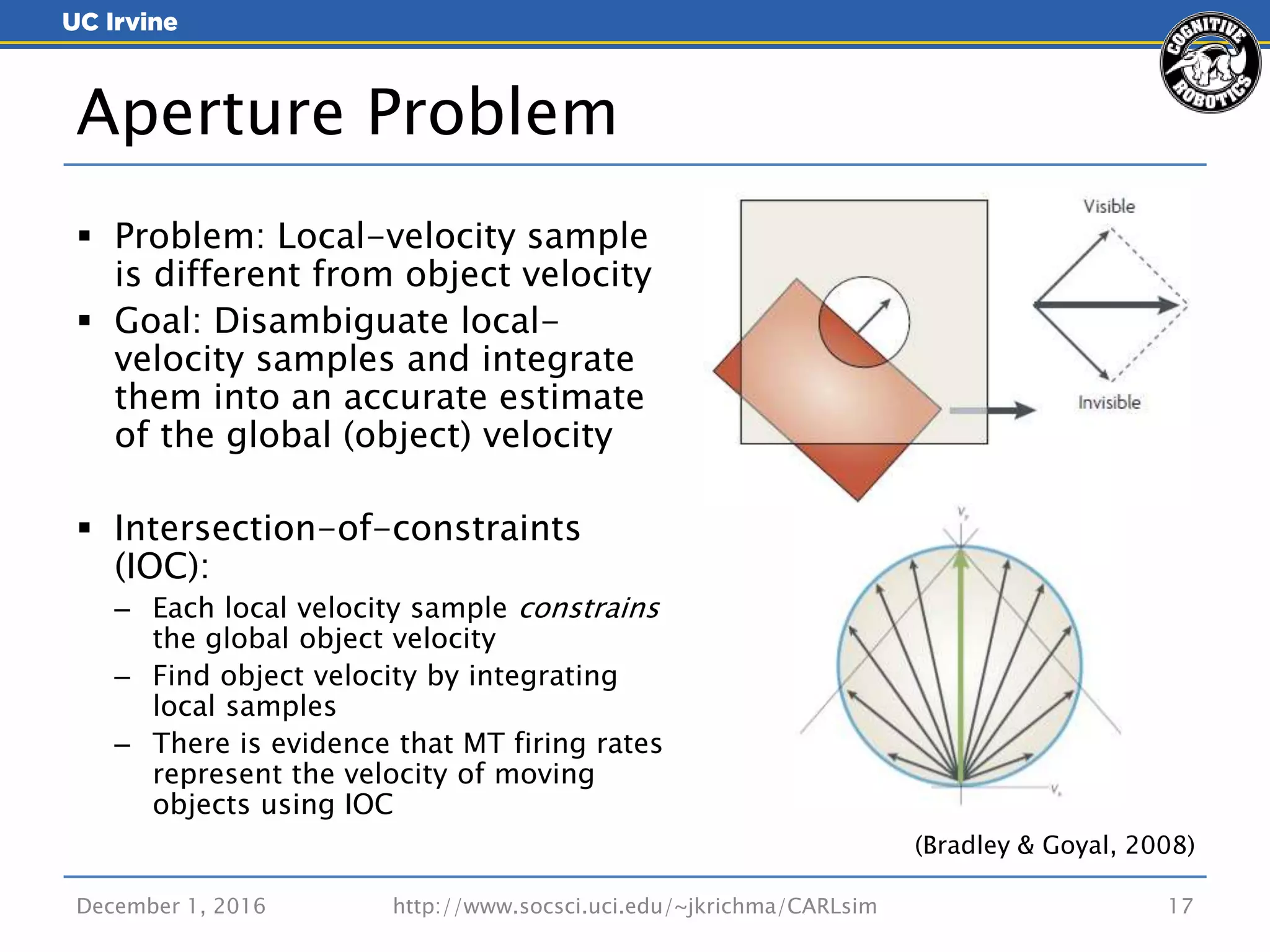
 Problem: Local-velocity sample
is different from object velocity
 Goal: Disambiguate local-
velocity samples and integrate
them into an accurate estimate
of the global (object) velocity
 Intersection-of-constraints
(IOC):
– Each local velocity sample constrains
the global object velocity
– Find object velocity by integrating
local samples
– There is evidence that MT firing rates
represent the velocity of moving
objects using IOC
Aperture Problem
(Bradley & Goyal, 2008)
http://www.socsci.uci.edu/~jkrichma/CARLsim
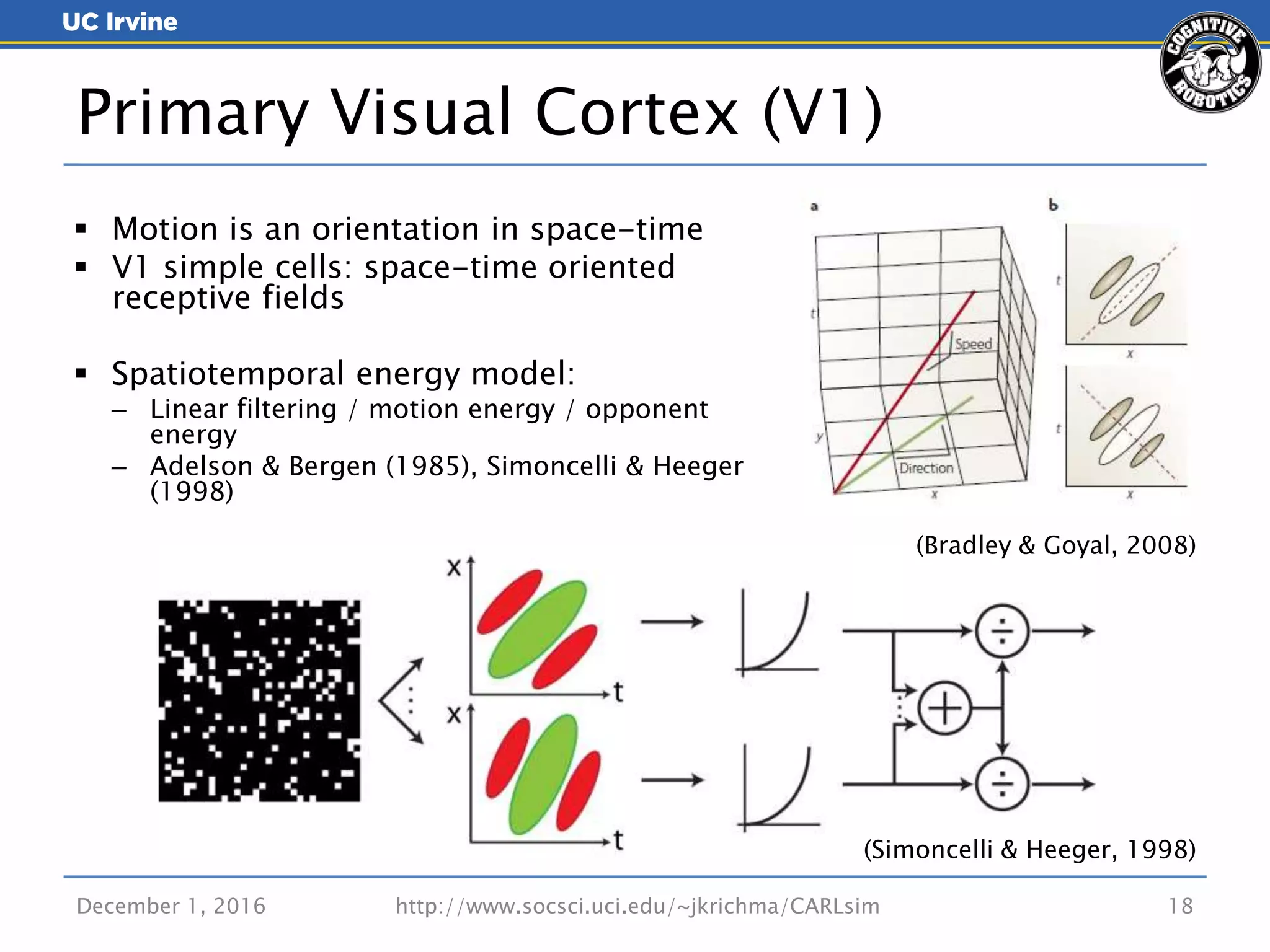
 Motion is an orientation in space-time
 V1 simple cells: space-time oriented
receptive fields
 Spatiotemporal energy model:
– Linear filtering / motion energy / opponent
energy
– Adelson & Bergen (1985), Simoncelli & Heeger
(1998)
December 1, 2016 18
Primary Visual Cortex (V1)
(Simoncelli & Heeger, 1998)
(Bradley & Goyal, 2008)
http://www.socsci.uci.edu/~jkrichma/CARLsim
December 1, 2016 19
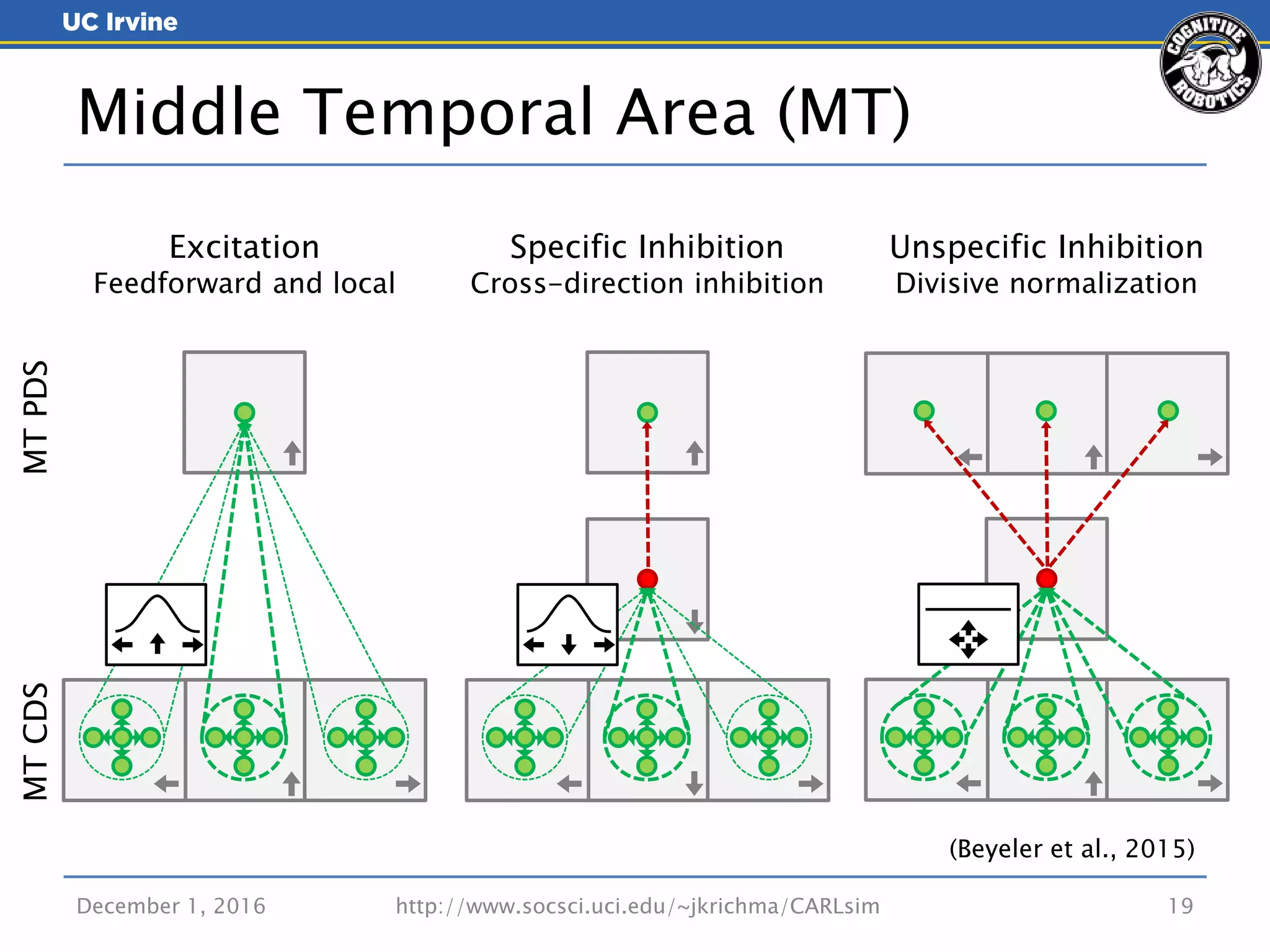
Middle Temporal Area (MT)
Excitation
Feedforward and local
Specific Inhibition
Cross-direction inhibition
Unspecific Inhibition
Divisive normalization
MTCDSMTPDS
http://www.socsci.uci.edu/~jkrichma/CARLsim
(Beyeler et al., 2015)
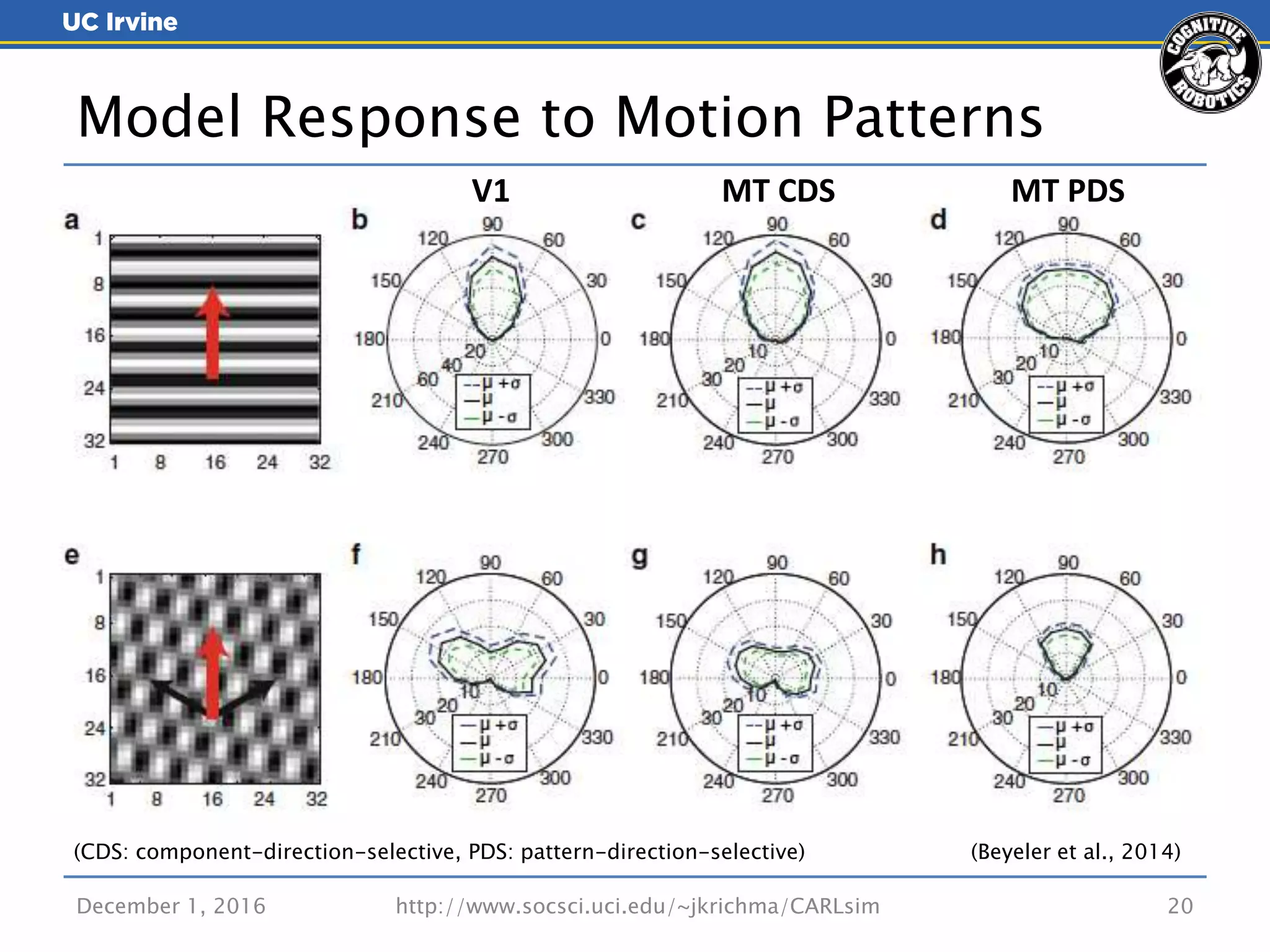
Model Response to Motion Patterns
V1 MT CDS MT PDS
(Beyeler et al., 2014)(CDS: component-direction-selective, PDS: pattern-direction-selective)
December 1, 2016 http://www.socsci.uci.edu/~jkrichma/CARLsim 20
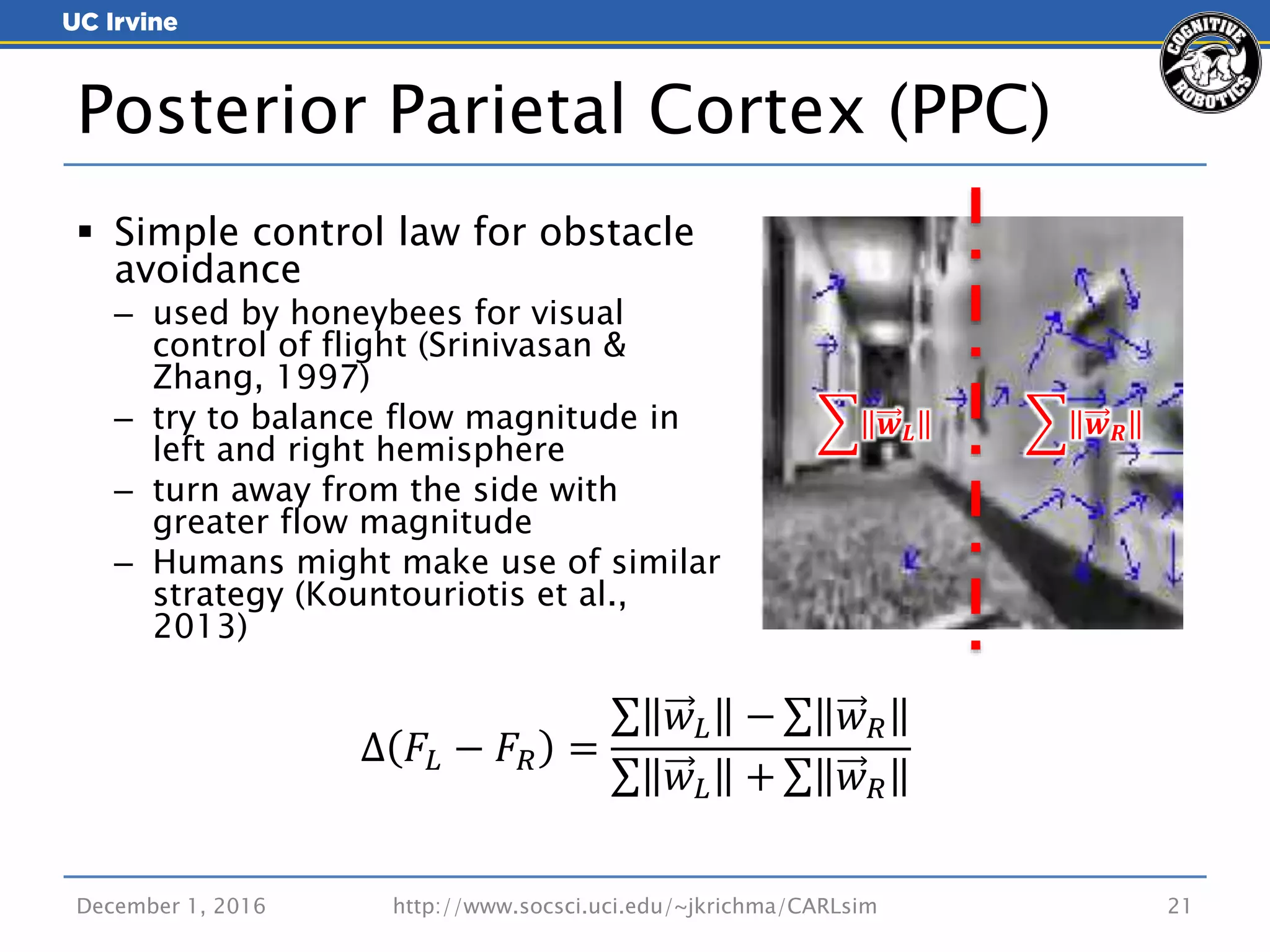
December 1, 2016 21
 Simple control law for obstacle
avoidance
– used by honeybees for visual
control of flight (Srinivasan &
Zhang, 1997)
– try to balance flow magnitude in
left and right hemisphere
– turn away from the side with
greater flow magnitude
– Humans might make use of similar
strategy (Kountouriotis et al.,
2013)
Posterior Parietal Cortex (PPC)
𝒘 𝑳 𝒘 𝑹
Δ 𝐹𝐿 − 𝐹𝑅 =
𝑤 𝐿 − 𝑤 𝑅
𝑤 𝐿 + 𝑤 𝑅
http://www.socsci.uci.edu/~jkrichma/CARLsim
Introducing Le Carl: The French Robot
December 1, 2016 22
Android Based Robotics
http://www.socsci.uci.edu/~jkrichma/CARLsim
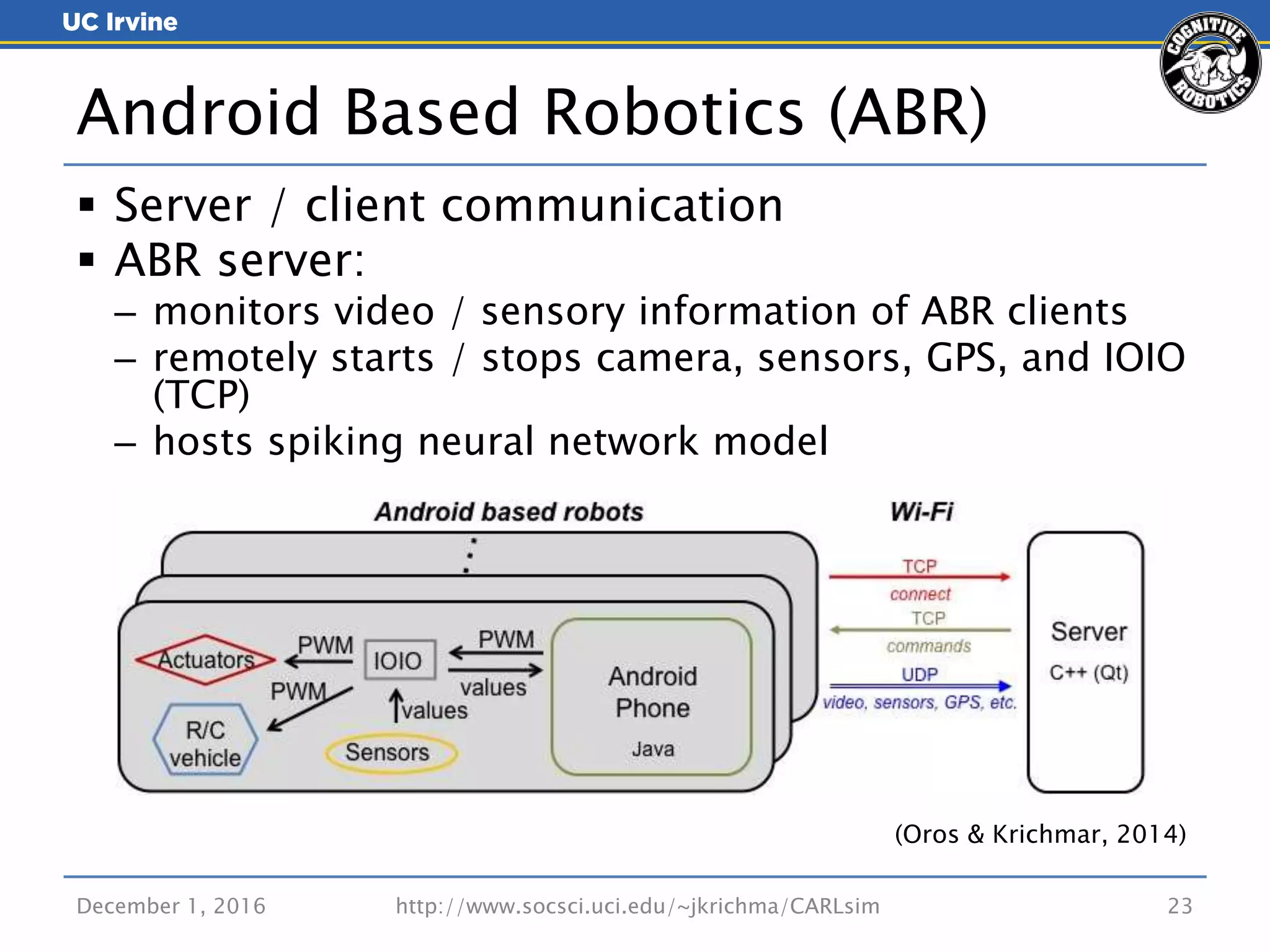
 Server / client communication
 ABR server:
– monitors video / sensory information of ABR clients
– remotely starts / stops camera, sensors, GPS, and IOIO
(TCP)
– hosts spiking neural network model
December 1, 2016 23
Android Based Robotics (ABR)
(Oros & Krichmar, 2014)
http://www.socsci.uci.edu/~jkrichma/CARLsim
December 1, 2016 24
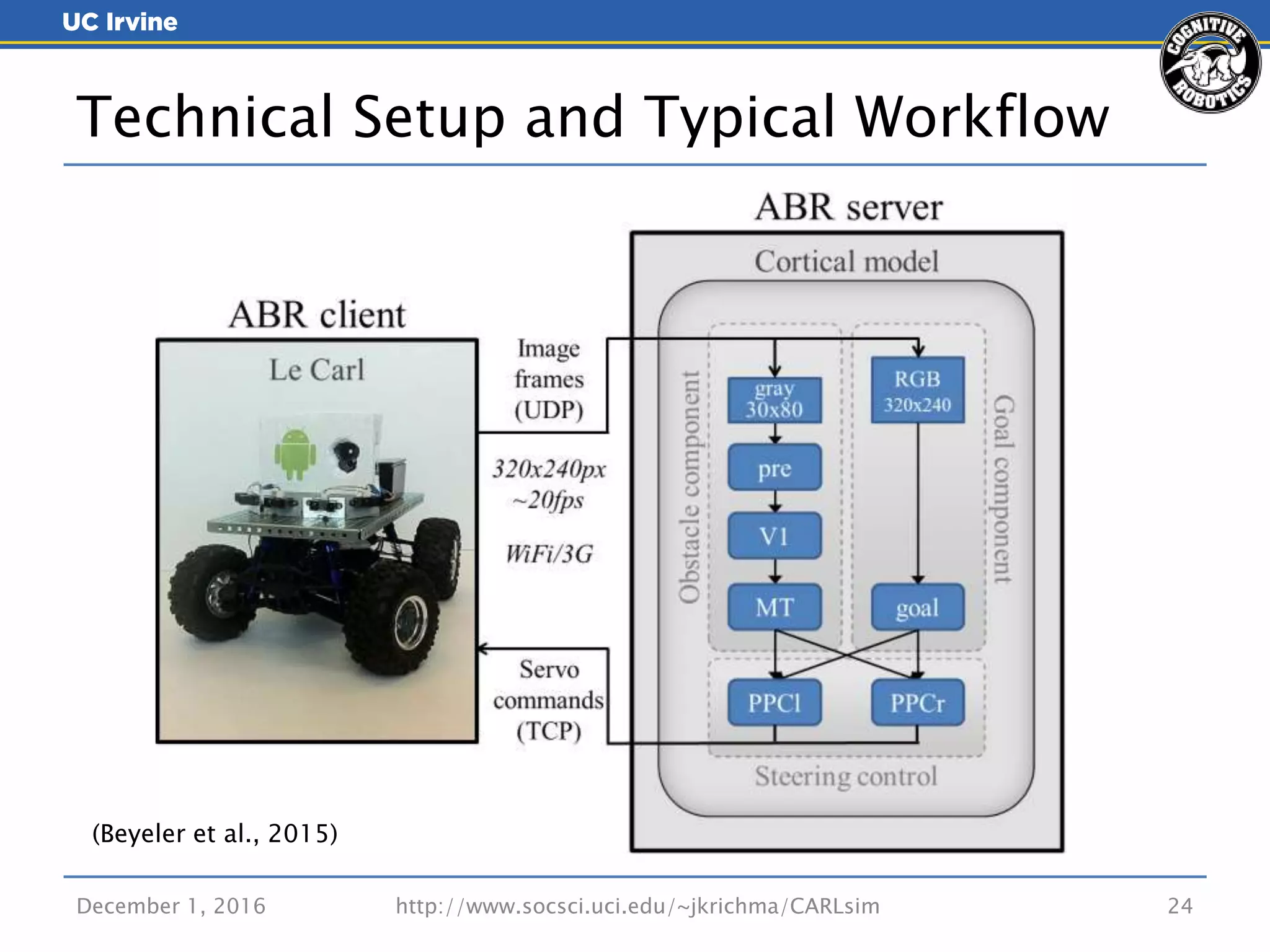
Technical Setup and Typical Workflow
(Beyeler et al., 2015)
http://www.socsci.uci.edu/~jkrichma/CARLsim
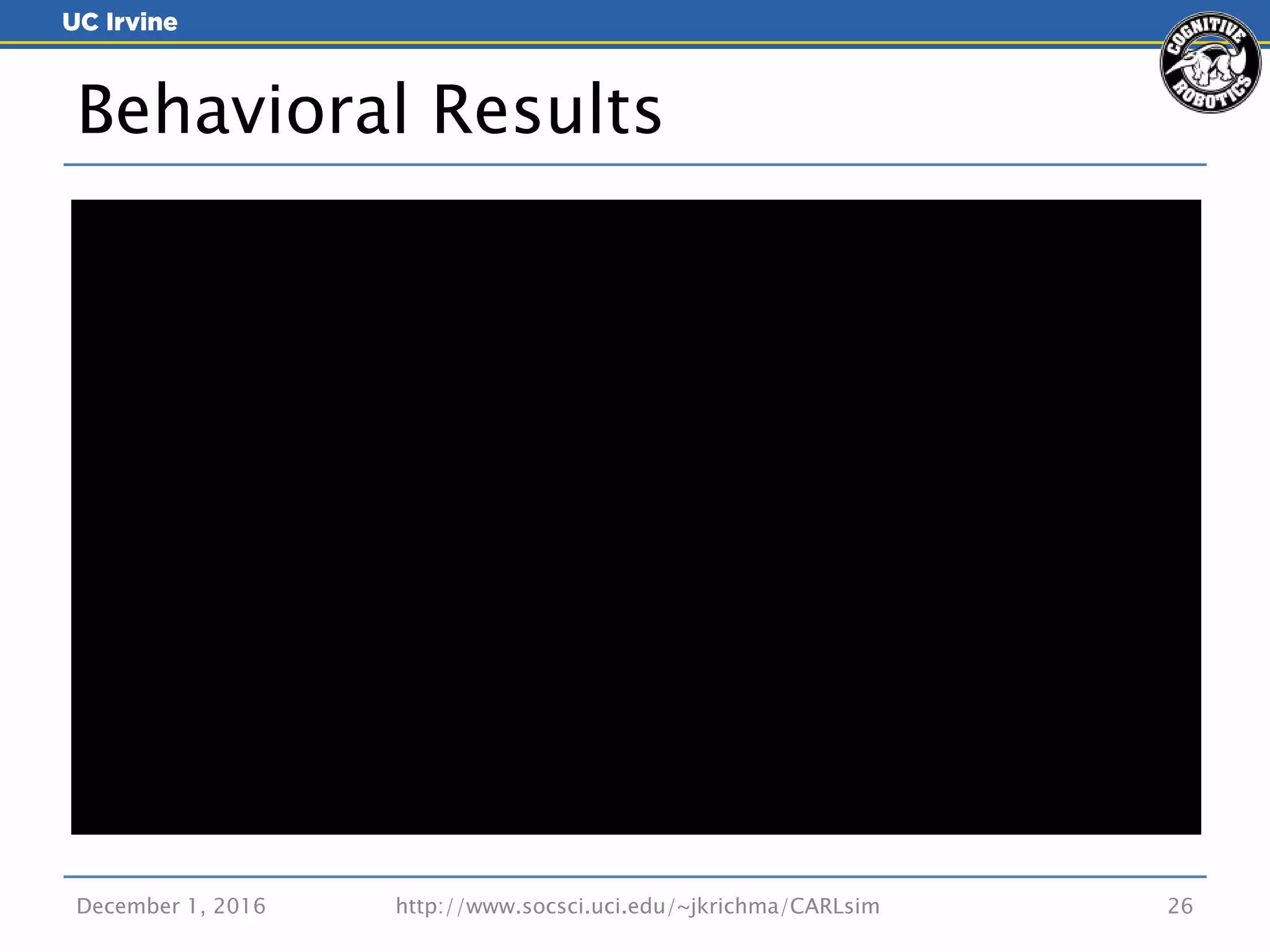
December 1, 2016 25
Simulated Neuronal Responses During Visual Navigation
(Beyeler et al., 2015)
http://www.socsci.uci.edu/~jkrichma/CARLsim
December 1, 2016 26
Behavioral Results
http://www.socsci.uci.edu/~jkrichma/CARLsim
Comparison to Psychophysical Data
December 1, 2016 http://www.socsci.uci.edu/~jkrichma/CARLsim 27
 CARLsim highlights:
– Runs on Linux, Mac OS X, Windows.
– Highly optimized for NVIDIA GPUs: CUDA ≥ 5.0, device
capability ≥2.0
– User-friendly, scalable, extendable
 Download: www.socsci.uci.edu/~jkrichma/CARLsim
 Presented a large-scale spiking neural network that
– is biologically inspired
– solves the aperture problem via cortical mechanisms
– is integrated with a real-time, real-world robotics platform
 Android Based Robotics combined with CARLsim is
the first step toward a complete robot navigation
system.
December 1, 2016 http://www.socsci.uci.edu/~jkrichma/CARLsim 28
Conclusions
December 1, 2016 http://www.socsci.uci.edu/~jkrichma/CARLsim 29
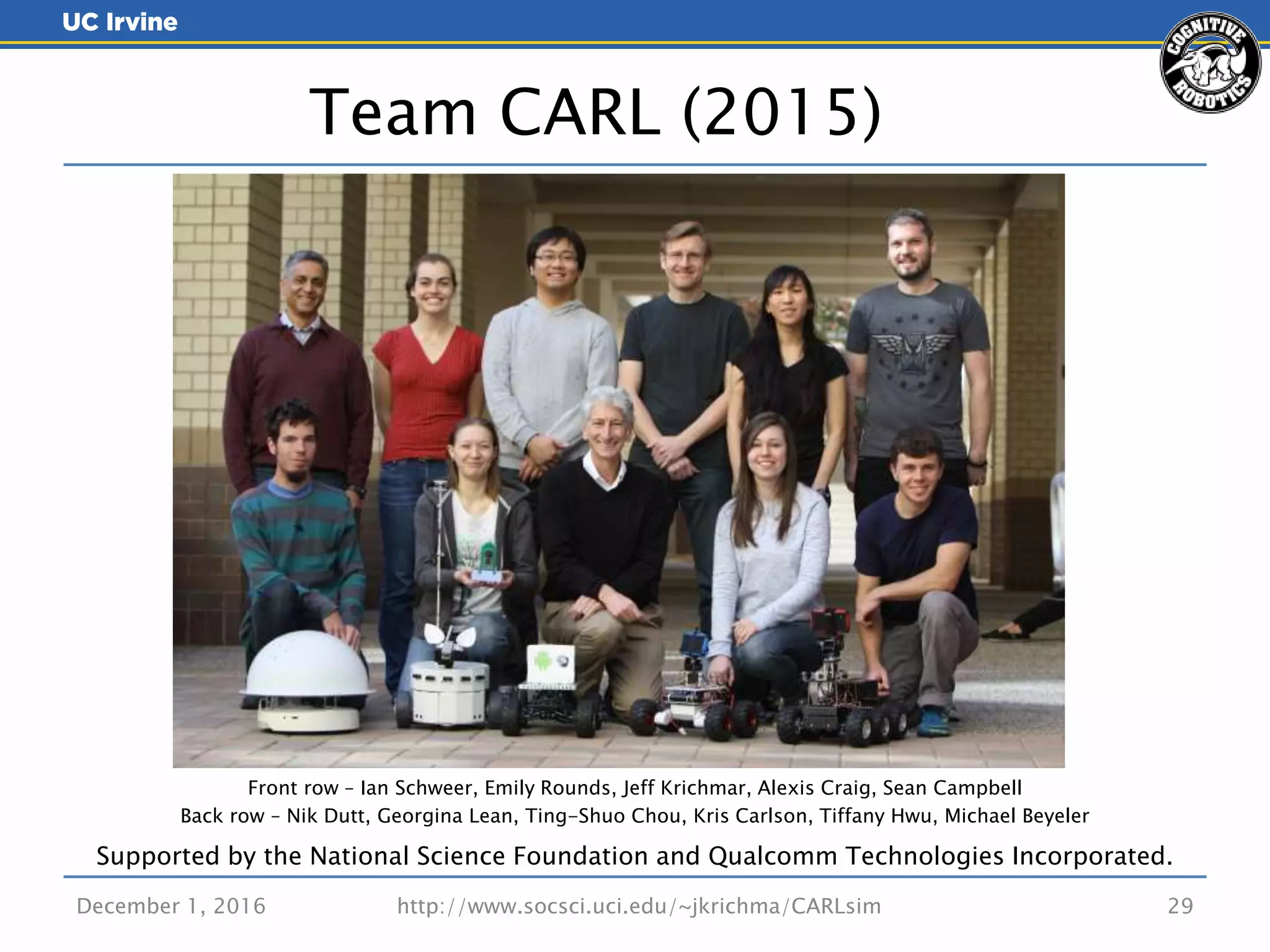
Team CARL (2015)
Front row – Ian Schweer, Emily Rounds, Jeff Krichmar, Alexis Craig, Sean Campbell
Back row – Nik Dutt, Georgina Lean, Ting-Shuo Chou, Kris Carlson, Tiffany Hwu, Michael Beyeler
Supported by the National Science Foundation and Qualcomm Technologies Incorporated.
December 1, 2016 http://www.socsci.uci.edu/~jkrichma/CARLsim 30

CARLsim 3: Concepts, Tools, and Applications

  • 1.
    Cognitive Anteater RoboticsLab (CARL) University of California, Irvine, CA, USA Michael Beyeler CARLsim 3 Concepts, Tools, and Applications
  • 2.
    December 1, 20162  Brain architecture =/= conventional computer architecture  Massive parallelism (1011 neurons)  Massive connectivity (1015 synapses)  Excellent power-efficiency – ~ 20W for 1016 flops  Probabilistic responses and fault- tolerant  Autonomous, on-line learning  Low-performance components (~100 Hz)  Low-speed comm. (~meters/sec)  Low-precision synaptic connections Brain Computations http://www.socsci.uci.edu/~jkrichma/CARLsim
  • 3.
    December 1, 2016http://www.socsci.uci.edu/~jkrichma/CARLsim 3  Spiking Neural Network (SNN) models describe key aspects of neural function and network dynamics – abstract away many molecular and cellular details – able to capture neuronal, synaptic, and network dynamics – can incorporate on-line learning that depends on millisecond time resolution  SNN models are composed of: – spiking point-neurons for computation • Izhikevich spiking neurons: 20 different neuron types – dynamic synapses for learning and memory storage • Synaptic receptors for AMPA, NMDA, and GABA – variable-delay axons for communication – neuromodulatory systems to control action selection and learning Spiking Neural Networks Izhikevich, 2003, 2004
  • 4.
    December 1, 2016http://www.socsci.uci.edu/~jkrichma/CARLsim 4 Constructing Functional SNN Models CARLsim 3 neural circuits: create tune/optimize explore Theoretical model Experimental data Functional application Theoretical neuroscience Real-time applications Neuromorphic engineering
  • 5.
     GPU-accelerated spikingneural network simulator  User-friendly, well documented. – Runs on Linux, Mac OS X, Windows systems with CUDA SDK.  Scalable, extendable.  PyNN-like interface.  Highly optimized for NVIDIA GPUs.  Capable of simulating biological detailed neural models.  Freely available at: – http://www.socsci.uci.edu/~jkrichma/CARLsim/ December 1, 2016 http://www.socsci.uci.edu/~jkrichma/CARLsim 5 CARLsim – in a Nutshell
  • 6.
     Provides aPyNN-like user interface  Lets you configure networks, apply input stimuli, and monitor network activity December 1, 2016 http://www.socsci.uci.edu/~jkrichma/CARLsim 6 CARLsim API
  • 7.
    December 1, 2016http://www.socsci.uci.edu/~jkrichma/CARLsim 7  Easily create complex network topographies: – Pre-defined connection types • “full”, “random”, “one-to-one”, “gaussian” – Custom connection types • arbitrary connectivity – 1D/2D/3D topography: Connectivity • Neurons organized on a grid • 1D/2D/3D receptive fields • arbitrary topographic connections
  • 8.
    December 1, 2016http://www.socsci.uci.edu/~jkrichma/CARLsim 8  Short-term plasticity (STP)  Homeostatic synaptic scaling  Spike-timing dependent plasticity (STDP)  Dopamine-modulated STDP Synaptic Plasticity
  • 9.
     Versatile toolboxfor the visualization and analysis of neuronal, synaptic, and network information.  Generates raster plots, histograms, heat maps, flow fields.  Plot, record, load, save. December 1, 2016 http://www.socsci.uci.edu/~jkrichma/CARLsim 9 MATLAB Offline Analysis Toolbox
  • 10.
    December 1, 2016http://www.socsci.uci.edu/~jkrichma/CARLsim 10  capable of quickly and efficiently tuning large-scale SNNs – arbitrary fitness function – multi-objective optimization  utilizes Evolutionary Computations in Java (ECJ)  fully integrated with CARLsim  transparent use of a GPU – up to 60x speedups compared to single-threaded CPU simulation  Emily will tell you all about it. Automated Parameter Tuning Interface
  • 11.
     Benchmark: 80-20network with E-STDP (Vogels & Abbott, 2005)  CPU: Intel Core i7 CPU 920 @ 2.67 GHz  GPU: NVIDIA GTX 780 (3 GB of GDDR5, 2304 CUDA cores) December 1, 2016 http://www.socsci.uci.edu/~jkrichma/CARLsim 11 Performance Benchmarks
  • 12.
     PyNN-like userinterface December 1, 2016 http://www.socsci.uci.edu/~jkrichma/CARLsim 12 CARLsim 3 Code Sample
  • 13.
    Neuron model Synapse model Synapticplasticity Input Tools Integration methods Front- ends Back-ends Platforms Leakyintegrate-and-fire(LIF) Izhikevich4-param Hodgkin-Huxley Current-bsaed(CUBA) Conductance-based(COBA) AMPA,NMDA,GABA Neuromodulation Short-termplasticity(STP) E-STDP I-STDP DA-STDP Synapticscaling/homeostasis Currentinjection Spikeinjection Parametertuning Analysisandvisualization Regressionsuite Forward/exponentialEuler Exactintegration Runge-Kutta Python/PyNN C/C++ Java Single-threaded Multi-threaded distributed SingleGPU Multi-GPU Linux MacOSX Windows CARLsim X X X X / X X X X X X X X X X X X X X / X X X Brian X X X X X X / X X X / X X X / / X X X X X X X X / X X X GeNN X X X X X / / X / X / X X X X X X X NCS X X X X X / X X X X / X X X X X X X X X NeMo X X / X X X X X X X X X X X X X X X X Nengo X X X X X X X X / X X X X X X X X X X X X X X NEST X X X X X X / X X X X X X X X X X X X X X X X PCSIM X X X X X X / X X X X X X / X X X / X X X X X X / December 1, 2016 http://www.socsci.uci.edu/~jkrichma/CARLsim 13 Comparison of SNN Simulators
  • 14.
     Visual CorticalProcessing – M. Beyeler, N. Oros, N. Dutt, and J.L. Krichmar (2015). A GPU-accelerated cortical neural network model for visually guided robot navigation. Neural Networks (in press). – M. Beyeler, M. Richert, N.D. Dutt, and J.L. Krichmar (2014). Efficient spiking neural network model of pattern motion selectivity in visual cortex. Neuroinformatics 12, 435-454. – M. Richert, J.M. Nageswaran, N. Dutt, and J.L. Krichmar (2011). An efficient simulation environment for modeling large-scale cortical processing. Frontiers in Neuroinformatics 5.  Tactile Sensory Processing – L.D. Bucci, T.S. Chou, and J.L. Krichmar (2014). Tactile Sensory Decoding in a Neuromorphic Interactive Robot. IEEE Conference on Robotics & Automation (ICRA).  Neuromodulation, Attention, and Working Memory – M.C. Avery, N. Dutt, and J.L. Krichmar (2014). Mechanisms underlying the basal forebrain enhancement of top-down and bottom-up attention. European Journal of Neuroscience 39. – M. Avery, N. Dutt, and J.L. Krichmar (2013). A large-scale neural network model of the influence of neuromodulatory levels on working memory and behavior. Frontiers in Computational Neuroscience.  Object Categorization and Plasticity – M. Beyeler, N.D. Dutt, and J.L. Krichmar (2013). Categorization and decision-making in a neurobiologically plausible spiking network using a STDP-like learning rule. Neural Networks 48. – K.D. Carlson, M. Richert, N. Dutt, and J.L. Krichmar (2013). Biologically Plausible Models of Homeostasis and STDP: Stability and Learning in Spiking Neural Networks. Paper presented at: International Joint Conference on Neural Networks December 1, 2016 http://www.socsci.uci.edu/~jkrichma/CARLsim 14 Recent CARLsim Models
  • 15.
    December 1, 201615  Visually guided robot navigation: – SNN model of motion processing in cortical areas V1 and MT – 80k neurons and 4 million synapses – controlled an autonomous robot in real-time – replicated human behavioral paths for obstacle avoidance (Fajen & Warren, 2003) CARLsim in Real-Time Applications (Beyeler et al., 2015) http://www.socsci.uci.edu/~jkrichma/CARLsim
  • 16.
    December 1, 201616  Primary visual cortex (V1) – tuned to simple attributes of shape, motion, color, texture, depth  Middle temporal (MT) area – tuned to coherent local motion (retinal flow)  Posterior parietal cortex (PPC) – Polysensory areas (VIP, MST, 7a, etc.) – Tuned to global, complex motion – Self-motion and object motion – Spatial reference frames – Path integration (?) Visual Motion Pathway (Britten, 2008) http://www.socsci.uci.edu/~jkrichma/CARLsim
  • 17.
    December 1, 201617  Problem: Local-velocity sample is different from object velocity  Goal: Disambiguate local- velocity samples and integrate them into an accurate estimate of the global (object) velocity  Intersection-of-constraints (IOC): – Each local velocity sample constrains the global object velocity – Find object velocity by integrating local samples – There is evidence that MT firing rates represent the velocity of moving objects using IOC Aperture Problem (Bradley & Goyal, 2008) http://www.socsci.uci.edu/~jkrichma/CARLsim
  • 18.
     Motion isan orientation in space-time  V1 simple cells: space-time oriented receptive fields  Spatiotemporal energy model: – Linear filtering / motion energy / opponent energy – Adelson & Bergen (1985), Simoncelli & Heeger (1998) December 1, 2016 18 Primary Visual Cortex (V1) (Simoncelli & Heeger, 1998) (Bradley & Goyal, 2008) http://www.socsci.uci.edu/~jkrichma/CARLsim
  • 19.
    December 1, 201619 Middle Temporal Area (MT) Excitation Feedforward and local Specific Inhibition Cross-direction inhibition Unspecific Inhibition Divisive normalization MTCDSMTPDS http://www.socsci.uci.edu/~jkrichma/CARLsim (Beyeler et al., 2015)
  • 20.
    Model Response toMotion Patterns V1 MT CDS MT PDS (Beyeler et al., 2014)(CDS: component-direction-selective, PDS: pattern-direction-selective) December 1, 2016 http://www.socsci.uci.edu/~jkrichma/CARLsim 20
  • 21.
    December 1, 201621  Simple control law for obstacle avoidance – used by honeybees for visual control of flight (Srinivasan & Zhang, 1997) – try to balance flow magnitude in left and right hemisphere – turn away from the side with greater flow magnitude – Humans might make use of similar strategy (Kountouriotis et al., 2013) Posterior Parietal Cortex (PPC) 𝒘 𝑳 𝒘 𝑹 Δ 𝐹𝐿 − 𝐹𝑅 = 𝑤 𝐿 − 𝑤 𝑅 𝑤 𝐿 + 𝑤 𝑅 http://www.socsci.uci.edu/~jkrichma/CARLsim
  • 22.
    Introducing Le Carl:The French Robot December 1, 2016 22 Android Based Robotics http://www.socsci.uci.edu/~jkrichma/CARLsim
  • 23.
     Server /client communication  ABR server: – monitors video / sensory information of ABR clients – remotely starts / stops camera, sensors, GPS, and IOIO (TCP) – hosts spiking neural network model December 1, 2016 23 Android Based Robotics (ABR) (Oros & Krichmar, 2014) http://www.socsci.uci.edu/~jkrichma/CARLsim
  • 24.
    December 1, 201624 Technical Setup and Typical Workflow (Beyeler et al., 2015) http://www.socsci.uci.edu/~jkrichma/CARLsim
  • 25.
    December 1, 201625 Simulated Neuronal Responses During Visual Navigation (Beyeler et al., 2015) http://www.socsci.uci.edu/~jkrichma/CARLsim
  • 26.
    December 1, 201626 Behavioral Results http://www.socsci.uci.edu/~jkrichma/CARLsim
  • 27.
    Comparison to PsychophysicalData December 1, 2016 http://www.socsci.uci.edu/~jkrichma/CARLsim 27
  • 28.
     CARLsim highlights: –Runs on Linux, Mac OS X, Windows. – Highly optimized for NVIDIA GPUs: CUDA ≥ 5.0, device capability ≥2.0 – User-friendly, scalable, extendable  Download: www.socsci.uci.edu/~jkrichma/CARLsim  Presented a large-scale spiking neural network that – is biologically inspired – solves the aperture problem via cortical mechanisms – is integrated with a real-time, real-world robotics platform  Android Based Robotics combined with CARLsim is the first step toward a complete robot navigation system. December 1, 2016 http://www.socsci.uci.edu/~jkrichma/CARLsim 28 Conclusions
  • 29.
    December 1, 2016http://www.socsci.uci.edu/~jkrichma/CARLsim 29 Team CARL (2015) Front row – Ian Schweer, Emily Rounds, Jeff Krichmar, Alexis Craig, Sean Campbell Back row – Nik Dutt, Georgina Lean, Ting-Shuo Chou, Kris Carlson, Tiffany Hwu, Michael Beyeler Supported by the National Science Foundation and Qualcomm Technologies Incorporated.
  • 30.
    December 1, 2016http://www.socsci.uci.edu/~jkrichma/CARLsim 30

Editor's Notes

  • #3 Maybe mention efficiency of IBM chip as well ().
  • #5 stop to think about what people are looking for in a simulator: needs to fit your purposes. neuron model, connectivity, plasticity, visualization, tuning.
  • #15 The bottom left video was not run in real time.