Energy and Environment

       Dr. Bradford
Overshooting Carrying Capacity
• The Problem: We want more
   energy than we have (or can easily
   get).
• Solution: Get More or Use Less?
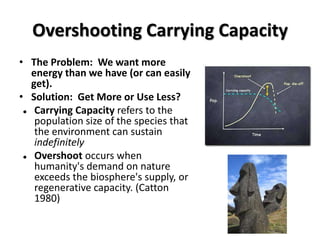
   Carrying Capacity refers to the
    population size of the species that
    the environment can sustain
    indefinitely
   Overshoot occurs when
    humanity's demand on nature
    exceeds the biosphere's supply, or
    regenerative capacity. (Catton
    1980)
Exponential Growth

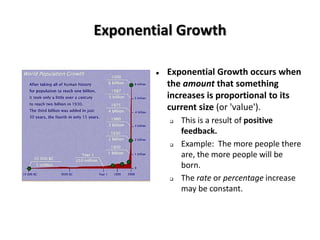
           Exponential Growth occurs when
            the amount that something
            increases is proportional to its
            current size (or 'value').
               This is a result of positive
                feedback.
               Example: The more people there
                are, the more people will be
                born.
               The rate or percentage increase
                may be constant.
Exponential Growth

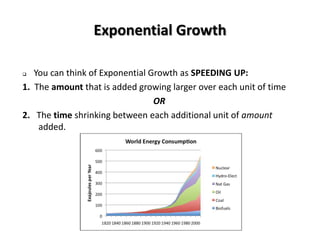
  You can think of Exponential Growth as SPEEDING UP:
1. The amount that is added growing larger over each unit of time
                                 OR
2. The time shrinking between each additional unit of amount
    added.
What is Peak Oil?
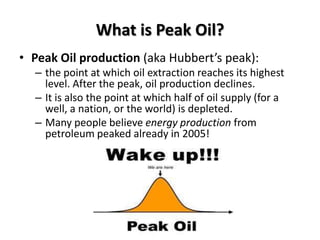
• Peak Oil production (aka Hubbert’s peak):
  – the point at which oil extraction reaches its highest
    level. After the peak, oil production declines.
  – It is also the point at which half of oil supply (for a
    well, a nation, or the world) is depleted.
  – Many people believe energy production from
    petroleum peaked already in 2005!
Facts about Oil
   Oil contributes to about 40 percent of energy production
    and supplies 90 percent of all transportation fuel (Korowicz
    2010).
   A barrel of oil, which can be extracted for a dollar, generates
    25,000 hours of labor. $1 = 25,000 hours of labor.
   1 calorie of food requires about 10 calories of hydrocarbon
    energy in the US today.
Facts about Oil
   Up until the 1950s, the United States was the “Saudi Arabia of
    oil”- it was world’s largest exporter. US
    production, however, peaked in 1970 at 10.2 million barrels a
    day and subsequently declined.
   Ten years later, domestic oil production was still in
    decline, despite the fact that four times more oil wells had
    been drilled.
   Currently the United States uses 25 percent of the world’s oil
    but possesses only 2 percent of the world’s known reserves
What is Peak Oil?
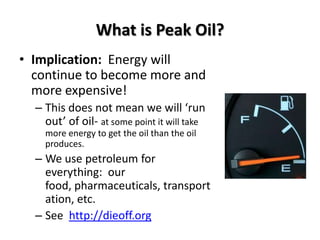
• Implication: Energy will
  continue to become more and
  more expensive!
  – This does not mean we will ‘run
    out’ of oil- at some point it will take
    more energy to get the oil than the oil
    produces.
  – We use petroleum for
    everything: our
    food, pharmaceuticals, transport
    ation, etc.
  – See http://dieoff.org
‘Peak Oil’ Facts
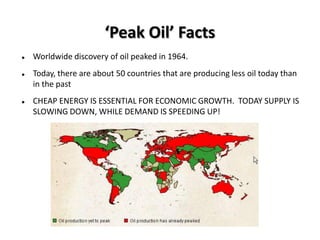
   Worldwide discovery of oil peaked in 1964.
   Today, there are about 50 countries that are producing less oil today than
    in the past
   CHEAP ENERGY IS ESSENTIAL FOR ECONOMIC GROWTH. TODAY SUPPLY IS
    SLOWING DOWN, WHILE DEMAND IS SPEEDING UP!
Peak Coal
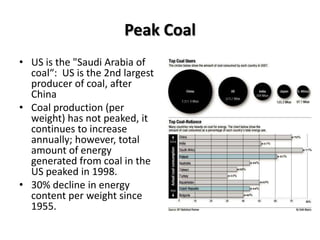
• US is the "Saudi Arabia of
  coal“: US is the 2nd largest
  producer of coal, after
  China
• Coal production (per
  weight) has not peaked, it
  continues to increase
  annually; however, total
  amount of energy
  generated from coal in the
  US peaked in 1998.
• 30% decline in energy
  content per weight since
  1955.
‘Drill Baby Drill’?
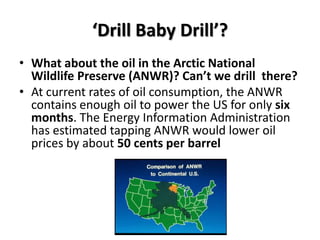
• What about the oil in the Arctic National
  Wildlife Preserve (ANWR)? Can’t we drill there?
• At current rates of oil consumption, the ANWR
  contains enough oil to power the US for only six
  months. The Energy Information Administration
  has estimated tapping ANWR would lower oil
  prices by about 50 cents per barrel
Peak Uranium
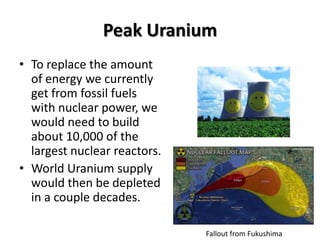
• To replace the amount
  of energy we currently
  get from fossil fuels
  with nuclear power, we
  would need to build
  about 10,000 of the
  largest nuclear reactors.
• World Uranium supply
  would then be depleted
  in a couple decades.

                              Fallout from Fukushima
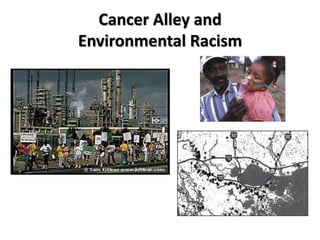
Cancer Alley and
Environmental Racism
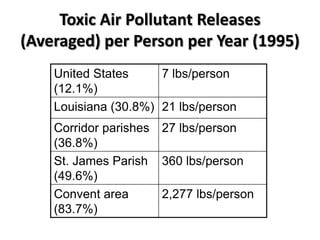
Toxic Air Pollutant Releases
(Averaged) per Person per Year (1995)
    United States     7 lbs/person
    (12.1%)
    Louisiana (30.8%) 21 lbs/person
    Corridor parishes   27 lbs/person
    (36.8%)
    St. James Parish    360 lbs/person
    (49.6%)
    Convent area        2,277 lbs/person
    (83.7%)
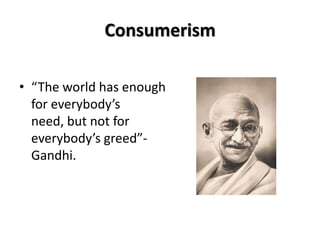
Consumerism

• “The world has enough
  for everybody’s
  need, but not for
  everybody’s greed”-
  Gandhi.
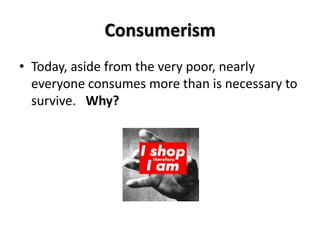
Consumerism
• Today, aside from the very poor, nearly
  everyone consumes more than is necessary to
  survive. Why?
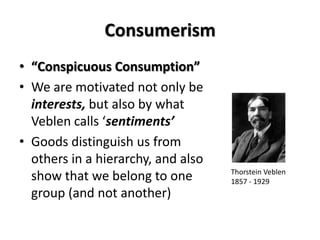
Consumerism
• “Conspicuous Consumption”
• We are motivated not only be
  interests, but also by what
  Veblen calls ‘sentiments’
• Goods distinguish us from
  others in a hierarchy, and also
                                    Thorstein Veblen
  show that we belong to one        1857 - 1929
  group (and not another)
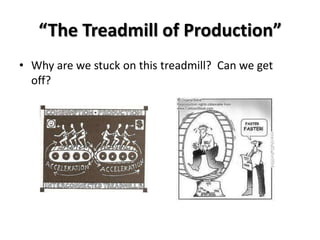
“The Treadmill of Production”
• Why are we stuck on this treadmill? Can we get
  off?
Treadmill of production
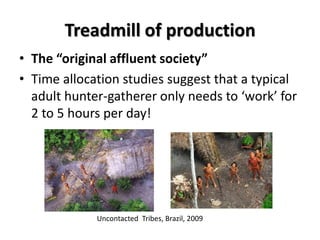
• The “original affluent society”
• Time allocation studies suggest that a typical
  adult hunter-gatherer only needs to ‘work’ for
  2 to 5 hours per day!


             Uncontacted Tribes, Brazil, 2009
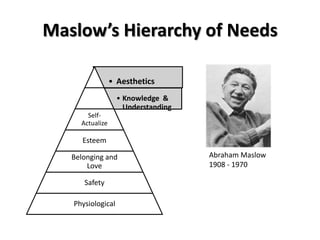
Maslow’s Hierarchy of Needs

                 • Aesthetics
                   • Knowledge &
                     Understanding
       Self-
     Actualize

      Esteem

   Belonging and                     Abraham Maslow
       Love                          1908 - 1970

      Safety

   Physiological

Bradford mvsu fall 2012 environment

  • 1.
  • 2.
    Overshooting Carrying Capacity •The Problem: We want more energy than we have (or can easily get). • Solution: Get More or Use Less?  Carrying Capacity refers to the population size of the species that the environment can sustain indefinitely  Overshoot occurs when humanity's demand on nature exceeds the biosphere's supply, or regenerative capacity. (Catton 1980)
  • 3.
    Exponential Growth  Exponential Growth occurs when the amount that something increases is proportional to its current size (or 'value').  This is a result of positive feedback.  Example: The more people there are, the more people will be born.  The rate or percentage increase may be constant.
  • 4.
    Exponential Growth  You can think of Exponential Growth as SPEEDING UP: 1. The amount that is added growing larger over each unit of time OR 2. The time shrinking between each additional unit of amount added.
  • 5.
    What is PeakOil? • Peak Oil production (aka Hubbert’s peak): – the point at which oil extraction reaches its highest level. After the peak, oil production declines. – It is also the point at which half of oil supply (for a well, a nation, or the world) is depleted. – Many people believe energy production from petroleum peaked already in 2005!
  • 6.
    Facts about Oil  Oil contributes to about 40 percent of energy production and supplies 90 percent of all transportation fuel (Korowicz 2010).  A barrel of oil, which can be extracted for a dollar, generates 25,000 hours of labor. $1 = 25,000 hours of labor.  1 calorie of food requires about 10 calories of hydrocarbon energy in the US today.
  • 7.
    Facts about Oil  Up until the 1950s, the United States was the “Saudi Arabia of oil”- it was world’s largest exporter. US production, however, peaked in 1970 at 10.2 million barrels a day and subsequently declined.  Ten years later, domestic oil production was still in decline, despite the fact that four times more oil wells had been drilled.  Currently the United States uses 25 percent of the world’s oil but possesses only 2 percent of the world’s known reserves
  • 8.
    What is PeakOil? • Implication: Energy will continue to become more and more expensive! – This does not mean we will ‘run out’ of oil- at some point it will take more energy to get the oil than the oil produces. – We use petroleum for everything: our food, pharmaceuticals, transport ation, etc. – See http://dieoff.org
  • 9.
    ‘Peak Oil’ Facts  Worldwide discovery of oil peaked in 1964.  Today, there are about 50 countries that are producing less oil today than in the past  CHEAP ENERGY IS ESSENTIAL FOR ECONOMIC GROWTH. TODAY SUPPLY IS SLOWING DOWN, WHILE DEMAND IS SPEEDING UP!
  • 10.
    Peak Coal • USis the "Saudi Arabia of coal“: US is the 2nd largest producer of coal, after China • Coal production (per weight) has not peaked, it continues to increase annually; however, total amount of energy generated from coal in the US peaked in 1998. • 30% decline in energy content per weight since 1955.
  • 11.
    ‘Drill Baby Drill’? •What about the oil in the Arctic National Wildlife Preserve (ANWR)? Can’t we drill there? • At current rates of oil consumption, the ANWR contains enough oil to power the US for only six months. The Energy Information Administration has estimated tapping ANWR would lower oil prices by about 50 cents per barrel
  • 12.
    Peak Uranium • Toreplace the amount of energy we currently get from fossil fuels with nuclear power, we would need to build about 10,000 of the largest nuclear reactors. • World Uranium supply would then be depleted in a couple decades. Fallout from Fukushima
  • 13.
  • 14.
    Toxic Air PollutantReleases (Averaged) per Person per Year (1995) United States 7 lbs/person (12.1%) Louisiana (30.8%) 21 lbs/person Corridor parishes 27 lbs/person (36.8%) St. James Parish 360 lbs/person (49.6%) Convent area 2,277 lbs/person (83.7%)
  • 15.
    Consumerism • “The worldhas enough for everybody’s need, but not for everybody’s greed”- Gandhi.
  • 16.
    Consumerism • Today, asidefrom the very poor, nearly everyone consumes more than is necessary to survive. Why?
  • 17.
    Consumerism • “Conspicuous Consumption” •We are motivated not only be interests, but also by what Veblen calls ‘sentiments’ • Goods distinguish us from others in a hierarchy, and also Thorstein Veblen show that we belong to one 1857 - 1929 group (and not another)
  • 18.
    “The Treadmill ofProduction” • Why are we stuck on this treadmill? Can we get off?
  • 19.
    Treadmill of production •The “original affluent society” • Time allocation studies suggest that a typical adult hunter-gatherer only needs to ‘work’ for 2 to 5 hours per day! Uncontacted Tribes, Brazil, 2009
  • 20.
    Maslow’s Hierarchy ofNeeds • Aesthetics • Knowledge & Understanding Self- Actualize Esteem Belonging and Abraham Maslow Love 1908 - 1970 Safety Physiological