Peak Oil and its implications for Planning and the Economy Southern New England  APA Conference  Providence, Rhode Island  October 21, 2011
“ Anybody who believes exponential growth can go on forever in a finite world is either a madman or an economist.” – Kenneth Boulding “ All truth passes through three stages. First, it is ridiculed. Second, it is violently opposed. Third, it is accepted as being self-evident.” – Arthur Schopenhauer  “ The greatest shortcoming of the human race is our inability to understand the exponential function.”  – Albert Bartlett  Quotes for the post peak oil world
Why  oil and natural  gas are so important  to our way of life Basic facts and trends   of oil depletion  When  world oil production  might peak Implications  for economic growth,  planning and development   Topics
Peak Oil = The end of ‘easy’ oil  –  not ‘running out’  The Deepwater Horizon accident – April, 2010
The importance of  Oil Oil is easily moved around the world, from its source  (oil wells) to end consumers (gas stations, etc.)  Oil provides :  40% of traded energy worldwide 90% of world and 95% of US  transportation energy   Oil is critical to : Industry and Commerce Modern Medicine  Modern Agriculture ( 10 / 1 ratio hydrocarbons to food )  Oil is very “energy dense” in comparison to other  energy sources.  One gallon = 350 man hours of labor .  Oil has enabled the world’s population to increase  six-fold from 1900-today.
Some key numbers and concepts There are 42 gallons in a barrel of oil. USA consumption  (2005 - 2007):  22 million barrels of oil per day (mbpd),  7.5 billion barrels per year (bbpy) World consumption  (2005 - 2007):  85 mbpd -  30 billion barrels per year   Reserves vs. rate of production Energy Returned Over Energy  Invested ( EROEI ) or Net Energy
Introduction to Peak Oil   Source: Robert L. Hirsch, SAIC
Source : US Rep. Roscoe Bartlett, Special Order Speech, Feb. 8, 2006  USA Oil Production, 1945 – 2006
Past discovery by ExxonMobil Discoveries vs. Production Global oil discoveries peaked in 1964. The last year we discovered more oil than we used was 1981. Today we’re using about four to five barrels of oil for every one barrel of oil discovered.
How close is Peak Oil? OPEC’s reserve claims are very likely to be exaggerated.  50% of the world’s oil is produced from just 100 mega-fields, most in the Middle-East. 80% of today’s oil production is from fields greater  than 30 years old. Saudi Arabia is likely near its peak . Oil from currently producing fields ( the ‘easy oil ’) has been declining since 2005 (at 6.7% per year).  World oil demand for 2020-2030 is forecast by  the IEA and the World Bank at 115 – 120 mbpd. Demand for oil in  China and India  is still growing, despite the world-wide recession.
The latest evidence and projections   World Crude Oil Production - January 2002 to September 2009
The latest evidence and projections
Non-Regular Oil, or, can Tar Sands save us? NRO : heavy oil, oil shale, tar sands Abundant  – hundreds of billions  of barrels of oil equivalent.  Very low energy returned on energy invested (EROEI)   though Very slow rate of production . Maximum likely to be no more than  5 million bpd (out of world 85+) Using natural gas to extract oil from tar sands is like “ feeding the dog steak and eating his ALPO ”.  --- energy analyst Steve Andrews.  It’s also as dirty as coal to mine and process.
What about alternative energy sources?   All  renewable sources = ~ 6% of US energy supply  Solar and wind contribute less than 1% of US energy. Ramping these up to even partially replace the energy supplied by oil and natural gas will be an enormous and expensive endeavor.  Yet, we should still install as much solar and wind power as possible.  Other than biomass, these sources produce  electricity only, not liquid fuels. Hydrogen  is currently a net energy loser –   an   energy carrier, not an energy source
Richard Heinberg’s 5 Axioms of Sustainability  Any society that continues to use resources unsustainably will fail. ( See Jared Diamond’s book “Collapse” for many examples. )  Growth in population and rates of consumption cannot be sustained indefinitely on a finite planet.  Renewable  resources must be consumed at a rate less than or equal to that of natural replacement.  Consumption of  non-renewable resources  must decline at a rate greater than or equal to the rate of depletion.  Wastes introduced into the environment must be minimized and rendered harmless to biosphere functions .
Can we ‘grow on’ like this forever?  Economic growth requires continual growth in net energy . There is a direct correlation between economic growth and the availability of energy, especially oil.  All money is loaned into existence as new debt, which requires economic growth to finance.  We pay for today’s debt with tomorrow’s ( projected ) growth , but can this go on forever?  What happens when an economic system that  requires growth to function  collides with a real world that can no longer supply the ever expanding energy needed to fuel  that growth?  We’ll find out soon…
Can we ‘grow on’ like this forever? Are there limits to growth?   Other factors contributing to reaching the limits to growth:  Increasing costs of natural disasters resulting from a destabilized global climate.  Known deposits of many critical minerals (rare earths, etc.) will be exhausted within 20+ years.  New ore deposits are getting harder to find, more remote, deeper down, more dilute or all of the above. Increasing the production of biofuels will incur increasing economic and environmental costs  / low EROEI.
A highly recommended internet resource on these topics   www.ChrisMartenson.com   A website exploring the relationship between the economy, peak oil and energy, the environment and likely future scenarios for the United States and the World.  Contains an excellent free video primer –  ‘The Crash Course’  If you want to understand the relationship between exponential growth curves, the money supply, debt, inflation, and why the next 20 years are unlikely to be like the last 20 years, you need to take the ‘Crash Course’. Other economic and energy experts also sounding the alarm : Richard Heinberg, Herman Daly, Albert Bartlett, Lester Brown, Richard Douthwaite, and many more…
Implications of Peak Oil for this decade Growing gap between supply and demand, leading to: Oil prices will trend ever upward, except when recessions trigger ‘demand destruction’ (i.e. 2009)  Oil prices will be volatile depending on the economy, world events, weather, etc. Transportation costs will rise.  Manufactured products will become  more expensive, esp. those shipped  long distances.  The cost of food will rise. Government budgets at all levels will be affected by rising fuel costs and economic contraction.
What can we do to prepare? The bottom line for our future: There will be less energy available, especially liquid fuels Mobility will be reduced compared  to today  Economic difficulties during the transition to a smaller-scaled sustainable economic system What we need to start doing:  Cut back on fossil fuel use Conserve energy  Bring producers and consumers closer together Re-consider long-range plans and planning tools that assume unlimited energy for economic development, transportation & agriculture
Planning and development in an  energy constrained world   James H. Kunstler’s  take on how planning and development need to adjust in a post-peak world:  Transportation : “ Think beyond the automobile ”  Trains and other mass transit will be crucial if we don’t want to be limited to bicycling range.  Agriculture : Farming will be a growth industry, but will require more human labor. We will need to grow a lot more food closer to population centers.  Manufacturing : … will need to return to its place as a foundation of our economy. ‘Made in the USA’ will replace ‘Made in China’ (yeah!) More goods will need to be made locally and regionally.  Land-Use : Far-flung sprawling large-lot subdivisions are out. Urban redevelopment and infill is in. Small cities situated near good agricultural land may actually fare quite well compared to many other parts of the USA,  if they actively plan for the post-peak world .
Relocalization   “ Relocalization ” means a return to local and regional production of essential goods and services, including:  Food production and distribution (top priority) Water supply (top priority)  Heating  Transportation  Emergency Services Health Care Manufacturing   The best possible outcome  will require planning and coordination at all levels, ranging from the personal,  to the community, state, national and international.
Some resources on peak oil,  smart development and sustainability Books to get you started:  The Party’s Over,  Richard Heinberg  Powerdown , Richard Heinberg The End of Growth , Richard Heinberg The Crash Course , Chris Martenson Post Carbon Cities , Daniel Lerch, editor  The Long Emergency , James H. Kunstler  Websites : www.energybulletin.net   www.chrismartenson.com www.theoildrum.com www.peakoil.net  (ASPO’s official site) www.postcarbon.org   (relocalization) www.grotonlocal.org Mark Archambault: 603-881-8591 [email_address]
Grass Roots Sustainability The Role of Government and Planning Professionals in Small City and Small Town Sustainability Initiatives Christopher J. Ryan, AICP, Ph.D. Southern New England APA Conference Providence, RI ~ October 2011
Agenda Sustainability and Our Predicaments:  A summary of the challenges and how seeking sustainability is the only humane path to a livable world The Lens of Risk Management:  The need to apply a risk model to our predicaments Movements That Inspire Action:  Key movements, building a local initiative through awareness, coalition building, leadership Where Government Fits In:  As partners ideally and leaders as needed The Role of Planning and Planners:  Leadership, standardization, collaboration… The Plan:  Draw from model participatory movements, use of an interdisciplinary strategic planning approach, a systems-based sustainability framework, and holistic programmatic criteria
Predicaments and Drivers Peak Oil Climate Change Debt-Based Economy Growth Culture
Sustainability A fairly simple concept…..? There are many definitions of sustainability beginning with 1987 Bruntland Commission report My favorite:   “… a community’s control and prudent use of all forms of capital—nature’s capital, human capital, human-created capital, social capital, and cultural capital—to ensure, to the degree possible, that present and future generations can attain a high degree of economic security and achieve democracy while maintaining the integrity of the ecological systems upon which all life and all production depends.” ~ Steven Veiderman in Pirages, 1996.
Sustainability: Dimensions, Indicators, Benchmarks ( from Feiden and Hamin, 2011; PAS Report 565) Dimensions of Sustainability Sustain communities as  good places to live Sustain the  values of our society Sustain the  biodiversity of the natural environment Sustain  ecosystem services   rarely counted by economists Indicators and Benchmarks Indicators :  Quantitative or qualitative measurement tools (Feiden and Hamin, 2011) Benchmarks:  References or targets for sustainability Limitations:  Effort, resources, infrastructure
Sustainability Why Pursue Sustainability? Risk Mgt : To reduce the risks posed by our predicaments Extend (indefinitely?) the human experiment Desire for a high and equitable quality of life for ourselves and succeeding generations (and all this entails) Ethics : a strong sense of responsibility and ownership for the predicaments Other Important Considerations Accountability Scale Resilience Flexibility
Risk Management Focus We seek to minimize risk through preparations and purchasing insurance for: Homeowners or Renters  (fire, wind damage, earthquake, etc) Car and Other Vehicles  (collision, theft, liability) Life  (term, permanent: whole or universal life, etc.) Flood  (in addition to homeowners) Health  (comprehensive, scheduled, public) We prepare for other types of risk in the public domain: Public Health  (epidemic, pandemic) Weather  (winter storms, hurricane, tornado, floods) Geology  (earthquakes, tsunami, volcanism) Social/Political  (terrorism, protests, nuclear weapons) Why not take the same approach for our communities for more existential threats? Why not factor potential major disruptions into our planning horizon?
Are our behaviors, our cultural practices too risky? The Precautionary Principle “ If an action or policy has a suspected risk of causing harm to the public or to the environment, in the absence of scientific consensus that the action or policy is harmful, the burden of proof that it is not harmful falls on those taking the action .” (Wikipedia)
One Size Does Not Fit All Approaching community sustainability is often a matter of: Fiscal Capital:  Large or Small budgets Human Resources:  Staff Social and Community Capital:  Is Community Fragmented or Close Knit? Movement Capital:  Volunteer Legacy? Intellectual/Skills Capital:  Experts in the Community Pragmatism:  Candid consideration of both opportunities and threats These factors may determine the best approach a specific community should consider taking.
Organizations, Groups, Philosophies Inspiring Action Deep Ecology (Arne Næss) The Natural Step (Karl-Henrik Robèrt) Ecological Design Regenerative Design Biomimicry (Jenine Benyus) Hannover Principles, Sanborn Principles Leadership in Energy and Environmental Design (LEED) Permaculture (Holmgren and Mollison) Theory U (Scharmer) Relocalization  (PCI) Transition Initiative  (Rob Hopkins)
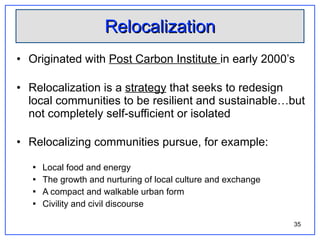
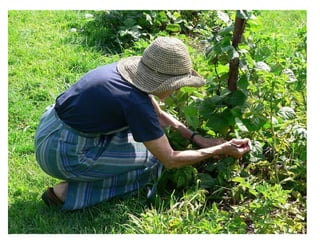
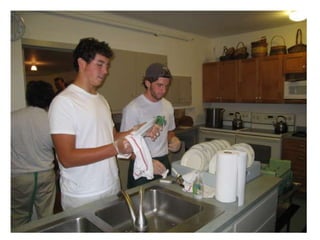
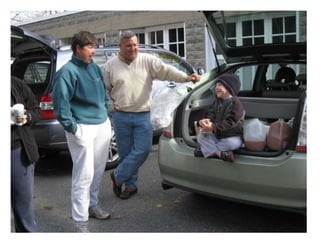
Relocalization Originated with  Post Carbon Institute  in early 2000’s Relocalization is a  strategy  that seeks to redesign local communities to be resilient and sustainable…but not completely self-sufficient or isolated Relocalizing communities pursue, for example: Local food and energy The growth and nurturing of local culture and exchange A compact and walkable urban form Civility and civil discourse
Transition Initiative The Transition Model is a  process  originated in Kinsale, Ireland in 2004 Uses a flexible set of  real world principles and practices  developed over time though experimentation and observation of communities as they drive forward to build local resilience and reduce carbon emissions. These initiatives, based on  12 key steps , recognize a set of basic premises: Climate Change  and  Peak Oil  require urgent action Life with less energy is  inevitable … We’ve lost the resilience to be able to cope with energy shocks We have to act  together  and we have to act  now I nfinite growth within a finite system   simply isn't possible Source : The Transition Initiatives Primer (Brangwyn & Hopkins)
Model Programs The “Groton” Relocalization Model Small discussion group Two-day education/awareness workshop Develop loose coordinating committee Develop strong, project-oriented subcommittees Healthy consideration of both proactive projects and pragmatic preparedness See article in December 2008  Planning Magazine Transition Initiative Model Twelve (12) steps to transition Similar to “Swamp Yankee” process Includes a time-delimited steering committee Concludes with an energy descent action plan (EDAP)
Key Steps in Transition Initiative Model Setting up the steering group Awareness/Consciousness raising Networking/Laying the foundation Organize a “Great Unleashing” Steering group dissolved, new created, form working groups Develop a project orientation Conduct visioning exercises Facilitate a “Great Re-skilling” Build a bridge to local government Honor the elders Let it go where it wants to go Create an Energy Descent Plan Adapted from the 12 Steps of Transition Initiatives; Transition Initiatives Primer; 2008
Local Program Essentials Building Awareness, Building Bridges Developing an awareness of the risks and predicaments Connecting to existing community groups Local Leadership and Organizing Local movement capital Existing leaders Consider sponsoring a local gathering to float the idea
Initiative Leadership and Government A “bottom-up” process,  local grassroots organization Success driven by strong citizen direction Government provides support, funding, resources, tools Yet weak local grassroots sector still has pathways
Relocalization, Transitioning, and Planning Relocalization and Transition Initiatives:  a strategy and a process to help communities become more resilient. Implementable models of sustainability at the most essential, local level Strategy:  based on scale and resources Removes the ideological baggage
The Role of Planning and Planners Ideal Profession to Pursue Sustainability Seek Leadership Role Establish Standardization Facilitate Participation and Collaboration
Local Planning Sectors From:   www.relocalizations.com  website; January 2011 Local Food Security Energy Security Natural Security (Ecosystem Health) Economic Development, Trade, and Currency Infrastructure (incl. water supply, waste management…) Transportation Spirituality Health Care (incl. preventative localized medicine) Arts and Culture Community Education (holistic and humility, continuous monitoring) Social Development and Human Resources Urban Design and Land Use Architecture and Building Design Prudent Limited Governance Prudent Preparedness (disasters, unrest, resource scarcity, etc.) Putting it all Together (Development of an Action Plan)
The Plan What do we call it? Energy Descent Action Plan Relocalization or Transition Plan Sustainability Plan Comprehensive or Master Plan How do we do it? Data collection: Community inventory and energy vulnerability assessment and a broader post-carbon SWOT analysis Intense Public Participation Maintain public access to plan development (Wiki, website Develop an implementable plan Assign specific tasks, timelines, funds
The Plan The plan should: Consider the widest range of community activities to capture the “system” Have significant and sizeable support from the public and stakeholders—a problem that we planners have had great difficulty achieving Be conducted whenever the community is ready… Stress opportunity, prevention, precaution…not sacrifice or hardship
Core Assumptions Acknowledge the  addiction to growth  as a first step Be proactive but be prepared  for the unexpected Sustainability is pursued  regardless of how predicaments play out
Strategic Planning Employ an Interdisciplinary Strategic Planning The process of developing a long-term plan to guide an organization towards a clearly articulated mission, goals and objectives. A process of assessing where an organization is presently, ascertaining the challenges and opportunities that present themselves, and determining what destination is most desirable and how to get there. Strategic Planning Steps SWOT Analysis:  Connect to a systems framework for analysis Vision and mission for the future Consider  Theory U  principles Multiple scenarios  (flexibility and adaptability) Goals, objectives, and performance measures  (indicators) Action strategies Implementation Evaluation Source:  Adapted from Bryson and Einsweiler, 1988
Systems-Based Sustainability Framework Level of complexity is based on community scale and resources Holistic and dynamic  approach to sustainability planning Link all local systems internally (and externally) to stocks and flow structures embedded in networks of positive and negative feedback loops Assess the behaviors of the systems across space and time Greatest benefit is the modeling process itself
“ Want of foresight, unwillingness to act when action would be simple and effective, lack of clear thinking, confusions of counsel, until the emergency comes, until self-preservation strikes its jarring gong – these are the features that constitute the endless repetition of history.”  ~ Winston Churchill House of Commons, 1935
Just a Few Resources…. http://www.livingeconomies.org/ http://steadystate.org/ www.transitionnetwork.org   http://www.transitionculture.org http://transitionus.org/ http://www.postcarbon.org http://www.energybulletin.net/ www.dynamiccities.squarespace.com http://www.feasta.org/ http://ineteconomics.org/ http://www.cnu.org http://www.usgbc.org/ http://www.naturalstep.org/ http://www.deepecology.org/ http://www.permaculture.org/ http://www.presencing.com/ http://biomimicry.net/ http://www.aia.org/about/initiatives/AIAS075425 http://blogs.planning.org/sustainability/2011/02/17/apas-sustainable-community-planning-interest-group/ http://www.planning.org/policy/guides/adopted/sustainability.htm http://www.growthbusters.org/ http://www.slowfood.com/ http://www.slowmoney.org/ http://www.walkable.org/ http://www.worldwatch.org/vsonline


Questions?

Meeting the Challenge of Peak Oil at the Local Level

  • 1.
    Peak Oil andits implications for Planning and the Economy Southern New England APA Conference Providence, Rhode Island October 21, 2011
  • 2.
    “ Anybody whobelieves exponential growth can go on forever in a finite world is either a madman or an economist.” – Kenneth Boulding “ All truth passes through three stages. First, it is ridiculed. Second, it is violently opposed. Third, it is accepted as being self-evident.” – Arthur Schopenhauer “ The greatest shortcoming of the human race is our inability to understand the exponential function.” – Albert Bartlett Quotes for the post peak oil world
  • 3.
    Why oiland natural gas are so important to our way of life Basic facts and trends of oil depletion When world oil production might peak Implications for economic growth, planning and development Topics
  • 4.
    Peak Oil =The end of ‘easy’ oil – not ‘running out’ The Deepwater Horizon accident – April, 2010
  • 5.
    The importance of Oil Oil is easily moved around the world, from its source (oil wells) to end consumers (gas stations, etc.) Oil provides : 40% of traded energy worldwide 90% of world and 95% of US transportation energy Oil is critical to : Industry and Commerce Modern Medicine Modern Agriculture ( 10 / 1 ratio hydrocarbons to food ) Oil is very “energy dense” in comparison to other energy sources. One gallon = 350 man hours of labor . Oil has enabled the world’s population to increase six-fold from 1900-today.
  • 6.
    Some key numbersand concepts There are 42 gallons in a barrel of oil. USA consumption (2005 - 2007): 22 million barrels of oil per day (mbpd), 7.5 billion barrels per year (bbpy) World consumption (2005 - 2007): 85 mbpd - 30 billion barrels per year Reserves vs. rate of production Energy Returned Over Energy Invested ( EROEI ) or Net Energy
  • 7.
    Introduction to PeakOil Source: Robert L. Hirsch, SAIC
  • 8.
    Source : USRep. Roscoe Bartlett, Special Order Speech, Feb. 8, 2006 USA Oil Production, 1945 – 2006
  • 9.
    Past discovery byExxonMobil Discoveries vs. Production Global oil discoveries peaked in 1964. The last year we discovered more oil than we used was 1981. Today we’re using about four to five barrels of oil for every one barrel of oil discovered.
  • 10.
    How close isPeak Oil? OPEC’s reserve claims are very likely to be exaggerated. 50% of the world’s oil is produced from just 100 mega-fields, most in the Middle-East. 80% of today’s oil production is from fields greater than 30 years old. Saudi Arabia is likely near its peak . Oil from currently producing fields ( the ‘easy oil ’) has been declining since 2005 (at 6.7% per year). World oil demand for 2020-2030 is forecast by the IEA and the World Bank at 115 – 120 mbpd. Demand for oil in China and India is still growing, despite the world-wide recession.
  • 11.
    The latest evidenceand projections World Crude Oil Production - January 2002 to September 2009
  • 12.
    The latest evidenceand projections
  • 13.
    Non-Regular Oil, or,can Tar Sands save us? NRO : heavy oil, oil shale, tar sands Abundant – hundreds of billions of barrels of oil equivalent. Very low energy returned on energy invested (EROEI) though Very slow rate of production . Maximum likely to be no more than 5 million bpd (out of world 85+) Using natural gas to extract oil from tar sands is like “ feeding the dog steak and eating his ALPO ”. --- energy analyst Steve Andrews. It’s also as dirty as coal to mine and process.
  • 14.
    What about alternativeenergy sources? All renewable sources = ~ 6% of US energy supply Solar and wind contribute less than 1% of US energy. Ramping these up to even partially replace the energy supplied by oil and natural gas will be an enormous and expensive endeavor. Yet, we should still install as much solar and wind power as possible. Other than biomass, these sources produce electricity only, not liquid fuels. Hydrogen is currently a net energy loser – an energy carrier, not an energy source
  • 15.
    Richard Heinberg’s 5Axioms of Sustainability Any society that continues to use resources unsustainably will fail. ( See Jared Diamond’s book “Collapse” for many examples. ) Growth in population and rates of consumption cannot be sustained indefinitely on a finite planet. Renewable resources must be consumed at a rate less than or equal to that of natural replacement. Consumption of non-renewable resources must decline at a rate greater than or equal to the rate of depletion. Wastes introduced into the environment must be minimized and rendered harmless to biosphere functions .
  • 16.
    Can we ‘growon’ like this forever? Economic growth requires continual growth in net energy . There is a direct correlation between economic growth and the availability of energy, especially oil. All money is loaned into existence as new debt, which requires economic growth to finance. We pay for today’s debt with tomorrow’s ( projected ) growth , but can this go on forever? What happens when an economic system that requires growth to function collides with a real world that can no longer supply the ever expanding energy needed to fuel that growth? We’ll find out soon…
  • 17.
    Can we ‘growon’ like this forever? Are there limits to growth? Other factors contributing to reaching the limits to growth: Increasing costs of natural disasters resulting from a destabilized global climate. Known deposits of many critical minerals (rare earths, etc.) will be exhausted within 20+ years. New ore deposits are getting harder to find, more remote, deeper down, more dilute or all of the above. Increasing the production of biofuels will incur increasing economic and environmental costs / low EROEI.
  • 18.
    A highly recommendedinternet resource on these topics www.ChrisMartenson.com A website exploring the relationship between the economy, peak oil and energy, the environment and likely future scenarios for the United States and the World. Contains an excellent free video primer – ‘The Crash Course’ If you want to understand the relationship between exponential growth curves, the money supply, debt, inflation, and why the next 20 years are unlikely to be like the last 20 years, you need to take the ‘Crash Course’. Other economic and energy experts also sounding the alarm : Richard Heinberg, Herman Daly, Albert Bartlett, Lester Brown, Richard Douthwaite, and many more…
  • 19.
    Implications of PeakOil for this decade Growing gap between supply and demand, leading to: Oil prices will trend ever upward, except when recessions trigger ‘demand destruction’ (i.e. 2009) Oil prices will be volatile depending on the economy, world events, weather, etc. Transportation costs will rise. Manufactured products will become more expensive, esp. those shipped long distances. The cost of food will rise. Government budgets at all levels will be affected by rising fuel costs and economic contraction.
  • 20.
    What can wedo to prepare? The bottom line for our future: There will be less energy available, especially liquid fuels Mobility will be reduced compared to today Economic difficulties during the transition to a smaller-scaled sustainable economic system What we need to start doing: Cut back on fossil fuel use Conserve energy Bring producers and consumers closer together Re-consider long-range plans and planning tools that assume unlimited energy for economic development, transportation & agriculture
  • 21.
    Planning and developmentin an energy constrained world James H. Kunstler’s take on how planning and development need to adjust in a post-peak world: Transportation : “ Think beyond the automobile ” Trains and other mass transit will be crucial if we don’t want to be limited to bicycling range. Agriculture : Farming will be a growth industry, but will require more human labor. We will need to grow a lot more food closer to population centers. Manufacturing : … will need to return to its place as a foundation of our economy. ‘Made in the USA’ will replace ‘Made in China’ (yeah!) More goods will need to be made locally and regionally. Land-Use : Far-flung sprawling large-lot subdivisions are out. Urban redevelopment and infill is in. Small cities situated near good agricultural land may actually fare quite well compared to many other parts of the USA, if they actively plan for the post-peak world .
  • 22.
    Relocalization “ Relocalization ” means a return to local and regional production of essential goods and services, including: Food production and distribution (top priority) Water supply (top priority) Heating Transportation Emergency Services Health Care Manufacturing The best possible outcome will require planning and coordination at all levels, ranging from the personal, to the community, state, national and international.
  • 23.
    Some resources onpeak oil, smart development and sustainability Books to get you started: The Party’s Over, Richard Heinberg Powerdown , Richard Heinberg The End of Growth , Richard Heinberg The Crash Course , Chris Martenson Post Carbon Cities , Daniel Lerch, editor The Long Emergency , James H. Kunstler Websites : www.energybulletin.net www.chrismartenson.com www.theoildrum.com www.peakoil.net (ASPO’s official site) www.postcarbon.org (relocalization) www.grotonlocal.org Mark Archambault: 603-881-8591 [email_address]
  • 25.
    Grass Roots SustainabilityThe Role of Government and Planning Professionals in Small City and Small Town Sustainability Initiatives Christopher J. Ryan, AICP, Ph.D. Southern New England APA Conference Providence, RI ~ October 2011
  • 26.
    Agenda Sustainability andOur Predicaments: A summary of the challenges and how seeking sustainability is the only humane path to a livable world The Lens of Risk Management: The need to apply a risk model to our predicaments Movements That Inspire Action: Key movements, building a local initiative through awareness, coalition building, leadership Where Government Fits In: As partners ideally and leaders as needed The Role of Planning and Planners: Leadership, standardization, collaboration… The Plan: Draw from model participatory movements, use of an interdisciplinary strategic planning approach, a systems-based sustainability framework, and holistic programmatic criteria
  • 27.
    Predicaments and DriversPeak Oil Climate Change Debt-Based Economy Growth Culture
  • 28.
    Sustainability A fairlysimple concept…..? There are many definitions of sustainability beginning with 1987 Bruntland Commission report My favorite: “… a community’s control and prudent use of all forms of capital—nature’s capital, human capital, human-created capital, social capital, and cultural capital—to ensure, to the degree possible, that present and future generations can attain a high degree of economic security and achieve democracy while maintaining the integrity of the ecological systems upon which all life and all production depends.” ~ Steven Veiderman in Pirages, 1996.
  • 29.
    Sustainability: Dimensions, Indicators,Benchmarks ( from Feiden and Hamin, 2011; PAS Report 565) Dimensions of Sustainability Sustain communities as good places to live Sustain the values of our society Sustain the biodiversity of the natural environment Sustain ecosystem services rarely counted by economists Indicators and Benchmarks Indicators : Quantitative or qualitative measurement tools (Feiden and Hamin, 2011) Benchmarks: References or targets for sustainability Limitations: Effort, resources, infrastructure
  • 30.
    Sustainability Why PursueSustainability? Risk Mgt : To reduce the risks posed by our predicaments Extend (indefinitely?) the human experiment Desire for a high and equitable quality of life for ourselves and succeeding generations (and all this entails) Ethics : a strong sense of responsibility and ownership for the predicaments Other Important Considerations Accountability Scale Resilience Flexibility
  • 31.
    Risk Management FocusWe seek to minimize risk through preparations and purchasing insurance for: Homeowners or Renters (fire, wind damage, earthquake, etc) Car and Other Vehicles (collision, theft, liability) Life (term, permanent: whole or universal life, etc.) Flood (in addition to homeowners) Health (comprehensive, scheduled, public) We prepare for other types of risk in the public domain: Public Health (epidemic, pandemic) Weather (winter storms, hurricane, tornado, floods) Geology (earthquakes, tsunami, volcanism) Social/Political (terrorism, protests, nuclear weapons) Why not take the same approach for our communities for more existential threats? Why not factor potential major disruptions into our planning horizon?
  • 32.
    Are our behaviors,our cultural practices too risky? The Precautionary Principle “ If an action or policy has a suspected risk of causing harm to the public or to the environment, in the absence of scientific consensus that the action or policy is harmful, the burden of proof that it is not harmful falls on those taking the action .” (Wikipedia)
  • 33.
    One Size DoesNot Fit All Approaching community sustainability is often a matter of: Fiscal Capital: Large or Small budgets Human Resources: Staff Social and Community Capital: Is Community Fragmented or Close Knit? Movement Capital: Volunteer Legacy? Intellectual/Skills Capital: Experts in the Community Pragmatism: Candid consideration of both opportunities and threats These factors may determine the best approach a specific community should consider taking.
  • 34.
    Organizations, Groups, PhilosophiesInspiring Action Deep Ecology (Arne Næss) The Natural Step (Karl-Henrik Robèrt) Ecological Design Regenerative Design Biomimicry (Jenine Benyus) Hannover Principles, Sanborn Principles Leadership in Energy and Environmental Design (LEED) Permaculture (Holmgren and Mollison) Theory U (Scharmer) Relocalization (PCI) Transition Initiative (Rob Hopkins)
  • 35.
    Relocalization Originated with Post Carbon Institute in early 2000’s Relocalization is a strategy that seeks to redesign local communities to be resilient and sustainable…but not completely self-sufficient or isolated Relocalizing communities pursue, for example: Local food and energy The growth and nurturing of local culture and exchange A compact and walkable urban form Civility and civil discourse
  • 36.
    Transition Initiative TheTransition Model is a process originated in Kinsale, Ireland in 2004 Uses a flexible set of real world principles and practices developed over time though experimentation and observation of communities as they drive forward to build local resilience and reduce carbon emissions. These initiatives, based on 12 key steps , recognize a set of basic premises: Climate Change and Peak Oil require urgent action Life with less energy is inevitable … We’ve lost the resilience to be able to cope with energy shocks We have to act together and we have to act now I nfinite growth within a finite system simply isn't possible Source : The Transition Initiatives Primer (Brangwyn & Hopkins)
  • 37.
    Model Programs The“Groton” Relocalization Model Small discussion group Two-day education/awareness workshop Develop loose coordinating committee Develop strong, project-oriented subcommittees Healthy consideration of both proactive projects and pragmatic preparedness See article in December 2008 Planning Magazine Transition Initiative Model Twelve (12) steps to transition Similar to “Swamp Yankee” process Includes a time-delimited steering committee Concludes with an energy descent action plan (EDAP)
  • 38.
    Key Steps inTransition Initiative Model Setting up the steering group Awareness/Consciousness raising Networking/Laying the foundation Organize a “Great Unleashing” Steering group dissolved, new created, form working groups Develop a project orientation Conduct visioning exercises Facilitate a “Great Re-skilling” Build a bridge to local government Honor the elders Let it go where it wants to go Create an Energy Descent Plan Adapted from the 12 Steps of Transition Initiatives; Transition Initiatives Primer; 2008
  • 39.
    Local Program EssentialsBuilding Awareness, Building Bridges Developing an awareness of the risks and predicaments Connecting to existing community groups Local Leadership and Organizing Local movement capital Existing leaders Consider sponsoring a local gathering to float the idea
  • 40.
    Initiative Leadership andGovernment A “bottom-up” process, local grassroots organization Success driven by strong citizen direction Government provides support, funding, resources, tools Yet weak local grassroots sector still has pathways
  • 41.
    Relocalization, Transitioning, andPlanning Relocalization and Transition Initiatives: a strategy and a process to help communities become more resilient. Implementable models of sustainability at the most essential, local level Strategy: based on scale and resources Removes the ideological baggage
  • 42.
    The Role ofPlanning and Planners Ideal Profession to Pursue Sustainability Seek Leadership Role Establish Standardization Facilitate Participation and Collaboration
  • 43.
    Local Planning SectorsFrom: www.relocalizations.com website; January 2011 Local Food Security Energy Security Natural Security (Ecosystem Health) Economic Development, Trade, and Currency Infrastructure (incl. water supply, waste management…) Transportation Spirituality Health Care (incl. preventative localized medicine) Arts and Culture Community Education (holistic and humility, continuous monitoring) Social Development and Human Resources Urban Design and Land Use Architecture and Building Design Prudent Limited Governance Prudent Preparedness (disasters, unrest, resource scarcity, etc.) Putting it all Together (Development of an Action Plan)
  • 44.
    The Plan Whatdo we call it? Energy Descent Action Plan Relocalization or Transition Plan Sustainability Plan Comprehensive or Master Plan How do we do it? Data collection: Community inventory and energy vulnerability assessment and a broader post-carbon SWOT analysis Intense Public Participation Maintain public access to plan development (Wiki, website Develop an implementable plan Assign specific tasks, timelines, funds
  • 45.
    The Plan Theplan should: Consider the widest range of community activities to capture the “system” Have significant and sizeable support from the public and stakeholders—a problem that we planners have had great difficulty achieving Be conducted whenever the community is ready… Stress opportunity, prevention, precaution…not sacrifice or hardship
  • 46.
    Core Assumptions Acknowledgethe addiction to growth as a first step Be proactive but be prepared for the unexpected Sustainability is pursued regardless of how predicaments play out
  • 47.
    Strategic Planning Employan Interdisciplinary Strategic Planning The process of developing a long-term plan to guide an organization towards a clearly articulated mission, goals and objectives. A process of assessing where an organization is presently, ascertaining the challenges and opportunities that present themselves, and determining what destination is most desirable and how to get there. Strategic Planning Steps SWOT Analysis: Connect to a systems framework for analysis Vision and mission for the future Consider Theory U principles Multiple scenarios (flexibility and adaptability) Goals, objectives, and performance measures (indicators) Action strategies Implementation Evaluation Source: Adapted from Bryson and Einsweiler, 1988
  • 48.
    Systems-Based Sustainability FrameworkLevel of complexity is based on community scale and resources Holistic and dynamic approach to sustainability planning Link all local systems internally (and externally) to stocks and flow structures embedded in networks of positive and negative feedback loops Assess the behaviors of the systems across space and time Greatest benefit is the modeling process itself
  • 49.
    “ Want offoresight, unwillingness to act when action would be simple and effective, lack of clear thinking, confusions of counsel, until the emergency comes, until self-preservation strikes its jarring gong – these are the features that constitute the endless repetition of history.” ~ Winston Churchill House of Commons, 1935
  • 50.
    Just a FewResources…. http://www.livingeconomies.org/ http://steadystate.org/ www.transitionnetwork.org http://www.transitionculture.org http://transitionus.org/ http://www.postcarbon.org http://www.energybulletin.net/ www.dynamiccities.squarespace.com http://www.feasta.org/ http://ineteconomics.org/ http://www.cnu.org http://www.usgbc.org/ http://www.naturalstep.org/ http://www.deepecology.org/ http://www.permaculture.org/ http://www.presencing.com/ http://biomimicry.net/ http://www.aia.org/about/initiatives/AIAS075425 http://blogs.planning.org/sustainability/2011/02/17/apas-sustainable-community-planning-interest-group/ http://www.planning.org/policy/guides/adopted/sustainability.htm http://www.growthbusters.org/ http://www.slowfood.com/ http://www.slowmoney.org/ http://www.walkable.org/ http://www.worldwatch.org/vsonline
  • 51.
  • 52.
  • 53.
  • 54.
  • 55.
  • 56.
  • 57.
  • 58.
  • 59.
  • 60.
  • 61.
  • 62.
  • 63.
  • 64.
  • 65.
  • 66.
  • 67.
  • 68.
  • 69.
  • 70.
  • 71.
  • 72.
  • 73.
  • 74.
  • 75.
  • 76.
  • 77.
  • 78.
  • 79.
  • 80.
  • 81.
  • 82.
  • 83.
  • 84.
  • 85.
  • 86.
  • 87.
  • 88.
  • 89.
  • 90.
  • 91.
  • 92.
  • 93.
  • 94.
  • 95.
  • 96.
  • 97.
  • 98.
  • 99.
  • 100.
  • 101.
  • 102.
  • 103.
  • 104.
  • 105.
  • 106.
  • 107.
  • 108.
  • 109.
  • 110.
  • 111.
  • 112.
  • 113.
  • 114.
  • 115.
  • 116.

Editor's Notes

  • #26 Good afternoon, my presentation is entitled, “GRASS ROOTS SUSTAINABILITY: The Role of Government and Planning Professionals in Small City and Small Town Sustainability Initiatives” … thank you for coming today [change slide]
  • #27 My agenda today covers six basic topics beginning with a summary of our predicaments and how sustainability is the only humane way to address them, and then progressing to: -- how we should approach our situation as if it were a risk management problem -- a summary of initiatives and movements that take this approach but also have other facets that we can learn from -- where government fits into this framework -- the role of planning and planners…what we can bring to the process -- and finishing up with the product, the plan, the can emerge from this process I want to leave you with at least four (4) takeaways: First, that there are a number of approaches to local sustainability planning but we need to standardize the criteria Second, that we cannot let a lack of resources prevent action Third, that planners can, and should, take a leadership role in setting standards, creating process, and outreach And Fourth, that a systems analysis and strategic planning approach are ideally suited for sustainability planning
  • #28 Debt-Based Economy: Requires perpetual growth but has led to extreme income inequalities…this was masked for a while by financial liberalization allowing consumption to continue until the levels of debt became unsustainable and saddles generations of working people with a lifetime burden of crushing debt obligations….of course this slowed consumption to not only pay down debt but also to merely survive. This led then to production contraction, job loss…. … .and to where we are today
  • #29 Sustainability should be a fairly simple concept: Humans rely on our natural environment to provide the essential elements of life: air, water, soil and the net primary production that is the basis for all foodstocks, a moderate climate, and so forth. Sustainability is the hypothetical harmonic balance and stasis of these human and biospheric supportive systems that allows humanity to provide equitably for present and future generations. Of course any definition must include the three E’s or three P’s which form the three legs of sustainability and the elements of the triple bottom line. But to me the definition of sustainability must not hint at the subjectivity of ecological sustainability for it is this leg that has no compromise if it to be genuine sustainability. There are countless definitions of sustainability beginning with the one developed for the 1987 Bruntland Commission Report….yet few of them are useful or robust….my favorite comes from Steven Veiderman READ SLIDE
  • #30 Regarding the dimensions of sustainability…this from the excellent PAS Report 565, Assessing Sustainability by Feiden and Hamin: We want to sustain communities as good places to live and places that offer good economic and other opportunities for inhabitants (social, economic, quality-of-life) We want to sustain the values of our society (social, cultural) We want to sustain the biodiversity of the natural environment (ecological) We want to sustain the ability of natural systems to provide the life supporting services rarely counted by economists (ecological and economic) Sustainability is measured using indicators and benchmarks are targets that allow progress to be followed…. But there are limitations of indicator-based programs include the effort required to establish and monitor indicators. This is particularly problematic, challenging, and daunting to smaller communities and those with few resources [change slide]
  • #31 Why should we pursue sustainability? Just a few of the reasons include: -- reducing the risks we face through our behaviors -- extending the viability of human culture -- equity and decent quality of life -- for ethical reasons based on shared responsibility for humanity and all of life……but there are other important considerations in the successful pursuit of sustainability Accountability: All stakeholders and participants understand what is being decided in the adoption of a plan Scale: Larger communities can pursue more complex agendas but they have more complex problems. Smaller communities can pursue more simple problems that fit their scale Resilience: The key to true sustainability is building community resilience and reducing overdependence on external systems. However, it’s unrealistic to believe that external dependence can be completely severed nor should communities want to do so as long as benefits accrue. Flexibility: Pursuit of sustainability also means building in flexibility and adaptability to adjust swiftly to changing circumstances as necessary.
  • #32 Regarding the risk management perspective as a justification for a sustainability program…. We try to minimize risk in our lives by being prepared the best we can and acquiring insurance for the unexpected such as for our homes, cars, our life, and health….we prepare for some public risks like disease, storms, and earthquakes… Why wouldn’t we take the same approach for our communities, our nation for more existential threats? Perhaps because of the sheer unpredictability of these events and the fact that they haven’t occurred yet. [change slide]
  • #33 Are our behaviors, our cultural practices too risky? Many would say that they are….the precautionary principle would be a valuable guide our local planning.
  • #34 In designing a sustainability program for a community, the particular characteristics of the community are important to take into consideration….one size does not fit all…. READ SLIDE
  • #35 A number of different groups and organizations pursuing sustainability understand that solutions must be “place specific” These include………READ SLIDE Two initiatives that I want to focus on, that have developed a significant inertia and following, include Relocalization and the Transition Initiative…. These initiatives have drawn from other historical movements and philosophies but have created a program
  • #36 Relocalization originated with Post Carbon Institute in early 2000’s and now embraced widely by people such as James Kunstler, Nate Hagens, John Cronin, Bill McKibben, Rob Hopkins, Daniel Lerch, Richard Heinberg, David Korten, Joel Salatin, Lisa Swallow Relocalization is a strategy that seeks to redesign local communities to: Be more energy independent and sustainable To create a carbon neutral society To produce more food and other goods locally To develop a stronger and more independent local economy (less leakage) To rebuild a sense of community and social capital Relocalized communities are based on: The production of food , energy , and other primary goods at the local level The growth and nurturing of local forms of exchange , governance , and culture A compact and walkable urban form Civility and civil discourse
  • #37 The transition initiative originated in Kinsale, Ireland in 2004 It uses a flexible set of tried and true real world principles and practices It follows a 12 step program and recognizes a set of basic premises including: Climate Change and Peak Oil require urgent action Life with less energy is inevitable …it is better to plan for it than be taken by surprise Industrial society has lost the resilience to be able to cope with energy shocks We have to act together and we have to act now Regarding the world economy and the consumptive patterns within it, as long as the laws of physics apply, infinite growth within a finite system (such as planet earth) simply isn't possible . Humans can call upon the same ingenuity and intelligence to navigate back down from the peak of the energy mountain that we used climbing the mountain. Planning and acting early enough , and using creativity and cooperation to unleash our local genius, we can build a future that could be far more fulfilling and enriching , more connected and more gentle on the earth than the lifestyles we live today.
  • #38 Relocalization spawned a number of “locals” including the Groton Local of which Tucker Smith will elaborate on next The transition initiative grew in England with initial programs in Totnes and Lewes and has spead across the globe with “transition towns” in Brattleboro, Newburyport, and hundreds of other communities
  • #39 As I noted, the transition initiative employs a 12 step model that begins with a small group of initiators who help raise awareness of the issues through speakers, films, and books The begin to build the group through individuals and by making connections to other local groups who may already be working on some small portion of community sustainability Once a critical mass is reached, the “great unleashing” occurs which is a celebratory event that kicks off the real work of forming groups and pursuing projects and programs that culminate in the development of a plan [change slide]
  • #40 The key to transition is the initial development of awareness and building bridges to other groups…and to see what leadership exists and who emerges as the process unfolds…. Building Awareness, Building Bridges Developing an awareness of the risks and predicaments within the community (films, books, discussions, speakers…) Connecting to existing community groups rather than trying to reinvent the wheel, taking it all on your shoulders Local Leadership and Organizing Assess local movement capital and the legacy of organizing and volunteering Are there existing leaders or groups in the community who could emerge to found a grass roots sustainability initiative? Consider sponsoring a local gathering to float the idea (CCAN)
  • #41 A “bottom-up” process based on local grassroots organization More likely be successful if the process is citizen-based or initiated In this case, government role should be clearly defined and generally relate to, Support, Funding, Resources, Tools With a weak local movement infrastructure, other models may be more successful (e.g. government or leadership driven)
  • #42 Relocalization or transition initiatives, as a type of local planning strategy, lead communities and organizations to become more resilient and less dependant on the highly volatile global system. Such communities are more likely to survive and thrive in a more sustainable and community-based setting. These pathways are implementable models of sustainability at the most essential, local level. The most effective community development strategies are designed and put into practice at the local level. Local sustainability initiatives can include a range of methods for assessment including indicators of various types….or not…based on scale and resources Most importantly, experience has shown that these programs remove or reduce the ideological baggage carried by “green” or “sustainability” programs and those where government is seen as “the solution.”
  • #43 You recall that one of a few takeaway’s I wanted to convey is that sustainability is an ideal discipline for the planning profession This is due to…. Planners technical expertise Our multidisciplinary perspective Our organizational and project management skills Our experience with facilitation and mediation And….our core philosophy of ensuring participation and inclusiveness Leadership: Planners have an opportunity, a narrow one, to seize the mantle in this multi-disciplinary area and establish a leadership role In order to establish leadership in this area, it will require something that planners are very good at: developing tools, standardization, and definitions Planners must also be willing to collaborate closely with other disciplines and with the public in order to develop the trust and legitimacy the leadership role requires
  • #46 READ SLIDE
  • #47 Acknowledge the addiction to growth: While critics suggest sugarcoating the threats, trends and circumstances need to be understood and acknowledged. We must still identify the growth culture as the problem as any addicts must recognize their addiction. Bad news must be followed by discussion and by identifying a clear path to a better future Be proactive but be prepared for the unexpected: Need to address a proactive agenda and a preparedness backup plan Sustainability is pursued regardless: Even if we adhere to the precautionary principle and it turns out that we were too cautious, we still result in a sustainable community and society, etc.
  • #48 SWOT Analysis: Connect to a systems framework for analysis Develop a vision and mission for the future (based on a fit between intersection of the SWOT domains should determine best course of action) Consider Theory U principles for “learning from the future as it emerges” or “Presencing” Use multiple scenarios to maximize flexibility and adaptability Development of goals, objectives, and performance measures (indicators?) Development of action strategies (policies, tasks, etc.) Implementation (operational or tactical plans) Evaluation of results (ongoing)
  • #49 Level of complexity is based on community scale and resources Holistic and dynamic approach to sustainability planning Link all local systems internally (and externally) to stocks and flow structures embedded in networks of positive and negative feedback loops Assess the behaviors of the systems across space and time Greatest benefit is the modeling process itself which teaches local leaders the interconnections and complexities of local systems