Global
Warming
, End of
Oil
A Perfect Storm
Richard Heinberg
PreparingPreparing
Together for aTogether for a
Changed WorldChanged World
Richard HeinbergRichard Heinberg
Post Carbon InstitutePost Carbon Institute
The economic crisis
changes everything
before crisis I after crisis
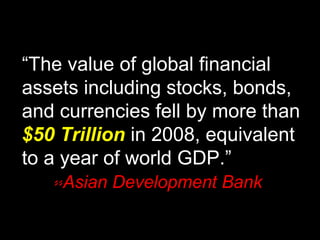
“The value of global financial
assets including stocks, bonds,
and currencies fell by more than
$50 Trillion in 2008, equivalent
to a year of world GDP.”
--Asian Development Bank
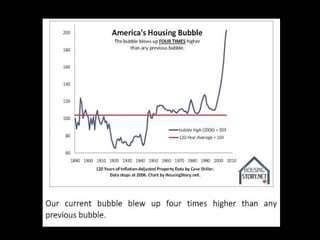
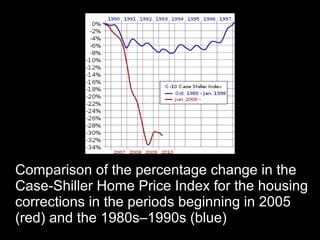
Comparison of the percentage change in the
Case-Shiller Home Price Index for the housing
corrections in the periods beginning in 2005
(red) and the 1980s–1990s (blue)
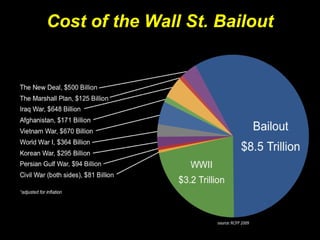
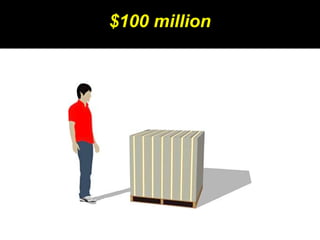
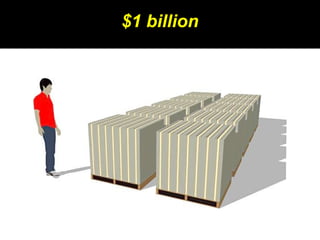
Cost of the Wall St. Bailout
$100
$10,000
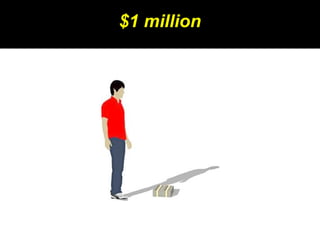
$1 million
$100 million
$1 billion
$1 trillion
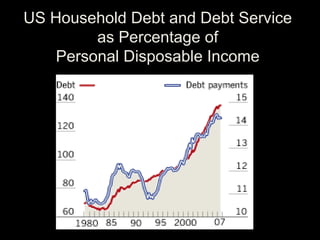
US Household Debt and Debt Service
as Percentage of
Personal Disposable Income
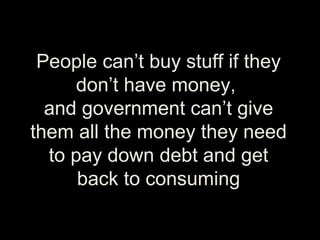
People can’t buy stuff if they
don’t have money,
and government can’t give
them all the money they need
to pay down debt and get
back to consuming
“We’re in the midst of a once-in-a-lifetime
set of economic conditions. The
perspective I would bring is not one of
recession. Rather, the economy is
resetting to a lower level of business
and consumer spending based largely
on the reduced leverage in the economy.”
Steven Ballmer
Chairman, Microsoft Corp.
The shape of the recovery
V
The shape of the recovery
U
The shape of the recovery
W
The shape of the recovery
L
Some economic perspective
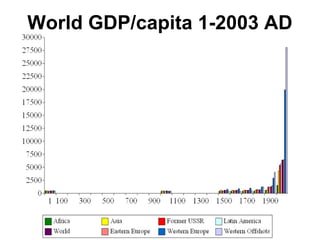
World GDP/capita 1-2003 AD
Meanwhile, we were
developing economic
institutions and theories
Growth becomes
institutionalized
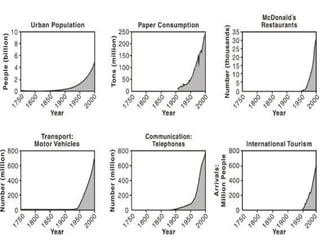
• With continual growth in energy,
population, and consumption, it was
assumed that economic growth could
continue forever
Growth becomes
institutionalized
• With continual growth in energy,
population, and consumption, it was
assumed that economic growth could
continue forever
• With compound interest, fractional reserve
banking, and debt leverage, growth
became necessary to the monetary health
of nations
When growth ceases, growth-
based economies enter
survival crisis mode
Why did we create a growth
economy in the first place?
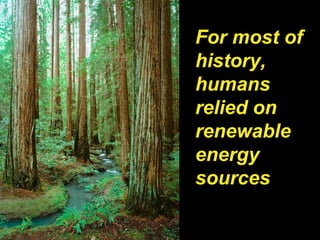
For most of
history,
humans
relied on
renewable
energy
sources
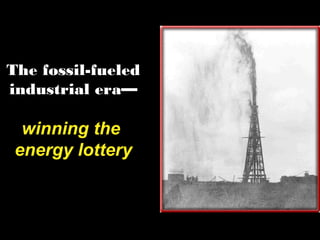
The fossil-fueled
industrial era—
winning the
energy lottery
Once upon a time…
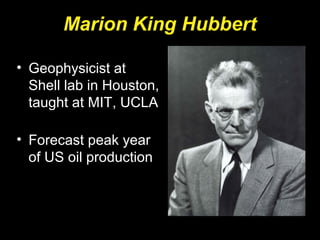
Marion King Hubbert
• Geophysicist at
Shell lab in Houston,
taught at MIT, UCLA
• Forecast peak year
of US oil production
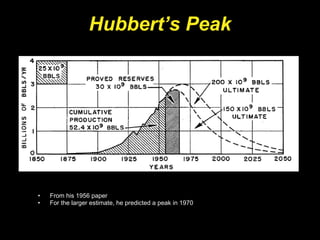
Hubbert’s Peak
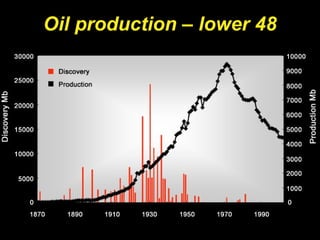
• From his 1956 paper
• For the larger estimate, he predicted a peak in 1970
Oil production – lower 48
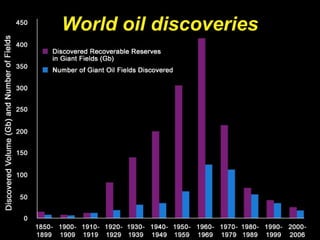
World oil discoveries
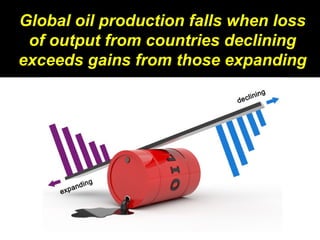
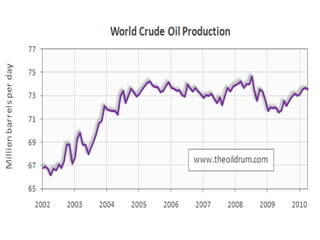
Global oil production falls when loss
of output from countries declining
exceeds gains from those expanding
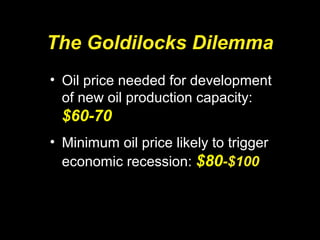
The Goldilocks Dilemma
• Oil price needed for development
of new oil production capacity:
$60-70
• Minimum oil price likely to trigger
economic recession: $80-$100
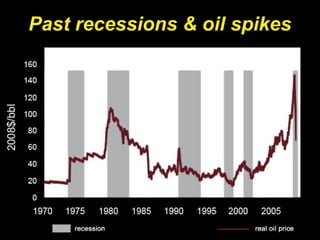
Past recessions & oil spikes
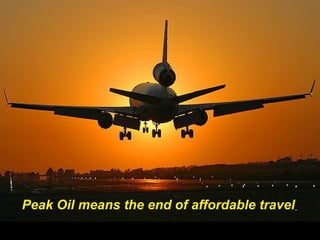
Peak Oil means the end of
cheap air travel
Peak Oil means the end of affordable travel
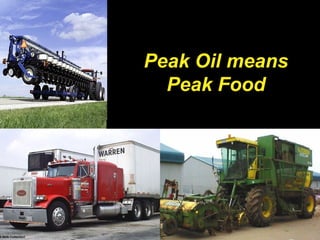
Peak Oil means
Peak Food
Evaluating Energy Options
• Energy return on investment
• Size of resource
• Infrastructure requirement
• Convenience of use
• Environmental impact
• Renewability
• Scalability
• Location of resource
There is no credible scenario
in which alternative energy
sources can make up for fossil
fuels once declines begin.
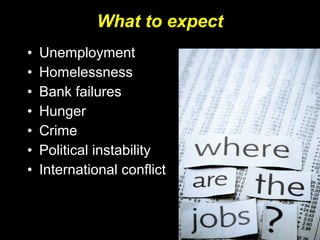
• Unemployment
• Homelessness
• Bank failures
• Hunger
• Crime
• Political instability
• International conflict
What to expect
What to do?
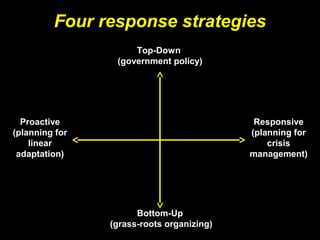
Proactive
(planning for
linear
adaptation)
Responsive
(planning for
crisis
management)
Top-Down
(government policy)
Bottom-Up
(grass-roots organizing)
Four response strategies
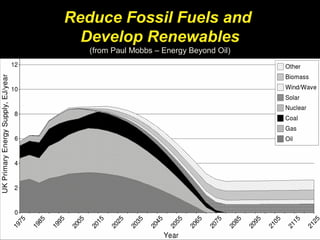
Reduce Fossil Fuels and
Develop Renewables
(from Paul Mobbs – Energy Beyond Oil)
The sustainability revolution
will be driven by crisis
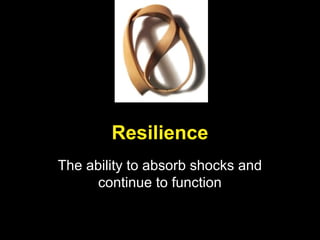
Resilience
The ability to absorb shocks and
continue to function
Resilience characteristics
• Redundancy in critical systems
• Dispersed system control points
• Dispersed inventories
• Balancing feedback loops
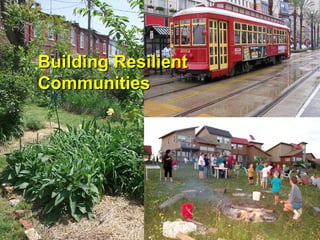
Building resilient communities
Building ResilientBuilding Resilient
CommunitiesCommunities
Co-op Power
• “A regional network
of local
communities
creating a multi-
class, multi-racial
movement for a
sustainable and
just energy future”
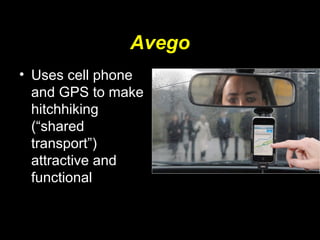
Avego
• Uses cell phone
and GPS to make
hitchhiking
(“shared
transport”)
attractive and
functional
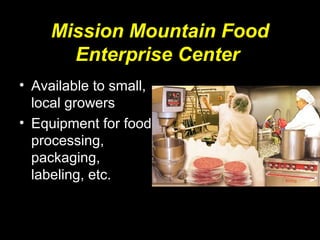
Mission Mountain Food
Enterprise Center
• Available to small,
local growers
• Equipment for food
processing,
packaging,
labeling, etc.
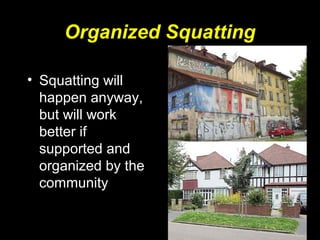
Organized Squatting
• Squatting will
happen anyway,
but will work
better if
supported and
organized by the
community
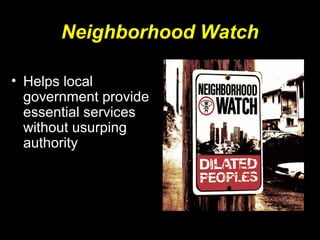
Neighborhood Watch
• Helps local
government provide
essential services
without usurping
authority
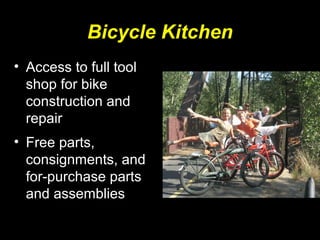
Bicycle Kitchen
• Access to full tool
shop for bike
construction and
repair
• Free parts,
consignments, and
for-purchase parts
and assemblies
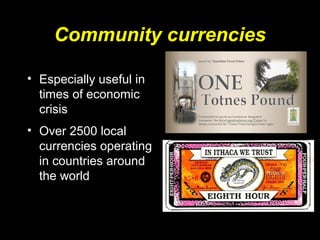
Community currencies
• Especially useful in
times of economic
crisis
• Over 2500 local
currencies operating
in countries around
the world
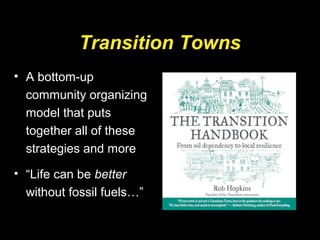
Transition Towns
• A bottom-up
community organizing
model that puts
together all of these
strategies and more
• “Life can be better
without fossil fuels…”
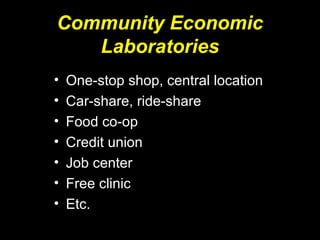
Community Economic
Laboratories
• One-stop shop, central location
• Car-share, ride-share
• Food co-op
• Credit union
• Job center
• Free clinic
• Etc.
Emphasize what is not at peak
• Community
• Satisfaction from honest work well done
• Intergenerational solidarity
• Cooperation
• Free time
• Happiness
• Artistry
• Beauty of the built environment
A personal strategy
• Reduce spending and consumption
• Grow your own food
• Get to know your neighbors
Imagine life after growth,
a world without fossil fuels,
the best case scenario
Imagine life after growth,
a world without fossil fuels,
the best case scenario
Now imagine a path
from here to there,
and start to build it
Remember:
crisis = opportunity
This is the biggest opportunity of
our lifetimes. Who will seize it?
www.postcarbon.org
Preparing Together for a Changed World

Preparing Together for a Changed World

Editor's Notes

  • #8 WALL STREET BAILOUT SO FAR EXCEEDS TOTAL COST OF ALL US WARS
  • #39 For examples of criticism see Environmental and Natural Resource Economics, by Tom Tietenburg, 7th edition , p. 151. For EIA criticism, see http://www.api.org/aboutoilgas/security/upload/Caruso2005.pdf
  • #42 It is like a scales. Although we will still be finding oil, still developing new fields if just slightly more of the world’s production capacity -- maybe just 51% -- is declining. Then production will have peaked. This is why it will be far earlier than most people expect.
  • #77 Our topic tonight is “Resilient Cities in a Post Carbon World,” and we’re very pleased to feature two of the top North American experts on urban sustainability, Bill Rees and Warren Karlenzig, both Fellows of the Institute. Bill and Warren will each deliver some opening remarks, I’ll pose some questions to get the discussion started, and then we’ll open to the floor for Q&A. Before we get started, though I’d like to introduce Bill, Warren, and Post Carbon Institute, and then lay some of the conceptual groundwork for tonight’s discussion. Bill Rees probably needs no introduction to a Canadian audience of urban thinkers. He is the co-originator of the widely-used "ecological footprint" concept -- and his classic book on the subject, Our Ecological Footprint (with Mathis Wackernagel), is now available in nine languages. Bill's teaching and research really go to the heart of what it means for humans to live sustainably – that is, for human civilization to persist and not consume the planet past the point of no return. He’s a long-time Professor at the School of Community and Regional Planning at the University of British Columbia. Bill is our Fellow of Ecology and Resilience at Post Carbon Institute. Warren Karlenzig is the President of Common Current, a sustainability consulting firm based in California. He’s an internationally expert having developed sustainability plans and metrics with the United Nations, the US Department of State, the White House Office of Science and Technology, and the Asian Institute for Energy, Environment & Sustainability, as well as a number of major cities, corporations, and non-governmental organizations. He’s also the author of How Green is Your City? The SustainLane US City Rankings. Warren is our Fellow of Urban Sustainability at Post Carbon Institute.