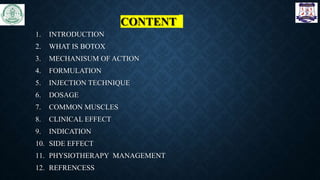
BOTULINUM TOXIN INJECTION
FOR SPASTICITY
Presented by –Shadab khan 2nd year MPT
Paediatric Physiotherapy Department
CONTENT
1. INTRODUCTION
2. WHAT IS BOTOX
3. MECHANISUM OF ACTION
4. FORMULATION
5. INJECTION TECHNIQUE
6. DOSAGE
7. COMMON MUSCLES
8. CLINICAL EFFECT
9. INDICATION
10. SIDE EFFECT
11. PHYSIOTHERAPY MANAGEMENT
12. REFRENCESS
OBJECTIVE
• What is botox ?
• What is Mechanism of action ?
• Formulation ?
• How much Dosage ?
• What is Indication ?
• What is Side effect ?
• Post botox physiotherapy treatment ?
INTRODUCTION
• Spasticity, or muscle stiffness, is a common problem for children with
cerebral palsy .
• Spastic muscles leads tightness and make all movement difficult, and
interfere with many motor activities including rolling , crawling , sitting,
walking, feeding .
• Oral and injected medications are helpful in treating cerebral palsy spasticity
• Oral medications are effective in treating mild spasticity
• Patients with significant spasticity can be treated with
injected medications such as Botulinum type A toxin
(Botox®).
WHAT IS BOTOX?
• Botulinum-A Toxin is also known as the botox it is made by bacteria
called bacillus clostridium
• Bacillus clostridium secretes 7 serotypes of botulinum toxin ( A- G)
• Botulinum toxin injection –
Ona botulinumtoxin A ( OBTA Botox®) is only botulinum neurotoxin
product available as drug administration approval for the treatment of
spasticity
MECHANISM OF ACTION
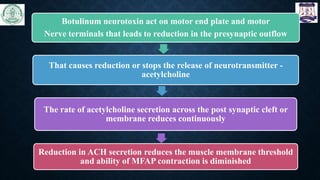
Botulinum neurotoxin act on motor end plate and motor
Nerve terminals that leads to reduction in the presynaptic outflow
That causes reduction or stops the release of neurotransmitter -
acetylcholine
The rate of acetylcholine secretion across the post synaptic cleft or
membrane reduces continuously
Reduction in ACH secretion reduces the muscle membrane threshold
and ability of MFAP contraction is diminished
FORMULATION
 Botox is commercially formulated – as a vacuum dried powder
 Storage at 2 – 8 degree c is recommended
 Shelf life is 2 year
Appropriate age for Botox = 2 -6 year of age
INJECTION TECHNIQUE
• Given in small sedition
• General anaesthesia
• Ultrasound and electromyography also require
• The injection dose depend on muscle involvement and clinical
presentation and severity of hypertonia
Atter , KE, McQuire J Nicholes S , Botulimum neurotoxin for treatment of muscle overactivity associated with upper motor neuron
syndrome In : Atter , KE , Wilson , NA, editor , rehabilitation medicine national institute of health 2015.p-122-76
DOSAGE
PEDIATRICS –
• Upper limb muscle = 0.5 – 2 units /kg /muscle
• Lower limb muscle = 2 - 4 units /kg /muscle
• Maximum dosage = 3 – 8 units /kg or 300 IU
Atter , KE, McQuire J Nicholes S , Botulimum neurotoxin for treatment of muscle overactivity associated with
upper motor neuron syndrome In : Atter , KE , Wilson , NA, editor , rehabilitation medicine national institute of
health 2015.p-122-76
COMMON MUSCLES OF UPPER AND LOWER
EXTREMITY WHICH ARE INJECTED ARE : -
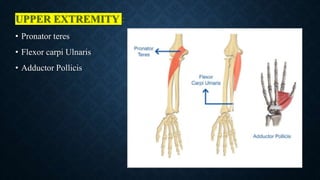
UPPER EXTREMITY :
• Pronator teres
• Flexor carpi Ulnaris
• Adductor Pollicis
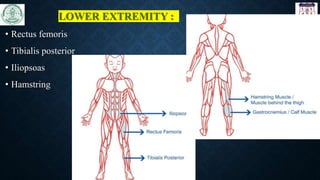
LOWER EXTREMITY :
• Rectus femoris
• Tibialis posterior
• Iliopsoas
• Hamstring
CLINICAL EFFECT
• Clinical effect of Botox therapy shows effect within – 3 - 4
days or some time 1 week
• Botox therapy is not permanent- Duration of effect is last for 6
month to 1 year
INDICATIONS
• Given in cerebral palsy
• Post stroke spasticity
• Spasticity for different reason
• Having the spasticity more then 2 ( Ashworth )
• Spasticity which is progressively increasing causing contracture
• Botox treatment decreases pain and stiffness in muscles.
• Improves range of motion, gait pattern.
• Possible delay in surgery until the patient is older.
• Improved independent use of the upper extremities for ADLs
SIDE EFFECTS
• Asthenia (lack or loss of strength and energy)
• Diplopia (double vision)
• Ptosis (droopy eyelids)
• Dysphagia (difficulty swallowing)
• Dysphonia (problems with voice quality)
• Dysarthria (problems speaking)
• Urinary incontinence, and breathing difficulties
• Temporary weakness to the extremity where the Botox has been given.
• Localized injection site pain.
• Localized injection site infection.
• Administration of Botulinum Toxin for the 1st time leads to symptoms like
Fever, cough, cold or flu
PHYSIOTHERAPY MANAGEMENT
• Parents education
• Improve muscle length
• Orthotic support
• Improve muscle power
• Improve trunk control
• Gait training and ambulation
• Balance training
Noureen Fatima 2019 ,Case study on post botox physiotherapy management in diplegic cerebral palsy ,
EAS journal of orthopedic and physiotherapy volume 1 , issue -1
• Parents education
stretching ex – thrice a day ,10 repetitions
With 20 sec hold and every 2 hourly on and off splinting ( HKAFO
or KAFO )
• Improve muscle length
• Stretching exercises –
• 10 repetition 20 sec hold
• Orthotic support = 6 hr. in a day
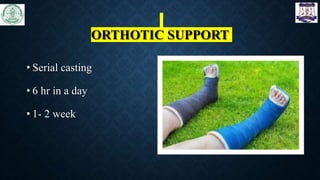
ORTHOTIC SUPPORT
• Serial casting
• 6 hr in a day
• 1- 2 week
IMPROVE MUSCLE STRENGTH
 STRENGTHENING EX.
• TheraBand exercise
• Weight cuff
Noureen Fatima 2019 ,Case study on post botox physiotherapy management in diplegic cerebral palsy , EAS journal of orthopedic and physiotherapy
volume 1 , issue -1
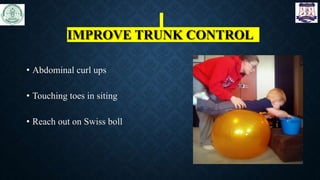
IMPROVE TRUNK CONTROL
• Abdominal curl ups
• Touching toes in siting
• Reach out on Swiss boll
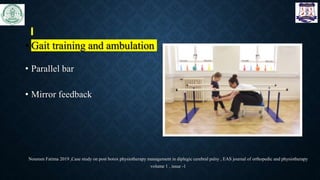
• Gait training and ambulation
• Parallel bar
• Mirror feedback
Noureen Fatima 2019 ,Case study on post botox physiotherapy management in diplegic cerebral palsy , EAS journal of orthopedic and physiotherapy
volume 1 , issue -1
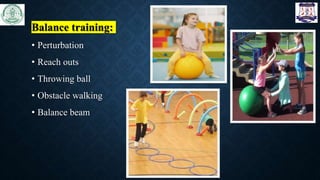
Balance training:
• Perturbation
• Reach outs
• Throwing ball
• Obstacle walking
• Balance beam
RECENT ADVANCE
• Effect of combined rehabilitation program with botulinum toxin type A
injections on gross motor functional in children with spastic cerebral
palsy
AUTHOR– ABEER FlEMBAN PT PhD WAlAA Elsyes
JOURNAL – the journal of physical therapy sciences
Published – jan 29 , 2018
Conclusion – the combine use of botox type A with intence physiotherapy effect
being greatest when use in children with mild to moderate spasticity
REFRENCESS
• Atter , KE, McQuire J Nicholes S , Botulimum neurotoxin for treatment of muscle
overactivity associated with upper motor neuron syndrome In : Atter , KE , Wilson ,
NA, editor , rehabilitation medicine national institute of health 2015.p-122-76
• Johan p ney and kevin r joseph , neurological uses of botulinim neurotoxin type A ,
neuropsychiatric diseases and treatment 2007 :3(6) 785-798
• J Jankovic , botulinum toxin in clinical practise , j neuronal neurosurg psychiatry
2004 ; 75 :951
• Vit0 pavone , Gianluca testa etal , botulinum toxin treatment for limb spasticity in
childhood cerebral palsy , frontiers in pharmacology , 19 February 2016 , 7 : 29
THANK YOU

BOTULINUM TOXIN INJECTION FOR SPASTICITY

  • 1.
    BOTULINUM TOXIN INJECTION FORSPASTICITY Presented by –Shadab khan 2nd year MPT Paediatric Physiotherapy Department
  • 2.
    CONTENT 1. INTRODUCTION 2. WHATIS BOTOX 3. MECHANISUM OF ACTION 4. FORMULATION 5. INJECTION TECHNIQUE 6. DOSAGE 7. COMMON MUSCLES 8. CLINICAL EFFECT 9. INDICATION 10. SIDE EFFECT 11. PHYSIOTHERAPY MANAGEMENT 12. REFRENCESS
  • 3.
    OBJECTIVE • What isbotox ? • What is Mechanism of action ? • Formulation ? • How much Dosage ? • What is Indication ? • What is Side effect ? • Post botox physiotherapy treatment ?
  • 4.
    INTRODUCTION • Spasticity, ormuscle stiffness, is a common problem for children with cerebral palsy . • Spastic muscles leads tightness and make all movement difficult, and interfere with many motor activities including rolling , crawling , sitting, walking, feeding . • Oral and injected medications are helpful in treating cerebral palsy spasticity
  • 5.
    • Oral medicationsare effective in treating mild spasticity • Patients with significant spasticity can be treated with injected medications such as Botulinum type A toxin (Botox®).
  • 6.
    WHAT IS BOTOX? •Botulinum-A Toxin is also known as the botox it is made by bacteria called bacillus clostridium • Bacillus clostridium secretes 7 serotypes of botulinum toxin ( A- G) • Botulinum toxin injection – Ona botulinumtoxin A ( OBTA Botox®) is only botulinum neurotoxin product available as drug administration approval for the treatment of spasticity
  • 7.
  • 8.
    Botulinum neurotoxin acton motor end plate and motor Nerve terminals that leads to reduction in the presynaptic outflow That causes reduction or stops the release of neurotransmitter - acetylcholine The rate of acetylcholine secretion across the post synaptic cleft or membrane reduces continuously Reduction in ACH secretion reduces the muscle membrane threshold and ability of MFAP contraction is diminished
  • 9.
    FORMULATION  Botox iscommercially formulated – as a vacuum dried powder  Storage at 2 – 8 degree c is recommended  Shelf life is 2 year Appropriate age for Botox = 2 -6 year of age
  • 10.
    INJECTION TECHNIQUE • Givenin small sedition • General anaesthesia • Ultrasound and electromyography also require • The injection dose depend on muscle involvement and clinical presentation and severity of hypertonia Atter , KE, McQuire J Nicholes S , Botulimum neurotoxin for treatment of muscle overactivity associated with upper motor neuron syndrome In : Atter , KE , Wilson , NA, editor , rehabilitation medicine national institute of health 2015.p-122-76
  • 11.
    DOSAGE PEDIATRICS – • Upperlimb muscle = 0.5 – 2 units /kg /muscle • Lower limb muscle = 2 - 4 units /kg /muscle • Maximum dosage = 3 – 8 units /kg or 300 IU Atter , KE, McQuire J Nicholes S , Botulimum neurotoxin for treatment of muscle overactivity associated with upper motor neuron syndrome In : Atter , KE , Wilson , NA, editor , rehabilitation medicine national institute of health 2015.p-122-76
  • 12.
    COMMON MUSCLES OFUPPER AND LOWER EXTREMITY WHICH ARE INJECTED ARE : -
  • 13.
    UPPER EXTREMITY : •Pronator teres • Flexor carpi Ulnaris • Adductor Pollicis
  • 14.
    LOWER EXTREMITY : •Rectus femoris • Tibialis posterior • Iliopsoas • Hamstring
  • 15.
    CLINICAL EFFECT • Clinicaleffect of Botox therapy shows effect within – 3 - 4 days or some time 1 week • Botox therapy is not permanent- Duration of effect is last for 6 month to 1 year
  • 16.
    INDICATIONS • Given incerebral palsy • Post stroke spasticity • Spasticity for different reason • Having the spasticity more then 2 ( Ashworth ) • Spasticity which is progressively increasing causing contracture
  • 17.
    • Botox treatmentdecreases pain and stiffness in muscles. • Improves range of motion, gait pattern. • Possible delay in surgery until the patient is older. • Improved independent use of the upper extremities for ADLs
  • 18.
    SIDE EFFECTS • Asthenia(lack or loss of strength and energy) • Diplopia (double vision) • Ptosis (droopy eyelids) • Dysphagia (difficulty swallowing) • Dysphonia (problems with voice quality) • Dysarthria (problems speaking) • Urinary incontinence, and breathing difficulties
  • 19.
    • Temporary weaknessto the extremity where the Botox has been given. • Localized injection site pain. • Localized injection site infection. • Administration of Botulinum Toxin for the 1st time leads to symptoms like Fever, cough, cold or flu
  • 20.
    PHYSIOTHERAPY MANAGEMENT • Parentseducation • Improve muscle length • Orthotic support • Improve muscle power • Improve trunk control • Gait training and ambulation • Balance training Noureen Fatima 2019 ,Case study on post botox physiotherapy management in diplegic cerebral palsy , EAS journal of orthopedic and physiotherapy volume 1 , issue -1
  • 21.
    • Parents education stretchingex – thrice a day ,10 repetitions With 20 sec hold and every 2 hourly on and off splinting ( HKAFO or KAFO ) • Improve muscle length • Stretching exercises – • 10 repetition 20 sec hold • Orthotic support = 6 hr. in a day
  • 22.
    ORTHOTIC SUPPORT • Serialcasting • 6 hr in a day • 1- 2 week
  • 23.
    IMPROVE MUSCLE STRENGTH STRENGTHENING EX. • TheraBand exercise • Weight cuff Noureen Fatima 2019 ,Case study on post botox physiotherapy management in diplegic cerebral palsy , EAS journal of orthopedic and physiotherapy volume 1 , issue -1
  • 24.
    IMPROVE TRUNK CONTROL •Abdominal curl ups • Touching toes in siting • Reach out on Swiss boll
  • 25.
    • Gait trainingand ambulation • Parallel bar • Mirror feedback Noureen Fatima 2019 ,Case study on post botox physiotherapy management in diplegic cerebral palsy , EAS journal of orthopedic and physiotherapy volume 1 , issue -1
  • 26.
    Balance training: • Perturbation •Reach outs • Throwing ball • Obstacle walking • Balance beam
  • 27.
    RECENT ADVANCE • Effectof combined rehabilitation program with botulinum toxin type A injections on gross motor functional in children with spastic cerebral palsy AUTHOR– ABEER FlEMBAN PT PhD WAlAA Elsyes JOURNAL – the journal of physical therapy sciences Published – jan 29 , 2018 Conclusion – the combine use of botox type A with intence physiotherapy effect being greatest when use in children with mild to moderate spasticity
  • 28.
    REFRENCESS • Atter ,KE, McQuire J Nicholes S , Botulimum neurotoxin for treatment of muscle overactivity associated with upper motor neuron syndrome In : Atter , KE , Wilson , NA, editor , rehabilitation medicine national institute of health 2015.p-122-76 • Johan p ney and kevin r joseph , neurological uses of botulinim neurotoxin type A , neuropsychiatric diseases and treatment 2007 :3(6) 785-798 • J Jankovic , botulinum toxin in clinical practise , j neuronal neurosurg psychiatry 2004 ; 75 :951 • Vit0 pavone , Gianluca testa etal , botulinum toxin treatment for limb spasticity in childhood cerebral palsy , frontiers in pharmacology , 19 February 2016 , 7 : 29
  • 29.

Editor's Notes

  • #5 Myobloc (Botulinum Toxin B) and Dysport (Botulinum Toxin A)
  • #7 These are highly purified and diluted protein which safely and effectively reducess spasticity in specific muscle groups.
  • #9 Motor fibre action potential
  • #10 International unit Appropriate age for Botox = 2 -6 year of age having less body weight
  • #18 Improved tolerance of braces.
  • #19 Generalized muscle weakness