Arq Neuropsiquiatr 2005;63(1):30-33


BOTULINUM TOXIN TYPE A FOR THE TREATMENT
OF THE UPPER LIMB SPASTICITY AFTER STROKE

A meta-analysis
Eduardo Cardoso1, Bernardo Rodrigues2, Rita Lucena3,
Irismar Reis de Oliveira5, Glícia Pedreira2, Ailton Melo4

           ABSTRACT - Muscle over-activity is one of the cardinal features of spasticity and it is a common disability of
           stroke patients. In this group, spasticity is responsible for several limitations that interfere in their daily ac-
           tivities and quality of life. To treat spasticity, neurologists usually prescribe drugs as baclofen, tizanidine
           or benzodiazepines or even use definitive treatment as phenol or surgery. Authors suggest the use of botuli-
           num toxin type A (BTX-A) for spasticity in the upper limbs after stroke, but there are few papers with adequa-
           te methodology supporting this idea. In this article we summarize the data of previous double-blind, randomi-
           sed clinical trials to asses, with a meta-analysis, if BTX-A is an adequate treatment for spasticity due to stroke.
           The results show a statistical superiority of BTX-A ov%r placebo on reducing muscle tone by the Modified
           Ashworth Scale (WMD= 0.95 [0.74 to 1.17]) in patients with post-stroke upper limb spasticity.
           KEY WORDS: stroke, spasticity, botulinum toxin, rehabilitation.


           Toxina botulínica tipo A para o tratamento da espasticidade de membros superiores pós-AVC:
           metanálise
           RESUMO - Hiperatividade muscular é um dos principais sinais encontrados na espasticidade e seqüela comum
           após acidente vascular encefálico (AVC). Nesse grupo de pacientes, a espasticidade é responsável por limi-
           tações que interferem nas atividades diárias e qualidade de vida. Para tratar a espasticidade, neurologistas
           geralmente prescrevem drogas como baclofeno, tizanidina, benzodiazepínicos ou mesmo intervenções defi-
           nitivas como fenol e cirurgia. Há quase duas décadas que a toxina botulínica tipo A (BTX-A) vem sendo uti-
           lizada para tratamento da espasticidade nos membros superiores pós-AVC; no entanto, há poucos artigos
           com metodologia adequada apoiando esta assertiva. Neste artigo avaliamos todos os dados de ensaios clí-
           nicos duplo-cegos e randomizados para definir, através de metanálise, se BTX-A é um tratamento adequa-
           do para espasticidade pós-AVC. Os nossos resultados mostram superioridade estatística da BTX-A sobre o
           placebo na redução do tônus muscular pela escala de Ashworth modificada (WMD= 0.95 [0.74 to 1.17])
           em pacientes com espasticidade de membros superiores pós-AVC.
           PALAVRAS-CHAVE: AVC, espasticidade, toxina botulínica, reabilitação.


    Stroke is the most important cause of neurologi-                    ly causes difficulties with activities of daily living,
cal disabilities in adults1. Severe hypertonia of up-                   such as dressing and cleaning the palm of the clen-
per limb muscles is a common complication in these                      ched hand. It may also interfere with voluntary motor
patients2. About 5% of stroke patients regain use-                      function in patients with residual muscle power4.
ful function of the paralysed arm and the prospects                     In some patients, severe hypertonia causes pain, dis-
of recovery after 3 months are usually negligible3.                     comfort and psychological disturbance with poor
Although the muscle weakness and loss of ability                        self-esteem and body image5. In these patients
are important factors in the motor functional disabili-                 botulinum toxin treatment presents an opportu-
ty in these patients, the contribution of muscle spas-                  nity to reduce disability by blocking acetylcholine
ticity is often quite significant. Spasticity frequent-                 release at the neuromuscular junction.


Division of Neurology and Epidemiology (DINEP) Federal University of Bahia, Salvador BA, Brazil: 1Mestre em Neurociências;
2
 Pesquisador da DINEP; 3Professor Adjunto de Neurologia; 4Professor Livre Docente em Neurologia; 5Professor Titular de Psiquiatria.
Received 31 March 2004, received in final form 15 July 2004. Accepted 8 September 2004.
Dr. Ailton Melo - Avenida Magalhães Neto 735/802 - 41820-020 Salvador BA - Brasil.
Arq Neuropsiquiatr 2005;63(1)                                        31


   Despite the great number of authors suggest-                           The individuals included in the studies have
ing the use of botulinum toxin type A (BTX-A) for                     not been previously submitted to other pharmaco-
spasticity in the upper limbs, there are few papers                   logical or surgical treatment for spasticity and all
with adequate methodology to support this idea.                       of them were doing physiotherapy.
   In this article we summarize the data of previ-                        All of the studies described the clinical data
ous randomised clinical trials to assess if botulinum                 referring from the period between the fourth and
toxin is an adequate treatment for spasticity due                     sixth weeks after the application of the botulinum
to stroke.                                                            toxin and these data where used in the analysis.
                                                                          Because heterogeneity (χ2=2,63; d.f.=2; p=0,007)
    METHOD                                                            was seen when clinical improvement was tested to
    In a systematic review of literature, we selected all
                                                                      compare the botulinum toxin group to placebo,
double-blind, placebo-controlled, randomized clinical tri-
                                                                      using either MAS or GAS, by means of a fixed effect
als (RCT) evaluating the safety and efficacy of BTX-A for
the treatment of spasticity in the upper limbs after
                                                                      model (OR= 3.38; 95% CI= 1.34 to 8.52), a random
stroke. Only data presented as, or allowing transforma-               effects model was used, confirming the results (OR=
tion into, mean±standard deviation were considered                    3.31, 95% CI= 1.18 to 9.26).
for analysis.                                                             Clinical improvement was also tested using the
    The searches were performed by means of Medline,                  modified Ashworth Scale and this result was con-
Cochrane Library, Bireme, Web of Science, and Scisearch               firmed as well (WMD= 0.95, 95% CI= 0.74 to 1.17).
databases between 1989 (year of approval of botulinum                 Mean clinical improvement was higher in the botu-
toxin in humans by FDA) and 2004, using the words
                                                                      linum group (Z= 8.57, p< 0.00001) at 4-6 week pe-
“botulinum toxin” “spasticity” and “stroke”. Then, refe-
                                                                      riod of the study. Mean MAS score change was also
rences of every selected study were checked with the pur-
pose of identifying studies not found on electronic se-
                                                                      higher, when wrist joint was included at the same
arch. The studies were selected and the quality of the                endpoint (Z= 8.44, p< 0.00001).
RCT evaluated by three independent reviewers using the                    The mean GAS scores improvement were signifi-
method proposed by Jadad et al.6 The measured out-                    cantly higher in all parameters of the botulinum
comes were any change in the Modified Ashworth Scale                  group (WMD=1.11, 95% CI= 0.81 to 1.41, Z=7 .32,
(MAS)7 or in the physician’s and patient’s Global Asses-              df= 1, p<0.00001).
sment Scale (GAS)8.                                                       Safety analysis was not possible, due to lack of
    Data were analysed with the statistical packs Revman
                                                                      adequate data in the selected studies, since only
4.0 from Cochrane Collaboration, and SPSS (Statistical
                                                                      one study described side effects or adverse events,
Package for the Social Sciences), v9.0.
                                                                      showing headache and pain as main complaints in
                                                                      both groups.
   RESULTS
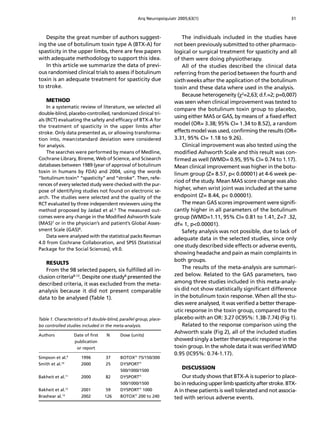
   From the 98 selected papers, six fulfilled all in-                     The results of the meta-analysis are summari-
clusion criteria8-13. Despite one study8 presented the                zed below. Related to the GAS parameters, two
described criteria, it was excluded from the meta-                    among three studies included in this meta-analy-
analysis because it did not present comparable                        sis did not show statistically significant difference
data to be analysed (Table 1).                                        in the botulinum toxin response. When all the stu-
                                                                      dies were analysed, it was verified a better therape-
                                                                      utic response in the toxin group, compared to the
Table 1. Characteristics of 5 double-blind, parallel group, place-    placebo with an OR: 3.27 (IC95%: 1.38-7.74) (Fig 1).
bo controlled studies included in the meta-analysis.                      Related to the response comparison using the
                                                                      Ashworth scale (Fig 2), all of the included studies
Authors            Date of first    N       Dose (units)
                   publication                                        showed singly a better therapeutic response in the
                    or report                                         toxin group. In the whole data it was verified WMD
                                                                      0.95 (IC95%: 0.74-1.17).
Simpson et al.9       1996          37      BOTOX® 75/150/300
Smith et al.10        2000          25      DYSPORT®
                                            500/1000/1500
                                                                          DISCUSSION
Bakheit et al.11      2000          82      DYSPORT®                     Our study shows that BTX-A is superior to place-
                                            500/1000/1500             bo in reducing upper limb spasticity after stroke. BTX-
Bakheit et al.12      2001         59       DYSPORT® 1000             A in these patients is well tolerated and not associa-
Brashear al.13        2002         126      BOTOX® 200 to 240         ted with serious adverse events.
32                                               Arq Neuropsiquiatr 2005;63(1)


Fig 1. Comparison of GAS score in the groups using BTX and placebo.


Fig 2. Change in Modified Ashworth scale from baseline at follow-up visits.


    The primary efficacy measure in all but one pa-                has been stressed by Simpson et al.9 additional func-
per was muscle tone activity using the MAS or GAS                  tional gains can be obtained using BTX-A in spe-
scale. Independent of doses or BTX-A used (Botox®                  cific spastic muscles and some investigators have
or Dysport®) the peak reduction of muscle tone was                 demonstrated that even though disability scores
obtained at weeks four and six after injection and                 are unchanged, patients were capable to perform
returned to baseline between 10 and 16 weeks.                      self care, which emphasises the necessity of more
Although the outcomes show that treatment with                     sensitive scales to reveal benefits associated to pa-
BTX-A in patients with upper limb spasticity result-               tients goals and subjective experience of impro-
ed in statistically significant reduction in muscle to-            vement. Some scales as the Barthel Index or the
ne, its overall effect in functional disability was not            Functional Independent Measures have not enough
fully observed by the majority of authors. In all revi-            accuracy to identify modifications in quality of life
sed papers patients were enrolled in physiothera-                  secondary to reduction in muscle spasticity. The spas-
py programs, but there was no specific occupation-                 ticity is variable from patient to patient and indi-
al therapy described and few authors applied func-                 vidualised scales will be necessary to measure spe-
tional or quality of life measures. Furthermore, the               cific goals14. Brashear et al.13 analysed functional as-
studied population had different time of post-stroke               pects of post-stroke patients with wrist and finger
spasticity and some patients were probably adapt-                  spasticity submitted to intra-muscular injection of
ed to their spasticity. Another matter of concern                  BTX-A or placebo. These authors observed signifi-
is related to standardize muscles to apply BTX-A. As               cant improvement of functional disability in pa-
Arq Neuropsiquiatr 2005;63(1)                                                                  33


tients that received BTX-A when compared to pla-                                  BMJ 1992;304:609-613.
                                                                               4. Mizrahi EM, Angel RW. Impairment of voluntary movement by spasti-
cebo group, emphasising the importance of BTX-A                                   city. Ann Neurol. 1979;5:494-495.
in clinical rehabilitation. In our view, the decrease                          5. Blasi J, Chapman ER, Link E, et al. Botulinum neurotoxin A selective-
                                                                                  ly cleaves the synaptic protein SNAP-25. Nature 1993;365:160-163.
of muscle tone in upper limb spastic patients is only                          6. Jadad AR, Moore A, Carrol D. Assessing the quality of reports of randomi-
part of treatment. In this way, the possibility of hy-                            sed clinical trials: is blinding necessary? Control Clin Trials 1996;17:1-12.
giene in arm-pit and palm of the hand as well as                               7. Bohannom RW, Smith MB. Inter-rater reliability of a modified Ashworth
                                                                                  Scale of muscle spasticity. Phys Ther. 1987;67:206-207.
possibility of physiologic postures to decrease habit-                         8. Bhakta BB, Cozens JA, Chamberlian MA, Bamford JM. Impact of botuli-
forming contractions have important role in the                                   num toxin type A on disability and carer burden due to arm spastici-
                                                                                  ty after stroke: a randonised double blind placebo controlled trial. J
quality of life. Although spasticity is frequently as-                            Neurol Neurosurg Psychiartry 2001;70:821.
sociated with pain, this symptom was poorly ana-                               9. Simpson DM, Alexander DN, O’Brien CF, et al. Botulinum toxin type
                                                                                  A in the treatment of upper extremity spasticity: a randomised, dou-
lysed and it was not possible to be compared.                                     ble-blind, placebo-controlled trial. Neurology 1996;46:1306-1310.
                                                                              10. Smith SJ, Ellis E, White S, Moore AP. A double-blind placebo-controlled
    In summary this meta-analysis shows that BTX-                                 study of botulinum toxin in upper limb spasticity after stroke or head
A decreases spasticity, is a safe therapeutic agent                               injury. Clin Rehabil 2000;14:5-13.
                                                                              11. Bakheit AM, Thilmann AF, Ward AB, et al. A randomised, double-
and also suggests that it probably improves quali-                                blind, placebo-controlled, dose-raging study to compare the efficacy
ty of life in upper limb spastic patients. There is no                            and safety of three doses of botulinum toxin type A with placebo in upper
                                                                                  limb spasticity after stroke. Stroke 2000;31:2402-2406.
information about long-term use of BTX-A.                                     12. Bakheit AMO; Pittock S, Moore AP, et al. A randomised, double-blind,
                                                                                  placebo-controlled study of the efficacy and safety of botulinum toxin
                                                                                  type A in upper limb spasticity in patients with stroke. Eur J Neurol
   REFERENCES                                                                     2001;8:559-565.
1. Nakaiama H, Jorgensen HS, Raaschou HO, et al. Recovery of upper extre-     13. Brashear A, Gordon MF, Elovic E, et al. Intra-muscular injection of bot-
   mity function in stroke patients: the Copenhagen stroke study. Arch Phys       ulinum toxin for the treatment of wrist and finger spasticity after a stroke.
   Med Rehab 1994;75:394-398.                                                     N Engl J Med 2002;347:395-400.
2. Rousseaux M, Kozlowski O, Froger J. Efficacy of botulinum toxin A in       14. Bakheit AMO. Optimising the methods of evaluation of the effective-
   upper limb function of hemiplegic patients. J Neurol 2002:249:76-84            ness of botuilinum toxin treatment of post-stroke muscle spasticity. J
3. Wade DT. Physiotherapy intervention late after stroke and morbidity.           Neurol Neurosurg Psychiatry 2004;75:665-666.

Botox

  • 1.
    Arq Neuropsiquiatr 2005;63(1):30-33 BOTULINUMTOXIN TYPE A FOR THE TREATMENT OF THE UPPER LIMB SPASTICITY AFTER STROKE A meta-analysis Eduardo Cardoso1, Bernardo Rodrigues2, Rita Lucena3, Irismar Reis de Oliveira5, Glícia Pedreira2, Ailton Melo4 ABSTRACT - Muscle over-activity is one of the cardinal features of spasticity and it is a common disability of stroke patients. In this group, spasticity is responsible for several limitations that interfere in their daily ac- tivities and quality of life. To treat spasticity, neurologists usually prescribe drugs as baclofen, tizanidine or benzodiazepines or even use definitive treatment as phenol or surgery. Authors suggest the use of botuli- num toxin type A (BTX-A) for spasticity in the upper limbs after stroke, but there are few papers with adequa- te methodology supporting this idea. In this article we summarize the data of previous double-blind, randomi- sed clinical trials to asses, with a meta-analysis, if BTX-A is an adequate treatment for spasticity due to stroke. The results show a statistical superiority of BTX-A ov%r placebo on reducing muscle tone by the Modified Ashworth Scale (WMD= 0.95 [0.74 to 1.17]) in patients with post-stroke upper limb spasticity. KEY WORDS: stroke, spasticity, botulinum toxin, rehabilitation. Toxina botulínica tipo A para o tratamento da espasticidade de membros superiores pós-AVC: metanálise RESUMO - Hiperatividade muscular é um dos principais sinais encontrados na espasticidade e seqüela comum após acidente vascular encefálico (AVC). Nesse grupo de pacientes, a espasticidade é responsável por limi- tações que interferem nas atividades diárias e qualidade de vida. Para tratar a espasticidade, neurologistas geralmente prescrevem drogas como baclofeno, tizanidina, benzodiazepínicos ou mesmo intervenções defi- nitivas como fenol e cirurgia. Há quase duas décadas que a toxina botulínica tipo A (BTX-A) vem sendo uti- lizada para tratamento da espasticidade nos membros superiores pós-AVC; no entanto, há poucos artigos com metodologia adequada apoiando esta assertiva. Neste artigo avaliamos todos os dados de ensaios clí- nicos duplo-cegos e randomizados para definir, através de metanálise, se BTX-A é um tratamento adequa- do para espasticidade pós-AVC. Os nossos resultados mostram superioridade estatística da BTX-A sobre o placebo na redução do tônus muscular pela escala de Ashworth modificada (WMD= 0.95 [0.74 to 1.17]) em pacientes com espasticidade de membros superiores pós-AVC. PALAVRAS-CHAVE: AVC, espasticidade, toxina botulínica, reabilitação. Stroke is the most important cause of neurologi- ly causes difficulties with activities of daily living, cal disabilities in adults1. Severe hypertonia of up- such as dressing and cleaning the palm of the clen- per limb muscles is a common complication in these ched hand. It may also interfere with voluntary motor patients2. About 5% of stroke patients regain use- function in patients with residual muscle power4. ful function of the paralysed arm and the prospects In some patients, severe hypertonia causes pain, dis- of recovery after 3 months are usually negligible3. comfort and psychological disturbance with poor Although the muscle weakness and loss of ability self-esteem and body image5. In these patients are important factors in the motor functional disabili- botulinum toxin treatment presents an opportu- ty in these patients, the contribution of muscle spas- nity to reduce disability by blocking acetylcholine ticity is often quite significant. Spasticity frequent- release at the neuromuscular junction. Division of Neurology and Epidemiology (DINEP) Federal University of Bahia, Salvador BA, Brazil: 1Mestre em Neurociências; 2 Pesquisador da DINEP; 3Professor Adjunto de Neurologia; 4Professor Livre Docente em Neurologia; 5Professor Titular de Psiquiatria. Received 31 March 2004, received in final form 15 July 2004. Accepted 8 September 2004. Dr. Ailton Melo - Avenida Magalhães Neto 735/802 - 41820-020 Salvador BA - Brasil.
  • 2.
    Arq Neuropsiquiatr 2005;63(1) 31 Despite the great number of authors suggest- The individuals included in the studies have ing the use of botulinum toxin type A (BTX-A) for not been previously submitted to other pharmaco- spasticity in the upper limbs, there are few papers logical or surgical treatment for spasticity and all with adequate methodology to support this idea. of them were doing physiotherapy. In this article we summarize the data of previ- All of the studies described the clinical data ous randomised clinical trials to assess if botulinum referring from the period between the fourth and toxin is an adequate treatment for spasticity due sixth weeks after the application of the botulinum to stroke. toxin and these data where used in the analysis. Because heterogeneity (χ2=2,63; d.f.=2; p=0,007) METHOD was seen when clinical improvement was tested to In a systematic review of literature, we selected all compare the botulinum toxin group to placebo, double-blind, placebo-controlled, randomized clinical tri- using either MAS or GAS, by means of a fixed effect als (RCT) evaluating the safety and efficacy of BTX-A for the treatment of spasticity in the upper limbs after model (OR= 3.38; 95% CI= 1.34 to 8.52), a random stroke. Only data presented as, or allowing transforma- effects model was used, confirming the results (OR= tion into, mean±standard deviation were considered 3.31, 95% CI= 1.18 to 9.26). for analysis. Clinical improvement was also tested using the The searches were performed by means of Medline, modified Ashworth Scale and this result was con- Cochrane Library, Bireme, Web of Science, and Scisearch firmed as well (WMD= 0.95, 95% CI= 0.74 to 1.17). databases between 1989 (year of approval of botulinum Mean clinical improvement was higher in the botu- toxin in humans by FDA) and 2004, using the words linum group (Z= 8.57, p< 0.00001) at 4-6 week pe- “botulinum toxin” “spasticity” and “stroke”. Then, refe- riod of the study. Mean MAS score change was also rences of every selected study were checked with the pur- pose of identifying studies not found on electronic se- higher, when wrist joint was included at the same arch. The studies were selected and the quality of the endpoint (Z= 8.44, p< 0.00001). RCT evaluated by three independent reviewers using the The mean GAS scores improvement were signifi- method proposed by Jadad et al.6 The measured out- cantly higher in all parameters of the botulinum comes were any change in the Modified Ashworth Scale group (WMD=1.11, 95% CI= 0.81 to 1.41, Z=7 .32, (MAS)7 or in the physician’s and patient’s Global Asses- df= 1, p<0.00001). sment Scale (GAS)8. Safety analysis was not possible, due to lack of Data were analysed with the statistical packs Revman adequate data in the selected studies, since only 4.0 from Cochrane Collaboration, and SPSS (Statistical one study described side effects or adverse events, Package for the Social Sciences), v9.0. showing headache and pain as main complaints in both groups. RESULTS From the 98 selected papers, six fulfilled all in- The results of the meta-analysis are summari- clusion criteria8-13. Despite one study8 presented the zed below. Related to the GAS parameters, two described criteria, it was excluded from the meta- among three studies included in this meta-analy- analysis because it did not present comparable sis did not show statistically significant difference data to be analysed (Table 1). in the botulinum toxin response. When all the stu- dies were analysed, it was verified a better therape- utic response in the toxin group, compared to the Table 1. Characteristics of 5 double-blind, parallel group, place- placebo with an OR: 3.27 (IC95%: 1.38-7.74) (Fig 1). bo controlled studies included in the meta-analysis. Related to the response comparison using the Ashworth scale (Fig 2), all of the included studies Authors Date of first N Dose (units) publication showed singly a better therapeutic response in the or report toxin group. In the whole data it was verified WMD 0.95 (IC95%: 0.74-1.17). Simpson et al.9 1996 37 BOTOX® 75/150/300 Smith et al.10 2000 25 DYSPORT® 500/1000/1500 DISCUSSION Bakheit et al.11 2000 82 DYSPORT® Our study shows that BTX-A is superior to place- 500/1000/1500 bo in reducing upper limb spasticity after stroke. BTX- Bakheit et al.12 2001 59 DYSPORT® 1000 A in these patients is well tolerated and not associa- Brashear al.13 2002 126 BOTOX® 200 to 240 ted with serious adverse events.
  • 3.
    32 Arq Neuropsiquiatr 2005;63(1) Fig 1. Comparison of GAS score in the groups using BTX and placebo. Fig 2. Change in Modified Ashworth scale from baseline at follow-up visits. The primary efficacy measure in all but one pa- has been stressed by Simpson et al.9 additional func- per was muscle tone activity using the MAS or GAS tional gains can be obtained using BTX-A in spe- scale. Independent of doses or BTX-A used (Botox® cific spastic muscles and some investigators have or Dysport®) the peak reduction of muscle tone was demonstrated that even though disability scores obtained at weeks four and six after injection and are unchanged, patients were capable to perform returned to baseline between 10 and 16 weeks. self care, which emphasises the necessity of more Although the outcomes show that treatment with sensitive scales to reveal benefits associated to pa- BTX-A in patients with upper limb spasticity result- tients goals and subjective experience of impro- ed in statistically significant reduction in muscle to- vement. Some scales as the Barthel Index or the ne, its overall effect in functional disability was not Functional Independent Measures have not enough fully observed by the majority of authors. In all revi- accuracy to identify modifications in quality of life sed papers patients were enrolled in physiothera- secondary to reduction in muscle spasticity. The spas- py programs, but there was no specific occupation- ticity is variable from patient to patient and indi- al therapy described and few authors applied func- vidualised scales will be necessary to measure spe- tional or quality of life measures. Furthermore, the cific goals14. Brashear et al.13 analysed functional as- studied population had different time of post-stroke pects of post-stroke patients with wrist and finger spasticity and some patients were probably adapt- spasticity submitted to intra-muscular injection of ed to their spasticity. Another matter of concern BTX-A or placebo. These authors observed signifi- is related to standardize muscles to apply BTX-A. As cant improvement of functional disability in pa-
  • 4.
    Arq Neuropsiquiatr 2005;63(1) 33 tients that received BTX-A when compared to pla- BMJ 1992;304:609-613. 4. Mizrahi EM, Angel RW. Impairment of voluntary movement by spasti- cebo group, emphasising the importance of BTX-A city. Ann Neurol. 1979;5:494-495. in clinical rehabilitation. In our view, the decrease 5. Blasi J, Chapman ER, Link E, et al. Botulinum neurotoxin A selective- ly cleaves the synaptic protein SNAP-25. Nature 1993;365:160-163. of muscle tone in upper limb spastic patients is only 6. Jadad AR, Moore A, Carrol D. Assessing the quality of reports of randomi- part of treatment. In this way, the possibility of hy- sed clinical trials: is blinding necessary? Control Clin Trials 1996;17:1-12. giene in arm-pit and palm of the hand as well as 7. Bohannom RW, Smith MB. Inter-rater reliability of a modified Ashworth Scale of muscle spasticity. Phys Ther. 1987;67:206-207. possibility of physiologic postures to decrease habit- 8. Bhakta BB, Cozens JA, Chamberlian MA, Bamford JM. Impact of botuli- forming contractions have important role in the num toxin type A on disability and carer burden due to arm spastici- ty after stroke: a randonised double blind placebo controlled trial. J quality of life. Although spasticity is frequently as- Neurol Neurosurg Psychiartry 2001;70:821. sociated with pain, this symptom was poorly ana- 9. Simpson DM, Alexander DN, O’Brien CF, et al. Botulinum toxin type A in the treatment of upper extremity spasticity: a randomised, dou- lysed and it was not possible to be compared. ble-blind, placebo-controlled trial. Neurology 1996;46:1306-1310. 10. Smith SJ, Ellis E, White S, Moore AP. A double-blind placebo-controlled In summary this meta-analysis shows that BTX- study of botulinum toxin in upper limb spasticity after stroke or head A decreases spasticity, is a safe therapeutic agent injury. Clin Rehabil 2000;14:5-13. 11. Bakheit AM, Thilmann AF, Ward AB, et al. A randomised, double- and also suggests that it probably improves quali- blind, placebo-controlled, dose-raging study to compare the efficacy ty of life in upper limb spastic patients. There is no and safety of three doses of botulinum toxin type A with placebo in upper limb spasticity after stroke. Stroke 2000;31:2402-2406. information about long-term use of BTX-A. 12. Bakheit AMO; Pittock S, Moore AP, et al. A randomised, double-blind, placebo-controlled study of the efficacy and safety of botulinum toxin type A in upper limb spasticity in patients with stroke. Eur J Neurol REFERENCES 2001;8:559-565. 1. Nakaiama H, Jorgensen HS, Raaschou HO, et al. Recovery of upper extre- 13. Brashear A, Gordon MF, Elovic E, et al. Intra-muscular injection of bot- mity function in stroke patients: the Copenhagen stroke study. Arch Phys ulinum toxin for the treatment of wrist and finger spasticity after a stroke. Med Rehab 1994;75:394-398. N Engl J Med 2002;347:395-400. 2. Rousseaux M, Kozlowski O, Froger J. Efficacy of botulinum toxin A in 14. Bakheit AMO. Optimising the methods of evaluation of the effective- upper limb function of hemiplegic patients. J Neurol 2002:249:76-84 ness of botuilinum toxin treatment of post-stroke muscle spasticity. J 3. Wade DT. Physiotherapy intervention late after stroke and morbidity. Neurol Neurosurg Psychiatry 2004;75:665-666.