Censorship and Libraries
What is censorship?
The suppression or prohibition of any parts of books, films, news, etc.
that are considered obscene, politically unacceptable, or a threat to
security:
• the regulation imposes censorship on all media
• [AS MODIFIER]: we have strict censorship laws (“Censorship”, 2016)
The viewpoint of the library industry
According to Australian Library and Information Service (ALIA)
Statement on Access to Information, it is the organisations objective to
promote the free flow of information and holds the principle that
unrestricted access to information is vital to a functioning democracy.
(ALIA, 2001, p. 1)
"asserting the equal and equitable rights of individuals to information
regardless of age, citizenship, political belief, physical or mental ability,
gender identity heritage, education, income, immigration and asylum
seeking status, marital status, origin, race, language religion or sexual
orientation“ (ALIA, 2001, p. 2)
How are books censored?
In libraries books and other materials can be censored in a number of ways
including:
• Removing an item from the collection due to complaints from individuals
in the community or community groups.
• Self censorship: Not purchasing an item due to personal prejudices or
wanting to keep in line with community standards (Moody, 2005, p. 4).
• Cataloguing an item incorrectly making it less visible to someone
researching a particular area (Moody, 2005, p. 6)
• Applying filters to the internet (Duthie, 2010, p. 88)
• Disallowing children under 12 access to the internet (Duthie, 2010, p. 88)
Why are books censored?
 Because they are “hate items”. These items promote negative behaviours
such as violence, homophobia, racism e.g.. A book which denies that the
Jewish Holocaust occurred.
 They are challenged by parents or others because they are deemed
unsuitable for the age group or are considered to not adhere to
community standards - reasons for such a challenge may include:
The inclusion of sex, the exploration of sexuality, violence, drug use,
and profanity.
Religious belief – i.e. creationists objecting to books on evolution
being in a school library, e.g. Books on evolution were removed from
a school library in Kansas in 1999 due to complaints from pressure
groups in the community (Duthie, 2010, p. 91)
Examples of most commonly challenged and
banned books in the United States
• The Hunger Games, by Suzanne Collins
Reasons: Religious viewpoint, unsuited to age group 2013
• Looking for Alaska, by John Green
Reasons: Drugs/alcohol/smoking, sexually explicit, unsuited to age group
2013
• Captain Underpants (series), by Dav Pilkey
Reasons: Offensive language, unsuited for age group, violence 2013
• ttyl; ttfn; l8r, g8r (series), by Lauren Myracle
Reasons: offensive language; religious viewpoint; sexually explicit
• To Kill a Mockingbird, by Harper Lee
Reasons: offensive language; racism
• Twilight, by Stephenie Meyer
Reasons: religious viewpoint and violence (American Library Association, 2016)
Yes, books are removed from libraries despite the library industry
ethical code of free access to information for all and despite the ALIA
code of:
‘Resisting attempts by individuals or groups within their communities
to restrict access to information and ideas while at the same time
recognising that powers of censorship are legally vested in state and
federal governments’ (ALIA, 2001, p. 2)
Why is this issue important?
• People are prevented from accessing the full range of ideas and
knowledge available
• Many works banned in the past have become not only accepted in the
culture but became highly regarded and celebrated works
• The Adventures of Huckleberry Finn, Mark Twain, 1884
• The Catcher in the Rye, J.D. Salinger, 1951
• Many of the books condemned as inappropriate are young adult novels
– however these books which touch on difficult topics d e.g. issues of
sexuality, suicide and death, drugs are often books the same books that
of interest to young people. Should young adults be able to determine
for themselves what is or is not appropriate or harmful material?
What do teens think?
You can get books at the library or store; why should we care about a book
being removed from one class of students or one community?
Books that are banned are often the most important to read. The fact that
people ban them implies that there is something to hide from society, which
begs the question--what’s being hidden from us? – Grace Barry - Member of book
club 451 degrees at Lane Tech (Chicago) who opposed the censorship of Marjane Satrapi’s 'Persepolis‘
(Banned books week, 2015)
Why do you think being aware of book challenges or bans is important to our
country today?
I think it is important to be aware of this because a lot of books that are being
banned, are books that yes may have some mature content, but also have
content that help kids, save kids, and keep them going. If I hadn’t heard about
this book being challenged, it could have been ban. This book could have been
taking away, and many kids that need it could never get the opportunity to read
it. – Carly Basler - One of the dedicated group of students fought to keep "The Perks of Being a
Wallflower" in schools (Banned books week, 2015)
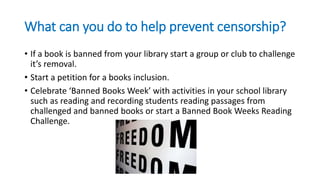
What can you do to help prevent censorship?
• If a book is banned from your library start a group or club to challenge
it’s removal.
• Start a petition for a books inclusion.
• Celebrate ‘Banned Books Week’ with activities in your school library
such as reading and recording students reading passages from
challenged and banned books or start a Banned Book Weeks Reading
Challenge.
References
American Library Association. (2016). Top ten frequently challenged book lists of the 21st century. Chicago: Author. Retrieved from
http://www.ala.org/bbooks/frequentlychallengedbooks/top10
Australian Library and Information Association. (2015). Statement on free access to information. Canberra: Author. Retrieved from:
https://www.alia.org.au/sites/default/files/documents/FreeAccessToInformation_2015.pdf
Banned Books Week. (2015). Carly Basler. Retrieved from http://www.bannedbooksweek.org/heroes/carly-basler.
Banned Books Week. (2015). Grace Barry. Retrieved from http://www.bannedbooksweek.org/heroes/grace-barry
Censorship. (2016). In Oxford dictionary online. Retrieved from: http://www.oxforddictionaries.com/definition/english/censorship
Duthie, F. (2010). Libraries and the ethics of censorship. Australian Library Journal, 59(3), 86-94. Retrieved from
http://search.proquest.com/docview/751836919?accountid=10344
Moody, K. (2005). Covert censorship in libraries: a discussion paper. Australian Library Journal, 54(2), 138-147. Retrieved from http://www.ebscowhost.com

Censorship and libraries

  • 1.
  • 2.
    What is censorship? Thesuppression or prohibition of any parts of books, films, news, etc. that are considered obscene, politically unacceptable, or a threat to security: • the regulation imposes censorship on all media • [AS MODIFIER]: we have strict censorship laws (“Censorship”, 2016)
  • 3.
    The viewpoint ofthe library industry According to Australian Library and Information Service (ALIA) Statement on Access to Information, it is the organisations objective to promote the free flow of information and holds the principle that unrestricted access to information is vital to a functioning democracy. (ALIA, 2001, p. 1) "asserting the equal and equitable rights of individuals to information regardless of age, citizenship, political belief, physical or mental ability, gender identity heritage, education, income, immigration and asylum seeking status, marital status, origin, race, language religion or sexual orientation“ (ALIA, 2001, p. 2)
  • 4.
    How are bookscensored? In libraries books and other materials can be censored in a number of ways including: • Removing an item from the collection due to complaints from individuals in the community or community groups. • Self censorship: Not purchasing an item due to personal prejudices or wanting to keep in line with community standards (Moody, 2005, p. 4). • Cataloguing an item incorrectly making it less visible to someone researching a particular area (Moody, 2005, p. 6) • Applying filters to the internet (Duthie, 2010, p. 88) • Disallowing children under 12 access to the internet (Duthie, 2010, p. 88)
  • 5.
    Why are bookscensored?  Because they are “hate items”. These items promote negative behaviours such as violence, homophobia, racism e.g.. A book which denies that the Jewish Holocaust occurred.  They are challenged by parents or others because they are deemed unsuitable for the age group or are considered to not adhere to community standards - reasons for such a challenge may include: The inclusion of sex, the exploration of sexuality, violence, drug use, and profanity. Religious belief – i.e. creationists objecting to books on evolution being in a school library, e.g. Books on evolution were removed from a school library in Kansas in 1999 due to complaints from pressure groups in the community (Duthie, 2010, p. 91)
  • 6.
    Examples of mostcommonly challenged and banned books in the United States • The Hunger Games, by Suzanne Collins Reasons: Religious viewpoint, unsuited to age group 2013 • Looking for Alaska, by John Green Reasons: Drugs/alcohol/smoking, sexually explicit, unsuited to age group 2013 • Captain Underpants (series), by Dav Pilkey Reasons: Offensive language, unsuited for age group, violence 2013 • ttyl; ttfn; l8r, g8r (series), by Lauren Myracle Reasons: offensive language; religious viewpoint; sexually explicit • To Kill a Mockingbird, by Harper Lee Reasons: offensive language; racism • Twilight, by Stephenie Meyer Reasons: religious viewpoint and violence (American Library Association, 2016)
  • 7.
    Yes, books areremoved from libraries despite the library industry ethical code of free access to information for all and despite the ALIA code of: ‘Resisting attempts by individuals or groups within their communities to restrict access to information and ideas while at the same time recognising that powers of censorship are legally vested in state and federal governments’ (ALIA, 2001, p. 2)
  • 8.
    Why is thisissue important? • People are prevented from accessing the full range of ideas and knowledge available • Many works banned in the past have become not only accepted in the culture but became highly regarded and celebrated works • The Adventures of Huckleberry Finn, Mark Twain, 1884 • The Catcher in the Rye, J.D. Salinger, 1951 • Many of the books condemned as inappropriate are young adult novels – however these books which touch on difficult topics d e.g. issues of sexuality, suicide and death, drugs are often books the same books that of interest to young people. Should young adults be able to determine for themselves what is or is not appropriate or harmful material?
  • 9.
    What do teensthink? You can get books at the library or store; why should we care about a book being removed from one class of students or one community? Books that are banned are often the most important to read. The fact that people ban them implies that there is something to hide from society, which begs the question--what’s being hidden from us? – Grace Barry - Member of book club 451 degrees at Lane Tech (Chicago) who opposed the censorship of Marjane Satrapi’s 'Persepolis‘ (Banned books week, 2015) Why do you think being aware of book challenges or bans is important to our country today? I think it is important to be aware of this because a lot of books that are being banned, are books that yes may have some mature content, but also have content that help kids, save kids, and keep them going. If I hadn’t heard about this book being challenged, it could have been ban. This book could have been taking away, and many kids that need it could never get the opportunity to read it. – Carly Basler - One of the dedicated group of students fought to keep "The Perks of Being a Wallflower" in schools (Banned books week, 2015)
  • 10.
    What can youdo to help prevent censorship? • If a book is banned from your library start a group or club to challenge it’s removal. • Start a petition for a books inclusion. • Celebrate ‘Banned Books Week’ with activities in your school library such as reading and recording students reading passages from challenged and banned books or start a Banned Book Weeks Reading Challenge.
  • 11.
    References American Library Association.(2016). Top ten frequently challenged book lists of the 21st century. Chicago: Author. Retrieved from http://www.ala.org/bbooks/frequentlychallengedbooks/top10 Australian Library and Information Association. (2015). Statement on free access to information. Canberra: Author. Retrieved from: https://www.alia.org.au/sites/default/files/documents/FreeAccessToInformation_2015.pdf Banned Books Week. (2015). Carly Basler. Retrieved from http://www.bannedbooksweek.org/heroes/carly-basler. Banned Books Week. (2015). Grace Barry. Retrieved from http://www.bannedbooksweek.org/heroes/grace-barry Censorship. (2016). In Oxford dictionary online. Retrieved from: http://www.oxforddictionaries.com/definition/english/censorship Duthie, F. (2010). Libraries and the ethics of censorship. Australian Library Journal, 59(3), 86-94. Retrieved from http://search.proquest.com/docview/751836919?accountid=10344 Moody, K. (2005). Covert censorship in libraries: a discussion paper. Australian Library Journal, 54(2), 138-147. Retrieved from http://www.ebscowhost.com