Bond Valuation An Overview

   Introduction to bonds and bond markets
    » What are they? Some examples

   Zero coupon bonds
    » Valuation
    » Interest rate sensitivity

   Coupon bonds
    » Valuation
    » Interest rate sensitivity

   The term structure of interest rates
                                             1
What is a Bond?

   A bond is a security that obligates the issuer to make specified interest
    and principal payments to the holder on specified dates.
     » Coupon rate
     » Face value (or par)
     » Maturity (or term)
   Bonds are also called fixed income securities.
   Bonds differ in several respects:
     » Repayment type
     » Issuer
     » Maturity
     » Security
     » Priority in case of default

                                                                                2
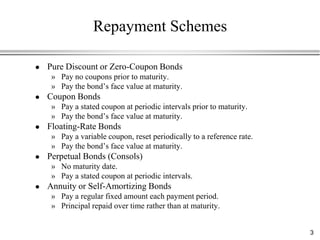
Repayment Schemes
   Pure Discount or Zero-Coupon Bonds
     » Pay no coupons prior to maturity.
     » Pay the bond‟s face value at maturity.
   Coupon Bonds
     » Pay a stated coupon at periodic intervals prior to maturity.
     » Pay the bond‟s face value at maturity.
   Floating-Rate Bonds
     » Pay a variable coupon, reset periodically to a reference rate.
     » Pay the bond‟s face value at maturity.
   Perpetual Bonds (Consols)
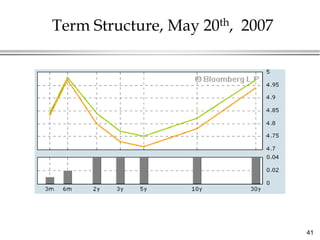
     » No maturity date.
     » Pay a stated coupon at periodic intervals.
   Annuity or Self-Amortizing Bonds
     » Pay a regular fixed amount each payment period.
     » Principal repaid over time rather than at maturity.


                                                                        3
Types of Bonds: Issuers


Bonds                        Issuer
Government Bonds             US Treasury, Government Agencies
Mortgage-Backed Securities   Government agencies (GNMA etc)
Municipal Bonds              State and local government
Corporate Bonds              Corporations
Asset-Back Securities        Corporations


                                                                4
U.S. Government Bonds

   Treasury Bills
    » No coupons (zero coupon security)
    » Face value paid at maturity
    » Maturities up to one year


   Treasury Notes
    » Coupons paid semiannually
    » Face value paid at maturity
    » Maturities from 2-10 years


                                          5
U.S. Government Bonds (Cont.)

   Treasury Bonds
    »   Coupons paid semiannually
    »   Face value paid at maturity
    »   Maturities over 10 years
    »   The 30-year bond is called the long bond.
   Treasury Strips
    » Zero-coupon bond
    » Created by “stripping” the coupons and principal from Treasury
      bonds and notes.
   No default risk. Considered to be risk free.
   Exempt from state and local taxes.
   Sold regularly through a network of primary dealers.
   Traded regularly in the over-the-counter market.
                                                                       6
Agency and Municipal Bonds

   Agency bonds: mortgage-backed bonds
    » Bonds issued by U.S. Government agencies that are backed by a
      pool of home mortgages.
    » Self-amortizing bonds. (mostly monthly payments)
    » Maturities up to 30 years.
    » Prepayment risk.
   Municipal bonds
    » Maturities from one month to 40 years.
    » Usually exempt from federal, state, and local taxes.
    » Generally two types:
       – Revenue bonds
       – General Obligation bonds
    » Riskier than U.S. Government bonds.
                                                                      7
Corporate Bonds


   Bonds issued by corporations
    »   Bonds vs. Debentures
    »   Fixed-rate versus floating-rate bonds.
    »   Investment-grade vs. Below investment-grade bonds.
    »   Additional features:
         – call provisions
         – convertible bonds
         – puttable bonds


                                                             8
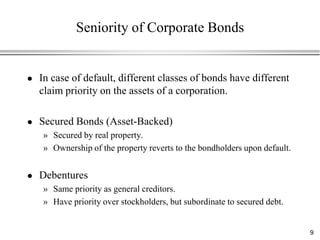
Seniority of Corporate Bonds


   In case of default, different classes of bonds have different
    claim priority on the assets of a corporation.

   Secured Bonds (Asset-Backed)
    » Secured by real property.
    » Ownership of the property reverts to the bondholders upon default.


   Debentures
    » Same priority as general creditors.
    » Have priority over stockholders, but subordinate to secured debt.


                                                                           9
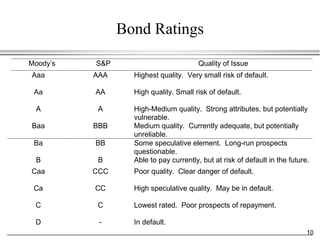
Bond Ratings
Moody’s   S&P                           Quality of Issue
Aaa       AAA     Highest quality. Very small risk of default.

 Aa       AA      High quality. Small risk of default.

 A         A      High-Medium quality. Strong attributes, but potentially
                  vulnerable.
Baa       BBB     Medium quality. Currently adequate, but potentially
                  unreliable.
 Ba       BB      Some speculative element. Long-run prospects
                  questionable.
 B         B      Able to pay currently, but at risk of default in the future.
Caa       CCC     Poor quality. Clear danger of default.

 Ca       CC      High speculative quality. May be in default.

 C        C       Lowest rated. Poor prospects of repayment.

 D         -      In default.
                                                                             10
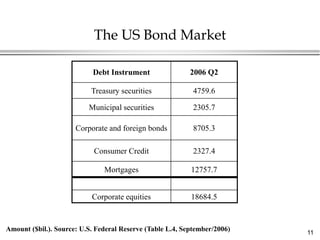
The US Bond Market

                           Debt Instrument                 2006 Q2

                           Treasury securities              4759.6

                          Municipal securities              2305.7

                      Corporate and foreign bonds           8705.3

                            Consumer Credit                 2327.4

                               Mortgages                   12757.7


                           Corporate equities              18684.5


Amount ($bil.). Source: U.S. Federal Reserve (Table L.4, September/2006)   11
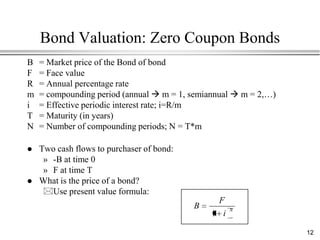
Bond Valuation: Zero Coupon Bonds
B   = Market price of the Bond of bond
F   = Face value
R   = Annual percentage rate
m   = compounding period (annual  m = 1, semiannual  m = 2,…)
i   = Effective periodic interest rate; i=R/m
T   = Maturity (in years)
N   = Number of compounding periods; N = T*m

   Two cash flows to purchaser of bond:
     » -B at time 0
     » F at time T
   What is the price of a bond?
     Use present value formula:
                                                F
                                           B         N
                                               1 i

                                                                  12
Valuing Zero Coupon Bonds:
                                An Example

   Value a 5 year, U.S. Treasury strip with face value of $1,000. The APR is
    R=7.5% with annual compounding? What about quarterly compounding?


   What is the APR on a U.S. Treasury strip that pays $1,000 in exactly 7 years
    and is currently selling for $591.11 under annual compounding? Semi-annual
    compounding?


                                                                                   13
Interest Rate Sensitivity:
                         Zero Coupon Bonds

   Consider the following 1, 2 and 10-year zero-coupon
    bonds, all with
     » face value of F=$1,000
     » APR of R=10%, compounded annually.
    We obtain the following table for increases and decreases of the
    interest rate by 1%:
         Interest Rate     Bond 1       Bond 2        Bond 3
                           1-Year       2-Year        10-Year
                 9.0%      $917.43      $841.68        $422.41
                10.0%      $909.09      $826.45        $385.54
                11.0%      $900.90      $811.62        $352.18
   Bond prices move up if interest rates drop, decrease if
    interest rates rise
                                                                       14
Bond Prices and Interest Rates
$1,200
                                                             Bond prices are
$1,000                                                        inversely related
                                                              to IR
 $800                                                        Longer term
 $600
                                                              bonds are more
                                                              sensitive to IR
 $400           1-Year                                        changes than
                2-Year                                        short term
 $200                                                         bonds
                10-Year
   $0                                                        The lower the
         0.0%   5.0%      10.0%   15.0%   20.0%   25.0%       IR, the more
                                                              sensitive the
                                                              price.


                                                                              15
Measuring Interest Rate Sensitivity
                           Zero Coupon Bonds

   We would like to measure the interest rate sensitivity of a bond or a
    portfolio of bonds.
     » How much do bond prices change if interest rates change by a small
        amount?
     » Why is this important?
   Use “Dollar value of a one basis point decrease” (DV01):
     » Basis point (bp): 1/100 of one percentage point =0.01%=0.0001
     » Calculate DV01:
          – Method 1: Difference of moving one basis point down:
               DV01= B(R-0.01%)-B(R).
          – Method 2: Difference of moving 1/2bp down minus 1/2pb up:
               DV01=B(R-0.005%) -B(R+0.005%).
          – Method 3: Use calculus:
                                                 B
                                     DV 01           0.0001
                                                 R
                                                                            16
Computing DV01: An Example

   Reconsider the 1, 2 and 10- year bonds discussed before:
         Interest Rate    Bond 1       Bond 2 Bond 3
                          1-Year       2-Year 10-Year
              9.990%     $909.1736   $826.5966 $385.8940
              9.995%     $909.1322   $826.5214 $385.7186
             10.000%     $909.0909   $826.4463 $385.5433
             10.005%     $909.0496   $826.3712 $385.3681
         Method 1        $0.082652   $0.150283 $0.350669
         Method 2        $0.082645   $0.150263 $0.350494
         Method 3        $0.082645   $0.150263 $0.350494

   Method 3:
                 B          $1,000                        1
                   0.0001 T         0.0001 T * $0.10 *
                 R          1.10T 1                    1.10T   1
                                                                   17
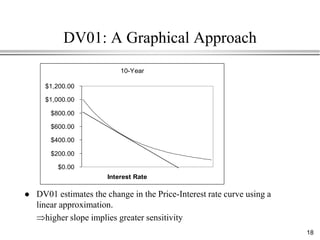
DV01: A Graphical Approach
                           10-Year

      $1,200.00

      $1,000.00

        $800.00

        $600.00

        $400.00

        $200.00

          $0.00
                       Interest Rate

   DV01 estimates the change in the Price-Interest rate curve using a
    linear approximation.
       higher slope implies greater sensitivity
                                                                         18
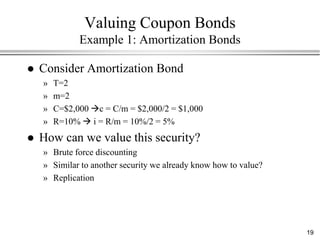
Valuing Coupon Bonds
              Example 1: Amortization Bonds

   Consider Amortization Bond
    »   T=2
    »   m=2
    »   C=$2,000 c = C/m = $2,000/2 = $1,000
    »   R=10%  i = R/m = 10%/2 = 5%
   How can we value this security?
    » Brute force discounting
    » Similar to another security we already know how to value?
    » Replication


                                                                  19
Valuing Coupon Bonds
                    Example 1: Amortization Bonds


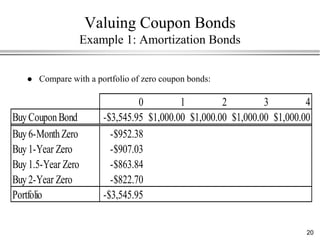
      Compare with a portfolio of zero coupon bonds:

                                 0         1         2         3         4
Buy Coupon Bond         -$3,545.95 $1,000.00 $1,000.00 $1,000.00 $1,000.00
Buy 6-Month Zero          -$952.38
Buy 1-Year Zero           -$907.03
Buy 1.5-Year Zero         -$863.84
Buy 2-Year Zero           -$822.70
Portfolio               -$3,545.95


                                                                         20
A First Look at Arbitrage

   Reconsider amortization bond; suppose bond
    trades at $3,500 (as opposed to computed price of
    $3,545.95)
    » Can we make a profit without any risk?
       – What is the strategy?
       – What is the profit?


                                                        21
A First Look at Arbitrage

   Reconsider amortization bond; suppose bond trades at $3,500 (as
    opposed to computed price of $3,545.95)
     » Can make risk less profit
         – Buy low: buy amortization bond
         – Sell high: Sell portfolio of zero coupon bonds
                                                         Time Period
                                          0            1           2         3          4
            Buy Coupon Bond      -$3,500.00    $1,000.00 $1,000.00 $1,000.00 $1,000.00
            Sell 6-Month Zero       $952.38   -$1,000.00      $0.00      $0.00      $0.00
            Sell 1-Year Zero        $907.03        $0.00 -$1,000.00      $0.00      $0.00
            Sell 1.5-Year Zero      $863.84        $0.00      $0.00 -$1,000.00      $0.00
            Sell 2-Year Zero        $822.70        $0.00      $0.00      $0.00 -$1,000.00
            Portfolio             $3,545.95   -$1,000.00 -$1,000.00 -$1,000.00 -$1,000.00
            Net Cash Flow            $45.95        $0.00      $0.00      $0.00      $0.00

         – riskless profit of $45.95
         – no riskless profit if price is correct                                           22
Valuation of Coupon Bonds:
                    Example 2: Straight Bonds


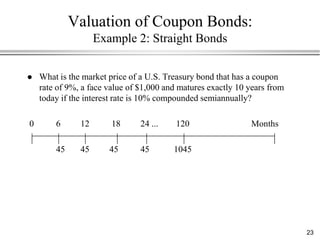
   What is the market price of a U.S. Treasury bond that has a coupon
    rate of 9%, a face value of $1,000 and matures exactly 10 years from
    today if the interest rate is 10% compounded semiannually?

0       6      12       18      24 ...   120                  Months

        45     45      45       45       1045


                                                                           23
Valuing Coupon Bonds
                 The General Formula
   What is the market price of a bond that has an annual coupon C, face
    value F and matures exactly T years from today if the required rate of
    return is R, with m-periodic compounding?
     » Coupon payment is: c = C/m
     » Effective periodic interest rate is: i = R/m
     » number of periods N = Tm

0       1      2       3        4 ...        …                  N
         c    c        c        c…           …                  c+F
                   B       Annuity       Zero
                        c            1            F
                          1              N             N
                        i       1 i              1 i
                                                                             24
The Concept of a “Yield to Maturity”
   So far we have valued bonds by using a given interest rate,
    then discounted all payments to the bond.
   Prices are usually given from trade prices
    » need to infer interest rate that has been used
    Definition: The yield to maturity is that interest rate that
    equates the present discounted value of all future payments
    to bondholders to the market price:
   Algebraic:

                  c            1                  F
         B              1               N                  N
              yield / m   1 yield / m        1 yield / m


                                                                   25
Yield to Maturity
                              A Graphical Interpretation


            $2,500.00


            $2,000.00


            $1,500.00


            $1,000.00


              $500.00


                $0.00
                        0%
                             2%
                                  4%
                                       6%
                                            8%
                                                 10%
                                                       12%
                                                             14%
                                                                   16%
                                                                         18%
                                                                               20%
                                                                                     22%
                                                                                           24%
   Consider a U.S. Treasury bond that has a coupon rate of 10%, a face value of
    $1,000 and matures exactly 10 years from now.
     » Market price of $1,500, implies a yield of 3.91% (semi-annual
        compounding); for B=$1,000 we obviously find R=10%.
                                                                                                 26
Interest Rate Sensitivity:
                          Coupon Bonds

   Coupon bonds can be represented as portfolios of zero-
    coupon bonds
    » Implication for price sensitivity


   Consider purchasing the US Treasury bond discussed
    earlier (10 year, 9% coupon, $1,000 face)
    » Suppose immediately thereafter interest rates fall to 8%,
      compounded semiannually.
    » Suppose immediately thereafter interest rate rises to 12%
      compounded semiannually.
    » Suppose the interest rate equals 9%, compounded semiannually.


   What are the pricing implications of these scenarios?
                                                                      27
Implication of Interest Rate Changes on
             Coupon Bond Prices
    Recall the general formula:

                            c       1          F
                       B      1          N         N
                            i      1 i       1 i

    What is the price of the bond if the APR is 8% compounded
     semiannually?


    Similarly:
          If R=12%: B=$ 827.95
          If R= 9%: B=$1,000.00
                                                                 28
Relationship Between Coupon Bond
          Prices and Interest Rates
   Bond prices are inversely related to interest rates (or
    yields).


   A bond sells at par only if its interest rate equals the
    coupon rate


   A bond sells at a premium if its coupon rate is above the
    interest rate.


   A bond sells at a discount if its coupon rate is below the
    interest rate.                                               29
DV01 and Coupon Bonds

   Consider two bonds with 10% annual coupons with maturities of 5
    years and 10 years.
   The APR is 8%
   What are the responses to a .01% (1bp) interest rate change?

     Yield   5-Year Bond   $ Change    % Change 10-Year Bond $ Change % Change
    7.995%   $1,080.06        $0.21019 0.0195% $1,134.57       $0.36585 0.0323%
    8.000%   $1,079.85                          $1,134.20
    8.005%   $1,079.64       -$0.21013 -0.0195% $1,133.84 -$0.36569 -0.0322%
     DV01                     $0.42032                         $0.73154

   Does the sensitivity of a coupon bond always increase with the term to
    maturity?


                                                                                  30
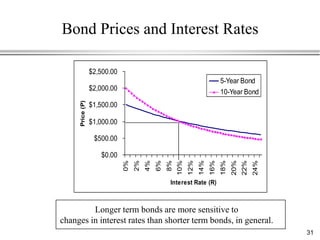
Bond Prices and Interest Rates

                 $2,500.00
                                                                              5-Year Bond
                 $2,000.00                                                    10-Year Bond
     Price (P)


                 $1,500.00

                 $1,000.00

                  $500.00

                    $0.00
                             0%
                                  2%
                                       4%
                                            6%
                                                 8%
                                                      10%
                                                            12%
                                                                  14%
                                                                        16%
                                                                              18%
                                                                                    20%
                                                                                          22%
                                                                                                24%
                                                  Interest Rate (R)


         Longer term bonds are more sensitive to
changes in interest rates than shorter term bonds, in general.
                                                                                                      31
Bond Yields and Prices
    Consider the following two bonds:
      » Both have a maturity of 5 years
      » Both have yield of 8%
      » First has 6% coupon, other has 10% coupon, compounded
        annually.
    Then, what are the price sensitivities of these bonds, measured by
     DV01 as for zero coupon bonds?
     Yield    6%-Bond    $ Change    % change     10%-Bond    $ Change    % change
    7.995%    $920.33    $0.1891                  $1,080.06   $0.2102
    8.000%    $920.15                             $1,079.85
    8.005%    $919.96    ($0.1891)                $1,079.64   ($0.2101)
                                        0.0411%                              0.0389%
    DV01      $0.3782                             $0.4203

    Why do we get different answers for two bonds with the same yield
     and same maturity?
                                                                                       32
Maturity and Price Risk

   Zero coupon bonds have well-defined relationship
    between maturity and interest rate sensitivity:

   Coupon bonds can have different sensitivities for
    the same maturity
    » DV01 now depends on maturity and coupon


   Need concept of “average maturity” of coupon
    bond:
    » Duration
                                                        33
Duration

   Duration is a weighted average term to maturity where the
    weights are relative size of the contemporaneous cash flow.
                    PV (c )   PV (c )     PV (c )
      Duration   T       1 T       2  T       N T PV (F)
                  1   B     2   B       N   B     N  B


   Duration is a unitless number that quantifies the percentage
    change in a bond‟s price for a 1 percentage change in the
    interest rate.                     B
                               B 1 R   B
                  Duration
                               R B           R
                                           1 R
                                                                   34
Duration (cont.)

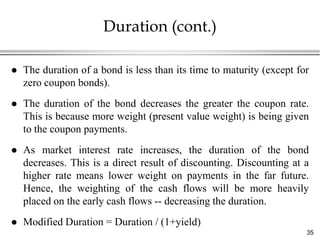
   The duration of a bond is less than its time to maturity (except for
    zero coupon bonds).
   The duration of the bond decreases the greater the coupon rate.
    This is because more weight (present value weight) is being given
    to the coupon payments.
   As market interest rate increases, the duration of the bond
    decreases. This is a direct result of discounting. Discounting at a
    higher rate means lower weight on payments in the far future.
    Hence, the weighting of the cash flows will be more heavily
    placed on the early cash flows -- decreasing the duration.
   Modified Duration = Duration / (1+yield)
                                                                       35
A Few Bond Markets Statistics
                   U.S. Treasuries, May 20th 2007.


Bills
                   MATURITY               DISCOUNT/YIELD      DISCOUNT/YIELD    TIME
                   DATE                                       CHANGE
3-Month            08/16/2007 4.72 / 4.84 0.01 / .010 13:41
6-Month            11/15/2007 4.78 / 4.98 0.01 / .015 13:41


Notes/Bonds
          COUPON   MATURITY               CURRENT              PRICE/YIELD      TIME
          DATE                PRICE/YIELD         CHANGE
2-Year    4.500    04/30/2009 99-121⁄4 / 4.84     -0-02 / .03514:08
3-Year    4.500    05/15/2010 99-081⁄2 / 4.77     -0-031⁄2 / .040       14:06
5-Year    4.500    04/30/2012 98-281⁄2 / 4.75     -0-06 / .04314:07
10-Year   4.500    05/15/2017 97-15 / 4.82        -0-091⁄2 / .038       14:07
30-Year   4.750    02/15/2037 96-17+ / 4.97       -0-17 / .03514:07


                                                                                       36
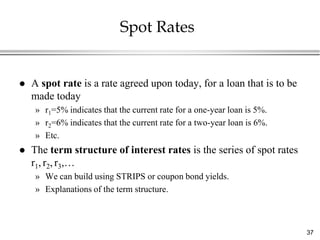
Spot Rates


   A spot rate is a rate agreed upon today, for a loan that is to be
    made today
    » r1=5% indicates that the current rate for a one-year loan is 5%.
    » r2=6% indicates that the current rate for a two-year loan is 6%.
    » Etc.
   The term structure of interest rates is the series of spot rates
    r1, r2, r3,…
    » We can build using STRIPS or coupon bond yields.
    » Explanations of the term structure.


                                                                         37
The Term Structure of Interest Rates
                  An Example


 Yield


   6.00

   5.75


   5.00


          1   2         3      Maturity


                                          38
Term Structure, July 1st 2005.


                                 39
Term Structure, September 12th, 2006


                                       40
Term Structure, May 20th, 2007


                                 41
Term Structure of Interest Rates


                                   42
43
Summary

   Bonds can be valued by discounting their future cash
    flows
   Bond prices change inversely with yield
   Price response of bond to interest rates depends on term
    to maturity.
    » Works well for zero-coupon bond, but not for coupon bonds
   Measure interest rate sensitivity using „DV01‟ and
    duration.
   The term structure implies terms for future borrowing:
    » Forward rates
    » Compare with expected future spot rates
                                                                  44

Bond valuation

  • 1.
    Bond Valuation AnOverview  Introduction to bonds and bond markets » What are they? Some examples  Zero coupon bonds » Valuation » Interest rate sensitivity  Coupon bonds » Valuation » Interest rate sensitivity  The term structure of interest rates 1
  • 2.
    What is aBond?  A bond is a security that obligates the issuer to make specified interest and principal payments to the holder on specified dates. » Coupon rate » Face value (or par) » Maturity (or term)  Bonds are also called fixed income securities.  Bonds differ in several respects: » Repayment type » Issuer » Maturity » Security » Priority in case of default 2
  • 3.
    Repayment Schemes  Pure Discount or Zero-Coupon Bonds » Pay no coupons prior to maturity. » Pay the bond‟s face value at maturity.  Coupon Bonds » Pay a stated coupon at periodic intervals prior to maturity. » Pay the bond‟s face value at maturity.  Floating-Rate Bonds » Pay a variable coupon, reset periodically to a reference rate. » Pay the bond‟s face value at maturity.  Perpetual Bonds (Consols) » No maturity date. » Pay a stated coupon at periodic intervals.  Annuity or Self-Amortizing Bonds » Pay a regular fixed amount each payment period. » Principal repaid over time rather than at maturity. 3
  • 4.
    Types of Bonds:Issuers Bonds Issuer Government Bonds US Treasury, Government Agencies Mortgage-Backed Securities Government agencies (GNMA etc) Municipal Bonds State and local government Corporate Bonds Corporations Asset-Back Securities Corporations 4
  • 5.
    U.S. Government Bonds  Treasury Bills » No coupons (zero coupon security) » Face value paid at maturity » Maturities up to one year  Treasury Notes » Coupons paid semiannually » Face value paid at maturity » Maturities from 2-10 years 5
  • 6.
    U.S. Government Bonds(Cont.)  Treasury Bonds » Coupons paid semiannually » Face value paid at maturity » Maturities over 10 years » The 30-year bond is called the long bond.  Treasury Strips » Zero-coupon bond » Created by “stripping” the coupons and principal from Treasury bonds and notes.  No default risk. Considered to be risk free.  Exempt from state and local taxes.  Sold regularly through a network of primary dealers.  Traded regularly in the over-the-counter market. 6
  • 7.
    Agency and MunicipalBonds  Agency bonds: mortgage-backed bonds » Bonds issued by U.S. Government agencies that are backed by a pool of home mortgages. » Self-amortizing bonds. (mostly monthly payments) » Maturities up to 30 years. » Prepayment risk.  Municipal bonds » Maturities from one month to 40 years. » Usually exempt from federal, state, and local taxes. » Generally two types: – Revenue bonds – General Obligation bonds » Riskier than U.S. Government bonds. 7
  • 8.
    Corporate Bonds  Bonds issued by corporations » Bonds vs. Debentures » Fixed-rate versus floating-rate bonds. » Investment-grade vs. Below investment-grade bonds. » Additional features: – call provisions – convertible bonds – puttable bonds 8
  • 9.
    Seniority of CorporateBonds  In case of default, different classes of bonds have different claim priority on the assets of a corporation.  Secured Bonds (Asset-Backed) » Secured by real property. » Ownership of the property reverts to the bondholders upon default.  Debentures » Same priority as general creditors. » Have priority over stockholders, but subordinate to secured debt. 9
  • 10.
    Bond Ratings Moody’s S&P Quality of Issue Aaa AAA Highest quality. Very small risk of default. Aa AA High quality. Small risk of default. A A High-Medium quality. Strong attributes, but potentially vulnerable. Baa BBB Medium quality. Currently adequate, but potentially unreliable. Ba BB Some speculative element. Long-run prospects questionable. B B Able to pay currently, but at risk of default in the future. Caa CCC Poor quality. Clear danger of default. Ca CC High speculative quality. May be in default. C C Lowest rated. Poor prospects of repayment. D - In default. 10
  • 11.
    The US BondMarket Debt Instrument 2006 Q2 Treasury securities 4759.6 Municipal securities 2305.7 Corporate and foreign bonds 8705.3 Consumer Credit 2327.4 Mortgages 12757.7 Corporate equities 18684.5 Amount ($bil.). Source: U.S. Federal Reserve (Table L.4, September/2006) 11
  • 12.
    Bond Valuation: ZeroCoupon Bonds B = Market price of the Bond of bond F = Face value R = Annual percentage rate m = compounding period (annual  m = 1, semiannual  m = 2,…) i = Effective periodic interest rate; i=R/m T = Maturity (in years) N = Number of compounding periods; N = T*m  Two cash flows to purchaser of bond: » -B at time 0 » F at time T  What is the price of a bond? Use present value formula: F B N 1 i 12
  • 13.
    Valuing Zero CouponBonds: An Example  Value a 5 year, U.S. Treasury strip with face value of $1,000. The APR is R=7.5% with annual compounding? What about quarterly compounding?  What is the APR on a U.S. Treasury strip that pays $1,000 in exactly 7 years and is currently selling for $591.11 under annual compounding? Semi-annual compounding? 13
  • 14.
    Interest Rate Sensitivity: Zero Coupon Bonds  Consider the following 1, 2 and 10-year zero-coupon bonds, all with » face value of F=$1,000 » APR of R=10%, compounded annually. We obtain the following table for increases and decreases of the interest rate by 1%: Interest Rate Bond 1 Bond 2 Bond 3 1-Year 2-Year 10-Year 9.0% $917.43 $841.68 $422.41 10.0% $909.09 $826.45 $385.54 11.0% $900.90 $811.62 $352.18  Bond prices move up if interest rates drop, decrease if interest rates rise 14
  • 15.
    Bond Prices andInterest Rates $1,200  Bond prices are $1,000 inversely related to IR $800  Longer term $600 bonds are more sensitive to IR $400 1-Year changes than 2-Year short term $200 bonds 10-Year $0  The lower the 0.0% 5.0% 10.0% 15.0% 20.0% 25.0% IR, the more sensitive the price. 15
  • 16.
    Measuring Interest RateSensitivity Zero Coupon Bonds  We would like to measure the interest rate sensitivity of a bond or a portfolio of bonds. » How much do bond prices change if interest rates change by a small amount? » Why is this important?  Use “Dollar value of a one basis point decrease” (DV01): » Basis point (bp): 1/100 of one percentage point =0.01%=0.0001 » Calculate DV01: – Method 1: Difference of moving one basis point down: DV01= B(R-0.01%)-B(R). – Method 2: Difference of moving 1/2bp down minus 1/2pb up: DV01=B(R-0.005%) -B(R+0.005%). – Method 3: Use calculus: B DV 01 0.0001 R 16
  • 17.
    Computing DV01: AnExample  Reconsider the 1, 2 and 10- year bonds discussed before: Interest Rate Bond 1 Bond 2 Bond 3 1-Year 2-Year 10-Year 9.990% $909.1736 $826.5966 $385.8940 9.995% $909.1322 $826.5214 $385.7186 10.000% $909.0909 $826.4463 $385.5433 10.005% $909.0496 $826.3712 $385.3681 Method 1 $0.082652 $0.150283 $0.350669 Method 2 $0.082645 $0.150263 $0.350494 Method 3 $0.082645 $0.150263 $0.350494  Method 3: B $1,000 1 0.0001 T 0.0001 T * $0.10 * R 1.10T 1 1.10T 1 17
  • 18.
    DV01: A GraphicalApproach 10-Year $1,200.00 $1,000.00 $800.00 $600.00 $400.00 $200.00 $0.00 Interest Rate  DV01 estimates the change in the Price-Interest rate curve using a linear approximation. higher slope implies greater sensitivity 18
  • 19.
    Valuing Coupon Bonds Example 1: Amortization Bonds  Consider Amortization Bond » T=2 » m=2 » C=$2,000 c = C/m = $2,000/2 = $1,000 » R=10%  i = R/m = 10%/2 = 5%  How can we value this security? » Brute force discounting » Similar to another security we already know how to value? » Replication 19
  • 20.
    Valuing Coupon Bonds Example 1: Amortization Bonds  Compare with a portfolio of zero coupon bonds: 0 1 2 3 4 Buy Coupon Bond -$3,545.95 $1,000.00 $1,000.00 $1,000.00 $1,000.00 Buy 6-Month Zero -$952.38 Buy 1-Year Zero -$907.03 Buy 1.5-Year Zero -$863.84 Buy 2-Year Zero -$822.70 Portfolio -$3,545.95 20
  • 21.
    A First Lookat Arbitrage  Reconsider amortization bond; suppose bond trades at $3,500 (as opposed to computed price of $3,545.95) » Can we make a profit without any risk? – What is the strategy? – What is the profit? 21
  • 22.
    A First Lookat Arbitrage  Reconsider amortization bond; suppose bond trades at $3,500 (as opposed to computed price of $3,545.95) » Can make risk less profit – Buy low: buy amortization bond – Sell high: Sell portfolio of zero coupon bonds Time Period 0 1 2 3 4 Buy Coupon Bond -$3,500.00 $1,000.00 $1,000.00 $1,000.00 $1,000.00 Sell 6-Month Zero $952.38 -$1,000.00 $0.00 $0.00 $0.00 Sell 1-Year Zero $907.03 $0.00 -$1,000.00 $0.00 $0.00 Sell 1.5-Year Zero $863.84 $0.00 $0.00 -$1,000.00 $0.00 Sell 2-Year Zero $822.70 $0.00 $0.00 $0.00 -$1,000.00 Portfolio $3,545.95 -$1,000.00 -$1,000.00 -$1,000.00 -$1,000.00 Net Cash Flow $45.95 $0.00 $0.00 $0.00 $0.00 – riskless profit of $45.95 – no riskless profit if price is correct 22
  • 23.
    Valuation of CouponBonds: Example 2: Straight Bonds  What is the market price of a U.S. Treasury bond that has a coupon rate of 9%, a face value of $1,000 and matures exactly 10 years from today if the interest rate is 10% compounded semiannually? 0 6 12 18 24 ... 120 Months 45 45 45 45 1045 23
  • 24.
    Valuing Coupon Bonds The General Formula  What is the market price of a bond that has an annual coupon C, face value F and matures exactly T years from today if the required rate of return is R, with m-periodic compounding? » Coupon payment is: c = C/m » Effective periodic interest rate is: i = R/m » number of periods N = Tm 0 1 2 3 4 ... … N c c c c… … c+F B Annuity Zero c 1 F 1 N N i 1 i 1 i 24
  • 25.
    The Concept ofa “Yield to Maturity”  So far we have valued bonds by using a given interest rate, then discounted all payments to the bond.  Prices are usually given from trade prices » need to infer interest rate that has been used Definition: The yield to maturity is that interest rate that equates the present discounted value of all future payments to bondholders to the market price:  Algebraic: c 1 F B 1 N N yield / m 1 yield / m 1 yield / m 25
  • 26.
    Yield to Maturity A Graphical Interpretation $2,500.00 $2,000.00 $1,500.00 $1,000.00 $500.00 $0.00 0% 2% 4% 6% 8% 10% 12% 14% 16% 18% 20% 22% 24%  Consider a U.S. Treasury bond that has a coupon rate of 10%, a face value of $1,000 and matures exactly 10 years from now. » Market price of $1,500, implies a yield of 3.91% (semi-annual compounding); for B=$1,000 we obviously find R=10%. 26
  • 27.
    Interest Rate Sensitivity: Coupon Bonds  Coupon bonds can be represented as portfolios of zero- coupon bonds » Implication for price sensitivity  Consider purchasing the US Treasury bond discussed earlier (10 year, 9% coupon, $1,000 face) » Suppose immediately thereafter interest rates fall to 8%, compounded semiannually. » Suppose immediately thereafter interest rate rises to 12% compounded semiannually. » Suppose the interest rate equals 9%, compounded semiannually.  What are the pricing implications of these scenarios? 27
  • 28.
    Implication of InterestRate Changes on Coupon Bond Prices  Recall the general formula: c 1 F B 1 N N i 1 i 1 i  What is the price of the bond if the APR is 8% compounded semiannually?  Similarly: If R=12%: B=$ 827.95 If R= 9%: B=$1,000.00 28
  • 29.
    Relationship Between CouponBond Prices and Interest Rates  Bond prices are inversely related to interest rates (or yields).  A bond sells at par only if its interest rate equals the coupon rate  A bond sells at a premium if its coupon rate is above the interest rate.  A bond sells at a discount if its coupon rate is below the interest rate. 29
  • 30.
    DV01 and CouponBonds  Consider two bonds with 10% annual coupons with maturities of 5 years and 10 years.  The APR is 8%  What are the responses to a .01% (1bp) interest rate change? Yield 5-Year Bond $ Change % Change 10-Year Bond $ Change % Change 7.995% $1,080.06 $0.21019 0.0195% $1,134.57 $0.36585 0.0323% 8.000% $1,079.85 $1,134.20 8.005% $1,079.64 -$0.21013 -0.0195% $1,133.84 -$0.36569 -0.0322% DV01 $0.42032 $0.73154  Does the sensitivity of a coupon bond always increase with the term to maturity? 30
  • 31.
    Bond Prices andInterest Rates $2,500.00 5-Year Bond $2,000.00 10-Year Bond Price (P) $1,500.00 $1,000.00 $500.00 $0.00 0% 2% 4% 6% 8% 10% 12% 14% 16% 18% 20% 22% 24% Interest Rate (R) Longer term bonds are more sensitive to changes in interest rates than shorter term bonds, in general. 31
  • 32.
    Bond Yields andPrices  Consider the following two bonds: » Both have a maturity of 5 years » Both have yield of 8% » First has 6% coupon, other has 10% coupon, compounded annually.  Then, what are the price sensitivities of these bonds, measured by DV01 as for zero coupon bonds? Yield 6%-Bond $ Change % change 10%-Bond $ Change % change 7.995% $920.33 $0.1891 $1,080.06 $0.2102 8.000% $920.15 $1,079.85 8.005% $919.96 ($0.1891) $1,079.64 ($0.2101) 0.0411% 0.0389% DV01 $0.3782 $0.4203  Why do we get different answers for two bonds with the same yield and same maturity? 32
  • 33.
    Maturity and PriceRisk  Zero coupon bonds have well-defined relationship between maturity and interest rate sensitivity:  Coupon bonds can have different sensitivities for the same maturity » DV01 now depends on maturity and coupon  Need concept of “average maturity” of coupon bond: » Duration 33
  • 34.
    Duration  Duration is a weighted average term to maturity where the weights are relative size of the contemporaneous cash flow. PV (c ) PV (c ) PV (c ) Duration T 1 T 2  T N T PV (F) 1 B 2 B N B N B  Duration is a unitless number that quantifies the percentage change in a bond‟s price for a 1 percentage change in the interest rate. B B 1 R B Duration R B R 1 R 34
  • 35.
    Duration (cont.)  The duration of a bond is less than its time to maturity (except for zero coupon bonds).  The duration of the bond decreases the greater the coupon rate. This is because more weight (present value weight) is being given to the coupon payments.  As market interest rate increases, the duration of the bond decreases. This is a direct result of discounting. Discounting at a higher rate means lower weight on payments in the far future. Hence, the weighting of the cash flows will be more heavily placed on the early cash flows -- decreasing the duration.  Modified Duration = Duration / (1+yield) 35
  • 36.
    A Few BondMarkets Statistics U.S. Treasuries, May 20th 2007. Bills MATURITY DISCOUNT/YIELD DISCOUNT/YIELD TIME DATE CHANGE 3-Month 08/16/2007 4.72 / 4.84 0.01 / .010 13:41 6-Month 11/15/2007 4.78 / 4.98 0.01 / .015 13:41 Notes/Bonds COUPON MATURITY CURRENT PRICE/YIELD TIME DATE PRICE/YIELD CHANGE 2-Year 4.500 04/30/2009 99-121⁄4 / 4.84 -0-02 / .03514:08 3-Year 4.500 05/15/2010 99-081⁄2 / 4.77 -0-031⁄2 / .040 14:06 5-Year 4.500 04/30/2012 98-281⁄2 / 4.75 -0-06 / .04314:07 10-Year 4.500 05/15/2017 97-15 / 4.82 -0-091⁄2 / .038 14:07 30-Year 4.750 02/15/2037 96-17+ / 4.97 -0-17 / .03514:07 36
  • 37.
    Spot Rates  A spot rate is a rate agreed upon today, for a loan that is to be made today » r1=5% indicates that the current rate for a one-year loan is 5%. » r2=6% indicates that the current rate for a two-year loan is 6%. » Etc.  The term structure of interest rates is the series of spot rates r1, r2, r3,… » We can build using STRIPS or coupon bond yields. » Explanations of the term structure. 37
  • 38.
    The Term Structureof Interest Rates An Example Yield 6.00 5.75 5.00 1 2 3 Maturity 38
  • 39.
  • 40.
  • 41.
    Term Structure, May20th, 2007 41
  • 42.
    Term Structure ofInterest Rates 42
  • 43.
  • 44.
    Summary  Bonds can be valued by discounting their future cash flows  Bond prices change inversely with yield  Price response of bond to interest rates depends on term to maturity. » Works well for zero-coupon bond, but not for coupon bonds  Measure interest rate sensitivity using „DV01‟ and duration.  The term structure implies terms for future borrowing: » Forward rates » Compare with expected future spot rates 44