Factors Affecting Body Image
in College Students
Nathan Horton
Spring Arbor University
April 25, 2014
Running head: BODY IMAGE
Factors Affecting Body Image
in College Students
Nathan Horton
Spring Arbor University
PSY 352: Research Design
April 25, 2014
Na004591@arbor.edu
BODY IMAGE
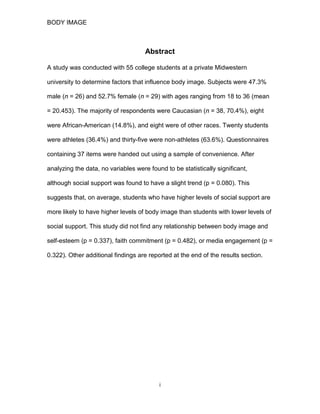
Abstract
A study was conducted with 55 college students at a private Midwestern
university to determine factors that influence body image. Subjects were 47.3%
male (n = 26) and 52.7% female (n = 29) with ages ranging from 18 to 36 (mean
= 20.453). The majority of respondents were Caucasian (n = 38, 70.4%), eight
were African-American (14.8%), and eight were of other races. Twenty students
were athletes (36.4%) and thirty-five were non-athletes (63.6%). Questionnaires
containing 37 items were handed out using a sample of convenience. After
analyzing the data, no variables were found to be statistically significant,
although social support was found to have a slight trend (p = 0.080). This
suggests that, on average, students who have higher levels of social support are
more likely to have higher levels of body image than students with lower levels of
social support. This study did not find any relationship between body image and
self-esteem (p = 0.337), faith commitment (p = 0.482), or media engagement (p =
0.322). Other additional findings are reported at the end of the results section.
i
BODY IMAGE
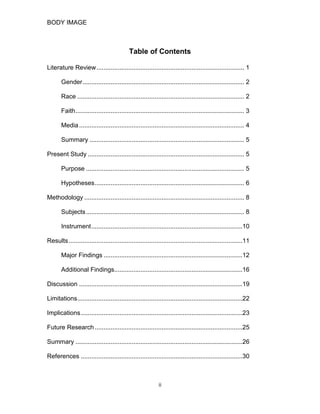
Table of Contents
Literature Review.................................................................................... 1
Gender............................................................................................ 2
Race ............................................................................................... 2
Faith................................................................................................ 3
Media.............................................................................................. 4
Summary ........................................................................................ 5
Present Study ......................................................................................... 5
Purpose .......................................................................................... 5
Hypotheses..................................................................................... 6
Methodology ........................................................................................... 8
Subjects.......................................................................................... 8
Instrument......................................................................................10
Results...................................................................................................11
Major Findings ...............................................................................12
Additional Findings.........................................................................16
Discussion .............................................................................................19
Limitations..............................................................................................22
Implications............................................................................................23
Future Research ....................................................................................25
Summary ...............................................................................................26
References ............................................................................................30
ii
BODY IMAGE
Appendices............................................................................................35
Appendix A ....................................................................................36
Appendix B ....................................................................................45
Appendix C ....................................................................................52
iii
BODY IMAGE
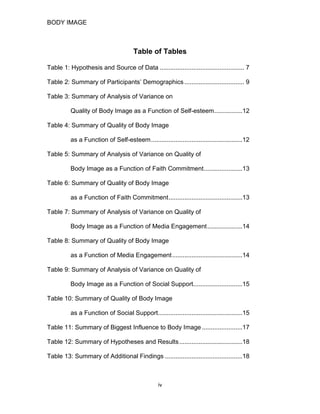
Table of Tables
Table 1: Hypothesis and Source of Data ................................................ 7
Table 2: Summary of Participants’ Demographics .................................. 9
Table 3: Summary of Analysis of Variance on
Quality of Body Image as a Function of Self-esteem................12
Table 4: Summary of Quality of Body Image
as a Function of Self-esteem....................................................12
Table 5: Summary of Analysis of Variance on Quality of
Body Image as a Function of Faith Commitment......................13
Table 6: Summary of Quality of Body Image
as a Function of Faith Commitment..........................................13
Table 7: Summary of Analysis of Variance on Quality of
Body Image as a Function of Media Engagement....................14
Table 8: Summary of Quality of Body Image
as a Function of Media Engagement........................................14
Table 9: Summary of Analysis of Variance on Quality of
Body Image as a Function of Social Support............................15
Table 10: Summary of Quality of Body Image
as a Function of Social Support................................................15
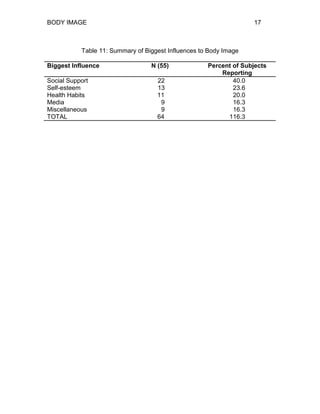
Table 11: Summary of Biggest Influence to Body Image .......................17
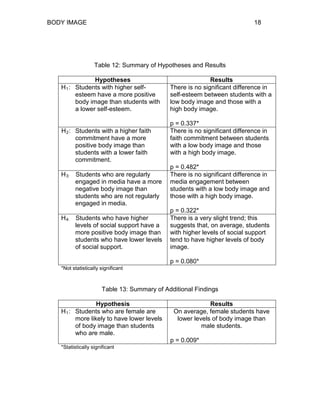
Table 12: Summary of Hypotheses and Results....................................18
Table 13: Summary of Additional Findings ............................................18
iv
BODY IMAGE
Table 14: Summary of Gender as a Function of Body Image ................46
v
BODY IMAGE 1
Literature Review
In a society with much focus on physical appearance, and with rise of
obesity and eating disorders (Comer, 2011), it is not surprising that one’s
satisfaction or dissatisfaction with one’s body image has an impact (Eyal &
Te’eni-Harari, 2013). Cash, Morrow, Hrabosky, and Perry (2004) found that such
dissatisfaction is not unusual and can harm a person’s “psychosocial functioning
and quality of life,” and define body image as “a multidimensional construct
encompassing self-perceptions and attitudes regarding one’s physical
appearance” (p. 1081). Objectification of women, a patriarchal byproduct, hurts
both men and women (Swami & Voracek, 2013), and studies show that most
college students (65-78%) have low body image (Gillen & Lefkowitz, 2006;
Yates, Edman, & Aruguete, 2004). Men who struggle with body image may
develop obsessive-compulsive symptoms, bulimic symptoms, depression, have
relationship issues, and/or abuse substances (Parent, 2013; McFarland & Petrie,
2012; Parent & Moradi, 2011). Women’s body dissatisfaction correlates to low
self-worth, low self-esteem, and eating disorders, including bulimic behaviors
(Homan, 2012; Rayner, Schniering, Rappe, Taylor, & Hutchinson, 2013).
This literature review explores several factors that affect body image.
Sundry sources factor into body image, including gender, race, faith, and media.
These four variables will be discussed in this literature review.
BODY IMAGE 2
Gender
While males, particularly of college age, may experience low levels of
body image satisfaction (Peat, Peyerl, Ferraro, & Butler, 2011; Parent & Moradi,
2011), females tend to be more dissatisfied with their body image and more likely
to alter their eating habits (Jacobson, Hall, & Anderson, 2013; Cash et al., 2004;
Else-Quest, Higgins, Allison, & Morton, 2012; Tylka & Kroon Van Diest, 2013).
Female athletes also have the difficulty of negotiating their athletic build and the
ideal feminine body type, which may lead to decreased body satisfaction and the
development of eating disorders (Anderson, Petrie, & Neumann, 2012; Steinfeldt,
Zakrajsek, Carter, & Steinfeldt, 2011).
Studies on men are limited, but younger men may have higher levels of
body dissatisfaction than older men (Daniel & Bridges, 2013; Peat, et al., 2011;
Murray & Lewis, 2014). This may be due to cultural standards of appearance
(Parent & Moradi, 2011). Most studies have been done on heterosexual men, but
Michaels, Parent, and Moradi (2013) found that sexual minority men have less
body satisfaction.
Race
There are differences in body image among races, including Blacks and
Whites. Cash and colleagues (2004) found that Black women did not vary greatly
over two decades (1980s-1990s) in body satisfaction and compared similarly with
non-Black men from 1996 to 2001 (17% and 16%, respectfully). However,
research suggests that body image concerns have increased over the past
BODY IMAGE 3
decade (2000s) for African-American women (Comer, 2011). White women were
found to be more likely to respond to media ideal of thinness, though publication
bias may in some part explain the discrepancy (Greenwood & Dal Cin, 2012;
Ferguson, 2013). Black women are underrepresented in media, which may be
why Black men desire a more “Eurocentric” appearance in Black women
(Capodilupo & Kim, 2014, p. 46). Researchers suggest that African Americans
who identify more closely with African American culture are less likely to be
dissatisfied with their bodies (Capodilupo & Kim, 2014; Greenwood & Dal Cin,
2012).
Faith
Various studies have shown that religious faith correlates with
psychological health (Comer, 2011). Homan (2012) used attachment theory
(developed by Bowlby, 1969/1982, 1973, 1980 and further investigated by Hazan
& Shaver, 1987) to see if a relationship with God would impact female body
image when subjects were presented with media pictures of thin women.
Participants were rated on their attachment to God before being exposed to
either thin or normal-weight models. After the slide show, the women filled out a
“visual analogue scale” pertaining to their body image (Homan, 2012, p. 326).
Although the manifestation of thin models resulted in more body dissatisfaction
than the manifestation of normal-weight models, women who were more securely
attached to God had lower levels of body dissatisfaction. In addition, Jacobson et
al. (2013) found that both men and women who considered their body as sacred
BODY IMAGE 4
(a religious concept) had greater body satisfaction. Both Homan (2012) and
Comer (2011) agree that secure attachment to God reduces the levels of stress
felt in a stressful situation.
Media
Media’s interpretations of female beauty often portray women who are
skinnier than the average woman, while men are presented in unattainable
muscular appearance (Greenwood & Dal Cin, 2012; Eyal & Te’eni-Harari, 2013;
Comer, 2011; Parent, 2013). Greenwood and Dal Cin (2012) investigated how
body image was connected with a woman’s favorite television character or
persona. Both Black and White women who were conscious of wanting the
approval of others were more aware of their physical appearance; this correlates
with lower levels of body image. Another study (Eyal & Te’eni-Harari, 2013)
connected favorite television characters and body dissatisfaction in adolescents,
manifesting that media impacts a person’s life early on. However, conditioning
intervention may lead to higher body satisfaction (Martijn et al., 2013; Becker,
Bull, Schaumberg, Cauble, & Franco, 2008).
Researchers studied another popular form of media, Facebook, but
discovered that usage of the social networking site is not related to greater body
image concerns (Rutledge, Gillmor, & Gillen, 2013). Indeed, a meta-analysis
discovered that media’s ideal body types for women (thin) and men (muscular)
may only affect women who are already dissatisfied with their body and do not
appear to affect men at all (Ferguson, 2013).
BODY IMAGE 5
Summary
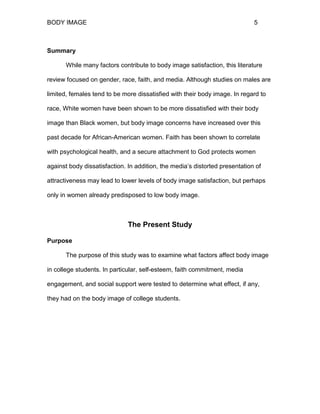
While many factors contribute to body image satisfaction, this literature
review focused on gender, race, faith, and media. Although studies on males are
limited, females tend to be more dissatisfied with their body image. In regard to
race, White women have been shown to be more dissatisfied with their body
image than Black women, but body image concerns have increased over this
past decade for African-American women. Faith has been shown to correlate
with psychological health, and a secure attachment to God protects women
against body dissatisfaction. In addition, the media’s distorted presentation of
attractiveness may lead to lower levels of body image satisfaction, but perhaps
only in women already predisposed to low body image.
The Present Study
Purpose
The purpose of this study was to examine what factors affect body image
in college students. In particular, self-esteem, faith commitment, media
engagement, and social support were tested to determine what effect, if any,
they had on the body image of college students.
BODY IMAGE 6
Hypotheses
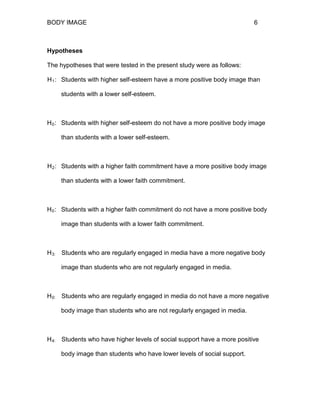
The hypotheses that were tested in the present study were as follows:
H1: Students with higher self-esteem have a more positive body image than
students with a lower self-esteem.
H0: Students with higher self-esteem do not have a more positive body image
than students with a lower self-esteem.
H2: Students with a higher faith commitment have a more positive body image
than students with a lower faith commitment.
H0: Students with a higher faith commitment do not have a more positive body
image than students with a lower faith commitment.
H3: Students who are regularly engaged in media have a more negative body
image than students who are not regularly engaged in media.
H0: Students who are regularly engaged in media do not have a more negative
body image than students who are not regularly engaged in media.
H4: Students who have higher levels of social support have a more positive
body image than students who have lower levels of social support.
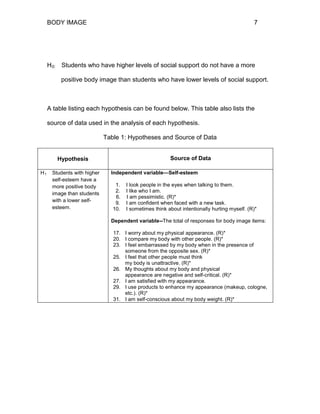
BODY IMAGE 7
H0: Students who have higher levels of social support do not have a more
positive body image than students who have lower levels of social support.
A table listing each hypothesis can be found below. This table also lists the
source of data used in the analysis of each hypothesis.
Table 1: Hypotheses and Source of Data
Hypothesis Source of Data
H1 Students with higher
self-esteem have a
more positive body
image than students
with a lower self-
esteem.
Independent variable—Self-esteem
1. I look people in the eyes when talking to them.
2. I like who I am.
6. I am pessimistic. (R)*
9. I am confident when faced with a new task.
10. I sometimes think about intentionally hurting myself. (R)*
Dependent variable--The total of responses for body image items:
17. I worry about my physical appearance. (R)*
20. I compare my body with other people. (R)*
23. I feel embarrassed by my body when in the presence of
someone from the opposite sex. (R)*
25. I feel that other people must think
my body is unattractive. (R)*
26. My thoughts about my body and physical
appearance are negative and self-critical. (R)*
27. I am satisfied with my appearance.
29. I use products to enhance my appearance (makeup, cologne,
etc.). (R)*
31. I am self-conscious about my body weight. (R)*
BODY IMAGE 8
*Reverse-scored
Methodology
Subjects
The sample of 55 college students came from a private Midwestern
university. Surveys were distributed in the Residence Halls, Library and Student
Center of the university and participants completed them voluntarily. Subjects
were 47.3% male (n = 26) and 52.7% female (n = 29) with ages ranging from 18
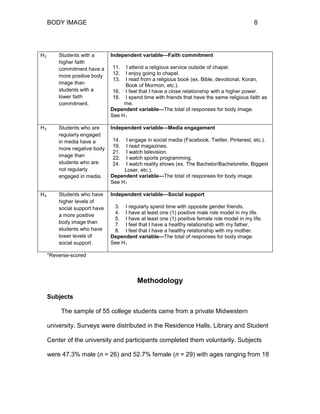
H2 Students with a
higher faith
commitment have a
more positive body
image than
students with a
lower faith
commitment.
Independent variable—Faith commitment
11. I attend a religious service outside of chapel.
12. I enjoy going to chapel.
13. I read from a religious book (ex. Bible, devotional, Koran,
Book of Mormon, etc.).
16. I feel that I have a close relationship with a higher power.
18. I spend time with friends that have the same religious faith as
me.
Dependent variable—The total of responses for body image.
See H1
H3 Students who are
regularly engaged
in media have a
more negative body
image than
students who are
not regularly
engaged in media.
Independent variable—Media engagement
14. I engage in social media (Facebook, Twitter, Pinterest, etc.).
19. I read magazines.
21. I watch television.
22. I watch sports programming.
24. I watch reality shows (ex. The Bachelor/Bachelorette, Biggest
Loser, etc.).
Dependent variable—The total of responses for body image.
See H1
H4 Students who have
higher levels of
social support have
a more positive
body image than
students who have
lower levels of
social support.
Independent variable—Social support
3. I regularly spend time with opposite gender friends.
4. I have at least one (1) positive male role model in my life.
5. I have at least one (1) positive female role model in my life.
7. I feel that I have a healthy relationship with my father.
8. I feel that I have a healthy relationship with my mother.
Dependent variable—The total of responses for body image.
See H1
BODY IMAGE 9
to 36 (mean = 20.453). The majority of respondents were Caucasian (n = 38,
70.4%), eight were African-American (14.8%), and eight were of other
race/ethnicities. One subject did not indicate race. In terms of class standing,
Juniors (n = 15, 27.3%) outnumbered Sophomores (n = 14, 25.5%), Freshman (n
= 13, 23.6%), Seniors (n = 10, 18.2%), Fifth-year Seniors (n = 2, 3.6%), and
Auditors (n = 1, 1.8%). Twenty students were athletes (36.4%) and thirty-five
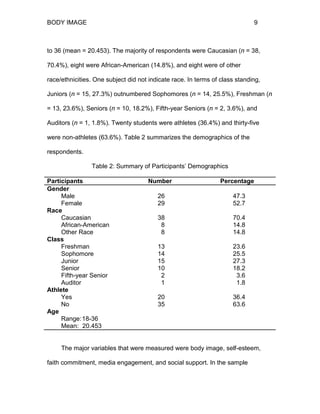
were non-athletes (63.6%). Table 2 summarizes the demographics of the
respondents.
Table 2: Summary of Participants’ Demographics
Participants Number Percentage
Gender
Male 26 47.3
Female
Race
29 52.7
Caucasian 38 70.4
African-American 8 14.8
Other Race
Class
8 14.8
Freshman 13 23.6
Sophomore 14 25.5
Junior 15 27.3
Senior 10 18.2
Fifth-year Senior 2 3.6
Auditor
Athlete
1 1.8
Yes 20 36.4
No 35 63.6
Age
Range:18-36
Mean: 20.453
The major variables that were measured were body image, self-esteem,
faith commitment, media engagement, and social support. In the sample
BODY IMAGE 10
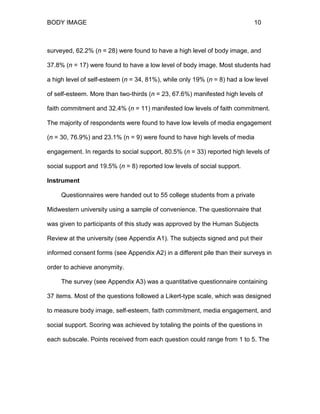
surveyed, 62.2% (n = 28) were found to have a high level of body image, and
37.8% (n = 17) were found to have a low level of body image. Most students had
a high level of self-esteem (n = 34, 81%), while only 19% (n = 8) had a low level
of self-esteem. More than two-thirds (n = 23, 67.6%) manifested high levels of
faith commitment and 32.4% (n = 11) manifested low levels of faith commitment.
The majority of respondents were found to have low levels of media engagement
(n = 30, 76.9%) and 23.1% (n = 9) were found to have high levels of media
engagement. In regards to social support, 80.5% (n = 33) reported high levels of
social support and 19.5% (n = 8) reported low levels of social support.
Instrument
Questionnaires were handed out to 55 college students from a private
Midwestern university using a sample of convenience. The questionnaire that
was given to participants of this study was approved by the Human Subjects
Review at the university (see Appendix A1). The subjects signed and put their
informed consent forms (see Appendix A2) in a different pile than their surveys in
order to achieve anonymity.
The survey (see Appendix A3) was a quantitative questionnaire containing
37 items. Most of the questions followed a Likert-type scale, which was designed
to measure body image, self-esteem, faith commitment, media engagement, and
social support. Scoring was achieved by totaling the points of the questions in
each subscale. Points received from each question could range from 1 to 5. The
BODY IMAGE 11
points on each subscale were then summed to form a total index for that
subscale.
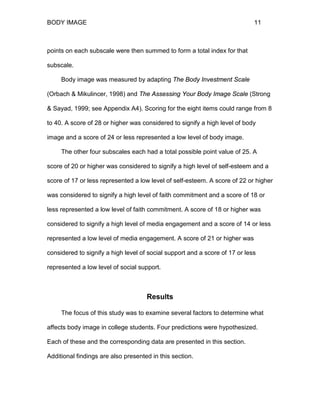
Body image was measured by adapting The Body Investment Scale
(Orbach & Mikulincer, 1998) and The Assessing Your Body Image Scale (Strong
& Sayad, 1999; see Appendix A4). Scoring for the eight items could range from 8
to 40. A score of 28 or higher was considered to signify a high level of body
image and a score of 24 or less represented a low level of body image.
The other four subscales each had a total possible point value of 25. A
score of 20 or higher was considered to signify a high level of self-esteem and a
score of 17 or less represented a low level of self-esteem. A score of 22 or higher
was considered to signify a high level of faith commitment and a score of 18 or
less represented a low level of faith commitment. A score of 18 or higher was
considered to signify a high level of media engagement and a score of 14 or less
represented a low level of media engagement. A score of 21 or higher was
considered to signify a high level of social support and a score of 17 or less
represented a low level of social support.
Results
The focus of this study was to examine several factors to determine what
affects body image in college students. Four predictions were hypothesized.
Each of these and the corresponding data are presented in this section.
Additional findings are also presented in this section.
BODY IMAGE 12
Major Findings
A. Self-esteem and Body Image
Hypothesis One:
H1: Students with higher self-esteem have a more positive body image than
students with a lower self-esteem.
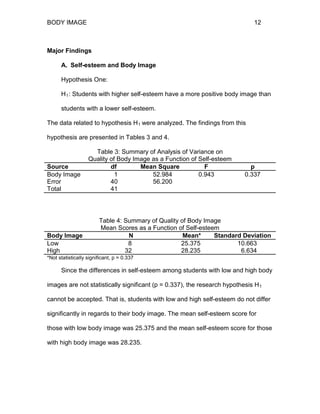
The data related to hypothesis H1 were analyzed. The findings from this
hypothesis are presented in Tables 3 and 4.
Table 3: Summary of Analysis of Variance on
Quality of Body Image as a Function of Self-esteem
Source df Mean Square F p
Body Image 1 52.984 0.943 0.337
Error 40 56.200
Total 41
Table 4: Summary of Quality of Body Image
Mean Scores as a Function of Self-esteem
Body Image N Mean* Standard Deviation
Low 8 25.375 10.663
High 32 28.235 6.634
*Not statistically significant, p = 0.337
Since the differences in self-esteem among students with low and high body
images are not statistically significant (p = 0.337), the research hypothesis H1
cannot be accepted. That is, students with low and high self-esteem do not differ
significantly in regards to their body image. The mean self-esteem score for
those with low body image was 25.375 and the mean self-esteem score for those
with high body image was 28.235.
BODY IMAGE 13
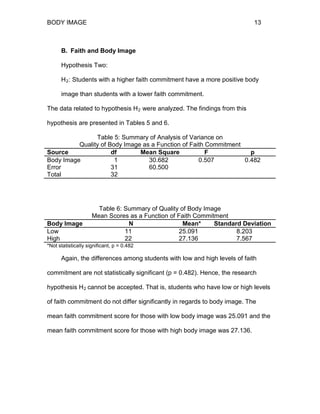
B. Faith and Body Image
Hypothesis Two:
H2: Students with a higher faith commitment have a more positive body
image than students with a lower faith commitment.
The data related to hypothesis H2 were analyzed. The findings from this
hypothesis are presented in Tables 5 and 6.
Table 5: Summary of Analysis of Variance on
Quality of Body Image as a Function of Faith Commitment
Source df Mean Square F p
Body Image 1 30.682 0.507 0.482
Error 31 60.500
Total 32
Table 6: Summary of Quality of Body Image
Mean Scores as a Function of Faith Commitment
Body Image N Mean* Standard Deviation
Low 11 25.091 8.203
High 22 27.136 7.567
*Not statistically significant, p = 0.482
Again, the differences among students with low and high levels of faith
commitment are not statistically significant (p = 0.482). Hence, the research
hypothesis H2 cannot be accepted. That is, students who have low or high levels
of faith commitment do not differ significantly in regards to body image. The
mean faith commitment score for those with low body image was 25.091 and the
mean faith commitment score for those with high body image was 27.136.
BODY IMAGE 14
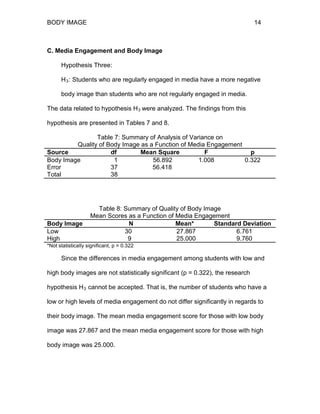
C. Media Engagement and Body Image
Hypothesis Three:
H3: Students who are regularly engaged in media have a more negative
body image than students who are not regularly engaged in media.
The data related to hypothesis H3 were analyzed. The findings from this
hypothesis are presented in Tables 7 and 8.
Table 7: Summary of Analysis of Variance on
Quality of Body Image as a Function of Media Engagement
Source df Mean Square F p
Body Image 1 56.892 1.008 0.322
Error 37 56.418
Total 38
Table 8: Summary of Quality of Body Image
Mean Scores as a Function of Media Engagement
Body Image N Mean* Standard Deviation
Low 30 27.867 6.761
High 9 25.000 9.760
*Not statistically significant, p = 0.322
Since the differences in media engagement among students with low and
high body images are not statistically significant (p = 0.322), the research
hypothesis H3 cannot be accepted. That is, the number of students who have a
low or high levels of media engagement do not differ significantly in regards to
their body image. The mean media engagement score for those with low body
image was 27.867 and the mean media engagement score for those with high
body image was 25.000.
BODY IMAGE 15
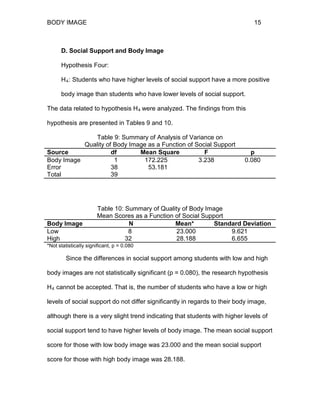
D. Social Support and Body Image
Hypothesis Four:
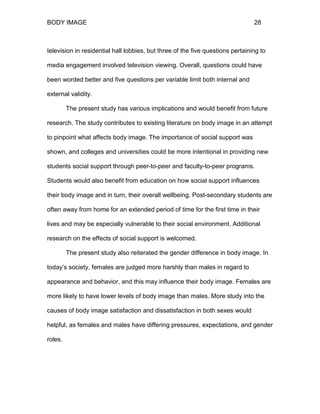
H4: Students who have higher levels of social support have a more positive
body image than students who have lower levels of social support.
The data related to hypothesis H4 were analyzed. The findings from this
hypothesis are presented in Tables 9 and 10.
Table 9: Summary of Analysis of Variance on
Quality of Body Image as a Function of Social Support
Source df Mean Square F p
Body Image 1 172.225 3.238 0.080
Error 38 53.181
Total 39
Table 10: Summary of Quality of Body Image
Mean Scores as a Function of Social Support
Body Image N Mean* Standard Deviation
Low 8 23.000 9.621
High 32 28.188 6.655
*Not statistically significant, p = 0.080
Since the differences in social support among students with low and high
body images are not statistically significant (p = 0.080), the research hypothesis
H4 cannot be accepted. That is, the number of students who have a low or high
levels of social support do not differ significantly in regards to their body image,
although there is a very slight trend indicating that students with higher levels of
social support tend to have higher levels of body image. The mean social support
score for those with low body image was 23.000 and the mean social support
score for those with high body image was 28.188.
BODY IMAGE 16
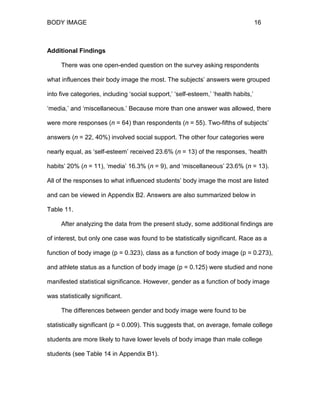
Additional Findings
There was one open-ended question on the survey asking respondents
what influences their body image the most. The subjects’ answers were grouped
into five categories, including ‘social support,’ ‘self-esteem,’ ‘health habits,’
‘media,’ and ‘miscellaneous.’ Because more than one answer was allowed, there
were more responses (n = 64) than respondents (n = 55). Two-fifths of subjects’
answers (n = 22, 40%) involved social support. The other four categories were
nearly equal, as ‘self-esteem’ received 23.6% (n = 13) of the responses, ‘health
habits’ 20% (n = 11), ‘media’ 16.3% (n = 9), and ‘miscellaneous’ 23.6% (n = 13).
All of the responses to what influenced students’ body image the most are listed
and can be viewed in Appendix B2. Answers are also summarized below in
Table 11.
After analyzing the data from the present study, some additional findings are
of interest, but only one case was found to be statistically significant. Race as a
function of body image (p = 0.323), class as a function of body image (p = 0.273),
and athlete status as a function of body image (p = 0.125) were studied and none
manifested statistical significance. However, gender as a function of body image
was statistically significant.
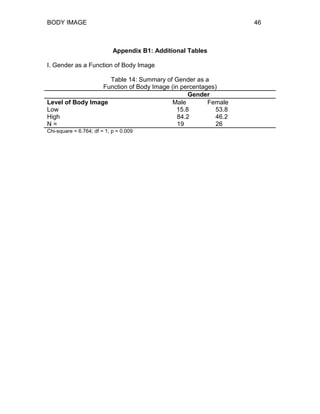
The differences between gender and body image were found to be
statistically significant (p = 0.009). This suggests that, on average, female college
students are more likely to have lower levels of body image than male college
students (see Table 14 in Appendix B1).
BODY IMAGE 17
Table 11: Summary of Biggest Influences to Body Image
Biggest Influence N (55) Percent of Subjects
Reporting
Social Support 22 40.0
Self-esteem 13 23.6
Health Habits 11 20.0
Media 9 16.3
Miscellaneous 9 16.3
TOTAL 64 116.3
BODY IMAGE 18
Table 12: Summary of Hypotheses and Results
Hypotheses Results
H1: Students with higher self-
esteem have a more positive
body image than students with
a lower self-esteem.
There is no significant difference in
self-esteem between students with a
low body image and those with a
high body image.
p = 0.337*
H2: Students with a higher faith
commitment have a more
positive body image than
students with a lower faith
commitment.
There is no significant difference in
faith commitment between students
with a low body image and those
with a high body image.
p = 0.482*
H3: Students who are regularly
engaged in media have a more
negative body image than
students who are not regularly
engaged in media.
There is no significant difference in
media engagement between
students with a low body image and
those with a high body image.
p = 0.322*
H4: Students who have higher
levels of social support have a
more positive body image than
students who have lower levels
of social support.
There is a very slight trend; this
suggests that, on average, students
with higher levels of social support
tend to have higher levels of body
image.
p = 0.080*
*Not statistically significant
Table 13: Summary of Additional Findings
Hypothesis Results
H1: Students who are female are
more likely to have lower levels
of body image than students
who are male.
On average, female students have
lower levels of body image than
male students.
p = 0.009*
*Statistically significant
BODY IMAGE 19
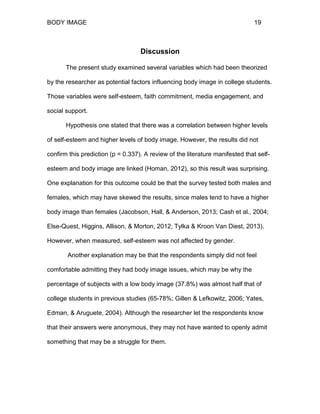
Discussion
The present study examined several variables which had been theorized
by the researcher as potential factors influencing body image in college students.
Those variables were self-esteem, faith commitment, media engagement, and
social support.
Hypothesis one stated that there was a correlation between higher levels
of self-esteem and higher levels of body image. However, the results did not
confirm this prediction (p = 0.337). A review of the literature manifested that self-
esteem and body image are linked (Homan, 2012), so this result was surprising.
One explanation for this outcome could be that the survey tested both males and
females, which may have skewed the results, since males tend to have a higher
body image than females (Jacobson, Hall, & Anderson, 2013; Cash et al., 2004;
Else-Quest, Higgins, Allison, & Morton, 2012; Tylka & Kroon Van Diest, 2013).
However, when measured, self-esteem was not affected by gender.
Another explanation may be that the respondents simply did not feel
comfortable admitting they had body image issues, which may be why the
percentage of subjects with a low body image (37.8%) was almost half that of
college students in previous studies (65-78%; Gillen & Lefkowitz, 2006; Yates,
Edman, & Aruguete, 2004). Although the researcher let the respondents know
that their answers were anonymous, they may not have wanted to openly admit
something that may be a struggle for them.
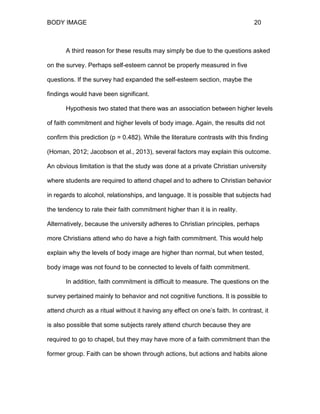
BODY IMAGE 20
A third reason for these results may simply be due to the questions asked
on the survey. Perhaps self-esteem cannot be properly measured in five
questions. If the survey had expanded the self-esteem section, maybe the
findings would have been significant.
Hypothesis two stated that there was an association between higher levels
of faith commitment and higher levels of body image. Again, the results did not
confirm this prediction (p = 0.482). While the literature contrasts with this finding
(Homan, 2012; Jacobson et al., 2013), several factors may explain this outcome.
An obvious limitation is that the study was done at a private Christian university
where students are required to attend chapel and to adhere to Christian behavior
in regards to alcohol, relationships, and language. It is possible that subjects had
the tendency to rate their faith commitment higher than it is in reality.
Alternatively, because the university adheres to Christian principles, perhaps
more Christians attend who do have a high faith commitment. This would help
explain why the levels of body image are higher than normal, but when tested,
body image was not found to be connected to levels of faith commitment.
In addition, faith commitment is difficult to measure. The questions on the
survey pertained mainly to behavior and not cognitive functions. It is possible to
attend church as a ritual without it having any effect on one’s faith. In contrast, it
is also possible that some subjects rarely attend church because they are
required to go to chapel, but they may have more of a faith commitment than the
former group. Faith can be shown through actions, but actions and habits alone
BODY IMAGE 21
do not equate to faith. Perhaps open-ended questions would have yielded more
honest results, as people could then define faith commitment for themselves. But
even this would not be a perfect measure. To yield the most accurate results in
faith commitment, perhaps a combination of qualitative or quantitative answers
and observance of behavior in real world settings is needed, but this was beyond
the scope of this study.
The third hypothesis predicted a connection with higher levels of media
engagement and lower body image, but this was not the result (p = 0.322). This
was not entirely surprising, as media may only play a factor when females
already have low levels of body image and may not affect males at all (Ferguson,
2013). In this study, additional analysis showed that media engagement was not
affected by either gender. Other explanations involve the campus environment.
Three of the five questions measuring media engagement had to do with
television viewing, when the university only provides televisions in residence hall
lobbies; individuals must bring their own to their rooms and a cable subscription
is not provided or even an option. Thus, people may be more likely to watch
movies or play video games in their rooms than watch television programs.
Perhaps if the questions were more geared to a specific form of media
(social media or movies or video games, etc.), statistical significance could be
found. The five questions covered a broad array of the forms of media: social
networks, magazines, and television were included. Lastly, many of the surveys
were handed out in the Library, which may have included students who more
BODY IMAGE 22
studious, and thus do not spend as much time engaging media than people who
do not frequent the Library.
Hypothesis four said that higher levels of social support correlate with
higher levels of body image. This was not found to be statistically significant (p =
0.080), but a very slight trend was found in favor of the prediction. In addition,
40% of respondents to the qualitative question stated that social support
influenced their body image the most. The literature shows some support to this,
as females tend to choose friends with similar levels of body satisfaction (Rayner
et al., 2013). As social creatures, it makes sense that the environment factors
into body image. Body image not only concerns how one person views him or
herself, but also how that person perceives what others think of his or her body.
Therefore, healthier relationships with parents, friends of both genders, and role
models tend to yield higher levels of body satisfaction. Of course, the survey only
shows correlation and not causation. Does healthy social support lead to high
body image or do those with high body image find healthy relationships?
Limitations
In retrospect, this study had several limitations, including sample size,
race demographics, sample location, and questionnaire structure. The sample
was small (n = 55), so generalizability may be limited. In addition, the sample
was taken from a Midwestern university that is comprised mainly of Caucasian
students; only 16 subjects indicated a race other than Caucasian, which again
BODY IMAGE 23
limits generalizability. The university also is faith based, and this may have
skewed the findings of faith commitment, as students may have had the
tendency to rate themselves higher in terms of faith commitment than is reality.
Since the researcher was also a student at the time when the data were
collected, subjects may have worried that their answers would be criticized,
although they were told their responses would be kept anonymous. The structure
of the survey could have been better as well. Questions pertaining to faith were
written in an attempt not to show bias (i.e. although the study was done at a
Christian university, a question about reading religious literature included options
of the Koran and Book of Mormon, in addition to the Bible.), but each of the four
variables had only five questions each. It is quite likely that self-esteem, faith
commitment, media engagement, and social support all require more
scrutinization and depth of questions than this study gave.
Implications
Despite none of the hypotheses showing statistical significance, the
present study has contributed to existing literature on body image. The purpose
of this study was to determine what factors affect body image in college students.
If certain factors could be pinpointed, then these areas could receive more
attention and subsequently, those with low levels of body image could be better
helped.
BODY IMAGE 24
This study found a very slight trend indicating that college students with
higher levels of social support tend to have higher levels of body image. Colleges
and universities could be more intentional in providing social support to new
students through various programs, including peer-to-peer and faculty-to-peer
interactions. This phase of life often is the first time students are away from their
families for an extended period of time and thus, this population may be more in
need of social support from the campus. In addition, students could be educated
about how social support affects their body image and in turn, their health. By
being aware of the importance of building positive relationships, college students
will have the ability to lead healthier lives.
Additional analysis confirmed the gender gap in terms of body image.
Females are more likely to have lower levels of body image than males. More
light needs to be shed on this issue in order that change can occur. In this
patriarchal society, women’s appearance has been scrutinized, and the
traditional role of women has morphed into more ambiguity in the past few
decades. Aside from being attractive, females are expected to succeed in school,
have a good job, rear children, and take care of the home. Men tend not to be
judged as harshly in terms of appearance or behavior, which may be why they do
not struggle as much with body image. A survey can only imply correlation, not
causation, but further study would be beneficial to discover what causes body
image issues.
BODY IMAGE 25
Future Research
Since body image dissatisfaction often leads to a lower quality of life,
including health issues, further study on its causes are needed. Of particular
importance would be to discover the differences in the potential causes of low
body image in females and males. As the two sexes have varying gender roles,
pressures, and expectations, it is likely that their causes of body image vary from
one another.
Another area that could receive increased attention is the importance of
social support in regard to body image. Media has been frequently blamed for
producing low body image, but this may only affect females who already have a
low body image. In today’s society, people are not only surrounded by myriad
forms of mass media, but also by people. No matter how advanced technology
becomes, people naturally form relationships with each other and these people
affect their lives. More work should be done to discover how these relationships
affect not only one’s body image, but one’s overall wellbeing. The friend groups,
families, and overall social environment (including co-workers, neighbors, and
enemies) should be examined in order to provide a fuller picture of one’s level of
social support.
Finally, future research on factors affecting body image may be better
served to concentrate on one variable at a time. In order to make a survey that
was not too time consuming (and thereby causing test fatigue), the four variables
received only five questions each, hardly enough to fully measure each item.
BODY IMAGE 26
This study may have turned out very differently with additional or alternative
questions. One variable that may need multiple studies or at least a multi-method
study is faith commitment. Since faith is not necessarily an observable behavior,
research could be done using open-ended questions as well as observations. In
this way, it may be possible to see a complete picture of faith commitment.
Summary
Body image encompasses the attitudes that one has with one’s physical
appearance. Low levels of body image are common in college students and may
lead to eating disorders, depression, and relationship issues. The goal of this
present study was to identify factors that contribute to body image. Self-esteem,
faith commitment, media engagement, and social support were analyzed in this
study. Having an understanding of what impacts body image will be beneficial to
the physical and mental health of college students. In addition, insight into these
factors would better enable teachers, parents, coaches, and mentors to instruct
and aid students, children, athletes, and mentees towards healthy lifestyles.
The literature review looked at gender, race, faith, and media as factors
affecting body image. It was manifested that females tend to struggle with body
image more than males. This may be due to Western culture’s patriarchal society
and enveloped other factors, such as media. Many studies bemoan the negative
effect media has on body image, but further investigation revealed that media
may only affect body image in females who already have a low body image and
BODY IMAGE 27
may not affect males at all. The literature also showed that faith commitment
correlates to higher levels of body image and that Caucasians are more likely
than minorities to have body image dissatisfaction.
In an attempt to identify factors that affect body image in college students,
a survey was distributed and completed by 55 students at a private Midwestern
university. The questionnaire included 37 items relating to four hypotheses
believed to contribute to body image. The variables were self-esteem, faith
commitment, media engagement, and social support. The results were later
analyzed.
In the present study, none of the four hypotheses were found to be
statistically significant. Only social support (p = 0.080) was found to have a very
slight trend. This indicates that, on average, students with higher levels of social
support tend to have higher levels of body image. Additional analysis examined
gender, race, class standing, and athlete status, but only gender was found to be
statistically significant (p = 0.009). On average, females have lower levels of
body image than males.
There are several explanations for these results, as the study had some
limitations. The sample size was small (n = 55) and the subjects were primarily
Caucasian (70.4%), so generalizability is an issue. The environment also was a
factor. The university where the research took place is a Christian institution,
which may have led to respondents scoring themselves higher in terms of faith
commitment than reality dictates. In addition, the institution only provides
BODY IMAGE 28
television in residential hall lobbies, but three of the five questions pertaining to
media engagement involved television viewing. Overall, questions could have
been worded better and five questions per variable limit both internal and
external validity.
The present study has various implications and would benefit from future
research. The study contributes to existing literature on body image in an attempt
to pinpoint what affects body image. The importance of social support was
shown, and colleges and universities could be more intentional in providing new
students social support through peer-to-peer and faculty-to-peer programs.
Students would also benefit from education on how social support influences
their body image and in turn, their overall wellbeing. Post-secondary students are
often away from home for an extended period of time for the first time in their
lives and may be especially vulnerable to their social environment. Additional
research on the effects of social support is welcomed.
The present study also reiterated the gender difference in body image. In
today’s society, females are judged more harshly than males in regard to
appearance and behavior, and this may influence their body image. Females are
more likely to have lower levels of body image than males. More study into the
causes of body image satisfaction and dissatisfaction in both sexes would
helpful, as females and males have differing pressures, expectations, and gender
roles.
BODY IMAGE 29
Many factors influence body image. Media is often blamed for producing
unrealistic physical expectations and goals, but this alone does not account for
an influx in body dissatisfaction nor does it have as great of an effect as is
believed. Other variables, including gender and social support have a greater
impact. In particular, females and those with lower levels of social support tend
to, on average, have lower levels of body image. More research is needed to
discover why this is and – more importantly – what can be done about it.
BODY IMAGE 30
References
Anderson, C. M., Petrie, T. A., & Neumann, C. S. (2012). Effects of sports
pressures on female collegiate athletes: A preliminary longitudinal
investigation. Sport, Exercise, and Performance Psychology, 1(2), 120-
134. doi: 10.1037/a0026587
Becker, C. B., Bull, S., Schaumberg, K., Cauble, A., & Franco, A. (2008).
Effectiveness of peer-led eating disorders prevention: A replication trial.
Journal of Consulting and Clinical Psychology, 76(2), 347-354. doi:
10.1037/0022-006X.76.2.347
Capodilupo, C. M., & Kim, S. (2014). Gender and race matter: The importance of
considering intersections in black women’s body image. Journal of
Counseling Psychology, 61(1), 37-49. doi: 10.1037/a0034597
Cash, T. F., Morrow, J. A., Hrabosky, J. I., & Perry, A. A. (2004). How has body
image changed? A cross-sectional investigation of college women and
men from 1983 to 2001. Journal of Consulting and Clinical Psychology,
72(6), 1081-1089. doi: 10.1037/0022-006X.72.6.1081
Comer, R. (2011). Fundamentals of abnormal psychology. New York: Worth
Publishers.
Daniel, S., & Bridges, S. K. (2013). The relationships among body image,
masculinity, and sexual satisfaction in men. Psychology of Men &
Masculinity, 14(4), 345-351. doi: 10.1037/a0029154
BODY IMAGE 31
Else-Quest, N. M., Higgins, A., Allison, C., & Morton, L. C. (2012). Gender
differences in self-conscious emotional experience: A meta-analysis.
Psychological Bulletin, 138(5), 947-981. doi: 10.1037/a0027930
Eyal, K., & Te’eni-Harari, T. (2013). Explaining the relationship between media
exposure and early adolescents’ body image perceptions: The role of
favorite characters. Journal of Media Psychology, 25(3), 129-141. doi:
10.1027/1864-1105/a000094
Ferguson, C. J. (2013). In the eye of the beholder: Thin-ideal media affects
some, but not most, viewers in a meta-analytic review of body
dissatisfaction in women and men. Psychology of Popular Media Culture,
2(1), 20-37. doi: 10.1037/a0030766
Gillen, M. M., & Lefkowitz, E. S. (2006). Gender role development and body
image among male and female first year college students. Sex Roles,
55(1), 25-37. doi: 10.1007/s11199-006-9057-4
Greenwood, D. N., & Dal Cin, S. (2012). Ethnicity and body consciousness:
Black and white American women’s negotiation of media ideals and
others’ approval. Psychology of Popular Media Culture, 1(4), 220-235. doi:
10.1037/a0029411
Homan, K. J., (2012). Attachment to God mitigates negative effect of media
exposure on women’s body image. Psychology of Religion and Spirituality,
4(4), 324-331. doi: 10.1037/a0029230
BODY IMAGE 32
Jacobson, H. L., Hall, M. E. L., & Anderson, T. L. (2013). Theology and the body:
Sanctification and bodily experiences. Psychology of Religion and
Spirituality, 5(1), 41-50. doi: 10.1037/a0028042
Martijn, C., Sheeran, P., Wesseldijk, L. W., Merrick, H., Webb, T. L., Roefs, A., &
Jansen, A. (2013). Evaluative conditioning makes slim models less
desirable as standards for comparison and increases body satisfaction.
Health Psychology, 32(4), 433-438. doi: 10.1037/a0028592
McFarland, M. B., & Petrie, T. A. (2012). Male body satisfaction: Factorial and
construct validity of the body parts satisfaction scale for men. Journal of
Counseling Psychology, 59(2), 329-337. doi: 10.1037/a0026777
Michaels, M. S., Parent, M. C., & Moradi, B. (2013). Does exposure to
muscularity-idealizing images have self-objectification consequences for
heterosexual and sexual minority men? Psychology of Men & Masculinity,
14(2), 175-183. doi: 10.1037/a0027259
Murray, T., & Lewis, V. (2014). Gender-role conflict and men’s body satisfaction:
The moderating role of age. Psychology of Men & Masculinity, 15(1), 40-
48. doi: 10.1037/a0030959
Orbach, I., & Mikulincer, M. (1998). The body investment scale: Construction and
validation of a body experience scale. Psychological Assessment, 10(4),
425.
BODY IMAGE 33
Parent, M. C. (2013). Clinical considerations in etiology, assessment, and
treatment of men’s muscularity-focused body image disturbance.
Psychology of Men & Masculinity, 14(1), 88-100. doi: 10.1037/a0025644
Parent, M. C., & Moradi, B. (2011). His biceps become him: A test of
objectification theory’s application to drive muscularity and propensity for
steroid use in college men. Journal of Counseling Psychology, 58(2), 246-
256. doi: 10.1037/a0021398
Peat, C. M., Peyerl, N. L., Ferraro, F. R., & Butler, M. (2011). Age and body
image in Caucasian men. Psychology of Men & Masculinity, 12(2), 195-
200. doi: 10.1037/a0021478
Rayner, K. E., Schiering, C. A., Rapee, R. M., Taylor, A., & Hutchinson, D. M.
(2013). Adolescent girls’ friendship networks, body dissatisfaction, and
disordered eating: Examining selection and socialization processes.
Journal of Abnormal Psychology, 122(1), 93-104. doi: 10.1037/a0029304
Rutledge, C. M., Gillmor, K. L., & Gillen, M. M. (2013). Does this profile picture
make me look fat? Facebook and body image in college students.
Psychology of Popular Media Culture, 2(4), 251-258. doi:
10.1037/ppm0000011
Steinfeldt, J. A., Zakrajsek, R., Carter, H., & Steinfeldt, M. C. (2011). Conformity
to gender norms among female student-athletes: Implications for body
image. Psychology of Men & Masculinity, 12(4), 401-416. doi:
10.1037/a0023634
BODY IMAGE 34
Strong, B., & Sayad, B. W. (1999). The resource book: A teacher’s tool kit to
accompany human sexuality. Mountain View, CA: Mayfield Publishing
Company.
Swami, V., & Voracek, M. (2013). Associations among men’s sexist attitudes,
objectification of women, and their own drive for muscularity. Psychology
of Men & Masculinity, 14(2), 168-174. doi: 10.1037/a0028437
Tylka, T. L., & Kroon Van Diest, A. M. (2013). The intuitive eating scale-2: Item
refinement and psychometric evaluation with college men and women.
Journal of Counseling Psychology, 60(1), 137-153. doi: 10.1037/a0030893
Yates, A., Edman, J., & Auguete, M. (2004). Ethnic differences in BMI and
body/self-dissatisfaction among whites, Asian subgroups, Pacific
Islanders, and African-Americans. Journal of Adolescent Health, 34(4),
300-307. doi: 10.1016/j.jadohealth.2003.07.014
BODY IMAGE 35
Appendices
Appendix A: Questionnaire
Appendix A1: Human Subjects Review........................... 37
Appendix A2: Letter of Informed Consent....................... 39
Appendix A3: Survey Questionnaire ............................... 40
Appendix A4: Questions taken from other sources......... 44
Appendix B: Additional Findings
Appendix B1: Additional Findings ................................... 46
Appendix B2: Additional Responses............................... 47
Appendix C: PowerPoint Presentation.................................... 53
BODY IMAGE 36
Appendix A:
Questionnaire
BODY IMAGE 37
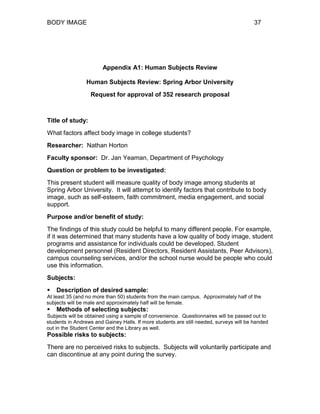
Appendix A1: Human Subjects Review
Human Subjects Review: Spring Arbor University
Request for approval of 352 research proposal
Title of study:
What factors affect body image in college students?
Researcher: Nathan Horton
Faculty sponsor: Dr. Jan Yeaman, Department of Psychology
Question or problem to be investigated:
This present student will measure quality of body image among students at
Spring Arbor University. It will attempt to identify factors that contribute to body
image, such as self-esteem, faith commitment, media engagement, and social
support.
Purpose and/or benefit of study:
The findings of this study could be helpful to many different people. For example,
if it was determined that many students have a low quality of body image, student
programs and assistance for individuals could be developed. Student
development personnel (Resident Directors, Resident Assistants, Peer Advisors),
campus counseling services, and/or the school nurse would be people who could
use this information.
Subjects:
 Description of desired sample:
At least 35 (and no more than 50) students from the main campus. Approximately half of the
subjects will be male and approximately half will be female.
 Methods of selecting subjects:
Subjects will be obtained using a sample of convenience. Questionnaires will be passed out to
students in Andrews and Gainey Halls. If more students are still needed, surveys will be handed
out in the Student Center and the Library as well.
Possible risks to subjects:
There are no perceived risks to subjects. Subjects will voluntarily participate and
can discontinue at any point during the survey.
BODY IMAGE 38
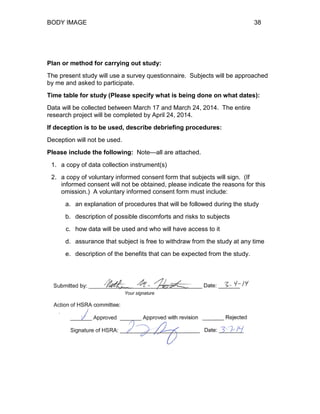
Plan or method for carrying out study:
The present study will use a survey questionnaire. Subjects will be approached
by me and asked to participate.
Time table for study (Please specify what is being done on what dates):
Data will be collected between March 17 and March 24, 2014. The entire
research project will be completed by April 24, 2014.
If deception is to be used, describe debriefing procedures:
Deception will not be used.
Please include the following: Note—all are attached.
1. a copy of data collection instrument(s)
2. a copy of voluntary informed consent form that subjects will sign. (If
informed consent will not be obtained, please indicate the reasons for this
omission.) A voluntary informed consent form must include:
a. an explanation of procedures that will be followed during the study
b. description of possible discomforts and risks to subjects
c. how data will be used and who will have access to it
d. assurance that subject is free to withdraw from the study at any time
e. description of the benefits that can be expected from the study.
BODY IMAGE 39
Appendix A2: Letter of Informed Consent
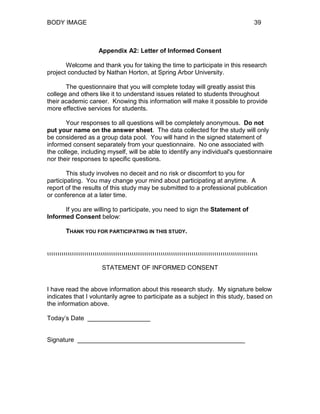
Welcome and thank you for taking the time to participate in this research
project conducted by Nathan Horton, at Spring Arbor University.
The questionnaire that you will complete today will greatly assist this
college and others like it to understand issues related to students throughout
their academic career. Knowing this information will make it possible to provide
more effective services for students.
Your responses to all questions will be completely anonymous. Do not
put your name on the answer sheet. The data collected for the study will only
be considered as a group data pool. You will hand in the signed statement of
informed consent separately from your questionnaire. No one associated with
the college, including myself, will be able to identify any individual's questionnaire
nor their responses to specific questions.
This study involves no deceit and no risk or discomfort to you for
participating. You may change your mind about participating at anytime. A
report of the results of this study may be submitted to a professional publication
or conference at a later time.
If you are willing to participate, you need to sign the Statement of
Informed Consent below:
THANK YOU FOR PARTICIPATING IN THIS STUDY.
ιιιιιιιιιιιιιιιιιιιιιιιιιιιιιιιιιιιιιιιιιιιιιιιιιιιιιιιιιιιιιιιιιιιιιιιιιιιιιιιιιιιιιιιιιιιιιιιιιιιιιι
STATEMENT OF INFORMED CONSENT
I have read the above information about this research study. My signature below
indicates that I voluntarily agree to participate as a subject in this study, based on
the information above.
Today’s Date __________________
Signature ________________________________________________
BODY IMAGE 40
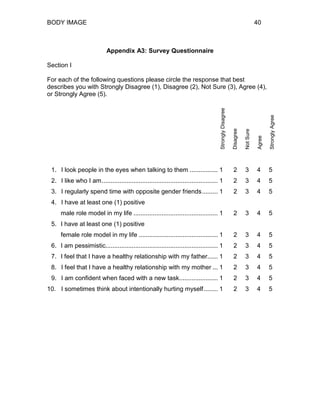
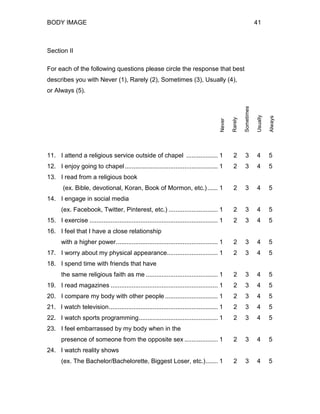
Appendix A3: Survey Questionnaire
Section I
For each of the following questions please circle the response that best
describes you with Strongly Disagree (1), Disagree (2), Not Sure (3), Agree (4),
or Strongly Agree (5).
1. I look people in the eyes when talking to them ................ 1 2 3 4 5
2. I like who I am.................................................................. 1 2 3 4 5
3. I regularly spend time with opposite gender friends......... 1 2 3 4 5
4. I have at least one (1) positive
male role model in my life ................................................ 1 2 3 4 5
5. I have at least one (1) positive
female role model in my life ............................................. 1 2 3 4 5
6. I am pessimistic................................................................ 1 2 3 4 5
7. I feel that I have a healthy relationship with my father...... 1 2 3 4 5
8. I feel that I have a healthy relationship with my mother ... 1 2 3 4 5
9. I am confident when faced with a new task...................... 1 2 3 4 5
10. I sometimes think about intentionally hurting myself........ 1 2 3 4 5
StronglyDisagree
Disagree
NotSure
Agree
StronglyAgree
BODY IMAGE 41
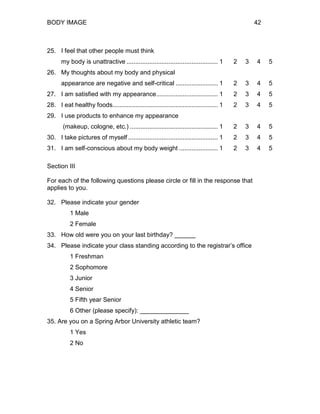
Section II
For each of the following questions please circle the response that best
describes you with Never (1), Rarely (2), Sometimes (3), Usually (4),
or Always (5).
11. I attend a religious service outside of chapel .................. 1 2 3 4 5
12. I enjoy going to chapel..................................................... 1 2 3 4 5
13. I read from a religious book
(ex. Bible, devotional, Koran, Book of Mormon, etc.)...... 1 2 3 4 5
14. I engage in social media
(ex. Facebook, Twitter, Pinterest, etc.) ............................ 1 2 3 4 5
15. I exercise ......................................................................... 1 2 3 4 5
16. I feel that I have a close relationship
with a higher power.......................................................... 1 2 3 4 5
17. I worry about my physical appearance............................. 1 2 3 4 5
18. I spend time with friends that have
the same religious faith as me ......................................... 1 2 3 4 5
19. I read magazines ............................................................. 1 2 3 4 5
20. I compare my body with other people .............................. 1 2 3 4 5
21. I watch television.............................................................. 1 2 3 4 5
22. I watch sports programming............................................. 1 2 3 4 5
23. I feel embarrassed by my body when in the
presence of someone from the opposite sex ................... 1 2 3 4 5
24. I watch reality shows
(ex. The Bachelor/Bachelorette, Biggest Loser, etc.)....... 1 2 3 4 5
Never
Rarely
Sometimes
Usually
Always
BODY IMAGE 42
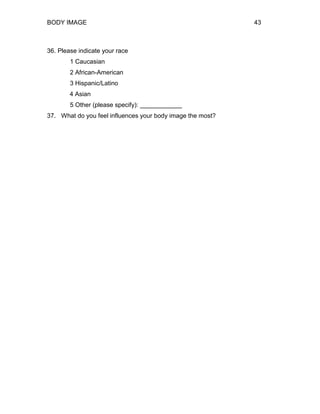
25. I feel that other people must think
my body is unattractive .................................................... 1 2 3 4 5
26. My thoughts about my body and physical
appearance are negative and self-critical ........................ 1 2 3 4 5
27. I am satisfied with my appearance................................... 1 2 3 4 5
28. I eat healthy foods............................................................ 1 2 3 4 5
29. I use products to enhance my appearance
(makeup, cologne, etc.) .................................................. 1 2 3 4 5
30. I take pictures of myself ................................................... 1 2 3 4 5
31. I am self-conscious about my body weight ...................... 1 2 3 4 5
Section III
For each of the following questions please circle or fill in the response that
applies to you.
32. Please indicate your gender
1 Male
2 Female
33. How old were you on your last birthday? ______
34. Please indicate your class standing according to the registrar’s office
1 Freshman
2 Sophomore
3 Junior
4 Senior
5 Fifth year Senior
6 Other (please specify): ______________
35. Are you on a Spring Arbor University athletic team?
1 Yes
2 No
BODY IMAGE 43
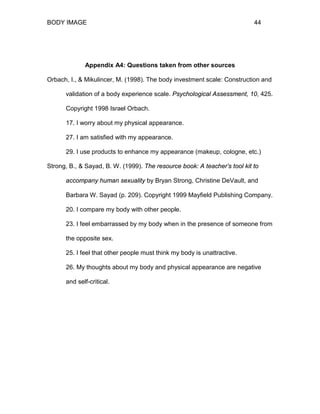
36. Please indicate your race
1 Caucasian
2 African-American
3 Hispanic/Latino
4 Asian
5 Other (please specify): ____________
37. What do you feel influences your body image the most?
BODY IMAGE 44
Appendix A4: Questions taken from other sources
Orbach, I., & Mikulincer, M. (1998). The body investment scale: Construction and
validation of a body experience scale. Psychological Assessment, 10, 425.
Copyright 1998 Israel Orbach.
17. I worry about my physical appearance.
27. I am satisfied with my appearance.
29. I use products to enhance my appearance (makeup, cologne, etc.)
Strong, B., & Sayad, B. W. (1999). The resource book: A teacher’s tool kit to
accompany human sexuality by Bryan Strong, Christine DeVault, and
Barbara W. Sayad (p. 209). Copyright 1999 Mayfield Publishing Company.
20. I compare my body with other people.
23. I feel embarrassed by my body when in the presence of someone from
the opposite sex.
25. I feel that other people must think my body is unattractive.
26. My thoughts about my body and physical appearance are negative
and self-critical.
BODY IMAGE 45
Appendix B:
Additional Findings
BODY IMAGE 46
Appendix B1: Additional Tables
I. Gender as a Function of Body Image
Table 14: Summary of Gender as a
Function of Body Image (in percentages)
Gender
Level of Body Image Male Female
Low 15.8 53.8
High 84.2 46.2
N = 19 26
Chi-square = 6.764; df = 1; p = 0.009
BODY IMAGE 47
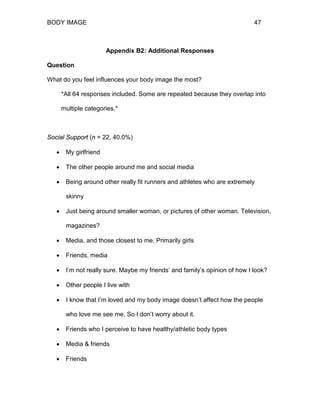
Appendix B2: Additional Responses
Question
What do you feel influences your body image the most?
*All 64 responses included. Some are repeated because they overlap into
multiple categories.*
Social Support (n = 22, 40.0%)
• My girlfriend
• The other people around me and social media
• Being around other really fit runners and athletes who are extremely
skinny
• Just being around smaller woman, or pictures of other woman. Television,
magazines?
• Media, and those closest to me. Primarily girls
• Friends, media
• I’m not really sure. Maybe my friends’ and family’s opinion of how I look?
• Other people I live with
• I know that I’m loved and my body image doesn’t affect how the people
who love me see me. So I don’t worry about it.
• Friends who I perceive to have healthy/athletic body types
• Media & friends
• Friends
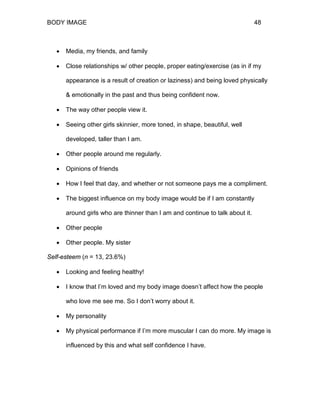
BODY IMAGE 48
• Media, my friends, and family
• Close relationships w/ other people, proper eating/exercise (as in if my
appearance is a result of creation or laziness) and being loved physically
& emotionally in the past and thus being confident now.
• The way other people view it.
• Seeing other girls skinnier, more toned, in shape, beautiful, well
developed, taller than I am.
• Other people around me regularly.
• Opinions of friends
• How I feel that day, and whether or not someone pays me a compliment.
• The biggest influence on my body image would be if I am constantly
around girls who are thinner than I am and continue to talk about it.
• Other people
• Other people. My sister
Self-esteem (n = 13, 23.6%)
• Looking and feeling healthy!
• I know that I’m loved and my body image doesn’t affect how the people
who love me see me. So I don’t worry about it.
• My personality
• My physical performance if I’m more muscular I can do more. My image is
influenced by this and what self confidence I have.
BODY IMAGE 49
• Close relationships w/ other people, proper eating/exercise (as in if my
appearance is a result of creation or laziness) and being loved physically
& emotionally in the past and thus being confident now.
• I will say nothing influences my body image. Because I feel confidently
about myself.
• Myself.
• My insecurities because of my lack of a father figure.
• Me.
• How I feel that day, and whether or not someone pays me a compliment.
• Attitude
• I’ve been small for a long time…my mom informed me that I probably
won’t start picking up major weight until I start having kids. So until that
time is right in my life. I just try to enjoy the shape and figure I have now!
• My feelings because I am a Health and Exercise major so staying fit is
proper to me. I feel happier when I eat and look better. More confidence
comes from a more comfortable look.
Health Habits (n = 11, 20.0%)
• What I eat and how I exercise
• Staying healthy
• I exercise constantly – at least twice a day, and I eat super healthy.
• Muscle, posture, clothes, and hygiene
BODY IMAGE 50
• Close relationships w/ other people, proper eating/exercise (as in if my
appearance is a result of creation or laziness) and being loved physically
& emotionally in the past and thus being confident now.
• How often I exercise
• Exercise
• My feelings because I am a Health and Exercise major so staying fit is
proper to me. I feel happier when I eat and look better. More confidence
comes from a more comfortable look.
• Athletic ability & Strength
• My physical performance if I’m more muscular I can do more. My image is
influenced by this and what self confidence I have.
• Muscles
Media (n = 9, 16.3%)
• The other people around me and social media
• Just being around smaller woman, or pictures of other woman. Television,
magazines?
• Media, and those closest to me. Primarily girls
• Friends, media
• Media
• Media & friends
• Media, my friends, and family
• The Internet and advertisements and my faith
BODY IMAGE 51
• All the different forms of media forcing perfection as a societal norm
Miscellaneous (n = 9, 16.3%)
• Nothing.
• Tall, Dark, & Handsome
• Christ and being made in his image
• Things
• N/A
• What Jesus has to say about it.
• Probably the stereotypical idea of what a “man” should look like.
• Clothes
• Clothing?
BODY IMAGE 52
Appendix C:
PowerPoint Presentation Slides
BODY IMAGE 53
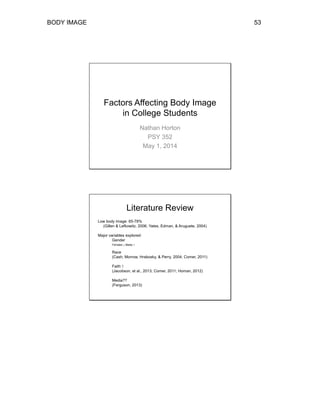
Factors Affecting Body Image
in College Students
Nathan Horton
PSY 352
May 1, 2014
Literature Review
Low body image: 65-78%
(Gillen & Lefkowitz, 2006; Yates, Edman, & Aruguete, 2004)
Major variables explored:
Gender
Females ↓ Males ↑
Race
(Cash, Morrow, Hrabosky, & Perry, 2004; Comer, 2011)
Faith ↑
(Jacobson, et al., 2013; Comer, 2011; Homan, 2012)
Media??
(Ferguson, 2013)
BODY IMAGE 54
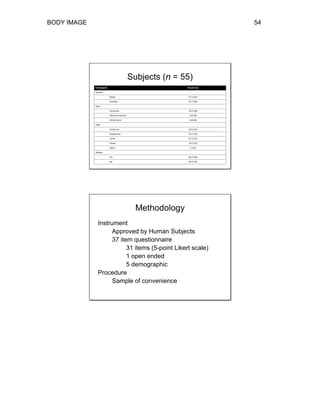
Subjects (n = 55)
Participants Percent (n)
Gender
Males 47.3 (26)
Females 52.7 (29)
Race
Caucasian 70.4 (38)
African-American 14.8 (8)
Other Races 14.8 (8)
Class
Freshman 23.6 (13)
Sophomore 25.5 (14)
Junior 27.3 (15)
Senior 18.2 (10)
Other 5.4 (3)
Athlete
Yes 36.4 (20)
No 63.6 (35)
Methodology
Instrument
Approved by Human Subjects
37 item questionnaire
31 items (5-point Likert scale)
1 open ended
5 demographic
Procedure
Sample of convenience
BODY IMAGE 55
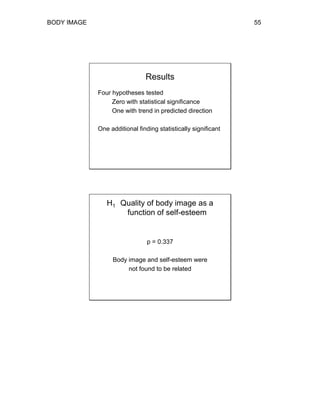
Results
Four hypotheses tested
Zero with statistical significance
One with trend in predicted direction
One additional finding statistically significant
H1 Quality of body image as a
function of self-esteem
p = 0.337
Body image and self-esteem were
not found to be related
BODY IMAGE 56
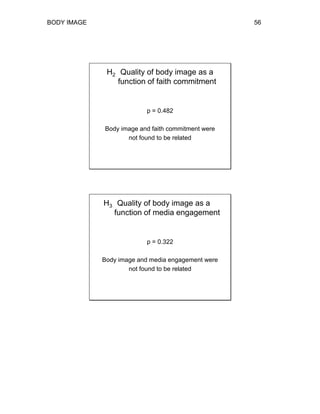
H2 Quality of body image as a
function of faith commitment
p = 0.482
Body image and faith commitment were
not found to be related
H3 Quality of body image as a
function of media engagement
p = 0.322
Body image and media engagement were
not found to be related
BODY IMAGE 57
H4 Quality of body image as a
function of social support
p = 0.080
Those with higher levels
of body image tend to have
higher levels of social support
Additional Findings
Females are more likely to
have lower levels of body image
p = 0.009
BODY IMAGE 58
Discussion: Any Questions??

Factors Affecting Body Image in College Students

  • 1.
    Factors Affecting BodyImage in College Students Nathan Horton Spring Arbor University April 25, 2014
  • 2.
    Running head: BODYIMAGE Factors Affecting Body Image in College Students Nathan Horton Spring Arbor University PSY 352: Research Design April 25, 2014 Na004591@arbor.edu
  • 3.
    BODY IMAGE Abstract A studywas conducted with 55 college students at a private Midwestern university to determine factors that influence body image. Subjects were 47.3% male (n = 26) and 52.7% female (n = 29) with ages ranging from 18 to 36 (mean = 20.453). The majority of respondents were Caucasian (n = 38, 70.4%), eight were African-American (14.8%), and eight were of other races. Twenty students were athletes (36.4%) and thirty-five were non-athletes (63.6%). Questionnaires containing 37 items were handed out using a sample of convenience. After analyzing the data, no variables were found to be statistically significant, although social support was found to have a slight trend (p = 0.080). This suggests that, on average, students who have higher levels of social support are more likely to have higher levels of body image than students with lower levels of social support. This study did not find any relationship between body image and self-esteem (p = 0.337), faith commitment (p = 0.482), or media engagement (p = 0.322). Other additional findings are reported at the end of the results section. i
  • 4.
    BODY IMAGE Table ofContents Literature Review.................................................................................... 1 Gender............................................................................................ 2 Race ............................................................................................... 2 Faith................................................................................................ 3 Media.............................................................................................. 4 Summary ........................................................................................ 5 Present Study ......................................................................................... 5 Purpose .......................................................................................... 5 Hypotheses..................................................................................... 6 Methodology ........................................................................................... 8 Subjects.......................................................................................... 8 Instrument......................................................................................10 Results...................................................................................................11 Major Findings ...............................................................................12 Additional Findings.........................................................................16 Discussion .............................................................................................19 Limitations..............................................................................................22 Implications............................................................................................23 Future Research ....................................................................................25 Summary ...............................................................................................26 References ............................................................................................30 ii
  • 5.
    BODY IMAGE Appendices............................................................................................35 Appendix A....................................................................................36 Appendix B ....................................................................................45 Appendix C ....................................................................................52 iii
  • 6.
    BODY IMAGE Table ofTables Table 1: Hypothesis and Source of Data ................................................ 7 Table 2: Summary of Participants’ Demographics .................................. 9 Table 3: Summary of Analysis of Variance on Quality of Body Image as a Function of Self-esteem................12 Table 4: Summary of Quality of Body Image as a Function of Self-esteem....................................................12 Table 5: Summary of Analysis of Variance on Quality of Body Image as a Function of Faith Commitment......................13 Table 6: Summary of Quality of Body Image as a Function of Faith Commitment..........................................13 Table 7: Summary of Analysis of Variance on Quality of Body Image as a Function of Media Engagement....................14 Table 8: Summary of Quality of Body Image as a Function of Media Engagement........................................14 Table 9: Summary of Analysis of Variance on Quality of Body Image as a Function of Social Support............................15 Table 10: Summary of Quality of Body Image as a Function of Social Support................................................15 Table 11: Summary of Biggest Influence to Body Image .......................17 Table 12: Summary of Hypotheses and Results....................................18 Table 13: Summary of Additional Findings ............................................18 iv
  • 7.
    BODY IMAGE Table 14:Summary of Gender as a Function of Body Image ................46 v
  • 8.
    BODY IMAGE 1 LiteratureReview In a society with much focus on physical appearance, and with rise of obesity and eating disorders (Comer, 2011), it is not surprising that one’s satisfaction or dissatisfaction with one’s body image has an impact (Eyal & Te’eni-Harari, 2013). Cash, Morrow, Hrabosky, and Perry (2004) found that such dissatisfaction is not unusual and can harm a person’s “psychosocial functioning and quality of life,” and define body image as “a multidimensional construct encompassing self-perceptions and attitudes regarding one’s physical appearance” (p. 1081). Objectification of women, a patriarchal byproduct, hurts both men and women (Swami & Voracek, 2013), and studies show that most college students (65-78%) have low body image (Gillen & Lefkowitz, 2006; Yates, Edman, & Aruguete, 2004). Men who struggle with body image may develop obsessive-compulsive symptoms, bulimic symptoms, depression, have relationship issues, and/or abuse substances (Parent, 2013; McFarland & Petrie, 2012; Parent & Moradi, 2011). Women’s body dissatisfaction correlates to low self-worth, low self-esteem, and eating disorders, including bulimic behaviors (Homan, 2012; Rayner, Schniering, Rappe, Taylor, & Hutchinson, 2013). This literature review explores several factors that affect body image. Sundry sources factor into body image, including gender, race, faith, and media. These four variables will be discussed in this literature review.
  • 9.
    BODY IMAGE 2 Gender Whilemales, particularly of college age, may experience low levels of body image satisfaction (Peat, Peyerl, Ferraro, & Butler, 2011; Parent & Moradi, 2011), females tend to be more dissatisfied with their body image and more likely to alter their eating habits (Jacobson, Hall, & Anderson, 2013; Cash et al., 2004; Else-Quest, Higgins, Allison, & Morton, 2012; Tylka & Kroon Van Diest, 2013). Female athletes also have the difficulty of negotiating their athletic build and the ideal feminine body type, which may lead to decreased body satisfaction and the development of eating disorders (Anderson, Petrie, & Neumann, 2012; Steinfeldt, Zakrajsek, Carter, & Steinfeldt, 2011). Studies on men are limited, but younger men may have higher levels of body dissatisfaction than older men (Daniel & Bridges, 2013; Peat, et al., 2011; Murray & Lewis, 2014). This may be due to cultural standards of appearance (Parent & Moradi, 2011). Most studies have been done on heterosexual men, but Michaels, Parent, and Moradi (2013) found that sexual minority men have less body satisfaction. Race There are differences in body image among races, including Blacks and Whites. Cash and colleagues (2004) found that Black women did not vary greatly over two decades (1980s-1990s) in body satisfaction and compared similarly with non-Black men from 1996 to 2001 (17% and 16%, respectfully). However, research suggests that body image concerns have increased over the past
  • 10.
    BODY IMAGE 3 decade(2000s) for African-American women (Comer, 2011). White women were found to be more likely to respond to media ideal of thinness, though publication bias may in some part explain the discrepancy (Greenwood & Dal Cin, 2012; Ferguson, 2013). Black women are underrepresented in media, which may be why Black men desire a more “Eurocentric” appearance in Black women (Capodilupo & Kim, 2014, p. 46). Researchers suggest that African Americans who identify more closely with African American culture are less likely to be dissatisfied with their bodies (Capodilupo & Kim, 2014; Greenwood & Dal Cin, 2012). Faith Various studies have shown that religious faith correlates with psychological health (Comer, 2011). Homan (2012) used attachment theory (developed by Bowlby, 1969/1982, 1973, 1980 and further investigated by Hazan & Shaver, 1987) to see if a relationship with God would impact female body image when subjects were presented with media pictures of thin women. Participants were rated on their attachment to God before being exposed to either thin or normal-weight models. After the slide show, the women filled out a “visual analogue scale” pertaining to their body image (Homan, 2012, p. 326). Although the manifestation of thin models resulted in more body dissatisfaction than the manifestation of normal-weight models, women who were more securely attached to God had lower levels of body dissatisfaction. In addition, Jacobson et al. (2013) found that both men and women who considered their body as sacred
  • 11.
    BODY IMAGE 4 (areligious concept) had greater body satisfaction. Both Homan (2012) and Comer (2011) agree that secure attachment to God reduces the levels of stress felt in a stressful situation. Media Media’s interpretations of female beauty often portray women who are skinnier than the average woman, while men are presented in unattainable muscular appearance (Greenwood & Dal Cin, 2012; Eyal & Te’eni-Harari, 2013; Comer, 2011; Parent, 2013). Greenwood and Dal Cin (2012) investigated how body image was connected with a woman’s favorite television character or persona. Both Black and White women who were conscious of wanting the approval of others were more aware of their physical appearance; this correlates with lower levels of body image. Another study (Eyal & Te’eni-Harari, 2013) connected favorite television characters and body dissatisfaction in adolescents, manifesting that media impacts a person’s life early on. However, conditioning intervention may lead to higher body satisfaction (Martijn et al., 2013; Becker, Bull, Schaumberg, Cauble, & Franco, 2008). Researchers studied another popular form of media, Facebook, but discovered that usage of the social networking site is not related to greater body image concerns (Rutledge, Gillmor, & Gillen, 2013). Indeed, a meta-analysis discovered that media’s ideal body types for women (thin) and men (muscular) may only affect women who are already dissatisfied with their body and do not appear to affect men at all (Ferguson, 2013).
  • 12.
    BODY IMAGE 5 Summary Whilemany factors contribute to body image satisfaction, this literature review focused on gender, race, faith, and media. Although studies on males are limited, females tend to be more dissatisfied with their body image. In regard to race, White women have been shown to be more dissatisfied with their body image than Black women, but body image concerns have increased over this past decade for African-American women. Faith has been shown to correlate with psychological health, and a secure attachment to God protects women against body dissatisfaction. In addition, the media’s distorted presentation of attractiveness may lead to lower levels of body image satisfaction, but perhaps only in women already predisposed to low body image. The Present Study Purpose The purpose of this study was to examine what factors affect body image in college students. In particular, self-esteem, faith commitment, media engagement, and social support were tested to determine what effect, if any, they had on the body image of college students.
  • 13.
    BODY IMAGE 6 Hypotheses Thehypotheses that were tested in the present study were as follows: H1: Students with higher self-esteem have a more positive body image than students with a lower self-esteem. H0: Students with higher self-esteem do not have a more positive body image than students with a lower self-esteem. H2: Students with a higher faith commitment have a more positive body image than students with a lower faith commitment. H0: Students with a higher faith commitment do not have a more positive body image than students with a lower faith commitment. H3: Students who are regularly engaged in media have a more negative body image than students who are not regularly engaged in media. H0: Students who are regularly engaged in media do not have a more negative body image than students who are not regularly engaged in media. H4: Students who have higher levels of social support have a more positive body image than students who have lower levels of social support.
  • 14.
    BODY IMAGE 7 H0:Students who have higher levels of social support do not have a more positive body image than students who have lower levels of social support. A table listing each hypothesis can be found below. This table also lists the source of data used in the analysis of each hypothesis. Table 1: Hypotheses and Source of Data Hypothesis Source of Data H1 Students with higher self-esteem have a more positive body image than students with a lower self- esteem. Independent variable—Self-esteem 1. I look people in the eyes when talking to them. 2. I like who I am. 6. I am pessimistic. (R)* 9. I am confident when faced with a new task. 10. I sometimes think about intentionally hurting myself. (R)* Dependent variable--The total of responses for body image items: 17. I worry about my physical appearance. (R)* 20. I compare my body with other people. (R)* 23. I feel embarrassed by my body when in the presence of someone from the opposite sex. (R)* 25. I feel that other people must think my body is unattractive. (R)* 26. My thoughts about my body and physical appearance are negative and self-critical. (R)* 27. I am satisfied with my appearance. 29. I use products to enhance my appearance (makeup, cologne, etc.). (R)* 31. I am self-conscious about my body weight. (R)*
  • 15.
    BODY IMAGE 8 *Reverse-scored Methodology Subjects Thesample of 55 college students came from a private Midwestern university. Surveys were distributed in the Residence Halls, Library and Student Center of the university and participants completed them voluntarily. Subjects were 47.3% male (n = 26) and 52.7% female (n = 29) with ages ranging from 18 H2 Students with a higher faith commitment have a more positive body image than students with a lower faith commitment. Independent variable—Faith commitment 11. I attend a religious service outside of chapel. 12. I enjoy going to chapel. 13. I read from a religious book (ex. Bible, devotional, Koran, Book of Mormon, etc.). 16. I feel that I have a close relationship with a higher power. 18. I spend time with friends that have the same religious faith as me. Dependent variable—The total of responses for body image. See H1 H3 Students who are regularly engaged in media have a more negative body image than students who are not regularly engaged in media. Independent variable—Media engagement 14. I engage in social media (Facebook, Twitter, Pinterest, etc.). 19. I read magazines. 21. I watch television. 22. I watch sports programming. 24. I watch reality shows (ex. The Bachelor/Bachelorette, Biggest Loser, etc.). Dependent variable—The total of responses for body image. See H1 H4 Students who have higher levels of social support have a more positive body image than students who have lower levels of social support. Independent variable—Social support 3. I regularly spend time with opposite gender friends. 4. I have at least one (1) positive male role model in my life. 5. I have at least one (1) positive female role model in my life. 7. I feel that I have a healthy relationship with my father. 8. I feel that I have a healthy relationship with my mother. Dependent variable—The total of responses for body image. See H1
  • 16.
    BODY IMAGE 9 to36 (mean = 20.453). The majority of respondents were Caucasian (n = 38, 70.4%), eight were African-American (14.8%), and eight were of other race/ethnicities. One subject did not indicate race. In terms of class standing, Juniors (n = 15, 27.3%) outnumbered Sophomores (n = 14, 25.5%), Freshman (n = 13, 23.6%), Seniors (n = 10, 18.2%), Fifth-year Seniors (n = 2, 3.6%), and Auditors (n = 1, 1.8%). Twenty students were athletes (36.4%) and thirty-five were non-athletes (63.6%). Table 2 summarizes the demographics of the respondents. Table 2: Summary of Participants’ Demographics Participants Number Percentage Gender Male 26 47.3 Female Race 29 52.7 Caucasian 38 70.4 African-American 8 14.8 Other Race Class 8 14.8 Freshman 13 23.6 Sophomore 14 25.5 Junior 15 27.3 Senior 10 18.2 Fifth-year Senior 2 3.6 Auditor Athlete 1 1.8 Yes 20 36.4 No 35 63.6 Age Range:18-36 Mean: 20.453 The major variables that were measured were body image, self-esteem, faith commitment, media engagement, and social support. In the sample
  • 17.
    BODY IMAGE 10 surveyed,62.2% (n = 28) were found to have a high level of body image, and 37.8% (n = 17) were found to have a low level of body image. Most students had a high level of self-esteem (n = 34, 81%), while only 19% (n = 8) had a low level of self-esteem. More than two-thirds (n = 23, 67.6%) manifested high levels of faith commitment and 32.4% (n = 11) manifested low levels of faith commitment. The majority of respondents were found to have low levels of media engagement (n = 30, 76.9%) and 23.1% (n = 9) were found to have high levels of media engagement. In regards to social support, 80.5% (n = 33) reported high levels of social support and 19.5% (n = 8) reported low levels of social support. Instrument Questionnaires were handed out to 55 college students from a private Midwestern university using a sample of convenience. The questionnaire that was given to participants of this study was approved by the Human Subjects Review at the university (see Appendix A1). The subjects signed and put their informed consent forms (see Appendix A2) in a different pile than their surveys in order to achieve anonymity. The survey (see Appendix A3) was a quantitative questionnaire containing 37 items. Most of the questions followed a Likert-type scale, which was designed to measure body image, self-esteem, faith commitment, media engagement, and social support. Scoring was achieved by totaling the points of the questions in each subscale. Points received from each question could range from 1 to 5. The
  • 18.
    BODY IMAGE 11 pointson each subscale were then summed to form a total index for that subscale. Body image was measured by adapting The Body Investment Scale (Orbach & Mikulincer, 1998) and The Assessing Your Body Image Scale (Strong & Sayad, 1999; see Appendix A4). Scoring for the eight items could range from 8 to 40. A score of 28 or higher was considered to signify a high level of body image and a score of 24 or less represented a low level of body image. The other four subscales each had a total possible point value of 25. A score of 20 or higher was considered to signify a high level of self-esteem and a score of 17 or less represented a low level of self-esteem. A score of 22 or higher was considered to signify a high level of faith commitment and a score of 18 or less represented a low level of faith commitment. A score of 18 or higher was considered to signify a high level of media engagement and a score of 14 or less represented a low level of media engagement. A score of 21 or higher was considered to signify a high level of social support and a score of 17 or less represented a low level of social support. Results The focus of this study was to examine several factors to determine what affects body image in college students. Four predictions were hypothesized. Each of these and the corresponding data are presented in this section. Additional findings are also presented in this section.
  • 19.
    BODY IMAGE 12 MajorFindings A. Self-esteem and Body Image Hypothesis One: H1: Students with higher self-esteem have a more positive body image than students with a lower self-esteem. The data related to hypothesis H1 were analyzed. The findings from this hypothesis are presented in Tables 3 and 4. Table 3: Summary of Analysis of Variance on Quality of Body Image as a Function of Self-esteem Source df Mean Square F p Body Image 1 52.984 0.943 0.337 Error 40 56.200 Total 41 Table 4: Summary of Quality of Body Image Mean Scores as a Function of Self-esteem Body Image N Mean* Standard Deviation Low 8 25.375 10.663 High 32 28.235 6.634 *Not statistically significant, p = 0.337 Since the differences in self-esteem among students with low and high body images are not statistically significant (p = 0.337), the research hypothesis H1 cannot be accepted. That is, students with low and high self-esteem do not differ significantly in regards to their body image. The mean self-esteem score for those with low body image was 25.375 and the mean self-esteem score for those with high body image was 28.235.
  • 20.
    BODY IMAGE 13 B.Faith and Body Image Hypothesis Two: H2: Students with a higher faith commitment have a more positive body image than students with a lower faith commitment. The data related to hypothesis H2 were analyzed. The findings from this hypothesis are presented in Tables 5 and 6. Table 5: Summary of Analysis of Variance on Quality of Body Image as a Function of Faith Commitment Source df Mean Square F p Body Image 1 30.682 0.507 0.482 Error 31 60.500 Total 32 Table 6: Summary of Quality of Body Image Mean Scores as a Function of Faith Commitment Body Image N Mean* Standard Deviation Low 11 25.091 8.203 High 22 27.136 7.567 *Not statistically significant, p = 0.482 Again, the differences among students with low and high levels of faith commitment are not statistically significant (p = 0.482). Hence, the research hypothesis H2 cannot be accepted. That is, students who have low or high levels of faith commitment do not differ significantly in regards to body image. The mean faith commitment score for those with low body image was 25.091 and the mean faith commitment score for those with high body image was 27.136.
  • 21.
    BODY IMAGE 14 C.Media Engagement and Body Image Hypothesis Three: H3: Students who are regularly engaged in media have a more negative body image than students who are not regularly engaged in media. The data related to hypothesis H3 were analyzed. The findings from this hypothesis are presented in Tables 7 and 8. Table 7: Summary of Analysis of Variance on Quality of Body Image as a Function of Media Engagement Source df Mean Square F p Body Image 1 56.892 1.008 0.322 Error 37 56.418 Total 38 Table 8: Summary of Quality of Body Image Mean Scores as a Function of Media Engagement Body Image N Mean* Standard Deviation Low 30 27.867 6.761 High 9 25.000 9.760 *Not statistically significant, p = 0.322 Since the differences in media engagement among students with low and high body images are not statistically significant (p = 0.322), the research hypothesis H3 cannot be accepted. That is, the number of students who have a low or high levels of media engagement do not differ significantly in regards to their body image. The mean media engagement score for those with low body image was 27.867 and the mean media engagement score for those with high body image was 25.000.
  • 22.
    BODY IMAGE 15 D.Social Support and Body Image Hypothesis Four: H4: Students who have higher levels of social support have a more positive body image than students who have lower levels of social support. The data related to hypothesis H4 were analyzed. The findings from this hypothesis are presented in Tables 9 and 10. Table 9: Summary of Analysis of Variance on Quality of Body Image as a Function of Social Support Source df Mean Square F p Body Image 1 172.225 3.238 0.080 Error 38 53.181 Total 39 Table 10: Summary of Quality of Body Image Mean Scores as a Function of Social Support Body Image N Mean* Standard Deviation Low 8 23.000 9.621 High 32 28.188 6.655 *Not statistically significant, p = 0.080 Since the differences in social support among students with low and high body images are not statistically significant (p = 0.080), the research hypothesis H4 cannot be accepted. That is, the number of students who have a low or high levels of social support do not differ significantly in regards to their body image, although there is a very slight trend indicating that students with higher levels of social support tend to have higher levels of body image. The mean social support score for those with low body image was 23.000 and the mean social support score for those with high body image was 28.188.
  • 23.
    BODY IMAGE 16 AdditionalFindings There was one open-ended question on the survey asking respondents what influences their body image the most. The subjects’ answers were grouped into five categories, including ‘social support,’ ‘self-esteem,’ ‘health habits,’ ‘media,’ and ‘miscellaneous.’ Because more than one answer was allowed, there were more responses (n = 64) than respondents (n = 55). Two-fifths of subjects’ answers (n = 22, 40%) involved social support. The other four categories were nearly equal, as ‘self-esteem’ received 23.6% (n = 13) of the responses, ‘health habits’ 20% (n = 11), ‘media’ 16.3% (n = 9), and ‘miscellaneous’ 23.6% (n = 13). All of the responses to what influenced students’ body image the most are listed and can be viewed in Appendix B2. Answers are also summarized below in Table 11. After analyzing the data from the present study, some additional findings are of interest, but only one case was found to be statistically significant. Race as a function of body image (p = 0.323), class as a function of body image (p = 0.273), and athlete status as a function of body image (p = 0.125) were studied and none manifested statistical significance. However, gender as a function of body image was statistically significant. The differences between gender and body image were found to be statistically significant (p = 0.009). This suggests that, on average, female college students are more likely to have lower levels of body image than male college students (see Table 14 in Appendix B1).
  • 24.
    BODY IMAGE 17 Table11: Summary of Biggest Influences to Body Image Biggest Influence N (55) Percent of Subjects Reporting Social Support 22 40.0 Self-esteem 13 23.6 Health Habits 11 20.0 Media 9 16.3 Miscellaneous 9 16.3 TOTAL 64 116.3
  • 25.
    BODY IMAGE 18 Table12: Summary of Hypotheses and Results Hypotheses Results H1: Students with higher self- esteem have a more positive body image than students with a lower self-esteem. There is no significant difference in self-esteem between students with a low body image and those with a high body image. p = 0.337* H2: Students with a higher faith commitment have a more positive body image than students with a lower faith commitment. There is no significant difference in faith commitment between students with a low body image and those with a high body image. p = 0.482* H3: Students who are regularly engaged in media have a more negative body image than students who are not regularly engaged in media. There is no significant difference in media engagement between students with a low body image and those with a high body image. p = 0.322* H4: Students who have higher levels of social support have a more positive body image than students who have lower levels of social support. There is a very slight trend; this suggests that, on average, students with higher levels of social support tend to have higher levels of body image. p = 0.080* *Not statistically significant Table 13: Summary of Additional Findings Hypothesis Results H1: Students who are female are more likely to have lower levels of body image than students who are male. On average, female students have lower levels of body image than male students. p = 0.009* *Statistically significant
  • 26.
    BODY IMAGE 19 Discussion Thepresent study examined several variables which had been theorized by the researcher as potential factors influencing body image in college students. Those variables were self-esteem, faith commitment, media engagement, and social support. Hypothesis one stated that there was a correlation between higher levels of self-esteem and higher levels of body image. However, the results did not confirm this prediction (p = 0.337). A review of the literature manifested that self- esteem and body image are linked (Homan, 2012), so this result was surprising. One explanation for this outcome could be that the survey tested both males and females, which may have skewed the results, since males tend to have a higher body image than females (Jacobson, Hall, & Anderson, 2013; Cash et al., 2004; Else-Quest, Higgins, Allison, & Morton, 2012; Tylka & Kroon Van Diest, 2013). However, when measured, self-esteem was not affected by gender. Another explanation may be that the respondents simply did not feel comfortable admitting they had body image issues, which may be why the percentage of subjects with a low body image (37.8%) was almost half that of college students in previous studies (65-78%; Gillen & Lefkowitz, 2006; Yates, Edman, & Aruguete, 2004). Although the researcher let the respondents know that their answers were anonymous, they may not have wanted to openly admit something that may be a struggle for them.
  • 27.
    BODY IMAGE 20 Athird reason for these results may simply be due to the questions asked on the survey. Perhaps self-esteem cannot be properly measured in five questions. If the survey had expanded the self-esteem section, maybe the findings would have been significant. Hypothesis two stated that there was an association between higher levels of faith commitment and higher levels of body image. Again, the results did not confirm this prediction (p = 0.482). While the literature contrasts with this finding (Homan, 2012; Jacobson et al., 2013), several factors may explain this outcome. An obvious limitation is that the study was done at a private Christian university where students are required to attend chapel and to adhere to Christian behavior in regards to alcohol, relationships, and language. It is possible that subjects had the tendency to rate their faith commitment higher than it is in reality. Alternatively, because the university adheres to Christian principles, perhaps more Christians attend who do have a high faith commitment. This would help explain why the levels of body image are higher than normal, but when tested, body image was not found to be connected to levels of faith commitment. In addition, faith commitment is difficult to measure. The questions on the survey pertained mainly to behavior and not cognitive functions. It is possible to attend church as a ritual without it having any effect on one’s faith. In contrast, it is also possible that some subjects rarely attend church because they are required to go to chapel, but they may have more of a faith commitment than the former group. Faith can be shown through actions, but actions and habits alone
  • 28.
    BODY IMAGE 21 donot equate to faith. Perhaps open-ended questions would have yielded more honest results, as people could then define faith commitment for themselves. But even this would not be a perfect measure. To yield the most accurate results in faith commitment, perhaps a combination of qualitative or quantitative answers and observance of behavior in real world settings is needed, but this was beyond the scope of this study. The third hypothesis predicted a connection with higher levels of media engagement and lower body image, but this was not the result (p = 0.322). This was not entirely surprising, as media may only play a factor when females already have low levels of body image and may not affect males at all (Ferguson, 2013). In this study, additional analysis showed that media engagement was not affected by either gender. Other explanations involve the campus environment. Three of the five questions measuring media engagement had to do with television viewing, when the university only provides televisions in residence hall lobbies; individuals must bring their own to their rooms and a cable subscription is not provided or even an option. Thus, people may be more likely to watch movies or play video games in their rooms than watch television programs. Perhaps if the questions were more geared to a specific form of media (social media or movies or video games, etc.), statistical significance could be found. The five questions covered a broad array of the forms of media: social networks, magazines, and television were included. Lastly, many of the surveys were handed out in the Library, which may have included students who more
  • 29.
    BODY IMAGE 22 studious,and thus do not spend as much time engaging media than people who do not frequent the Library. Hypothesis four said that higher levels of social support correlate with higher levels of body image. This was not found to be statistically significant (p = 0.080), but a very slight trend was found in favor of the prediction. In addition, 40% of respondents to the qualitative question stated that social support influenced their body image the most. The literature shows some support to this, as females tend to choose friends with similar levels of body satisfaction (Rayner et al., 2013). As social creatures, it makes sense that the environment factors into body image. Body image not only concerns how one person views him or herself, but also how that person perceives what others think of his or her body. Therefore, healthier relationships with parents, friends of both genders, and role models tend to yield higher levels of body satisfaction. Of course, the survey only shows correlation and not causation. Does healthy social support lead to high body image or do those with high body image find healthy relationships? Limitations In retrospect, this study had several limitations, including sample size, race demographics, sample location, and questionnaire structure. The sample was small (n = 55), so generalizability may be limited. In addition, the sample was taken from a Midwestern university that is comprised mainly of Caucasian students; only 16 subjects indicated a race other than Caucasian, which again
  • 30.
    BODY IMAGE 23 limitsgeneralizability. The university also is faith based, and this may have skewed the findings of faith commitment, as students may have had the tendency to rate themselves higher in terms of faith commitment than is reality. Since the researcher was also a student at the time when the data were collected, subjects may have worried that their answers would be criticized, although they were told their responses would be kept anonymous. The structure of the survey could have been better as well. Questions pertaining to faith were written in an attempt not to show bias (i.e. although the study was done at a Christian university, a question about reading religious literature included options of the Koran and Book of Mormon, in addition to the Bible.), but each of the four variables had only five questions each. It is quite likely that self-esteem, faith commitment, media engagement, and social support all require more scrutinization and depth of questions than this study gave. Implications Despite none of the hypotheses showing statistical significance, the present study has contributed to existing literature on body image. The purpose of this study was to determine what factors affect body image in college students. If certain factors could be pinpointed, then these areas could receive more attention and subsequently, those with low levels of body image could be better helped.
  • 31.
    BODY IMAGE 24 Thisstudy found a very slight trend indicating that college students with higher levels of social support tend to have higher levels of body image. Colleges and universities could be more intentional in providing social support to new students through various programs, including peer-to-peer and faculty-to-peer interactions. This phase of life often is the first time students are away from their families for an extended period of time and thus, this population may be more in need of social support from the campus. In addition, students could be educated about how social support affects their body image and in turn, their health. By being aware of the importance of building positive relationships, college students will have the ability to lead healthier lives. Additional analysis confirmed the gender gap in terms of body image. Females are more likely to have lower levels of body image than males. More light needs to be shed on this issue in order that change can occur. In this patriarchal society, women’s appearance has been scrutinized, and the traditional role of women has morphed into more ambiguity in the past few decades. Aside from being attractive, females are expected to succeed in school, have a good job, rear children, and take care of the home. Men tend not to be judged as harshly in terms of appearance or behavior, which may be why they do not struggle as much with body image. A survey can only imply correlation, not causation, but further study would be beneficial to discover what causes body image issues.
  • 32.
    BODY IMAGE 25 FutureResearch Since body image dissatisfaction often leads to a lower quality of life, including health issues, further study on its causes are needed. Of particular importance would be to discover the differences in the potential causes of low body image in females and males. As the two sexes have varying gender roles, pressures, and expectations, it is likely that their causes of body image vary from one another. Another area that could receive increased attention is the importance of social support in regard to body image. Media has been frequently blamed for producing low body image, but this may only affect females who already have a low body image. In today’s society, people are not only surrounded by myriad forms of mass media, but also by people. No matter how advanced technology becomes, people naturally form relationships with each other and these people affect their lives. More work should be done to discover how these relationships affect not only one’s body image, but one’s overall wellbeing. The friend groups, families, and overall social environment (including co-workers, neighbors, and enemies) should be examined in order to provide a fuller picture of one’s level of social support. Finally, future research on factors affecting body image may be better served to concentrate on one variable at a time. In order to make a survey that was not too time consuming (and thereby causing test fatigue), the four variables received only five questions each, hardly enough to fully measure each item.
  • 33.
    BODY IMAGE 26 Thisstudy may have turned out very differently with additional or alternative questions. One variable that may need multiple studies or at least a multi-method study is faith commitment. Since faith is not necessarily an observable behavior, research could be done using open-ended questions as well as observations. In this way, it may be possible to see a complete picture of faith commitment. Summary Body image encompasses the attitudes that one has with one’s physical appearance. Low levels of body image are common in college students and may lead to eating disorders, depression, and relationship issues. The goal of this present study was to identify factors that contribute to body image. Self-esteem, faith commitment, media engagement, and social support were analyzed in this study. Having an understanding of what impacts body image will be beneficial to the physical and mental health of college students. In addition, insight into these factors would better enable teachers, parents, coaches, and mentors to instruct and aid students, children, athletes, and mentees towards healthy lifestyles. The literature review looked at gender, race, faith, and media as factors affecting body image. It was manifested that females tend to struggle with body image more than males. This may be due to Western culture’s patriarchal society and enveloped other factors, such as media. Many studies bemoan the negative effect media has on body image, but further investigation revealed that media may only affect body image in females who already have a low body image and
  • 34.
    BODY IMAGE 27 maynot affect males at all. The literature also showed that faith commitment correlates to higher levels of body image and that Caucasians are more likely than minorities to have body image dissatisfaction. In an attempt to identify factors that affect body image in college students, a survey was distributed and completed by 55 students at a private Midwestern university. The questionnaire included 37 items relating to four hypotheses believed to contribute to body image. The variables were self-esteem, faith commitment, media engagement, and social support. The results were later analyzed. In the present study, none of the four hypotheses were found to be statistically significant. Only social support (p = 0.080) was found to have a very slight trend. This indicates that, on average, students with higher levels of social support tend to have higher levels of body image. Additional analysis examined gender, race, class standing, and athlete status, but only gender was found to be statistically significant (p = 0.009). On average, females have lower levels of body image than males. There are several explanations for these results, as the study had some limitations. The sample size was small (n = 55) and the subjects were primarily Caucasian (70.4%), so generalizability is an issue. The environment also was a factor. The university where the research took place is a Christian institution, which may have led to respondents scoring themselves higher in terms of faith commitment than reality dictates. In addition, the institution only provides
  • 35.
    BODY IMAGE 28 televisionin residential hall lobbies, but three of the five questions pertaining to media engagement involved television viewing. Overall, questions could have been worded better and five questions per variable limit both internal and external validity. The present study has various implications and would benefit from future research. The study contributes to existing literature on body image in an attempt to pinpoint what affects body image. The importance of social support was shown, and colleges and universities could be more intentional in providing new students social support through peer-to-peer and faculty-to-peer programs. Students would also benefit from education on how social support influences their body image and in turn, their overall wellbeing. Post-secondary students are often away from home for an extended period of time for the first time in their lives and may be especially vulnerable to their social environment. Additional research on the effects of social support is welcomed. The present study also reiterated the gender difference in body image. In today’s society, females are judged more harshly than males in regard to appearance and behavior, and this may influence their body image. Females are more likely to have lower levels of body image than males. More study into the causes of body image satisfaction and dissatisfaction in both sexes would helpful, as females and males have differing pressures, expectations, and gender roles.
  • 36.
    BODY IMAGE 29 Manyfactors influence body image. Media is often blamed for producing unrealistic physical expectations and goals, but this alone does not account for an influx in body dissatisfaction nor does it have as great of an effect as is believed. Other variables, including gender and social support have a greater impact. In particular, females and those with lower levels of social support tend to, on average, have lower levels of body image. More research is needed to discover why this is and – more importantly – what can be done about it.
  • 37.
    BODY IMAGE 30 References Anderson,C. M., Petrie, T. A., & Neumann, C. S. (2012). Effects of sports pressures on female collegiate athletes: A preliminary longitudinal investigation. Sport, Exercise, and Performance Psychology, 1(2), 120- 134. doi: 10.1037/a0026587 Becker, C. B., Bull, S., Schaumberg, K., Cauble, A., & Franco, A. (2008). Effectiveness of peer-led eating disorders prevention: A replication trial. Journal of Consulting and Clinical Psychology, 76(2), 347-354. doi: 10.1037/0022-006X.76.2.347 Capodilupo, C. M., & Kim, S. (2014). Gender and race matter: The importance of considering intersections in black women’s body image. Journal of Counseling Psychology, 61(1), 37-49. doi: 10.1037/a0034597 Cash, T. F., Morrow, J. A., Hrabosky, J. I., & Perry, A. A. (2004). How has body image changed? A cross-sectional investigation of college women and men from 1983 to 2001. Journal of Consulting and Clinical Psychology, 72(6), 1081-1089. doi: 10.1037/0022-006X.72.6.1081 Comer, R. (2011). Fundamentals of abnormal psychology. New York: Worth Publishers. Daniel, S., & Bridges, S. K. (2013). The relationships among body image, masculinity, and sexual satisfaction in men. Psychology of Men & Masculinity, 14(4), 345-351. doi: 10.1037/a0029154
  • 38.
    BODY IMAGE 31 Else-Quest,N. M., Higgins, A., Allison, C., & Morton, L. C. (2012). Gender differences in self-conscious emotional experience: A meta-analysis. Psychological Bulletin, 138(5), 947-981. doi: 10.1037/a0027930 Eyal, K., & Te’eni-Harari, T. (2013). Explaining the relationship between media exposure and early adolescents’ body image perceptions: The role of favorite characters. Journal of Media Psychology, 25(3), 129-141. doi: 10.1027/1864-1105/a000094 Ferguson, C. J. (2013). In the eye of the beholder: Thin-ideal media affects some, but not most, viewers in a meta-analytic review of body dissatisfaction in women and men. Psychology of Popular Media Culture, 2(1), 20-37. doi: 10.1037/a0030766 Gillen, M. M., & Lefkowitz, E. S. (2006). Gender role development and body image among male and female first year college students. Sex Roles, 55(1), 25-37. doi: 10.1007/s11199-006-9057-4 Greenwood, D. N., & Dal Cin, S. (2012). Ethnicity and body consciousness: Black and white American women’s negotiation of media ideals and others’ approval. Psychology of Popular Media Culture, 1(4), 220-235. doi: 10.1037/a0029411 Homan, K. J., (2012). Attachment to God mitigates negative effect of media exposure on women’s body image. Psychology of Religion and Spirituality, 4(4), 324-331. doi: 10.1037/a0029230
  • 39.
    BODY IMAGE 32 Jacobson,H. L., Hall, M. E. L., & Anderson, T. L. (2013). Theology and the body: Sanctification and bodily experiences. Psychology of Religion and Spirituality, 5(1), 41-50. doi: 10.1037/a0028042 Martijn, C., Sheeran, P., Wesseldijk, L. W., Merrick, H., Webb, T. L., Roefs, A., & Jansen, A. (2013). Evaluative conditioning makes slim models less desirable as standards for comparison and increases body satisfaction. Health Psychology, 32(4), 433-438. doi: 10.1037/a0028592 McFarland, M. B., & Petrie, T. A. (2012). Male body satisfaction: Factorial and construct validity of the body parts satisfaction scale for men. Journal of Counseling Psychology, 59(2), 329-337. doi: 10.1037/a0026777 Michaels, M. S., Parent, M. C., & Moradi, B. (2013). Does exposure to muscularity-idealizing images have self-objectification consequences for heterosexual and sexual minority men? Psychology of Men & Masculinity, 14(2), 175-183. doi: 10.1037/a0027259 Murray, T., & Lewis, V. (2014). Gender-role conflict and men’s body satisfaction: The moderating role of age. Psychology of Men & Masculinity, 15(1), 40- 48. doi: 10.1037/a0030959 Orbach, I., & Mikulincer, M. (1998). The body investment scale: Construction and validation of a body experience scale. Psychological Assessment, 10(4), 425.
  • 40.
    BODY IMAGE 33 Parent,M. C. (2013). Clinical considerations in etiology, assessment, and treatment of men’s muscularity-focused body image disturbance. Psychology of Men & Masculinity, 14(1), 88-100. doi: 10.1037/a0025644 Parent, M. C., & Moradi, B. (2011). His biceps become him: A test of objectification theory’s application to drive muscularity and propensity for steroid use in college men. Journal of Counseling Psychology, 58(2), 246- 256. doi: 10.1037/a0021398 Peat, C. M., Peyerl, N. L., Ferraro, F. R., & Butler, M. (2011). Age and body image in Caucasian men. Psychology of Men & Masculinity, 12(2), 195- 200. doi: 10.1037/a0021478 Rayner, K. E., Schiering, C. A., Rapee, R. M., Taylor, A., & Hutchinson, D. M. (2013). Adolescent girls’ friendship networks, body dissatisfaction, and disordered eating: Examining selection and socialization processes. Journal of Abnormal Psychology, 122(1), 93-104. doi: 10.1037/a0029304 Rutledge, C. M., Gillmor, K. L., & Gillen, M. M. (2013). Does this profile picture make me look fat? Facebook and body image in college students. Psychology of Popular Media Culture, 2(4), 251-258. doi: 10.1037/ppm0000011 Steinfeldt, J. A., Zakrajsek, R., Carter, H., & Steinfeldt, M. C. (2011). Conformity to gender norms among female student-athletes: Implications for body image. Psychology of Men & Masculinity, 12(4), 401-416. doi: 10.1037/a0023634
  • 41.
    BODY IMAGE 34 Strong,B., & Sayad, B. W. (1999). The resource book: A teacher’s tool kit to accompany human sexuality. Mountain View, CA: Mayfield Publishing Company. Swami, V., & Voracek, M. (2013). Associations among men’s sexist attitudes, objectification of women, and their own drive for muscularity. Psychology of Men & Masculinity, 14(2), 168-174. doi: 10.1037/a0028437 Tylka, T. L., & Kroon Van Diest, A. M. (2013). The intuitive eating scale-2: Item refinement and psychometric evaluation with college men and women. Journal of Counseling Psychology, 60(1), 137-153. doi: 10.1037/a0030893 Yates, A., Edman, J., & Auguete, M. (2004). Ethnic differences in BMI and body/self-dissatisfaction among whites, Asian subgroups, Pacific Islanders, and African-Americans. Journal of Adolescent Health, 34(4), 300-307. doi: 10.1016/j.jadohealth.2003.07.014
  • 42.
    BODY IMAGE 35 Appendices AppendixA: Questionnaire Appendix A1: Human Subjects Review........................... 37 Appendix A2: Letter of Informed Consent....................... 39 Appendix A3: Survey Questionnaire ............................... 40 Appendix A4: Questions taken from other sources......... 44 Appendix B: Additional Findings Appendix B1: Additional Findings ................................... 46 Appendix B2: Additional Responses............................... 47 Appendix C: PowerPoint Presentation.................................... 53
  • 43.
    BODY IMAGE 36 AppendixA: Questionnaire
  • 44.
    BODY IMAGE 37 AppendixA1: Human Subjects Review Human Subjects Review: Spring Arbor University Request for approval of 352 research proposal Title of study: What factors affect body image in college students? Researcher: Nathan Horton Faculty sponsor: Dr. Jan Yeaman, Department of Psychology Question or problem to be investigated: This present student will measure quality of body image among students at Spring Arbor University. It will attempt to identify factors that contribute to body image, such as self-esteem, faith commitment, media engagement, and social support. Purpose and/or benefit of study: The findings of this study could be helpful to many different people. For example, if it was determined that many students have a low quality of body image, student programs and assistance for individuals could be developed. Student development personnel (Resident Directors, Resident Assistants, Peer Advisors), campus counseling services, and/or the school nurse would be people who could use this information. Subjects:  Description of desired sample: At least 35 (and no more than 50) students from the main campus. Approximately half of the subjects will be male and approximately half will be female.  Methods of selecting subjects: Subjects will be obtained using a sample of convenience. Questionnaires will be passed out to students in Andrews and Gainey Halls. If more students are still needed, surveys will be handed out in the Student Center and the Library as well. Possible risks to subjects: There are no perceived risks to subjects. Subjects will voluntarily participate and can discontinue at any point during the survey.
  • 45.
    BODY IMAGE 38 Planor method for carrying out study: The present study will use a survey questionnaire. Subjects will be approached by me and asked to participate. Time table for study (Please specify what is being done on what dates): Data will be collected between March 17 and March 24, 2014. The entire research project will be completed by April 24, 2014. If deception is to be used, describe debriefing procedures: Deception will not be used. Please include the following: Note—all are attached. 1. a copy of data collection instrument(s) 2. a copy of voluntary informed consent form that subjects will sign. (If informed consent will not be obtained, please indicate the reasons for this omission.) A voluntary informed consent form must include: a. an explanation of procedures that will be followed during the study b. description of possible discomforts and risks to subjects c. how data will be used and who will have access to it d. assurance that subject is free to withdraw from the study at any time e. description of the benefits that can be expected from the study.
  • 46.
    BODY IMAGE 39 AppendixA2: Letter of Informed Consent Welcome and thank you for taking the time to participate in this research project conducted by Nathan Horton, at Spring Arbor University. The questionnaire that you will complete today will greatly assist this college and others like it to understand issues related to students throughout their academic career. Knowing this information will make it possible to provide more effective services for students. Your responses to all questions will be completely anonymous. Do not put your name on the answer sheet. The data collected for the study will only be considered as a group data pool. You will hand in the signed statement of informed consent separately from your questionnaire. No one associated with the college, including myself, will be able to identify any individual's questionnaire nor their responses to specific questions. This study involves no deceit and no risk or discomfort to you for participating. You may change your mind about participating at anytime. A report of the results of this study may be submitted to a professional publication or conference at a later time. If you are willing to participate, you need to sign the Statement of Informed Consent below: THANK YOU FOR PARTICIPATING IN THIS STUDY. ιιιιιιιιιιιιιιιιιιιιιιιιιιιιιιιιιιιιιιιιιιιιιιιιιιιιιιιιιιιιιιιιιιιιιιιιιιιιιιιιιιιιιιιιιιιιιιιιιιιιιι STATEMENT OF INFORMED CONSENT I have read the above information about this research study. My signature below indicates that I voluntarily agree to participate as a subject in this study, based on the information above. Today’s Date __________________ Signature ________________________________________________
  • 47.
    BODY IMAGE 40 AppendixA3: Survey Questionnaire Section I For each of the following questions please circle the response that best describes you with Strongly Disagree (1), Disagree (2), Not Sure (3), Agree (4), or Strongly Agree (5). 1. I look people in the eyes when talking to them ................ 1 2 3 4 5 2. I like who I am.................................................................. 1 2 3 4 5 3. I regularly spend time with opposite gender friends......... 1 2 3 4 5 4. I have at least one (1) positive male role model in my life ................................................ 1 2 3 4 5 5. I have at least one (1) positive female role model in my life ............................................. 1 2 3 4 5 6. I am pessimistic................................................................ 1 2 3 4 5 7. I feel that I have a healthy relationship with my father...... 1 2 3 4 5 8. I feel that I have a healthy relationship with my mother ... 1 2 3 4 5 9. I am confident when faced with a new task...................... 1 2 3 4 5 10. I sometimes think about intentionally hurting myself........ 1 2 3 4 5 StronglyDisagree Disagree NotSure Agree StronglyAgree
  • 48.
    BODY IMAGE 41 SectionII For each of the following questions please circle the response that best describes you with Never (1), Rarely (2), Sometimes (3), Usually (4), or Always (5). 11. I attend a religious service outside of chapel .................. 1 2 3 4 5 12. I enjoy going to chapel..................................................... 1 2 3 4 5 13. I read from a religious book (ex. Bible, devotional, Koran, Book of Mormon, etc.)...... 1 2 3 4 5 14. I engage in social media (ex. Facebook, Twitter, Pinterest, etc.) ............................ 1 2 3 4 5 15. I exercise ......................................................................... 1 2 3 4 5 16. I feel that I have a close relationship with a higher power.......................................................... 1 2 3 4 5 17. I worry about my physical appearance............................. 1 2 3 4 5 18. I spend time with friends that have the same religious faith as me ......................................... 1 2 3 4 5 19. I read magazines ............................................................. 1 2 3 4 5 20. I compare my body with other people .............................. 1 2 3 4 5 21. I watch television.............................................................. 1 2 3 4 5 22. I watch sports programming............................................. 1 2 3 4 5 23. I feel embarrassed by my body when in the presence of someone from the opposite sex ................... 1 2 3 4 5 24. I watch reality shows (ex. The Bachelor/Bachelorette, Biggest Loser, etc.)....... 1 2 3 4 5 Never Rarely Sometimes Usually Always
  • 49.
    BODY IMAGE 42 25.I feel that other people must think my body is unattractive .................................................... 1 2 3 4 5 26. My thoughts about my body and physical appearance are negative and self-critical ........................ 1 2 3 4 5 27. I am satisfied with my appearance................................... 1 2 3 4 5 28. I eat healthy foods............................................................ 1 2 3 4 5 29. I use products to enhance my appearance (makeup, cologne, etc.) .................................................. 1 2 3 4 5 30. I take pictures of myself ................................................... 1 2 3 4 5 31. I am self-conscious about my body weight ...................... 1 2 3 4 5 Section III For each of the following questions please circle or fill in the response that applies to you. 32. Please indicate your gender 1 Male 2 Female 33. How old were you on your last birthday? ______ 34. Please indicate your class standing according to the registrar’s office 1 Freshman 2 Sophomore 3 Junior 4 Senior 5 Fifth year Senior 6 Other (please specify): ______________ 35. Are you on a Spring Arbor University athletic team? 1 Yes 2 No
  • 50.
    BODY IMAGE 43 36.Please indicate your race 1 Caucasian 2 African-American 3 Hispanic/Latino 4 Asian 5 Other (please specify): ____________ 37. What do you feel influences your body image the most?
  • 51.
    BODY IMAGE 44 AppendixA4: Questions taken from other sources Orbach, I., & Mikulincer, M. (1998). The body investment scale: Construction and validation of a body experience scale. Psychological Assessment, 10, 425. Copyright 1998 Israel Orbach. 17. I worry about my physical appearance. 27. I am satisfied with my appearance. 29. I use products to enhance my appearance (makeup, cologne, etc.) Strong, B., & Sayad, B. W. (1999). The resource book: A teacher’s tool kit to accompany human sexuality by Bryan Strong, Christine DeVault, and Barbara W. Sayad (p. 209). Copyright 1999 Mayfield Publishing Company. 20. I compare my body with other people. 23. I feel embarrassed by my body when in the presence of someone from the opposite sex. 25. I feel that other people must think my body is unattractive. 26. My thoughts about my body and physical appearance are negative and self-critical.
  • 52.
    BODY IMAGE 45 AppendixB: Additional Findings
  • 53.
    BODY IMAGE 46 AppendixB1: Additional Tables I. Gender as a Function of Body Image Table 14: Summary of Gender as a Function of Body Image (in percentages) Gender Level of Body Image Male Female Low 15.8 53.8 High 84.2 46.2 N = 19 26 Chi-square = 6.764; df = 1; p = 0.009
  • 54.
    BODY IMAGE 47 AppendixB2: Additional Responses Question What do you feel influences your body image the most? *All 64 responses included. Some are repeated because they overlap into multiple categories.* Social Support (n = 22, 40.0%) • My girlfriend • The other people around me and social media • Being around other really fit runners and athletes who are extremely skinny • Just being around smaller woman, or pictures of other woman. Television, magazines? • Media, and those closest to me. Primarily girls • Friends, media • I’m not really sure. Maybe my friends’ and family’s opinion of how I look? • Other people I live with • I know that I’m loved and my body image doesn’t affect how the people who love me see me. So I don’t worry about it. • Friends who I perceive to have healthy/athletic body types • Media & friends • Friends
  • 55.
    BODY IMAGE 48 •Media, my friends, and family • Close relationships w/ other people, proper eating/exercise (as in if my appearance is a result of creation or laziness) and being loved physically & emotionally in the past and thus being confident now. • The way other people view it. • Seeing other girls skinnier, more toned, in shape, beautiful, well developed, taller than I am. • Other people around me regularly. • Opinions of friends • How I feel that day, and whether or not someone pays me a compliment. • The biggest influence on my body image would be if I am constantly around girls who are thinner than I am and continue to talk about it. • Other people • Other people. My sister Self-esteem (n = 13, 23.6%) • Looking and feeling healthy! • I know that I’m loved and my body image doesn’t affect how the people who love me see me. So I don’t worry about it. • My personality • My physical performance if I’m more muscular I can do more. My image is influenced by this and what self confidence I have.
  • 56.
    BODY IMAGE 49 •Close relationships w/ other people, proper eating/exercise (as in if my appearance is a result of creation or laziness) and being loved physically & emotionally in the past and thus being confident now. • I will say nothing influences my body image. Because I feel confidently about myself. • Myself. • My insecurities because of my lack of a father figure. • Me. • How I feel that day, and whether or not someone pays me a compliment. • Attitude • I’ve been small for a long time…my mom informed me that I probably won’t start picking up major weight until I start having kids. So until that time is right in my life. I just try to enjoy the shape and figure I have now! • My feelings because I am a Health and Exercise major so staying fit is proper to me. I feel happier when I eat and look better. More confidence comes from a more comfortable look. Health Habits (n = 11, 20.0%) • What I eat and how I exercise • Staying healthy • I exercise constantly – at least twice a day, and I eat super healthy. • Muscle, posture, clothes, and hygiene
  • 57.
    BODY IMAGE 50 •Close relationships w/ other people, proper eating/exercise (as in if my appearance is a result of creation or laziness) and being loved physically & emotionally in the past and thus being confident now. • How often I exercise • Exercise • My feelings because I am a Health and Exercise major so staying fit is proper to me. I feel happier when I eat and look better. More confidence comes from a more comfortable look. • Athletic ability & Strength • My physical performance if I’m more muscular I can do more. My image is influenced by this and what self confidence I have. • Muscles Media (n = 9, 16.3%) • The other people around me and social media • Just being around smaller woman, or pictures of other woman. Television, magazines? • Media, and those closest to me. Primarily girls • Friends, media • Media • Media & friends • Media, my friends, and family • The Internet and advertisements and my faith
  • 58.
    BODY IMAGE 51 •All the different forms of media forcing perfection as a societal norm Miscellaneous (n = 9, 16.3%) • Nothing. • Tall, Dark, & Handsome • Christ and being made in his image • Things • N/A • What Jesus has to say about it. • Probably the stereotypical idea of what a “man” should look like. • Clothes • Clothing?
  • 59.
    BODY IMAGE 52 AppendixC: PowerPoint Presentation Slides
  • 60.
    BODY IMAGE 53 FactorsAffecting Body Image in College Students Nathan Horton PSY 352 May 1, 2014 Literature Review Low body image: 65-78% (Gillen & Lefkowitz, 2006; Yates, Edman, & Aruguete, 2004) Major variables explored: Gender Females ↓ Males ↑ Race (Cash, Morrow, Hrabosky, & Perry, 2004; Comer, 2011) Faith ↑ (Jacobson, et al., 2013; Comer, 2011; Homan, 2012) Media?? (Ferguson, 2013)
  • 61.
    BODY IMAGE 54 Subjects(n = 55) Participants Percent (n) Gender Males 47.3 (26) Females 52.7 (29) Race Caucasian 70.4 (38) African-American 14.8 (8) Other Races 14.8 (8) Class Freshman 23.6 (13) Sophomore 25.5 (14) Junior 27.3 (15) Senior 18.2 (10) Other 5.4 (3) Athlete Yes 36.4 (20) No 63.6 (35) Methodology Instrument Approved by Human Subjects 37 item questionnaire 31 items (5-point Likert scale) 1 open ended 5 demographic Procedure Sample of convenience
  • 62.
    BODY IMAGE 55 Results Fourhypotheses tested Zero with statistical significance One with trend in predicted direction One additional finding statistically significant H1 Quality of body image as a function of self-esteem p = 0.337 Body image and self-esteem were not found to be related
  • 63.
    BODY IMAGE 56 H2Quality of body image as a function of faith commitment p = 0.482 Body image and faith commitment were not found to be related H3 Quality of body image as a function of media engagement p = 0.322 Body image and media engagement were not found to be related
  • 64.
    BODY IMAGE 57 H4Quality of body image as a function of social support p = 0.080 Those with higher levels of body image tend to have higher levels of social support Additional Findings Females are more likely to have lower levels of body image p = 0.009
  • 65.