Presented By: Sumeet Singh Roll No. 89  MBA Gen Sec B BODY  LANGUAGE
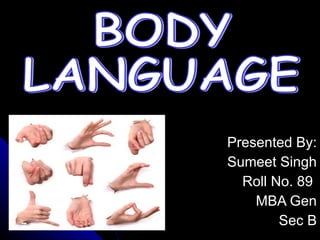
Body language is the unspoken or non-verbal mode of communication that we do in every single aspect of our interaction with another person. It is like a mirror that tells us what the other person thinks and feels in response to our words or actions. Body language involves gestures, mannerisms, and other bodily signs.   BODY LANGUAGE
Facial Expression Eye contact Gestures Head, Body Shape and Postures Appearance TYPES OF BODY LANGUAGE
A popular saying goes like this. ”The face is the index of the heart”. Whatever we feel deep within ourselves is at once reflected in the face. It plays an important role in face-to-face communication, we convey a lot  without speaking a word FACIAL EXPRESSION
 
Every body knows that eye contact is of paramount importance in all face-to-face communication. When we look at somebody face we primarily focus on his eyes and try to understand what he means. EYE CONTACT
EXAMPLES
The physical movement of arms, legs, hands, torso and head are known gestures. They play a very important role in conveying meaning without using words. GESTURES
 
In any face-to-face communication or meeting or interview the way we hold our head, body shape and posture is very important. POSTURES
 
Appearance, for our purpose, includes clothing, hair, jewellery, cosmetics etc. All these may seem unrelated to body language. But on having a closer look we find that they are very meaningfully related to our face, eyes, gestures, etc. APPERENCE
 
NONVERBAL BEHAVIOR Brisk, erect walk Sitting with legs crossed, foot kicking slightly Arms crossed on chest Hands clasped behind back Tapping or drumming fingers INTERPRETATION Confidence Boredom Defensiveness Anger, frustration, apprehension Impatience
Mind the Body-Talk Be Careful with the handshake Establish good eye contact We must be ourselves Graceful movement EFFECTIVE USE OF BODY LANGUAGE
Easily visible aspect of communication. Adds intensity to the process of communication. Improves the overall atmosphere and looks of organization. ADVANTAGES
Non-verbal communication People from different background and cultures No use, If listener is inattentive. Ineffective in large gathering. DISADVANTAGES


Body lang

  • 1.
    Presented By: SumeetSingh Roll No. 89 MBA Gen Sec B BODY LANGUAGE
  • 2.
    Body language isthe unspoken or non-verbal mode of communication that we do in every single aspect of our interaction with another person. It is like a mirror that tells us what the other person thinks and feels in response to our words or actions. Body language involves gestures, mannerisms, and other bodily signs. BODY LANGUAGE
  • 3.
    Facial Expression Eyecontact Gestures Head, Body Shape and Postures Appearance TYPES OF BODY LANGUAGE
  • 4.
    A popular sayinggoes like this. ”The face is the index of the heart”. Whatever we feel deep within ourselves is at once reflected in the face. It plays an important role in face-to-face communication, we convey a lot without speaking a word FACIAL EXPRESSION
  • 5.
  • 6.
    Every body knowsthat eye contact is of paramount importance in all face-to-face communication. When we look at somebody face we primarily focus on his eyes and try to understand what he means. EYE CONTACT
  • 7.
  • 8.
    The physical movementof arms, legs, hands, torso and head are known gestures. They play a very important role in conveying meaning without using words. GESTURES
  • 9.
  • 10.
    In any face-to-facecommunication or meeting or interview the way we hold our head, body shape and posture is very important. POSTURES
  • 11.
  • 12.
    Appearance, for ourpurpose, includes clothing, hair, jewellery, cosmetics etc. All these may seem unrelated to body language. But on having a closer look we find that they are very meaningfully related to our face, eyes, gestures, etc. APPERENCE
  • 13.
  • 14.
    NONVERBAL BEHAVIOR Brisk,erect walk Sitting with legs crossed, foot kicking slightly Arms crossed on chest Hands clasped behind back Tapping or drumming fingers INTERPRETATION Confidence Boredom Defensiveness Anger, frustration, apprehension Impatience
  • 15.
    Mind the Body-TalkBe Careful with the handshake Establish good eye contact We must be ourselves Graceful movement EFFECTIVE USE OF BODY LANGUAGE
  • 16.
    Easily visible aspectof communication. Adds intensity to the process of communication. Improves the overall atmosphere and looks of organization. ADVANTAGES
  • 17.
    Non-verbal communication Peoplefrom different background and cultures No use, If listener is inattentive. Ineffective in large gathering. DISADVANTAGES
  • 18.
  • 19.