BODY IMAGE
INSECURITY
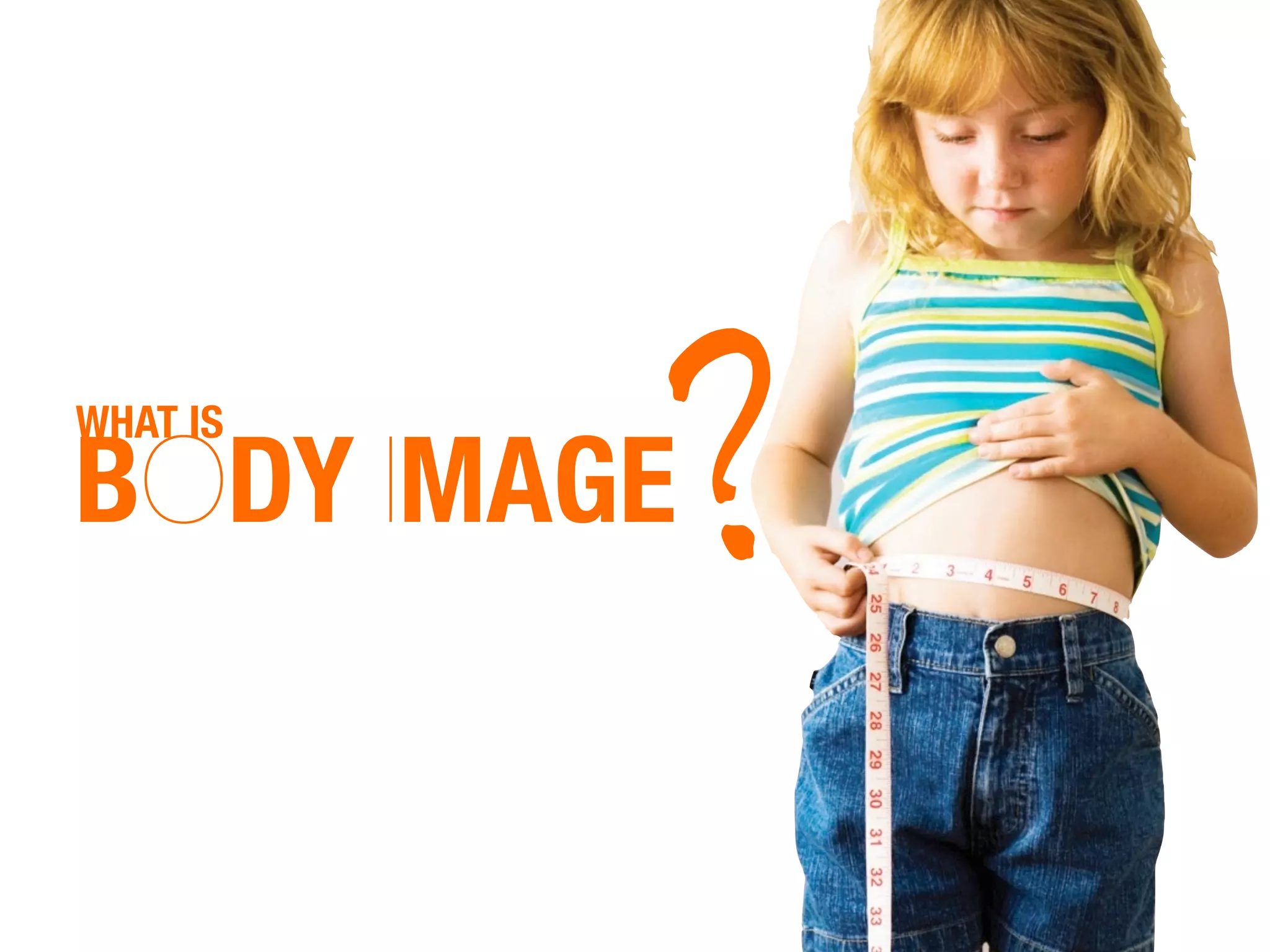
WHAT IS
BODY IMAGE?
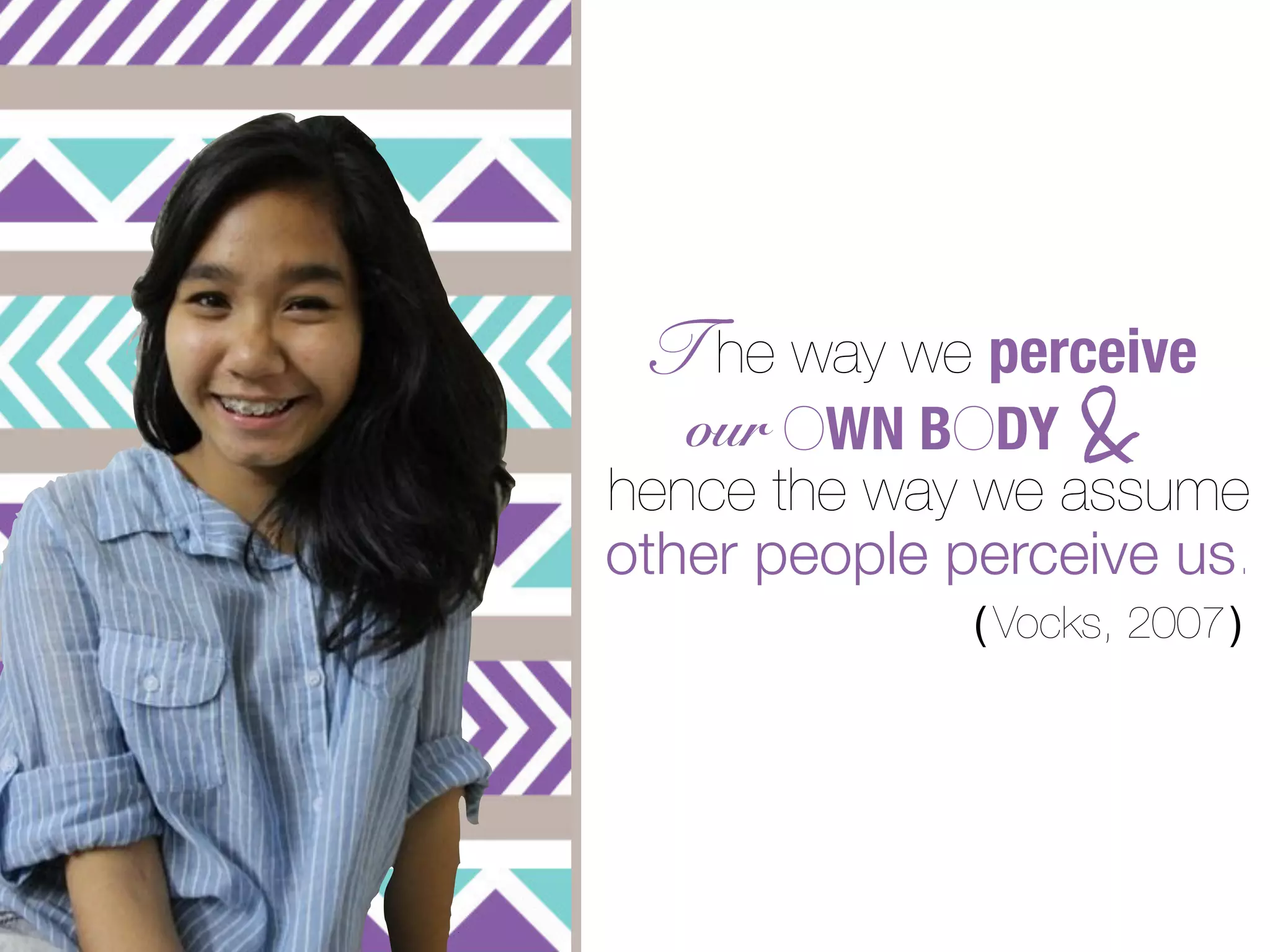
T he way we perceive
   our OWN BODY    &
hence the way we assume
other people perceive us.
              ( Vocks, 2007 )
T he mental picture
  you have of your body.
      what it looks like
  what you believe about it
how you feel about your body
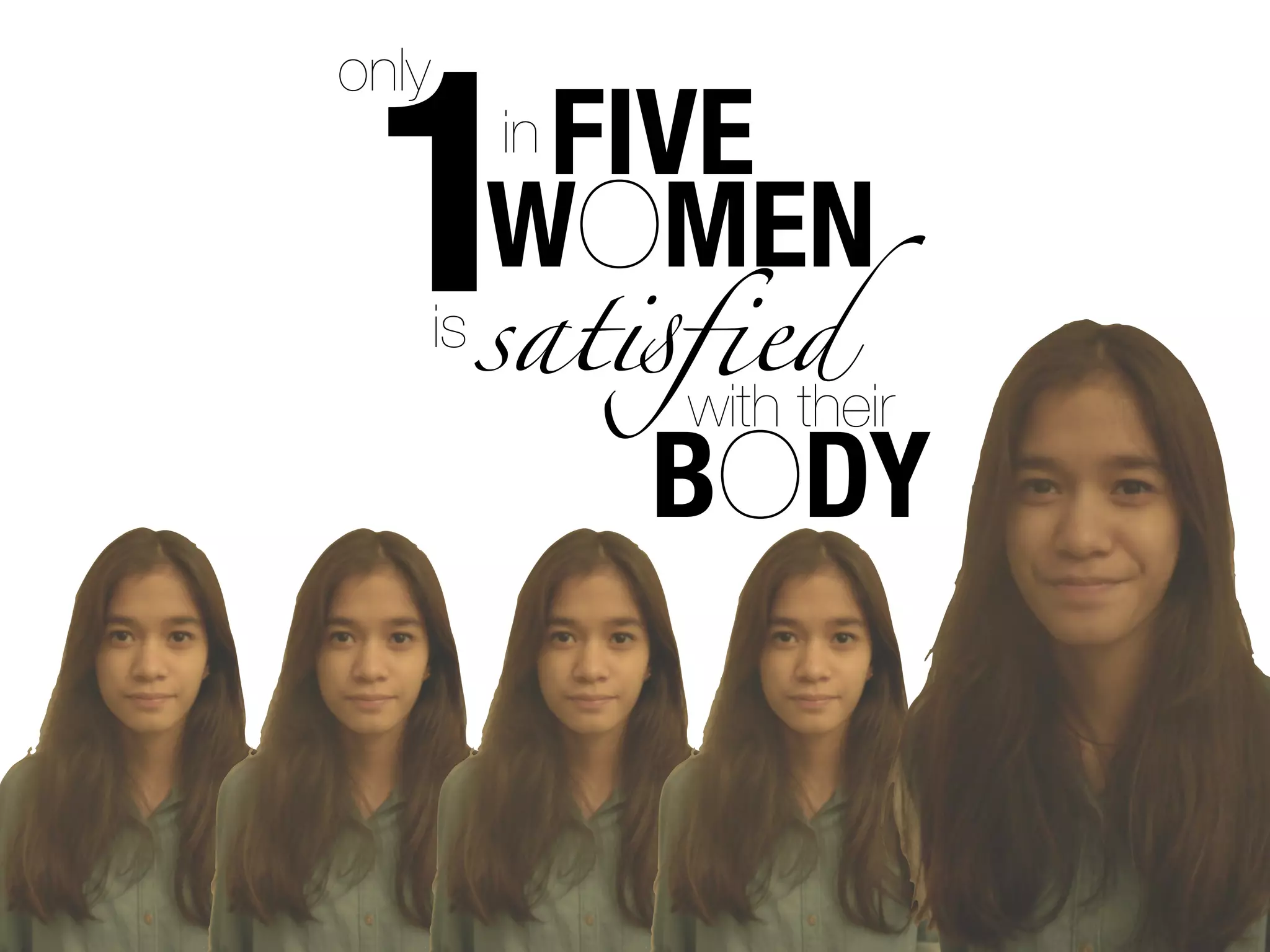
1
only
         FIVE
         in
        WOMEN
       is sat!fied
              with their
               BODY
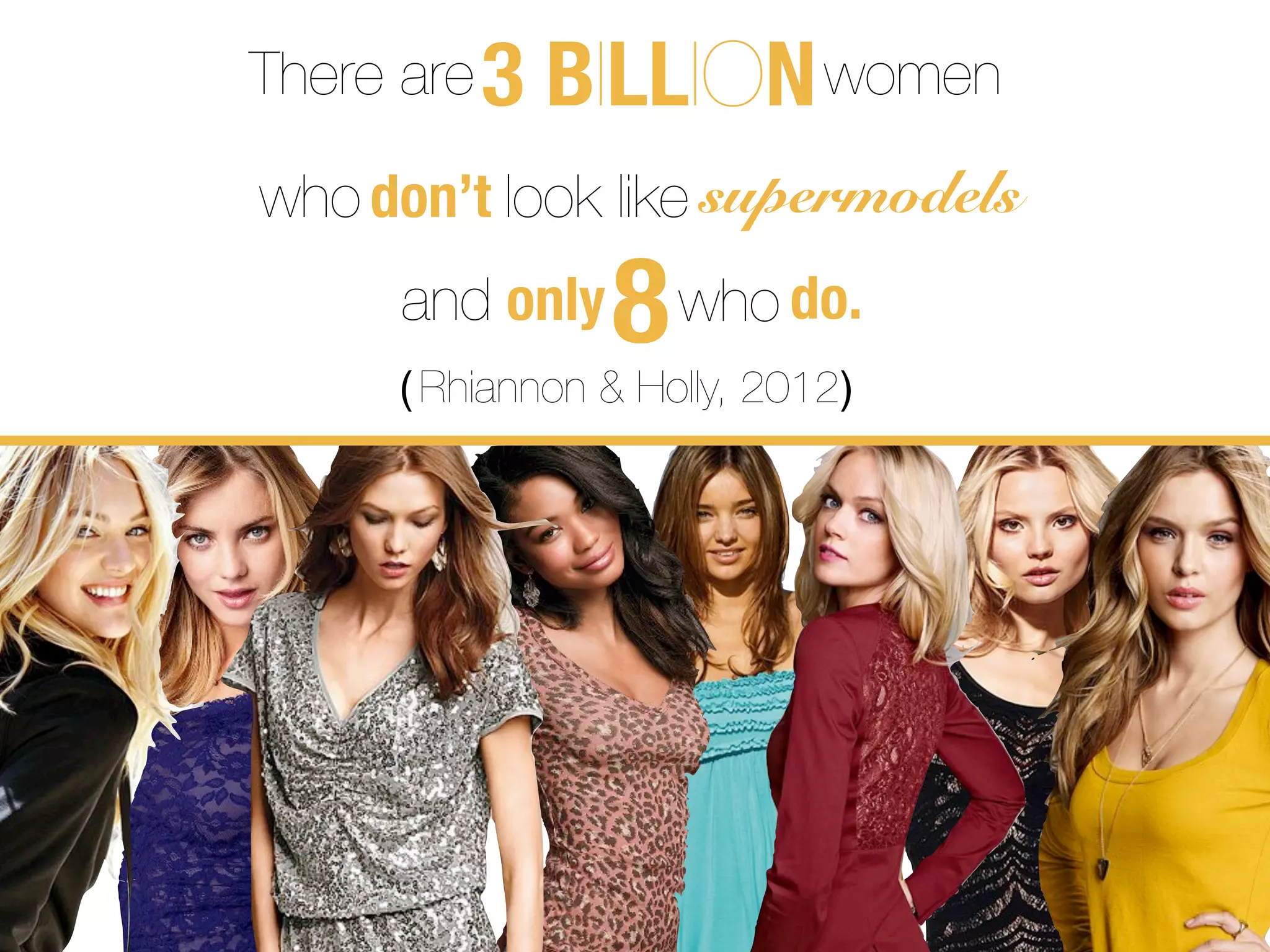
There are 3   BILLION women
who don’t look like supermodels
      and only    8   who do.
      ( Rhiannon & Holly, 2012 )
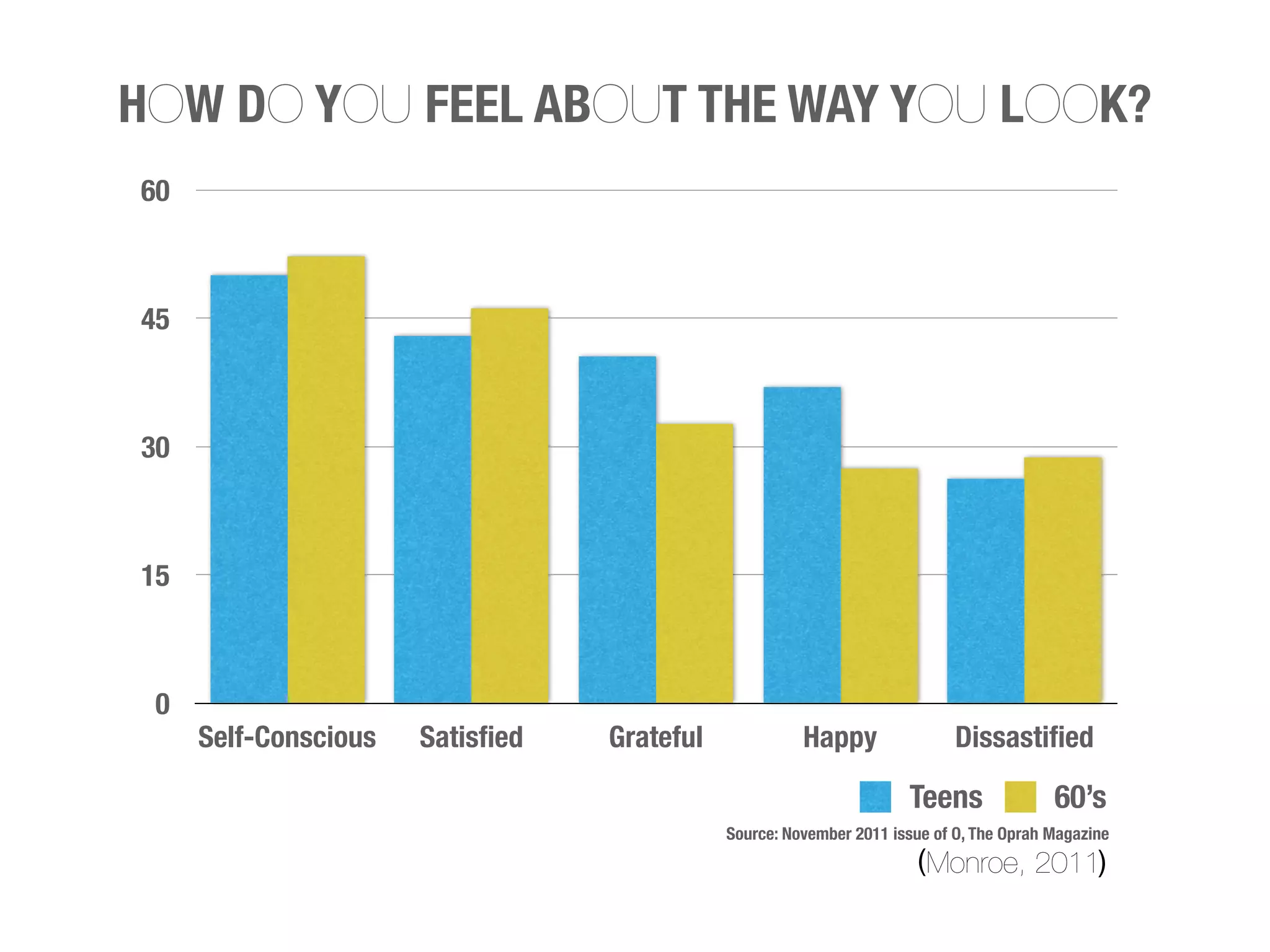
HOW DO YOU FEEL ABOUT THE WAY YOU LOOK?
60


45


30


15


 0
     Self-Conscious   Satisfied   Grateful             Happy                Dissastified

                                                                     Teens               60’s
                                             Source: November 2011 issue of O, The Oprah Magazine
                                                                      ( Monroe, 2011)
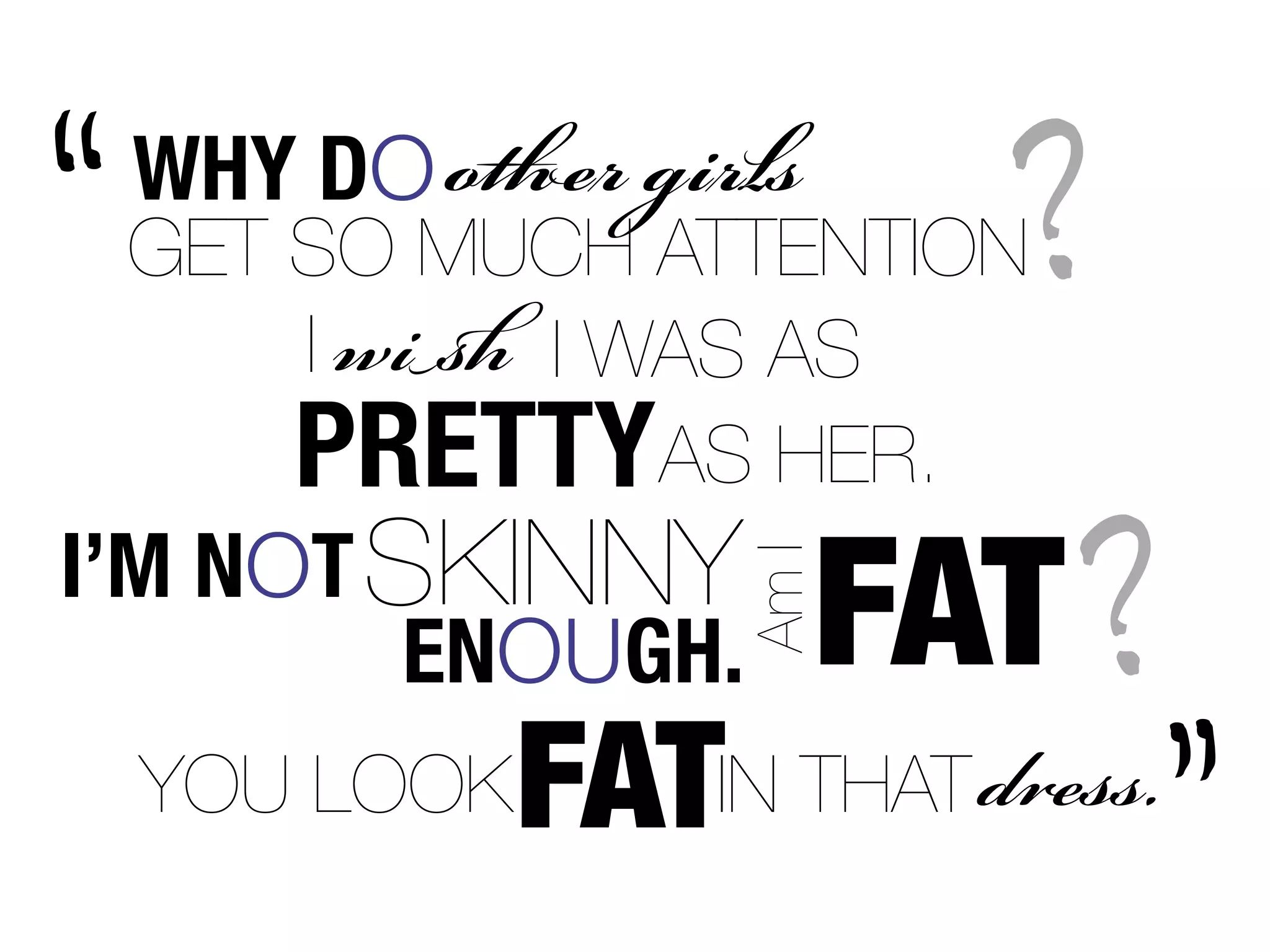
“   WHY DO  s
    GET SO MUCH ATTENTION
        I  I WAS AS
                            ?
        PRETTYAS HER.
I’M NOT SKINNY
                        FAT ?
                     Am I
         ENOUGH.
               FAT
    YOU LOOK      IN THAT .
                                ”
Based on the graph                  ,
most women are CONSCIOUS about the way they look.
   There are many factors that affects us on
         how we perceive ourselves to be.
       Let’s look at how does THE MEDIA
    affect the way WOMEN see themselves.
THE ROLE OF
MEDIA
  in
BODY IMAGE
concerns among
WOMEN
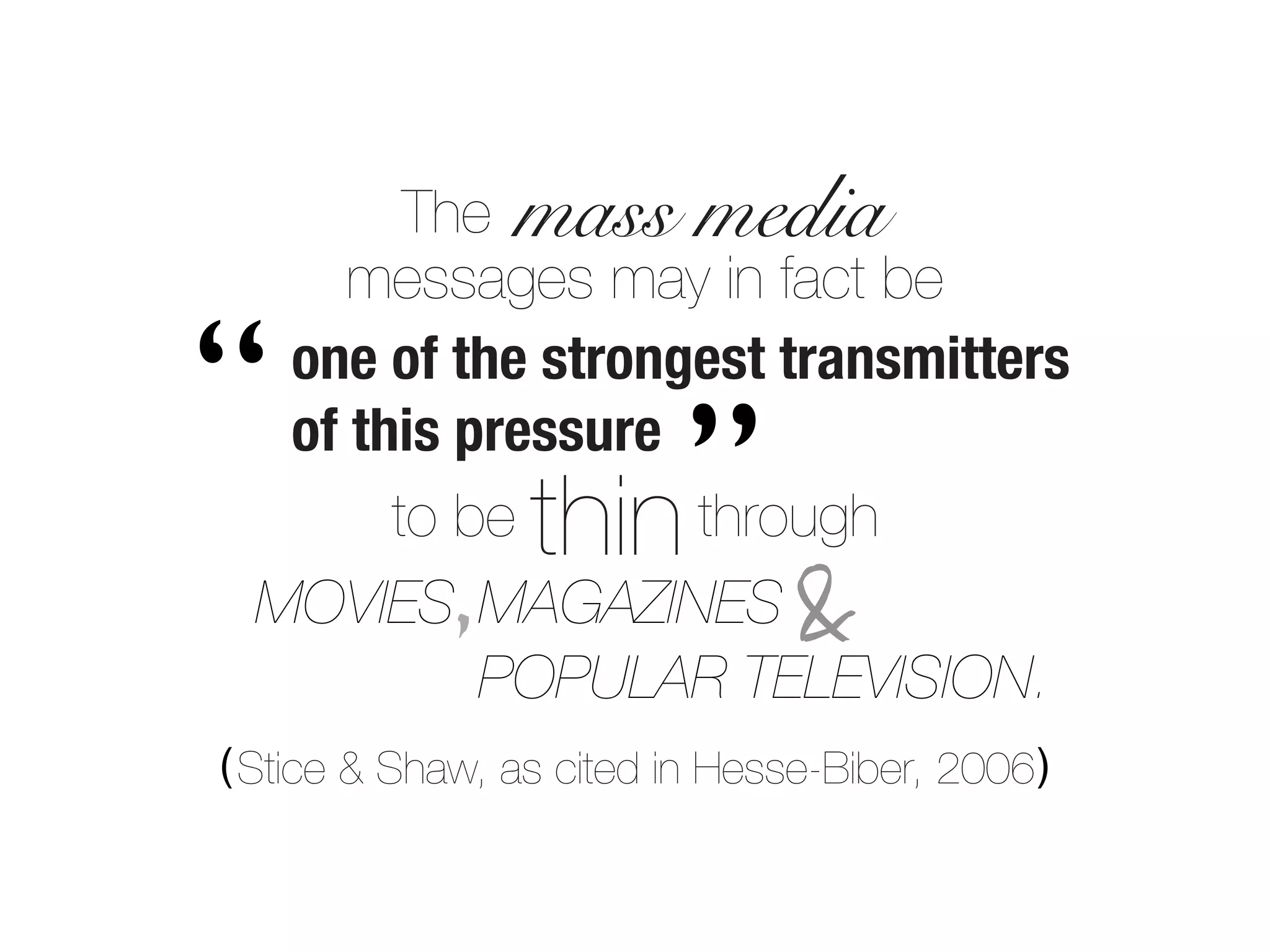
The mass media
      messages may in fact be

“  one of the strongest transmitters
   of this pressure
                      ”
        to be    thin
                    through
             ,
  MOVIES MAGAZINES              &
            POPULAR TELEVISION.
( Stice & Shaw, as cited in Hesse-Biber, 2006 )
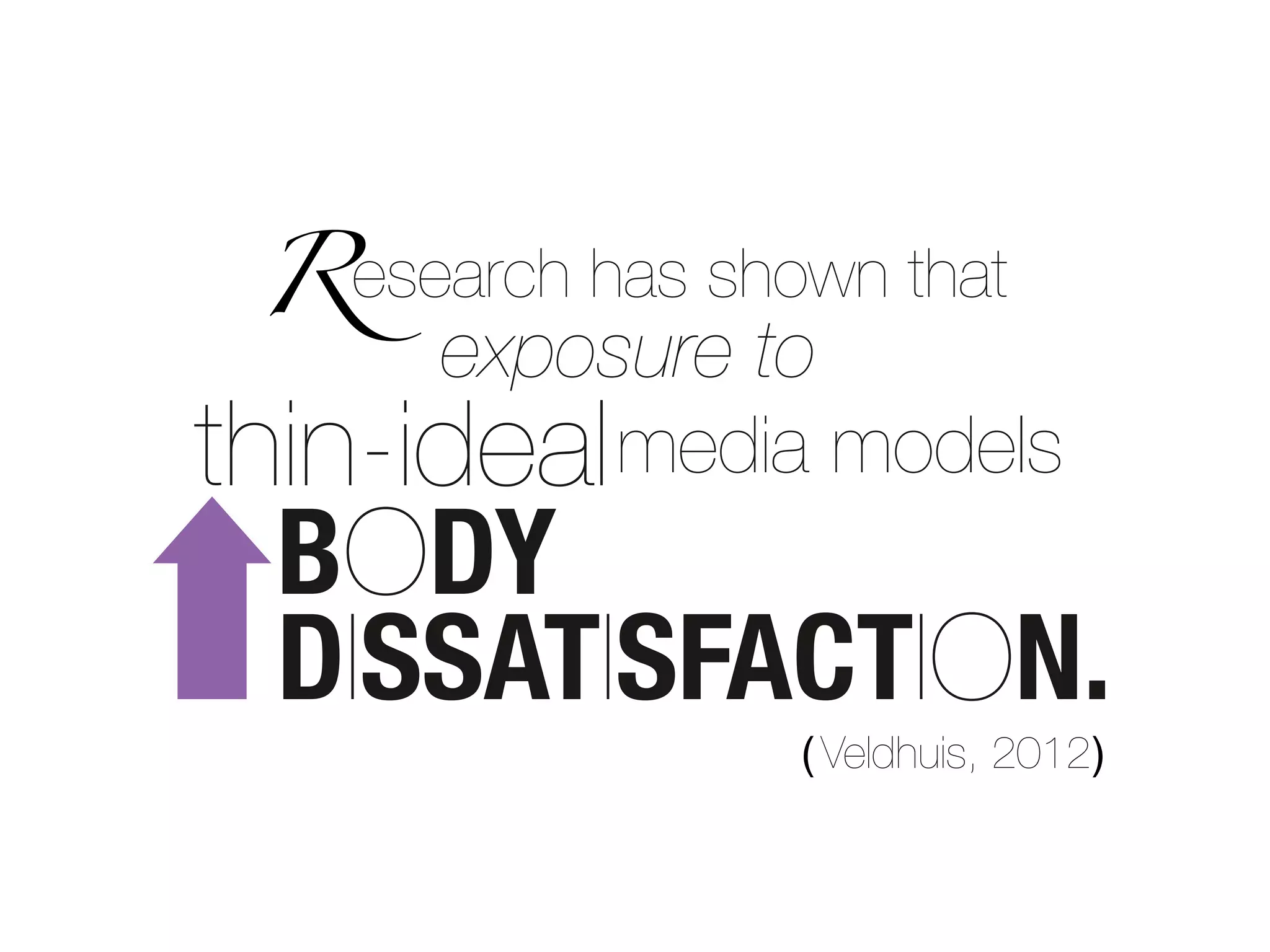
R esearch has shown that
      exposure to
thin-ideal media models
  BODY
  DISSATISFACTION.
                  ( Veldhuis, 2012 )
What kind of trends in the
  media industry
     are we noticing now?
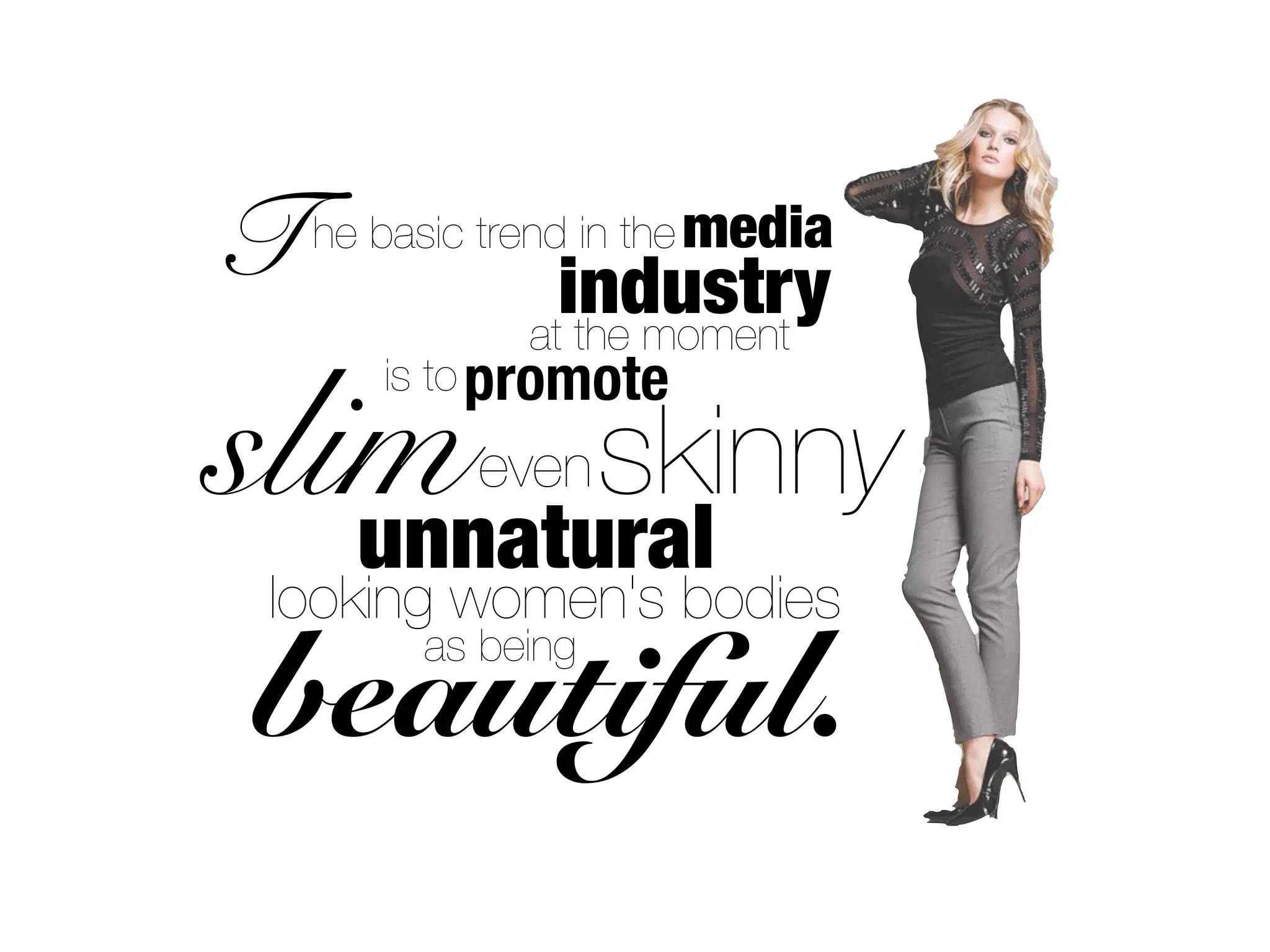
T   he basic trend in the media
                 industry
               at the moment


slim skinny
       is to promote

            even
   unnatural
 looking women's bodies
beautiful.
         as being
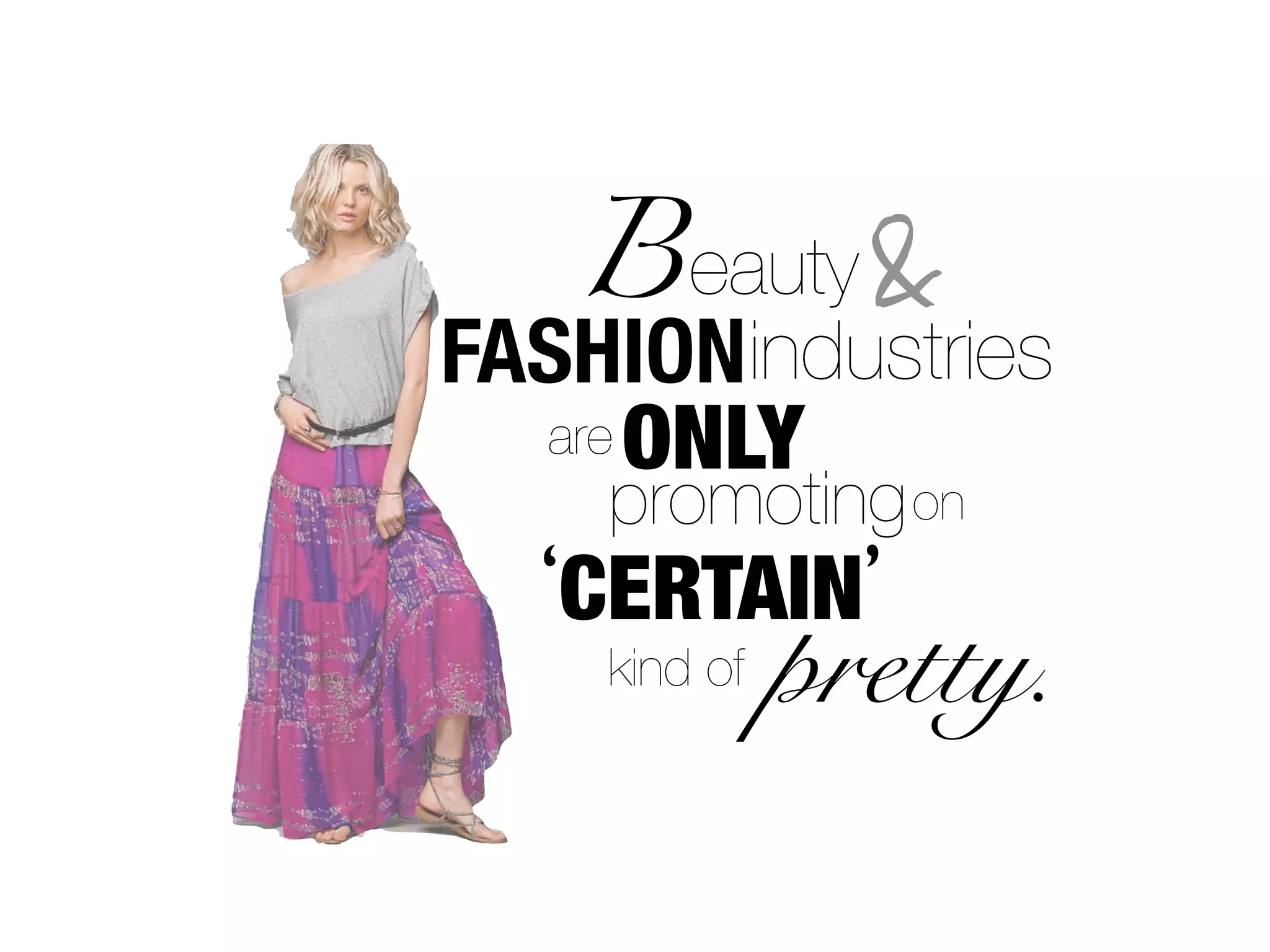
B eauty      &
FASHION industries
  are ONLY
    promoting on
  ‘CERTAIN’
    kind of   pretty.
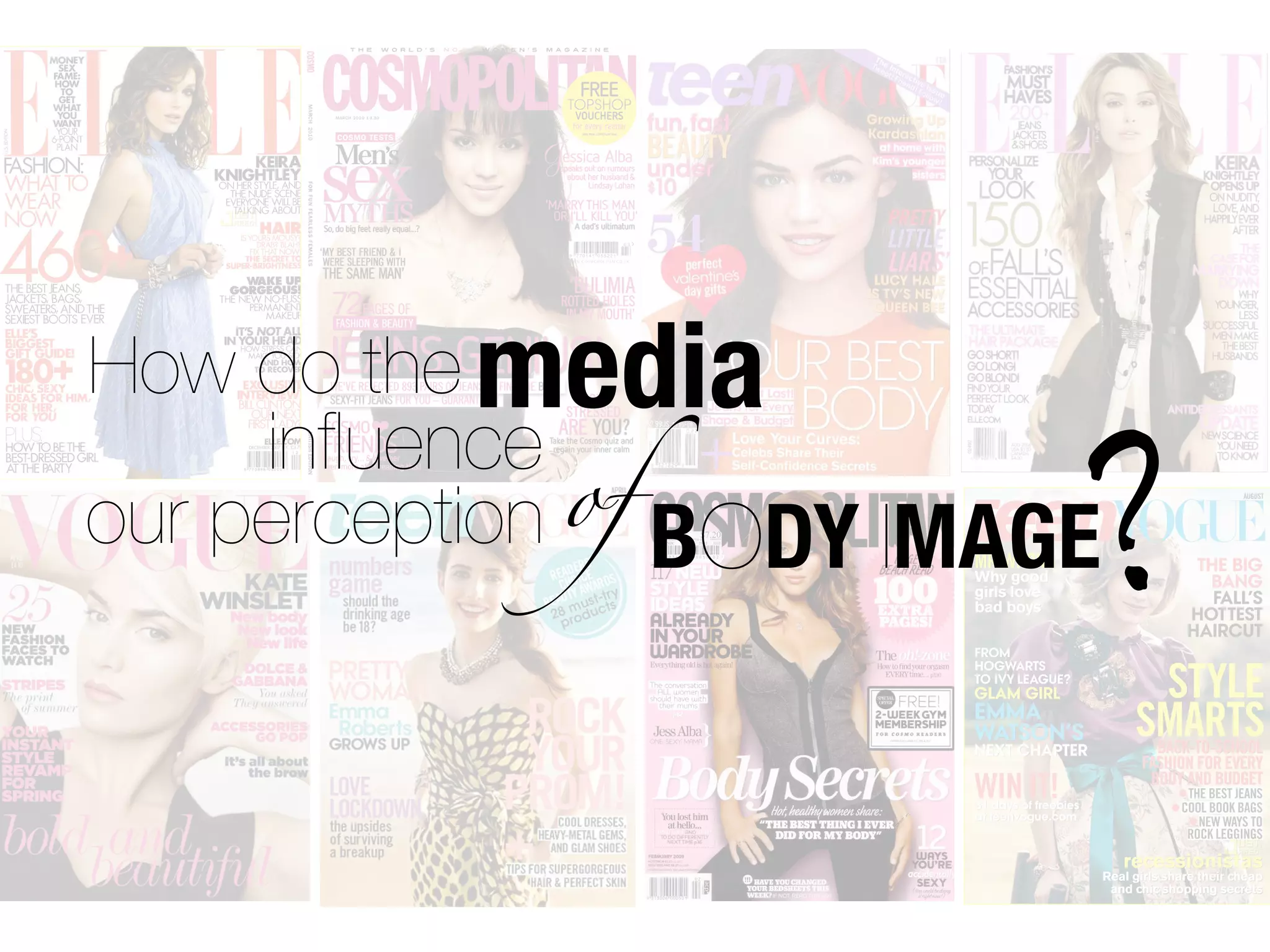
How do the media

                           ?
     influence
our perception of BODY IMAGE
WOMEN of   all ages
          but ESPECIALLY
  YOUNG WOMEN
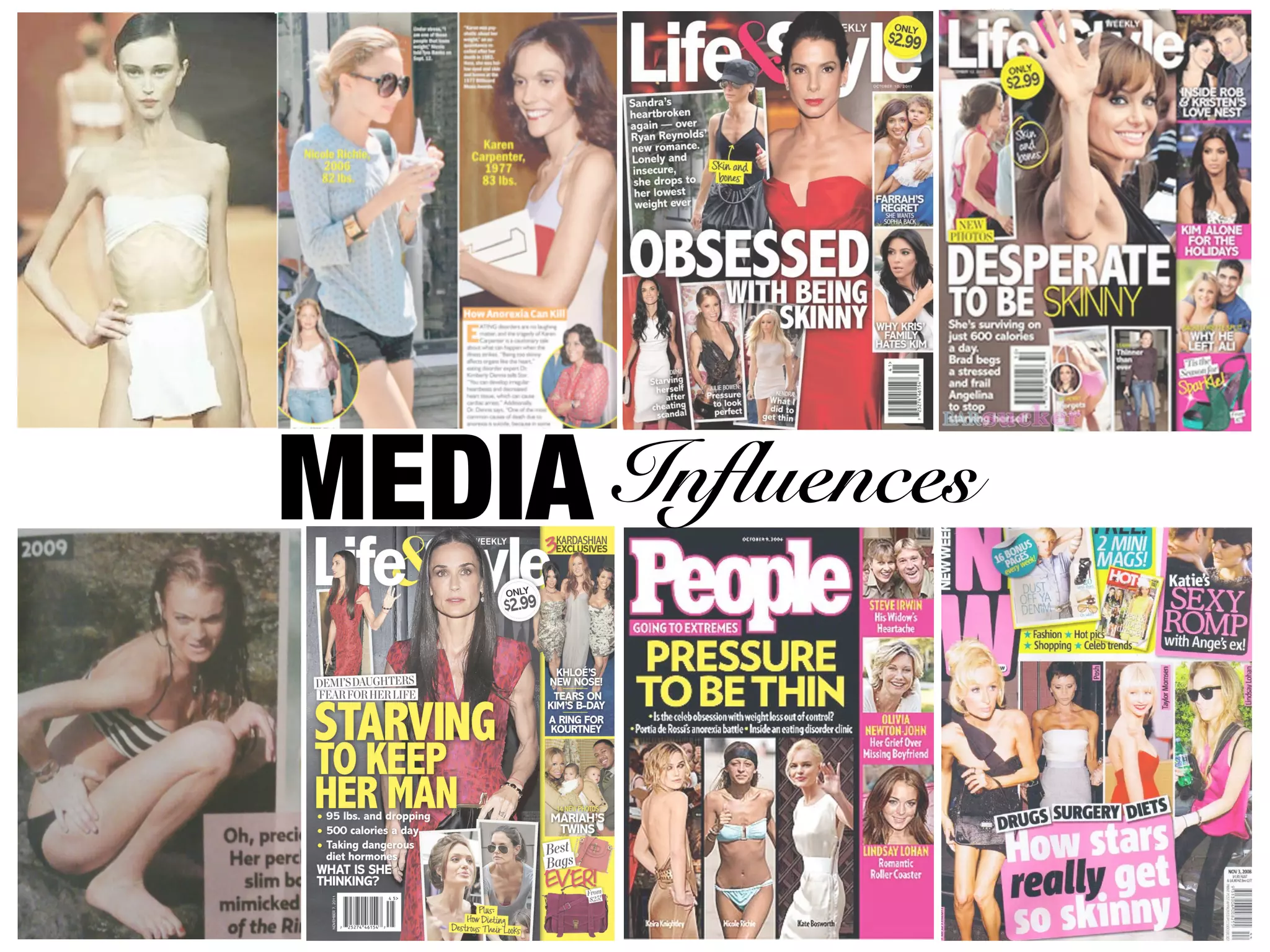
   look at MAGAZINES ,
          TELEVISION,
                ,
    &      MOVIES
          OTHER MEDIA PRODUCTS
skinny WOMEN’S bodies.
            FULL OF IMAGES THAT SHOW
MEDIA Influences
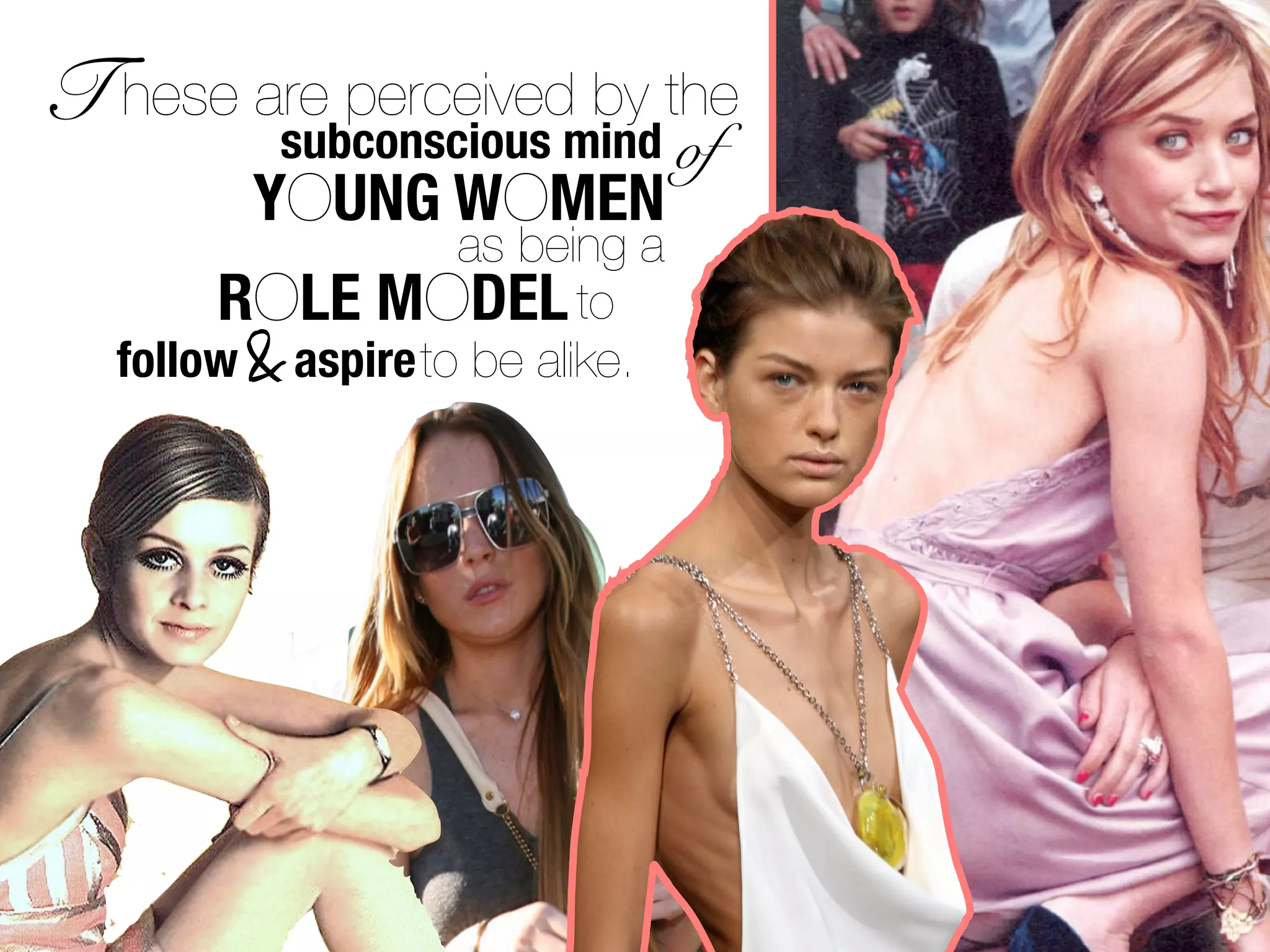
T hese are perceivedmind the
                     by
        subconscious            of
         YOUNG WOMEN
                   as being a
        ROLE MODEL to
        &
   follow aspire to be alike.
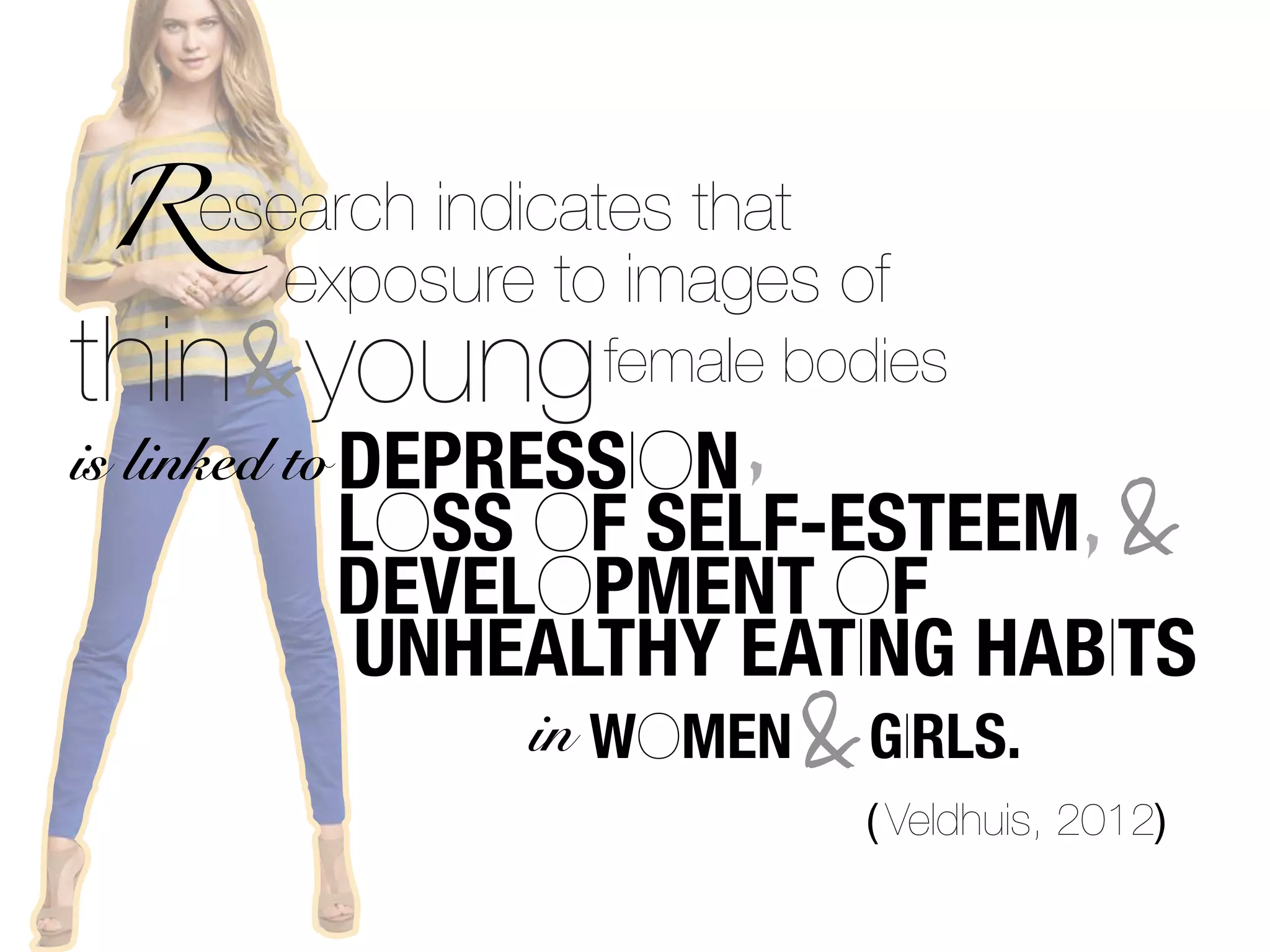
Research indicates that
      exposure to images of
thin&young female bodies
is linked to DEPRESSION ,
       LOSS OF SELF-ESTEEM, &
       DEVELOPMENT OF
       UNHEALTHY EATING HABITS
              in WOMEN    &   GIRLS.
                              ( Veldhuis, 2012)
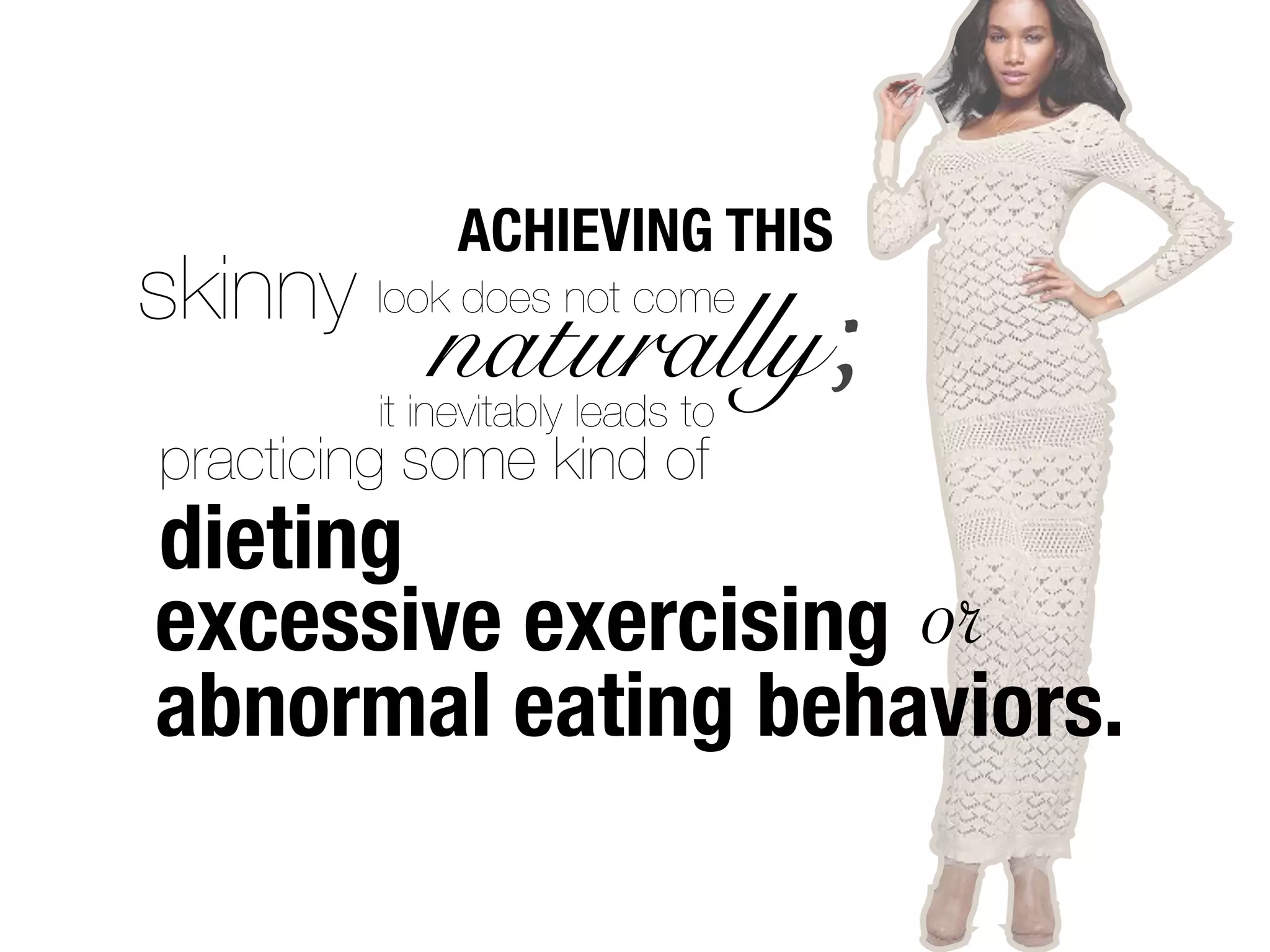
ACHIEVING THIS
skinny look does not come
             naturally;
          it inevitably leads to
practicing some kind of
dieting
excessive exercising or
abnormal eating behaviors.
of
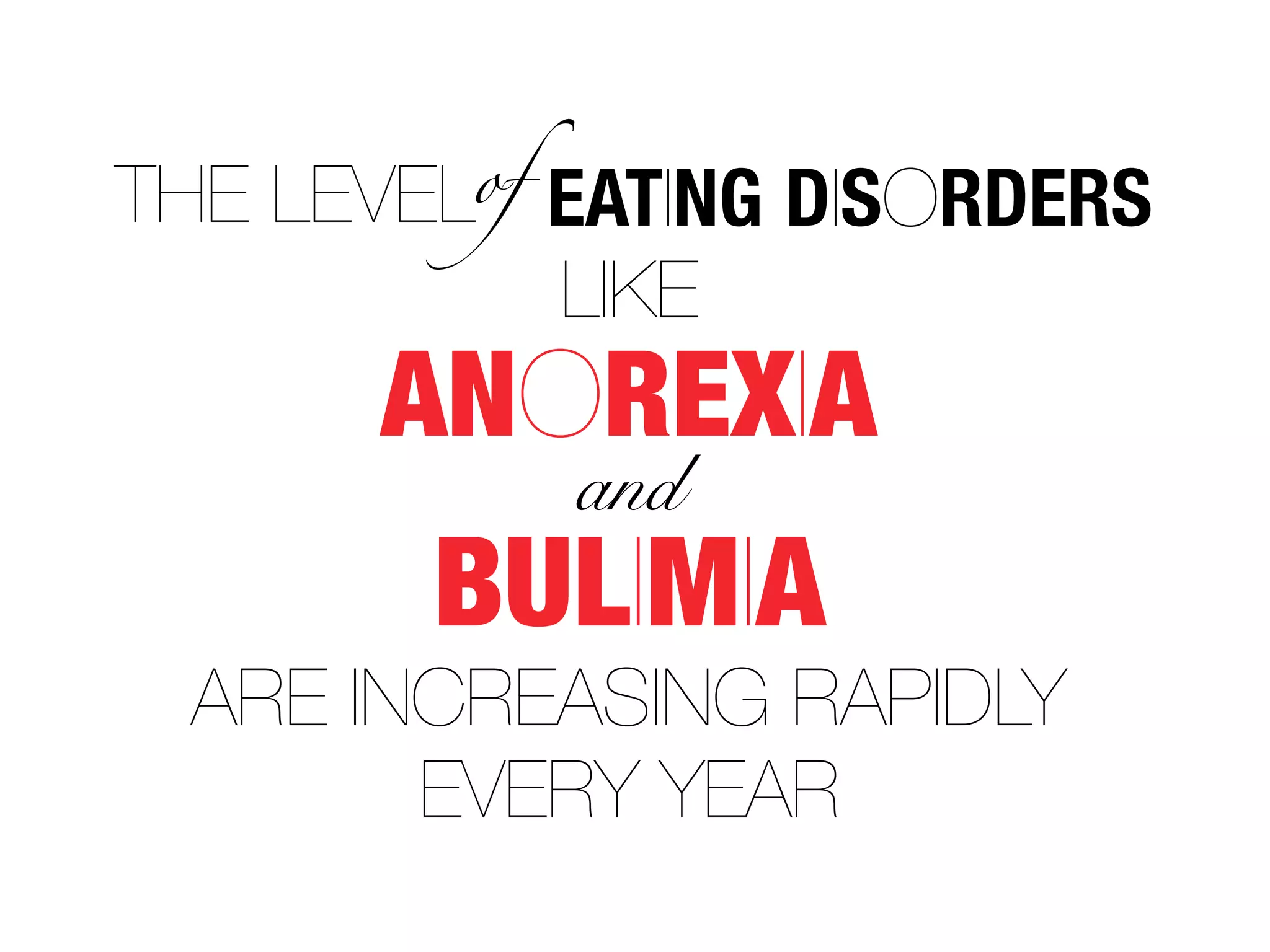
THE LEVEL EATING DISORDERS
          LIKE
      ANOREXIA
             and
       BULIMIA
 ARE INCREASING RAPIDLY
       EVERY YEAR
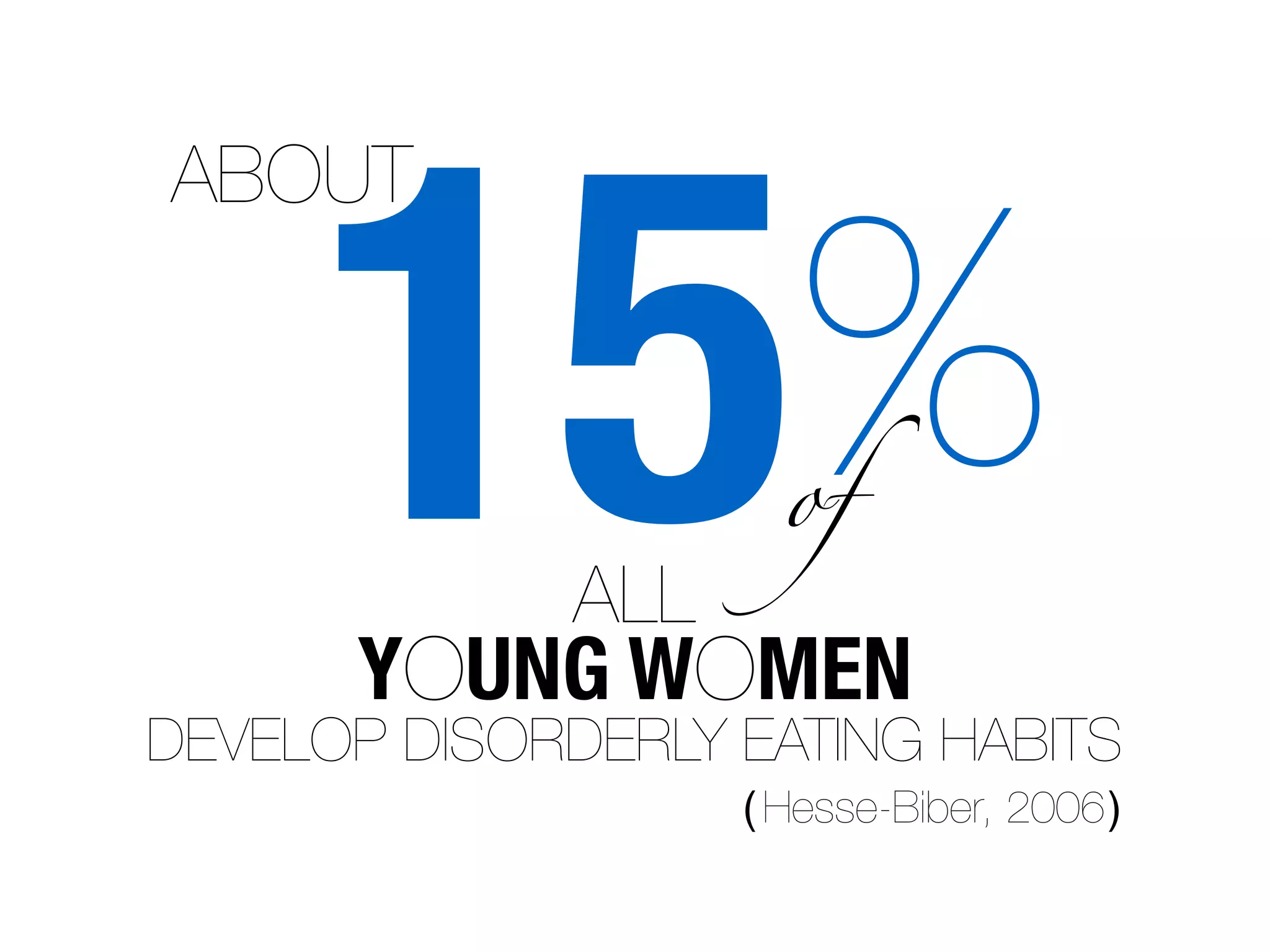
15
ABOUT


        %    ALL
                     of

      YOUNG WOMEN
DEVELOP DISORDERLY EATING HABITS
                   ( Hesse-Biber, 2006 )
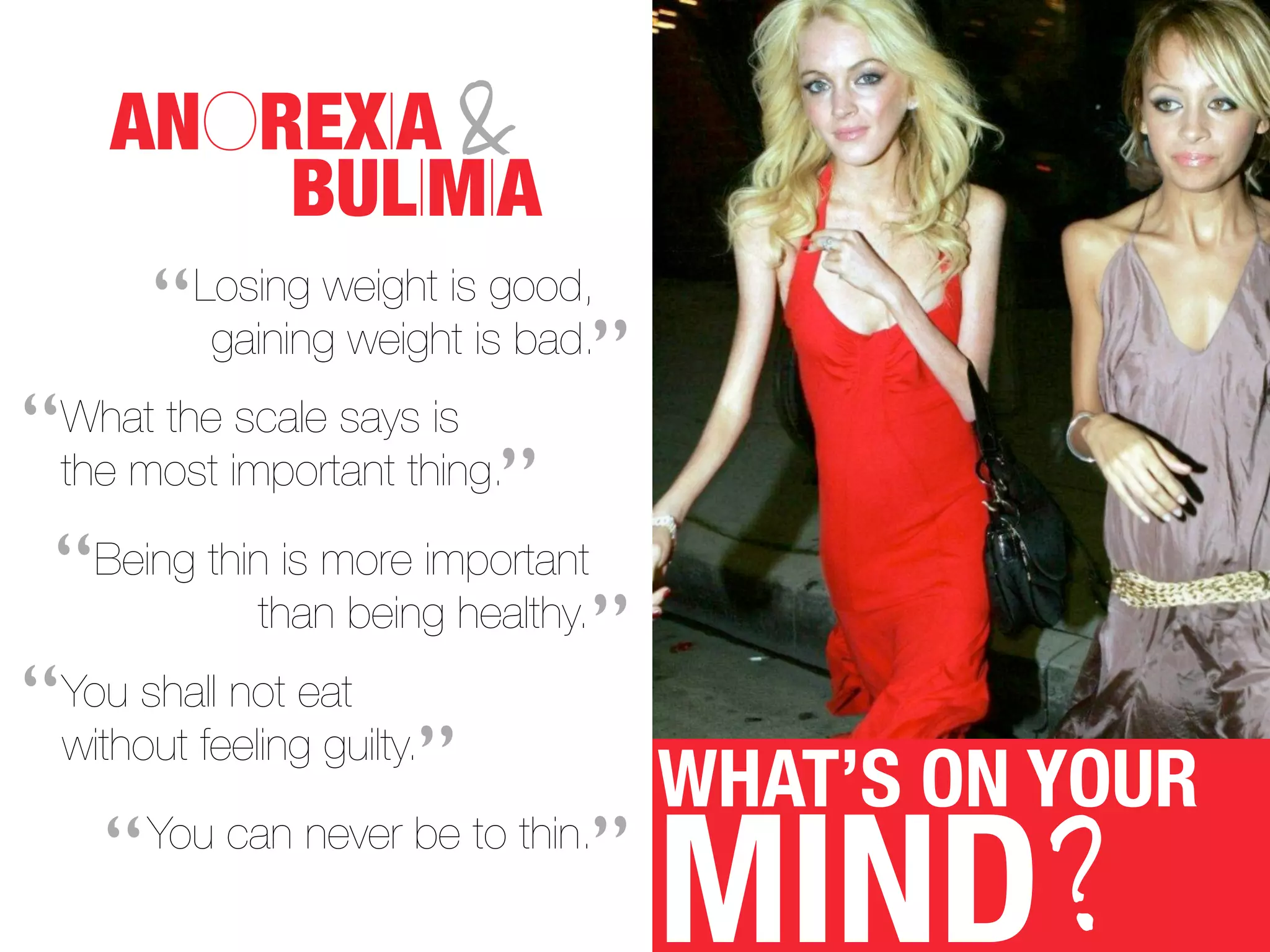
ANOREXIA &
          BULIMIA
         “   Losing weight is good,
              gaining weight is bad.
                                    ”
“   What the scale says is
    the most important thing.
                              ”
 “   Being thin is more important
                               ”
              than being healthy.

“without feeling guilty.
 You shall not eat
                        ”        WHAT’S ON YOUR
    “                          ”
                                        MIND?
      You can never be to thin.
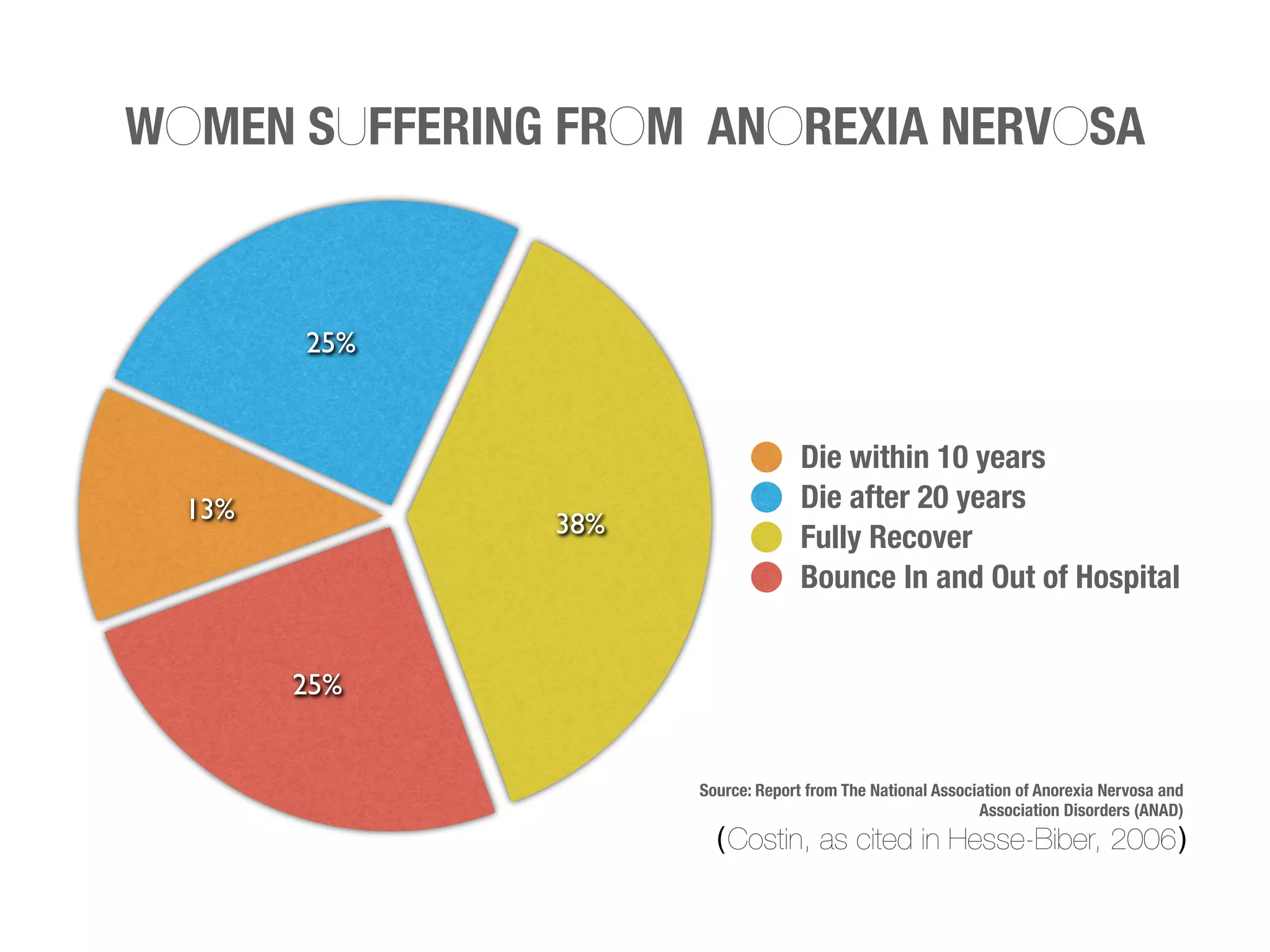
WOMEN SUFFERING FROM ANOREXIA NERVOSA


        25%


                                   Die within 10 years
  13%                              Die after 20 years
               38%                 Fully Recover
                                   Bounce In and Out of Hospital


        25%


                     Source: Report from The National Association of Anorexia Nervosa and
                                                            Association Disorders (ANAD)
                       ( Costin, as cited in Hesse-Biber, 2006 )
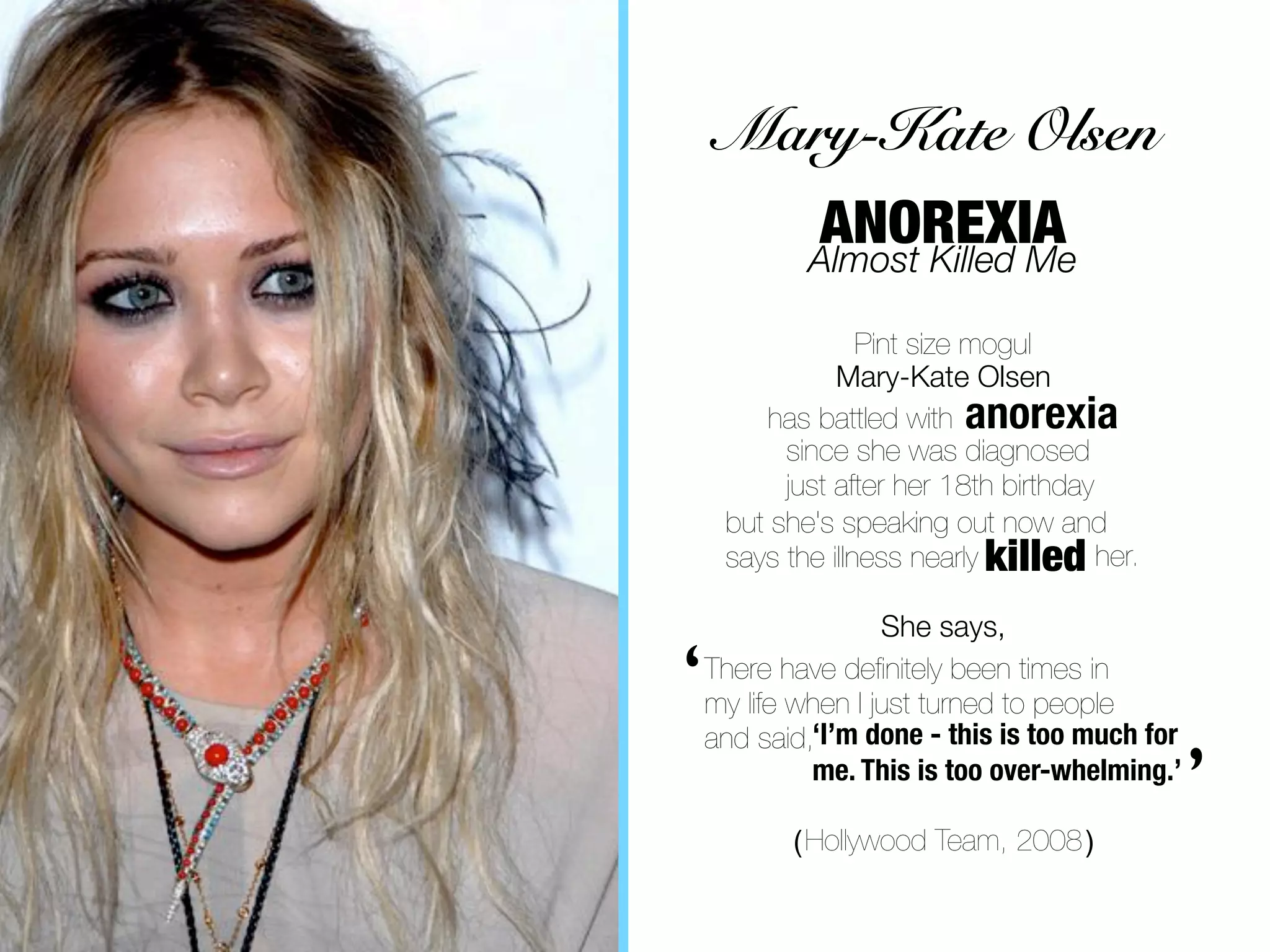
Mary-Kate Olsen
            ANOREXIA
            Almost Killed Me

                  Pint size mogul
               Mary-Kate Olsen
        has battled with anorexia
          since she was diagnosed
          just after her 18th birthday
     but she's speaking out now and
     says the illness nearly killed her.

                    She says,

‘   There have definitely been times in
    my life when I just turned to people
    and said,‘I’m done - this is too much for
             me. This is too over-whelming.’

           ( Hollywood Team, 2008 )
                                                ’
WHAT WOULD BE SOME
 REAL suggestions
     ON HOW TO
    improve your
   BODY IMAGE
WITHOUT RESORTING TO
  UNHEALTHY
 EATING HABITS      ?
1
          CHANGE YOUR
 GOAL             from
WEIGHT LOSS
  IMPROVING
to just

YOUR HEALTH
2
     FOCUS MORE ON THE
    INTERNAL beauty;
IMPROVING SELF-ESTEEM,
   SELF-CONFIDENCE,&
  INTERNAL STRENGTHS
  of YOUR CHARACTER
3
    GIVE YOURSELF A BREAK from
    WOMEN’S MAGAZINES &
         THE MASS MEDIA
             ADVERTISING
     IF YOU FEEL PRONE TO
THIS KIND of false PERCEPTIONS
The media
    does impact on
      WOMEN’S
     BODY IMAGE
 significantly and it can affect
    WOMEN’S
physical and mental
health in a negative way.
The only way to STOP
    these negative effects coming from
              the media
 is to teach women not to judge themselves
by the beauty industry’s standards
  and learn not to compare themselves to
            the cover girls.
         NOT ON BEING A
        STICK LIKE MODEL
        (unless you are born skinny)
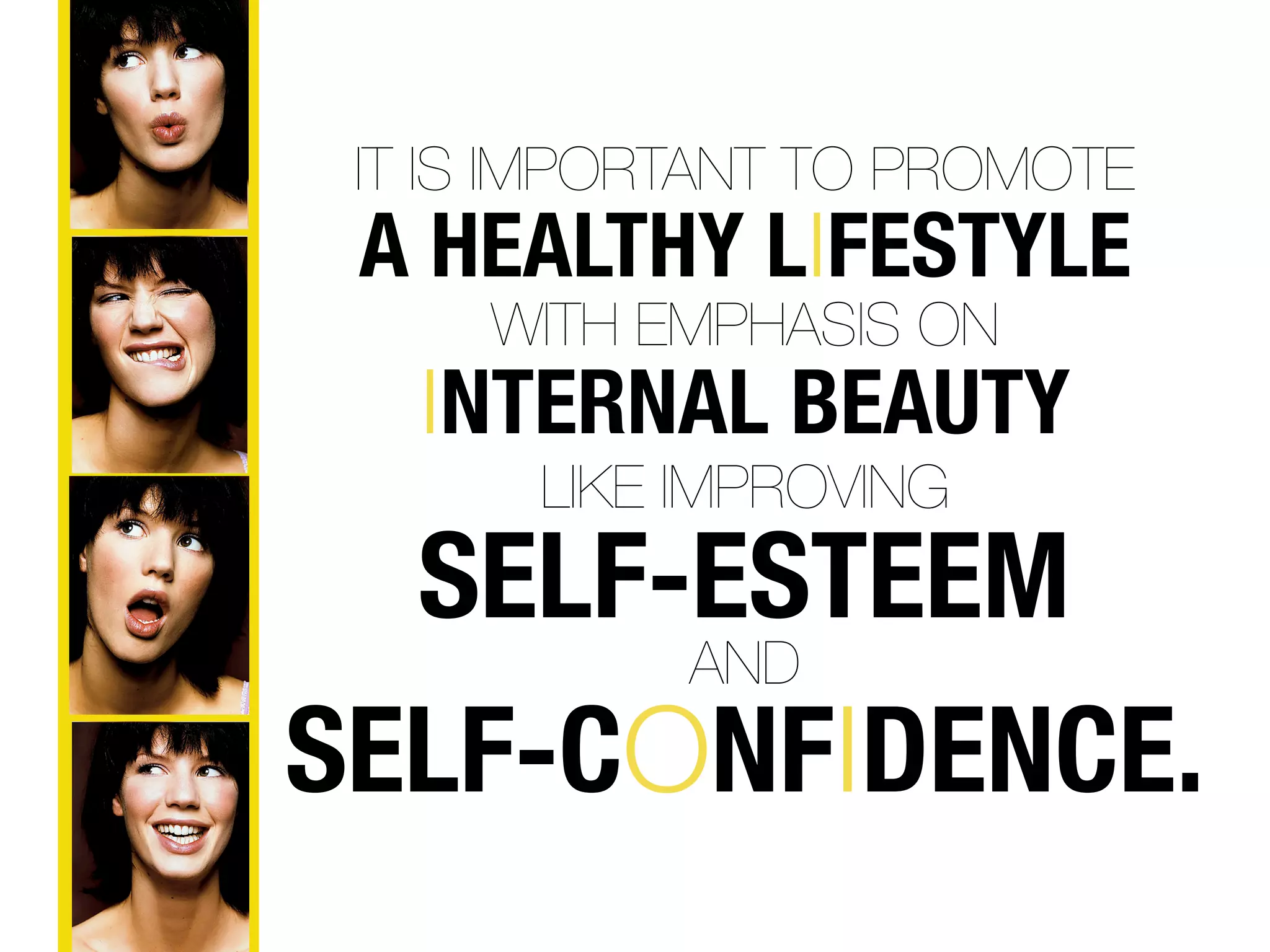
IT IS IMPORTANT TO PROMOTE
 A HEALTHY LIFESTYLE
     WITH EMPHASIS ON
   INTERNAL BEAUTY
       LIKE IMPROVING
  SELF-ESTEEM
       AND
SELF-CONFIDENCE.
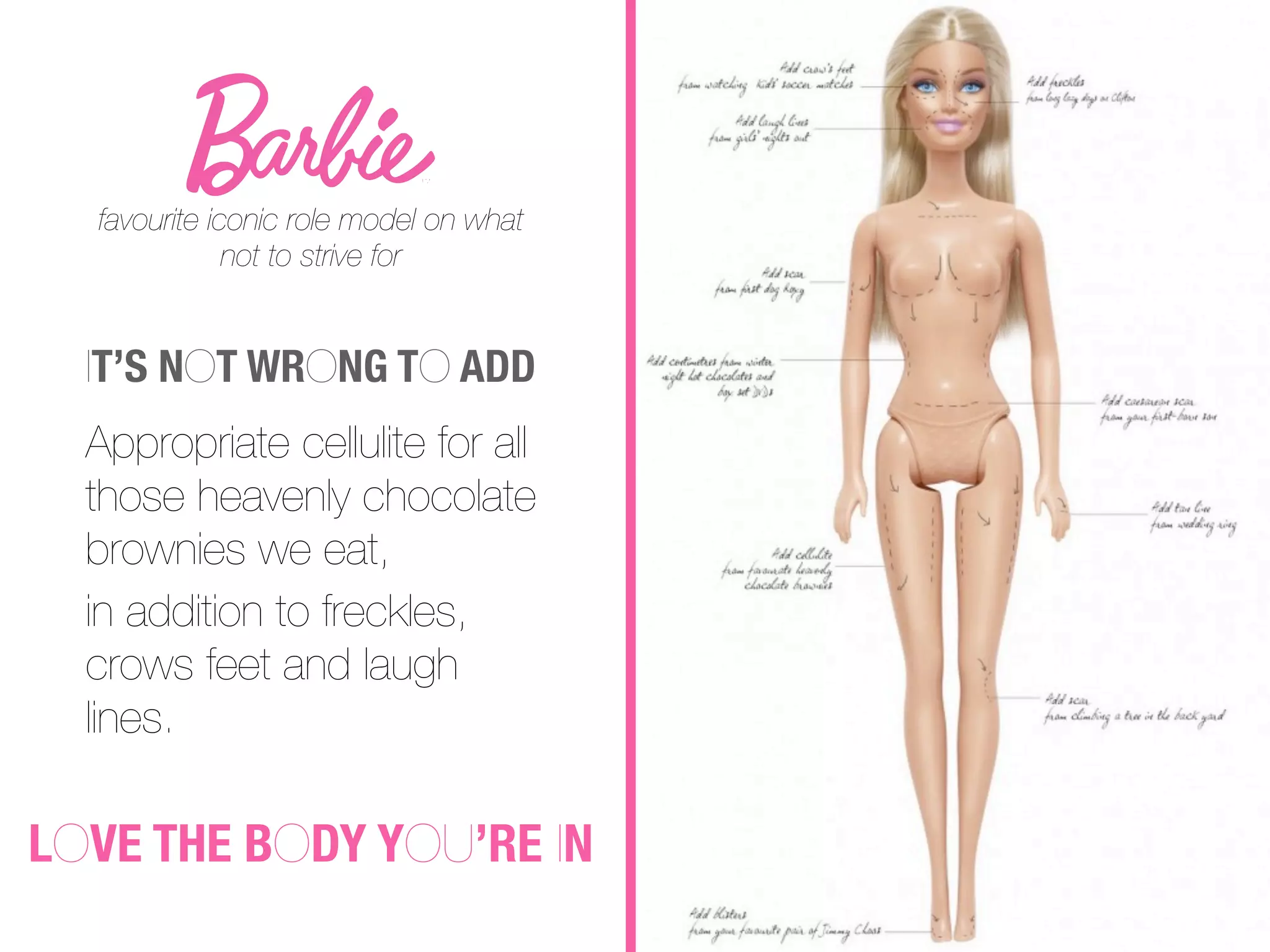
favourite iconic role model on what
              not to strive for


  IT’S NOT WRONG TO ADD
  Appropriate cellulite for all
  those heavenly chocolate
  brownies we eat,
  in addition to freckles,
  crows feet and laugh
  lines.

LOVE THE BODY YOU’RE IN
How do you
measure
yourself ?
These days, size isn’t just a number, it’s the way you
feel in the changing room. It’s the difference between a
good day and a bad day. It’s how you see yourself
every time you look in the mirror. But what if all that
went away? What if, instead of seeing x’s or l’s, we see
what’s really there -amazing, beautiful, healthy bodies.
Maybe it’s time to change the way we think about size.
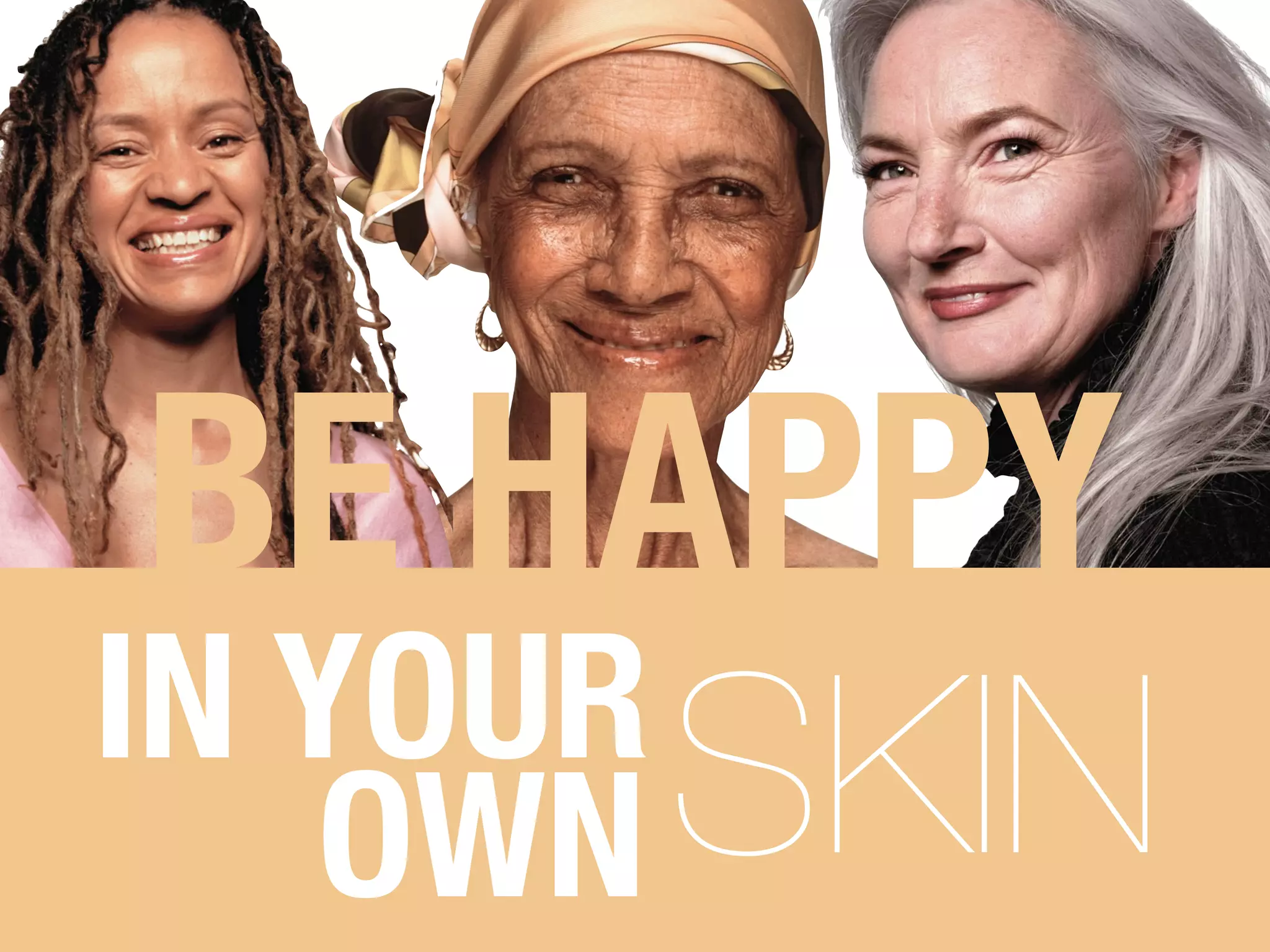
BE HAPPY
IN YOUR
   OWN  SKIN
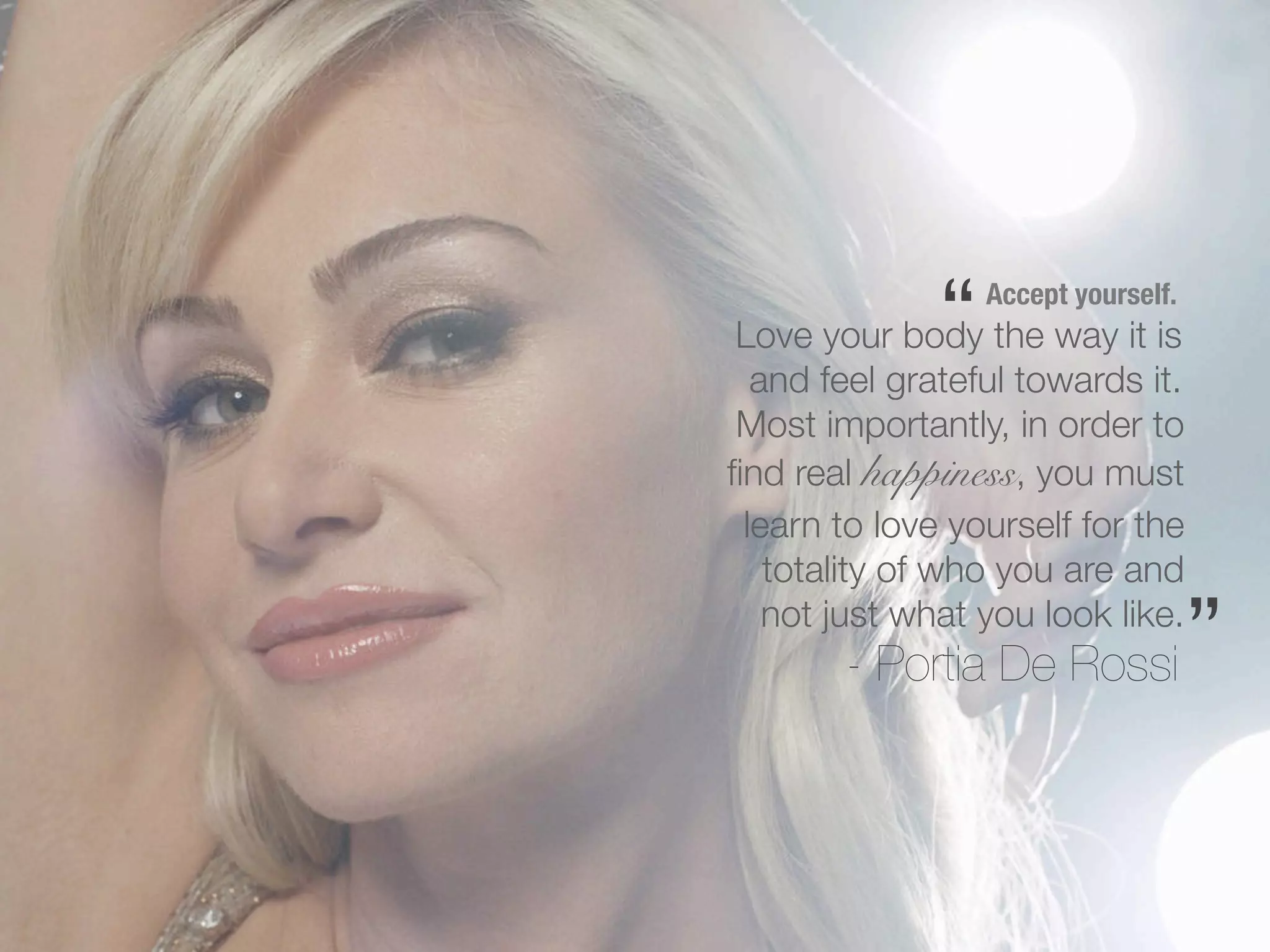
“   Accept yourself.
 Love your body the way it is
  and feel grateful towards it.
 Most importantly, in order to
find real happiness, you must
 learn to love yourself for the
   totality of who you are and
   not just what you look like.
        - Portia De Rossi            ”
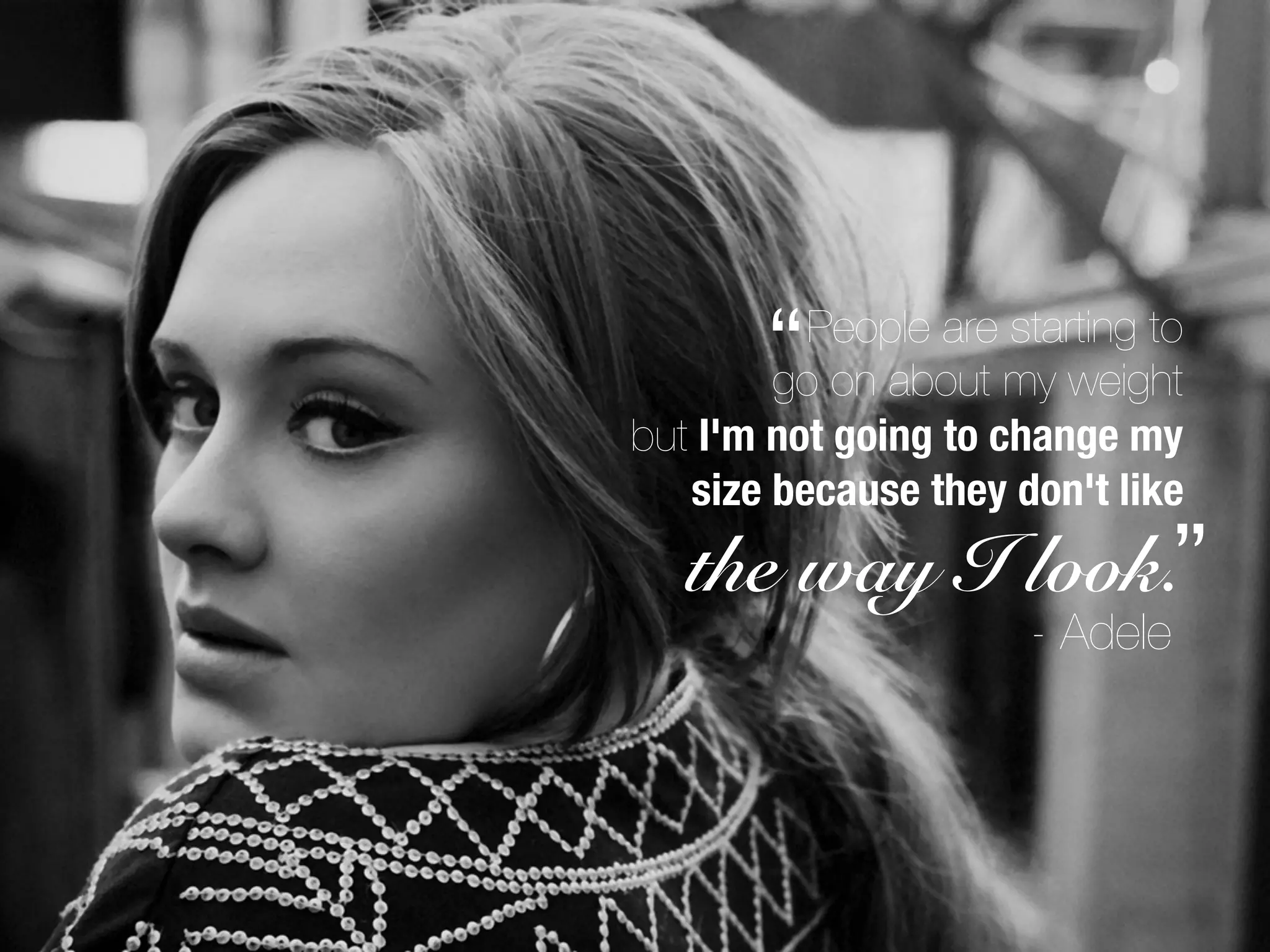
“  People are starting to
        go on about my weight
but I'm not going to change my
   size because they don't like
   the way I look.”
                       - Adele
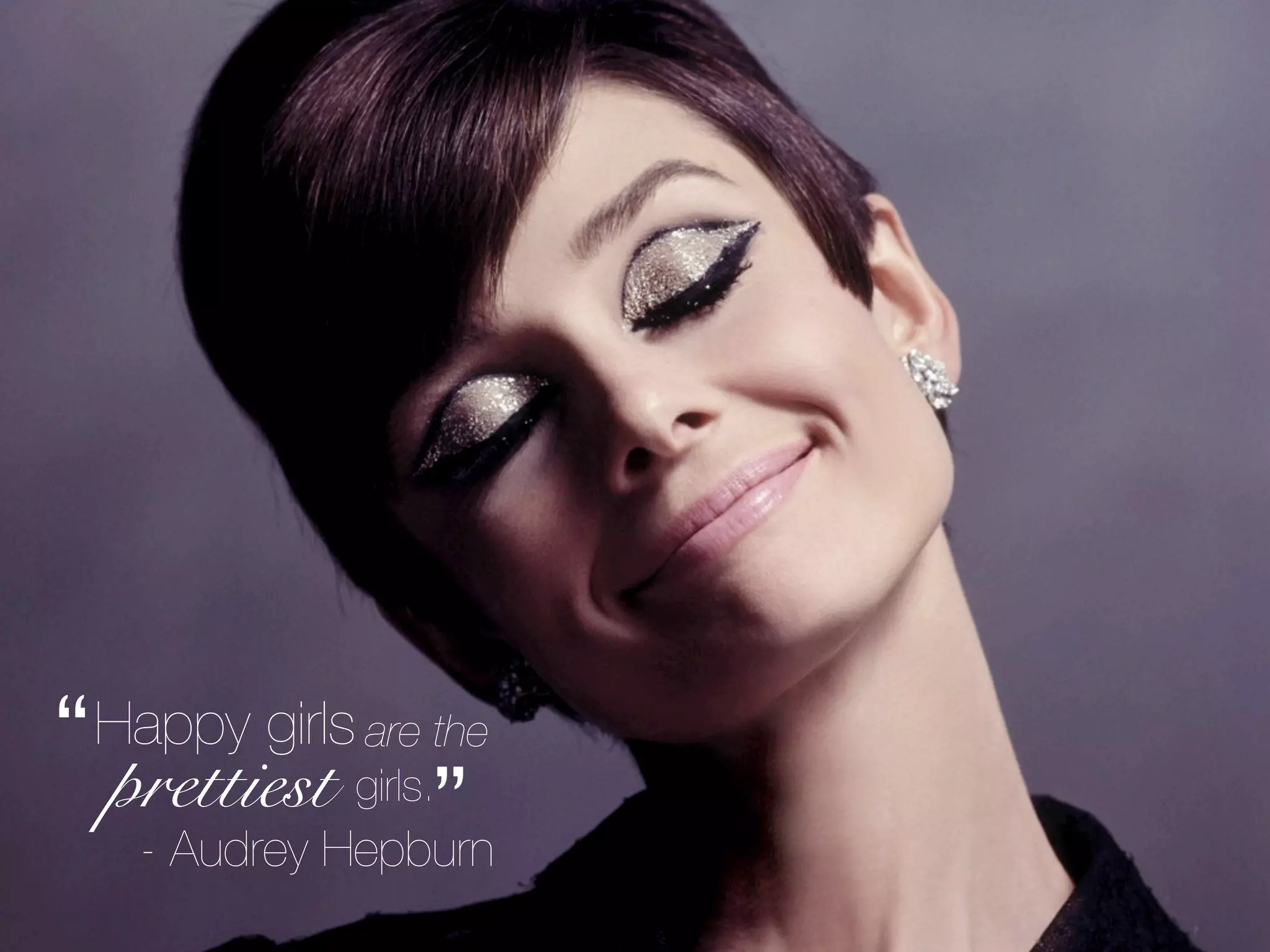
“ Happy girls are the
  prettiest girls.”
    - Audrey Hepburn
L VE YOUR LINES


L VE YOUR BODY
YOU ARE
    IMPERFECT
  PERMANENTLY &
INEVITABLY FLAWED
      and
beautiful.
 YOU ARE
EMBRACE THE
             of   you
UNIQUENESS
         and
APPRECIATE YOUR

 BODY
REFERENCES
JOURNAL
Hesse-Biber, S., Leavy, P. , Quinn, C. E. (2006). The mass
marketing of disordered eating and Eating Disorders: The social
psychology of women, thinness and culture. Women's Studies
International Forum 29, pp. 208–224

Vocks, S., Rüddel, H. (2007). Static and Dynamic Body Image
in Bulimia Nervosa: Mental Representation of Body Dimensions
and Biological Motion Patterns. International Journal of Eating
Disorders, pp. 59–66

Veldhuis, J., Konjin, E. A. (2012). Weight Information Labels on
Media Models Reduce Body Dissatisfaction in Adolescent Girls.
Journal of Adolescent Health, pp. 600–606
WEBSITE
Monroe, V. (2011) How Do Women Really Feel About How
They Look. Retrieved from http://www.oprah.com/style/Body-
Image-Statistics-How-Women-Feel-About-Their-Looks

Hollyscoop Team (2008) Mary-Kate Olsen: Anorexia Almost
Killed Me. Retrieved from http://www.hollyscoop.com/olsens/
mary-kate-olsen-anorexia-almost-killed-me.html


                    ARTICLE
Rhiannon, M., Holly, S. (2012). Body Image Limited. New
Statesman Ltd., pp. 12
Prepared by
  Yelena
  maseri
     2010228478
              BM1115F

Body Image Insecurity

  • 1.
  • 2.
  • 3.
    T he waywe perceive our OWN BODY & hence the way we assume other people perceive us. ( Vocks, 2007 )
  • 4.
    T he mentalpicture you have of your body. what it looks like what you believe about it how you feel about your body
  • 5.
    1 only FIVE in WOMEN is sat!fied with their BODY
  • 6.
    There are 3 BILLION women who don’t look like supermodels and only 8 who do. ( Rhiannon & Holly, 2012 )
  • 7.
    HOW DO YOUFEEL ABOUT THE WAY YOU LOOK? 60 45 30 15 0 Self-Conscious Satisfied Grateful Happy Dissastified Teens 60’s Source: November 2011 issue of O, The Oprah Magazine ( Monroe, 2011)
  • 8.
    WHY DO  s GET SO MUCH ATTENTION I  I WAS AS ? PRETTYAS HER. I’M NOT SKINNY FAT ? Am I ENOUGH. FAT YOU LOOK IN THAT . ”
  • 9.
    Based on thegraph , most women are CONSCIOUS about the way they look. There are many factors that affects us on how we perceive ourselves to be. Let’s look at how does THE MEDIA affect the way WOMEN see themselves.
  • 10.
    THE ROLE OF MEDIA in BODY IMAGE concerns among WOMEN
  • 11.
    The mass media messages may in fact be “ one of the strongest transmitters of this pressure ” to be thin through , MOVIES MAGAZINES & POPULAR TELEVISION. ( Stice & Shaw, as cited in Hesse-Biber, 2006 )
  • 12.
    R esearch hasshown that exposure to thin-ideal media models BODY DISSATISFACTION. ( Veldhuis, 2012 )
  • 13.
    What kind oftrends in the media industry are we noticing now?
  • 14.
    T he basic trend in the media industry at the moment slim skinny is to promote even unnatural looking women's bodies beautiful. as being
  • 15.
    B eauty & FASHION industries are ONLY promoting on ‘CERTAIN’ kind of pretty.
  • 16.
    How do themedia ? influence our perception of BODY IMAGE
  • 17.
    WOMEN of all ages but ESPECIALLY YOUNG WOMEN look at MAGAZINES , TELEVISION, , & MOVIES OTHER MEDIA PRODUCTS skinny WOMEN’S bodies. FULL OF IMAGES THAT SHOW
  • 18.
  • 19.
    T hese areperceivedmind the by subconscious of YOUNG WOMEN as being a ROLE MODEL to & follow aspire to be alike.
  • 20.
    Research indicates that exposure to images of thin&young female bodies is linked to DEPRESSION , LOSS OF SELF-ESTEEM, & DEVELOPMENT OF UNHEALTHY EATING HABITS in WOMEN & GIRLS. ( Veldhuis, 2012)
  • 21.
    ACHIEVING THIS skinny lookdoes not come naturally; it inevitably leads to practicing some kind of dieting excessive exercising or abnormal eating behaviors.
  • 22.
    of THE LEVEL EATINGDISORDERS LIKE ANOREXIA and BULIMIA ARE INCREASING RAPIDLY EVERY YEAR
  • 23.
    15 ABOUT % ALL of YOUNG WOMEN DEVELOP DISORDERLY EATING HABITS ( Hesse-Biber, 2006 )
  • 24.
    ANOREXIA & BULIMIA “ Losing weight is good, gaining weight is bad. ” “ What the scale says is the most important thing. ” “ Being thin is more important ” than being healthy. “without feeling guilty. You shall not eat ” WHAT’S ON YOUR “ ” MIND? You can never be to thin.
  • 25.
    WOMEN SUFFERING FROMANOREXIA NERVOSA 25% Die within 10 years 13% Die after 20 years 38% Fully Recover Bounce In and Out of Hospital 25% Source: Report from The National Association of Anorexia Nervosa and Association Disorders (ANAD) ( Costin, as cited in Hesse-Biber, 2006 )
  • 26.
    Mary-Kate Olsen ANOREXIA Almost Killed Me Pint size mogul Mary-Kate Olsen has battled with anorexia since she was diagnosed just after her 18th birthday but she's speaking out now and says the illness nearly killed her. She says, ‘ There have definitely been times in my life when I just turned to people and said,‘I’m done - this is too much for me. This is too over-whelming.’ ( Hollywood Team, 2008 ) ’
  • 27.
    WHAT WOULD BESOME REAL suggestions ON HOW TO improve your BODY IMAGE WITHOUT RESORTING TO UNHEALTHY EATING HABITS ?
  • 28.
    1 CHANGE YOUR GOAL from WEIGHT LOSS IMPROVING to just YOUR HEALTH
  • 29.
    2 FOCUS MORE ON THE INTERNAL beauty; IMPROVING SELF-ESTEEM, SELF-CONFIDENCE,& INTERNAL STRENGTHS of YOUR CHARACTER
  • 30.
    3 GIVE YOURSELF A BREAK from WOMEN’S MAGAZINES & THE MASS MEDIA ADVERTISING IF YOU FEEL PRONE TO THIS KIND of false PERCEPTIONS
  • 31.
    The media does impact on WOMEN’S BODY IMAGE significantly and it can affect WOMEN’S physical and mental health in a negative way.
  • 32.
    The only wayto STOP these negative effects coming from the media is to teach women not to judge themselves by the beauty industry’s standards and learn not to compare themselves to the cover girls. NOT ON BEING A STICK LIKE MODEL (unless you are born skinny)
  • 33.
    IT IS IMPORTANTTO PROMOTE A HEALTHY LIFESTYLE WITH EMPHASIS ON INTERNAL BEAUTY LIKE IMPROVING SELF-ESTEEM AND SELF-CONFIDENCE.
  • 34.
    favourite iconic rolemodel on what not to strive for IT’S NOT WRONG TO ADD Appropriate cellulite for all those heavenly chocolate brownies we eat, in addition to freckles, crows feet and laugh lines. LOVE THE BODY YOU’RE IN
  • 35.
    How do you measure yourself? These days, size isn’t just a number, it’s the way you feel in the changing room. It’s the difference between a good day and a bad day. It’s how you see yourself every time you look in the mirror. But what if all that went away? What if, instead of seeing x’s or l’s, we see what’s really there -amazing, beautiful, healthy bodies. Maybe it’s time to change the way we think about size.
  • 36.
  • 37.
    Accept yourself. Love your body the way it is and feel grateful towards it. Most importantly, in order to find real happiness, you must learn to love yourself for the totality of who you are and not just what you look like. - Portia De Rossi ”
  • 38.
    “ Peopleare starting to go on about my weight but I'm not going to change my size because they don't like the way I look.” - Adele
  • 39.
    “ Happy girlsare the prettiest girls.” - Audrey Hepburn
  • 40.
    L VE YOURLINES L VE YOUR BODY
  • 41.
    YOU ARE IMPERFECT PERMANENTLY & INEVITABLY FLAWED and beautiful. YOU ARE
  • 42.
    EMBRACE THE of you UNIQUENESS and APPRECIATE YOUR BODY
  • 43.
  • 44.
    JOURNAL Hesse-Biber, S., Leavy,P. , Quinn, C. E. (2006). The mass marketing of disordered eating and Eating Disorders: The social psychology of women, thinness and culture. Women's Studies International Forum 29, pp. 208–224 Vocks, S., Rüddel, H. (2007). Static and Dynamic Body Image in Bulimia Nervosa: Mental Representation of Body Dimensions and Biological Motion Patterns. International Journal of Eating Disorders, pp. 59–66 Veldhuis, J., Konjin, E. A. (2012). Weight Information Labels on Media Models Reduce Body Dissatisfaction in Adolescent Girls. Journal of Adolescent Health, pp. 600–606
  • 45.
    WEBSITE Monroe, V. (2011)How Do Women Really Feel About How They Look. Retrieved from http://www.oprah.com/style/Body- Image-Statistics-How-Women-Feel-About-Their-Looks Hollyscoop Team (2008) Mary-Kate Olsen: Anorexia Almost Killed Me. Retrieved from http://www.hollyscoop.com/olsens/ mary-kate-olsen-anorexia-almost-killed-me.html ARTICLE Rhiannon, M., Holly, S. (2012). Body Image Limited. New Statesman Ltd., pp. 12
  • 46.
    Prepared by Yelena maseri 2010228478 BM1115F