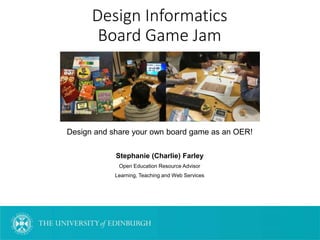
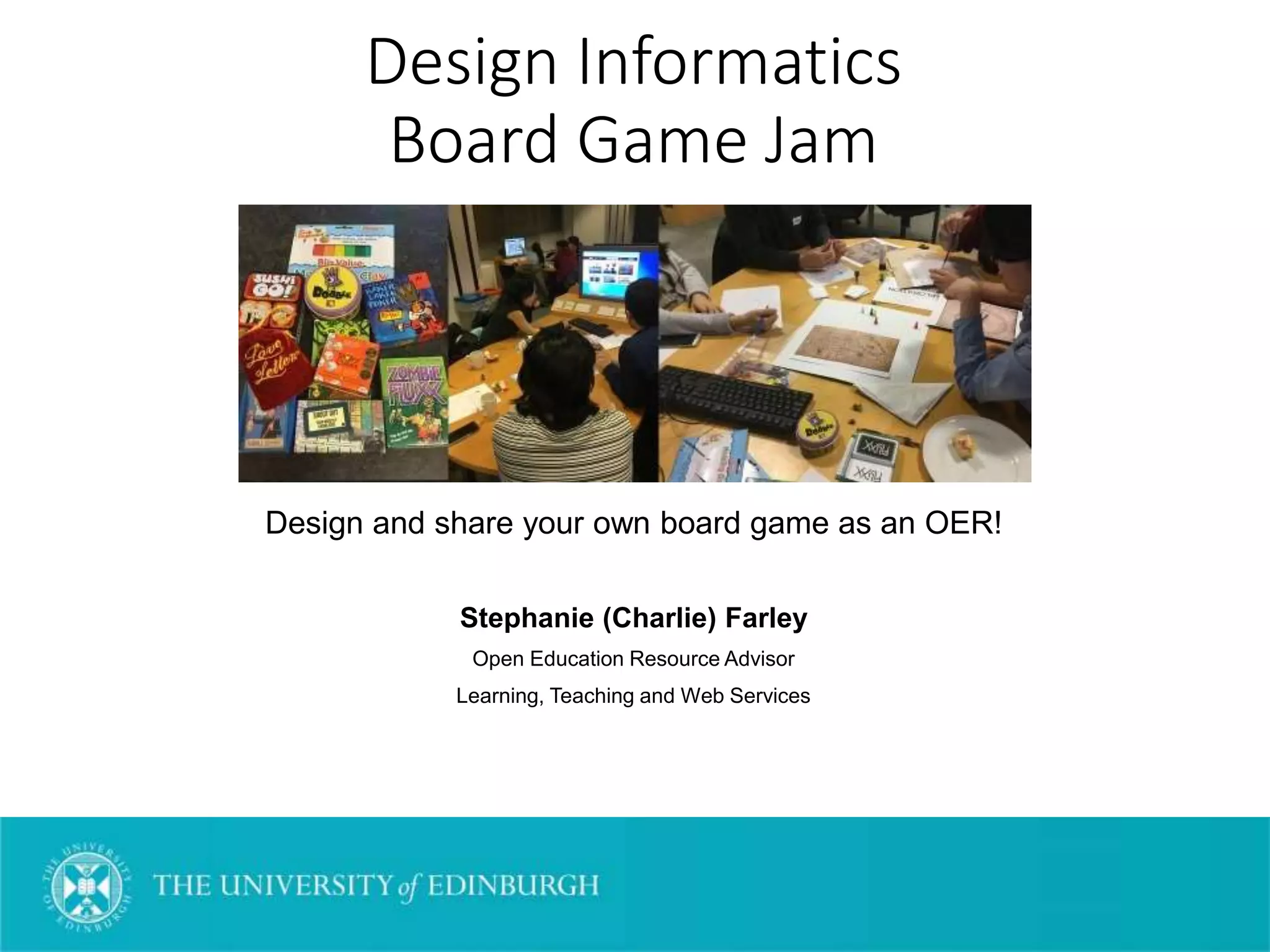
Design Informatics
Board Game Jam
Design and share your own board game as an OER!
Stephanie (Charlie) Farley
Open Education Resource Advisor
Learning, Teaching and Web Services
Aims for today
• Know more about OER when you leave than when you came
in.
• Be able to identify licensed material.
• Create your own fully attributable, shareable game.
By AIGA [Public domain], via Wikimedia
Timetable
11:00 Introductions (What are OERs, Board Games Renaissance). Play some
games.
11:40 OER and copyright.
12:00 Game kits and Images. Quick start game building.
13:00 Lunch
14:00 Design your game! Create your pieces.
15:00 Game Testing.
16:00 Test your game.
17:00 Refine and write-up your game
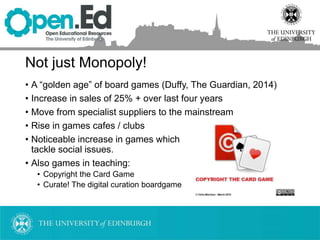
Not just Monopoly!
• A “golden age” of board games (Duffy, The Guardian, 2014)
• Increase in sales of 25% + over last four years
• Move from specialist suppliers to the mainstream
• Rise in games cafes / clubs
• Noticeable increase in games which
tackle social issues.
• Also games in teaching:
• Copyright the Card Game
• Curate! The digital curation boardgame
Role of the internet
• Cheap digital versions of games – “try before you buy”
• Online retailers make buying process easier
• Blogs / social media create buzz around games
https://www.boardgamegeek.com/
http://www.shutupandsitdown.com/
http://geekandsundry.com/shows/tabletop/
Games are improving!
• Merger of “Eurogames and Amerigames” traditions
• Eurogames (e.g. Settlers of Catan): strategy, mechanics,
abstract
• Amerigames (e.g. Risk): aggression / direct conflict, theme
more important than mechanics
• New games coming out which combine a strong theme with
diverse game mechanics (e.g. Game of Thrones)
• Board games and digital games borrowing from each other
Game mechanics
• Acting
• Co-operative play
• Dice rolling
• Player elimination
• Variable player powers
• Route Building
• Auction / bidding
• Memory
• Story telling
• Trading
• Voting
• Grid movement
Comprehensive list available at
https://boardgamegeek.com/browse/boardgamemechanic
Things to consider
• Theme
• Game mechanics
• Target audience
• Incentives / win conditions
• Game length
• Number of players
Create a game to be shared as an OER
• Today you will build a game document through the course of
the session. This will include:
• Attribution details for images used (identify at least 3 images
from the cards provided to be used in your game).
• Description of the Theme and Setting of the game
• Description of each type of card including: the image used for
that card, what happens when that card is played.
• Incentive / win conditions for the game.
• Set of rules/ gameplay instructions.
• 2 plasticine avatars/pieces for your game
What is an OER?
An Open Educational Resource, OER, is a freely available and openly
licensed digital resource.
“OERs are teaching, learning, and research resources that reside in the
public domain or have been released under an intellectual property
license that permits their free use and re-purposing by others. Open
educational resources include full courses, course materials, modules,
textbooks, streaming videos, tests, software, and any other tools,
materials, or techniques used to support access to knowledge”
The William and Flora Hewlett Foundation
By applying an open licence to a copyrighted
work, rights holders give permission for others to
copy or change their work in ways that would
otherwise infringe copyright law.
Definitions
Intellectual property rights (IPR):
Are the rights given to persons over the creations
of their minds (usually for a set period of time).
Image via Pixabay by geralt [Public Domain]
Is an area of IPR that covers the rights of authors
of creative works.
Copyright:
Image via Pixabay by Peggy_Marco [Public Domain]
is the permission,
or authorisation,
to re-use a
copyrighted work.
A licence:
Image via Pixabay by kartik27 [Public Domain]
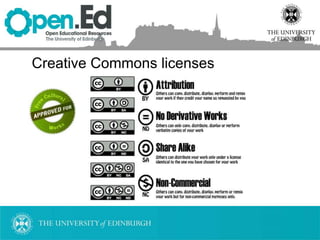
A Creative Commons (CC) licence is one of
several open licenses that enable the free
distribution of an otherwise copyrighted work.
Image via Pixabay by Kriemer [Public Domain]
For the games created today we will be using a CC BY 4.0 licence:
Except where otherwise stated, this work by [author’s names] is licensed
under a Creative Commons Attribution 4.0 International License
Creative Commons licenses
Select 3 images for your game
Keep in mind:
• Will you need to modify the image? Only use part of the image
or edit it in any way?
• Is the licence suitable for your needs?
• Is there any information about the image that is missing?
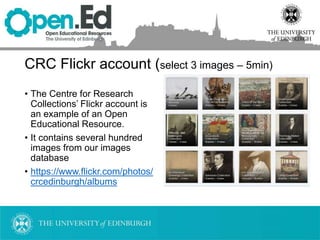
CRC Flickr account (select 3 images – 5min)
• The Centre for Research
Collections’ Flickr account is
an example of an Open
Educational Resource.
• It contains several hundred
images from our images
database
• https://www.flickr.com/photos/
crcedinburgh/albums
Theme and Setting (5min)
Theme – The underlying premise or set of assumptions the
describe what the players are doing in the game.
Setting – This can be the geographic location, time period, and/or
imaginative environment where the game is taking place.
Mechanics (5min)
Select 2 mechanics from the list provided.
“These are the procedures and rules of your game...how players
can and cannot try to achieve it, and what happens when they try.”
Jesse Schell, The Art of Game Design, A Book of Lenses
End Conditions (5min)
What are the end or win conditions for your game?
What objective or purpose are your players working towards (or to
avoid)?
Gameplay / Rules
Write out a basic set of rules on a spare sheet of paper (NOT on
your game document) that will guide your players through your
game mechanics towards the end/win condition of your game.
Gameplay / Rules (10min)
Confirm your rules as a group and write these down on your game
document.
Would you be able to follow these rules to reach the end/win
conditions of your game?
Title - What is the name of the material?
Author - Who owns the material?
Source - Where can I find it?
Licence - How can I use it?
Lastly, consider if there is anything else you should know before you use
it.
Attributing images in your game
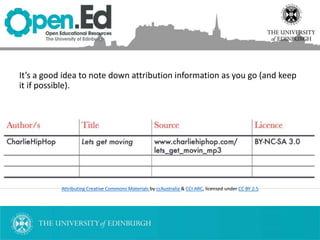
It’s a good idea to note down attribution information as you go (and keep
it if possible).
Attributing Creative Commons Materials by ccAustralia & CCI ARC, licensed under CC BY 2.5
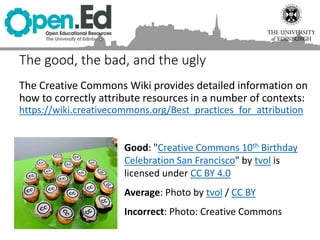
The good, the bad, and the ugly
The Creative Commons Wiki provides detailed information on
how to correctly attribute resources in a number of contexts:
https://wiki.creativecommons.org/Best_practices_for_attribution
Good: "Creative Commons 10th Birthday
Celebration San Francisco" by tvol is
licensed under CC BY 4.0
Average: Photo by tvol / CC BY
Incorrect: Photo: Creative Commons
Feedback and Follow Up
http://Open.Ed.ac.uk
@OpenEdEdinburgh

Board Game Jam - Design Informatics

  • 1.
    Design Informatics Board GameJam Design and share your own board game as an OER! Stephanie (Charlie) Farley Open Education Resource Advisor Learning, Teaching and Web Services
  • 2.
    Aims for today •Know more about OER when you leave than when you came in. • Be able to identify licensed material. • Create your own fully attributable, shareable game. By AIGA [Public domain], via Wikimedia
  • 3.
    Timetable 11:00 Introductions (Whatare OERs, Board Games Renaissance). Play some games. 11:40 OER and copyright. 12:00 Game kits and Images. Quick start game building. 13:00 Lunch 14:00 Design your game! Create your pieces. 15:00 Game Testing. 16:00 Test your game. 17:00 Refine and write-up your game
  • 4.
    Not just Monopoly! •A “golden age” of board games (Duffy, The Guardian, 2014) • Increase in sales of 25% + over last four years • Move from specialist suppliers to the mainstream • Rise in games cafes / clubs • Noticeable increase in games which tackle social issues. • Also games in teaching: • Copyright the Card Game • Curate! The digital curation boardgame
  • 5.
    Role of theinternet • Cheap digital versions of games – “try before you buy” • Online retailers make buying process easier • Blogs / social media create buzz around games https://www.boardgamegeek.com/ http://www.shutupandsitdown.com/ http://geekandsundry.com/shows/tabletop/
  • 6.
    Games are improving! •Merger of “Eurogames and Amerigames” traditions • Eurogames (e.g. Settlers of Catan): strategy, mechanics, abstract • Amerigames (e.g. Risk): aggression / direct conflict, theme more important than mechanics • New games coming out which combine a strong theme with diverse game mechanics (e.g. Game of Thrones) • Board games and digital games borrowing from each other
  • 7.
    Game mechanics • Acting •Co-operative play • Dice rolling • Player elimination • Variable player powers • Route Building • Auction / bidding • Memory • Story telling • Trading • Voting • Grid movement Comprehensive list available at https://boardgamegeek.com/browse/boardgamemechanic
  • 8.
    Things to consider •Theme • Game mechanics • Target audience • Incentives / win conditions • Game length • Number of players
  • 9.
    Create a gameto be shared as an OER • Today you will build a game document through the course of the session. This will include: • Attribution details for images used (identify at least 3 images from the cards provided to be used in your game). • Description of the Theme and Setting of the game • Description of each type of card including: the image used for that card, what happens when that card is played. • Incentive / win conditions for the game. • Set of rules/ gameplay instructions. • 2 plasticine avatars/pieces for your game
  • 10.
    What is anOER? An Open Educational Resource, OER, is a freely available and openly licensed digital resource. “OERs are teaching, learning, and research resources that reside in the public domain or have been released under an intellectual property license that permits their free use and re-purposing by others. Open educational resources include full courses, course materials, modules, textbooks, streaming videos, tests, software, and any other tools, materials, or techniques used to support access to knowledge” The William and Flora Hewlett Foundation
  • 11.
    By applying anopen licence to a copyrighted work, rights holders give permission for others to copy or change their work in ways that would otherwise infringe copyright law.
  • 12.
    Definitions Intellectual property rights(IPR): Are the rights given to persons over the creations of their minds (usually for a set period of time). Image via Pixabay by geralt [Public Domain]
  • 13.
    Is an areaof IPR that covers the rights of authors of creative works. Copyright: Image via Pixabay by Peggy_Marco [Public Domain]
  • 14.
    is the permission, orauthorisation, to re-use a copyrighted work. A licence: Image via Pixabay by kartik27 [Public Domain]
  • 15.
    A Creative Commons(CC) licence is one of several open licenses that enable the free distribution of an otherwise copyrighted work. Image via Pixabay by Kriemer [Public Domain]
  • 16.
    For the gamescreated today we will be using a CC BY 4.0 licence: Except where otherwise stated, this work by [author’s names] is licensed under a Creative Commons Attribution 4.0 International License
  • 17.
  • 18.
    Select 3 imagesfor your game Keep in mind: • Will you need to modify the image? Only use part of the image or edit it in any way? • Is the licence suitable for your needs? • Is there any information about the image that is missing?
  • 19.
    CRC Flickr account(select 3 images – 5min) • The Centre for Research Collections’ Flickr account is an example of an Open Educational Resource. • It contains several hundred images from our images database • https://www.flickr.com/photos/ crcedinburgh/albums
  • 20.
    Theme and Setting(5min) Theme – The underlying premise or set of assumptions the describe what the players are doing in the game. Setting – This can be the geographic location, time period, and/or imaginative environment where the game is taking place.
  • 21.
    Mechanics (5min) Select 2mechanics from the list provided. “These are the procedures and rules of your game...how players can and cannot try to achieve it, and what happens when they try.” Jesse Schell, The Art of Game Design, A Book of Lenses
  • 22.
    End Conditions (5min) Whatare the end or win conditions for your game? What objective or purpose are your players working towards (or to avoid)?
  • 23.
    Gameplay / Rules Writeout a basic set of rules on a spare sheet of paper (NOT on your game document) that will guide your players through your game mechanics towards the end/win condition of your game.
  • 24.
    Gameplay / Rules(10min) Confirm your rules as a group and write these down on your game document. Would you be able to follow these rules to reach the end/win conditions of your game?
  • 25.
    Title - Whatis the name of the material? Author - Who owns the material? Source - Where can I find it? Licence - How can I use it? Lastly, consider if there is anything else you should know before you use it. Attributing images in your game
  • 26.
    It’s a goodidea to note down attribution information as you go (and keep it if possible). Attributing Creative Commons Materials by ccAustralia & CCI ARC, licensed under CC BY 2.5
  • 27.
    The good, thebad, and the ugly The Creative Commons Wiki provides detailed information on how to correctly attribute resources in a number of contexts: https://wiki.creativecommons.org/Best_practices_for_attribution Good: "Creative Commons 10th Birthday Celebration San Francisco" by tvol is licensed under CC BY 4.0 Average: Photo by tvol / CC BY Incorrect: Photo: Creative Commons
  • 29.
    Feedback and FollowUp http://Open.Ed.ac.uk @OpenEdEdinburgh

Editor's Notes

  • #2 This document by Stephanie (Charlie) Farley of the The University of Edinburgh is licensed under a Creative Commons Attribution licence 4.0
  • #3 To be amended for the Half-day session
  • #4 To be amended for the Half-day session
  • #5 Could we include games used in teaching? Give examples such as ‘Copyright the Card Game’ https://ukcopyrightliteracy.wordpress.com/about-2/copyright-the-card-game/
  • #6 Perhaps we could cut this slide?
  • #9 So now we’ve run through a brief bit of scene setting, I now want to explore the thing people need to keep in mind when developing a game. What is the theme going to be? This is the overarching story that encompasses the game E.g. Risk is world domination, Cluedo is detection / solving a murder What are the game mechanics? The things that make the game work. For example the mechanics in Risk would include ‘dice rolling’, ‘player elimination’, ‘territory building’ etc Other mechanics include: Auction / bidding Cooperation Negotiation Role Playing Tile placement etc What is the target audience? Snakes and Ladders clearly for a younger audience! What are the incentives / win conditions? Settlers of Catan first to 10 VPs How long should the game last and for how many players? Now spend some time playing some games and think about these areas.
  • #18 On the back of each card is a screenshot of where the image was sourced. You will need to identify the licence on each image and if it means the image will be suitable for your game needs.
  • #20  Image cards have been provided for today’s session. The images are all sourced from the University’s CRC Flickr account which is an example of an Open Educational Resource and contains several hundred images from the University’s images database.
  • #21  Image cards have been provided for today’s session. The images are all sourced from the University’s CRC Flickr account which is an example of an Open Educational Resource and contains several hundred images from the University’s images database.
  • #22  Image cards have been provided for today’s session. The images are all sourced from the University’s CRC Flickr account which is an example of an Open Educational Resource and contains several hundred images from the University’s images database.
  • #23  Image cards have been provided for today’s session. The images are all sourced from the University’s CRC Flickr account which is an example of an Open Educational Resource and contains several hundred images from the University’s images database.
  • #24  Image cards have been provided for today’s session. The images are all sourced from the University’s CRC Flickr account which is an example of an Open Educational Resource and contains several hundred images from the University’s images database.
  • #25  Image cards have been provided for today’s session. The images are all sourced from the University’s CRC Flickr account which is an example of an Open Educational Resource and contains several hundred images from the University’s images database.
  • #26 After participants have selected at least three images for their game we will briefly discuss why each image was selected, any licence conditions to be considered, and how to appropriately attribute the images.