Actions of Medicinal Plants         1            © 2007 Eric Yarnell, ND

For more details visit:
                                 http://www.ashwagandha.tk

      Compendium of Pharmacological Actions of Medicinal Plants and Their
                                  Constituents

                      Compiled and copyrighted by Eric Yarnell, ND

This file may be freely distributed for non-commercial purposes as long as
                  its content is not altered in any way.

                            Alphabetic by Action
  Herbs marked with an asterisk (*) are ecologically threatened; use with
                             caution if at all.
Generally organized within each category by relative potency, where this is
 known (if no potency categories are listed, then they are unknown). Other
    organizational structures are stated where used. These lists are not
                                  complete.

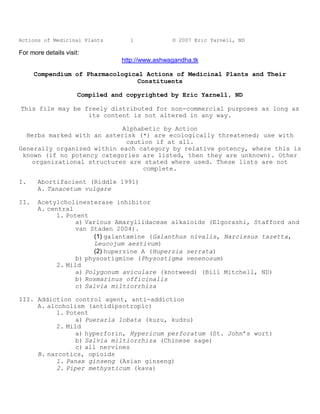
I.     Abortifacient (Riddle 1991)
       A. Tanacetum vulgare

II.    Acetylcholinesterase inhibitor
       A. central
             1. Potent
                   a) Various Amaryllidaceae alkaloids (Elgorashi, Stafford and
                   van Staden 2004).
                         (1) galantamine (Galanthus nivalis, Narcissus tazetta,
                         Leucojum aestivum)
                         (2) huperzine A (Huperzia serrata)
                   b) physostigmine (Physostigma venenosum)
             2. Mild
                   a) Polygonum aviculare (knotweed) (Bill Mitchell, ND)
                   b) Rosmarinus officinalis
                   c) Salvia miltiorrhiza

III. Addiction control agent, anti-addiction
     A. alcoholism (antidipsotropic)
           1. Potent
                 a) Pueraria lobata (kuzu, kudzu)
           2. Mild
                 a) hyperforin, Hypericum perforatum (St. John’s wort)
                 b) Salvia miltiorrhiza (Chinese sage)
                 c) all nervines
     B. narcotics, opioids
           1. Panax ginseng (Asian ginseng)
           2. Piper methysticum (kava)
Actions of Medicinal Plants    2             © 2007 Eric Yarnell, ND

            3. Withania somniferum (ashwagandha)
      C. nicotine
            1. Avena sativa (oats)
            2. Lobelia inflata (lobelia)
            3. Piper longum (long pepper)

IV.   Adenylate cyclase activator
      A. forskolin (Plectranthus barbatus)

V.    Aldose reductase inhibitor
      A. baicalin (Scutellaria baicalensis) (Zhou & Zhang 1989)
      B. chlorogenic acid (Varma 1986)
      C. coumarins
            1. esculetin, esculin (Varma 1986)
      D. ellagic acid (Terashima, et al. 1991)
            1. found in Caesalpinia ferrea--see herb monograph
      E. flavonoids (Chaudhry, et al. 1983; Varma 1986; Varma & Kinoshita
      1976)
            1. quercetin, myricitrin, those methoxylated at C6 or C8 (Tomás-
            Barberán, et al. 1986)
            2. quercetin, quercitrin, dihydroquercetin, isoquercetin,
            isoquerceitryl-2-malonate, quercitryl-2-acetatechrysin, apigenin,
            apiin, naringin, morin, rutin, hyperoside, hesperidin, herperidin
            chalcone (Varma 1986)
            3. nepetrin and other flavonoids from Rosmarinus officinalis and
            Sideritis spp (Shimizu, et al. 1984)
            4. Those from Polygonum hydropiper active in vitro (Haraguchi, et
            al. 1996).
      F. isoliquiritigenin and whole extract (Glycyrrhiza glabra) (Zhou &
      Zhang 1989)
      G. isoquercitrin (Camellia sinensis)

VI.   5-Alpha-hydroxylase inhibitor
      A. fatty acids (Serenoa repens)

VII. 5-Alpha-reductase inhibitor
     A. epicatechin-3-gallate and epigallocatechin-3-gallate (Camellia
     sinensis)
     B. fatty acids (Serenoa repens)

VIII.5-Alpha-reductase stimulator
     A. glycyrrhizin (Glycyrrhiza glabra)

IX.   Alteratives (in order by particular organ affinities)
      A. Circulatory
            1. Crataegus spp
            2. Zanthoxylum spp
      B. Gall bladder
Actions of Medicinal Plants    3           © 2007 Eric Yarnell, ND

            1. Fumaria officinalis
      C. Endocrine, general
            1. Podophyllum peltatum, water extracts (not resin)
      D. Hepatic and gastrointestinal
            1. Alnus serrulata (tag alder)
            2. Arctium lappa
            3. Chionanthus virginicus
            4. Gonolobus condurango
            5. Iris versicolor
            6. Mahonia aquifolium
            7. Rumex crispus
            8. Scrophularia spp
            9. Taraxacum officinale radix
      E. Immune/systemic
            1. Echinacea spp.
      F. Kidney
            1. Parietaria judaica
      G. Lymphatic
            1. Calendula officinalis
            2. Galium aparine (also urinary tract)
            3. Trifolium repens
            4. Viola odorata
      H. Nervous system
            1. Avena sativa
            2. Stachys betonica
            3. Stillingia sylvatica
      I. Rheumatologic/musculoskeletal
            1. Guaiacum spp
            2. Jeffersonia diphylla
            3. Kalmia latifolia (mountain laurel)
            4. Sassafras spp
            5. Smilax spp
            6. Stillingia sylvatica
      J. Thyroid
            1. Fucus vesiculosus
      K. Urinary tract
            1. Equisetum arvense
            2. Galium aparine
            3. Urtica dioica

X.    Analeptic, central nervous system stimulant
      A. direct
            1. caffeine
            2. cocaine (Erythroxylum coca)
            3. strychnine
            4. theobromine
            5. theophylline
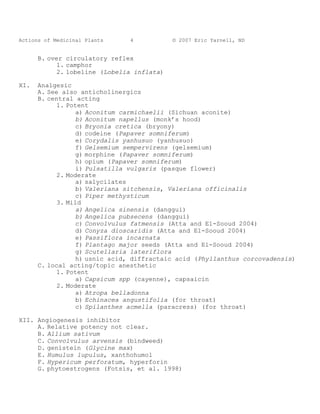
Actions of Medicinal Plants    4            © 2007 Eric Yarnell, ND


      B. over circulatory reflex
            1. camphor
            2. lobeline (Lobelia inflata)

XI.   Analgesic
      A. See also anticholinergics
      B. central acting
            1. Potent
                  a) Aconitum carmichaelii (Sichuan aconite)
                  b) Aconitum napellus (monk’s hood)
                  c) Bryonia cretica (bryony)
                  d) codeine (Papaver somniferum)
                  e) Corydalis yanhusuo (yanhusuo)
                  f) Gelsemium sempervirens (gelsemium)
                  g) morphine (Papaver somniferum)
                  h) opium (Papaver somniferum)
                  i) Pulsatilla vulgaris (pasque flower)
            2. Moderate
                  a) salycilates
                  b) Valeriana sitchensis, Valeriana officinalis
                  c) Piper methysticum
            3. Mild
                  a) Angelica sinensis (danggui)
                  b) Angelica pubsecens (danggui)
                  c) Convolvulus fatmensis (Atta and El-Sooud 2004)
                  d) Conyza dioscaridis (Atta and El-Sooud 2004)
                  e) Passiflora incarnata
                  f) Plantago major seeds (Atta and El-Sooud 2004)
                  g) Scutellaria lateriflora
                  h) usnic acid, diffractaic acid (Phyllanthus corcovadensis)
      C. local acting/topic anesthetic
            1. Potent
                  a) Capsicum spp (cayenne), capsaicin
            2. Moderate
                  a) Atropa belladonna
                  b) Echinacea angustifolia (for throat)
                  c) Spilanthes acmella (paracress) (for throat)

XII. Angiogenesis inhibitor
     A. Relative potency not clear.
     B. Allium sativum
     C. Convolvulus arvensis (bindweed)
     D. genistein (Glycine max)
     E. Humulus lupulus, xanthohumol
     F. Hypericum perforatum, hyperforin
     G. phytoestrogens (Fotsis, et al. 1998)
Actions of Medicinal Plants      5          © 2007 Eric Yarnell, ND

      H.   Magnolia liliflora
      I.   Rubus spp, gallic acid
      J.   Salvia miltiorrhiza (Chinese sage) (Kang, et al. 2003)
      K.   Typha spp (cattail)
      L.   Zingiber officinale, [6]-gingerol

XIII.Androgenic
     A. chyrsin (Matricaria recutita, Passiflora incarnata)
     B. Tribulus terrestris

XIV. Angiotensin-converting enzyme inhibitor, ACE inhibitor
     A. All mild.
     B. see also diuretic below
     C. Allium sativum (garlic)
     D. lithospermic acid (Salvia miltiorrhiza)
     E. proanthocyanidins (Crataegus laevigata, Vitis vinifera, Cupressus
     sempervirens) (Meunier, et al. 1987)
     F. secoiridoid glycosides eg oleuropein, ligstroside, excelcioside,
     oleoside 11-methyl ester, oleoside (Olea europaea and Olea lancea
     folium)
     G. triterpenoids (Ganoderma lucidum) (Morigawa, et al. 1986)

Anodyne:     see analgesic

XV.   Anthelmintic, anti-amebic, anti-parasitic, anti-protozoal
      A. By plant or constituent
            1. Potent
                  a) ascaridol
                  b) aspidine
                  c) Azadiractha indica (neem)
                  d) Cinchona spp (Peruvian bark)—quinine, quinidine,
                  cinchonine, cinchonidine
                  e) Dryopteris filix-mas (male fern) radix (filicin)
                  f) emetine (Cephaelis ipecacuanha)
                  g) Staphysagria
                  h) Tanacetum vulgaris (tansy)
            2. Mild-to-moderate
                  a) Allium sativum (garlic) bulbus (allicin)
                  b) Areca catechu
                  c) Artemisia annua (sweet Annie) herba (artemisinin =
                  qinghaosu)
                  d) Artemisia maritima herba (santonin)
                  e) berberine-containing herbs
                  f) Cucurbita pepo (pumpkin) seed
                  g) Cucurbita moschata seed
                  h) lapachol (Tabebuia avellanadae)
                  i) Melia spp
Actions of Medicinal Plants     6           © 2007 Eric Yarnell, ND

                  j) papain
                  k) Prunus mume (wu mei)
                  l) Punica granatum (pomegranate)
                  m) Quisqualis indica (shi jun zi)
            3. Uncertain potency
                  a) Cocculus indicus
                  b) flavaspidinic acid

      B. By parasite
            1. Ascaris lumbricoides (roundworm)
                  a) berberine-containing herbs
                  b) Chenopodium ambrosioides (epazote)
                  c) Prunus mume (wu mei)
                  d) Quassia spp
                  e) santonin from Artemisia paucifolia
                  f) Spigelia marylandica
                  g) turpentine
            2. Entamoeba histolytica
                  a) berberine (Mahonia, Berberis, Hydrastis, Coptis,
                  Xanthorrhiza)
                  b) emetine (Cephaelis ipecacuanha)
                  c) quinine (Cinchona spp)
                  d) tetrandrine and other alkaloids (Stephania tetrandra)
            3. Giardia lamblia
                  a) Allium sativum
                  b) Alpinia galanga
                  c) berberine
                  d) emetine (Cephaelis ipecacuanha)
                  e) epicatechin
                  f) Piper spp
                  g) propolis
                  h) Zingiber zerumbet
            4. Hookworms
                  a) Chenopodium ambrosioides oil
                  b) Monarda
                  c) thymol from Thymus vulgaris
            5. Leishmania spp (kala azar) (de Carvalho & Ferreira 2001)
                  a) Acanthus illicifolius--India
                  b) Ampelocera edentula--South America
                  c) Anacardium occidentale (cashew) cortex--Brazil
                  d) Annona spinescens--South America?
                  e) Anthostema senegalense--Guinea-Bissau
                  f) Asparagus africanus--Kenya
                  g) berberine (Ghosh, et al. 1985--see berberine file)
                  h) Dictyoloma peruviana--Bolivia
                  i) Dracaena spp (soap tree)--West Africa
                  j) Echinacea purpurea
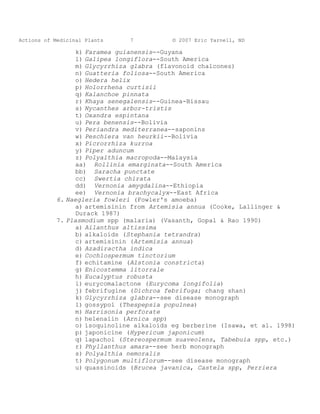
Actions of Medicinal Plants     7          © 2007 Eric Yarnell, ND

                  k) Faramea guianensis--Guyana
                  l) Galipea longiflora--South America
                  m) Glycyrrhiza glabra (flavonoid chalcones)
                  n) Guatteria foliosa--South America
                  o) Hedera helix
                  p) Holorrhena curtisii
                  q) Kalanchoe pinnata
                  r) Khaya senegalensis--Guinea-Bissau
                  s) Nycanthes arbor-tristis
                  t) Oxandra espintana
                  u) Pera benensis--Bolivia
                  v) Periandra mediterranea--saponins
                  w) Peschiera van heurkii--Bolivia
                  x) Picrorrhiza kurroa
                  y) Piper aduncum
                  z) Polyalthia macropoda--Malaysia
                  aa) Rollinia emarginata--South America
                  bb) Saracha punctate
                  cc) Swertia chirata
                  dd) Vernonia amygdalina--Ethiopia
                  ee) Vernonia brachycalyx--East Africa
            6. Naegleria fowleri (Fowler's amoeba)
                  a) artemisinin from Artemisia annua (Cooke, Lallinger &
                  Durack 1987)
            7. Plasmodium spp (malaria) (Vasanth, Gopal & Rao 1990)
                  a) Ailanthus altissima
                  b) alkaloids (Stephania tetrandra)
                  c) artemisinin (Artemisia annua)
                  d) Azadiractha indica
                  e) Cochlospermum tinctorium
                  f) echitamine (Alstonia constricta)
                  g) Enicostemma litorrale
                  h) Eucalyptus robusta
                  i) eurycomalactone (Eurycoma longifolia)
                  j) febrifugine (Dichroa febrifuga; chang shan)
                  k) Glycyrrhiza glabra--see disease monograph
                  l) gossypol (Thespepsia populnea)
                  m) Harrisonia perforate
                  n) helenalin (Arnica spp)
                  o) isoquinoline alkaloids eg berberine (Isawa, et al. 1998)
                  p) japonicine (Hypericum japonicum)
                  q) lapachol (Stereospermum suaveolens, Tabebuia spp, etc.)
                  r) Phyllanthus amara--see herb monograph
                  s) Polyalthia nemoralis
                  t) Polygonum multiflorum--see disease monograph
                  u) quassinoids (Brucea javanica, Castela spp, Perriera
Actions of Medicinal Plants     8           © 2007 Eric Yarnell, ND

                  madagascariensis, Picrasma spp, Picrolemma pseudocoffea,
                  Quassia spp, Simaba cedron, Simaruba glauca, Soulamena
                  tomentosa)
                  v) quinine, quinidine, cinchonine, cinchonidine (Cinchona
                  spp)
                  w) taccalonolides (Tacca plantaginea)
                  x) vinblastine (Catharanthus roseus)
            8. Tenia spp (tapeworms)
                  a) Aspidium
                  b) Curcurbita pepo seed
                  c) Punica granatum
            9. Trichomonas vaginalis
                  a) Aesculus hippocastanum
                  b) Calendula officinalis
                  c) Echinacea spp
                  d) propolis

XVI. Anti-adhesion
     A. berberine
     B. proanthocyanidins (Vaccinium spp)

XVII.Antiallergenic, anti-allergic
     A. Potent
           1. Ephedra sinica
     B. Moderate
           1. Glycyrrhiza glabra, G. uralensis
     C. Mild
           1. Ambrosia spp (ragweed) folium
           2. Euphrasia stricta
           3. Euphorbia hirta
           4. Luffa
           5. Solidago canadensis (goldenrod)
           6. Urtica dioica leaf

XVIII.     Anti-androgenic
     A. glycyrrhizin (Glycyrrhiza glabra)

XIX. Anti-anginal
     A. See also spasmolytics.
     B. Moderate
           1. Ammi visnaga (khella)
           2. Lobelia inflata
     C. Mild
           1. Allium sativum (garlic)
           2. Crataegus laevigata (hawthorn)
           3. Salvia miltiorrhiza (dan shen)
Actions of Medicinal Plants   9           © 2007 Eric Yarnell, ND

XX.   Anti-arrhythmic, antidysrhythmic
      A. Not all these herbs are useful or indicated for every type of
      arrhythmia.
      B. Potent
            1. ajmaline (Rauvolfia serpentina)
            2. atropine (Atropa belladonna)
            3. Convallaria majalis (lily-of-the-valley)
            4. Digitalis purpurea (foxglove)
            5. papaverine
            6. quinidine, quinine (Cinchona spp)
            7. sparteine (Cytisus scoparius)
      C. Moderate
            1. Hylocereus undatus
            2. Selenicereus grandiflora
      D. Mild
            1. Angelica archangelica
            2. Angelica sinensis
            3. Apocynum spp
            4. Crataegus laevigata
            5. proanthocyanidins and flavonoids (Crataegus laevigata)
            6. tetrandrine and other alkaloids (Stephania tetrandra)

XXI. Antibacterial, antiseptic, antimicrobial
     A. see also antimycobacterial below
     B. see also antibiotic resistance reversal agents
     C. Moderate to Potent
           1. alkaloids, multiple (Abbasoglu, et al. 1991)
           2. allicin (Allium sativum)
           3. berberine-containing herbs (Hydrastis, Berberis, Mahonia,
           Coptis, Xanthorrhiza)
           4. essential oils (Lis-Balchin, et al. 1997)
                 a) Lavandula spp
                 b) Rosmarinus officinalis
                 c) Salvia officinalis
                 d) Santalum albidum
                 e) Thymus vulgaris
           5. benzethonium chloride (semisynthetic agent in grapefruit seed
           extract) (Ionescu, et al. 1990)
           6. Tanacetum vulgare herba (Izzo, et al. 1995)
     D. Mild
           1. Allium cepa bulbus (Izzo, et al. 1995)
           2. Aloe vera
           3. Cichorium intybum root (Izzo, et al. 1995)
           4. coumestrol (Brassica oleracea var. gemmifera, Glycine max,
           Medicago sativa, Pisum sativum, Phaseolus lunatus, P. vulgaris,
           Taraxacum officinale, Trifolium pratense, etc.)
           5. flavonoids
Actions of Medicinal Plants    10          © 2007 Eric Yarnell, ND

                  a) myricetin, datiscetin, kaempferol, quercetin (anti-
                  vancomycin-resistant Enterococcus and methicillin-resistant
                  Staphylococcus aureus) (Xu & Lee 2001)
            6. genistein (prunetol, sophoricol, genisteol) (Pueraria lobata,
            Baptisia tinctoria, Cytisus scoparius, Glycine max, Glycyrrhiza
            glabra, Medicago sativa, Pueraria lobata, Trifolium pratense,
            etc.)
            7. lapachol (Tabebuia avellanadae)
            8. Marrubium vulgare herba (Izzo, et al. 1995)
            9. Origanum vulgare herba (Izzo, et al. 1995)
            10. Sambucus nigra flos (Izzo, et al. 1995)
            11. Silybum marianum herba (Izzo, et al. 1995)

      E. By microbe
            1. Escherichia coli
                  a) Anthriscus cerefolium herba (Izzo, et al. 1995)
                  b) Fumaria officinalis herba (Izzo, et al. 1995)
                  c) Grossheimia macrocephala herba (Izzo, et al. 1995)
                  d) Hieracium piloselloides herba (Izzo, et al. 1995)
                  e) Malva silvestris folia et flos (Izzo, et al. 1995)
                  f) Tussilago farfara herba (Izzo, et al. 1995)
            2. Helicobacter pylori
                  a) Allium sativum (Cellini, et al. 1996)
                  b) Aristolochia paucinervis--see herb monograph
                  c) Camellia sinensis catechins--see herb monograph
                  d) Cinnamomum spp., ethanol extract (Tabak, et al. 1996)
                  e) Coptis chinensis (goldthread) (Zhang, Yang & Yang 1992)
                  f) Corydalis yanhusuo (Zhang, Yang & Yang 1992)
                  g) Magnolia officinalis (Zhang, Yang & Yang 1992)
                  h) Magnolia sieboldii--see herb monograph
                  i) Panax ginseng polysaccharides--see herb monograph
                  j) Panax notoginseng (Zhang, Yang & Yang 1992)
                  k) Pistachia lentiscus (mastic gum)
                  l) Prunus mume (Zhang, Yang & Yang 1992)
                  m) Rheum palmatum (rhubarb) (Zhang, Yang & Yang 1992)
                  n) Terminalia spinosa (Fabry, et al. 1996; Fabry, Okemo &
                  Ansorg 1996)
                  o) Thymus vulgaris, aqueous extract (Tabak, et al. 1996)
                  p) Vaccinium macrocarpon (cranberry)--see herb monograph

XXII.Antibiotic resistance reversal agents, chemotherapy resistance
reversal agents
     A. Multidrug resistance protein-1 (MRP-1) inhibitors
           1. genistein, other isoflavones (Glycine max)
     B. P-glycoprotein inhibitors
           1. capsaicin (Capsicum spp) (Nabekura, eta l. 2005)
           2. Curcuma longa (Nabekura, eta l. 2005)
Actions of Medicinal Plants   11          © 2007 Eric Yarnell, ND

            3. Feijoa sellowiana pericarpium (Motohashi, et al. 2000)
            4. Ficus citrifolia
            5. indole-3-carbinol
            6. quercetin
            7. reserpine (Rauvolfia serpentina)
            8. resveratatrol (Nabekura, et al. 2005)
            9. Rosmarinus officinalis
            10. theanine (Camellia sinensis)
            11. Zingiber officinale (Nabekura, et al. 2005)
      C. Miscellaneous
            1. apigenin
            2. berberine and flavonoids (Berberis spp)
            3. curcumin
            4. 3,7-dihydroxyflavone (Liu, et al. 2001)
            5. flavone
            6. galangin (Liu, et al. 2001)
            7. genistein
            8. kaempferol
            9. verapamil

Anticarcinogenic, anti-cancer, anti-tumor:   see antineoplastic and
apoptosis modulator

XXIII.     Anticholinergic
     A. Potent (in order from highest to lowest)
           1. Atropa belladonna (belladonna)
           2. Brugmansia spp (angel trumpet)
           3. Datura stramonium (thornapple)
           4. Solanum dulcamara (dulcamara, nightshade)
           5. Hyoscyamus niger (henbane)
           6. Mandragora officinarum (mandrake), other species
     B. Moderate
           1. Garrya spp (silk tassel)

XXIV.Anticoagulant (interfere with clotting cascade)--see also platelet
aggregation inhibitors
     A. dicoumarol
     B. heparin
     C. heparinoids

XXV. Antidepressant
     A. Potent
           1. Papaver somniferum (opium poppy)
           2. Pausinystalia yohimbe (yohimbe)
           3. Peganum harmala (Syrian rue)
           4. Strychnos nux-vomica
     B. Moderate
           1. Hypericum perforatum (St. John’s wort)
Actions of Medicinal Plants      12          © 2007 Eric Yarnell, ND

            2.   Ignatia amara
            3.   kavalactones (Piper methysticum)
      C. Mild
            1.   Actaea racemosa (black cohosh)
            2.   Aralia racemosa
            3.   Eleutherococcus senticosus
            4.   Melissa officinalis
            5.   Oplopanax horridum
            6.   Panax spp
            7.   Selenicereus grandiflora
            8.   Turnera diffusa (damiana)

XXVI.Anti-diabetic
     See also hypoglycemic.
     Reference throughout, unless otherwise stated, is Bergner 2002-3.

      A. Insulin Secretagogues
            1. Note: Because these herbs may actual worsen the underlying
            cause, their use is not recommended for insulin-resistant
            patients.
            2. Brickellia californica (prodigiosa)**
            3. Capsicum frutescens (cayenne)
            4. Gymnema sylvestre (gurmar)—hasn’t shown secretagogue effects
            clinically
            5. Ocimum canum (dog basil) (Nyarko, et al. 2002)
            6. Panax ginseng (Asian ginseng) radix
            7. Syzygium cumini = S. jambolana (jambolan)**
            8. Trigonella foenum-graecum (fenugreek) leaf (Devi, et al. 2003)
            9. Urtica dioica (stinging nettle) leaf (Farzami, et al. 2003)
            10. Theobroma cacao (chococlate) (J Nutr 2003;133(10):3149-52)

** May decrease liver release of glucose.

      B. Insulin Sensitizers
            1. berberine (Ko, et al. 2005)
                  a) Another rat study suggested it elevated serum insulin
                  levels, raising the possibility that this constituent is
                  simultaneously an insulin secretagogue (Leng, et al. 2004)
            2. Cinnamomum spp (cinnamon)
            3. Foeniculum vulgare (fennel)
            4. Galega officinalis (goat’s rue), guanidine
                  a) Presumed insulin sensitizer based on mechanisms of
                  guanidine-derived drugs (eg metformin).
            5. Grifola frondosa (maitake)
            6. Hibiscus spp (Sachdewa & Khemani 2003)
            7. Momordica charantia (bitter melon)
            8. Ocimum tenuiflorum (holy basil)
Actions of Medicinal Plants    13          © 2007 Eric Yarnell, ND

            9. Panax ginseng (Asian ginseng) rootlets
            10. Panax quinquefolius (American ginseng)

      C. Unknown Mechanism
            1. Vaccinium spp (blueberry, bilberry) folium
            2. Oplopanax horridus (devil’s club)
            3. Phaseolus vulgaris (bean)
            4. Polygonatum multiflora

      D. Other Mechanisms
            1. Allium cepa (onion), allyl propyl disulfide
                  a) Mechanism: competes for binding sites on enzymes that
                  degrade insulin in liver

Abdominal obesity (diabetes, hypoglycemic, hypocholesteremic):
    Eleutherococcus senticosus diabetes (Baranov, 1982)
    Ocimum sanctum hypoglycemic and hypolipidaemic (Williamson, 2002)
    Panax quinquefolium hypoglycemic (Assinewe et al., 2003)
    Rhodiola rosea antihyperglycemic activity (Wagner et al., 1994)
    Tinospora cordifolia    hypoglycemic (Willamson, 2002)

Memory enhancing actions of Asiasari radix extracts via activation of
insulin receptor and extracellular signal regulated kinase (ERK) I/II in
rat hippocampus. Brain Research 974:193-201.

The effect of nerobol and ecdysterone on insulin-dependent processes linked
normally and in insulin resistance. Probl Endokrinol (Mosk) 35(5):77-81.

Eleutherococcus senticosus (Rupr. & Maxim.) Maxim. (Araliaceae) as an
adaptogen: a closer look. J Ethnopharmacol. 2000 Oct;72(3):345-93.

Wild ginseng prevents the onset of high-fat diet induced hyperglycemia and
obesity in ICR mice. Arch Pharm Res. 2004 Jul;27(7):790-6.

A novel insulin-releasing substance, phanoside, from the plant Gynostemma
pentaphyllum. J Biol Chem 2004;279(40):41361-7.

Use of natural plant exudates (Sanguis Draxonis) for sustained oral insulin
delivery with dramatic reduction of glycemic effects in diabetic rats. J
Control Release 2004;97(3):467-75.

Dynamical influence of Cordyceps sinensis on the activity of hepatic
insulinase of experimental liver cirrhosis. Hepatobiliary Pancreat Dis Int
2004;3(1):99-101.

The insulinotropic activity of a Nepalese medicinal plant Biophytum
sensitivum: preliminary experimental study. J Ethnopharmacol 2001;78(1):89-
93. (Oxalidaceae)
Actions of Medicinal Plants   14          © 2007 Eric Yarnell, ND


Insulin-like biological activity of culinary and medicinal plant aqueous
extracts in vitro. J Agric Food Chem 2000;48(3):849-52.

XXVII.    Anti-diarrheal
     See also astringent.

      A. Astringents
            1. tannins
            2. Uzara spp.
            3. Vaccinium myrtillus (bilberry) dried fruit (NOT fresh)
      B. Polysaccharides
            1. carob (Ceratonia silliquia)
            2. mucilage
            3. pectin
            4. rice
      C. Motility slowing agents
            1. Papaver somniferum

XXVIII.    Anti-emetic
     A. Potent
           1. Aconitum napellus
           2. cocaine (Erythoxylon coca)
           3. scopolamine (Datura spp)
     B. Mild-to-Moderate
           1. Alpinia galanga
           2. Magnolia officinalis (hou po) bark
           3. Matricaria recutita (chamomile)
           4. Mentha spp (mints)
           5. Pimpinella anisum (anise)
           6. Zingiber officinalis

XXIX.Anti-estrogenic
     A. indoles (Brassicaceae vegetables)
     B. isoflavonoids, isoflavones (Glycine max (soy)
           1. daidzein
           2. genistein
     C. lignans (Linum usitatissimum)
     D. quercetin
           1. ligand interaction with estrogen receptors thus interferes
           with estradiol binding

XXX. Anti-fibrotic, anticirrhosis
     A. bromelain
     B. Centella asiatica (gotu kola)
     C. colchicine (Colchicum autumnale)
     D. silymarin (Silybum marianum)
     E. sho-saiko-to and saiko-keishi-to formulae (Bupleurum falcatum,
Actions of Medicinal Plants    15            © 2007 Eric Yarnell, ND

      Scutellaria baicalensis, etc.)
      F. tetrandrine (Stephania tetrandra)

XXXI.Antifungal
     A. by plant
           1. fungicidal
                 a) berberine (Hydrastis canadensis, Berberis spp., etc.)
                 b) biochanin A (pratensol) (Baptisia tinctoria, Medicago
                 sativa, Trifolium pratense, etc.)
                 c) coumestrol (Brassica oleracea var. gemmifera, Glycine
                 max, Medicago sativa, Pisum sativum, Phaseolus lunatus, P.
                 vulgaris, Taraxacum officinale, Trifolium pratense, etc.)
                 d) naphthoquinones (Tabebuia avellenadae)
           2. fungistatic
                 a) biochanin A (pratensol) (Baptisia tinctoria, Medicago
                 sativa, Trifolium pratense, etc.)
                 b) genistein (prunetol, sophoricol, genisteol) (Baptisia
                 tinctoria, Cytisus scoparius, Glycine max, Glycyrrhiza
                 glabra, Medicago sativa, Pueraria lobata, Trifolium
                 pratense, etc.)
           3. possibly fungicidal or fungistatic
                 a) Aloe vera
                 b) daidzein (Genista tinctoria, Glycine max, Pueraria
                 lobata, Pueraria psuedohirsuta, Trifolium pratense, etc.)
                 c) protoanemonin (Martin, San Roman & Dominguez 1990)
           4. Allium sativum (garlic)
           5. berberine-containing herbs
           6. naphthoquinones from Diospyros
           7. Echinacea spp
           8. Hyssopus tincture
           9. Larrea tridentata (chaparral) (Zamora 1984)
           10. Melaleuca alternafolia (tea tree)
           11. Origanum spp volatile oil
           12. Thymus vulgaris oleum

      B. By organism
            1. Candida albicans
                  a) Terminalia spinosa (Fabry, et al. 1996)
            2. Cryptococcus neoformans
                  a) Allium sativum (Davis, Shen & Cai 1990)
                  b) catechin (Levitz, et al. 1995)

XXXII.     Anti-gastritis and anti-ulcer (peptic)
     A. Potent
           1. atropine (Atropa belladonna)
           2. Capsicum frutescens (cayenne)
     B. Mild-to-Moderate
Actions of Medicinal Plants    16           © 2007 Eric Yarnell, ND

            1. Aloe vera gel
            2. azulene (Matricaria recutita)
            3. Calendula officinalis
            4. Curcuma longa
            5. demulcents
            6. Glycyrrhiza glabra (licorice) (flavonoids, glycyrrhetinic
            acid) including DGL
            7. Symphytum officinale (comfrey)
            8. Theobroma cacao (chocolate)

XXXIII.      Antigonadotropic
     A.   Actaea racemosa
     B.   Lithospermum officinale
     C.   Rheum raponticum
     D.   Vitex agnus-castus

XXXIV.     Antigout
     A. Potent
           1. colchicine (Colchicum autumnale)
           2. demecolcine (Colchicum autumnale)
     B. Mild
           1. Apium graveolens (celery)
           2. other diuretic herbs

XXXV.Anti-metastatic
     A. Allium spp
     B. modified citrus pectin
     C. Playtocodon grandiflorum
     D. proanthocyanidins
     E. sulforaphane
     F. Withania somnifera, withanolides

XXXVI.       Anti-migraine
     A.   Cannabis sativa
     B.   Clematis spp
     C.   hydrogenated secale alkaloids
     D.   Petasites hybridus (butterbur)
     E.   Tanacetum parthenium (feverfew)

XXXVII.      Antimycobacterial (Newton, et al. 2000)
     A.   Adhatoda vasica
     B.   Allium sativum (allicin)
     C.   Aloe vera (aloe)
     D.   Bidens pilosa
     E.   Cetraria islandica (Iceland moss)
     F.   Ferula communis
     G.   Galipea officinalis (Angustura bitters)
Actions of Medicinal Plants     17          © 2007 Eric Yarnell, ND

      H.   Geum macrophyllum
      I.   glycyrrizin
      J.   Guaiacum officinale
      K.   Humulus lupulus (hops)
      L.   Inula helenium
      M.   Myroxolon balsamum var pereirae
      N.   Physalis angulata (Pietro, et al. 2000)

XXXVIII. Antineoplastic
see also apoptosis modulator, antimetastatic

      A. bullatin, bullatacin, other Annonaceous acetogenins
            1. inhibit NADH oxidase in plasma membrane of cancerous cells
      B. benzyl isothiocyanate (broccoli, cabbage)
      C. betulinic acid
      D. Cymbopogon citratus (lemongrass) (Vinitketkumnuen, et al. 1996)
      E. diindolylmethane (DIM)
            1. Natural metabolite of indole-3-carbinol, inhibits estrogen-
            dependent breast cancer cells by binding the aryl hydrocarbon
            receptor (Chen, et al. 1998).
            2. Induces apoptosis in cancer cells independent of p53 (Ge, et
            al. 1996).
      F. catechin
            1. stimulates deactivation of aflatoxin B1 by glutathione
      G. eleutherosides (Eleutherococcus senticosus)
      H. esculetin (Artemisia capillaris, Citrus limonia, Ceratostigma
      willmottianum)
            1. stimulates apoptosis in leukemia cells (Chu, et al. 2001)
      I. eugenol
            1. stimulates deactivation of aflatoxin B1 by glutathione
      J. flavonoids (Kuo 1996)
      K. garam masala (mix of Piper nigrum, cloves, Cinnamomum, mace,
      nutmeg, bay, cardamom, cumin and Zingiber) (Rao & Hashim 1995)
      L. indole-3-carbinol (Brassicaceae family vegetables)
            1. Ultimately upregulates 2 hydroxylase pathway for estrogen
            catabolism, thereby decreasing the amount of estrogen that goes
            through 16alpha hydroxylase pathyway. 16alpha hydroxy metabolites
            are responsible for the toxic effects of estrogen—the 2 hydroxy
            metabolites are far less toxic.
      M. limonenes (from lemon)
            1. inhibits isoprenylation of a certain cellular growth-
            associated proteins subset
      N. morin (Chlorophora tinctoria)
      O. naringin
            1. stimulates deactivation of aflatoxin B1 by glutathione
      P. Panax ginseng
      Q. phenethyl isothiocyanate (PETIC) (cabbage, fermented cabbage
      products, turnips)
Actions of Medicinal Plants   18          © 2007 Eric Yarnell, ND

            1. inhibits lung cancer in rodents by sacrificial metabolism by
            P450 which inhibits other chemicals from being broken down by it
      R. polysaccharides (Echinacea spp.)
      S. saponins (Konoshima 1996)
      T. Tabebuia avellanadae
      U. tangeretin (from tangerines)
            1. has IGF-1-like property of improving E cadherin cell binding
      V. tannins, catechins (Camellia sinensis)
      W. vanillin
            1. stimulates deactivation of aflatoxin B1 by glutathione
      X. Cytostatic
            1. colchicine (Colchicum)
            2. etoposide
            3. podophyllin
            4. vinblastine, vincristine (Catharanthus roseus)
      Y. Cytotoxic (anti-tumor)
            1. ajoene (Allium sativum)
            2. Allium ascalonicum (shallots)
            3. Allium cepa
            4. allicin (Allium sativum)
            5. flavones, also effective in multidrug-resistant cell lines
            (Choi, eta l. 1999)
      Z. Review of Taxus, Podophyllum, Camptotheca, Catharanthus and drugs
      derived from them (Mantle, Lennard & Pickering 2000).

XXXIX.      Antioxidant
     A.  chlorogenic acid (apricot, Echinacea spp., grapes, potato)
     B.  curcumin
     C.  Ginkgo biloba
     D.  fisetin
            1. protects LDL from oxidation
      E. flavonoids
            1. protect LDL from oxidation (Viana, et al. 1996)
      F. hispidulin
            1. weakly scavenges superoxide radicals
      G. miscellaneous (Anderson, Mantle & Thomas 1996)
      H. morin (Chlorophora tinctoria)
            1. protects LDL from oxidation
            2. weakly scavenges superoxide radicals
      I. quercetin
            1. protects LDL from oxidation
            2. scavenges superoxide radicals
      J. Rosmarinus officinalis
      K. rutin
            1. powerful superoxide radical scavenger
      L. Solanum tuberosum (potato, esp. russet): quercetin (in the skin),
      flavone aglycones, chlorogenic acid, glutathione, patatin (water-
      soluble glycoprotein)
Actions of Medicinal Plants     19           © 2007 Eric Yarnell, ND

      M. Vaccinium myrtillus
      N. Vitis vinifera
      O. In order of potency from strongest to weakest (Halliwell, et al.
      1995):
            1. Rosmarinus
            2. Salvia
            3. Thymus
            4. Origanum
            5. Zingiber
            6. Curcuma
            7. Capsicum
            8. Laurus

Anti-parasitic:     see anthelmintic above

Anti-platelet aggregation:     see platelet aggregation inhibitor

Antiprotozoal:     see anthelmintic above

XL.   Antipruritic, anti-itch
      A. capsaicin (Capsicum frutescens)
      B. Cimicifuga dahurica rhizome (Tohda, et al. 2000)
      C. Cnidium monirrieri fruit (Tohda, et al. 2000)
      D. Forsythia suspensa fruit (Tohda, et al. 2000)
      E. Patrinia villosa root (Tohda, et al. 2000)
      F. Schizonepeta tenuifolia flowering top (Tohda, et al. 2000)
      G. Scrophularia ningpoensis root (Tohda, et al. 2000)

XLI. Antipsoriatic
     A. anthranol
     B. furanocoumarin (psoralen w/ UV light)
     C. khellin (Ammi visnaga, w/ UV light)

XLII.Antipyretic
     A. Potent
           1. Aconitum napellus
           2. Gelsemium sempervirens
           3. quinine
           4. Veratrum album
     B. Moderate
           1. salicylates
                 a) Betula alba (birch)
                 b) Filipendula ulmaria (meadowsweet)
                 c) Populus tremuloides (aspen)
                 d) Salix alba (willow)

XLIII.      Antirheumatic
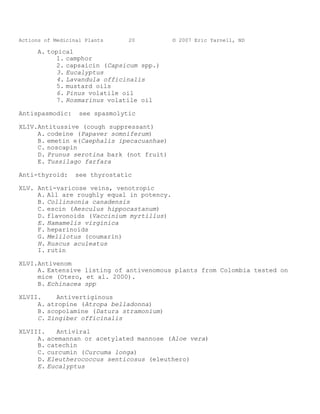
Actions of Medicinal Plants     20          © 2007 Eric Yarnell, ND

      A. topical
            1. camphor
            2. capsaicin (Capsicum spp.)
            3. Eucalyptus
            4. Lavandula officinalis
            5. mustard oils
            6. Pinus volatile oil
            7. Rosmarinus volatile oil

Antispasmodic:     see spasmolytic

XLIV.Antitussive (cough suppressant)
     A. codeine (Papaver somniferum)
     B. emetin e(Caephalis ipecacuanhae)
     C. noscapin
     D. Prunus serotina bark (not fruit)
     E. Tussilago farfara

Anti-thyroid:     see thyrostatic

XLV. Anti-varicose veins, venotropic
     A. All are roughly equal in potency.
     B. Collinsonia canadensis
     C. escin (Aesculus hippocastanum)
     D. flavonoids (Vaccinium myrtillus)
     E. Hamamelis virginica
     F. heparinoids
     G. Melilotus (coumarin)
     H. Ruscus aculeatus
     I. rutin

XLVI.Antivenom
     A. Extensive listing of antivenomous plants from Colombia tested on
     mice (Otero, et al. 2000).
     B. Echinacea spp

XLVII.     Antivertiginous
     A. atropine (Atropa belladonna)
     B. scopolamine (Datura stramonium)
     C. Zingiber officinalis

XLVIII.      Antiviral
     A.   acemannan or acetylated mannose (Aloe vera)
     B.   catechin
     C.   curcumin (Curcuma longa)
     D.   Eleutherococcus senticosus (eleuthero)
     E.   Eucalyptus
Actions of Medicinal Plants   21          © 2007 Eric Yarnell, ND

      F. hypericin, pseudohypericin (Hypericum perforatum)
      G. lapachol (Tabebuia avellanadae)
      H. Lomatium spp
      I. Phyllanthus amarus
      J. polysaccharides (Echinacea angustifolia, E. purpurea)—hyaluronidase
      inhibitor
      K. quercetin
      L. quinine (Cinchona)
      M. Salvia officinalis

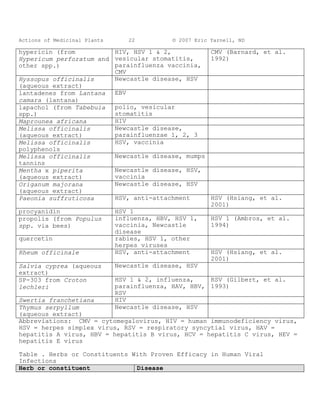
Table . In Vitro Antiviral Botanicals and Constituents
Botanical or Constituent Virus Inhibited          Reference
3-methyl-but-2-enyl      HSV
caffeate (from Populus
nigra & propolis)
5,7,4'-trihydroxy-8-     influenza A and B
methoxyflavone (from
Scutellaria baicalensis)
Allium sativum (garlic)  CMV                      CMV (Guo, et al. 1993)
                         HSV-1 and –2
Astragalus membranaceous Coxsackie type B
castanospermine (from    HIV
Australian tree
Castanospermum australe
and Brazilian trees
Alexa canaracunensis
(tunadi) and
Clathrotropis
macrocarpa)
catechin                 polio, parainfluenza 3,  influenza (Mantani, et
                         RSV, HSV 1, influenza    al. 2001)
Cetraria islandica       HIV
curcumin (from Curcuma   HIV-1
longa)
delta-9-                 HSV 1 & 2                HSV 1 & 2 (Blevins &
tetrahydrocannabinol                              Dumic 1980)
Echinacea purpurea       influenza, vesicular
                         stomatitis
apigenin (a flavonoid)   HSV 1
glycyrrhizic acid (from  vaccinia, HSV 1,
Glycyrrhiza glabra)      vesicular stomatitis,
                         HBV, HCV, HEV, HIV,
                         Newcastle disease
                         SARS virus
                         Marburg virus
Houttuynia cordata       HSV, influenza, HIV      Hayashi, Kamiya &
                                                  Hayashi 1995
Actions of Medicinal Plants   22        © 2007 Eric Yarnell, ND

hypericin (from           HIV, HSV 1 & 2,          CMV (Barnard, et al.
Hypericum perforatum and  vesicular stomatitis,    1992)
other spp.)               parainfluenza vaccinia,
                          CMV
Hyssopus officinalis      Newcastle disease, HSV
(aqueous extract)
lantadenes from Lantana   EBV
camara (lantana)
lapachol (from Tabebuia   polio, vesicular
spp.)                     stomatitis
Maprounea africana        HIV
Melissa officinalis       Newcastle disease,
(aqueous extract)         parainfluenzae 1, 2, 3
Melissa officinalis       HSV, vaccinia
polyphenols
Melissa officinalis       Newcastle disease, mumps
tannins
Mentha x piperita         Newcastle disease, HSV,
(aqueous extract)         vaccinia
Origanum majorana         Newcastle disease, HSV
(aqueous extract)
Paeonia suffruticosa      HSV, anti-attachment     HSV (Hsiang, et al.
                                                   2001)
procyanidin               HSV 1
propolis (from Populus    influenza, HBV, HSV 1,   HSV 1 (Ambros, et al.
spp. via bees)            vaccinia, Newcastle      1994)
                          disease
quercetin                 rabies, HSV 1, other
                          herpes viruses
Rheum officinale          HSV, anti-attachment     HSV (Hsiang, et al.
                                                   2001)
Salvia cyprea (aqueous    Newcastle disease, HSV
extract)
SP-303 from Croton        HSV 1 & 2, influenza,    RSV (Gilbert, et al.
lechleri                  parainfluenza, HAV, HBV, 1993)
                          RSV
Swertia franchetiana      HIV
Thymus serpyllum          Newcastle disease, HSV
(aqueous extract)
Abbreviations: CMV = cytomegalovirus, HIV = human immunodeficiency virus,
HSV = herpes simplex virus, RSV = respiratory syncytial virus, HAV =
hepatitis A virus, HBV = hepatitis B virus, HCV = hepatitis C virus, HEV =
hepatitis E virus

Table . Herbs or Constituents With Proven Efficacy in Human Viral
Infections
Herb or constituent            Disease
Actions of Medicinal Plants   23            © 2007 Eric Yarnell, ND

Melissa officinalis                herpes simplex infection (Wöhlbling &
                                   Leonhardt 1994)
glycyrrhizin (from                 chronic viral hepatitis (Suzuki, et al.
Glycyrrhiza glabra)                1985)
silymarin (from Silybum            viral hepatitis (Berenguer & Carrasco 1977;
marianum)                          Poser 1971)

XLIX.Anxiolytic
     A. apigenin (Matricaria recutita)
     B. Hypericum perforatum
     C. kavalactones (Piper methysticum)

L.    Aphrodisiac
      A. Crocus sativus (saffron)
      B. Mucuna pruriens
      C. Pausinystalia yohimbe
      D. Ptychopetalum olacoides
      E. Turnera aphrodisiaca
      F. Withania somnifera (ashwaganda)

LI.   Apoptosis Modulator
      A. allicin (Allium sativum) (Thatte, Bagadey & Dahanukar 2000)
      B. bryonolic acid (Trichosanthes kirilowii) (Thatte, Bagadey &
      Dahanukar 2000)
      C. crocin (Crocus sativus) (Thatte, Bagadey & Dahanukar 2000)
      D. Semicarpus anacardium (Thatte, Bagadey & Dahanukar 2000)
      E. sho-saikoto formula (Thatte, Bagadey & Dahanukar 2000)
      F. Viscum album (Thatte, Bagadey & Dahanukar 2000)

LII. Aromatase inhibitor
     Aromatase converts androstenedione to estrone that can then be
     converted to estradiol in peripheral tissues.
     A. coumestrol
     B. enterodiol and its precursors lignans, O-
     demethylsecoisolariciresinol (ODSI), demethoxysecoisolariciresinol
     (DMSI) and didemethylsecoisolariciresinol (DDSI)
     C. enterolactone and its precursor lignans 3'-demethoxy-3O-
     demethylmatairesinol (DMDM) and didemethoxymatairesinol (DDMM)
     D. flavonoids (Kellis & Vickery 1984)
     E. kaempferol
     F. luteolin
     G. phytoestrogens (Adlercreutz, et al. 1993)
     H. Urtica dioica root

LIII.Astringent; Tannin-rich plants
     A. All relatively equally effective.
     B. Abies (Spruce)
     C. Agrimonia (Agrimony)
Actions of Medicinal Plants   24          © 2007 Eric Yarnell, ND

      D. Alnus (Alder)
      E. Arbutus (Madrone)
      F. Arctostaphylos (Manzanita, Uva-Ursi)
      G. Betula (Birch)
      H. Ceanothus (Red Root)
      I. Cinnamomum (Cinnamon)
      J. Cola nitida (Cola Nuts)
      K. Ephedra (ma huang, Mormon tea)
      L. Fragaria vesca (wild strawberry)
      M. Fraxinus (Ash)
      N. Geranium (Cranesbill, Alum Root)
      O. Guaiacum (Lignum Vitae)
      P. Hamamelis (Witch Hazel)
      Q. Heuchera (American Alum Root)
      R. Jatropha cineria (Sangre de Drago)
      S. Juglans (Walnut, Butternut)
      T. Krameria (Rhatany)
      U. Ligustrum (Privet)
      V. Myrica (Bayberry), now Morella
      W. Orobanche (Broomrape)
      X. Paullinia (Guaraná)
      Y. Polygonum bistorta (Bistort Root)
      Z. Potentilla
      AA. Prunus (Wild or Choke Cherry)
      BB. Punica (Pomegranate)
      CC. Quercus (Oak
      DD. Rheum (Rhubarb)
      EE. Rhus (Sumach)
      FF. Rosa (Rose)
      GG. Rubus (Blackberry, Raspberry)
      HH. Rumex hymenosepalus (Cañaigre)
      II. Trillium (beth root)
      JJ. Vaccinium (Blue-/Huckle-/Bilberry)
      KK. Xanthium (Cocklebur)

LIV. ATPase (Na+/K+-ATPase) inhibitor
     A. cardiac glycosides (Convallaria, Digitalis, Apocynum, Urginea,
     Stropanthus, Nerium)
     B. digoxin, digitoxin, ouabain (Digitalis purpurea)

LV.   11-beta-hydroxysteroid dehydrogenase inhibitors
      A. 11-beta-HSD normally converts active cortisol to inactive
      cortisone.
      B. glycyrrhizic acid (Glycyrrhiza glabra)

LVI. 5-beta-reductase inhibitor (catabolizes cortisol)
     A. glycyrrhizin (Glycyrrhiza glabra)
Actions of Medicinal Plants    25          © 2007 Eric Yarnell, ND


LVII.Bitters
     A. alkaloids
           1. berberine and cogeners
                 a) Berberis haematocarpa (algerita)
                 b) Berberis vulgaris (barberry)
                 c) Coptis chinensis (Chinese goldthread)
                 d) Hydrastis canadensis (goldenseal)
                 e) Mahonia aquifolium (Oregon grape)
                 f) Mahonia repens (creeping barberry)
                 g) Xanthorhiza simplicissima (goldroot)
           2. quinine (Cinchona spp)
     B. citrus flavanones (Citrus spp (bitter orange)
     C. iridoids or sesquiterpene lactones
           1. Achillea millefolium (yarrow)
           2. Artemisia absinthium (wormwood)
           3. Chionanthus virginicus (fringetree)
           4. Cnicus benedictus (blessed thistle)
           5. Fraxinus americana (white ash)
           6. Gentiana lutea (yellow gentian)
           7. Marrubium vulgare (horehound)
           8. Menyanthes trilobata (bogbean)
           9. Rumex crispus (yellow dock)
           10. Swertia chirata (chiretta)
           11. Swertia radiata (deer's ears)
           12. Taraxacum officinale (dandelion)
           13. Verbena spp (vervain)
     D. quassinoids
           1. Picrasma excelsa (Jamaica quassia)
           2. Quassia amara (Surinam quassia)
     E. aromatic bitters (non-bitter tasting digestive stimulants)
           1. Acorus calamus (calamus)
           2. Alpinia galanga (galangal)
           3. Angelica archangelica (garden angelica)
           4. Capsicum spp (cayenne)
           5. Zingiber officinale (ginger)

LVIII.       Bone marrow stimulant, anti-pancytopenic
     A.   Angelica sinensis
     B.   Astragalus membranaceus
     C.   berbamine (Berberis spp)
     D.   Panax ginseng
     E.   Panax quinquefolius

LIX. Bronchodilator
     A. Potent
           1. Datura stramonium
Actions of Medicinal Plants     26          © 2007 Eric Yarnell, ND

            2. ephedrine (Ephedra sinica)
            3. lobeline (Lobelia inflata)
      B. Mild-to-Moderate
            1. forskolin (Plectranthus forskohlii)
            2. spasmolytics, general

LX.   Broncholytic
      A. atropine (Atropa belladonna)
      B. caffeine (Camellia sinensis)
      C. ephedrine (Ephedra sinica)
      D. khellin (Ammi visnaga)
      E. papaverine (Papaver somniferum)
      F. theophylline (Camellia sinensis)

LXI. Calcium channel blocker, calcium channel antagonist
     A. Angelica sinensis
     B. apigenin (Apium graveolens, Ginkgo biloba)
     C. Foeniculum vulgare
     D. khellin (Ammi visnaga)
     E. tetrandrine and other alkaloids (Stephania tetrandra)

LXII.cAMP-phosphodiesterase inhibitor (cyclic AMP phosphodiesterase
inhibitor)
     A. caffeine
     B. dihydrofuranocoumarins (Angelica sinensis)
     C. flavonoids (Crataegus oxyacantha, Citrus reticulata, Iris
     florentina)--see herb monographs
     D. glycyrrhizin (Glycyrrhiza glabra)
     E. miscellaneous (Nikaido, et al. 1981; Nikaido, et al. 1989; Ohmoto,
     et al. 1988; Nikaido, et al. 1988)
     F. papaverine
     G. quercetin
     H. silymarin (Silybum marianum)
     I. Sophora flavescens (Ohmoto, et al. 1986)
     J. theophylline
     K. Viscum album (European mistletoe), butanol extract, probably due to
     flavonoids, phenol carboxylic acids, phenylpropanes and lignans

LXIII.       Cardiovascular circulation stimulant
     A.   choline
     B.   nicotinic acid
     C.   quinidine
     D.   theobromine
     E.   theophylline

Carminative: see spasmolytic

LXIV.Cholagogue or choleretic
Actions of Medicinal Plants     27        © 2007 Eric Yarnell, ND

      All bitters are also cholagogue and/or choleretic to some degree.

      A.   Berberis spp
      B.   chelidonine (Chelidonium)
      C.   curcumin (Curcuma longa)
      D.   cynarin (Cynara scolymus)
      E.   Mahonia spp
      F.   Mentha spp.
      G.   Petasites
      H.   Peumus boldo
      I.   Taraxacum officinale

LXV. Chronotropic
     A. negative (slows HR)
           1. digoxin (Digitalis purpurea)
           2. reserpine (Rauvolfia serpentina)

LXVI.Circulatory stimulant, cerebral
     A. escin (Aesculus hippocastanum)
     B. Ginkgo biloba
     C. hydrogenated secale alkaloids
     D. Rosmarinus officinalis

LXVII.     Circulatory stimulant, peripheral
     A. Potent
           1. Capsicum frutescens
           2. Rauvolfia serpentina (raubasine, ajmaline)
           3. Zanthoxylum spp
           4. Zingiber officinale
     B. Mild
           1. Crataegus laevigata
           2. Ginkgo biloba
           3. Rosmarinus officinalis

LXVIII.    Contraceptives
     A. Azadirachta indica (neem)
     B. genistein (prunetol, sophoricol, genisteol) (Baptisia tinctoria,
     Cytisus scoparius, Glycine max, Glycyrrhiza glabra, Medicago sativa,
     Pueraria lobata, Trifolium pratense, etc.)
     C. Gossypium (cotton), antisperm
     D. Montanoa tomentosa (zoapatle), antisperm
     E. Tripterygium wilfordii, antisperm
     F. Vicoa indica (banjauri), Asteraceae
           1. female antifertility in monkeys (Rao AJ, Ravindra N, Moudgal
           NR (1997) Ind Acad Sci 71:918)

LXIX.Coronary artery dilator
Actions of Medicinal Plants   28          © 2007 Eric Yarnell, ND

      A. adenosine
      B. Crataegus laevigata
      C. daidzein (Genista tinctoria, Glycine max, Pueraria lobata, Pueraria
      psuedohirsuta, Trifolium pratense, etc.)
      D. visnadine (Ammi visnaga)

LXX. Corrigent, corrigen, flavor enhancer
     A. Foeniculum vulgare (fennel)
     B. Glycyrrhiza glabra (licorice)
     C. miraculin—makes other things taste sweet
     D. Pimpinella anisum (anise)
     E. Pungents
           1. Cinnamomum spp (cinnamon)
           2. Syzygium spp (clove)
           3. Zingiber officinale (ginger)
     F. Sugar-substitutes, botanical sweeteners
           1. abrusosides (Abrus precatorius)
           2. glycyrrhizin (Glycyrrhiza glabra)
           3. periandrin V (Periandra dulcis)
           4. polypodosides (Polypodium glycyrrhiza)
           5. pterocaryosides (Pterocarya paliurus)
           6. steviosides (Stevia rebaudiana)

LXXI.Cyclooxygenase inhibitor
     A. COX-1 and COX-2
           1. allicin (Allium sativum, A. cepa)
           2. Atracylodes lancea
           3. salicylic acid
     B. COX-2 specific
           1. apigenin (Rosmarinus officinalis, Matricaria recutita)
           2. Camellia sinensis
           3. carnosol (Rosmarinus officinalis, Ocimum sanctum)
           4. cerebrosides (Phytolacca americana)
           5. curcumin
           6. essential fatty acids
           7. Glycyrrhiza glabra (Herold, et al. 2003)
           8. humulone (Humulus lupulus)
           9. Inula britannica--see Inula monograph
           10. kaempferol (Liang, et al. 1999)
           11. oleanic acid (Mutoh, et al. 2000)
           12. parthenolides (Tanacetum parthenium)
           13. Plantago lanceolata (Herold, et al. 2003)
           14. Tripterygium wilfordii
           15. tryptanthin (Isatis tinctoria)
           16. ursolic acid (Rosmarinus officinalis, Ocimum sanctum)
           (Ringbom, et al. 1998)
           17. wogonin, other flavonoids (Scutellaria baicalensis)
Actions of Medicinal Plants      29         © 2007 Eric Yarnell, ND

             18.   zerumbone (Zingiber zerumbet)--see Zingiber monograph

LXXII.        Decongestant
     A.    Bidens pilosa (tickseed)
     B.    Ephedra sinica (ma huang)
     C.    Eriodictyon californica (yerba santa)
     D.    Lycium pallidum (wolfberry)

LXXIII.    Demulcent, Emollient, Mucilaginous, Bulk-Forming Laxative
     A. Althaea officinalis (marshmallow)
     B. Alcea rosea (hollyhock)
     C. Borago officinalis (borage) leaf
     D. Cetraria islandica (Iceland moss)
     E. Chondrus crispus (Irish moss)
     F. glycerin
     G. Glycyrrhiza glabra (licorice)
     H. Inula helenium (elecampane)
     I. Linum usitatissimum (flax)
     J. Malva neglecta (cheeseweed)
     K. Plantago lanceolata (lance-leaf plantain), Plantago major
     (broadleaf plantain)
     L. Plantago ovatum (psyllium, ispaghula)
     M. Sphaeralcea spp (globemallow)
     N. Sticta pulmonaria (lung moss)
     O. Symphytum officinale (comfrey)
     P. Tilia spp (linden)
     Q. tragacanth
     R. Tussilago farfara (Eastern coltsfoot)
     S. Ulmus fulva (slippery elm)
     T. Verbascum thapsus (mullein)

LXXIV.    Diaphoretic
     Actions: capillary vasodilating, immune stimulating (increased
     cytokines -> fever), direct effects on hypothalamus?

      A.   Achillea millefolium (yarrow)
      B.   Anthemis nobilis (Roman chamomile)
      C.   Aristolochia serpentaria
      D.   Asclepias tuberosa (pleurisy root)
      E.   Corallorhiza odontorhiza (coral root)
      F.   Encelia farinosa (brittlebush, incienso)
      G.   Ephedra sinica
      H.   Eupatorium perfoliatum (boneset)
      I.   Matricaria recutita (German chamomile)
      J.   Monarda spp
      K.   Pilocarpus jaborandi (jaborandi)
      L.   Sambucus spp (elder) flos
Actions of Medicinal Plants    30          © 2007 Eric Yarnell, ND

      M. Tilia cordata (lime flower, linden)

LXXV.Diuretic, aquaretic
     A. see also angiotensin-converting enzyme inhibitor
     B. Multiple herbs shown to be diuretic in animals in very high doses
     (Ribeiro, et al. 1988; Cáceres, et al. 1987).
     C. Diuretics
           1. cardioactive glycosides (Convallaria majalis, Urginea,
           Apocynum spp)
           2. methylxanthines (caffeine, theobromine, theophylline)
           3. Moringa oleifera in large doses in rats (Cáceres, et al.
           1992).
           4. Stephania tetrandra
     D. Aquaretics
           1. Potent
                 a) Juniperus communis (juniper)
                 b) Levisticum officinale (lovage)
                 c) Solidago canadensis (goldenrod)
           2. Mild
                 a) Agathosma betulina (buchu)
                 b) Equisetum arvense (horsetail)
                 c) Galium aparine (cleavers)
                 d) Hydrangea arborescens (seven barks)
                 e) Orthosiphon stamineus (Java tea)
                 f) Parietaria diffusa (pellitory-of-the-wall)
                 g) Petroselinum crispum (parsley)
                 h) Taraxacum officinale (dandelion) leaf
                 i) Urtica dioica leaf

LXXVI.       Emetic
     A.   Brassica alba (white mustard)
     B.   Cephaelis ipecacuanha
     C.   Lobelia inflata
     D.   Sanguinaria canadensis
     E.   Urginea maritima

LXXVII.      Emmenagogues
     A.   Achillea millefolium (yarrow)
     B.   Caulophyllum thalictroides (blue cohosh)
     C.   Chamaelirium luteum (false unicorn root)
     D.   Hedeoma pulegoides (American pennyroyal)
     E.   Leonurus cardiaca (motherwort)
     F.   Mentha pulegoides (European pennyroyal)
     G.   Mitchella repens (partridge berry)
     H.   Ruta graveolens (rue)

LXXVIII.    Epidermal growth factor receptor inhibitor
Actions of Medicinal Plants   31            © 2007 Eric Yarnell, ND

      A. hypericin (Hypericum perforatum)

LXXIX.    Escharotic
     See also vesicant.

      A. Sanguinaria canadensis (bloodroot)

LXXX.Estradiol 2-hydroxylase induction (turns estradiol --> 2-
hydroxyestradiol)
     A. indole-3-carbinol (broccoli, cabbage)

LXXXI.     Expectorant
     A. Relaxing expectorants
           1. Antispasmodic, indicated for patients with spasmodic, usually
           nonproductive coughs
           2. Angelica archangelica
           3. Grindelia spp
           4. Hyssopus officinalis
           5. Pilosella officinarum
           6. Pimpinella anisum
           7. Prunus serotina
           8. Verbascum thapsus
                 a) Also contains saponins and thus can act like a
                 stimulating expectorant, and contains complex carbohydrates
                 and thus can act like a demulcent. Thus, depending on the
                 form and dose administered, this herb could be used for any
                 type of cough.

      B. Stimulating expectorants: induce coughing, tend to loosen mucus,
      indicated for patients with wet or productive coughs
            1. Alkaloid-containing
                  a)
            2. Cardiac glycosides-containing
                  a) Asclepias tuboersa
            3. Saponin-containing
                  a) Aralia californica
                  b) Bellis perennis

Table. Summary of Botanical Expectorants (in alphabetical order)
Stimulating               Relaxing Expectorants Mixed
Expectorants                                    Expectorants
                   a
Aralia californica        Angelica archangelica Inula helenium
Asclepias tuberosac       Drosera rotundifolia  Marrubium vulgare
                        b
Aspidosperma quebracho    Grindelia spp
Bellis perennisa          Hyssopus officinalis
                      b
Cephaelis ipecacuanha     Pilosella officinarum
Glycyrrhiza glabraa       Pimpinella anisum
Actions of Medicinal Plants       32     © 2007 Eric Yarnell, ND

Hedera helixa            Prunus serotina
                b
Lobelia inflata          Verbascum thapsus
Polygala senegaa
Primula verisa
Sanguinaria canadensisb
Saponaria officinalisa
Stillingia sylvaticab
Trifolium pratensea
Urginea maritimac
Stimulating Expectorant Types: a = saponin-containing, b = alkaloid-
containing, c = cardiac glycoside-containing
Source: Yarnell E. Natural Pulmonology (Healing Mountain Publishing),
forthcoming.

Note some expectorants may have overlapping actions—for example, Lobelia is
also quite antispasmodic and Glycyrrhiza is also demulcent.

LXXXII.    Fibrinolytic
     A. see also thrombolytic below
     B. allicin (Allium sativum, Allium cepa)
           1. cyclooxygenase and lipoxygenase inhibition
     C. bromelain
     D. guggulsterones (Commiphora mukul)--mild
     E. ginsenosides (Panax ginseng)
           1. via stimulation of urokinase
     F. legumes (Gupta & Chatterjee 1982)

Fungicidal:    see anti-fungal

Fungistatic:    see anti-fungal

LXXXIII. Galactagogue
     A. Asparagus racemosa (shatavari)--shatavarin-I
     B. Bryenia patens (kamboji) and Leptadenia reticulata (jeevanti)
     formula (Patel, Parikh & Patel 1982)
     C. Physostigma venenosum
     D. Pilocarpus jaborandi
     E. Pimpinella anisum
     F. Ricinus communis leaf topically
     G. Silybum marianum (milk thistle) folium
     H. Urtica dioica (nettle) folium (Bingel & Farnsworth 1994)
     I. Vitex agnus-castus (chaste tree)

 Pradhan SK; Agrawal OP (1986) “A comparative study of various
galactogogues on the yield and composition of milk in dairy cows” Indian
Journal of Indigenous Medicine (4): 21-4
Actions of Medicinal Plants    33          © 2007 Eric Yarnell, ND

LXXXIV.    Ganglioplegic
     A. coniine
     B. nicotine
     C. lobeline

LXXXV.     Glutathione reductase inhibitor
     A. anthocyanidin
     B. catechin

LXXXVI.      Glutathione S-transferase inhibitor
     A.   butein
     B.   2-hydroxyl chalcone
     C.   morin (Chlorophora tinctoria)
     D.   quercetin
     E.   tannic acid

LXXXVII. Goitrogens (Langer 1983)--see also thyrostatics
     All of these are only clearly known to cause problems in settings of
     iodine deficiency.

      A. cyanogenic glycosides
            1. Brassica spp. (broccoli, cauliflower, kale, Brussels sprouts)
            2. Linum usitatissimum: quantities contained are very small
      B. flavone (Gaitan & Cooksey 1989)
      C. flavonoids
            1. apigenin and luteolin glycosides (Digitaria exilis (Fonio
            millet) and Pennisetum dasystachyum (pearl millet)
                  a) Goitrogenic in large amounts in iodine deficient people
                  (Sartelet, et al. 1996).
            2. Mechanisms: inhibit thyroid peroxidase, inhibit T4  T3
            conversion peripherally, thyroid hormone receptor antagonism
            (Fitzpatrick 2000)
      D. isoflavones (Glycine max (soy) semen) (Fitzpatrick 2000)

LXXXVIII. Guanylate cyclase inhibitor
     A. Momordica charantia

LXXXIX.   Hallucinogen (psychedelic, psychotomimetic, psychointegrator)
     Despite a wide variety of chemical constituents and botanical
     families, the underlying action of all hallucinogens/psychointegrators
     is on serotonergic neurons, producing hallucination (Siegel 1984;
     Hollister 1984; Jacobs 1984; Mandell 1985; Aghajanian 1994).
     Autonomic nervous system effects induce limbic system, which in turn
     increase integration of the front cortex with the limbic system and
     increase interhemispheric coherence (Mandell 1985). Some such as
     Datura stramonium and similar Solanaceae plants, however, act
     primarily through anticholinergic mechanisms.
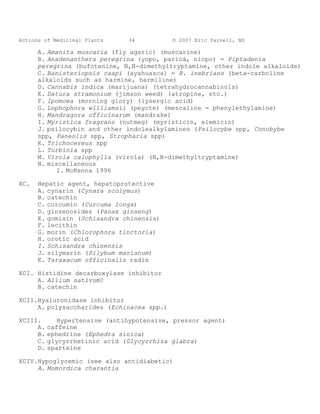
Actions of Medicinal Plants    34          © 2007 Eric Yarnell, ND

      A. Amanita muscaria (fly agaric) (muscarine)
      B. Anadenanthera peregrina (yopo, paricá, niopo) = Piptadenia
      peregrina (bufotenine, N,N-dimethyltryptamine, other indole alkaloids)
      C. Banisteriopsis caapi (ayahuasca) = B. inebrians (beta-carboline
      alkaloids such as harmine, harmiline)
      D. Cannabis indica (marijuana) (tetrahydrocannabinols)
      E. Datura stramonium (jimson weed) (atropine, etc.)
      F. Ipomoea (morning glory) (lysergic acid)
      G. Lophophora williamsii (peyote) (mescaline = phenylethylamine)
      H. Mandragora officinarum (mandrake)
      I. Myristica fragrans (nutmeg) (myristicin, elemicin)
      J. psilocybin and other indolealkylamines (Psilocybe spp, Conobybe
      spp, Paneolis spp, Stropharia spp)
      K. Trichocereus spp
      L. Turbinia spp
      M. Virola calophylla (virola) (N,N-dimethyltryptamine)
      N. miscellaneous
            1. McKenna 1996

XC.   Hepatic agent, hepatoprotective
      A. cynarin (Cynara scolymus)
      B. catechin
      C. curcumin (Curcuma longa)
      D. ginsenosides (Panax ginseng)
      E. gomisin (Schisandra chinensis)
      F. lecithin
      G. morin (Chlorophora tinctoria)
      H. orotic acid
      I. Schisandra chinensis
      J. silymarin (Silybum marianum)
      K. Taraxacum officinalis radix

XCI. Histidine decarboxylase inhibitor
     A. Allium sativum?
     B. catechin

XCII.Hyaluronidase inhibitor
     A. polysaccharides (Echinacea spp.)

XCIII.       Hypertensive (antihypotensive, pressor agent)
     A.   caffeine
     B.   ephedrine (Ephedra sinica)
     C.   glycyrrhetinic acid (Glycyrrhiza glabra)
     D.   sparteine

XCIV.Hypoglycemic (see also antidiabetic)
     A. Momordica charantia
Actions of Medicinal Plants   35          © 2007 Eric Yarnell, ND

      B. trigonelline (Trigonella foenum-graecum)
      C. miscellaneous (Oliver-Bever & Zahnd 1979)

XCV. Hypolipidemic agent, hypocholesterolemic, hypotriglyceridemic
     A. allicin (Allium sativum, A. cepa)
     B. biochanin A (pratensol) (Baptisia tinctoria, Medicago sativa,
     Trifolium pratense, etc.)
     C. forskolin (Plectranthus forskohlii)
     D. germacranolide and guaianolide sesquiterpene lactones (helenalin,
     tenulin, deoxyelephantopin, eupahyssopin) (Hall, et al. 1980)
     E. guggulsterones (Commiphora mukul)
           1. stimulate hepatic uptake of LDL
     F. ginsenosides (Panax ginseng)
     G. morin (Chlorophora tinctoria)
     H. policosanol = octacosanol (Saccharum officinarum)
     I. tannic acid

XCVI.Hypotensive (antihypertensive)
     A. Potent
           1. ajmaline (Rauvolfia serpentina)raubasine (Rauvolfia
           serpentina)
           2. raupine (Rauvolfia serpentina)
           3. rescinnamine (Rauvolfia serpentina)
           4. reserpine (Rauvolfia serpentina)
           5. serpentine (Rauvolfia serpentina)
           6. ester alkaloids (Veratrum spp)
     B. Mild
           1. Allium sativum
           2. Angelica sinensis
           3. Crataegus laevigata
           4. Dendranthemna x morifolium (chrysanthemum)
           5. forskolin (Plectranthus forskohlii)
           6. Ganoderma lucidum
           7. ginsenosides (Panax ginseng)
           8. Hibiscus
           9. Lonicera
           10. Olea europaea
           11. Rhododendron
           12. Salvia miltiorrhiza
           13. Viscum album

XCVII.     Immunomodulator, immune modulator, phytocytokine, adaptogen
(Alonso-Osorio 2001)
     A. Acanthopanax sessiflorum (wu jia pi)
     B. Albizzia lebbeck
     C. Albizzia julibrissin (silk tree)
     D. Andrographis paniculata
Actions of Medicinal Plants   36          © 2007 Eric Yarnell, ND

      E. Angelica sinensis (dong quai)—polysaccharides, coumarins
      F. Aralia elata (Japanese angelica tree)
      G. Aralia manshurica (Manchurian spikenard)
      H. Aralia racemosa (spikenard)
      I. Aralia schmidtii (Sakhalin spikenard)
      J. Astragalus membranaceus (astragalus)
      K. Centella asiatica (gotu kola)
      L. Cicer arientinum (chickpea)
      M. Codonopsis pilosula (dang shen)
      N. Echinopanax elatus (Asian devil’s club)
      O. Eleutherococcus senticosus (eleuthero)
      P. Eucommia ulmoides (hardy rubber tree)
      Q. Ganoderma lucidum (reishi)
      R. Hoppea dichotoma
      S. Lentinula edodes (shiitake)
      T. Leuzea carthamnoides (maral root)
      U. Ocimum tenuifolium (holy basil)
      V. Oplopanax horridum (devil’s club)
      W. Panax ginseng (Asian ginseng)
      X. Panax notoginseng (tienchi ginseng)
      Y. Panax quinquefolius (American ginseng)
      Z. Pfaffia paniculata (suma)
      AA. Rhodiola rosea (roseroot stonecrop)
      BB. Schisandra chinensis (wu wei zhi)
      CC. Tinospora cordifolia (guduchi)
      DD. Trametes versicolor (yun zhi)
      EE. Trichopus zeylanicus (arogyappacha)
      FF. Viscum album (European mistletoe)--lectins
      GG. Withania somnifera (ashwagandha)

XCVIII.     Immunostimulant
     A.  acemannan or acetylated mannose (Aloe barbadensis)
     B.  achyrocline
     C.  Baptisia tinctoria
     D.  catechin
     E.  Echinacea spp
     F.  Eupatorium perfoliatum
     G.  Thuja occidentalis
     H.  vincetoxicum
     I.  dendritic cell stimulators
     J.  macrophage phagocytosis stimulators
            1. BCG vaccine
            2. beta-1,3-glucan (Saccharomyces cerevesiae cell wall
            glycoprotein)
            3. Echinacea spp
            4. Viscum album
      K. NK cells stimulators
Actions of Medicinal Plants    37          © 2007 Eric Yarnell, ND

            1. function: Larix occidentalis (arabinogalactans), Chelidonium
            majus (semisynthetic agent Ukrain by injection), Astragalus
            membranaceus (lignans), AHCC
            2. number and function: Viscum album (Iscador extract,
            rhamnogalacturonan)

XCIX.Inflammation modulator, anti-inflammatory, anti-phlogistic
     A. Categorization by major constituents
           1. Miscellaneous anti-inflammatories
                 a) Aesculus hippocastanumˆ
                 b) Echinacea spp
                 c) Hypericum perforatum
                       (1) 5-Lipoxygenase inhibiting (Herold, et al. 2003).
                 d) Plantago lanceolata
                       (1) COX-2 inhibiting (Herold, et al. 2003).
           2. Enzymes
                 a) bromelain
                 b) papain
           3. Essential fatty acid, omega-6
                 a) Borago officinalis (borage)
                 b) Oenothera biennis (evening primrose)
                 c) Ribes niger (black currant)
           4. Essential fatty acids, omega 3
                 a) Cannabis sativa (hemp)
                 b) Linum usitatissimum (flax)
                 c) Juglans regia (walnut)
                 d) Perilla frutescens (perilla)
                 e) Portulacca oleracea (purslane)
                 f) Typha spp (cattail)
           5. Flavonoid anti-inflammatories
                 a) Crataegus spp (hawthorn)
                 b) Scutellaria baicalensis (Baical skullcap)
           6. Resin anti-inflammatories
                 a) Boswellia serrata (frankincense)
                 b) Capsicum frutescens (cayenne)
                 c) Commiphora molmol (myrrh)
                 d) Curcuma longa (turmeric)
                 e) Guaiacum officinalis (lignum vitae)
                 f) Liquidambar orientalis (storax)
                 g) Myroxylon balsamum (tolu balsam)
                 h) Myroxylon pereirae (peru balsam)
                 i) Populus balsamifera (poplar) gemma
                 j) Styrax benzoin (benzoin)
                 k) Zingiber officinale (ginger)
           7. Salicylate anti-inflammatories
                 a) Betula spp (birch)
                 b) Filipendula ulmaria (meadowsweet)
Actions of Medicinal Plants     38          © 2007 Eric Yarnell, ND

                  c) Gaultheria procumbens (wintergreen)
                  d) Populus spp (poplar, aspen, cottonwood)
                  e) Salix spp (willow)
                  f) Viburnum prunifolium (black haw)
            8. Sulfur anti-inflammatories
                  a) Allium cepa (onion)
                  b) Allium sativum (garlic)
                  c) Armoracia rusticana (horsh radish)
                  d) Brassica nigra (black mustard)
                  e) Sinapis alba (white mustard)
            9. Terpenoid/phenylpropanoid anti-inflammatories
                  a) Achillea millefolium (yarrow)
                  b) Betula spp (birch)
                  c) Cinnamomum camphora (camphor)
                  d) Guaiacum officinale (lignum vitae)
                  e) Juniperus communis (juniper)
                  f) Matricaria recutita (chamomile)
                  g) Melaleuca leucadendron (cajeput)
                  h) Myristica fragrans (nutmeg)
                  i) Rosmarinus officinalis (rosemary)
                  j) Tanacetum parthenium (feverfew)
                  k) Zingiber officinale (ginger)
            10. Triterpenoid/steroidal anti-inflammatories
                  a) Bupleurum falcatum (Chinese thoroughwax)
                  b) Dioscorea villosa (wild yam)
                  c) Glycyrrhiza glabra (licorice)
                        (1) Dual 5-lipoxygenase and COX-2 inhibitor (Herold, et
                        al. 2003).
                  d) Smilax spp (sarsaparilla)
                  e) Trigonella foenum-graecum (fenugreek)
                  f) Yucca spp (yucca)

      B. Dermatological anti-inflammatory agents
            1. Aloe vera (aloe) gel (polysaccharides)
                  a) inhibits thromboxane formation
            2. Arnica montana (arnica) flos
            3. Calendula officinalis (calendula) flos
            4. escin (Aesculus hippocastanum)
            5. Matricaria recutita
            6. mucilage
            7. Plantago spp (plantain)
            8. Salix alba
            9. Symphytum officinale (comfrey) herba or radix
            (polysaccharides)

C.    Inotropic
      A. negative (decreases contractility)
Actions of Medicinal Plants    39          © 2007 Eric Yarnell, ND

            1. Angelica sinensis
      B. positive (increases contractility)
            1. Convallaria majalis
            2. Crataegus laevigata
            3. digitoxin (Digitalis purpurea)
            4. forskolin (Plectranthus forskohlii)
            5. helenalin (Arnica montana)

CI.   Insect Repellant
      A. Citrus hystrix (kaffir lime) volatile oil (Tawatsin, et al. 2001)
      B. Cymbopogon winterianus (citronella grass) volatile oil (Tawatsin,
      et al. 2001)
      C. Curcuma longa (turmeric) volatile oil (Tawatsin, et al. 2001)
      D. Ocimum americanum (hairy basil) volatile oil (Tawatsin, et al.
      2001)
      E. Ocimum selloi (basil pepper) volatile oil
      F. vanillin (Tawatsin, et al. 2001)

CII. Insecticidal: see also anti-parasitic
     A. Annonaceous acetogenins
     B. Azadiracta indica (neem) (azadiractans)
     C. lemon peel oil (Mwaiko & Savaeli 1994)

CIII.Interleukin synthesis or secretion
     A. inhibitor
           1. Urtica dioica (of Il-1)
     B. stimulator
           1. Echinacea spp. (of Il-1), in vitro only
           2. epigallocatechin gallate (Camellia sinensis) (of Il-1)

CIV. Intestinal Permeability Increasers
     A. bromelain
     B. lectins
     C. piperine
     D. saponins

CV.   Intoxicant
      A. fermented palm sap: humans, palm civets, bats, monkeys and
      elephants become intoxicated when they drink it
      B. fermented wheat, rye, corn and many other plants yield ethanol
      C. Madhuca indica (mohwa tree)--fermented flowers are made into daroo
      wine in India; sloth bears also get intoxicated from eating the
      flowers

CVI. Iodothyronine deiodinase inhibitor
     converts T4  T3
     A. apigenin
     B. luteolin
Actions of Medicinal Plants       40         © 2007 Eric Yarnell, ND

      C. quercetin
      D. rosmarinic acid, ellagic acid, luteolin-7beta-glucoside (Melissa
      officinalis, Lithospermum officinale, Lycopus virginicus)

Lactagogue:    see Galactagogue

CVII.Laxatives, cathartic

      All cholagogues are also mildly cathartic.

      A. Anthraquinone glycosides (Rheum palmatum, Frangula purshiana,
      Rhamnus frangula, Senna alexandrina, Aloe vera latex, Juglans cinerea,
      Rumex crispus, etc.)
      B. Fatty acids (Ricinus communis oleum)
      C. Resins (Convolvulaceae, Podophyllum, Colocynthis citrullus)

CVIII.       Laxatives, osmotic
     A.   Ficus
     B.   fruit acids (eg fructose)
     C.   Manna
     D.   Tamarindus

CIX. Laxative, polysaccharide (bulk-forming)—see Demulcent

CX.   5-Lipoxygenase inhibitor
      A. allicin (Allium sativum, A. cepa)
      B. Atractylodes lancea
      C. curcumin (Curcuma longa)
      D. Glycyrrhiza glabra
      E. NDGA (Larrea tridentata)
      F. Tanacetum parthenium
      G. Zingiber officinale

CXI. Lymphatic, lymphagogue
     A. Upper body:
           1. Calendula officinalis
           2. Galium spp
           3. Phytolacca americana —most generic for entire body though
           4. Viola tricolor
     B. Abdomen, spleen:
           1. Ceanothus greggii
           2. Polymnia uvedalia (bear’s foot)
     C. Pelvis:
           1. Fouquieria splendens

CXII.Miotic (constricts pupil)
     A. physostigmine (Physostigma venenosum)
Actions of Medicinal Plants   41          © 2007 Eric Yarnell, ND

      B. pilocarpine (Pilocarpus jaborandi)

CXIII.     Monoamine oxidase (MAO) inhibitor
     A. Hypericum perforatum
           1. weak MAO A inhibitor in vitro only
     B. isoliquiritinigenin, glycyrrhizin (Glycyrrhiza glabra)
     C. nicotine
           1. inhibits MAO B, which catabolizes dopamine

Mucilaginous Herbs—see demulcent

CXIV.Muscle relaxant, central
     A. kavain (Piper methysticum)

CXV. Muscle relaxant, peripheral
     A. C-toxiferine
     B. tubocurarine (Curare)

CXVI.Mydriatic (dilates pupil)
     A. atropine (Atropa belladonna, Datura stramonium, Hyoscyamus niger)

CXVII.     NADH:ubiquinone oxidoreductase inhibitor
     A. Annonaceous actogenins (uvaricin, etc. isolated from the genera
     Annona, Asimina, Goniothalamus, Rollinia, Uvaria and Xylopia)

CXVIII.    Nervine, neurotonic
     A. Potent
           1. Pulsatilla spp
     B. Moderate
           1. Myristica fragrans
           2. Piper methysticum
           3. Valeriana officinalis
           4. Valeriana sitchensis
           5. Zizyphus spinosa
     C. Mild
           1. Avena sativa
           2. Cypripedium spp *
           3. Humulus lupulus
           4. Leonurus cardiaca
           5. Matricaria recutita
           6. Nepeta cataria
           7. Passiflora incarnata
           8. Scutellaria lateriflora
           9. Stachys betonica
           10. Verbacum thapsus flos
           11. Verbena spp

CXIX.NFkappaB inhibitors, inflammation modulating
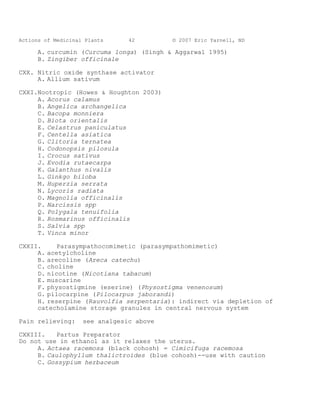
Actions of Medicinal Plants     42        © 2007 Eric Yarnell, ND

      A. curcumin (Curcuma longa) (Singh & Aggarwal 1995)
      B. Zingiber officinale

CXX. Nitric oxide synthase activator
     A. Allium sativum

CXXI.Nootropic (Howes & Houghton 2003)
     A. Acorus calamus
     B. Angelica archangelica
     C. Bacopa monniera
     D. Biota orientalis
     E. Celastrus paniculatus
     F. Centella asiatica
     G. Clitoria ternatea
     H. Codonopsis pilosula
     I. Crocus sativus
     J. Evodia rutaecarpa
     K. Galanthus nivalis
     L. Ginkgo biloba
     M. Huperzia serrata
     N. Lycoris radiata
     O. Magnolia officinalis
     P. Narcissis spp
     Q. Polygala tenuifolia
     R. Rosmarinus officinalis
     S. Salvia spp
     T. Vinca minor

CXXII.     Parasympathocomimetic (parasympathomimetic)
     A. acetylcholine
     B. arecoline (Areca catechu)
     C. choline
     D. nicotine (Nicotiana tabacum)
     E. muscarine
     F. physostigmine (eserine) (Physostigma venenosum)
     G. pilocarpine (Pilocarpus jaborandi)
     H. reserpine (Rauvolfia serpentaria): indirect via depletion of
     catecholamine storage granules in central nervous system

Pain relieving:     see analgesic above

CXXIII.    Partus Preparator
Do not use in ethanol as it relaxes the uterus.
     A. Actaea racemosa (black cohosh) = Cimicifuga racemosa
     B. Caulophyllum thalictroides (blue cohosh)--use with caution
     C. Gossypium herbaceum
Actions of Medicinal Plants     43          © 2007 Eric Yarnell, ND

CXXIV.     P-glycoprotein (Pgp, P-gp) inhibitor, multidrug resistance
inhibitor in cancer cells
     A. Atractylodes lancea
     B. epigallocatechin gallate (ECCG), theanine (Camellia sinensis)
     C. Feijoa sellowiana
     D. Ficus citrifolia
     E. flavonoids especially quercetin
     F. indole-3-carbinol (via its metabolite diindolylmethane)
     G. methoxyhydrnocarpin, a flavonoid in Berberis spp
     H. reserpine
     I. Rosmarinus officinalis
     J. Stephania tetrandra alkaloids

CXXV.Phenolsulfotransferase inhibitor
     A. Hepatic sulfating enzyme.
     B. apigenin
     C. chrysin
     D. curcumin (Curcuma longa)
     E. ellagic acid
     F. fisetin
     G. galangin
     H. genistein
     I. kaempferol
     J. myricetin
     K. quercetin

Phosphodiesterase (cAMP) inhibitor:     see cAMP-phosphdiesterase inhibitor

CXXVI.       Phospholipase (PLP) A2 inhibitor
     A.   Boswellia serrata
     B.   curcumin (Curcuma longa)
     C.   Tanacetum parthenium
     D.   Zingiber officinale

CXXVII.     Phospholipase C inhibitor

CXXVIII.    Phytoestrogenic agent, phytoestrogen

Summary of known phytoestrogenic constituents:
Isoflavones
Coumestans
Lignans (some)
Phenylpropanoids (some)
Anthraquinones (some)

      A. biochanin A (pratensol) (Baptisia tinctoria, Medicago sativa,
      Trifolium pratense, etc.)
      B. coumestrol (Brassica oleracea var. gemmifera, Glycine max, Medicago
Actions of Medicinal Plants   44          © 2007 Eric Yarnell, ND

      sativa, Pisum sativum, Phaseolus lunatus, P. vulgaris, Taraxacum
      officinale, Trifolium pratense, etc.)
      C. daidzein (Genista tinctoria, Glycine max, Pueraria lobata, Pueraria
      psuedohirsuta, Trifolium pratense, etc.)
      D. genistein (prunetol, sophoricol, genisteol) (Baptisia tinctoria,
      Cytisus scoparius, Glycine max, Glycyrrhiza glabra, Medicago sativa,
      Pueraria lobata, Trifolium pratense, etc.)
      E. Foeniculum vulgare (fennel)--anethole
      F. Glycine max (soy)--isoflavones
      G. Glycyrrhiza glabra (licorice)
      H. Humulus lupulus (hops)
      I. Linum usitatissimum (flax)--lignans
      J. Medicago sativum (alfalfa)--isoflavones
      K. Panax ginseng (Asian ginseng)
      L. Pimpinella anisum (anise)—anethole
      M. Serenoa repens
      N. Trifolium pratense (red clover)--isoflavones

Zhang CZ, Wang SX, Zhang Y, Chen JP, Liang XM. “In vitro estrogenic
activities of Chinese medicinal plants traditionally used for the
management of menopausal symptoms.” J Ethnopharmacol 2005;98(3):295-300.
The estrogenic activity of 70% EtOH extracts of 32 traditional Chinese
medicinal plants, selected according to their reported efficacy for the
treatment of menopausal symptoms, was assessed using a recombinant yeast
system with both a human estrogen receptor expression plasmid and a
reporter plasmid. Among them, 11 (34%) species proved to be active.
Polygonum cuspidatum had the highest estrogenic relative potency (RP) (3.28
x 10(-3)), followed by Rheumpalmatum (3.85 x 10(-4)), Cassia obtusifolia
(3.49 x 10(-4)), Polygonum multiflorum (2.87 x 10(-4)), Epimedium
brevicornum (2.30 x 10(-4)), Psoralea corylifolia (1.90 x 10(-4)),
Cynomorium songaricum (1.78 x 10(-4)), Belamcanda chinensis (1.26 x 10(-
4)), Scutellaria baicalensis (8.77 x 10(-5)), Astragalus membranaceus (8.47
x 10(-5)) and Pueraria lobata (6.17 x 10(-5)). The EC(50) value of 17beta-
estradiol used as the positive control was 0.205+/-0.025 ng/ml (RP=100).
This study gave support to the reported efficacy of Chinese medicines used
for hormone replacement therapy.

CXXIX.     Platelet-Activating Factor (PAF) antagonist and inhibitor
     A. androsin (Picrorhiza kurroa) (Dorsch & Wagner 1991)
     B. Arctium lappa (burdock) (Iwakami, et al. 1992)
     C. coumarins (Puecedanum praeruptorum) (Takeuchi, et al. 1988)
     D. curcumin (Curcuma longa)
     E. eugenol
     F. Forsythia suspensa
     G. forskolin (Coleus forskohlii)
     H. ginkgolides (Ginkgo biloba) (Nunez, et al. 1986; Braquet, et al.
     1985)
Actions of Medicinal Plants   45          © 2007 Eric Yarnell, ND

      I. ginsenosides (Panax ginseng)
      J. glycyrrhizin (Glycyrrhiza glabra)
      K. kadsurenone, a lignan (Piper futokadsura) (Shen, et al. 1985)
      L. lignans (Schisandra chinensis) (Lee, et al. 1999)
      M. pinusolide (Biota orientalis)
      N. tetragalloyl quinic acid (Galphimia glauca) (Dorsch & Wagner 1991)
      O. Tussilago farfara
            1. sesquiterpene L-652,469 (Hwang, et al. 1987)
      P. (+)-yangambin (Ocotea duckei) (receptor antagonist)

CXXX.Platelet aggregation inhibitor
     A. allicin (Allium sativum, A. cepa)
     B. bromelain
     C. capsaicin (Capsicum spp)
     D. Galega officinalis
     E. ginkgolides (Ginkgo biloba)
     F. ginsenosides (Panax ginseng)
     G. alpha-linolenic acid (Linum usitatissimum)
     H. quercetin
     I. ruscogenin (Ruscus aculeatus)
     J. Zingiber officinale (ginger) (negative clinical study exists)

CXXXI.     Prolactin modulators, anti-prolactin, prolactinogogue, prolactin
stimulator
     A. Prolactin amphoterics
           1. Vitex agnus-castus
     B. Prolactin inhibitors
     C. Prolactin stimulators: see also lactagogues
           1. Rauvolfia serpentina
           2. resveratrol
           3. Trigonella foenum-graecum

CXXXII.     Prostatic agent
     A.  Cucurbita pepo (fatty acids)
     B.  Hypoxis rooperi (African star grass)
     C.  Prunus africanum (pygeum)
     D.  Serenoa repens (fatty acids and sterols)
            1. inhibit 5-alpha-reductase
            2. inhibit movement of dihydrotestosterone-bound cytosolic
            receptor into nucleus
            3. spasmolytic (alpha adrenergic antagonist)
            4. phytoestrogen
      E. Urtica dioica root (blocks SHBG receptor)
      F. Beta-Sitosterol

CXXXIII. Protease inhibitor
     A. triterpene acids (Geum japonicum) (Xu HX, et al. J Nat Prod
Actions of Medicinal Plants    46           © 2007 Eric Yarnell, ND

      1996;(7))

CXXXIV.    Protein Kinase C inhibitor
     A. hypericin (Hypericum perforatum)
     B. quercetin (Ferriola, Cody & Middleton 1989)

CXXXV.     Protein-Tyrosine kinase inhibitor (see also Tyrosine kinase
inhibitor)
     A. emodin (Rheum palmatum)
     B. hydroxystilbene, O-glycosides (Rheum officinale)

CXXXVI.    Redifferentiator, Cancer Normalizer
     A. berberine
     B. vitamin A

CXXXVII. Rhinologic
     A. ephedrine
     B. galphimia (Luffa)
     C. pseudoephedrine
     D. Urtica dioica

CXXXVIII. Rubefacient
     A. Brassica nigra (black mustard)
     B. Capsicum spp (cayenne)
     C. Juniperus spp (juniper)
     D. Rosmarinus officinalis (rosemary)
     E. turpentine

CXXXIX.      Sedative, Tranquilizer, Hypnotic, see also nervine
     A.   Avena sativa
     B.   Chamaesyce hirta
     C.   Eschscholzia californica
     D.   Gelsemium sempervirens
     E.   Humulus lupulus
     F.   isoeugenol (Syzygium aromaticum)
     G.   kavain (Piper methysticum)
     H.   Matricaria recutita
     I.   Melissa officinalis
     J.   Passiflora incarnata
     K.   Pulsatilla spp
     L.   Rosa spp. oil
     M.   reserpine, other alkaloids (Rauvolfia serpentina)
     N.   Scutellaria spp.
     O.   Valeriana spp
     P.   Zizyphus spinosa

CXL. Secretolytic (respiratory)
     A. Potent
Actions of Medicinal Plants    47         © 2007 Eric Yarnell, ND

            1. Atropa belladonna
            2. Datura stramonium
            3. Ephedra sinica
      B. Mild-to-Moderate
            1. Glycyrrhiza glabra
            2. Grindelia spp
            3. Hedera helix
            4. Primula spp.
            5. Polygala senega

CXLI.Sialagogue
     A. Brassica alba (white mustard)
     B. Capsicum spp
     C. Echinacea angustifolia
     D. Physostigma venenosum
     E. Pilocarpus jaborandi
     F. Piper cubeba
     G. Piper nigrum
     H. Sanguinaria canadensis
     I. Zingiber officinale

CXLII.     Spasmolytic
     A. Potent
           1. anticholinergics
                 a) atropine (Atropa belladonna)
                 b) Datura stramonium
                 c) Hyoscyamus niger
                 d) Mandragora officarinum
                 e) Soldanum dulcamara
           2. papaverine
     B. Moderate
           1. anticholinergics
                 a) Garrya flavescens (silk tassel)
                 b) Garrya wrightii (Wright’s silk tassel)
           2. Paeonia lactiflora
           3. Viburnum opulus
           4. Viburnum prunifolium
     C. Mild
           1. Angelica sinensis
           2. carminatives
                 a) Acorus calamus
                 b) Carum carvi
                 c) Cinnamomum zeylanicum
                 d) Coriandrum sativum
                 e) Foeniculum vulgare
                 f) Melissa officinalis
                 g) Mentha x piperita
Actions of Medicinal Plants    48          © 2007 Eric Yarnell, ND

                  h) Mentha spicata
                  i) Pimpinella anisum
                  j) Piper nigrum
                  k) Syzygium aromaticum
                  l) Zingiber officinale
            3. daidzein (Genista tinctoria, Glycine max, Pueraria lobata,
            Pueraria psuedohirsuta, Trifolium pratense, etc.)
            4. Dioscorea villosa (wild yam)
            5. Piper methysticum
            6. Pueraria lobata

CXLIII.      Styptic, anti-hemorrhagic
     A.   See also astringents.
     B.   Capsella bursa-pastoris
     C.   Panax notoginseng (tienchi ginseng)
     D.   Trillium spp (bethroot)

CXLIV.     Sympatholytic, adrenergic antagonist, beta blocker, alpha blocker
     A. alkaloids such as ergotoxin, ergotamine (Secale)
     B. ergometrin
     C. liposterolic compounds (Serenoa repens): alpha-1 adrenergic
     antagonists
     D. reserpine (Rauvolfia serpentina): depletes norepinephrine from
     storage granules in neurons in CNS thus general central sympatholytic
     (parasympathomimetic)
     E. rose and patchouli volatile oils (Haze, et al. 2002)
     F. yohimbine (Pausinystalia yohimbe): presynaptic alpha-2 adrenergic
     antagonist

CXLV.Sympathomimetic, adrenergic agonist
     A. ephedrine, pseudoephedrine (Ephedra sinica): alpha-1 and both
     beta adrenergic agonists
     B. pepper, estragon, fennel, grapefruit volatile oils (Haze, et al.
     2002)
     C. tyramine

CXLVI.       Thrombolytic, thrombosis inhibitor
     A.   see also fibrinolytic above
     B.   Allium cepa
     C.   Allium sativum
     D.   Ginkgo biloba

CXLVII.      Thyrostatic--see goitrogens also
     A.   Fucus vesiculosus
     B.   Lithospermum ruderale, L. officinale
     C.   Lycopus virginicus, L. europaeus
     D.   Melissa officinalis
     E.   Thymus serpyllum
Actions of Medicinal Plants   49          © 2007 Eric Yarnell, ND


CXLVIII. Thyrostimulant, thyrotropic, thyrotrophic
     A. Fucus vesiculosis (bladderwrack)
     B. guggulsterones (Commiphora mukul)

CXLIX.     Tonic
     A. Definition: herbs that strengthen and improve function in an organ,
     tissue, or the entire body. They are gentle, non-toxic, and generally
     require higher doses taken long-term for optimal effects. They have
     broad effects generally that are sustained even when the herb is
     stopped. They do not suppress. They also support normal function in
     healthy people and can be taken preventively. Bidirectional or
     modulating effects are not inherent in their definition. Often contain
     nutrients and can be nourishing, but only if taken in food doses.
           1. “Replete deficiency in function or integrity.”

CL.   Topoisomerase-I inhibitor (uncoils DNA before cell division)
      A. acacetin
      B. apigenin
      C. camptothecins
            1. topotecan (Hycamtin) is an FDA-approved drug for advanced
            ovarian cancer
      D. catechins
      E. epipodophyllotoxins (etoposide)
      F. genistein (Glycine max)
      G. kaempferol
      H. morin (Chlorophora tinctoria)
      I. podophyllin resin
      J. quercetin

CLI. Topoisomerase-II inhibitor
     A. genistein (Glycine max, Pueraria lobata, etc.)

CLII.Tumor necrosis factor (TNF) secretion or synthesis
     A. inhibitor
           1. Arnica spp
           2. berbamine (Berberis spp)
           3. Camellia sinensis
           4. curcumin (Curcuma longa) (indirect via PLPA2 inhibition)
           5. DHEA
           6. Echinacea spp
           7. gentiopicroside (Gentiana lutea) (Kondo, Takano & Hojo 1994)
           8. ginsenosides (Panax ginseng)--see herb monograph
           9. Hypericum perforatum
           10. melatonin
           11. Panax ginseng
           12. Perilla frutescens (perilla) folium
           13. Phytolacca americana
Actions of Medicinal Plants      50          © 2007 Eric Yarnell, ND

             14.   quercetin
             15.   Silybum marianum
             16.   Tanacetum parthenium (indirect via PLPA2 inhibition)
             17.   tetrandrine (Stephania tetrandra)
             18.   Tripterygium wilfordii
             19.   Urtica dioica (inhibits secretion of TNF-alpha)
             20.   Zingiber officinale

      B. stimulator
            1. Echinacea spp. polysaccharides--stimulate secretion in vitro
            2. sho-saiko-to formula stimulates synthesis of TNF-alpha

CLIII.     Tyrosine kinase inhibitor
     A. genistein (Glycine max, Pueraria lobata, etc.)
     B. quercetin (Levy, et al. 1984)

CLIV.Uterine Tonic
     A. Aletris farinosa
     B. Angelica sinensis
     C. Caulophyllum thalictroides
     D. Chamaelirium luteum
     E. Rubus idaeus

CLV. Vasodilator (see coronary artery dilator as well)
     A. apigenin (Apium graveolens, Ginkgo biloba)
     B. Ginkgo biloba
     C. khellin (Ammi visnaga)
     D. Rosmarinus officinalis

CLVI.Vesicant, suppurant, pustulant
     See also escharotic.

      A.   cantharis
      B.   croton oil
      C.   Podophyllum peltatum—podophyllin, podophyllotoxin
      D.   Ranunculus spp—fresh plant topically

CLVII.     Wound Healing, Vulnerary
     A. asiatic acid, madecassic acid, asiaticoside and madecassoside
     (Centella asiatica)
     B. Aristolochia
     C. Arnica montana
     D. Azadirachta indica
     E. Calendula officinalis
     F. Digitalis spp (topically)
     G. Lophophora williamsii
     H. Matricaria recutita
Actions of Medicinal Plants   51          © 2007 Eric Yarnell, ND

      I. polysaccharides (Echinacea angustifolia, E. purpurea)
      J. polysaccharides (Aloe vera)
            1. including stimulation of fibroblast activity
      K. Symphytum officinale (comfrey) radix or herba (allantoin)

CLVIII.    Xanthine oxidase inhibitor
     A. morin (Chlorophora tinctoria)
           1. moderately effective

CLIX.References

Abbasoglu U, Sener B, Gunay Y, Temizer H (1991) "Antimicrobial activity of
some isoquinoline alkaloids" Arch Pharm 324:379-80

Adlercretuz H, Bannwart C, Wahala K, et al. (1993) "Inhibition of human
aromatase by mammalian lignins and isoflavonoid phytoestrogens" J Steroid
Biochem Mol Biol 44:147-53

Aghajanian G (1994) "Serotonin and the action of LSD in the brain"
Psychiatric Annals 2463(?? 26 #63?):137-41

Alonso-Osorio MJ (2001) “Phytotherapy and immunomodulators” Circular
Farmaceutica 59:40-44

Alsat E (1987) "Lomatium dissectum" Comp Med May/June:32-4

Ambros M, Lurton E, Boustie J and Girre L (1994) "Comparison of the anti-
herpes simplex virus activities of propolis and 3-methyl-but-2-enyl
caffeate" J Nat Prod 57(5):644-7

Anderson D, et al. (1991) "In vitro virucidal activity of selected
anthraquinones and anthraquinone derivatives" Antiviral Res 16:185-96

Anderton JG, Mantle D, Thomas TH (1996) "Antioxidant herbal preparations" J
R Soc Med 89(9):540 [letter]

Atta AH, El-Sooud KA (2004) “The antinociceptive effect of some Egyptian
medicinal plant extracts” J Ethnopharmacol 95(2-3):235-8.
    see abstract at end of monograph

Barnard D, et al. (1992) "Evaluation of the antiviral activity of
anthraquinones, anthrones and anthraquinone derivatives against human
cytomegalovirus" Antiviral Res 1992;17:63-77

Beládi I, Pusztan R, et al. (1977) "Activity of some flavonoids against
viruses" Ann NY Acad Sci 284:358-64

Belidi I, et al. (1981) "In vitro and in vivo antiviral effects of
Actions of Medicinal Plants   52        © 2007 Eric Yarnell, ND

flavonoids" In Farkas, et al. (eds) Flavonoids and Bioflavonoids:    Proceeds
of the International Bioflavonoid Symposium (Munich: Elsevier)

* Bergner P (2002-2003) “Herbs and insulin resistance” Medical Herbalism
13(2):1,3-

Berenguer J, Carrasco D (1977) "Double-blind trial of silymarin versus
placebo in the treatment of chronic hepatitis" Munch Med Wochenschr
119:240-60

* Bingel AS, Farnsworth NR (1994) "Higher plants as potential sources of
galactagogues" Econ Med Plant Res 6:1-54 [review]

Blevins R, Dumic M (1980) "The effect of delta-9-tetrahydrocannabinol on
herpes simplex virus replication" J Gen Virol 49:427-31

Braquet PG, Spinnewyn B, Braquet M, et al. (1985) Blood & Vessel 16:558

Cáceres A, Girón LM, Martínez AM (1987) "Diuretic activity of plants used
for the treatment of urinary ailments in Guatemala" J Ethnopharmacol
19:233-45

Cáceres A, Saravia A, Rizzo S, et al. (1992) "Pharmacologic properties of
Moringa oleifera. 2: Screening for antispasmodic, antiinflammatory and
diuretic activity" J Ethnopharmacol 36:233-7

Cellini L, Di Campli E, Masulli M, et al. (1996) Inhibition of Helicobacter
pylori by garlic extract (Allium sativum)" FEMS Immunol Med Microbiol
13(4):273-7

Chaudhry PS, Cabrera J, Juliani HR, Varma SD (1983) "Inhibition of human
lens aldose reductase by flavonoids, sulindac and indomethacin" Biochem
Pharmacol 32:1995-8

Chen I, McDougal A, Wang F, Safe S (1998) "Aryl hydrocarbon receptor-
mediated antiestrogenic and antitumorigenic activity of diindolylmethane"
Carcinogenesis 19:1631-9

Chiang J, et al. "Three inhibitors of type I human immunodeficiency virus
long terminal repeat-directed gene expression and virus replication" Proc
Natl Acad Sci 1991;90:1839-42

Choi SU, Ryu SY, Yoon SK, et al. (1999) “Effects of flavonoids on the
growth and cell cycle of cancer cells” Anticancer Res 19(6B):5229-33
     see abstract at end of monograph

Chu CY, Tsai YY, Wang CJ, et al. (2001) "Induction of apoptosis by
esculetin in human leukemia cells" Eur J Pharmacol 416:25-32
Actions of Medicinal Plants   53        © 2007 Eric Yarnell, ND


Cooke DW Lallinger GJ Durack DT. In vitro sensitivity of Naegleria
fowleri to qinghaosu and dihydroqinghaosu. J Parasitol (1987 Apr)
73(2):411-3

Davis LE, Shen JK, Cai Y (1990) "Antifungal activity in human cerebrospinal
fluid and plasma after intravenous administration of Allium sativum"
Antimicrob Agents Chemother 34:651-3

* de Carvalho PB, Ferreria EI (2001) "Leishmaniasis phytotherapy. Nature's
leadership against an ancient disease" Fitoterapia 72:599-618 [review]

* Devi BA, Kamalakkannan N, Prince PSM (2003) “Supplementation of fenugreek
leaves to diabetic rats. Effect on carbohydrate metabolic enzymes in
diabetic liver and kidney” Phytother Res 17:1231-3

Dorsch W, Wagner H (1991) "New antiasthmatic drugs from traditional
medicine?" Int Arch Allergy Appl Immunol 94:262-5 [review]

* Elgorashi EE, Stafford GI, van Staden J (2004) “Acetylcholinesterase
enzyme inhibitory effects of Amaryllidaceae alkaloids” Planta Med 70:260-2

Fabry W, Okemo P, Ansorg R (1996) "Activity of east African medicinal
plants against Helicobacter pylori" Chemotherapy 42(5):315-7

Fabry W, Okemo P, Mwatha WE, et al. (1996) "Susceptibility of Helicobacter
pylori and Candida spp. to the east African plant Terminalia spinosa"
Arzneim Forsch 46(5):539-40

* Farzami B, Ahmadvand D, Vardasbi S, et al. (2003) “Induction of insulin
secretion by a component of Urtica dioica leave [sic] extract in perifused
[sic] islets of Langerhans and its in vivo effects in normal and
streptozotocin diabetic rats” J Ethnopharmacol 89:47-53

Ferriola PC, Cody V and Middleton E Jr (1989) "Protein kinase C inhibition
by plant flavonoids. Kinetic mechanisms and structure-activity
relationships" Biochem Pharmacol 38:1617-24

Fitzpatrick M (2000) "Soy formulas and the effects of isoflavones on the
thyroid" N Z Med J 113:24-26 [review]

Fotsis T, Pepper MS, Montesano R, et al. (1998) "Phytoestrogens and
inhibition of angiogenesis" Baillieres Clin Endocrin Metab 12:649-66

Gaitan EO, Cooksey RC (1989) "General concepts of environmental
goitrogenesis" In: Gaitan E (ed) Environmental Goitrogenesis (Boca Raton,
FL: CRC Press):3-11
Actions of Medicinal Plants   54          © 2007 Eric Yarnell, ND

Ge X, Yannai S, Rennert G, et al. (1996) "3,3'-diindolylmethane induces
apoptosis in human cancer cells" Biochem Biophys Res Comm 228:153-8

Gilbert BE, Wyde PR, Wilson SZ, Meyerson LR (1993) "SP-303 small-particle
aerosol treatment of influenza A virus infection in mice and respiratory
syncytial virus infection in cotton rats" Antiviral Res 21(1):37-45

Guo NL, Lu DP, Woods GL, et al. (1993) "Demonstration of the anti-viral
activity of garlic extract against human cytomegalovirus in vitro" Chin Med
J 106:93-6

Gupta RK, Chatterjee PC (1982) "The fibrinolytic effect of leguminosae plant
seed extracts on human fibrinogen" Ind J Pathol Microbiol 25:237

Hall IH, Lee KH, Starnes OC, et al. (1980) "Antihyperlipidaemic activity of
sesquiterpene lactones and related compounds" J Pharm Sci 69:694

Halliwell B, Aeschbach R, Loliger, Aruoma OI (1995) "The characterization
of antioxidants" Food Chem Toxicol 33:601-17

* Haraguchi H, Ohmi I, Sakai S, Fukuda A (1996) "Effect of Polygonum
hydropiper sulfated flavonoids on lens aldose reductase and related
enzymes" J Nat Prod 59:443-5

Hayashi K, Kamiya M and Hayashi T (1995) "Virucidal effects of the steam
distillate from Houttuynia cordata and its components on HSV-1, influenza
virus and HIV" Planta Med 61:237-41

Haze S, Sakai K, Gozu Y (2002) “Effects of fragrance inhalation on
sympathetic activity in normal adults” Jpn J Pharmacol 90(3):247-53.

Herold A, Cremer L, Calugaru A, Tamas V, Ionescu F, Manea S, Szegli G
(2003) “Hydroalcoholic plant extracts with anti-inflammatory activity” Roum
Arch Microbiol Immunol 62(1-2):117-29.
     see abstract at end of monograph

Herrmann E and Kucera L (1967) "Antiviral Substances in Plants of the Mint
Family (Labiatae) II. Nontannin Polyphenol of Melissa officinalis" Proc
Soc Exp Biol Med 124:869-74

Herrmann E and Kucera L (1967) "Antiviral Substances in Plants of the Mint
Family (Labiatae) III. Peppermint (Mentha piperita) and other Mint Plants"
Proc Soc Exp Biol Med 124:874-8

Hollister L (1984) "effects of hallucinogens in humans" In: Jacobs B (ed)
Hallucinogens: Neurochemical, Behavioral and Clinical Perspectives (New
York: Raven Press):203-26
Actions of Medicinal Plants   55        © 2007 Eric Yarnell, ND

* Howes MJR, Houghton PJ (2003) “Plants used in Chinese and Indian
traditional medicine for improvement of memory and cognitive function”
Pharmacol Biochem Behav 75:513-27

Hsiang CY, Hsieh CL, Wu SL, Lai IL, Ho TY (2001) “Inhibitory effect of
anti-pyretic and anti-inflammatory herbs on herpes simplex virus
replication” Am J Chin Med 29:459-67
     see abstract at end of monograph

Hudson JB (1990) Antiviral Compounds from Plants (CRC Press, Inc.     Boca
Raton, Florida)

Hwang SB, Chang MN, Garcia ML, et al. (1987) Eur J Pharmacol 141:269

Ionescu G, Kiehi R, Wichmann-Kunz F, et al. (1990) "Oral citrus seed
extract in atopic eczema: In vitro and in vivo studies on intestinal
microflora" J Orthomolec Med 5:155-7

Isawa K, Kim HS, Wataya Y, Lee DU (1998) "Antimalarial activity and
structure-activity relationships of protoberberine alkaloids" Eur J Med
Chem 33:65-9

Iwakami S, Wu JB, Ebizuka Y, Sankawa U (1992) "Platelet activating factor
(PAF) antagonist contained in medicinal plants: Lignans and sesquiterpenes"
Chem Pharm Bull 40:1196-8

Izzo AA, Di Carlo G, et al. (1995) "Biological screening of Italian
medicinal plants for antibacerial activity" Phytother Res 9:281-6

Jacobs B (ed) Hallucinogens: Neurochemical, Behavioral and Clinical
Perspectives (New York: Raven Press)

Kang DG, Oh H, Chung HT, Lee HS. Inhibition of angiotensin converting
enzyme by lithospermic acid B isolated from Radix Salviae miltiorrhiza
Bunge. Phytother Res 2003;17(8):917-20.

Kaul TN, Middleton E Jr. and Ogra PL (1985) "Antiviral effect of flavonoids
on human viruses" J Med Virology 15:71-9

Kellis JT Jr and Vickery LE (1984) "Inhibition of human estrogen synthetase
(aromatase) by flavones" Science 225:1032-4

Ko BS, Choi SB, Park SK, Jang JS, Kim YE, Park S (2005) “Insulin
sensitizing and insulinotropic action of berberine from Cortidis rhizoma”
Biol Pharm Bull 28(8):1431-7

Kondo Y, Takano F, Hojo H (1994) "Suppression of chemically and
immunologically induced hepatic injuries by gentiopicroside in mice" Planta
Actions of Medicinal Plants   56        © 2007 Eric Yarnell, ND

Med 60:414-6

Konoshima T (1996) "Anti-tumor-promoting activities or triterpenoid
glycosides; cancer chemoprevention by saponins" Adv Exp Med Biol 404:87-100

Kucera L, Herrmann E "Antiviral Substances in Plants of the Mint Family
(Labiatae) I. Tannin of Melissa officinalis" Proc Soc Exp Biol Med
124:865-9

Kuo SM (1996) "Antiproliferative potency of structurally distinct dietary
flavonoids on human colon cancer cells" Cancer Lett 110:41-8

Lagrota M, et al. (1983) "Antiviral activity of lapachol" Rev Microbiol
14:21-6

Langer P (1983) "Naturally occurring food toxicants" Goitrogens" In:
Rechcigl M (ed) CRC Handbook of Naturally Occurring Food Toxicants (Boca
Raton, FL: CRC Press):101-29

Lavie G, et al. (1989) "Studies of the mechanism of action of the
antiretroviral agents hypericin and pseudohypericin" Proc Natl Acad Sci
86:5963-7

Lee IS, Jung KY, Oh SR, et al. (1999) "Structure-activity relationships of
lignans from Schisandra chinensis as platelet activating factor
antagonists" Biol Pharm Bull 22:265-7

Leng SH, Lu FE, Xu LJ (2004) “Therapeutic effects of berberine in impaired
glucose tolerance rats and its influence on insulin secretion” Acta
Pharmacol Sin 25(4):496-502

Levitz SM, North EA, Dupont MP and Harrison TS (1995) "Mechanisms of
inhibition of Cryptococcus neoformans by human lymphocytes" Infect Immun
63(9):3550-4

Levy J, Teuerstein I, Marbach M, et al. (1984) "Tyrosine protein kinase
activity in the DMBA-induced rat mammary tumor: Inhibition by quercetin"
Biochem Biophys Res Comm 123:1227-33

Liang YC, Huang YT, Tsai SH, et al. (1999) "Suppression of inducible
cyclooxygenase and inducible nitric oxide synthase by apigenin and related
flavonoids in mouse macrophages" Carcinogenesis 20:1945-52

Lis-Balchin M, Deans S, Hart S (1997) "A study of the changes in the
bioactivity of essential oils used singly and as mixtures in aromatherapy"
J Alt Compl Med 3:249-56

Liu IX, Durham DG, Richard RME (2001) "Vancomycin resistance reversal in
Actions of Medicinal Plants   57        © 2007 Eric Yarnell, ND

enterococci by flavonoids" J Pharm Pharmacol 53:129-32

Mandell A (1985) "Interhemispheric fusion" J Psychoactive Drugs 17:257-66

* Mantani N, Imanishi N, Kawamata H, et al. (2001) "Inhibitory effect of
(+)-catechin on the growth of influenza A/PR/8 virus in MDCK cells" Planta
Med 67:240-3

Mantle D, Lennard TW, Pickering AT (2000) “Therapeutic applications of
medicinal plants in the treatment of breast cancer: a review of their
pharmacology, efficacy and tolerability” Adverse Drug React Toxicol Rev
19(3):223-40
     see abstract at end

Martin MC, San Roman L, Dominguez A (1990) "In vitro activity of
protoanemonin, an antifungal agent" Planta Med 56:66-69

McKenna DJ (1996) "Plant hallucinogens: springboards for psychotherapeutic
drug discovery" Behav Brain Res 73(1-2):109-16

Meruelo D, Lavie G, Lavie D (1988) "Therapeutic agents with dramatic
antiretroviral activity and little toxicity at effective doses: Aromatic
polycyclic diones hypericin and pseudohypericin" Proc Natl Acad Sci
85:5230-4

Meuniet MT, Villié F, Jonadet M, et al. (1987) "Inhibition of angiotensin I
coverting enzyme by flavanolic compounds. In vitro and in vivo studies"
Planta Med :12

Meurer-Grimes B, McBeth DL, Hallihan B, Delph S (1996) "Antimicrobial
activity in medicinal plants of the Scrophulariaceae and Acanthaceae" Int J
Pharmacognosy 34:243-8

Morigawa A, Kitabataka K, Fujimoto Y, Ikekawa N (1986) "Angiotensin
converting enzyme-inhibitory triterpenes from Ganoderma lucidum" Chem Pharm
Bull 34:3025-8

Motohashi N, Kawase M, Shirataki Y, et al. (2000) "Biological activity of
feijoa peel extracts" Anticancer Res 20:4323-30

Mutoh M, Takahashi M, Fukuda K, et al. (2000) "Suppression of
cyclooxygenase-2 promoter-dependent transcriptional activity in colon
cancer cells by chemopreventive agents with a resorcin-type structure"
Carcinogenesis 21:963-9

Mwaiko GL, Savaeli ZX (1994) "Lemon peel oil extract as mosquito larvicide"
East Afr Med J 71(12):797-9
     see abstract at end of monograph
Actions of Medicinal Plants   58        © 2007 Eric Yarnell, ND


Nabekura T, Kamiyama S, Kitagawa S (2005) “Effects of dietary
chemopreventive phytochemicals on P-glycoprotein function” Biochem Biophys
Res Commun 327(3):866-70.
    see abstract at end of monograph

Nagai T, Suzuki Y, Tomimori T and Yamada H (1995) "Antiviral activity of
plant flavonoid, 5,7,4'-trihydroxy-8-methoxyflavone, from the roots of
Scutellaria baicalensis against influenza A (H3N2) and B viruses" Biol
Pharm Bull 18:295-9

Newton SM, Lau C, Wright CW (2000) "A review of antimycobacterial natural
products" Phytother Res 14:303-22 [review]

Nikaido T, Ohmoto T, Noghuchi H, et al. (1981) "Inhibitors of cyclic AMP
phosphodiesterase in medicinal plants" Planta Med 43:18-23

Nikaido T, Ohmoto T, Sankawa U, et al. (1988) "Inhibition of adenosine
3',5'-cyclic monophosphate phosphodiesterase by flavonoids. II." Chem Pharm
Bull (Tokyo) 36(2):654-61

Nikaido T, Ohmoto T, Kinoshita T, et al. (1989) "Inhibition of adenosine
3',5'-cyclic monophosphate phosphodiesterase by flavonoids. III." Chem
Pharm Bull (Tokyo) 37(5):1392-5
     see abstract at end of monograph

Nonaka G-I, Lee K-H, Cheng Y-C and Kilkuskie RE (1990) "Inhibition of human
retroviruses" Patent #WO 90/04968

Nunez D, Chignard M, Korth R, et al. (1986) Eur J Pharmacol 123:197

Nyarko AK, Asare-Anane H, Ofosuhene M, Addy ME (2002) “Extract of Ocimum
canum lowers blood glucose and facilitates insulin release by isolated
pancreatic beta-islet cells” Phytomedicine 9(4):346-51.

Ohmoto T, Aikawa R, Nikaido T, et al. (1986) "Inhibition of adenosine
3',5'-cyclic monophosphate phosphodiesterase by components of Sophora
flavescens Aiton." Chem Pharm Bull (Tokyo) 34(5):2094-9

Ohmoto T, Nikaido T, Koike K, et al. (1988) "Inhibition of adenosine 3',5'-
cyclic monophosphate phosphodiesterase by alkaloids. II." Chem Pharm Bull
(Tokyo) 36(11):4588-92

Oliver-Bever B, Zahnd GR (1979) "Plants with oral hypoglycaemic action" Q J
Crude Drug Res 17:139-96

Otero-R; Nunez-V; Barona-J; et al. (2000) "Snakebites and ethnobotany in
the northwest region of Colombia - Part III: Neutralization of the
Actions of Medicinal Plants   59        © 2007 Eric Yarnell, ND

haemorrhagic effect of Bothrops atrox venom" J Ethnopharhamcol 73:233-41
     see abstract at end of monograph

* Patel BC, Parikh MV, Patel LB (1982) "'Leptaden' a nonhormonal Ayurvedic
drug, for deficient lactation in mothers of an urban community (a double-
blind clinical trial)" Med Surg 22:25-28

Pengsuparp T, Cai L, e al. (1995) "Mechanistic evaluation of new plant-
derived compounds that inhibit HIV-1 reverse transcriptase" J Nat Prod
58:1024-31

Pietro-RCLR; Kashima-S; Sato-DN; Januario-AH; Franca-SC (2000) "In vitro
antimycobacterial activities of physalis angulata L" Phytomedicine 7:335-8
     see abstract at end of monograph

Pompei R, et al. (1980) "Antiviral activity of glycyrrhizic acid"
Experientia 36:304-5

Poser G (1971) "Experience in the treatment of chronic hepatopathies with
silymarin" Arzneim Forsch 21:1209-12

Rao AR, Hashim S (1995) "Chemopreventive action of oriental food-seasoning
spices mixture garam masala on DMBA-induced transplacental and
translactational carcinogenesis in mice" Nutr Cancer 23:91-101

Ribeiro R de A, de Barros F, de Melo MM, et al. (1988) "Acute diuretic
effects in conscious rats produced by some medicinal plants used in the
state of Sao Paulo, Brasil" J Ethnopharmacol 24:19-29

Riddle JM (1991) “Oral contraceptives and early-term abortifacients during
classical antiquity and the Middle Ages” Past Present 132:3-32

Ringbom T, Segura L, Noreen Y, et al. (1998) "Ursolic acid from Plantago
major, a selective inhibitor of cyclooxygenase-2 catalyzed prostaglandin
biosynthesis" J Nat Prod 61:1212-5

* Sachdewa A, Khemani LD (2003) “Effect of Hibiscus rosa sinensis Linn
ethanol flower extract on blood glucose and lipid profile in streptozotocin
induced diabetes in rats” J Ethnopharmacol 89:61-66

Sartelet H, Serghat S, Lobstein A, et al. (1996) "Flavonoids extracted from
Fonio millet (Digitaria exilis) reveal potent antithyroid properties"
Nutrition 12:100-6

Selway JWT "Antiviral activity of flavones and flavans" in Plant Flavonoids
in Biology and Medicine: Biochemical, Pharmacological and Structure-
Activity Relations (Alan R. Liss, Inc. New York: 1986) pp. 521-36
Actions of Medicinal Plants      60         © 2007 Eric Yarnell, ND

Shen TY, Hwang SB, Chang MN, et al. (1985) Proc Natl Acad Sci USA 82:672

Shimizu M, Ito T, Terashima s, et al. (1984) Phytochemistry 23:1885

Siegel R (1984) "The natural history of hallucinogens" In: Jacobs B (ed)
Hallucinogens: Neurochemical, Behavioral and Clinical Perspectives (New
York: Raven Press):1-18

Singh S, Aggarwal BB (1995) "Activation of transcription factor NF-kappa B
is suppressed by curcumin (diferuloylmethane)" J Biol Chem 270:24995-5000

Suzuki, H., et al. "Effects of glycyrrhizin on biochemical tests in
patients with chronic hepatitis--double blind trial" Asian Med J
1985;26:423-38

Sydiskis RJ, Owen DG, LohrJL, et al. (1991) "Inactivation of enveloped
viruses by anthraquinones extracted from plants" Antimicrob Agents
Chemother 35(12):2463-6

Tabak M, Armon R, Potasman I, Neeman I (1996) "In vitro inhibition of
Helicobacter pylori by extracts of thyme" J Appl Bacteriol 80(6):667-72

Takeuchi N, Kasama T, Mayuzumi K, et al. (1988) Chem Pharm Bull 36:4221

Tawatsin A, Wratten SD, Scott RR, et al. Repellency of volatile oils from
plants against three mosquito vectors. J Vector Ecol 2001 Jun;26(1):76-82

Tempestra M (1993) "Proanthocyanidin polymers having antiviral activity and
methods of obtaining same" US Patent #5,211,944

Terashima S, Shimizu M, Horie S, Morita N (1991) "Studies on aldose
reductase inhibitors from natural products. IV. Constituents and aldose
reductase inhibitory effect of Chrysanthemum morifolium, Bixa orellana and
Ipomoea batatas" Chem Pharm Bull 39(12):3346-7
     see abstract at end of monograph

Thatte U, Bagadey S, Dahanukar S (2000) “Modulation of programmed cell
death by medicinal plants” Cell Mol Biol (Noisy-le-grand) 46(1):199-214
     see abstract at end of monograph

Tohda C, Kakihara Y,     Komatsu K, Kuraishi Y (2000) “Inhibitory effects of
methanol extracts of     herbal medicines on substance P-induced itch-scratch
response. Biol Pharm     Bull 23(5):599-601
     see abstract at     end of monograph

Tomás-Barberán FA, Lopéz-Gómez C, Villar A, Tomás-Lorente F (1986)
"Inhibition of lens aldose reductase by Labiatae flavonoids" Planta Med
:239
Actions of Medicinal Plants   61         © 2007 Eric Yarnell, ND


Vanden Berghe DA, Vlietinck AJ and Van Hoof L (1986) "Plant products as
potential antiviral agents" Bull Inst Pasteur 101-47

Varma SD (1986) "Inhibition of aldose reductase by flavonoids: Possible
attenuation of diabetic complications" In: Plant Flavonoids in Biology and
Medicine: Biochemical, Pharmacological, and Structure-Activity
Relationships (NY: Alan R. Liss):343-57

Varma SD, Kinoshita JH (1976) "Inhibition of aldose reductase by
flavonoids. Their possible role in the prevention of diabetic cataracts"
Biochem Pharmacol 25:2505-13

* Vasanth S, Gopal RH, Rao RB (1990) "Plant anti-malarial agents" J Sci
Industr Res 49:68-77 [review]

Viana M, Barbas C, Bonet B, et al. (1996) "In vitro effects of a flavonoid-
rich extract on LDL oxidation" Atherosclerosis 123(1-2):83-91
     see abstract at end of monograph

Vinitketkumnuen U, Puatanachokchai R, Lertprasertsuke N, et al. (1996)
"Antimutagenicity and anti-tumor activity of lemon grass" Mutat Res Environ
Mutagen 359:200-1

Wacker A, Hilbig W "Virus-inhibition by Echinacea purpurea" Planta Med
1978;33:89-102

Wöhlbling R, Leonhardt K (1994 "Local therapy of herpes simplex with dried
extract from Melissa officinalis" Phytomedicine 1:25-31

Xu HX, Lee SF (2001) "Activity of plant flavonoids against antibiotic-
resistant bacteria" Phytother Res 15(1):39-43
     see abstract at end of monograph

Zamora (1984) Cytotoxic, Antimicrobial and Phytochemical Properties of
Larrea tridentata Cav. Doctoral Dissertation. Auburn University, Auburn,
Alabama.

Zhang L, Yang LW, Yang LJ (1992) “[Relation between Helicobacter pylori and
pathogenesis of chronic atrophic gastritis and the research of its
prevention and treatment]” Zhongguo Zhong Xi Yi Jie He Za Zhi 12(9):521-3,
515-6 [Article in Chinese]

Zhou YP, Zhang JP (1989) "Oral baicalin and liquid extract of licorice reduce
sorbitol levels in red blood cell in diabetic rats" Chin Med J 102:203-6

CLX. Abstracts to articles mentioned above
Actions of Medicinal Plants   62        © 2007 Eric Yarnell, ND

Atta and El-Sooud 2004 Abstract: The antinociceptive effect of methanolic
extracts (200 and 400 mg kg(-1)) of eight Egyptian medicinal plants was
studied using acetic acid-induced writhing and tail-flick test in mice.
Oral administration of 400 mg kg(-1) methanolic extracts of Convolvulus
fatmensis, Alhagi maurorum, Plantago major seeds, Conyza dioscaridis
significantly (P < 0.05) inhibited the nociception to acetic acid-induced
writhes with a protection of 85.5-61.3%. Schouwia thebaica, Diplotaxis
acris, Plantago major leaves and Mentha microphylla, in the large dose,
showed a protection of 50.8-45.8%, which were significantly different as
compared to control. The smaller dose of the tested plant extracts did not
protect animals from painful acetic acid stimulation with the exception of
Alhagi maurorum. In the tail-flick test, methanolic extracts of Mentha
microphylla, Conyza dioscaridis, Alhagi maurorum, Plantago major leaves,
Diplotaxis acris and Convolvulus fatmensis in a dose of 400 mg kg(-1)
produced significant increase in the latency to response of tail to thermal
stimulation. Mild or no effect was observed by the small dose with the
exception of Diplotaxis acris that had significant antinociceptive effect
at the dose of 200 mg kg(-1). The extracts of all tested plants in doses up
to 2 g kg(-1) b.wt. did not cause any deaths or major signs of acute
toxicity. Phytochemical screening indicated the presence of unsaturated
sterols, triterpenes, tannins, flavonoids and carbohydrates and/or
glycosides as major constituents.

Choi, et al. 1999 Abstract: In this study, we investigated the
cytotoxicities of flavone (F01), 3-hydroxyflavone (F02), 6- hydroxyflavone
(F03), 7-hydroxyflavone (F04), 3,6-dihydroxyflavone (F05), 5,7-
dihydroxyflavone (F06) and 5,6,7-trihydroxyflavone (F07) to human cancer
cells including P-glycoprotein (Pgp)-expressing HCT15 cells and its
multidrug resistant subline, HCT15/CL02 cells. We also examined the effects
of those flavonoids on the cell cycle of these cancer cells. HCT15/CL02
cells did not reveal resistance to all the flavonoids tested in comparison
with HCT15 cells. In cell cycle analysis, all the flavonoids tested, except
F01 and F04, reduced the G0/G1 population of SF295 cells at growth
inhibitory concentrations, and increased G2/M (F02, F03 and F06) or S (F05
and F07) populations. In addition, F02 and F03 decreased the G2/M and G0/G1
population, and increased the S and G2/M population in HCT15 cells,
respectively. Meanwhile, in HCT15/CL02 cells, F02 and F03 decreased the
G0/G1 populations and increased the S population. In conclusion, we deemed
that the flavonoids tested had diverse cytotoxic mechanisms, and exerted
their cell growth inhibitory or killing activity by distinctive ways in
different cells.

Herold, et al. 2003 Abstract: The aim of the present study was to
investigate if standardized hydroalcoholic plant extracts such as Calendula
officinalis, Hypericum perforatum, Plantago lanceolata and Glycyrrhiza
glabra can suppress in cell-free systems the activities of 5-lipoxygenase
(5-LO) and cyclooxygenase-2 (COX-2), key enzymes in the formation of
proinflammatory eicosanoids from arachidonic acid (AA). Studies were
undertaken to compare the above mentioned plant extracts to a known NSAID
Actions of Medicinal Plants   63        © 2007 Eric Yarnell, ND

(nimesulide) in their ability to inhibit both cyclooxygenase (COX-2) and
lipoxygenase (5-LO) activities in cell-free systems. We report on 2 vegetal
extracts (Hypericum perforatum and Glycyrrhiza glabra) that inhibit 5-LO
activity and 2 vegetal extracts (Plantago lanceolata and Glycyrrhiza
glabra) that inhibit COX-2 activity. In this study, we demonstrate for the
first time that Glycyrrhiza glabra extract efficiently suppresses both
eicosanoids and leukotrienes formation in cell-free systems, implying that
this extract directly acts as a dual inhibitor of 5-LO and COX-2
activities. With regard to the properties of dual COX-2/5-LO inhibitors,
Glycyrrhiza glabra extract might be a potential drug possessing anti-
inflammatory activity devoid of the most troublesome (gastric) side effects
seen for drugs used as COX-2 and 5-LO inhibitors. Hypericum perforatum,
Plantago lanceolata and Glycyrrhiza glabra extracts can be added to an
already impressive list of these species that have anti-inflammatory
activity.

Hsiang, et al. 2001 Abstract: The increasing clinical use of acyclovir,
ganciclovir, and foscarnet against herpes simplex virus (HSV), varicella-
zoster virus, and cytomegalovirus has been associated with the emergence of
drug-resistant herpesvirus strains. To develop anti-HSV compounds from
plants, 31 herbs used as antipyretic and anti-inflammatory agents in
Chinese medicine were screened. Five different preparations (cold aqueous,
hot aqueous, ethanolic, acid ethanolic, and methanolic) from 31 herbs were
analyzed by plaque reduction assay, and 7 extracts. which showed
significant antiviral activities, were further elucidated for their
antiviral mechanisms. Our results showed that ethanolic extract of Rheum
officinale and methanolic extract of Paeonia suffruticosa prevented the
process of virus attachment and penetration. Aqueous extract of P.
suffruticosa and ethanolic extract of Melia toosendan inhibited virus
attachment to cell surface. Aqueous extract of Sophora flavescens and
methanolic extract of M. toosendan showed no effect on virus attachment and
penetration. These data indicated that these 4 herbs have a potential value
as a source of new powerful anti-HSV compounds.

Mantle, Lennard & Pickering 2000 Abstract: Various active compounds (or
their semi-synthetic derivatives) derived from medicinal plants have been
assessed for their efficacy and tolerability in the treatment of breast
cancer. Some of these plant species, including Taxus baccata (paclitaxel,
docetaxel), Podophyllum peltatum (etoposide), Camptotheca acuminata
(camptothecin) and Vinca rosea (vinblastine, vinorelbine) have well
recognized antitumour activity in breast cancer, and have been evaluated in
clinical trials. For example, results from recent Phase II/III trials have
established docetaxel as the most active single agent in the treatment
(first or second-line) of advanced metastatic breast cancer. For other
plant species such as Panax ginseng and Allium sativum, antitumour activity
has been evaluated in experimental studies using cultured cells and animal
models, but the therapeutic potential in patients remains to be determined.
Antitumour activity derived from medicinal plants may produce results via a
number of mechanisms, including effects on cytoskeletal proteins which play
Actions of Medicinal Plants   64        © 2007 Eric Yarnell, ND

a key role in mitosis (paclitaxel), inhibition of activity of topoisomerase
enzymes I (camptothecin) or II (etoposide), stimulation of the immune
system (Viscum album), or antiprotease-antioxidant activity. Medicinal
plant-derived antineoplastic agents may be used in single agent or in
combinational therapies, and have been used in first-line or second-line
(including anthracycline-refractory patients) treatment of localized or
metastatic breast cancer. Adverse effects resulting from the use of these
agents include neutropenia and peripheral neuropathies.

McKenna 1996 Abstract: Medicinal chemists have traditionally looked to the
biosynthetic diversity found in nature to provide structural templates for
the development of novel therapeutic agents, and the field of hallucinogen
chemistry is similar to other fields in this respect. Even LSD, for many
psychopharmacologists the prototype hallucinogen, is not itself a natural
compound but rather is a semisynthetic analogue of alkaloids found in
plants and fungi. A similar statement could be made about the other major
structural classes of hallucinogenic agents: the phenylethylamine
derivatives, the tryptamine derivatives, and the beta-carboline
derivatives. In each case, compounds occurring naturally in some plant,
usually associated with a long tradition of ethnomedical or ceremonial use,
have been the starting point for the synthesis of numerous analogues. Some
of these, such as the methoxylated amphetamine derivatives, display a
pharmacological profile that differs in important respects from their
natural product templates. In some instances the analogues have proven to
be useful tools in the hands of neurobiologists characterizing the
structure and function of brain neurotransmitter systems; in other cases,
they have led to the development of new psychopharmacological agents with
realized or potential clinical utility. This paper gives a brief historical
overview of the role of natural products in the history and development of
medicinal chemistry and experimental pharmacology, particularly with
respect to the development of psychopharmacology and the discovery of
CNS-active agents. It discusses the potential for the discovery of new
medications with psychotherapeutic and/or research applications though the
investigation of plants and natural compounds with serotonergic activities.
Finally, consideration is given to some lesser known plant hallucinogens
which may provide further useful leads for psychotherapeutic drug
discovery.

Mwaiko & Savaeli 1994 Abstract: Tests on lemon peel oil extract as a
mosquito larvicide were carried out. The oil was found to be toxic on
larvae, pupae and eggs of Culex quinquefasciatus. The oil also fulfilled
other required specifications like suitable specific gravity, spreading
pressure and viscosity. It was also toxic at a wide pH range, stable to
heat and light in terms of chemical change which could alter larvicidal
action. However, it was volatile and did not form a permanent film on water
surfaces for long periods. This affected the larvicidal action.

Nabekura, et al. 2005 Abstract: The effects of dietary phytochemicals on P-
glycoprotein function were investigated using human multidrug-resistant
Actions of Medicinal Plants   65        © 2007 Eric Yarnell, ND

carcinoma KB-C2 cells and the fluorescent P-glycoprotein substrates
daunorubicin and rhodamine 123. The effects of natural chemopreventive
compounds, capsaicin found in chilli peppers, curcumin in turmeric, [6]-
gingerol in ginger, resveratrol in grapes, sulforaphane in broccoli, 6-
methylsulfinyl hexyl isothiocyanate (6-HITC) in Japanese horseradish
wasabi, indole-3-carbinol (I3C) in cabbage, and diallyl sulfide and diallyl
trisulfide in garlic, were examined. The accumulation of daunorubicin in
KB-C2 cells increased in the presence of capsaicin, curcumin, [6]-gingerol,
and resveratrol in a concentration-dependent manner. The accumulation of
rhodamine 123 in KB-C2 cells was also increased, and the efflux of
rhodamine 123 from KB-C2 cells was decreased by these phytochemicals.
Sulforaphane, 6-HITC, I3C, and diallyl sulfide and diallyl trisulfide had
no effect. These results suggest that dietary phytochemicals, such as
capsaicin, curcumin, [6]-gingerol, and resveratrol, have inhibitory effects
on P-glycoprotein and potencies to cause drug-food interactions.

Nikaido, et al. 1989 Abstract: Sixty-one flavanones, twenty-six
isoflavones and eight other   flavonoids, obtained from Sophora tomentosa,
S. flavescens, Scutellaria baicalensis and other medicinal plants or
synthesized, were tested for their inhibitory activity against adenosine
3',5'-cyclic monophosphate (cAMP) phosphodiesterase from beef heart. The
structure-activity relationships were investigated.

Otero, et al. 2000 Abstract: Thirty-one of 75 extracts of plants used by
traditional healers for snakebites, had moderate or high neutralizing
ability against the haemorrhagic effect of Bothrops atrox venom from
Antioquia and Choco, north-western Colombia. After preincubation of several
doses of every extract (7.8- 4000 < mu >g/mouse) with six minimum
haemorrhagic doses (10 < mu >g) of venom, 12 of them demonstrated 100%
neutralizing capacity when the mixture was i.d. injected into mice (18-20
g). These were the stem barks of Brownea rosademonte (Caesalpiniaceae) and
Tabebuia rosea (Bignoniaceae); the whole plants of Pleopeltis percussa
(Polypodiaceae), Trichomanes elegans (Hymenophyllaceae) and Senna dariensis
(Caesalpiniaceae); rhizomes of Heliconia curtispatha (Heliconiaceae);
leaves and branches of Bixa orellana (Bixaceae), Philodendron tripartitum
(Araceae), Struthanthus orbicularis (Loranthaceae) and Gonzalagunia
panamensis (Rubiaceae); the ripe fruits of Citrus limon (Rutaceae); leaves,
branches and stem of Ficus nymphaeifolia (Moraceae). Extracts of another 19
species showed moderate neutralization (21-72%) at doses up to 4 mg/mouse,
e.g. the whole plants of Aristolochia grandiflora (Aristolochiaceae),
Columnea kalbreyeriana (Gesneriaceae), Sida acuta (Malvaceae), Selaginella
articulata (Selaginellaceae) and Pseudoelephantopus spicatus (Asteraceae);
rhizomes of Renealmia alpinia (Zingiberaceae); the stem of Strychnos
xinguensis (Loganiaceae); leaves, branches and stems of Hyptis capitata
(Lamiaceae), Ipomoea cairica (Convolvulaceae), Neurolaena lobata
(Asteraceae), Ocimum micranthum (Lamiaceae), Piper pulchrum (Piperaceae),
Siparuna thecaphora (Monimiaceae), Castilla elastica (Moraceae) and
Allamanda cathartica (Apocynaceae); the macerated ripe fruits of Capsicum
frutescens (Solanaceae); the unripe fruits of Crescentia cujete
Actions of Medicinal Plants   66        © 2007 Eric Yarnell, ND

(Bignoniaceae); leaves and branches of Piper arboreum (Piperaceae) and
Passiflora quadrangularis (Passifloraceae). When the extracts were
independently administered by oral, i.p. or i.v. route either before or
after an i.d. venom injection (10 < mu >g), neutralization of haemorrhage
dropped below 25% for all the extracts. Additionally, B. rosademonte and P.
percussa extracts were able to inhibit the proteolytic activity of B. atrox
venom on casein.

Pietro, et al. 2000 Abstract: The HIV-tuberculosis co-infection has caused
an impact on tuberculosis epidemiology all over the world and the
efficacies of the therapeutic schemes traditionally prescribed in the
treatment of tuberculosis, such as isoniazid, rifampicin and pyrazinamide,
have decreased due to the appearance of multidrug-resistant M. tuberculosis
strains (MDR). This work is part of research on natural antimicrobial
agents from plant extracts through bioassay-guided fractionation, by in
vitro determination of the minimum inhibitory concentration (MIC) using the
microdilution method with Alamar blue oxidation-reduction dye. Crude CHCl-3
Physalis angulata extracts and physalin-containing fractions displayed
antimycobac-terial activity against Mycobacterium tuberculosis,
Mycobacterium avium, Mycobacterium kansasii, Mycobacterium malmoense and
Mycobacterium intracellulare.

Terashima, et al. 1991 Abstract: The hot water extracts of Chrysanthemum
morifolium, Bixa orellana and Ipomoea batatas, were found to have potent
inhibitory activity towards lens aldose reductase (AR). Ellagic acid (4)
was isolated from C. morifolium and I. batatas, isoscutellarein (7) from B.
orellana and 3,5-dicaffeoylquinic acid (10) from I. batatas, respectively,
as potent inhibitors.

Thatte, Bagadey & Dahanukar 2000 Abstract: Programmed cell death
(apoptosis), a form of cell death, described by Kerr and Wyllie some 20
years ago, has generated considerable interest in recent years. The
mechanisms by which this mode of cell death (seen both in animal and plant
cells), takes place have been examined in detail. Extracellular signals and
intracellular events have been elaborated. Of interest to the clinician, is
the concentrated effort to study pharmacological modulation of programmed
cell death. The attempt to influence the natural phenomenon of programmed
cell death stems from the fact that it is reduced (like in cancer) or
increased (like in neurodegenerative diseases) in several clinical
situations. Thus, chemicals that can modify programmed cell death are
likely to be potentially useful drugs. From foxglove, which gave digitalis
to the Pacific Yew from which came taxol, plants have been a source of
research material for useful drugs. Recently, a variety of plant extracts
have been investigated for their ability to influence the apoptotic
process. This article discusses some of the interesting data. The ability
of plants to influence programmed cell death in cancerous cells in an
attempt to arrest their proliferation has been the topic of much research.
Various cell-lines like HL60, human hepatocellular carcinoma cell line
(KIM-1), a cholangiocarcinoma cell-line (KMC-1), B-cell hybridomas, U937 a
Actions of Medicinal Plants   67        © 2007 Eric Yarnell, ND

monocytic cell-line, HeLa cells, human lymphoid leukemia (MOLT-4B) cells
and K562 cells have been studied. The agents found to induce programmed
cell death (measured either morphologically or flow cytometrically)
included extracts of plants like mistletoe and Semicarpus anacardium.
Isolated compounds like bryonolic acid (from Trichosanthes kirilowii var.
Japonica, crocin (from saffron) and allicin (from Allium sativum) have also
been found to induce programmed cell death and therefore arrest
proliferation. Even Chinese herbal medicine "Sho-saiko-to" induces
programmed cell death in selected cancerous cell lines. Of considerable
interest is the finding that Panax ginseng prevents irradiation-induced
programmed cell death in hair follicles, suggesting important therapeutic
implications. Nutraceuticals (dietary plants) like soya bean, garlic,
ginger, green tea, etc. which have been suggested, in epidemiological
studies, to reduce the incidence of cancer may do so by inducing programmed
cell death. Soy bean extracts have been shown to prevent development of
diseases like polycystic kidneys, while Artemisia asiatica attenuates
cerulein-induced pancreatitis in rats. Interestingly enough, a number of
food items as well as herbal medicines have been reported to produce toxic
effects by inducing programmed cell death. For example, programmed cell
death in isolated rat hepatocytes has been implicated in the hepatitis
induced by a herbal medicine containing diterpinoids from germander. Other
studies suggest that rapid progression of the betel- and tobacco-related
oral squamous cell carcinomas may be associated with a simultaneous
involvement of p53 and c-myc leading to inhibition of programmed cell
death. Several mechanisms have been identified to underlie the modulation
of programmed cell death by plants including endonuclease activation,
induction of p53, activation of caspase 3 protease via a Bcl-2-insensitive
pathway, potentiate free-radical formation and accumulation of sphinganine.
Programmed cell death is a highly conserved mechanism of self-defense, also
found to occur in plants. Hence, it is natural to assume that chemicals
must exist in them to regulate programmed cell death in them. Thus, plants
are likely to prove to be important sources of agents that will modulate
programmed cell death.

Tohda, et al. Abstract 2000: In a search for new anti-pruritic drugs we
screened methanol extracts of 33 herbal medicines which have been used for
cutaneous diseases for their antipruritic activity using substance P (SP)
as a pruritogen in mice. When administered perorally 30 min before SP
injection, methanol extracts of 6 of these herbal medicines, the root of
Scrophularia ningpoensis Hemsl., the root of Patrinia villosa (Thunb.)
Juss, the fruit of Forsythia suspenna Vahl, the rhizome of Cimicifuga
dahurica (Turcz.) Maxim., the aerial part of Schizonepeta tenuifolia Briq.
and the fruit of Cnidium monnieri (L.) Cuss, inhibited SP-induced itch-
scratch response at a dose of 200 mg/kg with-out affecting locomotor
activity. Dose dependence of these 6 extracts (50-500 mg/kg) was
investigated and all of them inhibited SP-induced itch-scratch response,
with extracts from Scrophularia ningpoensis, Schizonepeta tenuifolia and
Cnidium monnieri showing particularly significant inhibition. The results
suggest that these 6 methanol extracts have inhibitory activity against SP-
Actions of Medicinal Plants   68        © 2007 Eric Yarnell, ND

induced itching.

Viana, et al. 1996 Abstract: Flavonoids are phenolic compounds of
vegetable origin with antioxidant effects. The present study aimed to
determine their properties as LDL antioxidants. LDL were incubated with
increasing concentrations of flavonoids (0-16 micrograms/ml) and LDL
oxidation was started by adding CuCl2 (2 microM) to the media. When
flavonoids were present in the media, vitamin E consumption, the lag phase
of conjugated diene formation, LDL electrophoretic mobility in agarose gels
and the appearance of thiobarbituric acid reacting substances (TBARS) were
delayed in a concentration-dependent manner. To determine whether
flavonoids could terminate LDL oxidation once initiated, two sets of
experiments were performed. In the first, LDL oxidation was initiated as
described above. At 2 or 4 h of incubation, flavonoids were added (4
micrograms/ml) and their effect compared to samples where butylated
hydroxytoluene or EDTA were added. At 5 h, in the LDL samples where
flavonoids were added, the electrophoretic mobility and TBARS production
were the same as those present in LDL samples incubated for the whole
period in the absence of flavonoids. However, when either butylate
hydroxytoluene or EDTA was added, as would be expected, the LDL oxidation
process was completely arrested as shown by a reduction in the appearance
of TBARS and a lower LDL electrophoretic mobility. In the second
experiment, LDL oxidation was initiated as described above and at 0, 10 and
20 min, flavonoids were added (4 micrograms/ml). When vitamin E was still
present in the LDL solution, the flavonoids were able to both increase the
lag phase in the formation of conjugated dienes and to delay the
consumption of vitamin E. The present results show that in vitro,
flavonoids prevent LDL oxidation in a concentration-dependent manner,
delaying the consumption of vitamin E, but they cannot terminate or delay
LDL oxidation once vitamin E in LDL is consumed.

Xu & Lee 2001 Abstract: Thirty eight plant-derived flavonoids representing
seven different structural groups were tested for activities against
antibiotic-resistant bacteria using the disc-diffusion assay and broth
dilution assay. Among the flavonoids examined, four flavonols (myricetin,
datiscetin, kaempferol and quercetin) and two -flavones (flavone and
luteolin) exhibited inhibitory activity against methicillin-resistant
Staphylococcus aureus (MRSA). Myricetin was also found to inhibit the
growth of multidrug-resistant Burkholderia -cepacia, vancomycin-resistant
enterococci (VRE) and other medically important organisms such as -
Klebsiella pneumoniae and Staphylococcus epidermidis. Myricetin was
bactericidal to B. cepacia. The results of the radiolabel incorporation
assay showed that myricetin inhibited protein synthesis by -B. cepacia. The
structure-activity relationship of these flavonoids is discussed.

Bo eyarnell herbactions

  • 1.
    Actions of MedicinalPlants 1 © 2007 Eric Yarnell, ND For more details visit: http://www.ashwagandha.tk Compendium of Pharmacological Actions of Medicinal Plants and Their Constituents Compiled and copyrighted by Eric Yarnell, ND This file may be freely distributed for non-commercial purposes as long as its content is not altered in any way. Alphabetic by Action Herbs marked with an asterisk (*) are ecologically threatened; use with caution if at all. Generally organized within each category by relative potency, where this is known (if no potency categories are listed, then they are unknown). Other organizational structures are stated where used. These lists are not complete. I. Abortifacient (Riddle 1991) A. Tanacetum vulgare II. Acetylcholinesterase inhibitor A. central 1. Potent a) Various Amaryllidaceae alkaloids (Elgorashi, Stafford and van Staden 2004). (1) galantamine (Galanthus nivalis, Narcissus tazetta, Leucojum aestivum) (2) huperzine A (Huperzia serrata) b) physostigmine (Physostigma venenosum) 2. Mild a) Polygonum aviculare (knotweed) (Bill Mitchell, ND) b) Rosmarinus officinalis c) Salvia miltiorrhiza III. Addiction control agent, anti-addiction A. alcoholism (antidipsotropic) 1. Potent a) Pueraria lobata (kuzu, kudzu) 2. Mild a) hyperforin, Hypericum perforatum (St. John’s wort) b) Salvia miltiorrhiza (Chinese sage) c) all nervines B. narcotics, opioids 1. Panax ginseng (Asian ginseng) 2. Piper methysticum (kava)
  • 2.
    Actions of MedicinalPlants 2 © 2007 Eric Yarnell, ND 3. Withania somniferum (ashwagandha) C. nicotine 1. Avena sativa (oats) 2. Lobelia inflata (lobelia) 3. Piper longum (long pepper) IV. Adenylate cyclase activator A. forskolin (Plectranthus barbatus) V. Aldose reductase inhibitor A. baicalin (Scutellaria baicalensis) (Zhou & Zhang 1989) B. chlorogenic acid (Varma 1986) C. coumarins 1. esculetin, esculin (Varma 1986) D. ellagic acid (Terashima, et al. 1991) 1. found in Caesalpinia ferrea--see herb monograph E. flavonoids (Chaudhry, et al. 1983; Varma 1986; Varma & Kinoshita 1976) 1. quercetin, myricitrin, those methoxylated at C6 or C8 (Tomás- Barberán, et al. 1986) 2. quercetin, quercitrin, dihydroquercetin, isoquercetin, isoquerceitryl-2-malonate, quercitryl-2-acetatechrysin, apigenin, apiin, naringin, morin, rutin, hyperoside, hesperidin, herperidin chalcone (Varma 1986) 3. nepetrin and other flavonoids from Rosmarinus officinalis and Sideritis spp (Shimizu, et al. 1984) 4. Those from Polygonum hydropiper active in vitro (Haraguchi, et al. 1996). F. isoliquiritigenin and whole extract (Glycyrrhiza glabra) (Zhou & Zhang 1989) G. isoquercitrin (Camellia sinensis) VI. 5-Alpha-hydroxylase inhibitor A. fatty acids (Serenoa repens) VII. 5-Alpha-reductase inhibitor A. epicatechin-3-gallate and epigallocatechin-3-gallate (Camellia sinensis) B. fatty acids (Serenoa repens) VIII.5-Alpha-reductase stimulator A. glycyrrhizin (Glycyrrhiza glabra) IX. Alteratives (in order by particular organ affinities) A. Circulatory 1. Crataegus spp 2. Zanthoxylum spp B. Gall bladder
  • 3.
    Actions of MedicinalPlants 3 © 2007 Eric Yarnell, ND 1. Fumaria officinalis C. Endocrine, general 1. Podophyllum peltatum, water extracts (not resin) D. Hepatic and gastrointestinal 1. Alnus serrulata (tag alder) 2. Arctium lappa 3. Chionanthus virginicus 4. Gonolobus condurango 5. Iris versicolor 6. Mahonia aquifolium 7. Rumex crispus 8. Scrophularia spp 9. Taraxacum officinale radix E. Immune/systemic 1. Echinacea spp. F. Kidney 1. Parietaria judaica G. Lymphatic 1. Calendula officinalis 2. Galium aparine (also urinary tract) 3. Trifolium repens 4. Viola odorata H. Nervous system 1. Avena sativa 2. Stachys betonica 3. Stillingia sylvatica I. Rheumatologic/musculoskeletal 1. Guaiacum spp 2. Jeffersonia diphylla 3. Kalmia latifolia (mountain laurel) 4. Sassafras spp 5. Smilax spp 6. Stillingia sylvatica J. Thyroid 1. Fucus vesiculosus K. Urinary tract 1. Equisetum arvense 2. Galium aparine 3. Urtica dioica X. Analeptic, central nervous system stimulant A. direct 1. caffeine 2. cocaine (Erythroxylum coca) 3. strychnine 4. theobromine 5. theophylline
  • 4.
    Actions of MedicinalPlants 4 © 2007 Eric Yarnell, ND B. over circulatory reflex 1. camphor 2. lobeline (Lobelia inflata) XI. Analgesic A. See also anticholinergics B. central acting 1. Potent a) Aconitum carmichaelii (Sichuan aconite) b) Aconitum napellus (monk’s hood) c) Bryonia cretica (bryony) d) codeine (Papaver somniferum) e) Corydalis yanhusuo (yanhusuo) f) Gelsemium sempervirens (gelsemium) g) morphine (Papaver somniferum) h) opium (Papaver somniferum) i) Pulsatilla vulgaris (pasque flower) 2. Moderate a) salycilates b) Valeriana sitchensis, Valeriana officinalis c) Piper methysticum 3. Mild a) Angelica sinensis (danggui) b) Angelica pubsecens (danggui) c) Convolvulus fatmensis (Atta and El-Sooud 2004) d) Conyza dioscaridis (Atta and El-Sooud 2004) e) Passiflora incarnata f) Plantago major seeds (Atta and El-Sooud 2004) g) Scutellaria lateriflora h) usnic acid, diffractaic acid (Phyllanthus corcovadensis) C. local acting/topic anesthetic 1. Potent a) Capsicum spp (cayenne), capsaicin 2. Moderate a) Atropa belladonna b) Echinacea angustifolia (for throat) c) Spilanthes acmella (paracress) (for throat) XII. Angiogenesis inhibitor A. Relative potency not clear. B. Allium sativum C. Convolvulus arvensis (bindweed) D. genistein (Glycine max) E. Humulus lupulus, xanthohumol F. Hypericum perforatum, hyperforin G. phytoestrogens (Fotsis, et al. 1998)
  • 5.
    Actions of MedicinalPlants 5 © 2007 Eric Yarnell, ND H. Magnolia liliflora I. Rubus spp, gallic acid J. Salvia miltiorrhiza (Chinese sage) (Kang, et al. 2003) K. Typha spp (cattail) L. Zingiber officinale, [6]-gingerol XIII.Androgenic A. chyrsin (Matricaria recutita, Passiflora incarnata) B. Tribulus terrestris XIV. Angiotensin-converting enzyme inhibitor, ACE inhibitor A. All mild. B. see also diuretic below C. Allium sativum (garlic) D. lithospermic acid (Salvia miltiorrhiza) E. proanthocyanidins (Crataegus laevigata, Vitis vinifera, Cupressus sempervirens) (Meunier, et al. 1987) F. secoiridoid glycosides eg oleuropein, ligstroside, excelcioside, oleoside 11-methyl ester, oleoside (Olea europaea and Olea lancea folium) G. triterpenoids (Ganoderma lucidum) (Morigawa, et al. 1986) Anodyne: see analgesic XV. Anthelmintic, anti-amebic, anti-parasitic, anti-protozoal A. By plant or constituent 1. Potent a) ascaridol b) aspidine c) Azadiractha indica (neem) d) Cinchona spp (Peruvian bark)—quinine, quinidine, cinchonine, cinchonidine e) Dryopteris filix-mas (male fern) radix (filicin) f) emetine (Cephaelis ipecacuanha) g) Staphysagria h) Tanacetum vulgaris (tansy) 2. Mild-to-moderate a) Allium sativum (garlic) bulbus (allicin) b) Areca catechu c) Artemisia annua (sweet Annie) herba (artemisinin = qinghaosu) d) Artemisia maritima herba (santonin) e) berberine-containing herbs f) Cucurbita pepo (pumpkin) seed g) Cucurbita moschata seed h) lapachol (Tabebuia avellanadae) i) Melia spp
  • 6.
    Actions of MedicinalPlants 6 © 2007 Eric Yarnell, ND j) papain k) Prunus mume (wu mei) l) Punica granatum (pomegranate) m) Quisqualis indica (shi jun zi) 3. Uncertain potency a) Cocculus indicus b) flavaspidinic acid B. By parasite 1. Ascaris lumbricoides (roundworm) a) berberine-containing herbs b) Chenopodium ambrosioides (epazote) c) Prunus mume (wu mei) d) Quassia spp e) santonin from Artemisia paucifolia f) Spigelia marylandica g) turpentine 2. Entamoeba histolytica a) berberine (Mahonia, Berberis, Hydrastis, Coptis, Xanthorrhiza) b) emetine (Cephaelis ipecacuanha) c) quinine (Cinchona spp) d) tetrandrine and other alkaloids (Stephania tetrandra) 3. Giardia lamblia a) Allium sativum b) Alpinia galanga c) berberine d) emetine (Cephaelis ipecacuanha) e) epicatechin f) Piper spp g) propolis h) Zingiber zerumbet 4. Hookworms a) Chenopodium ambrosioides oil b) Monarda c) thymol from Thymus vulgaris 5. Leishmania spp (kala azar) (de Carvalho & Ferreira 2001) a) Acanthus illicifolius--India b) Ampelocera edentula--South America c) Anacardium occidentale (cashew) cortex--Brazil d) Annona spinescens--South America? e) Anthostema senegalense--Guinea-Bissau f) Asparagus africanus--Kenya g) berberine (Ghosh, et al. 1985--see berberine file) h) Dictyoloma peruviana--Bolivia i) Dracaena spp (soap tree)--West Africa j) Echinacea purpurea
  • 7.
    Actions of MedicinalPlants 7 © 2007 Eric Yarnell, ND k) Faramea guianensis--Guyana l) Galipea longiflora--South America m) Glycyrrhiza glabra (flavonoid chalcones) n) Guatteria foliosa--South America o) Hedera helix p) Holorrhena curtisii q) Kalanchoe pinnata r) Khaya senegalensis--Guinea-Bissau s) Nycanthes arbor-tristis t) Oxandra espintana u) Pera benensis--Bolivia v) Periandra mediterranea--saponins w) Peschiera van heurkii--Bolivia x) Picrorrhiza kurroa y) Piper aduncum z) Polyalthia macropoda--Malaysia aa) Rollinia emarginata--South America bb) Saracha punctate cc) Swertia chirata dd) Vernonia amygdalina--Ethiopia ee) Vernonia brachycalyx--East Africa 6. Naegleria fowleri (Fowler's amoeba) a) artemisinin from Artemisia annua (Cooke, Lallinger & Durack 1987) 7. Plasmodium spp (malaria) (Vasanth, Gopal & Rao 1990) a) Ailanthus altissima b) alkaloids (Stephania tetrandra) c) artemisinin (Artemisia annua) d) Azadiractha indica e) Cochlospermum tinctorium f) echitamine (Alstonia constricta) g) Enicostemma litorrale h) Eucalyptus robusta i) eurycomalactone (Eurycoma longifolia) j) febrifugine (Dichroa febrifuga; chang shan) k) Glycyrrhiza glabra--see disease monograph l) gossypol (Thespepsia populnea) m) Harrisonia perforate n) helenalin (Arnica spp) o) isoquinoline alkaloids eg berberine (Isawa, et al. 1998) p) japonicine (Hypericum japonicum) q) lapachol (Stereospermum suaveolens, Tabebuia spp, etc.) r) Phyllanthus amara--see herb monograph s) Polyalthia nemoralis t) Polygonum multiflorum--see disease monograph u) quassinoids (Brucea javanica, Castela spp, Perriera
  • 8.
    Actions of MedicinalPlants 8 © 2007 Eric Yarnell, ND madagascariensis, Picrasma spp, Picrolemma pseudocoffea, Quassia spp, Simaba cedron, Simaruba glauca, Soulamena tomentosa) v) quinine, quinidine, cinchonine, cinchonidine (Cinchona spp) w) taccalonolides (Tacca plantaginea) x) vinblastine (Catharanthus roseus) 8. Tenia spp (tapeworms) a) Aspidium b) Curcurbita pepo seed c) Punica granatum 9. Trichomonas vaginalis a) Aesculus hippocastanum b) Calendula officinalis c) Echinacea spp d) propolis XVI. Anti-adhesion A. berberine B. proanthocyanidins (Vaccinium spp) XVII.Antiallergenic, anti-allergic A. Potent 1. Ephedra sinica B. Moderate 1. Glycyrrhiza glabra, G. uralensis C. Mild 1. Ambrosia spp (ragweed) folium 2. Euphrasia stricta 3. Euphorbia hirta 4. Luffa 5. Solidago canadensis (goldenrod) 6. Urtica dioica leaf XVIII. Anti-androgenic A. glycyrrhizin (Glycyrrhiza glabra) XIX. Anti-anginal A. See also spasmolytics. B. Moderate 1. Ammi visnaga (khella) 2. Lobelia inflata C. Mild 1. Allium sativum (garlic) 2. Crataegus laevigata (hawthorn) 3. Salvia miltiorrhiza (dan shen)
  • 9.
    Actions of MedicinalPlants 9 © 2007 Eric Yarnell, ND XX. Anti-arrhythmic, antidysrhythmic A. Not all these herbs are useful or indicated for every type of arrhythmia. B. Potent 1. ajmaline (Rauvolfia serpentina) 2. atropine (Atropa belladonna) 3. Convallaria majalis (lily-of-the-valley) 4. Digitalis purpurea (foxglove) 5. papaverine 6. quinidine, quinine (Cinchona spp) 7. sparteine (Cytisus scoparius) C. Moderate 1. Hylocereus undatus 2. Selenicereus grandiflora D. Mild 1. Angelica archangelica 2. Angelica sinensis 3. Apocynum spp 4. Crataegus laevigata 5. proanthocyanidins and flavonoids (Crataegus laevigata) 6. tetrandrine and other alkaloids (Stephania tetrandra) XXI. Antibacterial, antiseptic, antimicrobial A. see also antimycobacterial below B. see also antibiotic resistance reversal agents C. Moderate to Potent 1. alkaloids, multiple (Abbasoglu, et al. 1991) 2. allicin (Allium sativum) 3. berberine-containing herbs (Hydrastis, Berberis, Mahonia, Coptis, Xanthorrhiza) 4. essential oils (Lis-Balchin, et al. 1997) a) Lavandula spp b) Rosmarinus officinalis c) Salvia officinalis d) Santalum albidum e) Thymus vulgaris 5. benzethonium chloride (semisynthetic agent in grapefruit seed extract) (Ionescu, et al. 1990) 6. Tanacetum vulgare herba (Izzo, et al. 1995) D. Mild 1. Allium cepa bulbus (Izzo, et al. 1995) 2. Aloe vera 3. Cichorium intybum root (Izzo, et al. 1995) 4. coumestrol (Brassica oleracea var. gemmifera, Glycine max, Medicago sativa, Pisum sativum, Phaseolus lunatus, P. vulgaris, Taraxacum officinale, Trifolium pratense, etc.) 5. flavonoids
  • 10.
    Actions of MedicinalPlants 10 © 2007 Eric Yarnell, ND a) myricetin, datiscetin, kaempferol, quercetin (anti- vancomycin-resistant Enterococcus and methicillin-resistant Staphylococcus aureus) (Xu & Lee 2001) 6. genistein (prunetol, sophoricol, genisteol) (Pueraria lobata, Baptisia tinctoria, Cytisus scoparius, Glycine max, Glycyrrhiza glabra, Medicago sativa, Pueraria lobata, Trifolium pratense, etc.) 7. lapachol (Tabebuia avellanadae) 8. Marrubium vulgare herba (Izzo, et al. 1995) 9. Origanum vulgare herba (Izzo, et al. 1995) 10. Sambucus nigra flos (Izzo, et al. 1995) 11. Silybum marianum herba (Izzo, et al. 1995) E. By microbe 1. Escherichia coli a) Anthriscus cerefolium herba (Izzo, et al. 1995) b) Fumaria officinalis herba (Izzo, et al. 1995) c) Grossheimia macrocephala herba (Izzo, et al. 1995) d) Hieracium piloselloides herba (Izzo, et al. 1995) e) Malva silvestris folia et flos (Izzo, et al. 1995) f) Tussilago farfara herba (Izzo, et al. 1995) 2. Helicobacter pylori a) Allium sativum (Cellini, et al. 1996) b) Aristolochia paucinervis--see herb monograph c) Camellia sinensis catechins--see herb monograph d) Cinnamomum spp., ethanol extract (Tabak, et al. 1996) e) Coptis chinensis (goldthread) (Zhang, Yang & Yang 1992) f) Corydalis yanhusuo (Zhang, Yang & Yang 1992) g) Magnolia officinalis (Zhang, Yang & Yang 1992) h) Magnolia sieboldii--see herb monograph i) Panax ginseng polysaccharides--see herb monograph j) Panax notoginseng (Zhang, Yang & Yang 1992) k) Pistachia lentiscus (mastic gum) l) Prunus mume (Zhang, Yang & Yang 1992) m) Rheum palmatum (rhubarb) (Zhang, Yang & Yang 1992) n) Terminalia spinosa (Fabry, et al. 1996; Fabry, Okemo & Ansorg 1996) o) Thymus vulgaris, aqueous extract (Tabak, et al. 1996) p) Vaccinium macrocarpon (cranberry)--see herb monograph XXII.Antibiotic resistance reversal agents, chemotherapy resistance reversal agents A. Multidrug resistance protein-1 (MRP-1) inhibitors 1. genistein, other isoflavones (Glycine max) B. P-glycoprotein inhibitors 1. capsaicin (Capsicum spp) (Nabekura, eta l. 2005) 2. Curcuma longa (Nabekura, eta l. 2005)
  • 11.
    Actions of MedicinalPlants 11 © 2007 Eric Yarnell, ND 3. Feijoa sellowiana pericarpium (Motohashi, et al. 2000) 4. Ficus citrifolia 5. indole-3-carbinol 6. quercetin 7. reserpine (Rauvolfia serpentina) 8. resveratatrol (Nabekura, et al. 2005) 9. Rosmarinus officinalis 10. theanine (Camellia sinensis) 11. Zingiber officinale (Nabekura, et al. 2005) C. Miscellaneous 1. apigenin 2. berberine and flavonoids (Berberis spp) 3. curcumin 4. 3,7-dihydroxyflavone (Liu, et al. 2001) 5. flavone 6. galangin (Liu, et al. 2001) 7. genistein 8. kaempferol 9. verapamil Anticarcinogenic, anti-cancer, anti-tumor: see antineoplastic and apoptosis modulator XXIII. Anticholinergic A. Potent (in order from highest to lowest) 1. Atropa belladonna (belladonna) 2. Brugmansia spp (angel trumpet) 3. Datura stramonium (thornapple) 4. Solanum dulcamara (dulcamara, nightshade) 5. Hyoscyamus niger (henbane) 6. Mandragora officinarum (mandrake), other species B. Moderate 1. Garrya spp (silk tassel) XXIV.Anticoagulant (interfere with clotting cascade)--see also platelet aggregation inhibitors A. dicoumarol B. heparin C. heparinoids XXV. Antidepressant A. Potent 1. Papaver somniferum (opium poppy) 2. Pausinystalia yohimbe (yohimbe) 3. Peganum harmala (Syrian rue) 4. Strychnos nux-vomica B. Moderate 1. Hypericum perforatum (St. John’s wort)
  • 12.
    Actions of MedicinalPlants 12 © 2007 Eric Yarnell, ND 2. Ignatia amara 3. kavalactones (Piper methysticum) C. Mild 1. Actaea racemosa (black cohosh) 2. Aralia racemosa 3. Eleutherococcus senticosus 4. Melissa officinalis 5. Oplopanax horridum 6. Panax spp 7. Selenicereus grandiflora 8. Turnera diffusa (damiana) XXVI.Anti-diabetic See also hypoglycemic. Reference throughout, unless otherwise stated, is Bergner 2002-3. A. Insulin Secretagogues 1. Note: Because these herbs may actual worsen the underlying cause, their use is not recommended for insulin-resistant patients. 2. Brickellia californica (prodigiosa)** 3. Capsicum frutescens (cayenne) 4. Gymnema sylvestre (gurmar)—hasn’t shown secretagogue effects clinically 5. Ocimum canum (dog basil) (Nyarko, et al. 2002) 6. Panax ginseng (Asian ginseng) radix 7. Syzygium cumini = S. jambolana (jambolan)** 8. Trigonella foenum-graecum (fenugreek) leaf (Devi, et al. 2003) 9. Urtica dioica (stinging nettle) leaf (Farzami, et al. 2003) 10. Theobroma cacao (chococlate) (J Nutr 2003;133(10):3149-52) ** May decrease liver release of glucose. B. Insulin Sensitizers 1. berberine (Ko, et al. 2005) a) Another rat study suggested it elevated serum insulin levels, raising the possibility that this constituent is simultaneously an insulin secretagogue (Leng, et al. 2004) 2. Cinnamomum spp (cinnamon) 3. Foeniculum vulgare (fennel) 4. Galega officinalis (goat’s rue), guanidine a) Presumed insulin sensitizer based on mechanisms of guanidine-derived drugs (eg metformin). 5. Grifola frondosa (maitake) 6. Hibiscus spp (Sachdewa & Khemani 2003) 7. Momordica charantia (bitter melon) 8. Ocimum tenuiflorum (holy basil)
  • 13.
    Actions of MedicinalPlants 13 © 2007 Eric Yarnell, ND 9. Panax ginseng (Asian ginseng) rootlets 10. Panax quinquefolius (American ginseng) C. Unknown Mechanism 1. Vaccinium spp (blueberry, bilberry) folium 2. Oplopanax horridus (devil’s club) 3. Phaseolus vulgaris (bean) 4. Polygonatum multiflora D. Other Mechanisms 1. Allium cepa (onion), allyl propyl disulfide a) Mechanism: competes for binding sites on enzymes that degrade insulin in liver Abdominal obesity (diabetes, hypoglycemic, hypocholesteremic): Eleutherococcus senticosus diabetes (Baranov, 1982) Ocimum sanctum hypoglycemic and hypolipidaemic (Williamson, 2002) Panax quinquefolium hypoglycemic (Assinewe et al., 2003) Rhodiola rosea antihyperglycemic activity (Wagner et al., 1994) Tinospora cordifolia hypoglycemic (Willamson, 2002) Memory enhancing actions of Asiasari radix extracts via activation of insulin receptor and extracellular signal regulated kinase (ERK) I/II in rat hippocampus. Brain Research 974:193-201. The effect of nerobol and ecdysterone on insulin-dependent processes linked normally and in insulin resistance. Probl Endokrinol (Mosk) 35(5):77-81. Eleutherococcus senticosus (Rupr. & Maxim.) Maxim. (Araliaceae) as an adaptogen: a closer look. J Ethnopharmacol. 2000 Oct;72(3):345-93. Wild ginseng prevents the onset of high-fat diet induced hyperglycemia and obesity in ICR mice. Arch Pharm Res. 2004 Jul;27(7):790-6. A novel insulin-releasing substance, phanoside, from the plant Gynostemma pentaphyllum. J Biol Chem 2004;279(40):41361-7. Use of natural plant exudates (Sanguis Draxonis) for sustained oral insulin delivery with dramatic reduction of glycemic effects in diabetic rats. J Control Release 2004;97(3):467-75. Dynamical influence of Cordyceps sinensis on the activity of hepatic insulinase of experimental liver cirrhosis. Hepatobiliary Pancreat Dis Int 2004;3(1):99-101. The insulinotropic activity of a Nepalese medicinal plant Biophytum sensitivum: preliminary experimental study. J Ethnopharmacol 2001;78(1):89- 93. (Oxalidaceae)
  • 14.
    Actions of MedicinalPlants 14 © 2007 Eric Yarnell, ND Insulin-like biological activity of culinary and medicinal plant aqueous extracts in vitro. J Agric Food Chem 2000;48(3):849-52. XXVII. Anti-diarrheal See also astringent. A. Astringents 1. tannins 2. Uzara spp. 3. Vaccinium myrtillus (bilberry) dried fruit (NOT fresh) B. Polysaccharides 1. carob (Ceratonia silliquia) 2. mucilage 3. pectin 4. rice C. Motility slowing agents 1. Papaver somniferum XXVIII. Anti-emetic A. Potent 1. Aconitum napellus 2. cocaine (Erythoxylon coca) 3. scopolamine (Datura spp) B. Mild-to-Moderate 1. Alpinia galanga 2. Magnolia officinalis (hou po) bark 3. Matricaria recutita (chamomile) 4. Mentha spp (mints) 5. Pimpinella anisum (anise) 6. Zingiber officinalis XXIX.Anti-estrogenic A. indoles (Brassicaceae vegetables) B. isoflavonoids, isoflavones (Glycine max (soy) 1. daidzein 2. genistein C. lignans (Linum usitatissimum) D. quercetin 1. ligand interaction with estrogen receptors thus interferes with estradiol binding XXX. Anti-fibrotic, anticirrhosis A. bromelain B. Centella asiatica (gotu kola) C. colchicine (Colchicum autumnale) D. silymarin (Silybum marianum) E. sho-saiko-to and saiko-keishi-to formulae (Bupleurum falcatum,
  • 15.
    Actions of MedicinalPlants 15 © 2007 Eric Yarnell, ND Scutellaria baicalensis, etc.) F. tetrandrine (Stephania tetrandra) XXXI.Antifungal A. by plant 1. fungicidal a) berberine (Hydrastis canadensis, Berberis spp., etc.) b) biochanin A (pratensol) (Baptisia tinctoria, Medicago sativa, Trifolium pratense, etc.) c) coumestrol (Brassica oleracea var. gemmifera, Glycine max, Medicago sativa, Pisum sativum, Phaseolus lunatus, P. vulgaris, Taraxacum officinale, Trifolium pratense, etc.) d) naphthoquinones (Tabebuia avellenadae) 2. fungistatic a) biochanin A (pratensol) (Baptisia tinctoria, Medicago sativa, Trifolium pratense, etc.) b) genistein (prunetol, sophoricol, genisteol) (Baptisia tinctoria, Cytisus scoparius, Glycine max, Glycyrrhiza glabra, Medicago sativa, Pueraria lobata, Trifolium pratense, etc.) 3. possibly fungicidal or fungistatic a) Aloe vera b) daidzein (Genista tinctoria, Glycine max, Pueraria lobata, Pueraria psuedohirsuta, Trifolium pratense, etc.) c) protoanemonin (Martin, San Roman & Dominguez 1990) 4. Allium sativum (garlic) 5. berberine-containing herbs 6. naphthoquinones from Diospyros 7. Echinacea spp 8. Hyssopus tincture 9. Larrea tridentata (chaparral) (Zamora 1984) 10. Melaleuca alternafolia (tea tree) 11. Origanum spp volatile oil 12. Thymus vulgaris oleum B. By organism 1. Candida albicans a) Terminalia spinosa (Fabry, et al. 1996) 2. Cryptococcus neoformans a) Allium sativum (Davis, Shen & Cai 1990) b) catechin (Levitz, et al. 1995) XXXII. Anti-gastritis and anti-ulcer (peptic) A. Potent 1. atropine (Atropa belladonna) 2. Capsicum frutescens (cayenne) B. Mild-to-Moderate
  • 16.
    Actions of MedicinalPlants 16 © 2007 Eric Yarnell, ND 1. Aloe vera gel 2. azulene (Matricaria recutita) 3. Calendula officinalis 4. Curcuma longa 5. demulcents 6. Glycyrrhiza glabra (licorice) (flavonoids, glycyrrhetinic acid) including DGL 7. Symphytum officinale (comfrey) 8. Theobroma cacao (chocolate) XXXIII. Antigonadotropic A. Actaea racemosa B. Lithospermum officinale C. Rheum raponticum D. Vitex agnus-castus XXXIV. Antigout A. Potent 1. colchicine (Colchicum autumnale) 2. demecolcine (Colchicum autumnale) B. Mild 1. Apium graveolens (celery) 2. other diuretic herbs XXXV.Anti-metastatic A. Allium spp B. modified citrus pectin C. Playtocodon grandiflorum D. proanthocyanidins E. sulforaphane F. Withania somnifera, withanolides XXXVI. Anti-migraine A. Cannabis sativa B. Clematis spp C. hydrogenated secale alkaloids D. Petasites hybridus (butterbur) E. Tanacetum parthenium (feverfew) XXXVII. Antimycobacterial (Newton, et al. 2000) A. Adhatoda vasica B. Allium sativum (allicin) C. Aloe vera (aloe) D. Bidens pilosa E. Cetraria islandica (Iceland moss) F. Ferula communis G. Galipea officinalis (Angustura bitters)
  • 17.
    Actions of MedicinalPlants 17 © 2007 Eric Yarnell, ND H. Geum macrophyllum I. glycyrrizin J. Guaiacum officinale K. Humulus lupulus (hops) L. Inula helenium M. Myroxolon balsamum var pereirae N. Physalis angulata (Pietro, et al. 2000) XXXVIII. Antineoplastic see also apoptosis modulator, antimetastatic A. bullatin, bullatacin, other Annonaceous acetogenins 1. inhibit NADH oxidase in plasma membrane of cancerous cells B. benzyl isothiocyanate (broccoli, cabbage) C. betulinic acid D. Cymbopogon citratus (lemongrass) (Vinitketkumnuen, et al. 1996) E. diindolylmethane (DIM) 1. Natural metabolite of indole-3-carbinol, inhibits estrogen- dependent breast cancer cells by binding the aryl hydrocarbon receptor (Chen, et al. 1998). 2. Induces apoptosis in cancer cells independent of p53 (Ge, et al. 1996). F. catechin 1. stimulates deactivation of aflatoxin B1 by glutathione G. eleutherosides (Eleutherococcus senticosus) H. esculetin (Artemisia capillaris, Citrus limonia, Ceratostigma willmottianum) 1. stimulates apoptosis in leukemia cells (Chu, et al. 2001) I. eugenol 1. stimulates deactivation of aflatoxin B1 by glutathione J. flavonoids (Kuo 1996) K. garam masala (mix of Piper nigrum, cloves, Cinnamomum, mace, nutmeg, bay, cardamom, cumin and Zingiber) (Rao & Hashim 1995) L. indole-3-carbinol (Brassicaceae family vegetables) 1. Ultimately upregulates 2 hydroxylase pathway for estrogen catabolism, thereby decreasing the amount of estrogen that goes through 16alpha hydroxylase pathyway. 16alpha hydroxy metabolites are responsible for the toxic effects of estrogen—the 2 hydroxy metabolites are far less toxic. M. limonenes (from lemon) 1. inhibits isoprenylation of a certain cellular growth- associated proteins subset N. morin (Chlorophora tinctoria) O. naringin 1. stimulates deactivation of aflatoxin B1 by glutathione P. Panax ginseng Q. phenethyl isothiocyanate (PETIC) (cabbage, fermented cabbage products, turnips)
  • 18.
    Actions of MedicinalPlants 18 © 2007 Eric Yarnell, ND 1. inhibits lung cancer in rodents by sacrificial metabolism by P450 which inhibits other chemicals from being broken down by it R. polysaccharides (Echinacea spp.) S. saponins (Konoshima 1996) T. Tabebuia avellanadae U. tangeretin (from tangerines) 1. has IGF-1-like property of improving E cadherin cell binding V. tannins, catechins (Camellia sinensis) W. vanillin 1. stimulates deactivation of aflatoxin B1 by glutathione X. Cytostatic 1. colchicine (Colchicum) 2. etoposide 3. podophyllin 4. vinblastine, vincristine (Catharanthus roseus) Y. Cytotoxic (anti-tumor) 1. ajoene (Allium sativum) 2. Allium ascalonicum (shallots) 3. Allium cepa 4. allicin (Allium sativum) 5. flavones, also effective in multidrug-resistant cell lines (Choi, eta l. 1999) Z. Review of Taxus, Podophyllum, Camptotheca, Catharanthus and drugs derived from them (Mantle, Lennard & Pickering 2000). XXXIX. Antioxidant A. chlorogenic acid (apricot, Echinacea spp., grapes, potato) B. curcumin C. Ginkgo biloba D. fisetin 1. protects LDL from oxidation E. flavonoids 1. protect LDL from oxidation (Viana, et al. 1996) F. hispidulin 1. weakly scavenges superoxide radicals G. miscellaneous (Anderson, Mantle & Thomas 1996) H. morin (Chlorophora tinctoria) 1. protects LDL from oxidation 2. weakly scavenges superoxide radicals I. quercetin 1. protects LDL from oxidation 2. scavenges superoxide radicals J. Rosmarinus officinalis K. rutin 1. powerful superoxide radical scavenger L. Solanum tuberosum (potato, esp. russet): quercetin (in the skin), flavone aglycones, chlorogenic acid, glutathione, patatin (water- soluble glycoprotein)
  • 19.
    Actions of MedicinalPlants 19 © 2007 Eric Yarnell, ND M. Vaccinium myrtillus N. Vitis vinifera O. In order of potency from strongest to weakest (Halliwell, et al. 1995): 1. Rosmarinus 2. Salvia 3. Thymus 4. Origanum 5. Zingiber 6. Curcuma 7. Capsicum 8. Laurus Anti-parasitic: see anthelmintic above Anti-platelet aggregation: see platelet aggregation inhibitor Antiprotozoal: see anthelmintic above XL. Antipruritic, anti-itch A. capsaicin (Capsicum frutescens) B. Cimicifuga dahurica rhizome (Tohda, et al. 2000) C. Cnidium monirrieri fruit (Tohda, et al. 2000) D. Forsythia suspensa fruit (Tohda, et al. 2000) E. Patrinia villosa root (Tohda, et al. 2000) F. Schizonepeta tenuifolia flowering top (Tohda, et al. 2000) G. Scrophularia ningpoensis root (Tohda, et al. 2000) XLI. Antipsoriatic A. anthranol B. furanocoumarin (psoralen w/ UV light) C. khellin (Ammi visnaga, w/ UV light) XLII.Antipyretic A. Potent 1. Aconitum napellus 2. Gelsemium sempervirens 3. quinine 4. Veratrum album B. Moderate 1. salicylates a) Betula alba (birch) b) Filipendula ulmaria (meadowsweet) c) Populus tremuloides (aspen) d) Salix alba (willow) XLIII. Antirheumatic
  • 20.
    Actions of MedicinalPlants 20 © 2007 Eric Yarnell, ND A. topical 1. camphor 2. capsaicin (Capsicum spp.) 3. Eucalyptus 4. Lavandula officinalis 5. mustard oils 6. Pinus volatile oil 7. Rosmarinus volatile oil Antispasmodic: see spasmolytic XLIV.Antitussive (cough suppressant) A. codeine (Papaver somniferum) B. emetin e(Caephalis ipecacuanhae) C. noscapin D. Prunus serotina bark (not fruit) E. Tussilago farfara Anti-thyroid: see thyrostatic XLV. Anti-varicose veins, venotropic A. All are roughly equal in potency. B. Collinsonia canadensis C. escin (Aesculus hippocastanum) D. flavonoids (Vaccinium myrtillus) E. Hamamelis virginica F. heparinoids G. Melilotus (coumarin) H. Ruscus aculeatus I. rutin XLVI.Antivenom A. Extensive listing of antivenomous plants from Colombia tested on mice (Otero, et al. 2000). B. Echinacea spp XLVII. Antivertiginous A. atropine (Atropa belladonna) B. scopolamine (Datura stramonium) C. Zingiber officinalis XLVIII. Antiviral A. acemannan or acetylated mannose (Aloe vera) B. catechin C. curcumin (Curcuma longa) D. Eleutherococcus senticosus (eleuthero) E. Eucalyptus
  • 21.
    Actions of MedicinalPlants 21 © 2007 Eric Yarnell, ND F. hypericin, pseudohypericin (Hypericum perforatum) G. lapachol (Tabebuia avellanadae) H. Lomatium spp I. Phyllanthus amarus J. polysaccharides (Echinacea angustifolia, E. purpurea)—hyaluronidase inhibitor K. quercetin L. quinine (Cinchona) M. Salvia officinalis Table . In Vitro Antiviral Botanicals and Constituents Botanical or Constituent Virus Inhibited Reference 3-methyl-but-2-enyl HSV caffeate (from Populus nigra & propolis) 5,7,4'-trihydroxy-8- influenza A and B methoxyflavone (from Scutellaria baicalensis) Allium sativum (garlic) CMV CMV (Guo, et al. 1993) HSV-1 and –2 Astragalus membranaceous Coxsackie type B castanospermine (from HIV Australian tree Castanospermum australe and Brazilian trees Alexa canaracunensis (tunadi) and Clathrotropis macrocarpa) catechin polio, parainfluenza 3, influenza (Mantani, et RSV, HSV 1, influenza al. 2001) Cetraria islandica HIV curcumin (from Curcuma HIV-1 longa) delta-9- HSV 1 & 2 HSV 1 & 2 (Blevins & tetrahydrocannabinol Dumic 1980) Echinacea purpurea influenza, vesicular stomatitis apigenin (a flavonoid) HSV 1 glycyrrhizic acid (from vaccinia, HSV 1, Glycyrrhiza glabra) vesicular stomatitis, HBV, HCV, HEV, HIV, Newcastle disease SARS virus Marburg virus Houttuynia cordata HSV, influenza, HIV Hayashi, Kamiya & Hayashi 1995
  • 22.
    Actions of MedicinalPlants 22 © 2007 Eric Yarnell, ND hypericin (from HIV, HSV 1 & 2, CMV (Barnard, et al. Hypericum perforatum and vesicular stomatitis, 1992) other spp.) parainfluenza vaccinia, CMV Hyssopus officinalis Newcastle disease, HSV (aqueous extract) lantadenes from Lantana EBV camara (lantana) lapachol (from Tabebuia polio, vesicular spp.) stomatitis Maprounea africana HIV Melissa officinalis Newcastle disease, (aqueous extract) parainfluenzae 1, 2, 3 Melissa officinalis HSV, vaccinia polyphenols Melissa officinalis Newcastle disease, mumps tannins Mentha x piperita Newcastle disease, HSV, (aqueous extract) vaccinia Origanum majorana Newcastle disease, HSV (aqueous extract) Paeonia suffruticosa HSV, anti-attachment HSV (Hsiang, et al. 2001) procyanidin HSV 1 propolis (from Populus influenza, HBV, HSV 1, HSV 1 (Ambros, et al. spp. via bees) vaccinia, Newcastle 1994) disease quercetin rabies, HSV 1, other herpes viruses Rheum officinale HSV, anti-attachment HSV (Hsiang, et al. 2001) Salvia cyprea (aqueous Newcastle disease, HSV extract) SP-303 from Croton HSV 1 & 2, influenza, RSV (Gilbert, et al. lechleri parainfluenza, HAV, HBV, 1993) RSV Swertia franchetiana HIV Thymus serpyllum Newcastle disease, HSV (aqueous extract) Abbreviations: CMV = cytomegalovirus, HIV = human immunodeficiency virus, HSV = herpes simplex virus, RSV = respiratory syncytial virus, HAV = hepatitis A virus, HBV = hepatitis B virus, HCV = hepatitis C virus, HEV = hepatitis E virus Table . Herbs or Constituents With Proven Efficacy in Human Viral Infections Herb or constituent Disease
  • 23.
    Actions of MedicinalPlants 23 © 2007 Eric Yarnell, ND Melissa officinalis herpes simplex infection (Wöhlbling & Leonhardt 1994) glycyrrhizin (from chronic viral hepatitis (Suzuki, et al. Glycyrrhiza glabra) 1985) silymarin (from Silybum viral hepatitis (Berenguer & Carrasco 1977; marianum) Poser 1971) XLIX.Anxiolytic A. apigenin (Matricaria recutita) B. Hypericum perforatum C. kavalactones (Piper methysticum) L. Aphrodisiac A. Crocus sativus (saffron) B. Mucuna pruriens C. Pausinystalia yohimbe D. Ptychopetalum olacoides E. Turnera aphrodisiaca F. Withania somnifera (ashwaganda) LI. Apoptosis Modulator A. allicin (Allium sativum) (Thatte, Bagadey & Dahanukar 2000) B. bryonolic acid (Trichosanthes kirilowii) (Thatte, Bagadey & Dahanukar 2000) C. crocin (Crocus sativus) (Thatte, Bagadey & Dahanukar 2000) D. Semicarpus anacardium (Thatte, Bagadey & Dahanukar 2000) E. sho-saikoto formula (Thatte, Bagadey & Dahanukar 2000) F. Viscum album (Thatte, Bagadey & Dahanukar 2000) LII. Aromatase inhibitor Aromatase converts androstenedione to estrone that can then be converted to estradiol in peripheral tissues. A. coumestrol B. enterodiol and its precursors lignans, O- demethylsecoisolariciresinol (ODSI), demethoxysecoisolariciresinol (DMSI) and didemethylsecoisolariciresinol (DDSI) C. enterolactone and its precursor lignans 3'-demethoxy-3O- demethylmatairesinol (DMDM) and didemethoxymatairesinol (DDMM) D. flavonoids (Kellis & Vickery 1984) E. kaempferol F. luteolin G. phytoestrogens (Adlercreutz, et al. 1993) H. Urtica dioica root LIII.Astringent; Tannin-rich plants A. All relatively equally effective. B. Abies (Spruce) C. Agrimonia (Agrimony)
  • 24.
    Actions of MedicinalPlants 24 © 2007 Eric Yarnell, ND D. Alnus (Alder) E. Arbutus (Madrone) F. Arctostaphylos (Manzanita, Uva-Ursi) G. Betula (Birch) H. Ceanothus (Red Root) I. Cinnamomum (Cinnamon) J. Cola nitida (Cola Nuts) K. Ephedra (ma huang, Mormon tea) L. Fragaria vesca (wild strawberry) M. Fraxinus (Ash) N. Geranium (Cranesbill, Alum Root) O. Guaiacum (Lignum Vitae) P. Hamamelis (Witch Hazel) Q. Heuchera (American Alum Root) R. Jatropha cineria (Sangre de Drago) S. Juglans (Walnut, Butternut) T. Krameria (Rhatany) U. Ligustrum (Privet) V. Myrica (Bayberry), now Morella W. Orobanche (Broomrape) X. Paullinia (Guaraná) Y. Polygonum bistorta (Bistort Root) Z. Potentilla AA. Prunus (Wild or Choke Cherry) BB. Punica (Pomegranate) CC. Quercus (Oak DD. Rheum (Rhubarb) EE. Rhus (Sumach) FF. Rosa (Rose) GG. Rubus (Blackberry, Raspberry) HH. Rumex hymenosepalus (Cañaigre) II. Trillium (beth root) JJ. Vaccinium (Blue-/Huckle-/Bilberry) KK. Xanthium (Cocklebur) LIV. ATPase (Na+/K+-ATPase) inhibitor A. cardiac glycosides (Convallaria, Digitalis, Apocynum, Urginea, Stropanthus, Nerium) B. digoxin, digitoxin, ouabain (Digitalis purpurea) LV. 11-beta-hydroxysteroid dehydrogenase inhibitors A. 11-beta-HSD normally converts active cortisol to inactive cortisone. B. glycyrrhizic acid (Glycyrrhiza glabra) LVI. 5-beta-reductase inhibitor (catabolizes cortisol) A. glycyrrhizin (Glycyrrhiza glabra)
  • 25.
    Actions of MedicinalPlants 25 © 2007 Eric Yarnell, ND LVII.Bitters A. alkaloids 1. berberine and cogeners a) Berberis haematocarpa (algerita) b) Berberis vulgaris (barberry) c) Coptis chinensis (Chinese goldthread) d) Hydrastis canadensis (goldenseal) e) Mahonia aquifolium (Oregon grape) f) Mahonia repens (creeping barberry) g) Xanthorhiza simplicissima (goldroot) 2. quinine (Cinchona spp) B. citrus flavanones (Citrus spp (bitter orange) C. iridoids or sesquiterpene lactones 1. Achillea millefolium (yarrow) 2. Artemisia absinthium (wormwood) 3. Chionanthus virginicus (fringetree) 4. Cnicus benedictus (blessed thistle) 5. Fraxinus americana (white ash) 6. Gentiana lutea (yellow gentian) 7. Marrubium vulgare (horehound) 8. Menyanthes trilobata (bogbean) 9. Rumex crispus (yellow dock) 10. Swertia chirata (chiretta) 11. Swertia radiata (deer's ears) 12. Taraxacum officinale (dandelion) 13. Verbena spp (vervain) D. quassinoids 1. Picrasma excelsa (Jamaica quassia) 2. Quassia amara (Surinam quassia) E. aromatic bitters (non-bitter tasting digestive stimulants) 1. Acorus calamus (calamus) 2. Alpinia galanga (galangal) 3. Angelica archangelica (garden angelica) 4. Capsicum spp (cayenne) 5. Zingiber officinale (ginger) LVIII. Bone marrow stimulant, anti-pancytopenic A. Angelica sinensis B. Astragalus membranaceus C. berbamine (Berberis spp) D. Panax ginseng E. Panax quinquefolius LIX. Bronchodilator A. Potent 1. Datura stramonium
  • 26.
    Actions of MedicinalPlants 26 © 2007 Eric Yarnell, ND 2. ephedrine (Ephedra sinica) 3. lobeline (Lobelia inflata) B. Mild-to-Moderate 1. forskolin (Plectranthus forskohlii) 2. spasmolytics, general LX. Broncholytic A. atropine (Atropa belladonna) B. caffeine (Camellia sinensis) C. ephedrine (Ephedra sinica) D. khellin (Ammi visnaga) E. papaverine (Papaver somniferum) F. theophylline (Camellia sinensis) LXI. Calcium channel blocker, calcium channel antagonist A. Angelica sinensis B. apigenin (Apium graveolens, Ginkgo biloba) C. Foeniculum vulgare D. khellin (Ammi visnaga) E. tetrandrine and other alkaloids (Stephania tetrandra) LXII.cAMP-phosphodiesterase inhibitor (cyclic AMP phosphodiesterase inhibitor) A. caffeine B. dihydrofuranocoumarins (Angelica sinensis) C. flavonoids (Crataegus oxyacantha, Citrus reticulata, Iris florentina)--see herb monographs D. glycyrrhizin (Glycyrrhiza glabra) E. miscellaneous (Nikaido, et al. 1981; Nikaido, et al. 1989; Ohmoto, et al. 1988; Nikaido, et al. 1988) F. papaverine G. quercetin H. silymarin (Silybum marianum) I. Sophora flavescens (Ohmoto, et al. 1986) J. theophylline K. Viscum album (European mistletoe), butanol extract, probably due to flavonoids, phenol carboxylic acids, phenylpropanes and lignans LXIII. Cardiovascular circulation stimulant A. choline B. nicotinic acid C. quinidine D. theobromine E. theophylline Carminative: see spasmolytic LXIV.Cholagogue or choleretic
  • 27.
    Actions of MedicinalPlants 27 © 2007 Eric Yarnell, ND All bitters are also cholagogue and/or choleretic to some degree. A. Berberis spp B. chelidonine (Chelidonium) C. curcumin (Curcuma longa) D. cynarin (Cynara scolymus) E. Mahonia spp F. Mentha spp. G. Petasites H. Peumus boldo I. Taraxacum officinale LXV. Chronotropic A. negative (slows HR) 1. digoxin (Digitalis purpurea) 2. reserpine (Rauvolfia serpentina) LXVI.Circulatory stimulant, cerebral A. escin (Aesculus hippocastanum) B. Ginkgo biloba C. hydrogenated secale alkaloids D. Rosmarinus officinalis LXVII. Circulatory stimulant, peripheral A. Potent 1. Capsicum frutescens 2. Rauvolfia serpentina (raubasine, ajmaline) 3. Zanthoxylum spp 4. Zingiber officinale B. Mild 1. Crataegus laevigata 2. Ginkgo biloba 3. Rosmarinus officinalis LXVIII. Contraceptives A. Azadirachta indica (neem) B. genistein (prunetol, sophoricol, genisteol) (Baptisia tinctoria, Cytisus scoparius, Glycine max, Glycyrrhiza glabra, Medicago sativa, Pueraria lobata, Trifolium pratense, etc.) C. Gossypium (cotton), antisperm D. Montanoa tomentosa (zoapatle), antisperm E. Tripterygium wilfordii, antisperm F. Vicoa indica (banjauri), Asteraceae 1. female antifertility in monkeys (Rao AJ, Ravindra N, Moudgal NR (1997) Ind Acad Sci 71:918) LXIX.Coronary artery dilator
  • 28.
    Actions of MedicinalPlants 28 © 2007 Eric Yarnell, ND A. adenosine B. Crataegus laevigata C. daidzein (Genista tinctoria, Glycine max, Pueraria lobata, Pueraria psuedohirsuta, Trifolium pratense, etc.) D. visnadine (Ammi visnaga) LXX. Corrigent, corrigen, flavor enhancer A. Foeniculum vulgare (fennel) B. Glycyrrhiza glabra (licorice) C. miraculin—makes other things taste sweet D. Pimpinella anisum (anise) E. Pungents 1. Cinnamomum spp (cinnamon) 2. Syzygium spp (clove) 3. Zingiber officinale (ginger) F. Sugar-substitutes, botanical sweeteners 1. abrusosides (Abrus precatorius) 2. glycyrrhizin (Glycyrrhiza glabra) 3. periandrin V (Periandra dulcis) 4. polypodosides (Polypodium glycyrrhiza) 5. pterocaryosides (Pterocarya paliurus) 6. steviosides (Stevia rebaudiana) LXXI.Cyclooxygenase inhibitor A. COX-1 and COX-2 1. allicin (Allium sativum, A. cepa) 2. Atracylodes lancea 3. salicylic acid B. COX-2 specific 1. apigenin (Rosmarinus officinalis, Matricaria recutita) 2. Camellia sinensis 3. carnosol (Rosmarinus officinalis, Ocimum sanctum) 4. cerebrosides (Phytolacca americana) 5. curcumin 6. essential fatty acids 7. Glycyrrhiza glabra (Herold, et al. 2003) 8. humulone (Humulus lupulus) 9. Inula britannica--see Inula monograph 10. kaempferol (Liang, et al. 1999) 11. oleanic acid (Mutoh, et al. 2000) 12. parthenolides (Tanacetum parthenium) 13. Plantago lanceolata (Herold, et al. 2003) 14. Tripterygium wilfordii 15. tryptanthin (Isatis tinctoria) 16. ursolic acid (Rosmarinus officinalis, Ocimum sanctum) (Ringbom, et al. 1998) 17. wogonin, other flavonoids (Scutellaria baicalensis)
  • 29.
    Actions of MedicinalPlants 29 © 2007 Eric Yarnell, ND 18. zerumbone (Zingiber zerumbet)--see Zingiber monograph LXXII. Decongestant A. Bidens pilosa (tickseed) B. Ephedra sinica (ma huang) C. Eriodictyon californica (yerba santa) D. Lycium pallidum (wolfberry) LXXIII. Demulcent, Emollient, Mucilaginous, Bulk-Forming Laxative A. Althaea officinalis (marshmallow) B. Alcea rosea (hollyhock) C. Borago officinalis (borage) leaf D. Cetraria islandica (Iceland moss) E. Chondrus crispus (Irish moss) F. glycerin G. Glycyrrhiza glabra (licorice) H. Inula helenium (elecampane) I. Linum usitatissimum (flax) J. Malva neglecta (cheeseweed) K. Plantago lanceolata (lance-leaf plantain), Plantago major (broadleaf plantain) L. Plantago ovatum (psyllium, ispaghula) M. Sphaeralcea spp (globemallow) N. Sticta pulmonaria (lung moss) O. Symphytum officinale (comfrey) P. Tilia spp (linden) Q. tragacanth R. Tussilago farfara (Eastern coltsfoot) S. Ulmus fulva (slippery elm) T. Verbascum thapsus (mullein) LXXIV. Diaphoretic Actions: capillary vasodilating, immune stimulating (increased cytokines -> fever), direct effects on hypothalamus? A. Achillea millefolium (yarrow) B. Anthemis nobilis (Roman chamomile) C. Aristolochia serpentaria D. Asclepias tuberosa (pleurisy root) E. Corallorhiza odontorhiza (coral root) F. Encelia farinosa (brittlebush, incienso) G. Ephedra sinica H. Eupatorium perfoliatum (boneset) I. Matricaria recutita (German chamomile) J. Monarda spp K. Pilocarpus jaborandi (jaborandi) L. Sambucus spp (elder) flos
  • 30.
    Actions of MedicinalPlants 30 © 2007 Eric Yarnell, ND M. Tilia cordata (lime flower, linden) LXXV.Diuretic, aquaretic A. see also angiotensin-converting enzyme inhibitor B. Multiple herbs shown to be diuretic in animals in very high doses (Ribeiro, et al. 1988; Cáceres, et al. 1987). C. Diuretics 1. cardioactive glycosides (Convallaria majalis, Urginea, Apocynum spp) 2. methylxanthines (caffeine, theobromine, theophylline) 3. Moringa oleifera in large doses in rats (Cáceres, et al. 1992). 4. Stephania tetrandra D. Aquaretics 1. Potent a) Juniperus communis (juniper) b) Levisticum officinale (lovage) c) Solidago canadensis (goldenrod) 2. Mild a) Agathosma betulina (buchu) b) Equisetum arvense (horsetail) c) Galium aparine (cleavers) d) Hydrangea arborescens (seven barks) e) Orthosiphon stamineus (Java tea) f) Parietaria diffusa (pellitory-of-the-wall) g) Petroselinum crispum (parsley) h) Taraxacum officinale (dandelion) leaf i) Urtica dioica leaf LXXVI. Emetic A. Brassica alba (white mustard) B. Cephaelis ipecacuanha C. Lobelia inflata D. Sanguinaria canadensis E. Urginea maritima LXXVII. Emmenagogues A. Achillea millefolium (yarrow) B. Caulophyllum thalictroides (blue cohosh) C. Chamaelirium luteum (false unicorn root) D. Hedeoma pulegoides (American pennyroyal) E. Leonurus cardiaca (motherwort) F. Mentha pulegoides (European pennyroyal) G. Mitchella repens (partridge berry) H. Ruta graveolens (rue) LXXVIII. Epidermal growth factor receptor inhibitor
  • 31.
    Actions of MedicinalPlants 31 © 2007 Eric Yarnell, ND A. hypericin (Hypericum perforatum) LXXIX. Escharotic See also vesicant. A. Sanguinaria canadensis (bloodroot) LXXX.Estradiol 2-hydroxylase induction (turns estradiol --> 2- hydroxyestradiol) A. indole-3-carbinol (broccoli, cabbage) LXXXI. Expectorant A. Relaxing expectorants 1. Antispasmodic, indicated for patients with spasmodic, usually nonproductive coughs 2. Angelica archangelica 3. Grindelia spp 4. Hyssopus officinalis 5. Pilosella officinarum 6. Pimpinella anisum 7. Prunus serotina 8. Verbascum thapsus a) Also contains saponins and thus can act like a stimulating expectorant, and contains complex carbohydrates and thus can act like a demulcent. Thus, depending on the form and dose administered, this herb could be used for any type of cough. B. Stimulating expectorants: induce coughing, tend to loosen mucus, indicated for patients with wet or productive coughs 1. Alkaloid-containing a) 2. Cardiac glycosides-containing a) Asclepias tuboersa 3. Saponin-containing a) Aralia californica b) Bellis perennis Table. Summary of Botanical Expectorants (in alphabetical order) Stimulating Relaxing Expectorants Mixed Expectorants Expectorants a Aralia californica Angelica archangelica Inula helenium Asclepias tuberosac Drosera rotundifolia Marrubium vulgare b Aspidosperma quebracho Grindelia spp Bellis perennisa Hyssopus officinalis b Cephaelis ipecacuanha Pilosella officinarum Glycyrrhiza glabraa Pimpinella anisum
  • 32.
    Actions of MedicinalPlants 32 © 2007 Eric Yarnell, ND Hedera helixa Prunus serotina b Lobelia inflata Verbascum thapsus Polygala senegaa Primula verisa Sanguinaria canadensisb Saponaria officinalisa Stillingia sylvaticab Trifolium pratensea Urginea maritimac Stimulating Expectorant Types: a = saponin-containing, b = alkaloid- containing, c = cardiac glycoside-containing Source: Yarnell E. Natural Pulmonology (Healing Mountain Publishing), forthcoming. Note some expectorants may have overlapping actions—for example, Lobelia is also quite antispasmodic and Glycyrrhiza is also demulcent. LXXXII. Fibrinolytic A. see also thrombolytic below B. allicin (Allium sativum, Allium cepa) 1. cyclooxygenase and lipoxygenase inhibition C. bromelain D. guggulsterones (Commiphora mukul)--mild E. ginsenosides (Panax ginseng) 1. via stimulation of urokinase F. legumes (Gupta & Chatterjee 1982) Fungicidal: see anti-fungal Fungistatic: see anti-fungal LXXXIII. Galactagogue A. Asparagus racemosa (shatavari)--shatavarin-I B. Bryenia patens (kamboji) and Leptadenia reticulata (jeevanti) formula (Patel, Parikh & Patel 1982) C. Physostigma venenosum D. Pilocarpus jaborandi E. Pimpinella anisum F. Ricinus communis leaf topically G. Silybum marianum (milk thistle) folium H. Urtica dioica (nettle) folium (Bingel & Farnsworth 1994) I. Vitex agnus-castus (chaste tree) Pradhan SK; Agrawal OP (1986) “A comparative study of various galactogogues on the yield and composition of milk in dairy cows” Indian Journal of Indigenous Medicine (4): 21-4
  • 33.
    Actions of MedicinalPlants 33 © 2007 Eric Yarnell, ND LXXXIV. Ganglioplegic A. coniine B. nicotine C. lobeline LXXXV. Glutathione reductase inhibitor A. anthocyanidin B. catechin LXXXVI. Glutathione S-transferase inhibitor A. butein B. 2-hydroxyl chalcone C. morin (Chlorophora tinctoria) D. quercetin E. tannic acid LXXXVII. Goitrogens (Langer 1983)--see also thyrostatics All of these are only clearly known to cause problems in settings of iodine deficiency. A. cyanogenic glycosides 1. Brassica spp. (broccoli, cauliflower, kale, Brussels sprouts) 2. Linum usitatissimum: quantities contained are very small B. flavone (Gaitan & Cooksey 1989) C. flavonoids 1. apigenin and luteolin glycosides (Digitaria exilis (Fonio millet) and Pennisetum dasystachyum (pearl millet) a) Goitrogenic in large amounts in iodine deficient people (Sartelet, et al. 1996). 2. Mechanisms: inhibit thyroid peroxidase, inhibit T4  T3 conversion peripherally, thyroid hormone receptor antagonism (Fitzpatrick 2000) D. isoflavones (Glycine max (soy) semen) (Fitzpatrick 2000) LXXXVIII. Guanylate cyclase inhibitor A. Momordica charantia LXXXIX. Hallucinogen (psychedelic, psychotomimetic, psychointegrator) Despite a wide variety of chemical constituents and botanical families, the underlying action of all hallucinogens/psychointegrators is on serotonergic neurons, producing hallucination (Siegel 1984; Hollister 1984; Jacobs 1984; Mandell 1985; Aghajanian 1994). Autonomic nervous system effects induce limbic system, which in turn increase integration of the front cortex with the limbic system and increase interhemispheric coherence (Mandell 1985). Some such as Datura stramonium and similar Solanaceae plants, however, act primarily through anticholinergic mechanisms.
  • 34.
    Actions of MedicinalPlants 34 © 2007 Eric Yarnell, ND A. Amanita muscaria (fly agaric) (muscarine) B. Anadenanthera peregrina (yopo, paricá, niopo) = Piptadenia peregrina (bufotenine, N,N-dimethyltryptamine, other indole alkaloids) C. Banisteriopsis caapi (ayahuasca) = B. inebrians (beta-carboline alkaloids such as harmine, harmiline) D. Cannabis indica (marijuana) (tetrahydrocannabinols) E. Datura stramonium (jimson weed) (atropine, etc.) F. Ipomoea (morning glory) (lysergic acid) G. Lophophora williamsii (peyote) (mescaline = phenylethylamine) H. Mandragora officinarum (mandrake) I. Myristica fragrans (nutmeg) (myristicin, elemicin) J. psilocybin and other indolealkylamines (Psilocybe spp, Conobybe spp, Paneolis spp, Stropharia spp) K. Trichocereus spp L. Turbinia spp M. Virola calophylla (virola) (N,N-dimethyltryptamine) N. miscellaneous 1. McKenna 1996 XC. Hepatic agent, hepatoprotective A. cynarin (Cynara scolymus) B. catechin C. curcumin (Curcuma longa) D. ginsenosides (Panax ginseng) E. gomisin (Schisandra chinensis) F. lecithin G. morin (Chlorophora tinctoria) H. orotic acid I. Schisandra chinensis J. silymarin (Silybum marianum) K. Taraxacum officinalis radix XCI. Histidine decarboxylase inhibitor A. Allium sativum? B. catechin XCII.Hyaluronidase inhibitor A. polysaccharides (Echinacea spp.) XCIII. Hypertensive (antihypotensive, pressor agent) A. caffeine B. ephedrine (Ephedra sinica) C. glycyrrhetinic acid (Glycyrrhiza glabra) D. sparteine XCIV.Hypoglycemic (see also antidiabetic) A. Momordica charantia
  • 35.
    Actions of MedicinalPlants 35 © 2007 Eric Yarnell, ND B. trigonelline (Trigonella foenum-graecum) C. miscellaneous (Oliver-Bever & Zahnd 1979) XCV. Hypolipidemic agent, hypocholesterolemic, hypotriglyceridemic A. allicin (Allium sativum, A. cepa) B. biochanin A (pratensol) (Baptisia tinctoria, Medicago sativa, Trifolium pratense, etc.) C. forskolin (Plectranthus forskohlii) D. germacranolide and guaianolide sesquiterpene lactones (helenalin, tenulin, deoxyelephantopin, eupahyssopin) (Hall, et al. 1980) E. guggulsterones (Commiphora mukul) 1. stimulate hepatic uptake of LDL F. ginsenosides (Panax ginseng) G. morin (Chlorophora tinctoria) H. policosanol = octacosanol (Saccharum officinarum) I. tannic acid XCVI.Hypotensive (antihypertensive) A. Potent 1. ajmaline (Rauvolfia serpentina)raubasine (Rauvolfia serpentina) 2. raupine (Rauvolfia serpentina) 3. rescinnamine (Rauvolfia serpentina) 4. reserpine (Rauvolfia serpentina) 5. serpentine (Rauvolfia serpentina) 6. ester alkaloids (Veratrum spp) B. Mild 1. Allium sativum 2. Angelica sinensis 3. Crataegus laevigata 4. Dendranthemna x morifolium (chrysanthemum) 5. forskolin (Plectranthus forskohlii) 6. Ganoderma lucidum 7. ginsenosides (Panax ginseng) 8. Hibiscus 9. Lonicera 10. Olea europaea 11. Rhododendron 12. Salvia miltiorrhiza 13. Viscum album XCVII. Immunomodulator, immune modulator, phytocytokine, adaptogen (Alonso-Osorio 2001) A. Acanthopanax sessiflorum (wu jia pi) B. Albizzia lebbeck C. Albizzia julibrissin (silk tree) D. Andrographis paniculata
  • 36.
    Actions of MedicinalPlants 36 © 2007 Eric Yarnell, ND E. Angelica sinensis (dong quai)—polysaccharides, coumarins F. Aralia elata (Japanese angelica tree) G. Aralia manshurica (Manchurian spikenard) H. Aralia racemosa (spikenard) I. Aralia schmidtii (Sakhalin spikenard) J. Astragalus membranaceus (astragalus) K. Centella asiatica (gotu kola) L. Cicer arientinum (chickpea) M. Codonopsis pilosula (dang shen) N. Echinopanax elatus (Asian devil’s club) O. Eleutherococcus senticosus (eleuthero) P. Eucommia ulmoides (hardy rubber tree) Q. Ganoderma lucidum (reishi) R. Hoppea dichotoma S. Lentinula edodes (shiitake) T. Leuzea carthamnoides (maral root) U. Ocimum tenuifolium (holy basil) V. Oplopanax horridum (devil’s club) W. Panax ginseng (Asian ginseng) X. Panax notoginseng (tienchi ginseng) Y. Panax quinquefolius (American ginseng) Z. Pfaffia paniculata (suma) AA. Rhodiola rosea (roseroot stonecrop) BB. Schisandra chinensis (wu wei zhi) CC. Tinospora cordifolia (guduchi) DD. Trametes versicolor (yun zhi) EE. Trichopus zeylanicus (arogyappacha) FF. Viscum album (European mistletoe)--lectins GG. Withania somnifera (ashwagandha) XCVIII. Immunostimulant A. acemannan or acetylated mannose (Aloe barbadensis) B. achyrocline C. Baptisia tinctoria D. catechin E. Echinacea spp F. Eupatorium perfoliatum G. Thuja occidentalis H. vincetoxicum I. dendritic cell stimulators J. macrophage phagocytosis stimulators 1. BCG vaccine 2. beta-1,3-glucan (Saccharomyces cerevesiae cell wall glycoprotein) 3. Echinacea spp 4. Viscum album K. NK cells stimulators
  • 37.
    Actions of MedicinalPlants 37 © 2007 Eric Yarnell, ND 1. function: Larix occidentalis (arabinogalactans), Chelidonium majus (semisynthetic agent Ukrain by injection), Astragalus membranaceus (lignans), AHCC 2. number and function: Viscum album (Iscador extract, rhamnogalacturonan) XCIX.Inflammation modulator, anti-inflammatory, anti-phlogistic A. Categorization by major constituents 1. Miscellaneous anti-inflammatories a) Aesculus hippocastanumˆ b) Echinacea spp c) Hypericum perforatum (1) 5-Lipoxygenase inhibiting (Herold, et al. 2003). d) Plantago lanceolata (1) COX-2 inhibiting (Herold, et al. 2003). 2. Enzymes a) bromelain b) papain 3. Essential fatty acid, omega-6 a) Borago officinalis (borage) b) Oenothera biennis (evening primrose) c) Ribes niger (black currant) 4. Essential fatty acids, omega 3 a) Cannabis sativa (hemp) b) Linum usitatissimum (flax) c) Juglans regia (walnut) d) Perilla frutescens (perilla) e) Portulacca oleracea (purslane) f) Typha spp (cattail) 5. Flavonoid anti-inflammatories a) Crataegus spp (hawthorn) b) Scutellaria baicalensis (Baical skullcap) 6. Resin anti-inflammatories a) Boswellia serrata (frankincense) b) Capsicum frutescens (cayenne) c) Commiphora molmol (myrrh) d) Curcuma longa (turmeric) e) Guaiacum officinalis (lignum vitae) f) Liquidambar orientalis (storax) g) Myroxylon balsamum (tolu balsam) h) Myroxylon pereirae (peru balsam) i) Populus balsamifera (poplar) gemma j) Styrax benzoin (benzoin) k) Zingiber officinale (ginger) 7. Salicylate anti-inflammatories a) Betula spp (birch) b) Filipendula ulmaria (meadowsweet)
  • 38.
    Actions of MedicinalPlants 38 © 2007 Eric Yarnell, ND c) Gaultheria procumbens (wintergreen) d) Populus spp (poplar, aspen, cottonwood) e) Salix spp (willow) f) Viburnum prunifolium (black haw) 8. Sulfur anti-inflammatories a) Allium cepa (onion) b) Allium sativum (garlic) c) Armoracia rusticana (horsh radish) d) Brassica nigra (black mustard) e) Sinapis alba (white mustard) 9. Terpenoid/phenylpropanoid anti-inflammatories a) Achillea millefolium (yarrow) b) Betula spp (birch) c) Cinnamomum camphora (camphor) d) Guaiacum officinale (lignum vitae) e) Juniperus communis (juniper) f) Matricaria recutita (chamomile) g) Melaleuca leucadendron (cajeput) h) Myristica fragrans (nutmeg) i) Rosmarinus officinalis (rosemary) j) Tanacetum parthenium (feverfew) k) Zingiber officinale (ginger) 10. Triterpenoid/steroidal anti-inflammatories a) Bupleurum falcatum (Chinese thoroughwax) b) Dioscorea villosa (wild yam) c) Glycyrrhiza glabra (licorice) (1) Dual 5-lipoxygenase and COX-2 inhibitor (Herold, et al. 2003). d) Smilax spp (sarsaparilla) e) Trigonella foenum-graecum (fenugreek) f) Yucca spp (yucca) B. Dermatological anti-inflammatory agents 1. Aloe vera (aloe) gel (polysaccharides) a) inhibits thromboxane formation 2. Arnica montana (arnica) flos 3. Calendula officinalis (calendula) flos 4. escin (Aesculus hippocastanum) 5. Matricaria recutita 6. mucilage 7. Plantago spp (plantain) 8. Salix alba 9. Symphytum officinale (comfrey) herba or radix (polysaccharides) C. Inotropic A. negative (decreases contractility)
  • 39.
    Actions of MedicinalPlants 39 © 2007 Eric Yarnell, ND 1. Angelica sinensis B. positive (increases contractility) 1. Convallaria majalis 2. Crataegus laevigata 3. digitoxin (Digitalis purpurea) 4. forskolin (Plectranthus forskohlii) 5. helenalin (Arnica montana) CI. Insect Repellant A. Citrus hystrix (kaffir lime) volatile oil (Tawatsin, et al. 2001) B. Cymbopogon winterianus (citronella grass) volatile oil (Tawatsin, et al. 2001) C. Curcuma longa (turmeric) volatile oil (Tawatsin, et al. 2001) D. Ocimum americanum (hairy basil) volatile oil (Tawatsin, et al. 2001) E. Ocimum selloi (basil pepper) volatile oil F. vanillin (Tawatsin, et al. 2001) CII. Insecticidal: see also anti-parasitic A. Annonaceous acetogenins B. Azadiracta indica (neem) (azadiractans) C. lemon peel oil (Mwaiko & Savaeli 1994) CIII.Interleukin synthesis or secretion A. inhibitor 1. Urtica dioica (of Il-1) B. stimulator 1. Echinacea spp. (of Il-1), in vitro only 2. epigallocatechin gallate (Camellia sinensis) (of Il-1) CIV. Intestinal Permeability Increasers A. bromelain B. lectins C. piperine D. saponins CV. Intoxicant A. fermented palm sap: humans, palm civets, bats, monkeys and elephants become intoxicated when they drink it B. fermented wheat, rye, corn and many other plants yield ethanol C. Madhuca indica (mohwa tree)--fermented flowers are made into daroo wine in India; sloth bears also get intoxicated from eating the flowers CVI. Iodothyronine deiodinase inhibitor converts T4  T3 A. apigenin B. luteolin
  • 40.
    Actions of MedicinalPlants 40 © 2007 Eric Yarnell, ND C. quercetin D. rosmarinic acid, ellagic acid, luteolin-7beta-glucoside (Melissa officinalis, Lithospermum officinale, Lycopus virginicus) Lactagogue: see Galactagogue CVII.Laxatives, cathartic All cholagogues are also mildly cathartic. A. Anthraquinone glycosides (Rheum palmatum, Frangula purshiana, Rhamnus frangula, Senna alexandrina, Aloe vera latex, Juglans cinerea, Rumex crispus, etc.) B. Fatty acids (Ricinus communis oleum) C. Resins (Convolvulaceae, Podophyllum, Colocynthis citrullus) CVIII. Laxatives, osmotic A. Ficus B. fruit acids (eg fructose) C. Manna D. Tamarindus CIX. Laxative, polysaccharide (bulk-forming)—see Demulcent CX. 5-Lipoxygenase inhibitor A. allicin (Allium sativum, A. cepa) B. Atractylodes lancea C. curcumin (Curcuma longa) D. Glycyrrhiza glabra E. NDGA (Larrea tridentata) F. Tanacetum parthenium G. Zingiber officinale CXI. Lymphatic, lymphagogue A. Upper body: 1. Calendula officinalis 2. Galium spp 3. Phytolacca americana —most generic for entire body though 4. Viola tricolor B. Abdomen, spleen: 1. Ceanothus greggii 2. Polymnia uvedalia (bear’s foot) C. Pelvis: 1. Fouquieria splendens CXII.Miotic (constricts pupil) A. physostigmine (Physostigma venenosum)
  • 41.
    Actions of MedicinalPlants 41 © 2007 Eric Yarnell, ND B. pilocarpine (Pilocarpus jaborandi) CXIII. Monoamine oxidase (MAO) inhibitor A. Hypericum perforatum 1. weak MAO A inhibitor in vitro only B. isoliquiritinigenin, glycyrrhizin (Glycyrrhiza glabra) C. nicotine 1. inhibits MAO B, which catabolizes dopamine Mucilaginous Herbs—see demulcent CXIV.Muscle relaxant, central A. kavain (Piper methysticum) CXV. Muscle relaxant, peripheral A. C-toxiferine B. tubocurarine (Curare) CXVI.Mydriatic (dilates pupil) A. atropine (Atropa belladonna, Datura stramonium, Hyoscyamus niger) CXVII. NADH:ubiquinone oxidoreductase inhibitor A. Annonaceous actogenins (uvaricin, etc. isolated from the genera Annona, Asimina, Goniothalamus, Rollinia, Uvaria and Xylopia) CXVIII. Nervine, neurotonic A. Potent 1. Pulsatilla spp B. Moderate 1. Myristica fragrans 2. Piper methysticum 3. Valeriana officinalis 4. Valeriana sitchensis 5. Zizyphus spinosa C. Mild 1. Avena sativa 2. Cypripedium spp * 3. Humulus lupulus 4. Leonurus cardiaca 5. Matricaria recutita 6. Nepeta cataria 7. Passiflora incarnata 8. Scutellaria lateriflora 9. Stachys betonica 10. Verbacum thapsus flos 11. Verbena spp CXIX.NFkappaB inhibitors, inflammation modulating
  • 42.
    Actions of MedicinalPlants 42 © 2007 Eric Yarnell, ND A. curcumin (Curcuma longa) (Singh & Aggarwal 1995) B. Zingiber officinale CXX. Nitric oxide synthase activator A. Allium sativum CXXI.Nootropic (Howes & Houghton 2003) A. Acorus calamus B. Angelica archangelica C. Bacopa monniera D. Biota orientalis E. Celastrus paniculatus F. Centella asiatica G. Clitoria ternatea H. Codonopsis pilosula I. Crocus sativus J. Evodia rutaecarpa K. Galanthus nivalis L. Ginkgo biloba M. Huperzia serrata N. Lycoris radiata O. Magnolia officinalis P. Narcissis spp Q. Polygala tenuifolia R. Rosmarinus officinalis S. Salvia spp T. Vinca minor CXXII. Parasympathocomimetic (parasympathomimetic) A. acetylcholine B. arecoline (Areca catechu) C. choline D. nicotine (Nicotiana tabacum) E. muscarine F. physostigmine (eserine) (Physostigma venenosum) G. pilocarpine (Pilocarpus jaborandi) H. reserpine (Rauvolfia serpentaria): indirect via depletion of catecholamine storage granules in central nervous system Pain relieving: see analgesic above CXXIII. Partus Preparator Do not use in ethanol as it relaxes the uterus. A. Actaea racemosa (black cohosh) = Cimicifuga racemosa B. Caulophyllum thalictroides (blue cohosh)--use with caution C. Gossypium herbaceum
  • 43.
    Actions of MedicinalPlants 43 © 2007 Eric Yarnell, ND CXXIV. P-glycoprotein (Pgp, P-gp) inhibitor, multidrug resistance inhibitor in cancer cells A. Atractylodes lancea B. epigallocatechin gallate (ECCG), theanine (Camellia sinensis) C. Feijoa sellowiana D. Ficus citrifolia E. flavonoids especially quercetin F. indole-3-carbinol (via its metabolite diindolylmethane) G. methoxyhydrnocarpin, a flavonoid in Berberis spp H. reserpine I. Rosmarinus officinalis J. Stephania tetrandra alkaloids CXXV.Phenolsulfotransferase inhibitor A. Hepatic sulfating enzyme. B. apigenin C. chrysin D. curcumin (Curcuma longa) E. ellagic acid F. fisetin G. galangin H. genistein I. kaempferol J. myricetin K. quercetin Phosphodiesterase (cAMP) inhibitor: see cAMP-phosphdiesterase inhibitor CXXVI. Phospholipase (PLP) A2 inhibitor A. Boswellia serrata B. curcumin (Curcuma longa) C. Tanacetum parthenium D. Zingiber officinale CXXVII. Phospholipase C inhibitor CXXVIII. Phytoestrogenic agent, phytoestrogen Summary of known phytoestrogenic constituents: Isoflavones Coumestans Lignans (some) Phenylpropanoids (some) Anthraquinones (some) A. biochanin A (pratensol) (Baptisia tinctoria, Medicago sativa, Trifolium pratense, etc.) B. coumestrol (Brassica oleracea var. gemmifera, Glycine max, Medicago
  • 44.
    Actions of MedicinalPlants 44 © 2007 Eric Yarnell, ND sativa, Pisum sativum, Phaseolus lunatus, P. vulgaris, Taraxacum officinale, Trifolium pratense, etc.) C. daidzein (Genista tinctoria, Glycine max, Pueraria lobata, Pueraria psuedohirsuta, Trifolium pratense, etc.) D. genistein (prunetol, sophoricol, genisteol) (Baptisia tinctoria, Cytisus scoparius, Glycine max, Glycyrrhiza glabra, Medicago sativa, Pueraria lobata, Trifolium pratense, etc.) E. Foeniculum vulgare (fennel)--anethole F. Glycine max (soy)--isoflavones G. Glycyrrhiza glabra (licorice) H. Humulus lupulus (hops) I. Linum usitatissimum (flax)--lignans J. Medicago sativum (alfalfa)--isoflavones K. Panax ginseng (Asian ginseng) L. Pimpinella anisum (anise)—anethole M. Serenoa repens N. Trifolium pratense (red clover)--isoflavones Zhang CZ, Wang SX, Zhang Y, Chen JP, Liang XM. “In vitro estrogenic activities of Chinese medicinal plants traditionally used for the management of menopausal symptoms.” J Ethnopharmacol 2005;98(3):295-300. The estrogenic activity of 70% EtOH extracts of 32 traditional Chinese medicinal plants, selected according to their reported efficacy for the treatment of menopausal symptoms, was assessed using a recombinant yeast system with both a human estrogen receptor expression plasmid and a reporter plasmid. Among them, 11 (34%) species proved to be active. Polygonum cuspidatum had the highest estrogenic relative potency (RP) (3.28 x 10(-3)), followed by Rheumpalmatum (3.85 x 10(-4)), Cassia obtusifolia (3.49 x 10(-4)), Polygonum multiflorum (2.87 x 10(-4)), Epimedium brevicornum (2.30 x 10(-4)), Psoralea corylifolia (1.90 x 10(-4)), Cynomorium songaricum (1.78 x 10(-4)), Belamcanda chinensis (1.26 x 10(- 4)), Scutellaria baicalensis (8.77 x 10(-5)), Astragalus membranaceus (8.47 x 10(-5)) and Pueraria lobata (6.17 x 10(-5)). The EC(50) value of 17beta- estradiol used as the positive control was 0.205+/-0.025 ng/ml (RP=100). This study gave support to the reported efficacy of Chinese medicines used for hormone replacement therapy. CXXIX. Platelet-Activating Factor (PAF) antagonist and inhibitor A. androsin (Picrorhiza kurroa) (Dorsch & Wagner 1991) B. Arctium lappa (burdock) (Iwakami, et al. 1992) C. coumarins (Puecedanum praeruptorum) (Takeuchi, et al. 1988) D. curcumin (Curcuma longa) E. eugenol F. Forsythia suspensa G. forskolin (Coleus forskohlii) H. ginkgolides (Ginkgo biloba) (Nunez, et al. 1986; Braquet, et al. 1985)
  • 45.
    Actions of MedicinalPlants 45 © 2007 Eric Yarnell, ND I. ginsenosides (Panax ginseng) J. glycyrrhizin (Glycyrrhiza glabra) K. kadsurenone, a lignan (Piper futokadsura) (Shen, et al. 1985) L. lignans (Schisandra chinensis) (Lee, et al. 1999) M. pinusolide (Biota orientalis) N. tetragalloyl quinic acid (Galphimia glauca) (Dorsch & Wagner 1991) O. Tussilago farfara 1. sesquiterpene L-652,469 (Hwang, et al. 1987) P. (+)-yangambin (Ocotea duckei) (receptor antagonist) CXXX.Platelet aggregation inhibitor A. allicin (Allium sativum, A. cepa) B. bromelain C. capsaicin (Capsicum spp) D. Galega officinalis E. ginkgolides (Ginkgo biloba) F. ginsenosides (Panax ginseng) G. alpha-linolenic acid (Linum usitatissimum) H. quercetin I. ruscogenin (Ruscus aculeatus) J. Zingiber officinale (ginger) (negative clinical study exists) CXXXI. Prolactin modulators, anti-prolactin, prolactinogogue, prolactin stimulator A. Prolactin amphoterics 1. Vitex agnus-castus B. Prolactin inhibitors C. Prolactin stimulators: see also lactagogues 1. Rauvolfia serpentina 2. resveratrol 3. Trigonella foenum-graecum CXXXII. Prostatic agent A. Cucurbita pepo (fatty acids) B. Hypoxis rooperi (African star grass) C. Prunus africanum (pygeum) D. Serenoa repens (fatty acids and sterols) 1. inhibit 5-alpha-reductase 2. inhibit movement of dihydrotestosterone-bound cytosolic receptor into nucleus 3. spasmolytic (alpha adrenergic antagonist) 4. phytoestrogen E. Urtica dioica root (blocks SHBG receptor) F. Beta-Sitosterol CXXXIII. Protease inhibitor A. triterpene acids (Geum japonicum) (Xu HX, et al. J Nat Prod
  • 46.
    Actions of MedicinalPlants 46 © 2007 Eric Yarnell, ND 1996;(7)) CXXXIV. Protein Kinase C inhibitor A. hypericin (Hypericum perforatum) B. quercetin (Ferriola, Cody & Middleton 1989) CXXXV. Protein-Tyrosine kinase inhibitor (see also Tyrosine kinase inhibitor) A. emodin (Rheum palmatum) B. hydroxystilbene, O-glycosides (Rheum officinale) CXXXVI. Redifferentiator, Cancer Normalizer A. berberine B. vitamin A CXXXVII. Rhinologic A. ephedrine B. galphimia (Luffa) C. pseudoephedrine D. Urtica dioica CXXXVIII. Rubefacient A. Brassica nigra (black mustard) B. Capsicum spp (cayenne) C. Juniperus spp (juniper) D. Rosmarinus officinalis (rosemary) E. turpentine CXXXIX. Sedative, Tranquilizer, Hypnotic, see also nervine A. Avena sativa B. Chamaesyce hirta C. Eschscholzia californica D. Gelsemium sempervirens E. Humulus lupulus F. isoeugenol (Syzygium aromaticum) G. kavain (Piper methysticum) H. Matricaria recutita I. Melissa officinalis J. Passiflora incarnata K. Pulsatilla spp L. Rosa spp. oil M. reserpine, other alkaloids (Rauvolfia serpentina) N. Scutellaria spp. O. Valeriana spp P. Zizyphus spinosa CXL. Secretolytic (respiratory) A. Potent
  • 47.
    Actions of MedicinalPlants 47 © 2007 Eric Yarnell, ND 1. Atropa belladonna 2. Datura stramonium 3. Ephedra sinica B. Mild-to-Moderate 1. Glycyrrhiza glabra 2. Grindelia spp 3. Hedera helix 4. Primula spp. 5. Polygala senega CXLI.Sialagogue A. Brassica alba (white mustard) B. Capsicum spp C. Echinacea angustifolia D. Physostigma venenosum E. Pilocarpus jaborandi F. Piper cubeba G. Piper nigrum H. Sanguinaria canadensis I. Zingiber officinale CXLII. Spasmolytic A. Potent 1. anticholinergics a) atropine (Atropa belladonna) b) Datura stramonium c) Hyoscyamus niger d) Mandragora officarinum e) Soldanum dulcamara 2. papaverine B. Moderate 1. anticholinergics a) Garrya flavescens (silk tassel) b) Garrya wrightii (Wright’s silk tassel) 2. Paeonia lactiflora 3. Viburnum opulus 4. Viburnum prunifolium C. Mild 1. Angelica sinensis 2. carminatives a) Acorus calamus b) Carum carvi c) Cinnamomum zeylanicum d) Coriandrum sativum e) Foeniculum vulgare f) Melissa officinalis g) Mentha x piperita
  • 48.
    Actions of MedicinalPlants 48 © 2007 Eric Yarnell, ND h) Mentha spicata i) Pimpinella anisum j) Piper nigrum k) Syzygium aromaticum l) Zingiber officinale 3. daidzein (Genista tinctoria, Glycine max, Pueraria lobata, Pueraria psuedohirsuta, Trifolium pratense, etc.) 4. Dioscorea villosa (wild yam) 5. Piper methysticum 6. Pueraria lobata CXLIII. Styptic, anti-hemorrhagic A. See also astringents. B. Capsella bursa-pastoris C. Panax notoginseng (tienchi ginseng) D. Trillium spp (bethroot) CXLIV. Sympatholytic, adrenergic antagonist, beta blocker, alpha blocker A. alkaloids such as ergotoxin, ergotamine (Secale) B. ergometrin C. liposterolic compounds (Serenoa repens): alpha-1 adrenergic antagonists D. reserpine (Rauvolfia serpentina): depletes norepinephrine from storage granules in neurons in CNS thus general central sympatholytic (parasympathomimetic) E. rose and patchouli volatile oils (Haze, et al. 2002) F. yohimbine (Pausinystalia yohimbe): presynaptic alpha-2 adrenergic antagonist CXLV.Sympathomimetic, adrenergic agonist A. ephedrine, pseudoephedrine (Ephedra sinica): alpha-1 and both beta adrenergic agonists B. pepper, estragon, fennel, grapefruit volatile oils (Haze, et al. 2002) C. tyramine CXLVI. Thrombolytic, thrombosis inhibitor A. see also fibrinolytic above B. Allium cepa C. Allium sativum D. Ginkgo biloba CXLVII. Thyrostatic--see goitrogens also A. Fucus vesiculosus B. Lithospermum ruderale, L. officinale C. Lycopus virginicus, L. europaeus D. Melissa officinalis E. Thymus serpyllum
  • 49.
    Actions of MedicinalPlants 49 © 2007 Eric Yarnell, ND CXLVIII. Thyrostimulant, thyrotropic, thyrotrophic A. Fucus vesiculosis (bladderwrack) B. guggulsterones (Commiphora mukul) CXLIX. Tonic A. Definition: herbs that strengthen and improve function in an organ, tissue, or the entire body. They are gentle, non-toxic, and generally require higher doses taken long-term for optimal effects. They have broad effects generally that are sustained even when the herb is stopped. They do not suppress. They also support normal function in healthy people and can be taken preventively. Bidirectional or modulating effects are not inherent in their definition. Often contain nutrients and can be nourishing, but only if taken in food doses. 1. “Replete deficiency in function or integrity.” CL. Topoisomerase-I inhibitor (uncoils DNA before cell division) A. acacetin B. apigenin C. camptothecins 1. topotecan (Hycamtin) is an FDA-approved drug for advanced ovarian cancer D. catechins E. epipodophyllotoxins (etoposide) F. genistein (Glycine max) G. kaempferol H. morin (Chlorophora tinctoria) I. podophyllin resin J. quercetin CLI. Topoisomerase-II inhibitor A. genistein (Glycine max, Pueraria lobata, etc.) CLII.Tumor necrosis factor (TNF) secretion or synthesis A. inhibitor 1. Arnica spp 2. berbamine (Berberis spp) 3. Camellia sinensis 4. curcumin (Curcuma longa) (indirect via PLPA2 inhibition) 5. DHEA 6. Echinacea spp 7. gentiopicroside (Gentiana lutea) (Kondo, Takano & Hojo 1994) 8. ginsenosides (Panax ginseng)--see herb monograph 9. Hypericum perforatum 10. melatonin 11. Panax ginseng 12. Perilla frutescens (perilla) folium 13. Phytolacca americana
  • 50.
    Actions of MedicinalPlants 50 © 2007 Eric Yarnell, ND 14. quercetin 15. Silybum marianum 16. Tanacetum parthenium (indirect via PLPA2 inhibition) 17. tetrandrine (Stephania tetrandra) 18. Tripterygium wilfordii 19. Urtica dioica (inhibits secretion of TNF-alpha) 20. Zingiber officinale B. stimulator 1. Echinacea spp. polysaccharides--stimulate secretion in vitro 2. sho-saiko-to formula stimulates synthesis of TNF-alpha CLIII. Tyrosine kinase inhibitor A. genistein (Glycine max, Pueraria lobata, etc.) B. quercetin (Levy, et al. 1984) CLIV.Uterine Tonic A. Aletris farinosa B. Angelica sinensis C. Caulophyllum thalictroides D. Chamaelirium luteum E. Rubus idaeus CLV. Vasodilator (see coronary artery dilator as well) A. apigenin (Apium graveolens, Ginkgo biloba) B. Ginkgo biloba C. khellin (Ammi visnaga) D. Rosmarinus officinalis CLVI.Vesicant, suppurant, pustulant See also escharotic. A. cantharis B. croton oil C. Podophyllum peltatum—podophyllin, podophyllotoxin D. Ranunculus spp—fresh plant topically CLVII. Wound Healing, Vulnerary A. asiatic acid, madecassic acid, asiaticoside and madecassoside (Centella asiatica) B. Aristolochia C. Arnica montana D. Azadirachta indica E. Calendula officinalis F. Digitalis spp (topically) G. Lophophora williamsii H. Matricaria recutita
  • 51.
    Actions of MedicinalPlants 51 © 2007 Eric Yarnell, ND I. polysaccharides (Echinacea angustifolia, E. purpurea) J. polysaccharides (Aloe vera) 1. including stimulation of fibroblast activity K. Symphytum officinale (comfrey) radix or herba (allantoin) CLVIII. Xanthine oxidase inhibitor A. morin (Chlorophora tinctoria) 1. moderately effective CLIX.References Abbasoglu U, Sener B, Gunay Y, Temizer H (1991) "Antimicrobial activity of some isoquinoline alkaloids" Arch Pharm 324:379-80 Adlercretuz H, Bannwart C, Wahala K, et al. (1993) "Inhibition of human aromatase by mammalian lignins and isoflavonoid phytoestrogens" J Steroid Biochem Mol Biol 44:147-53 Aghajanian G (1994) "Serotonin and the action of LSD in the brain" Psychiatric Annals 2463(?? 26 #63?):137-41 Alonso-Osorio MJ (2001) “Phytotherapy and immunomodulators” Circular Farmaceutica 59:40-44 Alsat E (1987) "Lomatium dissectum" Comp Med May/June:32-4 Ambros M, Lurton E, Boustie J and Girre L (1994) "Comparison of the anti- herpes simplex virus activities of propolis and 3-methyl-but-2-enyl caffeate" J Nat Prod 57(5):644-7 Anderson D, et al. (1991) "In vitro virucidal activity of selected anthraquinones and anthraquinone derivatives" Antiviral Res 16:185-96 Anderton JG, Mantle D, Thomas TH (1996) "Antioxidant herbal preparations" J R Soc Med 89(9):540 [letter] Atta AH, El-Sooud KA (2004) “The antinociceptive effect of some Egyptian medicinal plant extracts” J Ethnopharmacol 95(2-3):235-8. see abstract at end of monograph Barnard D, et al. (1992) "Evaluation of the antiviral activity of anthraquinones, anthrones and anthraquinone derivatives against human cytomegalovirus" Antiviral Res 1992;17:63-77 Beládi I, Pusztan R, et al. (1977) "Activity of some flavonoids against viruses" Ann NY Acad Sci 284:358-64 Belidi I, et al. (1981) "In vitro and in vivo antiviral effects of
  • 52.
    Actions of MedicinalPlants 52 © 2007 Eric Yarnell, ND flavonoids" In Farkas, et al. (eds) Flavonoids and Bioflavonoids: Proceeds of the International Bioflavonoid Symposium (Munich: Elsevier) * Bergner P (2002-2003) “Herbs and insulin resistance” Medical Herbalism 13(2):1,3- Berenguer J, Carrasco D (1977) "Double-blind trial of silymarin versus placebo in the treatment of chronic hepatitis" Munch Med Wochenschr 119:240-60 * Bingel AS, Farnsworth NR (1994) "Higher plants as potential sources of galactagogues" Econ Med Plant Res 6:1-54 [review] Blevins R, Dumic M (1980) "The effect of delta-9-tetrahydrocannabinol on herpes simplex virus replication" J Gen Virol 49:427-31 Braquet PG, Spinnewyn B, Braquet M, et al. (1985) Blood & Vessel 16:558 Cáceres A, Girón LM, Martínez AM (1987) "Diuretic activity of plants used for the treatment of urinary ailments in Guatemala" J Ethnopharmacol 19:233-45 Cáceres A, Saravia A, Rizzo S, et al. (1992) "Pharmacologic properties of Moringa oleifera. 2: Screening for antispasmodic, antiinflammatory and diuretic activity" J Ethnopharmacol 36:233-7 Cellini L, Di Campli E, Masulli M, et al. (1996) Inhibition of Helicobacter pylori by garlic extract (Allium sativum)" FEMS Immunol Med Microbiol 13(4):273-7 Chaudhry PS, Cabrera J, Juliani HR, Varma SD (1983) "Inhibition of human lens aldose reductase by flavonoids, sulindac and indomethacin" Biochem Pharmacol 32:1995-8 Chen I, McDougal A, Wang F, Safe S (1998) "Aryl hydrocarbon receptor- mediated antiestrogenic and antitumorigenic activity of diindolylmethane" Carcinogenesis 19:1631-9 Chiang J, et al. "Three inhibitors of type I human immunodeficiency virus long terminal repeat-directed gene expression and virus replication" Proc Natl Acad Sci 1991;90:1839-42 Choi SU, Ryu SY, Yoon SK, et al. (1999) “Effects of flavonoids on the growth and cell cycle of cancer cells” Anticancer Res 19(6B):5229-33 see abstract at end of monograph Chu CY, Tsai YY, Wang CJ, et al. (2001) "Induction of apoptosis by esculetin in human leukemia cells" Eur J Pharmacol 416:25-32
  • 53.
    Actions of MedicinalPlants 53 © 2007 Eric Yarnell, ND Cooke DW Lallinger GJ Durack DT. In vitro sensitivity of Naegleria fowleri to qinghaosu and dihydroqinghaosu. J Parasitol (1987 Apr) 73(2):411-3 Davis LE, Shen JK, Cai Y (1990) "Antifungal activity in human cerebrospinal fluid and plasma after intravenous administration of Allium sativum" Antimicrob Agents Chemother 34:651-3 * de Carvalho PB, Ferreria EI (2001) "Leishmaniasis phytotherapy. Nature's leadership against an ancient disease" Fitoterapia 72:599-618 [review] * Devi BA, Kamalakkannan N, Prince PSM (2003) “Supplementation of fenugreek leaves to diabetic rats. Effect on carbohydrate metabolic enzymes in diabetic liver and kidney” Phytother Res 17:1231-3 Dorsch W, Wagner H (1991) "New antiasthmatic drugs from traditional medicine?" Int Arch Allergy Appl Immunol 94:262-5 [review] * Elgorashi EE, Stafford GI, van Staden J (2004) “Acetylcholinesterase enzyme inhibitory effects of Amaryllidaceae alkaloids” Planta Med 70:260-2 Fabry W, Okemo P, Ansorg R (1996) "Activity of east African medicinal plants against Helicobacter pylori" Chemotherapy 42(5):315-7 Fabry W, Okemo P, Mwatha WE, et al. (1996) "Susceptibility of Helicobacter pylori and Candida spp. to the east African plant Terminalia spinosa" Arzneim Forsch 46(5):539-40 * Farzami B, Ahmadvand D, Vardasbi S, et al. (2003) “Induction of insulin secretion by a component of Urtica dioica leave [sic] extract in perifused [sic] islets of Langerhans and its in vivo effects in normal and streptozotocin diabetic rats” J Ethnopharmacol 89:47-53 Ferriola PC, Cody V and Middleton E Jr (1989) "Protein kinase C inhibition by plant flavonoids. Kinetic mechanisms and structure-activity relationships" Biochem Pharmacol 38:1617-24 Fitzpatrick M (2000) "Soy formulas and the effects of isoflavones on the thyroid" N Z Med J 113:24-26 [review] Fotsis T, Pepper MS, Montesano R, et al. (1998) "Phytoestrogens and inhibition of angiogenesis" Baillieres Clin Endocrin Metab 12:649-66 Gaitan EO, Cooksey RC (1989) "General concepts of environmental goitrogenesis" In: Gaitan E (ed) Environmental Goitrogenesis (Boca Raton, FL: CRC Press):3-11
  • 54.
    Actions of MedicinalPlants 54 © 2007 Eric Yarnell, ND Ge X, Yannai S, Rennert G, et al. (1996) "3,3'-diindolylmethane induces apoptosis in human cancer cells" Biochem Biophys Res Comm 228:153-8 Gilbert BE, Wyde PR, Wilson SZ, Meyerson LR (1993) "SP-303 small-particle aerosol treatment of influenza A virus infection in mice and respiratory syncytial virus infection in cotton rats" Antiviral Res 21(1):37-45 Guo NL, Lu DP, Woods GL, et al. (1993) "Demonstration of the anti-viral activity of garlic extract against human cytomegalovirus in vitro" Chin Med J 106:93-6 Gupta RK, Chatterjee PC (1982) "The fibrinolytic effect of leguminosae plant seed extracts on human fibrinogen" Ind J Pathol Microbiol 25:237 Hall IH, Lee KH, Starnes OC, et al. (1980) "Antihyperlipidaemic activity of sesquiterpene lactones and related compounds" J Pharm Sci 69:694 Halliwell B, Aeschbach R, Loliger, Aruoma OI (1995) "The characterization of antioxidants" Food Chem Toxicol 33:601-17 * Haraguchi H, Ohmi I, Sakai S, Fukuda A (1996) "Effect of Polygonum hydropiper sulfated flavonoids on lens aldose reductase and related enzymes" J Nat Prod 59:443-5 Hayashi K, Kamiya M and Hayashi T (1995) "Virucidal effects of the steam distillate from Houttuynia cordata and its components on HSV-1, influenza virus and HIV" Planta Med 61:237-41 Haze S, Sakai K, Gozu Y (2002) “Effects of fragrance inhalation on sympathetic activity in normal adults” Jpn J Pharmacol 90(3):247-53. Herold A, Cremer L, Calugaru A, Tamas V, Ionescu F, Manea S, Szegli G (2003) “Hydroalcoholic plant extracts with anti-inflammatory activity” Roum Arch Microbiol Immunol 62(1-2):117-29. see abstract at end of monograph Herrmann E and Kucera L (1967) "Antiviral Substances in Plants of the Mint Family (Labiatae) II. Nontannin Polyphenol of Melissa officinalis" Proc Soc Exp Biol Med 124:869-74 Herrmann E and Kucera L (1967) "Antiviral Substances in Plants of the Mint Family (Labiatae) III. Peppermint (Mentha piperita) and other Mint Plants" Proc Soc Exp Biol Med 124:874-8 Hollister L (1984) "effects of hallucinogens in humans" In: Jacobs B (ed) Hallucinogens: Neurochemical, Behavioral and Clinical Perspectives (New York: Raven Press):203-26
  • 55.
    Actions of MedicinalPlants 55 © 2007 Eric Yarnell, ND * Howes MJR, Houghton PJ (2003) “Plants used in Chinese and Indian traditional medicine for improvement of memory and cognitive function” Pharmacol Biochem Behav 75:513-27 Hsiang CY, Hsieh CL, Wu SL, Lai IL, Ho TY (2001) “Inhibitory effect of anti-pyretic and anti-inflammatory herbs on herpes simplex virus replication” Am J Chin Med 29:459-67 see abstract at end of monograph Hudson JB (1990) Antiviral Compounds from Plants (CRC Press, Inc. Boca Raton, Florida) Hwang SB, Chang MN, Garcia ML, et al. (1987) Eur J Pharmacol 141:269 Ionescu G, Kiehi R, Wichmann-Kunz F, et al. (1990) "Oral citrus seed extract in atopic eczema: In vitro and in vivo studies on intestinal microflora" J Orthomolec Med 5:155-7 Isawa K, Kim HS, Wataya Y, Lee DU (1998) "Antimalarial activity and structure-activity relationships of protoberberine alkaloids" Eur J Med Chem 33:65-9 Iwakami S, Wu JB, Ebizuka Y, Sankawa U (1992) "Platelet activating factor (PAF) antagonist contained in medicinal plants: Lignans and sesquiterpenes" Chem Pharm Bull 40:1196-8 Izzo AA, Di Carlo G, et al. (1995) "Biological screening of Italian medicinal plants for antibacerial activity" Phytother Res 9:281-6 Jacobs B (ed) Hallucinogens: Neurochemical, Behavioral and Clinical Perspectives (New York: Raven Press) Kang DG, Oh H, Chung HT, Lee HS. Inhibition of angiotensin converting enzyme by lithospermic acid B isolated from Radix Salviae miltiorrhiza Bunge. Phytother Res 2003;17(8):917-20. Kaul TN, Middleton E Jr. and Ogra PL (1985) "Antiviral effect of flavonoids on human viruses" J Med Virology 15:71-9 Kellis JT Jr and Vickery LE (1984) "Inhibition of human estrogen synthetase (aromatase) by flavones" Science 225:1032-4 Ko BS, Choi SB, Park SK, Jang JS, Kim YE, Park S (2005) “Insulin sensitizing and insulinotropic action of berberine from Cortidis rhizoma” Biol Pharm Bull 28(8):1431-7 Kondo Y, Takano F, Hojo H (1994) "Suppression of chemically and immunologically induced hepatic injuries by gentiopicroside in mice" Planta
  • 56.
    Actions of MedicinalPlants 56 © 2007 Eric Yarnell, ND Med 60:414-6 Konoshima T (1996) "Anti-tumor-promoting activities or triterpenoid glycosides; cancer chemoprevention by saponins" Adv Exp Med Biol 404:87-100 Kucera L, Herrmann E "Antiviral Substances in Plants of the Mint Family (Labiatae) I. Tannin of Melissa officinalis" Proc Soc Exp Biol Med 124:865-9 Kuo SM (1996) "Antiproliferative potency of structurally distinct dietary flavonoids on human colon cancer cells" Cancer Lett 110:41-8 Lagrota M, et al. (1983) "Antiviral activity of lapachol" Rev Microbiol 14:21-6 Langer P (1983) "Naturally occurring food toxicants" Goitrogens" In: Rechcigl M (ed) CRC Handbook of Naturally Occurring Food Toxicants (Boca Raton, FL: CRC Press):101-29 Lavie G, et al. (1989) "Studies of the mechanism of action of the antiretroviral agents hypericin and pseudohypericin" Proc Natl Acad Sci 86:5963-7 Lee IS, Jung KY, Oh SR, et al. (1999) "Structure-activity relationships of lignans from Schisandra chinensis as platelet activating factor antagonists" Biol Pharm Bull 22:265-7 Leng SH, Lu FE, Xu LJ (2004) “Therapeutic effects of berberine in impaired glucose tolerance rats and its influence on insulin secretion” Acta Pharmacol Sin 25(4):496-502 Levitz SM, North EA, Dupont MP and Harrison TS (1995) "Mechanisms of inhibition of Cryptococcus neoformans by human lymphocytes" Infect Immun 63(9):3550-4 Levy J, Teuerstein I, Marbach M, et al. (1984) "Tyrosine protein kinase activity in the DMBA-induced rat mammary tumor: Inhibition by quercetin" Biochem Biophys Res Comm 123:1227-33 Liang YC, Huang YT, Tsai SH, et al. (1999) "Suppression of inducible cyclooxygenase and inducible nitric oxide synthase by apigenin and related flavonoids in mouse macrophages" Carcinogenesis 20:1945-52 Lis-Balchin M, Deans S, Hart S (1997) "A study of the changes in the bioactivity of essential oils used singly and as mixtures in aromatherapy" J Alt Compl Med 3:249-56 Liu IX, Durham DG, Richard RME (2001) "Vancomycin resistance reversal in
  • 57.
    Actions of MedicinalPlants 57 © 2007 Eric Yarnell, ND enterococci by flavonoids" J Pharm Pharmacol 53:129-32 Mandell A (1985) "Interhemispheric fusion" J Psychoactive Drugs 17:257-66 * Mantani N, Imanishi N, Kawamata H, et al. (2001) "Inhibitory effect of (+)-catechin on the growth of influenza A/PR/8 virus in MDCK cells" Planta Med 67:240-3 Mantle D, Lennard TW, Pickering AT (2000) “Therapeutic applications of medicinal plants in the treatment of breast cancer: a review of their pharmacology, efficacy and tolerability” Adverse Drug React Toxicol Rev 19(3):223-40 see abstract at end Martin MC, San Roman L, Dominguez A (1990) "In vitro activity of protoanemonin, an antifungal agent" Planta Med 56:66-69 McKenna DJ (1996) "Plant hallucinogens: springboards for psychotherapeutic drug discovery" Behav Brain Res 73(1-2):109-16 Meruelo D, Lavie G, Lavie D (1988) "Therapeutic agents with dramatic antiretroviral activity and little toxicity at effective doses: Aromatic polycyclic diones hypericin and pseudohypericin" Proc Natl Acad Sci 85:5230-4 Meuniet MT, Villié F, Jonadet M, et al. (1987) "Inhibition of angiotensin I coverting enzyme by flavanolic compounds. In vitro and in vivo studies" Planta Med :12 Meurer-Grimes B, McBeth DL, Hallihan B, Delph S (1996) "Antimicrobial activity in medicinal plants of the Scrophulariaceae and Acanthaceae" Int J Pharmacognosy 34:243-8 Morigawa A, Kitabataka K, Fujimoto Y, Ikekawa N (1986) "Angiotensin converting enzyme-inhibitory triterpenes from Ganoderma lucidum" Chem Pharm Bull 34:3025-8 Motohashi N, Kawase M, Shirataki Y, et al. (2000) "Biological activity of feijoa peel extracts" Anticancer Res 20:4323-30 Mutoh M, Takahashi M, Fukuda K, et al. (2000) "Suppression of cyclooxygenase-2 promoter-dependent transcriptional activity in colon cancer cells by chemopreventive agents with a resorcin-type structure" Carcinogenesis 21:963-9 Mwaiko GL, Savaeli ZX (1994) "Lemon peel oil extract as mosquito larvicide" East Afr Med J 71(12):797-9 see abstract at end of monograph
  • 58.
    Actions of MedicinalPlants 58 © 2007 Eric Yarnell, ND Nabekura T, Kamiyama S, Kitagawa S (2005) “Effects of dietary chemopreventive phytochemicals on P-glycoprotein function” Biochem Biophys Res Commun 327(3):866-70. see abstract at end of monograph Nagai T, Suzuki Y, Tomimori T and Yamada H (1995) "Antiviral activity of plant flavonoid, 5,7,4'-trihydroxy-8-methoxyflavone, from the roots of Scutellaria baicalensis against influenza A (H3N2) and B viruses" Biol Pharm Bull 18:295-9 Newton SM, Lau C, Wright CW (2000) "A review of antimycobacterial natural products" Phytother Res 14:303-22 [review] Nikaido T, Ohmoto T, Noghuchi H, et al. (1981) "Inhibitors of cyclic AMP phosphodiesterase in medicinal plants" Planta Med 43:18-23 Nikaido T, Ohmoto T, Sankawa U, et al. (1988) "Inhibition of adenosine 3',5'-cyclic monophosphate phosphodiesterase by flavonoids. II." Chem Pharm Bull (Tokyo) 36(2):654-61 Nikaido T, Ohmoto T, Kinoshita T, et al. (1989) "Inhibition of adenosine 3',5'-cyclic monophosphate phosphodiesterase by flavonoids. III." Chem Pharm Bull (Tokyo) 37(5):1392-5 see abstract at end of monograph Nonaka G-I, Lee K-H, Cheng Y-C and Kilkuskie RE (1990) "Inhibition of human retroviruses" Patent #WO 90/04968 Nunez D, Chignard M, Korth R, et al. (1986) Eur J Pharmacol 123:197 Nyarko AK, Asare-Anane H, Ofosuhene M, Addy ME (2002) “Extract of Ocimum canum lowers blood glucose and facilitates insulin release by isolated pancreatic beta-islet cells” Phytomedicine 9(4):346-51. Ohmoto T, Aikawa R, Nikaido T, et al. (1986) "Inhibition of adenosine 3',5'-cyclic monophosphate phosphodiesterase by components of Sophora flavescens Aiton." Chem Pharm Bull (Tokyo) 34(5):2094-9 Ohmoto T, Nikaido T, Koike K, et al. (1988) "Inhibition of adenosine 3',5'- cyclic monophosphate phosphodiesterase by alkaloids. II." Chem Pharm Bull (Tokyo) 36(11):4588-92 Oliver-Bever B, Zahnd GR (1979) "Plants with oral hypoglycaemic action" Q J Crude Drug Res 17:139-96 Otero-R; Nunez-V; Barona-J; et al. (2000) "Snakebites and ethnobotany in the northwest region of Colombia - Part III: Neutralization of the
  • 59.
    Actions of MedicinalPlants 59 © 2007 Eric Yarnell, ND haemorrhagic effect of Bothrops atrox venom" J Ethnopharhamcol 73:233-41 see abstract at end of monograph * Patel BC, Parikh MV, Patel LB (1982) "'Leptaden' a nonhormonal Ayurvedic drug, for deficient lactation in mothers of an urban community (a double- blind clinical trial)" Med Surg 22:25-28 Pengsuparp T, Cai L, e al. (1995) "Mechanistic evaluation of new plant- derived compounds that inhibit HIV-1 reverse transcriptase" J Nat Prod 58:1024-31 Pietro-RCLR; Kashima-S; Sato-DN; Januario-AH; Franca-SC (2000) "In vitro antimycobacterial activities of physalis angulata L" Phytomedicine 7:335-8 see abstract at end of monograph Pompei R, et al. (1980) "Antiviral activity of glycyrrhizic acid" Experientia 36:304-5 Poser G (1971) "Experience in the treatment of chronic hepatopathies with silymarin" Arzneim Forsch 21:1209-12 Rao AR, Hashim S (1995) "Chemopreventive action of oriental food-seasoning spices mixture garam masala on DMBA-induced transplacental and translactational carcinogenesis in mice" Nutr Cancer 23:91-101 Ribeiro R de A, de Barros F, de Melo MM, et al. (1988) "Acute diuretic effects in conscious rats produced by some medicinal plants used in the state of Sao Paulo, Brasil" J Ethnopharmacol 24:19-29 Riddle JM (1991) “Oral contraceptives and early-term abortifacients during classical antiquity and the Middle Ages” Past Present 132:3-32 Ringbom T, Segura L, Noreen Y, et al. (1998) "Ursolic acid from Plantago major, a selective inhibitor of cyclooxygenase-2 catalyzed prostaglandin biosynthesis" J Nat Prod 61:1212-5 * Sachdewa A, Khemani LD (2003) “Effect of Hibiscus rosa sinensis Linn ethanol flower extract on blood glucose and lipid profile in streptozotocin induced diabetes in rats” J Ethnopharmacol 89:61-66 Sartelet H, Serghat S, Lobstein A, et al. (1996) "Flavonoids extracted from Fonio millet (Digitaria exilis) reveal potent antithyroid properties" Nutrition 12:100-6 Selway JWT "Antiviral activity of flavones and flavans" in Plant Flavonoids in Biology and Medicine: Biochemical, Pharmacological and Structure- Activity Relations (Alan R. Liss, Inc. New York: 1986) pp. 521-36
  • 60.
    Actions of MedicinalPlants 60 © 2007 Eric Yarnell, ND Shen TY, Hwang SB, Chang MN, et al. (1985) Proc Natl Acad Sci USA 82:672 Shimizu M, Ito T, Terashima s, et al. (1984) Phytochemistry 23:1885 Siegel R (1984) "The natural history of hallucinogens" In: Jacobs B (ed) Hallucinogens: Neurochemical, Behavioral and Clinical Perspectives (New York: Raven Press):1-18 Singh S, Aggarwal BB (1995) "Activation of transcription factor NF-kappa B is suppressed by curcumin (diferuloylmethane)" J Biol Chem 270:24995-5000 Suzuki, H., et al. "Effects of glycyrrhizin on biochemical tests in patients with chronic hepatitis--double blind trial" Asian Med J 1985;26:423-38 Sydiskis RJ, Owen DG, LohrJL, et al. (1991) "Inactivation of enveloped viruses by anthraquinones extracted from plants" Antimicrob Agents Chemother 35(12):2463-6 Tabak M, Armon R, Potasman I, Neeman I (1996) "In vitro inhibition of Helicobacter pylori by extracts of thyme" J Appl Bacteriol 80(6):667-72 Takeuchi N, Kasama T, Mayuzumi K, et al. (1988) Chem Pharm Bull 36:4221 Tawatsin A, Wratten SD, Scott RR, et al. Repellency of volatile oils from plants against three mosquito vectors. J Vector Ecol 2001 Jun;26(1):76-82 Tempestra M (1993) "Proanthocyanidin polymers having antiviral activity and methods of obtaining same" US Patent #5,211,944 Terashima S, Shimizu M, Horie S, Morita N (1991) "Studies on aldose reductase inhibitors from natural products. IV. Constituents and aldose reductase inhibitory effect of Chrysanthemum morifolium, Bixa orellana and Ipomoea batatas" Chem Pharm Bull 39(12):3346-7 see abstract at end of monograph Thatte U, Bagadey S, Dahanukar S (2000) “Modulation of programmed cell death by medicinal plants” Cell Mol Biol (Noisy-le-grand) 46(1):199-214 see abstract at end of monograph Tohda C, Kakihara Y, Komatsu K, Kuraishi Y (2000) “Inhibitory effects of methanol extracts of herbal medicines on substance P-induced itch-scratch response. Biol Pharm Bull 23(5):599-601 see abstract at end of monograph Tomás-Barberán FA, Lopéz-Gómez C, Villar A, Tomás-Lorente F (1986) "Inhibition of lens aldose reductase by Labiatae flavonoids" Planta Med :239
  • 61.
    Actions of MedicinalPlants 61 © 2007 Eric Yarnell, ND Vanden Berghe DA, Vlietinck AJ and Van Hoof L (1986) "Plant products as potential antiviral agents" Bull Inst Pasteur 101-47 Varma SD (1986) "Inhibition of aldose reductase by flavonoids: Possible attenuation of diabetic complications" In: Plant Flavonoids in Biology and Medicine: Biochemical, Pharmacological, and Structure-Activity Relationships (NY: Alan R. Liss):343-57 Varma SD, Kinoshita JH (1976) "Inhibition of aldose reductase by flavonoids. Their possible role in the prevention of diabetic cataracts" Biochem Pharmacol 25:2505-13 * Vasanth S, Gopal RH, Rao RB (1990) "Plant anti-malarial agents" J Sci Industr Res 49:68-77 [review] Viana M, Barbas C, Bonet B, et al. (1996) "In vitro effects of a flavonoid- rich extract on LDL oxidation" Atherosclerosis 123(1-2):83-91 see abstract at end of monograph Vinitketkumnuen U, Puatanachokchai R, Lertprasertsuke N, et al. (1996) "Antimutagenicity and anti-tumor activity of lemon grass" Mutat Res Environ Mutagen 359:200-1 Wacker A, Hilbig W "Virus-inhibition by Echinacea purpurea" Planta Med 1978;33:89-102 Wöhlbling R, Leonhardt K (1994 "Local therapy of herpes simplex with dried extract from Melissa officinalis" Phytomedicine 1:25-31 Xu HX, Lee SF (2001) "Activity of plant flavonoids against antibiotic- resistant bacteria" Phytother Res 15(1):39-43 see abstract at end of monograph Zamora (1984) Cytotoxic, Antimicrobial and Phytochemical Properties of Larrea tridentata Cav. Doctoral Dissertation. Auburn University, Auburn, Alabama. Zhang L, Yang LW, Yang LJ (1992) “[Relation between Helicobacter pylori and pathogenesis of chronic atrophic gastritis and the research of its prevention and treatment]” Zhongguo Zhong Xi Yi Jie He Za Zhi 12(9):521-3, 515-6 [Article in Chinese] Zhou YP, Zhang JP (1989) "Oral baicalin and liquid extract of licorice reduce sorbitol levels in red blood cell in diabetic rats" Chin Med J 102:203-6 CLX. Abstracts to articles mentioned above
  • 62.
    Actions of MedicinalPlants 62 © 2007 Eric Yarnell, ND Atta and El-Sooud 2004 Abstract: The antinociceptive effect of methanolic extracts (200 and 400 mg kg(-1)) of eight Egyptian medicinal plants was studied using acetic acid-induced writhing and tail-flick test in mice. Oral administration of 400 mg kg(-1) methanolic extracts of Convolvulus fatmensis, Alhagi maurorum, Plantago major seeds, Conyza dioscaridis significantly (P < 0.05) inhibited the nociception to acetic acid-induced writhes with a protection of 85.5-61.3%. Schouwia thebaica, Diplotaxis acris, Plantago major leaves and Mentha microphylla, in the large dose, showed a protection of 50.8-45.8%, which were significantly different as compared to control. The smaller dose of the tested plant extracts did not protect animals from painful acetic acid stimulation with the exception of Alhagi maurorum. In the tail-flick test, methanolic extracts of Mentha microphylla, Conyza dioscaridis, Alhagi maurorum, Plantago major leaves, Diplotaxis acris and Convolvulus fatmensis in a dose of 400 mg kg(-1) produced significant increase in the latency to response of tail to thermal stimulation. Mild or no effect was observed by the small dose with the exception of Diplotaxis acris that had significant antinociceptive effect at the dose of 200 mg kg(-1). The extracts of all tested plants in doses up to 2 g kg(-1) b.wt. did not cause any deaths or major signs of acute toxicity. Phytochemical screening indicated the presence of unsaturated sterols, triterpenes, tannins, flavonoids and carbohydrates and/or glycosides as major constituents. Choi, et al. 1999 Abstract: In this study, we investigated the cytotoxicities of flavone (F01), 3-hydroxyflavone (F02), 6- hydroxyflavone (F03), 7-hydroxyflavone (F04), 3,6-dihydroxyflavone (F05), 5,7- dihydroxyflavone (F06) and 5,6,7-trihydroxyflavone (F07) to human cancer cells including P-glycoprotein (Pgp)-expressing HCT15 cells and its multidrug resistant subline, HCT15/CL02 cells. We also examined the effects of those flavonoids on the cell cycle of these cancer cells. HCT15/CL02 cells did not reveal resistance to all the flavonoids tested in comparison with HCT15 cells. In cell cycle analysis, all the flavonoids tested, except F01 and F04, reduced the G0/G1 population of SF295 cells at growth inhibitory concentrations, and increased G2/M (F02, F03 and F06) or S (F05 and F07) populations. In addition, F02 and F03 decreased the G2/M and G0/G1 population, and increased the S and G2/M population in HCT15 cells, respectively. Meanwhile, in HCT15/CL02 cells, F02 and F03 decreased the G0/G1 populations and increased the S population. In conclusion, we deemed that the flavonoids tested had diverse cytotoxic mechanisms, and exerted their cell growth inhibitory or killing activity by distinctive ways in different cells. Herold, et al. 2003 Abstract: The aim of the present study was to investigate if standardized hydroalcoholic plant extracts such as Calendula officinalis, Hypericum perforatum, Plantago lanceolata and Glycyrrhiza glabra can suppress in cell-free systems the activities of 5-lipoxygenase (5-LO) and cyclooxygenase-2 (COX-2), key enzymes in the formation of proinflammatory eicosanoids from arachidonic acid (AA). Studies were undertaken to compare the above mentioned plant extracts to a known NSAID
  • 63.
    Actions of MedicinalPlants 63 © 2007 Eric Yarnell, ND (nimesulide) in their ability to inhibit both cyclooxygenase (COX-2) and lipoxygenase (5-LO) activities in cell-free systems. We report on 2 vegetal extracts (Hypericum perforatum and Glycyrrhiza glabra) that inhibit 5-LO activity and 2 vegetal extracts (Plantago lanceolata and Glycyrrhiza glabra) that inhibit COX-2 activity. In this study, we demonstrate for the first time that Glycyrrhiza glabra extract efficiently suppresses both eicosanoids and leukotrienes formation in cell-free systems, implying that this extract directly acts as a dual inhibitor of 5-LO and COX-2 activities. With regard to the properties of dual COX-2/5-LO inhibitors, Glycyrrhiza glabra extract might be a potential drug possessing anti- inflammatory activity devoid of the most troublesome (gastric) side effects seen for drugs used as COX-2 and 5-LO inhibitors. Hypericum perforatum, Plantago lanceolata and Glycyrrhiza glabra extracts can be added to an already impressive list of these species that have anti-inflammatory activity. Hsiang, et al. 2001 Abstract: The increasing clinical use of acyclovir, ganciclovir, and foscarnet against herpes simplex virus (HSV), varicella- zoster virus, and cytomegalovirus has been associated with the emergence of drug-resistant herpesvirus strains. To develop anti-HSV compounds from plants, 31 herbs used as antipyretic and anti-inflammatory agents in Chinese medicine were screened. Five different preparations (cold aqueous, hot aqueous, ethanolic, acid ethanolic, and methanolic) from 31 herbs were analyzed by plaque reduction assay, and 7 extracts. which showed significant antiviral activities, were further elucidated for their antiviral mechanisms. Our results showed that ethanolic extract of Rheum officinale and methanolic extract of Paeonia suffruticosa prevented the process of virus attachment and penetration. Aqueous extract of P. suffruticosa and ethanolic extract of Melia toosendan inhibited virus attachment to cell surface. Aqueous extract of Sophora flavescens and methanolic extract of M. toosendan showed no effect on virus attachment and penetration. These data indicated that these 4 herbs have a potential value as a source of new powerful anti-HSV compounds. Mantle, Lennard & Pickering 2000 Abstract: Various active compounds (or their semi-synthetic derivatives) derived from medicinal plants have been assessed for their efficacy and tolerability in the treatment of breast cancer. Some of these plant species, including Taxus baccata (paclitaxel, docetaxel), Podophyllum peltatum (etoposide), Camptotheca acuminata (camptothecin) and Vinca rosea (vinblastine, vinorelbine) have well recognized antitumour activity in breast cancer, and have been evaluated in clinical trials. For example, results from recent Phase II/III trials have established docetaxel as the most active single agent in the treatment (first or second-line) of advanced metastatic breast cancer. For other plant species such as Panax ginseng and Allium sativum, antitumour activity has been evaluated in experimental studies using cultured cells and animal models, but the therapeutic potential in patients remains to be determined. Antitumour activity derived from medicinal plants may produce results via a number of mechanisms, including effects on cytoskeletal proteins which play
  • 64.
    Actions of MedicinalPlants 64 © 2007 Eric Yarnell, ND a key role in mitosis (paclitaxel), inhibition of activity of topoisomerase enzymes I (camptothecin) or II (etoposide), stimulation of the immune system (Viscum album), or antiprotease-antioxidant activity. Medicinal plant-derived antineoplastic agents may be used in single agent or in combinational therapies, and have been used in first-line or second-line (including anthracycline-refractory patients) treatment of localized or metastatic breast cancer. Adverse effects resulting from the use of these agents include neutropenia and peripheral neuropathies. McKenna 1996 Abstract: Medicinal chemists have traditionally looked to the biosynthetic diversity found in nature to provide structural templates for the development of novel therapeutic agents, and the field of hallucinogen chemistry is similar to other fields in this respect. Even LSD, for many psychopharmacologists the prototype hallucinogen, is not itself a natural compound but rather is a semisynthetic analogue of alkaloids found in plants and fungi. A similar statement could be made about the other major structural classes of hallucinogenic agents: the phenylethylamine derivatives, the tryptamine derivatives, and the beta-carboline derivatives. In each case, compounds occurring naturally in some plant, usually associated with a long tradition of ethnomedical or ceremonial use, have been the starting point for the synthesis of numerous analogues. Some of these, such as the methoxylated amphetamine derivatives, display a pharmacological profile that differs in important respects from their natural product templates. In some instances the analogues have proven to be useful tools in the hands of neurobiologists characterizing the structure and function of brain neurotransmitter systems; in other cases, they have led to the development of new psychopharmacological agents with realized or potential clinical utility. This paper gives a brief historical overview of the role of natural products in the history and development of medicinal chemistry and experimental pharmacology, particularly with respect to the development of psychopharmacology and the discovery of CNS-active agents. It discusses the potential for the discovery of new medications with psychotherapeutic and/or research applications though the investigation of plants and natural compounds with serotonergic activities. Finally, consideration is given to some lesser known plant hallucinogens which may provide further useful leads for psychotherapeutic drug discovery. Mwaiko & Savaeli 1994 Abstract: Tests on lemon peel oil extract as a mosquito larvicide were carried out. The oil was found to be toxic on larvae, pupae and eggs of Culex quinquefasciatus. The oil also fulfilled other required specifications like suitable specific gravity, spreading pressure and viscosity. It was also toxic at a wide pH range, stable to heat and light in terms of chemical change which could alter larvicidal action. However, it was volatile and did not form a permanent film on water surfaces for long periods. This affected the larvicidal action. Nabekura, et al. 2005 Abstract: The effects of dietary phytochemicals on P- glycoprotein function were investigated using human multidrug-resistant
  • 65.
    Actions of MedicinalPlants 65 © 2007 Eric Yarnell, ND carcinoma KB-C2 cells and the fluorescent P-glycoprotein substrates daunorubicin and rhodamine 123. The effects of natural chemopreventive compounds, capsaicin found in chilli peppers, curcumin in turmeric, [6]- gingerol in ginger, resveratrol in grapes, sulforaphane in broccoli, 6- methylsulfinyl hexyl isothiocyanate (6-HITC) in Japanese horseradish wasabi, indole-3-carbinol (I3C) in cabbage, and diallyl sulfide and diallyl trisulfide in garlic, were examined. The accumulation of daunorubicin in KB-C2 cells increased in the presence of capsaicin, curcumin, [6]-gingerol, and resveratrol in a concentration-dependent manner. The accumulation of rhodamine 123 in KB-C2 cells was also increased, and the efflux of rhodamine 123 from KB-C2 cells was decreased by these phytochemicals. Sulforaphane, 6-HITC, I3C, and diallyl sulfide and diallyl trisulfide had no effect. These results suggest that dietary phytochemicals, such as capsaicin, curcumin, [6]-gingerol, and resveratrol, have inhibitory effects on P-glycoprotein and potencies to cause drug-food interactions. Nikaido, et al. 1989 Abstract: Sixty-one flavanones, twenty-six isoflavones and eight other flavonoids, obtained from Sophora tomentosa, S. flavescens, Scutellaria baicalensis and other medicinal plants or synthesized, were tested for their inhibitory activity against adenosine 3',5'-cyclic monophosphate (cAMP) phosphodiesterase from beef heart. The structure-activity relationships were investigated. Otero, et al. 2000 Abstract: Thirty-one of 75 extracts of plants used by traditional healers for snakebites, had moderate or high neutralizing ability against the haemorrhagic effect of Bothrops atrox venom from Antioquia and Choco, north-western Colombia. After preincubation of several doses of every extract (7.8- 4000 < mu >g/mouse) with six minimum haemorrhagic doses (10 < mu >g) of venom, 12 of them demonstrated 100% neutralizing capacity when the mixture was i.d. injected into mice (18-20 g). These were the stem barks of Brownea rosademonte (Caesalpiniaceae) and Tabebuia rosea (Bignoniaceae); the whole plants of Pleopeltis percussa (Polypodiaceae), Trichomanes elegans (Hymenophyllaceae) and Senna dariensis (Caesalpiniaceae); rhizomes of Heliconia curtispatha (Heliconiaceae); leaves and branches of Bixa orellana (Bixaceae), Philodendron tripartitum (Araceae), Struthanthus orbicularis (Loranthaceae) and Gonzalagunia panamensis (Rubiaceae); the ripe fruits of Citrus limon (Rutaceae); leaves, branches and stem of Ficus nymphaeifolia (Moraceae). Extracts of another 19 species showed moderate neutralization (21-72%) at doses up to 4 mg/mouse, e.g. the whole plants of Aristolochia grandiflora (Aristolochiaceae), Columnea kalbreyeriana (Gesneriaceae), Sida acuta (Malvaceae), Selaginella articulata (Selaginellaceae) and Pseudoelephantopus spicatus (Asteraceae); rhizomes of Renealmia alpinia (Zingiberaceae); the stem of Strychnos xinguensis (Loganiaceae); leaves, branches and stems of Hyptis capitata (Lamiaceae), Ipomoea cairica (Convolvulaceae), Neurolaena lobata (Asteraceae), Ocimum micranthum (Lamiaceae), Piper pulchrum (Piperaceae), Siparuna thecaphora (Monimiaceae), Castilla elastica (Moraceae) and Allamanda cathartica (Apocynaceae); the macerated ripe fruits of Capsicum frutescens (Solanaceae); the unripe fruits of Crescentia cujete
  • 66.
    Actions of MedicinalPlants 66 © 2007 Eric Yarnell, ND (Bignoniaceae); leaves and branches of Piper arboreum (Piperaceae) and Passiflora quadrangularis (Passifloraceae). When the extracts were independently administered by oral, i.p. or i.v. route either before or after an i.d. venom injection (10 < mu >g), neutralization of haemorrhage dropped below 25% for all the extracts. Additionally, B. rosademonte and P. percussa extracts were able to inhibit the proteolytic activity of B. atrox venom on casein. Pietro, et al. 2000 Abstract: The HIV-tuberculosis co-infection has caused an impact on tuberculosis epidemiology all over the world and the efficacies of the therapeutic schemes traditionally prescribed in the treatment of tuberculosis, such as isoniazid, rifampicin and pyrazinamide, have decreased due to the appearance of multidrug-resistant M. tuberculosis strains (MDR). This work is part of research on natural antimicrobial agents from plant extracts through bioassay-guided fractionation, by in vitro determination of the minimum inhibitory concentration (MIC) using the microdilution method with Alamar blue oxidation-reduction dye. Crude CHCl-3 Physalis angulata extracts and physalin-containing fractions displayed antimycobac-terial activity against Mycobacterium tuberculosis, Mycobacterium avium, Mycobacterium kansasii, Mycobacterium malmoense and Mycobacterium intracellulare. Terashima, et al. 1991 Abstract: The hot water extracts of Chrysanthemum morifolium, Bixa orellana and Ipomoea batatas, were found to have potent inhibitory activity towards lens aldose reductase (AR). Ellagic acid (4) was isolated from C. morifolium and I. batatas, isoscutellarein (7) from B. orellana and 3,5-dicaffeoylquinic acid (10) from I. batatas, respectively, as potent inhibitors. Thatte, Bagadey & Dahanukar 2000 Abstract: Programmed cell death (apoptosis), a form of cell death, described by Kerr and Wyllie some 20 years ago, has generated considerable interest in recent years. The mechanisms by which this mode of cell death (seen both in animal and plant cells), takes place have been examined in detail. Extracellular signals and intracellular events have been elaborated. Of interest to the clinician, is the concentrated effort to study pharmacological modulation of programmed cell death. The attempt to influence the natural phenomenon of programmed cell death stems from the fact that it is reduced (like in cancer) or increased (like in neurodegenerative diseases) in several clinical situations. Thus, chemicals that can modify programmed cell death are likely to be potentially useful drugs. From foxglove, which gave digitalis to the Pacific Yew from which came taxol, plants have been a source of research material for useful drugs. Recently, a variety of plant extracts have been investigated for their ability to influence the apoptotic process. This article discusses some of the interesting data. The ability of plants to influence programmed cell death in cancerous cells in an attempt to arrest their proliferation has been the topic of much research. Various cell-lines like HL60, human hepatocellular carcinoma cell line (KIM-1), a cholangiocarcinoma cell-line (KMC-1), B-cell hybridomas, U937 a
  • 67.
    Actions of MedicinalPlants 67 © 2007 Eric Yarnell, ND monocytic cell-line, HeLa cells, human lymphoid leukemia (MOLT-4B) cells and K562 cells have been studied. The agents found to induce programmed cell death (measured either morphologically or flow cytometrically) included extracts of plants like mistletoe and Semicarpus anacardium. Isolated compounds like bryonolic acid (from Trichosanthes kirilowii var. Japonica, crocin (from saffron) and allicin (from Allium sativum) have also been found to induce programmed cell death and therefore arrest proliferation. Even Chinese herbal medicine "Sho-saiko-to" induces programmed cell death in selected cancerous cell lines. Of considerable interest is the finding that Panax ginseng prevents irradiation-induced programmed cell death in hair follicles, suggesting important therapeutic implications. Nutraceuticals (dietary plants) like soya bean, garlic, ginger, green tea, etc. which have been suggested, in epidemiological studies, to reduce the incidence of cancer may do so by inducing programmed cell death. Soy bean extracts have been shown to prevent development of diseases like polycystic kidneys, while Artemisia asiatica attenuates cerulein-induced pancreatitis in rats. Interestingly enough, a number of food items as well as herbal medicines have been reported to produce toxic effects by inducing programmed cell death. For example, programmed cell death in isolated rat hepatocytes has been implicated in the hepatitis induced by a herbal medicine containing diterpinoids from germander. Other studies suggest that rapid progression of the betel- and tobacco-related oral squamous cell carcinomas may be associated with a simultaneous involvement of p53 and c-myc leading to inhibition of programmed cell death. Several mechanisms have been identified to underlie the modulation of programmed cell death by plants including endonuclease activation, induction of p53, activation of caspase 3 protease via a Bcl-2-insensitive pathway, potentiate free-radical formation and accumulation of sphinganine. Programmed cell death is a highly conserved mechanism of self-defense, also found to occur in plants. Hence, it is natural to assume that chemicals must exist in them to regulate programmed cell death in them. Thus, plants are likely to prove to be important sources of agents that will modulate programmed cell death. Tohda, et al. Abstract 2000: In a search for new anti-pruritic drugs we screened methanol extracts of 33 herbal medicines which have been used for cutaneous diseases for their antipruritic activity using substance P (SP) as a pruritogen in mice. When administered perorally 30 min before SP injection, methanol extracts of 6 of these herbal medicines, the root of Scrophularia ningpoensis Hemsl., the root of Patrinia villosa (Thunb.) Juss, the fruit of Forsythia suspenna Vahl, the rhizome of Cimicifuga dahurica (Turcz.) Maxim., the aerial part of Schizonepeta tenuifolia Briq. and the fruit of Cnidium monnieri (L.) Cuss, inhibited SP-induced itch- scratch response at a dose of 200 mg/kg with-out affecting locomotor activity. Dose dependence of these 6 extracts (50-500 mg/kg) was investigated and all of them inhibited SP-induced itch-scratch response, with extracts from Scrophularia ningpoensis, Schizonepeta tenuifolia and Cnidium monnieri showing particularly significant inhibition. The results suggest that these 6 methanol extracts have inhibitory activity against SP-
  • 68.
    Actions of MedicinalPlants 68 © 2007 Eric Yarnell, ND induced itching. Viana, et al. 1996 Abstract: Flavonoids are phenolic compounds of vegetable origin with antioxidant effects. The present study aimed to determine their properties as LDL antioxidants. LDL were incubated with increasing concentrations of flavonoids (0-16 micrograms/ml) and LDL oxidation was started by adding CuCl2 (2 microM) to the media. When flavonoids were present in the media, vitamin E consumption, the lag phase of conjugated diene formation, LDL electrophoretic mobility in agarose gels and the appearance of thiobarbituric acid reacting substances (TBARS) were delayed in a concentration-dependent manner. To determine whether flavonoids could terminate LDL oxidation once initiated, two sets of experiments were performed. In the first, LDL oxidation was initiated as described above. At 2 or 4 h of incubation, flavonoids were added (4 micrograms/ml) and their effect compared to samples where butylated hydroxytoluene or EDTA were added. At 5 h, in the LDL samples where flavonoids were added, the electrophoretic mobility and TBARS production were the same as those present in LDL samples incubated for the whole period in the absence of flavonoids. However, when either butylate hydroxytoluene or EDTA was added, as would be expected, the LDL oxidation process was completely arrested as shown by a reduction in the appearance of TBARS and a lower LDL electrophoretic mobility. In the second experiment, LDL oxidation was initiated as described above and at 0, 10 and 20 min, flavonoids were added (4 micrograms/ml). When vitamin E was still present in the LDL solution, the flavonoids were able to both increase the lag phase in the formation of conjugated dienes and to delay the consumption of vitamin E. The present results show that in vitro, flavonoids prevent LDL oxidation in a concentration-dependent manner, delaying the consumption of vitamin E, but they cannot terminate or delay LDL oxidation once vitamin E in LDL is consumed. Xu & Lee 2001 Abstract: Thirty eight plant-derived flavonoids representing seven different structural groups were tested for activities against antibiotic-resistant bacteria using the disc-diffusion assay and broth dilution assay. Among the flavonoids examined, four flavonols (myricetin, datiscetin, kaempferol and quercetin) and two -flavones (flavone and luteolin) exhibited inhibitory activity against methicillin-resistant Staphylococcus aureus (MRSA). Myricetin was also found to inhibit the growth of multidrug-resistant Burkholderia -cepacia, vancomycin-resistant enterococci (VRE) and other medically important organisms such as - Klebsiella pneumoniae and Staphylococcus epidermidis. Myricetin was bactericidal to B. cepacia. The results of the radiolabel incorporation assay showed that myricetin inhibited protein synthesis by -B. cepacia. The structure-activity relationship of these flavonoids is discussed.