SAP Business One
PUBLIC
Blueprint Configuration
Release Family 8.8
August 2011
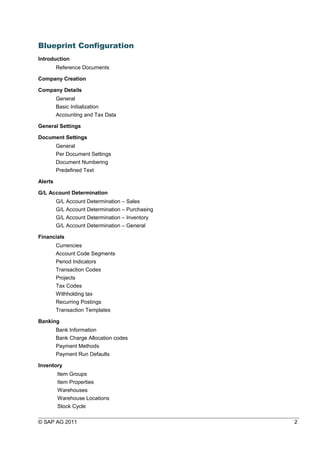
Blueprint Configuration
Introduction
Reference Documents
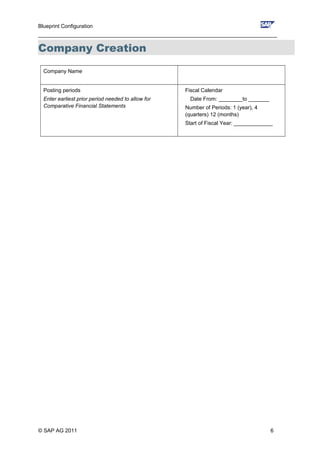
Company Creation
Company Details
General
Basic Initialization
Accounting and Tax Data
General Settings
Document Settings
General
Per Document Settings
Document Numbering
Predefined Text
Alerts
G/L Account Determination
G/L Account Determination – Sales
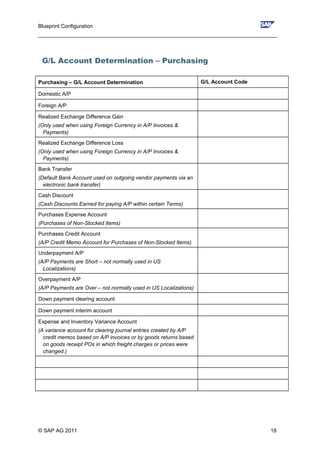
G/L Account Determination – Purchasing
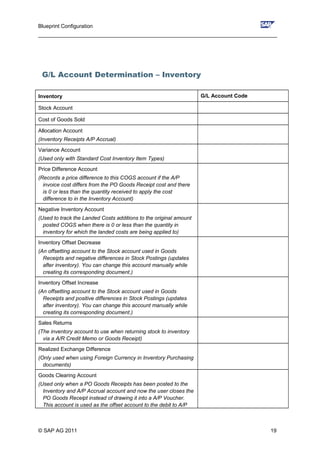
G/L Account Determination – Inventory
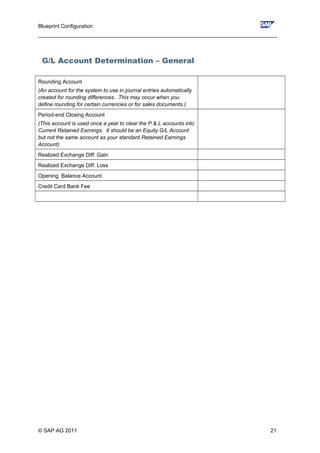
G/L Account Determination – General
Financials
Currencies
Account Code Segments
Period Indicators
Transaction Codes
Projects
Tax Codes
Withholding tax
Recurring Postings
Transaction Templates
Banking
Bank Information
Bank Charge Allocation codes
Payment Methods
Payment Run Defaults
Inventory
Item Groups
Item Properties
Warehouses
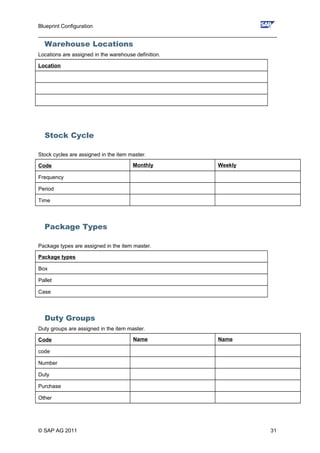
Warehouse Locations
Stock Cycle
© SAP AG 2011 2
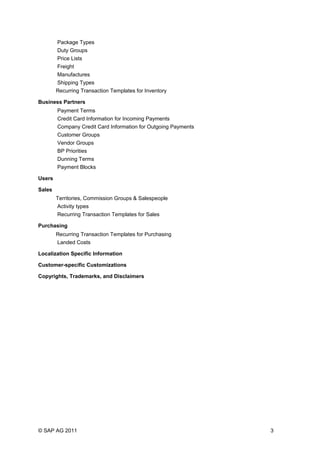
Package Types
Duty Groups
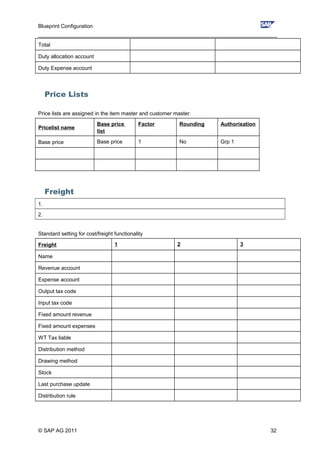
Price Lists
Freight
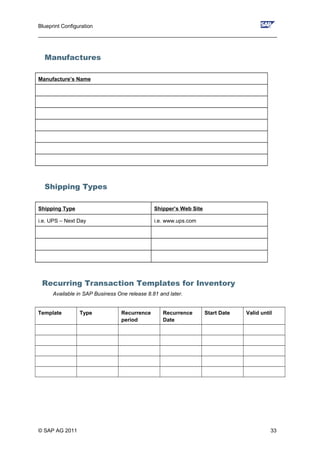
Manufactures
Shipping Types
Recurring Transaction Templates for Inventory
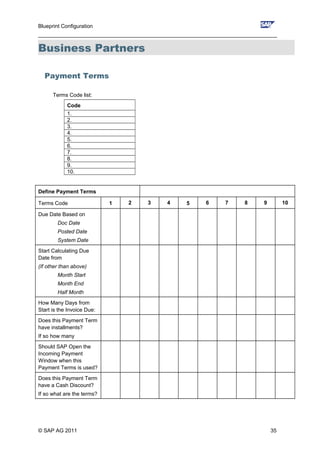
Business Partners
Payment Terms
Credit Card Information for Incoming Payments
Company Credit Card Information for Outgoing Payments
Customer Groups
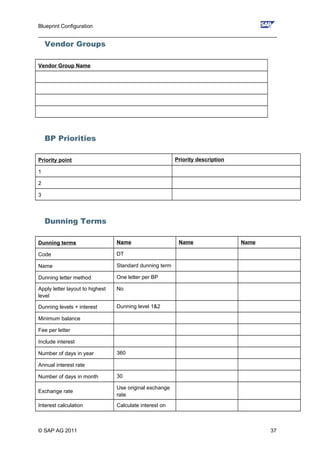
Vendor Groups
BP Priorities
Dunning Terms
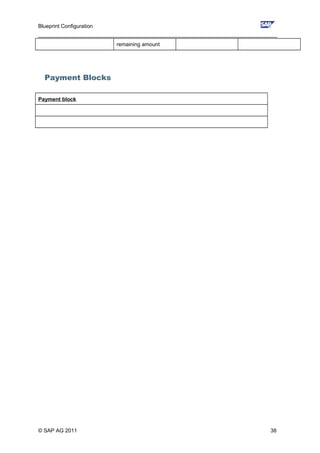
Payment Blocks
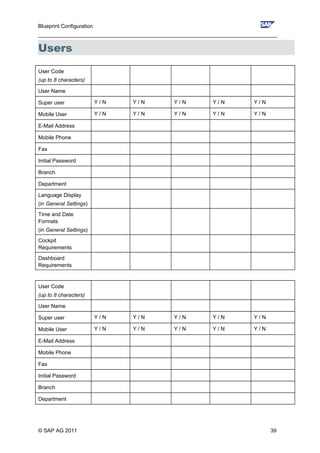
Users
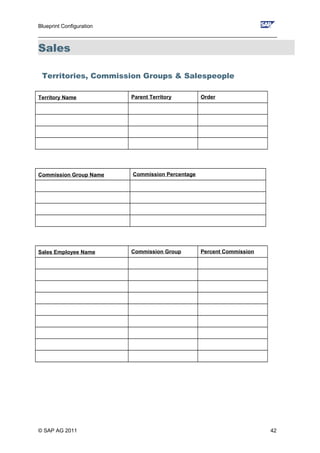
Sales
Territories, Commission Groups & Salespeople
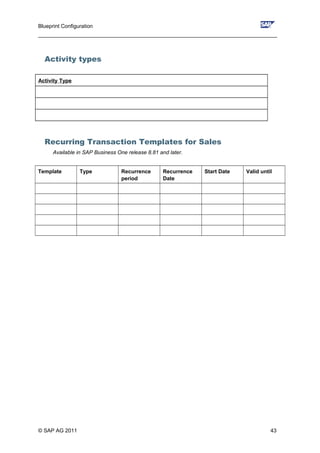
Activity types
Recurring Transaction Templates for Sales
Purchasing
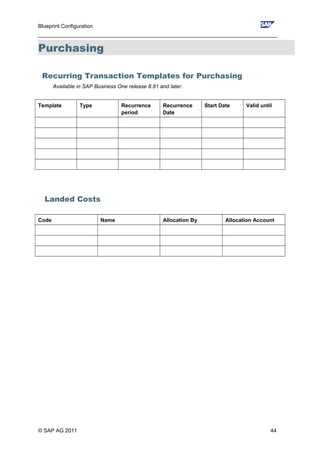
Recurring Transaction Templates for Purchasing
Landed Costs
Localization Specific Information
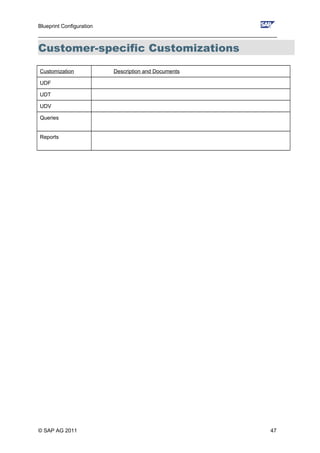
Customer-specific Customizations
Copyrights, Trademarks, and Disclaimers
© SAP AG 2011 3
Blueprint Configuration
________________________________________________________________________________
Introduction
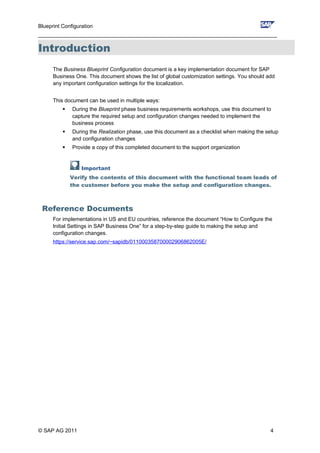
The Business Blueprint Configuration document is a key implementation document for SAP
Business One. This document shows the list of global customization settings. You should add
any important configuration settings for the localization.
This document can be used in multiple ways:
 During the Blueprint phase business requirements workshops, use this document to
capture the required setup and configuration changes needed to implement the
business process
 During the Realization phase, use this document as a checklist when making the setup
and configuration changes
 Provide a copy of this completed document to the support organization
Important
Verify the contents of this document with the functional team leads of
the customer before you make the setup and configuration changes.
Reference Documents
For implementations in US and EU countries, reference the document “How to Configure the
Initial Settings in SAP Business One” for a step-by-step guide to making the setup and
configuration changes.
https://service.sap.com/~sapidb/011000358700002906862005E/
© SAP AG 2011 4
Blueprint Configuration
________________________________________________________________________________
© SAP AG 2011 5
Blueprint Configuration
________________________________________________________________________________
Company Creation
Company Name
Posting periods
Enter earliest prior period needed to allow for
Comparative Financial Statements
Fiscal Calendar
Date From: ________to _______
Number of Periods: 1 (year), 4
(quarters) 12 (months)
Start of Fiscal Year: _____________
© SAP AG 2011 6
Blueprint Configuration
________________________________________________________________________________
Company Details
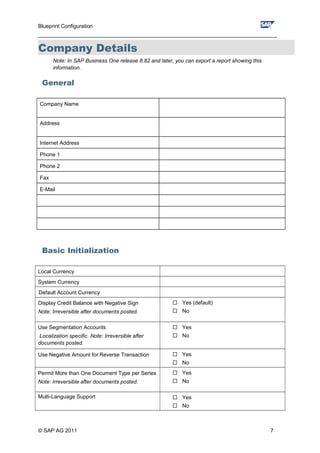
Note: In SAP Business One release 8.82 and later, you can export a report showing this
information.
General
Company Name
Address
Internet Address
Phone 1
Phone 2
Fax
E-Mail
Basic Initialization
Local Currency
System Currency
Default Account Currency
Display Credit Balance with Negative Sign
Note: Irreversible after documents posted.
 Yes (default)
 No
Use Segmentation Accounts
Localization specific. Note: Irreversible after
documents posted.
 Yes
 No
Use Negative Amount for Reverse Transaction  Yes
 No
Permit More than One Document Type per Series
Note: Irreversible after documents posted.
 Yes
 No
Multi-Language Support  Yes
 No
© SAP AG 2011 7
Blueprint Configuration
________________________________________________________________________________
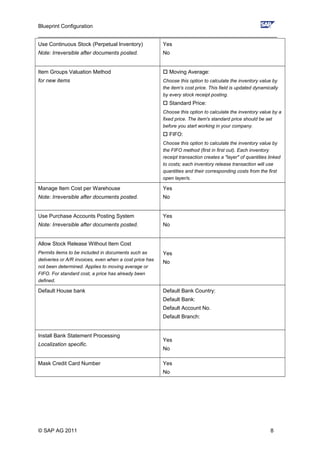
Use Continuous Stock (Perpetual Inventory)
Note: Irreversible after documents posted.
Yes
No
Item Groups Valuation Method
for new items
 Moving Average:
Choose this option to calculate the inventory value by
the item's cost price. This field is updated dynamically
by every stock receipt posting.
 Standard Price:
Choose this option to calculate the inventory value by a
fixed price. The item's standard price should be set
before you start working in your company.
 FIFO:
Choose this option to calculate the inventory value by
the FIFO method (first in first out). Each inventory
receipt transaction creates a "layer" of quantities linked
to costs; each inventory release transaction will use
quantities and their corresponding costs from the first
open layer/s.
Manage Item Cost per Warehouse
Note: Irreversible after documents posted.
Yes
No
Use Purchase Accounts Posting System
Note: Irreversible after documents posted.
Yes
No
Allow Stock Release Without Item Cost
Permits items to be included in documents such as
deliveries or A/R invoices, even when a cost price has
not been determined. Applies to moving average or
FIFO. For standard cost, a price has already been
defined.
Yes
No
Default House bank Default Bank Country:
Default Bank:
Default Account No.
Default Branch:
Install Bank Statement Processing
Localization specific.
Yes
No
Mask Credit Card Number Yes
No
© SAP AG 2011 8
Blueprint Configuration
________________________________________________________________________________
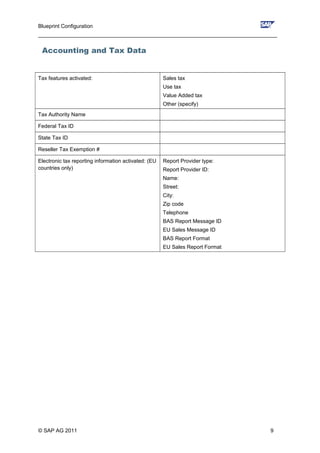
Accounting and Tax Data
Tax features activated: Sales tax
Use tax
Value Added tax
Other (specify)
Tax Authority Name
Federal Tax ID
State Tax ID
Reseller Tax Exemption #
Electronic tax reporting information activated: (EU
countries only)
Report Provider type:
Report Provider ID:
Name:
Street:
City:
Zip code
Telephone
BAS Report Message ID
EU Sales Message ID
BAS Report Format
EU Sales Report Format
© SAP AG 2011 9
Blueprint Configuration
________________________________________________________________________________
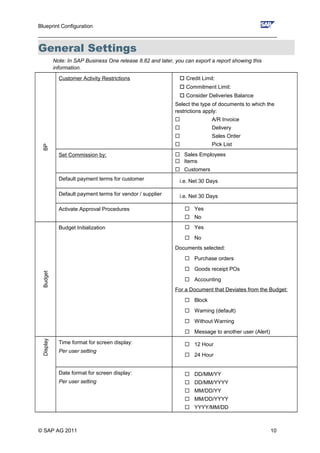
General Settings
Note: In SAP Business One release 8.82 and later, you can export a report showing this
information.
BP
Customer Activity Restrictions  Credit Limit:
 Commitment Limit:
 Consider Deliveries Balance
Select the type of documents to which the
restrictions apply:
 A/R Invoice
 Delivery
 Sales Order
 Pick List
Set Commission by:  Sales Employees
 Items
 Customers
Default payment terms for customer i.e. Net 30 Days
Default payment terms for vendor / supplier i.e. Net 30 Days
Activate Approval Procedures  Yes
 No
Budget
Budget Initialization  Yes
 No
Documents selected:
 Purchase orders
 Goods receipt POs
 Accounting
For a Document that Deviates from the Budget:
 Block
 Warning (default)
 Without Warning
 Message to another user (Alert)
Display
Time format for screen display:
Per user setting
 12 Hour
 24 Hour
Date format for screen display:
Per user setting
 DD/MM/YY
 DD/MM/YYYY
 MM/DD/YY
 MM/DD/YYYY
 YYYY/MM/DD
© SAP AG 2011 10
Blueprint Configuration
________________________________________________________________________________
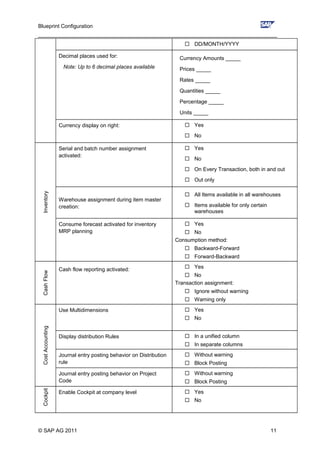
 DD/MONTH/YYYY
Decimal places used for:
Note: Up to 6 decimal places available
Currency Amounts _____
Prices _____
Rates _____
Quantities _____
Percentage _____
Units _____
Currency display on right:  Yes
 No
Inventory
Serial and batch number assignment
activated:
 Yes
 No
 On Every Transaction, both in and out
 Out only
Warehouse assignment during item master
creation:
 All Items available in all warehouses
 Items available for only certain
warehouses
Consume forecast activated for inventory
MRP planning
 Yes
 No
Consumption method:
 Backward-Forward
 Forward-Backward
CashFlow
Cash flow reporting activated:  Yes
 No
Transaction assignment:
 Ignore without warning
 Warning only
CostAccounting
Use Multidimensions  Yes
 No
Display distribution Rules  In a unified column
 In separate columns
Journal entry posting behavior on Distribution
rule
 Without warning
 Block Posting
Journal entry posting behavior on Project
Code
 Without warning
 Block Posting
Cockpit
Enable Cockpit at company level  Yes
 No
© SAP AG 2011 11
Blueprint Configuration
________________________________________________________________________________
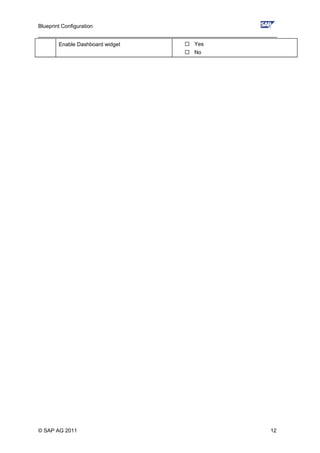
Enable Dashboard widget  Yes
 No
© SAP AG 2011 12
Blueprint Configuration
________________________________________________________________________________
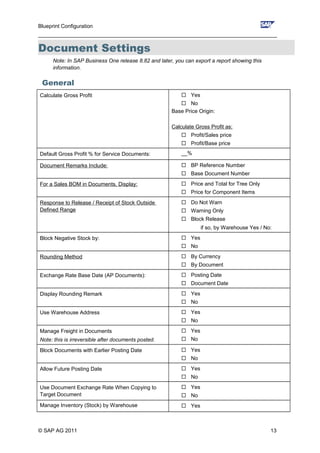
Document Settings
Note: In SAP Business One release 8.82 and later, you can export a report showing this
information.
General
Calculate Gross Profit  Yes
 No
Base Price Origin:
Calculate Gross Profit as:
 Profit/Sales price
 Profit/Base price
Default Gross Profit % for Service Documents: __%
Document Remarks Include:  BP Reference Number
 Base Document Number
For a Sales BOM in Documents, Display:  Price and Total for Tree Only
 Price for Component Items
Response to Release / Receipt of Stock Outside
Defined Range
 Do Not Warn
 Warning Only
 Block Release
if so, by Warehouse Yes / No:
Block Negative Stock by:  Yes
 No
Rounding Method  By Currency
 By Document
Exchange Rate Base Date (AP Documents):  Posting Date
 Document Date
Display Rounding Remark  Yes
 No
Use Warehouse Address  Yes
 No
Manage Freight in Documents
Note: this is irreversible after documents posted.
 Yes
 No
Block Documents with Earlier Posting Date  Yes
 No
Allow Future Posting Date  Yes
 No
Use Document Exchange Rate When Copying to
Target Document
 Yes
 No
Manage Inventory (Stock) by Warehouse  Yes
© SAP AG 2011 13
Blueprint Configuration
________________________________________________________________________________
 No
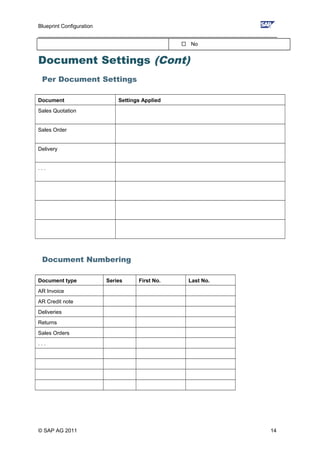
Document Settings (Cont)
Per Document Settings
Document Settings Applied
Sales Quotation
Sales Order
Delivery
. . .
Document Numbering
Document type Series First No. Last No.
AR Invoice
AR Credit note
Deliveries
Returns
Sales Orders
. . .
© SAP AG 2011 14
Blueprint Configuration
________________________________________________________________________________
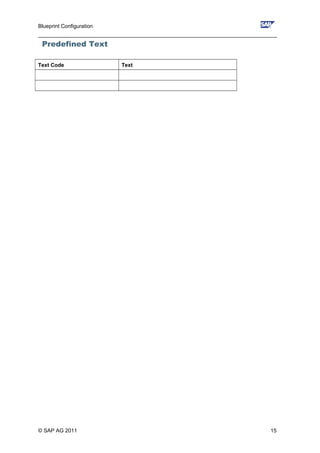
Predefined Text
Text Code Text
© SAP AG 2011 15
Blueprint Configuration
________________________________________________________________________________
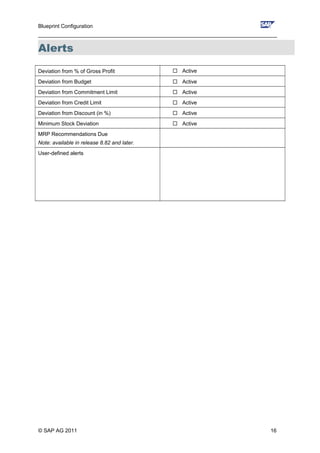
Alerts
Deviation from % of Gross Profit  Active
Deviation from Budget  Active
Deviation from Commitment Limit  Active
Deviation from Credit Limit  Active
Deviation from Discount (in %)  Active
Minimum Stock Deviation  Active
MRP Recommendations Due
Note: available in release 8.82 and later.
User-defined alerts
© SAP AG 2011 16
Blueprint Configuration
________________________________________________________________________________
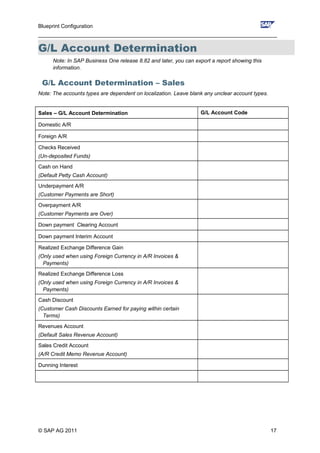
G/L Account Determination
Note: In SAP Business One release 8.82 and later, you can export a report showing this
information.
G/L Account Determination – Sales
Note: The accounts types are dependent on localization. Leave blank any unclear account types.
Sales – G/L Account Determination G/L Account Code
Domestic A/R
Foreign A/R
Checks Received
(Un-deposited Funds)
Cash on Hand
(Default Petty Cash Account)
Underpayment A/R
(Customer Payments are Short)
Overpayment A/R
(Customer Payments are Over)
Down payment Clearing Account
Down payment Interim Account
Realized Exchange Difference Gain
(Only used when using Foreign Currency in A/R Invoices &
Payments)
Realized Exchange Difference Loss
(Only used when using Foreign Currency in A/R Invoices &
Payments)
Cash Discount
(Customer Cash Discounts Earned for paying within certain
Terms)
Revenues Account
(Default Sales Revenue Account)
Sales Credit Account
(A/R Credit Memo Revenue Account)
Dunning Interest
© SAP AG 2011 17
Blueprint Configuration
________________________________________________________________________________
G/L Account Determination – Purchasing
Purchasing – G/L Account Determination G/L Account Code
Domestic A/P
Foreign A/P
Realized Exchange Difference Gain
(Only used when using Foreign Currency in A/P Invoices &
Payments)
Realized Exchange Difference Loss
(Only used when using Foreign Currency in A/P Invoices &
Payments)
Bank Transfer
(Default Bank Account used on outgoing vendor payments via an
electronic bank transfer)
Cash Discount
(Cash Discounts Earned for paying A/P within certain Terms)
Purchases Expense Account
(Purchases of Non-Stocked Items)
Purchases Credit Account
(A/P Credit Memo Account for Purchases of Non-Stocked Items)
Underpayment A/P
(A/P Payments are Short – not normally used in US
Localizations)
Overpayment A/P
(A/P Payments are Over – not normally used in US Localizations)
Down payment clearing account
Down payment interim account
Expense and Inventory Variance Account
(A variance account for clearing journal entries created by A/P
credit memos based on A/P invoices or by goods returns based
on goods receipt POs in which freight charges or prices were
changed.)
© SAP AG 2011 18
Blueprint Configuration
________________________________________________________________________________
G/L Account Determination – Inventory
Inventory G/L Account Code
Stock Account
Cost of Goods Sold
Allocation Account
(Inventory Receipts A/P Accrual)
Variance Account
(Used only with Standard Cost Inventory Item Types)
Price Difference Account
(Records a price difference to this COGS account if the A/P
invoice cost differs from the PO Goods Receipt cost and there
is 0 or less than the quantity received to apply the cost
difference to in the Inventory Account)
Negative Inventory Account
(Used to track the Landed Costs additions to the original amount
posted COGS when there is 0 or less than the quantity in
inventory for which the landed costs are being applied to)
Inventory Offset Decrease
(An offsetting account to the Stock account used in Goods
Receipts and negative differences in Stock Postings (updates
after inventory). You can change this account manually while
creating its corresponding document.)
Inventory Offset Increase
(An offsetting account to the Stock account used in Goods
Receipts and positive differences in Stock Postings (updates
after inventory). You can change this account manually while
creating its corresponding document.)
Sales Returns
(The inventory account to use when returning stock to inventory
via a A/R Credit Memo or Goods Receipt)
Realized Exchange Difference
(Only used when using Foreign Currency in Inventory Purchasing
documents)
Goods Clearing Account
(Used only when a PO Goods Receipts has been posted to the
Inventory and A/P Accrual account and now the user closes the
PO Goods Receipt instead of drawing it into a A/P Voucher.
This account is used as the offset account to the debit to A/P
© SAP AG 2011 19
Blueprint Configuration
________________________________________________________________________________
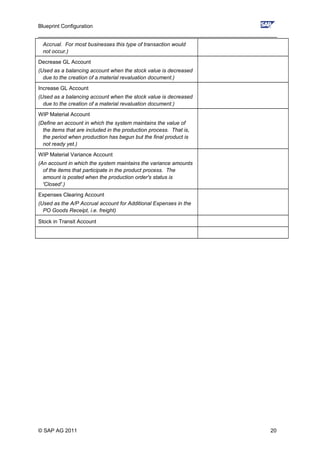
Accrual. For most businesses this type of transaction would
not occur.)
Decrease GL Account
(Used as a balancing account when the stock value is decreased
due to the creation of a material revaluation document.)
Increase GL Account
(Used as a balancing account when the stock value is decreased
due to the creation of a material revaluation document.)
WIP Material Account
(Define an account in which the system maintains the value of
the items that are included in the production process. That is,
the period when production has begun but the final product is
not ready yet.)
WIP Material Variance Account
(An account in which the system maintains the variance amounts
of the items that participate in the product process. The
amount is posted when the production order's status is
'Closed'.)
Expenses Clearing Account
(Used as the A/P Accrual account for Additional Expenses in the
PO Goods Receipt, i.e. freight)
Stock in Transit Account
© SAP AG 2011 20
Blueprint Configuration
________________________________________________________________________________
G/L Account Determination – General
Rounding Account
(An account for the system to use in journal entries automatically
created for rounding differences. This may occur when you
define rounding for certain currencies or for sales documents.)
Period-end Closing Account
(This account is used once a year to clear the P & L accounts into
Current Retained Earnings. It should be an Equity G/L Account
but not the same account as your standard Retained Earnings
Account)
Realized Exchange Diff. Gain
Realized Exchange Diff. Loss
Opening Balance Account
Credit Card Bank Fee
© SAP AG 2011 21
Blueprint Configuration
________________________________________________________________________________
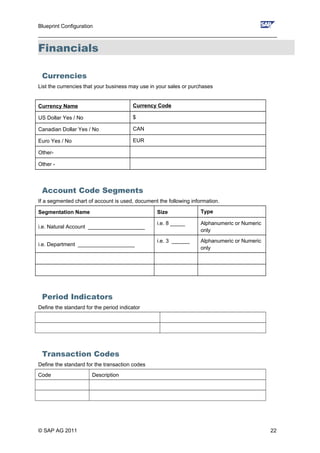
Financials
Currencies
List the currencies that your business may use in your sales or purchases
Currency Name Currency Code
US Dollar Yes / No $
Canadian Dollar Yes / No CAN
Euro Yes / No EUR
Other-
Other -
Account Code Segments
If a segmented chart of account is used, document the following information.
Segmentation Name Size Type
i.e. Natural Account ___________________
i.e. 8 _____ Alphanumeric or Numeric
only
i.e. Department ___________________
i.e. 3 ______ Alphanumeric or Numeric
only
Period Indicators
Define the standard for the period indicator
Transaction Codes
Define the standard for the transaction codes
Code Description
© SAP AG 2011 22
Blueprint Configuration
________________________________________________________________________________
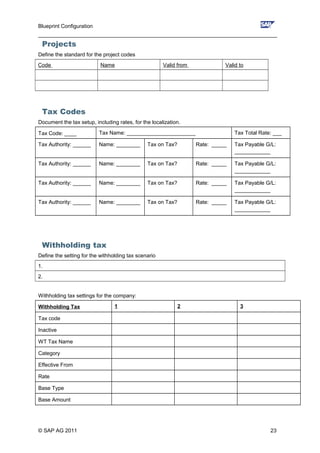
Projects
Define the standard for the project codes
Code Name Valid from Valid to
Tax Codes
Document the tax setup, including rates, for the localization.
Tax Code: ____ Tax Name: _______________________ Tax Total Rate: ___
Tax Authority: ______ Name: ________ Tax on Tax? Rate: _____ Tax Payable G/L:
____________
Tax Authority: ______ Name: ________ Tax on Tax? Rate: _____ Tax Payable G/L:
____________
Tax Authority: ______ Name: ________ Tax on Tax? Rate: _____ Tax Payable G/L:
____________
Tax Authority: ______ Name: ________ Tax on Tax? Rate: _____ Tax Payable G/L:
____________
Withholding tax
Define the setting for the withholding tax scenario
1.
2.
Withholding tax settings for the company:
Withholding Tax 1 2 3
Tax code
Inactive
WT Tax Name
Category
Effective From
Rate
Base Type
Base Amount
© SAP AG 2011 23
Blueprint Configuration
________________________________________________________________________________
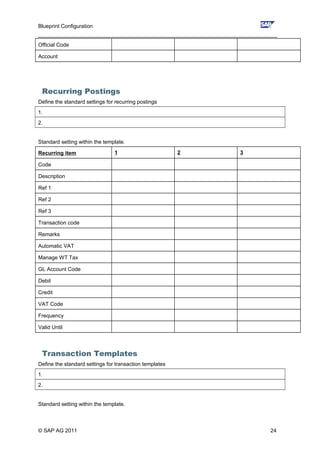
Official Code
Account
Recurring Postings
Define the standard settings for recurring postings
1.
2.
Standard setting within the template.
Recurring item 1 2 3
Code
Description
Ref 1
Ref 2
Ref 3
Transaction code
Remarks
Automatic VAT
Manage WT Tax
GL Account Code
Debit
Credit
VAT Code
Frequency
Valid Until
Transaction Templates
Define the standard settings for transaction templates
1.
2.
Standard setting within the template.
© SAP AG 2011 24
Blueprint Configuration
________________________________________________________________________________
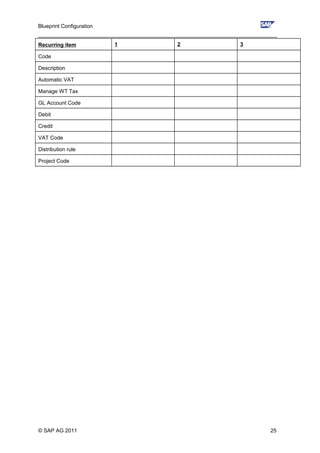
Recurring item 1 2 3
Code
Description
Automatic VAT
Manage WT Tax
GL Account Code
Debit
Credit
VAT Code
Distribution rule
Project Code
© SAP AG 2011 25
Blueprint Configuration
________________________________________________________________________________
© SAP AG 2011 26
Blueprint Configuration
________________________________________________________________________________
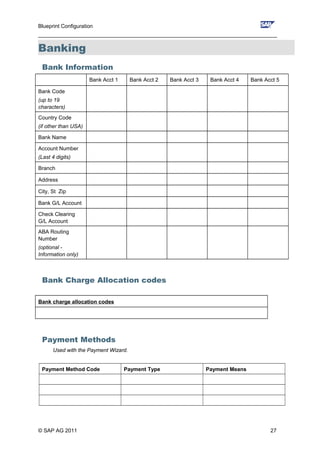
Banking
Bank Information
Bank Acct 1 Bank Acct 2 Bank Acct 3 Bank Acct 4 Bank Acct 5
Bank Code
(up to 19
characters)
Country Code
(if other than USA)
Bank Name
Account Number
(Last 4 digits)
Branch
Address
City, St Zip
Bank G/L Account
Check Clearing
G/L Account
ABA Routing
Number
(optional -
Information only)
Bank Charge Allocation codes
Bank charge allocation codes
Payment Methods
Used with the Payment Wizard.
Payment Method Code Payment Type Payment Means
© SAP AG 2011 27
Blueprint Configuration
________________________________________________________________________________
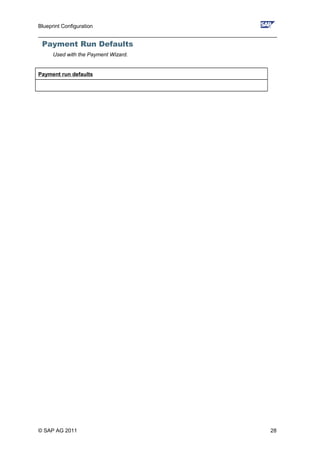
Payment Run Defaults
Used with the Payment Wizard.
Payment run defaults
© SAP AG 2011 28
Blueprint Configuration
________________________________________________________________________________
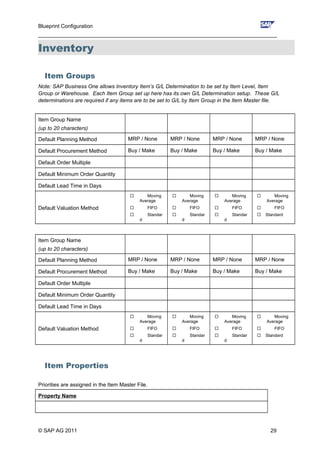
Inventory
Item Groups
Note: SAP Business One allows Inventory Item’s G/L Determination to be set by Item Level, Item
Group or Warehouse. Each Item Group set up here has its own G/L Determination setup. These G/L
determinations are required if any items are to be set to G/L by Item Group in the Item Master file.
Item Group Name
(up to 20 characters)
Default Planning Method MRP / None MRP / None MRP / None MRP / None
Default Procurement Method Buy / Make Buy / Make Buy / Make Buy / Make
Default Order Multiple
Default Minimum Order Quantity
Default Lead Time in Days
Default Valuation Method
 Moving
Average
 FIFO
 Standar
d
 Moving
Average
 FIFO
 Standar
d
 Moving
Average
 FIFO
 Standar
d
 Moving
Average
 FIFO
 Standard
Item Group Name
(up to 20 characters)
Default Planning Method MRP / None MRP / None MRP / None MRP / None
Default Procurement Method Buy / Make Buy / Make Buy / Make Buy / Make
Default Order Multiple
Default Minimum Order Quantity
Default Lead Time in Days
Default Valuation Method
 Moving
Average
 FIFO
 Standar
d
 Moving
Average
 FIFO
 Standar
d
 Moving
Average
 FIFO
 Standar
d
 Moving
Average
 FIFO
 Standard
Item Properties
Priorities are assigned in the Item Master File.
Property Name
© SAP AG 2011 29
Blueprint Configuration
________________________________________________________________________________
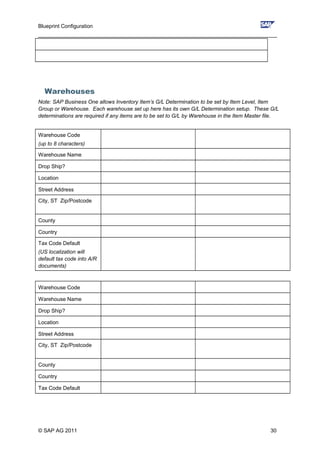
Warehouses
Note: SAP Business One allows Inventory Item’s G/L Determination to be set by Item Level, Item
Group or Warehouse. Each warehouse set up here has its own G/L Determination setup. These G/L
determinations are required if any items are to be set to G/L by Warehouse in the Item Master file.
Warehouse Code
(up to 8 characters)
Warehouse Name
Drop Ship?
Location
Street Address
City, ST Zip/Postcode
County
Country
Tax Code Default
(US localization will
default tax code into A/R
documents)
Warehouse Code
Warehouse Name
Drop Ship?
Location
Street Address
City, ST Zip/Postcode
County
Country
Tax Code Default
© SAP AG 2011 30
Blueprint Configuration
________________________________________________________________________________
Warehouse Locations
Locations are assigned in the warehouse definition.
Location
Stock Cycle
Stock cycles are assigned in the item master.
Code Monthly Weekly
Frequency
Period
Time
Package Types
Package types are assigned in the item master.
Package types
Box
Pallet
Case
Duty Groups
Duty groups are assigned in the item master.
Code Name Name
code
Number
Duty
Purchase
Other
© SAP AG 2011 31
Blueprint Configuration
________________________________________________________________________________
Total
Duty allocation account
Duty Expense account
Price Lists
Price lists are assigned in the item master and customer master.
Pricelist name
Base price
list
Factor Rounding Authorisation
Base price Base price 1 No Grp 1
Freight
1.
2.
Standard setting for cost/freight functionality
Freight 1 2 3
Name
Revenue account
Expense account
Output tax code
Input tax code
Fixed amount revenue
Fixed amount expenses
WT Tax liable
Distribution method
Drawing method
Stock
Last purchase update
Distribution rule
© SAP AG 2011 32
Blueprint Configuration
________________________________________________________________________________
Manufactures
Manufacture’s Name
Shipping Types
Shipping Type Shipper’s Web Site
i.e. UPS – Next Day i.e. www.ups.com
Recurring Transaction Templates for Inventory
Available in SAP Business One release 8.81 and later.
Template Type Recurrence
period
Recurrence
Date
Start Date Valid until
© SAP AG 2011 33
Blueprint Configuration
________________________________________________________________________________
© SAP AG 2011 34
Blueprint Configuration
________________________________________________________________________________
Business Partners
Payment Terms
Terms Code list:
Code
1.
2.
3.
4.
5.
6.
7.
8.
9.
10.
Define Payment Terms
Terms Code 1 2 3 4 5 6 7 8 9 10
Due Date Based on
Doc Date
Posted Date
System Date
Start Calculating Due
Date from
(If other than above)
Month Start
Month End
Half Month
How Many Days from
Start is the Invoice Due:
Does this Payment Term
have installments?
If so how many
Should SAP Open the
Incoming Payment
Window when this
Payment Terms is used?
Does this Payment Term
have a Cash Discount?
If so what are the terms?
© SAP AG 2011 35
Blueprint Configuration
________________________________________________________________________________
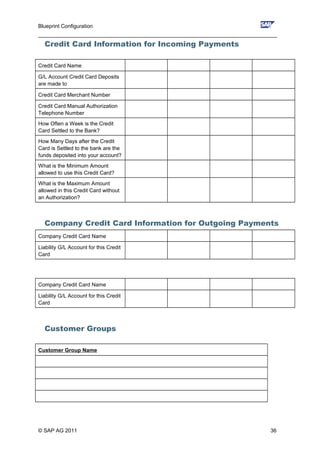
Credit Card Information for Incoming Payments
Credit Card Name
G/L Account Credit Card Deposits
are made to
Credit Card Merchant Number
Credit Card Manual Authorization
Telephone Number
How Often a Week is the Credit
Card Settled to the Bank?
How Many Days after the Credit
Card is Settled to the bank are the
funds deposited into your account?
What is the Minimum Amount
allowed to use this Credit Card?
What is the Maximum Amount
allowed in this Credit Card without
an Authorization?
Company Credit Card Information for Outgoing Payments
Company Credit Card Name
Liability G/L Account for this Credit
Card
Company Credit Card Name
Liability G/L Account for this Credit
Card
Customer Groups
Customer Group Name
© SAP AG 2011 36
Blueprint Configuration
________________________________________________________________________________
Vendor Groups
Vendor Group Name
BP Priorities
Priority point Priority description
1
2
3
Dunning Terms
Dunning terms Name Name Name
Code DT
Name Standard dunning term
Dunning letter method One letter per BP
Apply letter layout to highest
level
No
Dunning levels + interest Dunning level 1&2
Minimum balance
Fee per letter
Include interest
Number of days in year 360
Annual interest rate
Number of days in month 30
Exchange rate
Use original exchange
rate
Interest calculation Calculate interest on
© SAP AG 2011 37
Blueprint Configuration
________________________________________________________________________________
remaining amount
Payment Blocks
Payment block
© SAP AG 2011 38
Blueprint Configuration
________________________________________________________________________________
Users
User Code
(up to 8 characters)
User Name
Super user Y / N Y / N Y / N Y / N Y / N
Mobile User Y / N Y / N Y / N Y / N Y / N
E-Mail Address
Mobile Phone
Fax
Initial Password
Branch
Department
Language Display
(in General Settings)
Time and Date
Formats
(in General Settings)
Cockpit
Requirements
Dashboard
Requirements
User Code
(up to 8 characters)
User Name
Super user Y / N Y / N Y / N Y / N Y / N
Mobile User Y / N Y / N Y / N Y / N Y / N
E-Mail Address
Mobile Phone
Fax
Initial Password
Branch
Department
© SAP AG 2011 39
Blueprint Configuration
________________________________________________________________________________
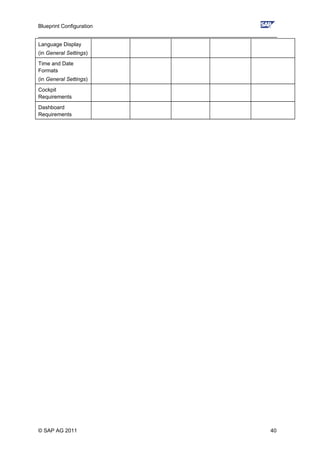
Language Display
(in General Settings)
Time and Date
Formats
(in General Settings)
Cockpit
Requirements
Dashboard
Requirements
© SAP AG 2011 40
Blueprint Configuration
________________________________________________________________________________
© SAP AG 2011 41
Blueprint Configuration
________________________________________________________________________________
Sales
Territories, Commission Groups & Salespeople
Territory Name Parent Territory Order
Commission Group Name Commission Percentage
Sales Employee Name Commission Group Percent Commission
© SAP AG 2011 42
Blueprint Configuration
________________________________________________________________________________
Activity types
Activity Type
Recurring Transaction Templates for Sales
Available in SAP Business One release 8.81 and later.
Template Type Recurrence
period
Recurrence
Date
Start Date Valid until
© SAP AG 2011 43
Blueprint Configuration
________________________________________________________________________________
Purchasing
Recurring Transaction Templates for Purchasing
Available in SAP Business One release 8.81 and later.
Template Type Recurrence
period
Recurrence
Date
Start Date Valid until
Landed Costs
Code Name Allocation By Allocation Account
© SAP AG 2011 44
Blueprint Configuration
________________________________________________________________________________
© SAP AG 2011 45
Blueprint Configuration
________________________________________________________________________________
Localization Specific Information
Add additional configuration settings as needed for the localization.
Setting Description
© SAP AG 2011 46
Blueprint Configuration
________________________________________________________________________________
Customer-specific Customizations
Customization Description and Documents
UDF
UDT
UDV
Queries
Reports
© SAP AG 2011 47
Blueprint Configuration
________________________________________________________________________________
Copyrights, Trademarks, and Disclaimers
© Copyright 2011 SAP AG. All rights reserved.
The current version of the copyrights, trademarks, and disclaimers at
http://service.sap.com/smb/sbocustomer/documentation is valid for this document.
© SAP AG 2011 48

Blue print Configuration

  • 1.
    SAP Business One PUBLIC BlueprintConfiguration Release Family 8.8 August 2011
  • 2.
    Blueprint Configuration Introduction Reference Documents CompanyCreation Company Details General Basic Initialization Accounting and Tax Data General Settings Document Settings General Per Document Settings Document Numbering Predefined Text Alerts G/L Account Determination G/L Account Determination – Sales G/L Account Determination – Purchasing G/L Account Determination – Inventory G/L Account Determination – General Financials Currencies Account Code Segments Period Indicators Transaction Codes Projects Tax Codes Withholding tax Recurring Postings Transaction Templates Banking Bank Information Bank Charge Allocation codes Payment Methods Payment Run Defaults Inventory Item Groups Item Properties Warehouses Warehouse Locations Stock Cycle © SAP AG 2011 2
  • 3.
    Package Types Duty Groups PriceLists Freight Manufactures Shipping Types Recurring Transaction Templates for Inventory Business Partners Payment Terms Credit Card Information for Incoming Payments Company Credit Card Information for Outgoing Payments Customer Groups Vendor Groups BP Priorities Dunning Terms Payment Blocks Users Sales Territories, Commission Groups & Salespeople Activity types Recurring Transaction Templates for Sales Purchasing Recurring Transaction Templates for Purchasing Landed Costs Localization Specific Information Customer-specific Customizations Copyrights, Trademarks, and Disclaimers © SAP AG 2011 3
  • 4.
    Blueprint Configuration ________________________________________________________________________________ Introduction The BusinessBlueprint Configuration document is a key implementation document for SAP Business One. This document shows the list of global customization settings. You should add any important configuration settings for the localization. This document can be used in multiple ways:  During the Blueprint phase business requirements workshops, use this document to capture the required setup and configuration changes needed to implement the business process  During the Realization phase, use this document as a checklist when making the setup and configuration changes  Provide a copy of this completed document to the support organization Important Verify the contents of this document with the functional team leads of the customer before you make the setup and configuration changes. Reference Documents For implementations in US and EU countries, reference the document “How to Configure the Initial Settings in SAP Business One” for a step-by-step guide to making the setup and configuration changes. https://service.sap.com/~sapidb/011000358700002906862005E/ © SAP AG 2011 4
  • 5.
  • 6.
    Blueprint Configuration ________________________________________________________________________________ Company Creation CompanyName Posting periods Enter earliest prior period needed to allow for Comparative Financial Statements Fiscal Calendar Date From: ________to _______ Number of Periods: 1 (year), 4 (quarters) 12 (months) Start of Fiscal Year: _____________ © SAP AG 2011 6
  • 7.
    Blueprint Configuration ________________________________________________________________________________ Company Details Note:In SAP Business One release 8.82 and later, you can export a report showing this information. General Company Name Address Internet Address Phone 1 Phone 2 Fax E-Mail Basic Initialization Local Currency System Currency Default Account Currency Display Credit Balance with Negative Sign Note: Irreversible after documents posted.  Yes (default)  No Use Segmentation Accounts Localization specific. Note: Irreversible after documents posted.  Yes  No Use Negative Amount for Reverse Transaction  Yes  No Permit More than One Document Type per Series Note: Irreversible after documents posted.  Yes  No Multi-Language Support  Yes  No © SAP AG 2011 7
  • 8.
    Blueprint Configuration ________________________________________________________________________________ Use ContinuousStock (Perpetual Inventory) Note: Irreversible after documents posted. Yes No Item Groups Valuation Method for new items  Moving Average: Choose this option to calculate the inventory value by the item's cost price. This field is updated dynamically by every stock receipt posting.  Standard Price: Choose this option to calculate the inventory value by a fixed price. The item's standard price should be set before you start working in your company.  FIFO: Choose this option to calculate the inventory value by the FIFO method (first in first out). Each inventory receipt transaction creates a "layer" of quantities linked to costs; each inventory release transaction will use quantities and their corresponding costs from the first open layer/s. Manage Item Cost per Warehouse Note: Irreversible after documents posted. Yes No Use Purchase Accounts Posting System Note: Irreversible after documents posted. Yes No Allow Stock Release Without Item Cost Permits items to be included in documents such as deliveries or A/R invoices, even when a cost price has not been determined. Applies to moving average or FIFO. For standard cost, a price has already been defined. Yes No Default House bank Default Bank Country: Default Bank: Default Account No. Default Branch: Install Bank Statement Processing Localization specific. Yes No Mask Credit Card Number Yes No © SAP AG 2011 8
  • 9.
    Blueprint Configuration ________________________________________________________________________________ Accounting andTax Data Tax features activated: Sales tax Use tax Value Added tax Other (specify) Tax Authority Name Federal Tax ID State Tax ID Reseller Tax Exemption # Electronic tax reporting information activated: (EU countries only) Report Provider type: Report Provider ID: Name: Street: City: Zip code Telephone BAS Report Message ID EU Sales Message ID BAS Report Format EU Sales Report Format © SAP AG 2011 9
  • 10.
    Blueprint Configuration ________________________________________________________________________________ General Settings Note:In SAP Business One release 8.82 and later, you can export a report showing this information. BP Customer Activity Restrictions  Credit Limit:  Commitment Limit:  Consider Deliveries Balance Select the type of documents to which the restrictions apply:  A/R Invoice  Delivery  Sales Order  Pick List Set Commission by:  Sales Employees  Items  Customers Default payment terms for customer i.e. Net 30 Days Default payment terms for vendor / supplier i.e. Net 30 Days Activate Approval Procedures  Yes  No Budget Budget Initialization  Yes  No Documents selected:  Purchase orders  Goods receipt POs  Accounting For a Document that Deviates from the Budget:  Block  Warning (default)  Without Warning  Message to another user (Alert) Display Time format for screen display: Per user setting  12 Hour  24 Hour Date format for screen display: Per user setting  DD/MM/YY  DD/MM/YYYY  MM/DD/YY  MM/DD/YYYY  YYYY/MM/DD © SAP AG 2011 10
  • 11.
    Blueprint Configuration ________________________________________________________________________________  DD/MONTH/YYYY Decimalplaces used for: Note: Up to 6 decimal places available Currency Amounts _____ Prices _____ Rates _____ Quantities _____ Percentage _____ Units _____ Currency display on right:  Yes  No Inventory Serial and batch number assignment activated:  Yes  No  On Every Transaction, both in and out  Out only Warehouse assignment during item master creation:  All Items available in all warehouses  Items available for only certain warehouses Consume forecast activated for inventory MRP planning  Yes  No Consumption method:  Backward-Forward  Forward-Backward CashFlow Cash flow reporting activated:  Yes  No Transaction assignment:  Ignore without warning  Warning only CostAccounting Use Multidimensions  Yes  No Display distribution Rules  In a unified column  In separate columns Journal entry posting behavior on Distribution rule  Without warning  Block Posting Journal entry posting behavior on Project Code  Without warning  Block Posting Cockpit Enable Cockpit at company level  Yes  No © SAP AG 2011 11
  • 12.
  • 13.
    Blueprint Configuration ________________________________________________________________________________ Document Settings Note:In SAP Business One release 8.82 and later, you can export a report showing this information. General Calculate Gross Profit  Yes  No Base Price Origin: Calculate Gross Profit as:  Profit/Sales price  Profit/Base price Default Gross Profit % for Service Documents: __% Document Remarks Include:  BP Reference Number  Base Document Number For a Sales BOM in Documents, Display:  Price and Total for Tree Only  Price for Component Items Response to Release / Receipt of Stock Outside Defined Range  Do Not Warn  Warning Only  Block Release if so, by Warehouse Yes / No: Block Negative Stock by:  Yes  No Rounding Method  By Currency  By Document Exchange Rate Base Date (AP Documents):  Posting Date  Document Date Display Rounding Remark  Yes  No Use Warehouse Address  Yes  No Manage Freight in Documents Note: this is irreversible after documents posted.  Yes  No Block Documents with Earlier Posting Date  Yes  No Allow Future Posting Date  Yes  No Use Document Exchange Rate When Copying to Target Document  Yes  No Manage Inventory (Stock) by Warehouse  Yes © SAP AG 2011 13
  • 14.
    Blueprint Configuration ________________________________________________________________________________  No DocumentSettings (Cont) Per Document Settings Document Settings Applied Sales Quotation Sales Order Delivery . . . Document Numbering Document type Series First No. Last No. AR Invoice AR Credit note Deliveries Returns Sales Orders . . . © SAP AG 2011 14
  • 15.
  • 16.
    Blueprint Configuration ________________________________________________________________________________ Alerts Deviation from% of Gross Profit  Active Deviation from Budget  Active Deviation from Commitment Limit  Active Deviation from Credit Limit  Active Deviation from Discount (in %)  Active Minimum Stock Deviation  Active MRP Recommendations Due Note: available in release 8.82 and later. User-defined alerts © SAP AG 2011 16
  • 17.
    Blueprint Configuration ________________________________________________________________________________ G/L AccountDetermination Note: In SAP Business One release 8.82 and later, you can export a report showing this information. G/L Account Determination – Sales Note: The accounts types are dependent on localization. Leave blank any unclear account types. Sales – G/L Account Determination G/L Account Code Domestic A/R Foreign A/R Checks Received (Un-deposited Funds) Cash on Hand (Default Petty Cash Account) Underpayment A/R (Customer Payments are Short) Overpayment A/R (Customer Payments are Over) Down payment Clearing Account Down payment Interim Account Realized Exchange Difference Gain (Only used when using Foreign Currency in A/R Invoices & Payments) Realized Exchange Difference Loss (Only used when using Foreign Currency in A/R Invoices & Payments) Cash Discount (Customer Cash Discounts Earned for paying within certain Terms) Revenues Account (Default Sales Revenue Account) Sales Credit Account (A/R Credit Memo Revenue Account) Dunning Interest © SAP AG 2011 17
  • 18.
    Blueprint Configuration ________________________________________________________________________________ G/L AccountDetermination – Purchasing Purchasing – G/L Account Determination G/L Account Code Domestic A/P Foreign A/P Realized Exchange Difference Gain (Only used when using Foreign Currency in A/P Invoices & Payments) Realized Exchange Difference Loss (Only used when using Foreign Currency in A/P Invoices & Payments) Bank Transfer (Default Bank Account used on outgoing vendor payments via an electronic bank transfer) Cash Discount (Cash Discounts Earned for paying A/P within certain Terms) Purchases Expense Account (Purchases of Non-Stocked Items) Purchases Credit Account (A/P Credit Memo Account for Purchases of Non-Stocked Items) Underpayment A/P (A/P Payments are Short – not normally used in US Localizations) Overpayment A/P (A/P Payments are Over – not normally used in US Localizations) Down payment clearing account Down payment interim account Expense and Inventory Variance Account (A variance account for clearing journal entries created by A/P credit memos based on A/P invoices or by goods returns based on goods receipt POs in which freight charges or prices were changed.) © SAP AG 2011 18
  • 19.
    Blueprint Configuration ________________________________________________________________________________ G/L AccountDetermination – Inventory Inventory G/L Account Code Stock Account Cost of Goods Sold Allocation Account (Inventory Receipts A/P Accrual) Variance Account (Used only with Standard Cost Inventory Item Types) Price Difference Account (Records a price difference to this COGS account if the A/P invoice cost differs from the PO Goods Receipt cost and there is 0 or less than the quantity received to apply the cost difference to in the Inventory Account) Negative Inventory Account (Used to track the Landed Costs additions to the original amount posted COGS when there is 0 or less than the quantity in inventory for which the landed costs are being applied to) Inventory Offset Decrease (An offsetting account to the Stock account used in Goods Receipts and negative differences in Stock Postings (updates after inventory). You can change this account manually while creating its corresponding document.) Inventory Offset Increase (An offsetting account to the Stock account used in Goods Receipts and positive differences in Stock Postings (updates after inventory). You can change this account manually while creating its corresponding document.) Sales Returns (The inventory account to use when returning stock to inventory via a A/R Credit Memo or Goods Receipt) Realized Exchange Difference (Only used when using Foreign Currency in Inventory Purchasing documents) Goods Clearing Account (Used only when a PO Goods Receipts has been posted to the Inventory and A/P Accrual account and now the user closes the PO Goods Receipt instead of drawing it into a A/P Voucher. This account is used as the offset account to the debit to A/P © SAP AG 2011 19
  • 20.
    Blueprint Configuration ________________________________________________________________________________ Accrual. Formost businesses this type of transaction would not occur.) Decrease GL Account (Used as a balancing account when the stock value is decreased due to the creation of a material revaluation document.) Increase GL Account (Used as a balancing account when the stock value is decreased due to the creation of a material revaluation document.) WIP Material Account (Define an account in which the system maintains the value of the items that are included in the production process. That is, the period when production has begun but the final product is not ready yet.) WIP Material Variance Account (An account in which the system maintains the variance amounts of the items that participate in the product process. The amount is posted when the production order's status is 'Closed'.) Expenses Clearing Account (Used as the A/P Accrual account for Additional Expenses in the PO Goods Receipt, i.e. freight) Stock in Transit Account © SAP AG 2011 20
  • 21.
    Blueprint Configuration ________________________________________________________________________________ G/L AccountDetermination – General Rounding Account (An account for the system to use in journal entries automatically created for rounding differences. This may occur when you define rounding for certain currencies or for sales documents.) Period-end Closing Account (This account is used once a year to clear the P & L accounts into Current Retained Earnings. It should be an Equity G/L Account but not the same account as your standard Retained Earnings Account) Realized Exchange Diff. Gain Realized Exchange Diff. Loss Opening Balance Account Credit Card Bank Fee © SAP AG 2011 21
  • 22.
    Blueprint Configuration ________________________________________________________________________________ Financials Currencies List thecurrencies that your business may use in your sales or purchases Currency Name Currency Code US Dollar Yes / No $ Canadian Dollar Yes / No CAN Euro Yes / No EUR Other- Other - Account Code Segments If a segmented chart of account is used, document the following information. Segmentation Name Size Type i.e. Natural Account ___________________ i.e. 8 _____ Alphanumeric or Numeric only i.e. Department ___________________ i.e. 3 ______ Alphanumeric or Numeric only Period Indicators Define the standard for the period indicator Transaction Codes Define the standard for the transaction codes Code Description © SAP AG 2011 22
  • 23.
    Blueprint Configuration ________________________________________________________________________________ Projects Define thestandard for the project codes Code Name Valid from Valid to Tax Codes Document the tax setup, including rates, for the localization. Tax Code: ____ Tax Name: _______________________ Tax Total Rate: ___ Tax Authority: ______ Name: ________ Tax on Tax? Rate: _____ Tax Payable G/L: ____________ Tax Authority: ______ Name: ________ Tax on Tax? Rate: _____ Tax Payable G/L: ____________ Tax Authority: ______ Name: ________ Tax on Tax? Rate: _____ Tax Payable G/L: ____________ Tax Authority: ______ Name: ________ Tax on Tax? Rate: _____ Tax Payable G/L: ____________ Withholding tax Define the setting for the withholding tax scenario 1. 2. Withholding tax settings for the company: Withholding Tax 1 2 3 Tax code Inactive WT Tax Name Category Effective From Rate Base Type Base Amount © SAP AG 2011 23
  • 24.
    Blueprint Configuration ________________________________________________________________________________ Official Code Account RecurringPostings Define the standard settings for recurring postings 1. 2. Standard setting within the template. Recurring item 1 2 3 Code Description Ref 1 Ref 2 Ref 3 Transaction code Remarks Automatic VAT Manage WT Tax GL Account Code Debit Credit VAT Code Frequency Valid Until Transaction Templates Define the standard settings for transaction templates 1. 2. Standard setting within the template. © SAP AG 2011 24
  • 25.
    Blueprint Configuration ________________________________________________________________________________ Recurring item1 2 3 Code Description Automatic VAT Manage WT Tax GL Account Code Debit Credit VAT Code Distribution rule Project Code © SAP AG 2011 25
  • 26.
  • 27.
    Blueprint Configuration ________________________________________________________________________________ Banking Bank Information BankAcct 1 Bank Acct 2 Bank Acct 3 Bank Acct 4 Bank Acct 5 Bank Code (up to 19 characters) Country Code (if other than USA) Bank Name Account Number (Last 4 digits) Branch Address City, St Zip Bank G/L Account Check Clearing G/L Account ABA Routing Number (optional - Information only) Bank Charge Allocation codes Bank charge allocation codes Payment Methods Used with the Payment Wizard. Payment Method Code Payment Type Payment Means © SAP AG 2011 27
  • 28.
    Blueprint Configuration ________________________________________________________________________________ Payment RunDefaults Used with the Payment Wizard. Payment run defaults © SAP AG 2011 28
  • 29.
    Blueprint Configuration ________________________________________________________________________________ Inventory Item Groups Note:SAP Business One allows Inventory Item’s G/L Determination to be set by Item Level, Item Group or Warehouse. Each Item Group set up here has its own G/L Determination setup. These G/L determinations are required if any items are to be set to G/L by Item Group in the Item Master file. Item Group Name (up to 20 characters) Default Planning Method MRP / None MRP / None MRP / None MRP / None Default Procurement Method Buy / Make Buy / Make Buy / Make Buy / Make Default Order Multiple Default Minimum Order Quantity Default Lead Time in Days Default Valuation Method  Moving Average  FIFO  Standar d  Moving Average  FIFO  Standar d  Moving Average  FIFO  Standar d  Moving Average  FIFO  Standard Item Group Name (up to 20 characters) Default Planning Method MRP / None MRP / None MRP / None MRP / None Default Procurement Method Buy / Make Buy / Make Buy / Make Buy / Make Default Order Multiple Default Minimum Order Quantity Default Lead Time in Days Default Valuation Method  Moving Average  FIFO  Standar d  Moving Average  FIFO  Standar d  Moving Average  FIFO  Standar d  Moving Average  FIFO  Standard Item Properties Priorities are assigned in the Item Master File. Property Name © SAP AG 2011 29
  • 30.
    Blueprint Configuration ________________________________________________________________________________ Warehouses Note: SAPBusiness One allows Inventory Item’s G/L Determination to be set by Item Level, Item Group or Warehouse. Each warehouse set up here has its own G/L Determination setup. These G/L determinations are required if any items are to be set to G/L by Warehouse in the Item Master file. Warehouse Code (up to 8 characters) Warehouse Name Drop Ship? Location Street Address City, ST Zip/Postcode County Country Tax Code Default (US localization will default tax code into A/R documents) Warehouse Code Warehouse Name Drop Ship? Location Street Address City, ST Zip/Postcode County Country Tax Code Default © SAP AG 2011 30
  • 31.
    Blueprint Configuration ________________________________________________________________________________ Warehouse Locations Locationsare assigned in the warehouse definition. Location Stock Cycle Stock cycles are assigned in the item master. Code Monthly Weekly Frequency Period Time Package Types Package types are assigned in the item master. Package types Box Pallet Case Duty Groups Duty groups are assigned in the item master. Code Name Name code Number Duty Purchase Other © SAP AG 2011 31
  • 32.
    Blueprint Configuration ________________________________________________________________________________ Total Duty allocationaccount Duty Expense account Price Lists Price lists are assigned in the item master and customer master. Pricelist name Base price list Factor Rounding Authorisation Base price Base price 1 No Grp 1 Freight 1. 2. Standard setting for cost/freight functionality Freight 1 2 3 Name Revenue account Expense account Output tax code Input tax code Fixed amount revenue Fixed amount expenses WT Tax liable Distribution method Drawing method Stock Last purchase update Distribution rule © SAP AG 2011 32
  • 33.
    Blueprint Configuration ________________________________________________________________________________ Manufactures Manufacture’s Name ShippingTypes Shipping Type Shipper’s Web Site i.e. UPS – Next Day i.e. www.ups.com Recurring Transaction Templates for Inventory Available in SAP Business One release 8.81 and later. Template Type Recurrence period Recurrence Date Start Date Valid until © SAP AG 2011 33
  • 34.
  • 35.
    Blueprint Configuration ________________________________________________________________________________ Business Partners PaymentTerms Terms Code list: Code 1. 2. 3. 4. 5. 6. 7. 8. 9. 10. Define Payment Terms Terms Code 1 2 3 4 5 6 7 8 9 10 Due Date Based on Doc Date Posted Date System Date Start Calculating Due Date from (If other than above) Month Start Month End Half Month How Many Days from Start is the Invoice Due: Does this Payment Term have installments? If so how many Should SAP Open the Incoming Payment Window when this Payment Terms is used? Does this Payment Term have a Cash Discount? If so what are the terms? © SAP AG 2011 35
  • 36.
    Blueprint Configuration ________________________________________________________________________________ Credit CardInformation for Incoming Payments Credit Card Name G/L Account Credit Card Deposits are made to Credit Card Merchant Number Credit Card Manual Authorization Telephone Number How Often a Week is the Credit Card Settled to the Bank? How Many Days after the Credit Card is Settled to the bank are the funds deposited into your account? What is the Minimum Amount allowed to use this Credit Card? What is the Maximum Amount allowed in this Credit Card without an Authorization? Company Credit Card Information for Outgoing Payments Company Credit Card Name Liability G/L Account for this Credit Card Company Credit Card Name Liability G/L Account for this Credit Card Customer Groups Customer Group Name © SAP AG 2011 36
  • 37.
    Blueprint Configuration ________________________________________________________________________________ Vendor Groups VendorGroup Name BP Priorities Priority point Priority description 1 2 3 Dunning Terms Dunning terms Name Name Name Code DT Name Standard dunning term Dunning letter method One letter per BP Apply letter layout to highest level No Dunning levels + interest Dunning level 1&2 Minimum balance Fee per letter Include interest Number of days in year 360 Annual interest rate Number of days in month 30 Exchange rate Use original exchange rate Interest calculation Calculate interest on © SAP AG 2011 37
  • 38.
  • 39.
    Blueprint Configuration ________________________________________________________________________________ Users User Code (upto 8 characters) User Name Super user Y / N Y / N Y / N Y / N Y / N Mobile User Y / N Y / N Y / N Y / N Y / N E-Mail Address Mobile Phone Fax Initial Password Branch Department Language Display (in General Settings) Time and Date Formats (in General Settings) Cockpit Requirements Dashboard Requirements User Code (up to 8 characters) User Name Super user Y / N Y / N Y / N Y / N Y / N Mobile User Y / N Y / N Y / N Y / N Y / N E-Mail Address Mobile Phone Fax Initial Password Branch Department © SAP AG 2011 39
  • 40.
    Blueprint Configuration ________________________________________________________________________________ Language Display (inGeneral Settings) Time and Date Formats (in General Settings) Cockpit Requirements Dashboard Requirements © SAP AG 2011 40
  • 41.
  • 42.
    Blueprint Configuration ________________________________________________________________________________ Sales Territories, CommissionGroups & Salespeople Territory Name Parent Territory Order Commission Group Name Commission Percentage Sales Employee Name Commission Group Percent Commission © SAP AG 2011 42
  • 43.
    Blueprint Configuration ________________________________________________________________________________ Activity types ActivityType Recurring Transaction Templates for Sales Available in SAP Business One release 8.81 and later. Template Type Recurrence period Recurrence Date Start Date Valid until © SAP AG 2011 43
  • 44.
    Blueprint Configuration ________________________________________________________________________________ Purchasing Recurring TransactionTemplates for Purchasing Available in SAP Business One release 8.81 and later. Template Type Recurrence period Recurrence Date Start Date Valid until Landed Costs Code Name Allocation By Allocation Account © SAP AG 2011 44
  • 45.
  • 46.
    Blueprint Configuration ________________________________________________________________________________ Localization SpecificInformation Add additional configuration settings as needed for the localization. Setting Description © SAP AG 2011 46
  • 47.
  • 48.
    Blueprint Configuration ________________________________________________________________________________ Copyrights, Trademarks,and Disclaimers © Copyright 2011 SAP AG. All rights reserved. The current version of the copyrights, trademarks, and disclaimers at http://service.sap.com/smb/sbocustomer/documentation is valid for this document. © SAP AG 2011 48