ABAP Package Concept
Use Cases & Best Practices
 Tobias Trapp, AOK Systems GmbH
 Enterprise Architect, SAP Mentor
ABAP Developers and Reuse

 „In SAP Business Suite there‘s so much useful stuff.“

 „I can save 40 seconds of my life time by using data elements
   from SAP standard: CHAR04, CHAR130, BEZEI30…“

 „And for something more complicated I‘m looking for an
   function module.“
Is this how we should do reuse?

 Do you use a certain data element (BEZEI30) because it is
  part of SAP data model you want use?

 If not: don‘t you want to be able to define your own short
  and help texts?

 How do you know that this certain function module is
  appropriate? How do you know that it belongs to a
  public API?
An Architect‘s Answer

 Think in terms of applications and APIs - not in terms of data
  elements and function modules.
 If you work with a certain SAP data model use the
  corresponding data elements and domains. In your own
  applications don‘t be afraid to create your own DDIC elements
  and local data types.
 Use DDIC elements, classes… that are exposed in package
  interfaces. Within SAP Business Suite this is a development
  guideline. So you can be sure that you use appropriate
  functions that are stable according to release changes. The
  local integration engine infrastructure (package SAI) is a good
  example.
Development Classes vs. Packages

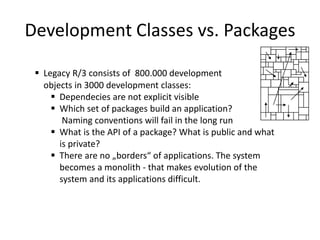
  Legacy R/3 consists of 800.000 development
   objects in 3000 development classes:
      Dependecies are not explicit visible
      Which set of packages build an application?
        Naming conventions will fail in the long run
      What is the API of a package? What is public and what
       is private?
      There are no „borders“ of applications. The system
       becomes a monolith - that makes evolution of the
       system and its applications difficult.
How can the Package Concept help?

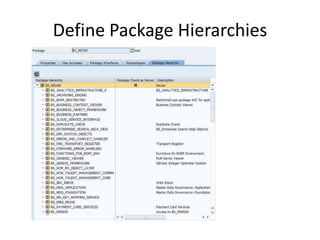
 Packages can be ordered hierarchically. An application consists
  of a package hierarchy with a main or structure package on
  top.

 With package interfaces you can define (and document)
  dependencies between applications in an explicit way.

 Using package checks you can check violations of
  dependencies.
How can the Package Concept help
you in Custom Development Projects?
  Reduce dependencies: control impact of Ehps /
   switched Business Functions
  Use stable APIs
  Guarantee installability of software components at
   development time
  Structure your applications
  Maintain and evolve applications independently
  Define stable APIs using interfaces
  Need for privacy - don‘t expose everything to everyone!
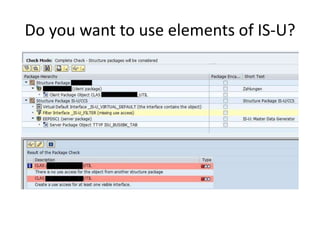
Do you want to use elements of IS-U?

 
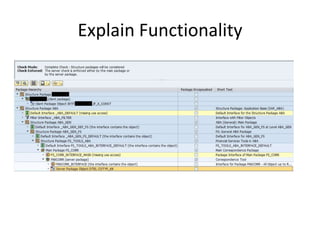
Explain Functionality

Software Components &
            Structure Packages
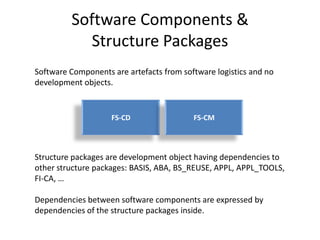
Software Components are artefacts from software logistics and no
development objects.


                    FS-CD                 FS-CM


Structure packages are development object having dependencies to
other structure packages: BASIS, ABA, BS_REUSE, APPL, APPL_TOOLS,
FI-CA, …

Dependencies between software components are expressed by
dependencies of the structure packages inside.
Properties of Structure Packages
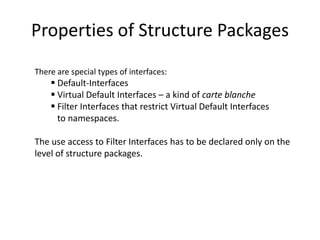
There are special types of interfaces:
     Default-Interfaces
     Virtual Default Interfaces – a kind of carte blanche
     Filter Interfaces that restrict Virtual Default Interfaces
      to namespaces.

The use access to Filter Interfaces has to be declared only on the
level of structure packages.
How to implement
           ABAP Package Concept
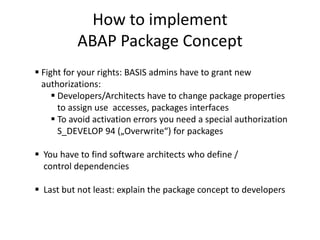
 Fight for your rights: BASIS admins have to grant new
  authorizations:
      Developers/Architects have to change package properties
       to assign use accesses, packages interfaces
      To avoid activation errors you need a special authorization
       S_DEVELOP 94 („Overwrite“) for packages

 You have to find software architects who define /
  control dependencies

 Last but not least: explain the package concept to developers
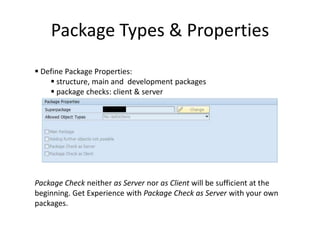
Package Types & Properties
 Define Package Properties:
     structure, main and development packages
     package checks: client & server


Package Check neither as Server nor as Client will be sufficient at the
beginning. Get Experience with Package Check as Server with your own
packages.
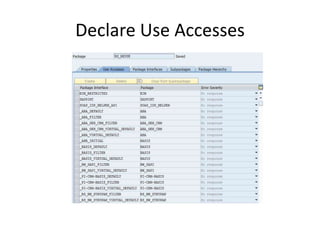
Declare Use Accesses
Define Package Hierarchies

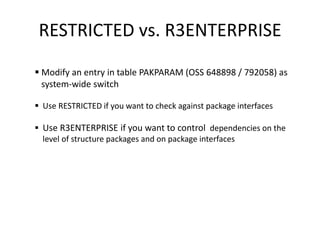
RESTRICTED vs. R3ENTERPRISE

 Modify an entry in table PAKPARAM (OSS 648898 / 792058) as
  system-wide switch

 Use RESTRICTED if you want to check against package interfaces

 Use R3ENTERPRISE if you want to control dependencies on the
  level of structure packages and on package interfaces
Define Interfaces

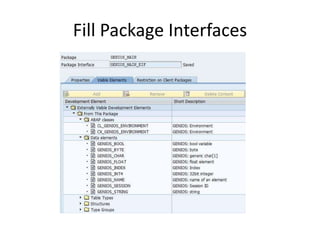
 Package interfaces can contain package interfaces from
 packages deeper in the hierarchy.
Fill Package Interfaces
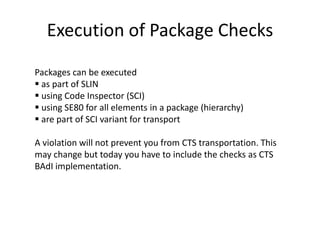
Execution of Package Checks

Packages can be executed
 as part of SLIN
 using Code Inspector (SCI)
 using SE80 for all elements in a package (hierarchy)
 are part of SCI variant for transport

A violation will not prevent you from CTS transportation. This
may change but today you have to include the checks as CTS
BAdI implementation.
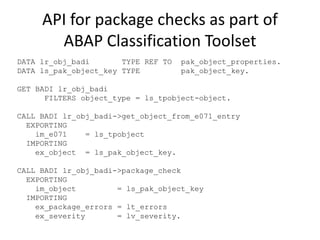
API for package checks as part of
       ABAP Classification Toolset
DATA lr_obj_badi       TYPE REF TO   pak_object_properties.
DATA ls_pak_object_key TYPE          pak_object_key.

GET BADI lr_obj_badi
      FILTERS object_type = ls_tpobject-object.

CALL BADI lr_obj_badi->get_object_from_e071_entry
  EXPORTING
    im_e071    = ls_tpobject
  IMPORTING
    ex_object = ls_pak_object_key.

CALL BADI lr_obj_badi->package_check
  EXPORTING
    im_object         = ls_pak_object_key
  IMPORTING
    ex_package_errors = lt_errors
    ex_severity       = lv_severity.
SAP NetWeaver 7.30

 ABAP package concept gets more complex: access control list…

 Some interface types will vanish

 Migration reports (have a look at OSS):
    RS_MIGRATE_PACKAGES
    RS_MIGRATE_PACKAGEINTERFACES
    SPAK_CREATE_HYBRID_PACK_DATA

 Packages checks not (yet) part of ABAP runtime
Questions? Criticism? Comments?


  I would like to get into discussion!

  I‘ll blog on SCN about this topic.

Abap package concept

  • 1.
    ABAP Package Concept UseCases & Best Practices Tobias Trapp, AOK Systems GmbH Enterprise Architect, SAP Mentor
  • 2.
    ABAP Developers andReuse  „In SAP Business Suite there‘s so much useful stuff.“  „I can save 40 seconds of my life time by using data elements from SAP standard: CHAR04, CHAR130, BEZEI30…“  „And for something more complicated I‘m looking for an function module.“
  • 3.
    Is this howwe should do reuse?  Do you use a certain data element (BEZEI30) because it is part of SAP data model you want use?  If not: don‘t you want to be able to define your own short and help texts?  How do you know that this certain function module is appropriate? How do you know that it belongs to a public API?
  • 4.
    An Architect‘s Answer Think in terms of applications and APIs - not in terms of data elements and function modules.  If you work with a certain SAP data model use the corresponding data elements and domains. In your own applications don‘t be afraid to create your own DDIC elements and local data types.  Use DDIC elements, classes… that are exposed in package interfaces. Within SAP Business Suite this is a development guideline. So you can be sure that you use appropriate functions that are stable according to release changes. The local integration engine infrastructure (package SAI) is a good example.
  • 5.
    Development Classes vs.Packages  Legacy R/3 consists of 800.000 development objects in 3000 development classes:  Dependecies are not explicit visible  Which set of packages build an application? Naming conventions will fail in the long run  What is the API of a package? What is public and what is private?  There are no „borders“ of applications. The system becomes a monolith - that makes evolution of the system and its applications difficult.
  • 6.
    How can thePackage Concept help?  Packages can be ordered hierarchically. An application consists of a package hierarchy with a main or structure package on top.  With package interfaces you can define (and document) dependencies between applications in an explicit way.  Using package checks you can check violations of dependencies.
  • 7.
    How can thePackage Concept help you in Custom Development Projects?  Reduce dependencies: control impact of Ehps / switched Business Functions  Use stable APIs  Guarantee installability of software components at development time  Structure your applications  Maintain and evolve applications independently  Define stable APIs using interfaces  Need for privacy - don‘t expose everything to everyone!
  • 8.
    Do you wantto use elements of IS-U? 
  • 9.
  • 10.
    Software Components & Structure Packages Software Components are artefacts from software logistics and no development objects. FS-CD FS-CM Structure packages are development object having dependencies to other structure packages: BASIS, ABA, BS_REUSE, APPL, APPL_TOOLS, FI-CA, … Dependencies between software components are expressed by dependencies of the structure packages inside.
  • 11.
    Properties of StructurePackages There are special types of interfaces:  Default-Interfaces  Virtual Default Interfaces – a kind of carte blanche  Filter Interfaces that restrict Virtual Default Interfaces to namespaces. The use access to Filter Interfaces has to be declared only on the level of structure packages.
  • 12.
    How to implement ABAP Package Concept  Fight for your rights: BASIS admins have to grant new authorizations:  Developers/Architects have to change package properties to assign use accesses, packages interfaces  To avoid activation errors you need a special authorization S_DEVELOP 94 („Overwrite“) for packages  You have to find software architects who define / control dependencies  Last but not least: explain the package concept to developers
  • 13.
    Package Types &Properties  Define Package Properties:  structure, main and development packages  package checks: client & server Package Check neither as Server nor as Client will be sufficient at the beginning. Get Experience with Package Check as Server with your own packages.
  • 14.
  • 15.
  • 16.
    RESTRICTED vs. R3ENTERPRISE Modify an entry in table PAKPARAM (OSS 648898 / 792058) as system-wide switch  Use RESTRICTED if you want to check against package interfaces  Use R3ENTERPRISE if you want to control dependencies on the level of structure packages and on package interfaces
  • 17.
    Define Interfaces  Packageinterfaces can contain package interfaces from packages deeper in the hierarchy.
  • 18.
  • 19.
    Execution of PackageChecks Packages can be executed  as part of SLIN  using Code Inspector (SCI)  using SE80 for all elements in a package (hierarchy)  are part of SCI variant for transport A violation will not prevent you from CTS transportation. This may change but today you have to include the checks as CTS BAdI implementation.
  • 20.
    API for packagechecks as part of ABAP Classification Toolset DATA lr_obj_badi TYPE REF TO pak_object_properties. DATA ls_pak_object_key TYPE pak_object_key. GET BADI lr_obj_badi FILTERS object_type = ls_tpobject-object. CALL BADI lr_obj_badi->get_object_from_e071_entry EXPORTING im_e071 = ls_tpobject IMPORTING ex_object = ls_pak_object_key. CALL BADI lr_obj_badi->package_check EXPORTING im_object = ls_pak_object_key IMPORTING ex_package_errors = lt_errors ex_severity = lv_severity.
  • 21.
    SAP NetWeaver 7.30 ABAP package concept gets more complex: access control list…  Some interface types will vanish  Migration reports (have a look at OSS):  RS_MIGRATE_PACKAGES  RS_MIGRATE_PACKAGEINTERFACES  SPAK_CREATE_HYBRID_PACK_DATA  Packages checks not (yet) part of ABAP runtime
  • 22.
    Questions? Criticism? Comments? I would like to get into discussion! I‘ll blog on SCN about this topic.