• Blood transfusion is generally
the process of
receiving blood or blood
products into
one's circulation intravenously.
• Transfusions are used for
various medical conditions to
replace lost components of the
blood
Reference: Robert davidson, Thomas walker,maryland press, 21st edition, 2O10-Davidson’s
principle & practice of medicine, Pages 97-99, London
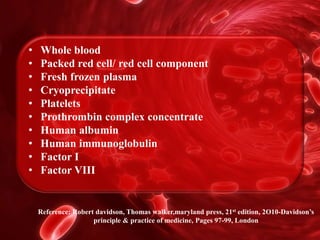
• Whole blood
• Packed red cell/ red cell component
• Fresh frozen plasma
• Cryoprecipitate
• Platelets
• Prothrombin complex concentrate
• Human albumin
• Human immunoglobulin
• Factor I
• Factor VIII
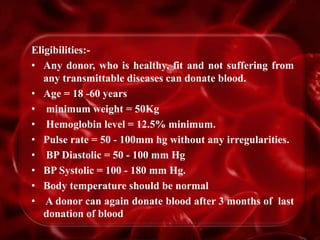
Eligibilities:-
• Any donor, who is healthy, fit and not suffering from
any transmittable diseases can donate blood.
• Age = 18 -60 years
• minimum weight = 50Kg
• Hemoglobin level = 12.5% minimum.
• Pulse rate = 50 - 100mm hg without any irregularities.
• BP Diastolic = 50 - 100 mm Hg
• BP Systolic = 100 - 180 mm Hg.
• Body temperature should be normal
• A donor can again donate blood after 3 months of last
donation of blood
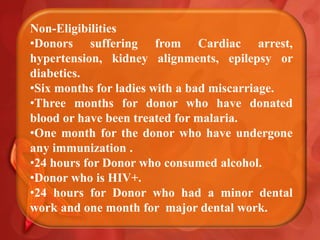
Non-Eligibilities
•Donors suffering from Cardiac arrest,
hypertension, kidney alignments, epilepsy or
diabetics.
•Six months for ladies with a bad miscarriage.
•Three months for donor who have donated
blood or have been treated for malaria.
•One month for the donor who have undergone
any immunization .
•24 hours for Donor who consumed alcohol.
•Donor who is HIV+.
•24 hours for Donor who had a minor dental
work and one month for major dental work.
Tests for
safe blood
transfusion
REFERENCE: Robert davidson, Thomas walker, Maryland press, 21st edition, 2O10-Davidson’s
principle & practice of medicine, Pages 97-99, London
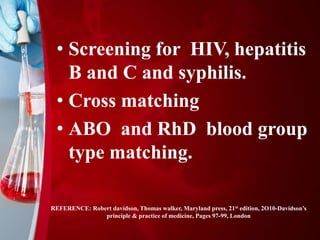
• Screening for HIV, hepatitis
B and C and syphilis.
• Cross matching
• ABO and RhD blood group
type matching.
Complications
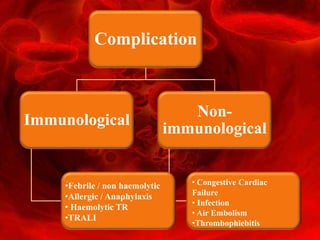
Complication
Non-
immunological
Immunological
•Febrile / non haemolytic
•Allergic / Anaphylaxis
• Haemolytic TR
•TRALI
• Congestive Cardiac
Failure
• Infection
• Air Embolism
•Thrombophlebitis
Prevention of
complication
by massive
blood
transfusion
• Proper screening & cross matching
• Avoid hypothermia by using a blood
warmer and a slower rate of
transfusion, particularly in patients
with hepatic or renal failure.
• Coagulation status and platelet count
should be checked regularly.
REFERENCE: Leon shargel, Alan H. Mutnick, Alex publication, 7th edition, 2001-
comprehensive pharmacy review, pg367- 370, phildelphia
Reference
• Robert davidson, Thomas walker,maryland
press, 21st edition, 2O10-Davidson’s
principle & practice of medicine, Pages 97-
99, London
• Leon shargel, Alan H. Mutnick, Alex
publication, 7th edition, 2001-
comprehensive pharmacy review, pg367-
370, phildelphia
blood transfusion

blood transfusion

  • 3.
    • Blood transfusionis generally the process of receiving blood or blood products into one's circulation intravenously. • Transfusions are used for various medical conditions to replace lost components of the blood
  • 5.
    Reference: Robert davidson,Thomas walker,maryland press, 21st edition, 2O10-Davidson’s principle & practice of medicine, Pages 97-99, London • Whole blood • Packed red cell/ red cell component • Fresh frozen plasma • Cryoprecipitate • Platelets • Prothrombin complex concentrate • Human albumin • Human immunoglobulin • Factor I • Factor VIII
  • 9.
    Eligibilities:- • Any donor,who is healthy, fit and not suffering from any transmittable diseases can donate blood. • Age = 18 -60 years • minimum weight = 50Kg • Hemoglobin level = 12.5% minimum. • Pulse rate = 50 - 100mm hg without any irregularities. • BP Diastolic = 50 - 100 mm Hg • BP Systolic = 100 - 180 mm Hg. • Body temperature should be normal • A donor can again donate blood after 3 months of last donation of blood
  • 10.
    Non-Eligibilities •Donors suffering fromCardiac arrest, hypertension, kidney alignments, epilepsy or diabetics. •Six months for ladies with a bad miscarriage. •Three months for donor who have donated blood or have been treated for malaria. •One month for the donor who have undergone any immunization . •24 hours for Donor who consumed alcohol. •Donor who is HIV+. •24 hours for Donor who had a minor dental work and one month for major dental work.
  • 11.
  • 12.
    REFERENCE: Robert davidson,Thomas walker, Maryland press, 21st edition, 2O10-Davidson’s principle & practice of medicine, Pages 97-99, London • Screening for HIV, hepatitis B and C and syphilis. • Cross matching • ABO and RhD blood group type matching.
  • 13.
  • 14.
    Complication Non- immunological Immunological •Febrile / nonhaemolytic •Allergic / Anaphylaxis • Haemolytic TR •TRALI • Congestive Cardiac Failure • Infection • Air Embolism •Thrombophlebitis
  • 15.
  • 16.
    • Proper screening& cross matching • Avoid hypothermia by using a blood warmer and a slower rate of transfusion, particularly in patients with hepatic or renal failure. • Coagulation status and platelet count should be checked regularly. REFERENCE: Leon shargel, Alan H. Mutnick, Alex publication, 7th edition, 2001- comprehensive pharmacy review, pg367- 370, phildelphia
  • 17.
    Reference • Robert davidson,Thomas walker,maryland press, 21st edition, 2O10-Davidson’s principle & practice of medicine, Pages 97- 99, London • Leon shargel, Alan H. Mutnick, Alex publication, 7th edition, 2001- comprehensive pharmacy review, pg367- 370, phildelphia