Description
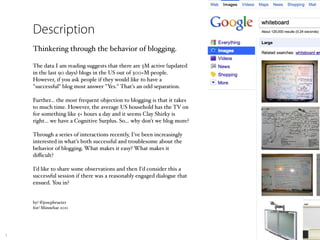
    Thinkering through the behavior of blogging.

    The data I am reading suggests that there are 5M active (updated
    in the last 90 days) blogs in the US out of 300+M people.
    However, if you ask people if they would like to have a
    "successful" blog most answer "Yes." That's an odd separation.

    Further... the most frequent objection to blogging is that it takes
    to much time. However, the average US household has the TV on
    for something like 5+ hours a day and it seems Clay Shirky is
    right... we have a Cognitive Surplus. So... why don't we blog more?

    Through a series of interactions recently, I've been increasingly
    interested in what's both successful and troublesome about the
    behavior of blogging. What makes it easy? What makes it
    difficult?

    I'd like to share some observations and then I'd consider this a
    successful session if there was a reasonably engaged dialogue that
    ensued. You in?


    by/ @josephrueter
    for/ Minnebar 2011


1
WHY DON’T YOU BLOG MORE?
       Thinkering through the behavior of blogging.


2
WHY DON’T I BLOG MORE?


3
WHY DON’T I BLOG MORE?
              Not enough ideas?
               I was not taught?
             It takes lots of time?
                It’s way public?
         There are not enough readers?
            It’s not crisp and easy?


4
Intro
    What Wiki Says:

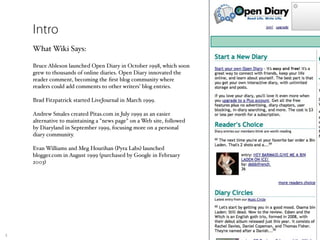
    Bruce Ableson launched Open Diary in October 1998, which soon
    grew to thousands of online diaries. Open Diary innovated the
    reader comment, becoming the first blog community where
    readers could add comments to other writers' blog entries.

    Brad Fitzpatrick started LiveJournal in March 1999.

    Andrew Smales created Pitas.com in July 1999 as an easier
    alternative to maintaining a "news page" on a Web site, followed
    by Diaryland in September 1999, focusing more on a personal
    diary community.

    Evan Williams and Meg Hourihan (Pyra Labs) launched
    blogger.com in August 1999 (purchased by Google in February
    2003)


5
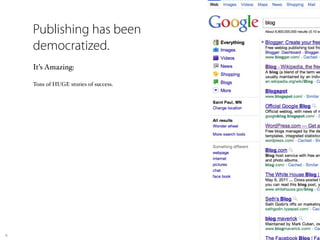
Publishing has been
    democratized.
    It’s Amazing:

    Tons of HUGE stories of success.


6
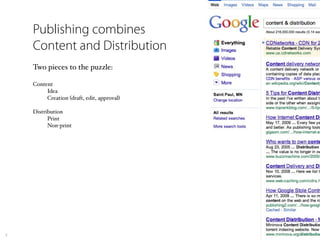
Publishing combines
    Content and Distribution
    Two pieces to the puzzle:

    Content
    
    Idea
    
    Creation (draft, edit, approval)

    Distribution
    
     Print
    
     Non-print


7
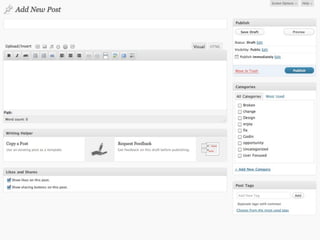
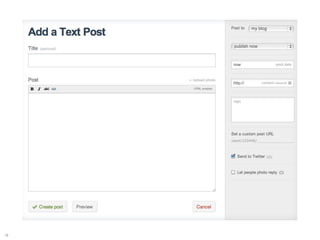
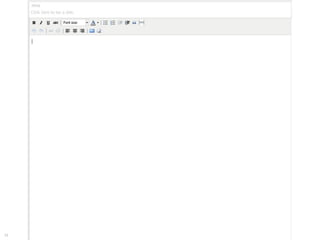
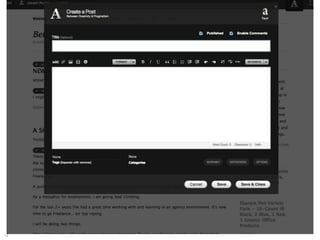
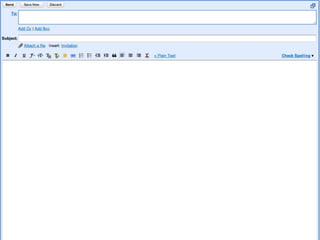
Problem
    It’s BLANK:

    Content:
    While a blank screen with a pile of editing tools have been
    democratized KNOWING how or wanting to write/create
    content has not.

    Distribution:
    Further... the audience when you start is blank too.


8
9
10
11
12
13
14
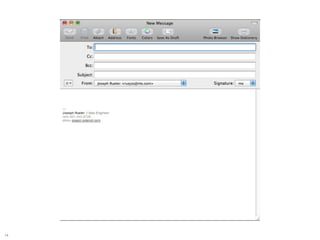
what’s a bookmarklet?


15
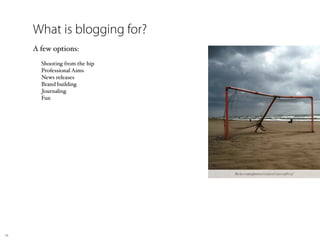
What is blogging for?
     A few options:
     
         Shooting from the hip
         Professional Aims
         News releases
         Brand building
         Journaling
         Fun


                                 flickr.com/photos/corscri/1320198723/


16
Content Strategy vs.
     Con dence Strategy
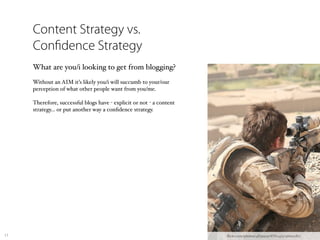
     What are you/i looking to get from blogging?
     Without an AIM it’s likely you/i will succumb to your/our
     perception of what other people want from you/me.

     Therefore, successful blogs have - explicit or not - a content
     strategy… or put another way a confidence strategy.


17                                                                    flickr.com/photos/48399297@N04/5036691180/
Bloggers have an edge
     They have Access:

       Information
       Perspective


18                           flickr.com/photos/83156837@N00/349367047/
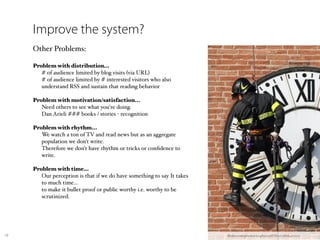
Improve the system?
     Other Problems:

     Problem with distribution…
     
 # of audience limited by blog visits (via URL)
     
 # of audience limited by # interested visitors who also
        understand RSS and sustain that reading behavior

     Problem with motivation/satisfaction...
     
 Need others to see what you're doing.
     
 Dan Arieli ### books / stories - recognition
     
     Problem with rhythm...
     
 We watch a ton of TV and read news but as an aggregate
        population we don't write.
     
 Therefore we don't have rhythm or tricks or confidence to
        write.

     Problem with time…
     
 Our perception is that if we do have something to say It takes
        to much time…
     
 to make it bullet proof or public worthy i.e. worthy to be
        scrutinized.


19                                                                      flickr.com/photos/52485003@N00/281640001/
Improve the system?
     Solve for the Content and/or Distribution

     Twitter…
     
 Content Problem: Blog posts are to long and hard to write
     
 Solution: Twitter limits the size of the posts

     
   Distribution Problem: Jumping around to different blogs is
         hard for readers and I want readers if I am going to write
     
   Solution: Twitter built in a reader and follower counts

     Posterous…
     
 Content Problem: the process of making a post is to hard
     
 Solution: Posterous championed emailing it in.

     
   Distribution Problem: I am in many places and it takes to
         long to manually make them work together
     
   Solution: Posterous automates the distribution of content to
         other places.

     Tumblr...
     
 Content Problem: posts can be made easier if they are built
       atop reference content
     
 Solution: tumblr has a killer bookmarklet.
     
     
 Distribution Problem: Jumping around is hard
     
 Solution: Tumblr has a reader on the first page after login
20                                                                      flickr.com/photos/41864721@N00/3616409588/
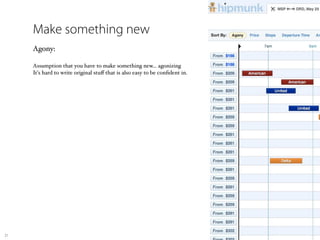
Make something new
     Agony:

     Assumption that you have to make something new… agonizing
     It's hard to write original stuff that is also easy to be confident in.


21
Make something new
     Few willingly write for NO readers:
     The most successful blogs are of two content types.
        - self
        - other content repackaged


22                                                         flickr.com/photos/90046593@N00/292761778/
Ways Forward
     We read and have opinions.
      Find ways to share them


     We care what other people think
      Have a content and confidence strategy


     We care that our work is recognized.
      Find ways to get others to share with you what
      they are thinking when reading your content.
      Find successful analytics software.


     Structure ways to now they are engaging with
     your content in a way that is meaningful to you.
        Get those metrics automatically delivered.


23                                                      flickr.com/photos/34974864@N00/389537711/
Ways Forward
     We read and have opinions.
      Find ways to share them


     We care what other people think
      Have a content and confidence strategy


     We care that our work is recognized.
      Find ways to get others to share with you what
      they are thinking when reading your content.
      Find successful analytics software.


     Structure ways to now they are engaging with
     your content in a way that is meaningful to you.
        Get those metrics automatically delivered.


24                                                      flickr.com/photos/34974864@N00/389537711/
Ways Forward
     We read and have opinions.
      Find ways to share them


     We care what other people think
      Have a content and confidence strategy


     We care that our work is recognized.
      Find ways to get others to share with you what
      they are thinking when reading your content.
      Find successful analytics software.


     Structure ways to now they are engaging with
     your content in a way that is meaningful to you.
        Get those metrics automatically delivered.


25                                                      flickr.com/photos/34974864@N00/389537711/
Ways Forward
     We read and have opinions.
      Find ways to share them


     We care what other people think
      Have a content and confidence strategy


     We care that our work is recognized.
      Find ways to get others to share with you what
      they are thinking when reading your content.
      Find successful analytics software.


     Structure ways to know they are engaging with
     your content in a way that is meaningful to you.
        Get those metrics automatically delivered.


26                                                      flickr.com/photos/34974864@N00/389537711/
flickr.com/photos/7900943@N06/3985803157/

Why Don't You Blog More?

  • 1.
    Description Thinkering through the behavior of blogging. The data I am reading suggests that there are 5M active (updated in the last 90 days) blogs in the US out of 300+M people. However, if you ask people if they would like to have a "successful" blog most answer "Yes." That's an odd separation. Further... the most frequent objection to blogging is that it takes to much time. However, the average US household has the TV on for something like 5+ hours a day and it seems Clay Shirky is right... we have a Cognitive Surplus. So... why don't we blog more? Through a series of interactions recently, I've been increasingly interested in what's both successful and troublesome about the behavior of blogging. What makes it easy? What makes it difficult? I'd like to share some observations and then I'd consider this a successful session if there was a reasonably engaged dialogue that ensued. You in? by/ @josephrueter for/ Minnebar 2011 1
  • 2.
    WHY DON’T YOUBLOG MORE? Thinkering through the behavior of blogging. 2
  • 3.
    WHY DON’T IBLOG MORE? 3
  • 4.
    WHY DON’T IBLOG MORE? Not enough ideas? I was not taught? It takes lots of time? It’s way public? There are not enough readers? It’s not crisp and easy? 4
  • 5.
    Intro What Wiki Says: Bruce Ableson launched Open Diary in October 1998, which soon grew to thousands of online diaries. Open Diary innovated the reader comment, becoming the first blog community where readers could add comments to other writers' blog entries. Brad Fitzpatrick started LiveJournal in March 1999. Andrew Smales created Pitas.com in July 1999 as an easier alternative to maintaining a "news page" on a Web site, followed by Diaryland in September 1999, focusing more on a personal diary community. Evan Williams and Meg Hourihan (Pyra Labs) launched blogger.com in August 1999 (purchased by Google in February 2003) 5
  • 6.
    Publishing has been democratized. It’s Amazing: Tons of HUGE stories of success. 6
  • 7.
    Publishing combines Content and Distribution Two pieces to the puzzle: Content Idea Creation (draft, edit, approval) Distribution Print Non-print 7
  • 8.
    Problem It’s BLANK: Content: While a blank screen with a pile of editing tools have been democratized KNOWING how or wanting to write/create content has not. Distribution: Further... the audience when you start is blank too. 8
  • 9.
  • 10.
  • 11.
  • 12.
  • 13.
  • 14.
  • 15.
  • 16.
    What is bloggingfor? A few options: Shooting from the hip Professional Aims News releases Brand building Journaling Fun flickr.com/photos/corscri/1320198723/ 16
  • 17.
    Content Strategy vs. Con dence Strategy What are you/i looking to get from blogging? Without an AIM it’s likely you/i will succumb to your/our perception of what other people want from you/me. Therefore, successful blogs have - explicit or not - a content strategy… or put another way a confidence strategy. 17 flickr.com/photos/48399297@N04/5036691180/
  • 18.
    Bloggers have anedge They have Access: Information Perspective 18 flickr.com/photos/83156837@N00/349367047/
  • 19.
    Improve the system? Other Problems: Problem with distribution… # of audience limited by blog visits (via URL) # of audience limited by # interested visitors who also understand RSS and sustain that reading behavior Problem with motivation/satisfaction... Need others to see what you're doing. Dan Arieli ### books / stories - recognition Problem with rhythm... We watch a ton of TV and read news but as an aggregate population we don't write. Therefore we don't have rhythm or tricks or confidence to write. Problem with time… Our perception is that if we do have something to say It takes to much time… to make it bullet proof or public worthy i.e. worthy to be scrutinized. 19 flickr.com/photos/52485003@N00/281640001/
  • 20.
    Improve the system? Solve for the Content and/or Distribution Twitter… Content Problem: Blog posts are to long and hard to write Solution: Twitter limits the size of the posts Distribution Problem: Jumping around to different blogs is hard for readers and I want readers if I am going to write Solution: Twitter built in a reader and follower counts Posterous… Content Problem: the process of making a post is to hard Solution: Posterous championed emailing it in. Distribution Problem: I am in many places and it takes to long to manually make them work together Solution: Posterous automates the distribution of content to other places. Tumblr... Content Problem: posts can be made easier if they are built atop reference content Solution: tumblr has a killer bookmarklet. Distribution Problem: Jumping around is hard Solution: Tumblr has a reader on the first page after login 20 flickr.com/photos/41864721@N00/3616409588/
  • 21.
    Make something new Agony: Assumption that you have to make something new… agonizing It's hard to write original stuff that is also easy to be confident in. 21
  • 22.
    Make something new Few willingly write for NO readers: The most successful blogs are of two content types. - self - other content repackaged 22 flickr.com/photos/90046593@N00/292761778/
  • 23.
    Ways Forward We read and have opinions. Find ways to share them We care what other people think Have a content and confidence strategy We care that our work is recognized. Find ways to get others to share with you what they are thinking when reading your content. Find successful analytics software. Structure ways to now they are engaging with your content in a way that is meaningful to you. Get those metrics automatically delivered. 23 flickr.com/photos/34974864@N00/389537711/
  • 24.
    Ways Forward We read and have opinions. Find ways to share them We care what other people think Have a content and confidence strategy We care that our work is recognized. Find ways to get others to share with you what they are thinking when reading your content. Find successful analytics software. Structure ways to now they are engaging with your content in a way that is meaningful to you. Get those metrics automatically delivered. 24 flickr.com/photos/34974864@N00/389537711/
  • 25.
    Ways Forward We read and have opinions. Find ways to share them We care what other people think Have a content and confidence strategy We care that our work is recognized. Find ways to get others to share with you what they are thinking when reading your content. Find successful analytics software. Structure ways to now they are engaging with your content in a way that is meaningful to you. Get those metrics automatically delivered. 25 flickr.com/photos/34974864@N00/389537711/
  • 26.
    Ways Forward We read and have opinions. Find ways to share them We care what other people think Have a content and confidence strategy We care that our work is recognized. Find ways to get others to share with you what they are thinking when reading your content. Find successful analytics software. Structure ways to know they are engaging with your content in a way that is meaningful to you. Get those metrics automatically delivered. 26 flickr.com/photos/34974864@N00/389537711/
  • 27.