CodeFreeze Meetup, Dec `16
Blockchain For Developers
Alexander Chepurnoy
(aka kushti)
@chepurnoy
IOHK Research
Background
● Nxt core developer
● smartcontract.com cofounder (left)
● Scorex since late 2014
● IOHK Research
The talk is about
● How a developer can view a blockchain system
● What are open problems in blockchains
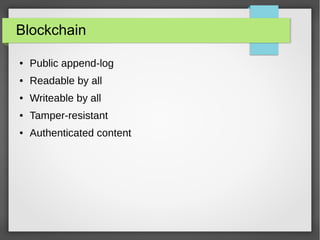
Blockchain
● Public append-log
● Readable by all
● Writeable by all
● Tamper-resistant
● Authenticated content
Use Cases
● E-Cash
● Titles
● Stocks settlement
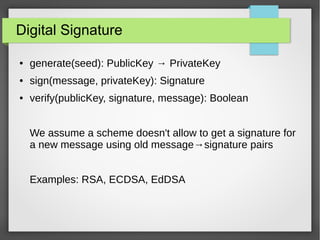
Digital Signature
● generate(seed): PublicKey → PrivateKey
● sign(message, privateKey): Signature
● verify(publicKey, signature, message): Boolean
We assume a scheme doesn't allow to get a signature for
a new message using old message→signature pairs
Examples: RSA, ECDSA, EdDSA
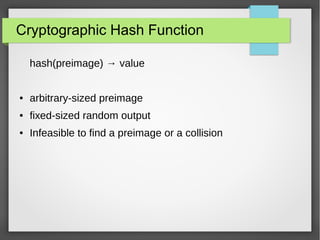
Cryptographic Hash Function
hash(preimage) → value
● arbitrary-sized preimage
● fixed-sized random output
● Infeasible to find a preimage or a collision
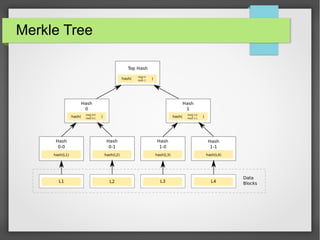
Merkle Tree
Background: E-Cash
● Alice is sending a coin to Bob
● A coin is just a bitstring
● How to prevent double-spend?
● How to make money transfers untrackable?
Background: E-Cash
● David Chaum, mid-1980s
● E-Cash
● Anonymous
● Central Bank required
● DigiCash (bankruptcy in 1998)
● a lot of academic research (not turned out to be practical)
Distributed Consensus
● Fixed number of known parties
● 0/1 inputs
Properties:
● Agreement – all the parties agree on the same output
● Validity – an output must be some node's input
● Termination – the protocol somewhen finishes
Failure Models
● Crash-Stop
● Crash-Recovery
● Byzantine – arbitrary behaviour
Impossibility Results
● FLP theorem (Fischer et al, 1983) – a deterministic
consensus protocol doesn't have a guarantee of
termination in case of asynchronous messaging and a
possibility of a single node to fail
● Byzantine Generals problem - it there are t Byzantine
parties amongst n, agreement is possible only if n > 3t and
the communication is synchronous (bounded delay)
Environment
● P2P network
● No central party
● Many parties are possibly malicious
● Probabilistic broadcast
P2P network
● Each node has own view
● The goal is to have replicated subset of it across the
network
● In the presence of Byzantine adversaries!
● (so only honest nodes agree on the state)
● (and only eventually)
A transaction
● Atomic state modifier
● Authenticated
Minimal State
● Can answer the question „whether a transaction is valid
and so applicable“
● apply(min_state, tx): (MinimalState | Error)
● apply(apply(min_state, tx), tx) is always Error
● In Bitcoin UTXO set
Minimal State
● Transaction application is deterministic
● There's some initial (genesis) state hardcoded
● By applying the same sequence of transactions to the
genesis state, two honest nodes got the same minimal
state
● Thus we need for a guarantee every pair of honest nodes
is eventually applying the same sequence of transactions!
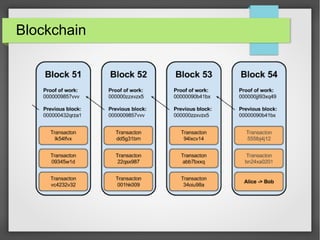
Blockchain
● Transactions packed into blocks
● Blocks are linked
Blockchain
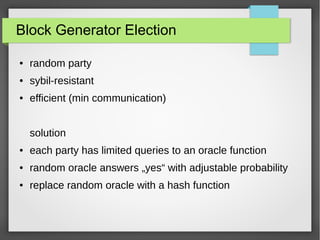
Block Generator Election
● random party
● sybil-resistant
● efficient (min communication)
solution
● each party has limited queries to an oracle function
● random oracle answers „yes“ with adjustable probability
● replace random oracle with a hash function
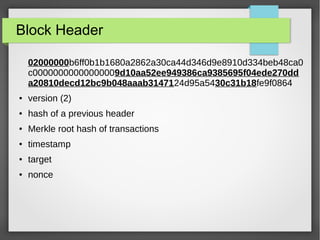
Block Header
02000000b6ff0b1b1680a2862a30ca44d346d9e8910d334beb48ca0
c00000000000000009d10aa52ee949386ca9385695f04ede270dd
a20810decd12bc9b048aaab3147124d95a5430c31b18fe9f0864
● version (2)
● hash of a previous header
● Merkle root hash of transactions
● timestamp
● target
● nonce
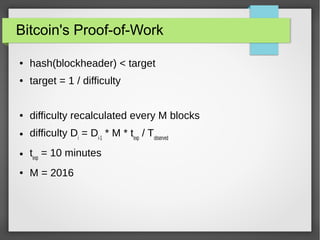
Bitcoin's Proof-of-Work
● hash(blockheader) < target
● target = 1 / difficulty
● difficulty recalculated every M blocks
● difficulty Di
= Di-1
* M * texp
/ Tobserved
● texp
= 10 minutes
● M = 2016
Rewards
● Why to perform work?
● Miner creates a transaction to self with a fixed amount
● This is the 1st transaction in the Merkle tree (coinbase tx)
Race For a Block
● Everyone can participate
● Chance to win is hashpower(mine) / hashpower(total)
(well, not really)
● Collisions are possible (two blocks at about same time)
● Eventually longest chain wins
(well, not really)
Break!
● Questions?
GKL Model
● „The Bitcoin Backbone Protocol:Analysis and Applications“
by Garay / Kiayias / Leonardos
● slides: https://bitcoinschool.gr/slides/session2.pdf
Bitcoin consensus protocol properties:
● Common Prefix
● Chain Quality
● Chain Growth
Common Prefix
no matter the strategy of the adversary, the chains of two
honest parties will fork in the last k blocks with probability
exponentially decreasing with k
Chain Quality
any sequence of blocks in an honest party’s chain will
contain some number of honest blocks with overwhelming
probability
Chain Growth
honest party's chain grows with some minimal pace with
an overwhelming probability
Bitcoin
● digital cash
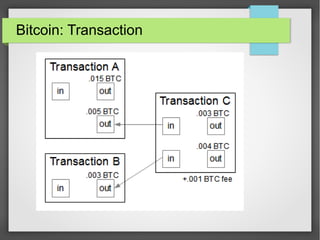
● transaction is a set of token transfers
Bitcoin: Transaction
Bitcoin Script
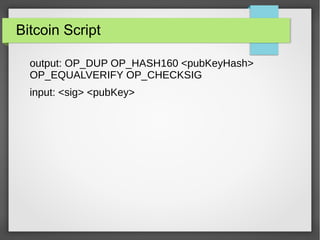
output: OP_DUP OP_HASH160 <pubKeyHash>
OP_EQUALVERIFY OP_CHECKSIG
input: <sig> <pubKey>
Bitcoin Addresses
● There are no any accounts in Bitcoin
● In most cases address is PKH (160 bits) + checksum +
additional info, in Base58 encoding
Bitcoin: UTXO set
● unspent outputs set
● enough to validate any transaction
● application is about removing outputs spent and add new
ones
Memory Pool
● contains unconfirmed transaction
● inconsistent across a network
Vault (Wallet)
● node-specific information
● e.g. transactions for selected pubkeys
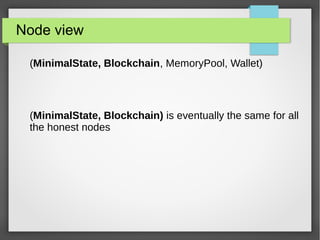
Node view
(MinimalState, Blockchain, MemoryPool, Wallet)
(MinimalState, Blockchain) is eventually the same for all
the honest nodes
What app developer should know
● Rollbacks are possible!
● Transaction is always visible before inclusion
● Frontrunning / replay attacks
● Signature and transaction malleability
Modifications
● alternative consensus protocols (Proof-of-Stake etc)
● richer transactional models (NameCoin, Ethereum, ZCash)
● alternative log structures (Bitcoin-NG, GHOST,
TwinsChain)
● incentivization of certain activities (Permacoin, Rollerchain)
Scalability
Basic assumption
● It should be possible to run a fullnode on a commodity
hardware
● HDD
● 1-2 GB RAM
● 1 Mbps at most
● Ethereum lost
● Bitcoin is doing hard to hold the assumption
Bitcoin's Troughput (TPS)
● 7 ??? no
● 2-3 in fact
● 1/600 in worse case
https://www.reddit.com/r/Bitcoin/comments/3cgft7/largest_trans
Better throughput
● Bitcoin-NG
● GHOST/SPECTRE
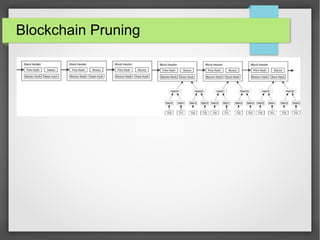
Blockchain Pruning
Rollerchain
● Chepurnoy, Larangeira, Ozhiganov
http://arxiv.org/abs/1603.07926
„Rollerchain, a Blockchain Secure in the Rational Storage
Setting“
Rollerchain
● Only last n full blocks to be stored collectively
and n state snapshots
● Each miner stores k state snapshots
Rollerchain
● New node can download a historical snapshot
● Fullblocks not needed for mining could be thrown away
● Blockheaders are to be stored forever, so must be small
Unload the chain
● Move things off-chain
● Sidechains
● Avoid all the transactions execution(RsCoin)
Offchain
● Lightning Network
● Offchain contracts(SMC/SMP)
Smart Contracts
● Ethereum isn't scalable
● Hawk
● Enigma
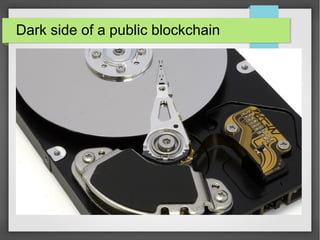
Dark side of a public blockchain
Slowing down processing
● Bitcoin: CVE-2013-2293 (fetching outputs from hdd)
● Ethereum: most of recent attacks (fetching account states)
Asymmetric schemes
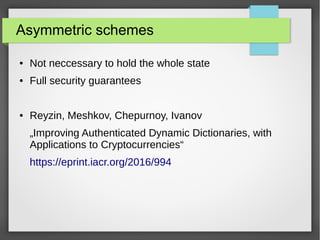
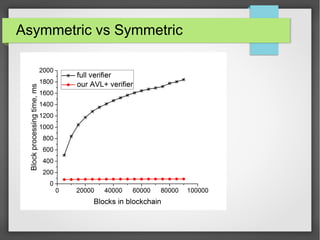
● Not neccessary to hold the whole state
● Full security guarantees
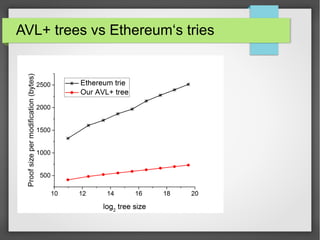
● Reyzin, Meshkov, Chepurnoy, Ivanov
„Improving Authenticated Dynamic Dictionaries, with
Applications to Cryptocurrencies“
https://eprint.iacr.org/2016/994
Asymmetric vs Symmetric
AVL+ trees vs Ethereum‘s tries
Rational Behaviour
● Why store blocks for years after processing?
● Why to validate blocks (in PoW)?
● Why to work on a single chain (in PoS)?
Validationless (SPV) mining
● Start to mine on a header
● Trust other nodes regarding transactions
● https://bitcoin.org/en/alert/2015-07-04-spv-mining - 6
blocks starting with an invalid one
If no block reward
Carlsten, Kalodner, Weinberg, Narayan
„On the Instability of Bitcoin Without the Block Reward“
http://randomwalker.info/publications/mining_CCS.pdf
Advices
● Don‘t roll your own crypto
● Don‘t roll own blockchain
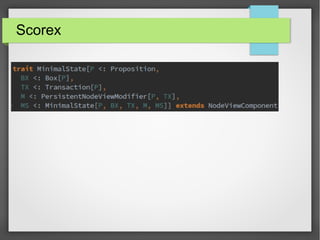
Scorex
● Scorex
● Utterly abstract (no even a blockchain in the bottom)
● GitHub
https://github.com/ScorexFoundation/Scorex
● Manual (not fully ready):
https://github.com/ScorexFoundation/ScorexTutorial
Scorex
Questions?
Twitter: @chepurnoy
Mail: kushti@protonmail.ch

Blockchan For Developers