Bitcoin
Blockchain
Under the Hood
by Galin Dinkov
https://www.linkedin.com/in/galindinkov/
Introduction
Motivation for Bitcoin Creation
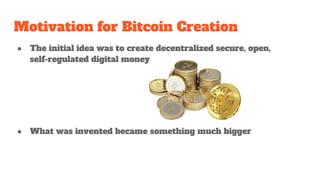
● The initial idea was to create decentralized secure, open,
self-regulated digital money
● What was invented became something much bigger
What is
Blockchain?
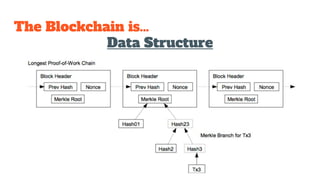
The Blockchain is…
Data Structure
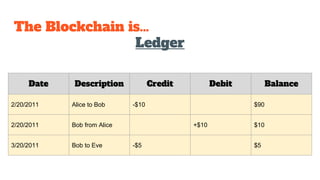
The Blockchain is…
Ledger
Date Description Credit Debit Balance
2/20/2011 Alice to Bob -$10 $90
2/20/2011 Bob from Alice +$10 $10
3/20/2011 Bob to Eve -$5 $5
The Blockchain is…
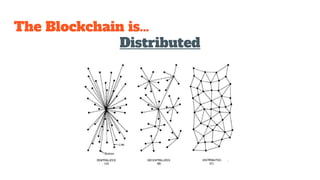
Distributed
The Blockchain is…
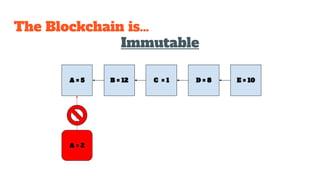
Immutable
The Blockchain is…
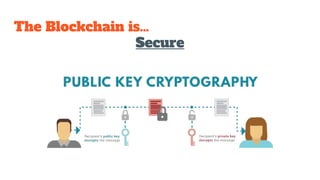
Secure
The Blockchain is…
Anonymous (Pseudo)
The Blockchain is…
Autonomous
The Blockchain is…
Public
Digital Money
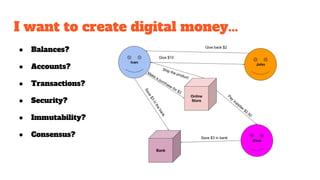
I want to create digital money...
● Balances?
● Accounts?
● Transactions?
● Security?
● Immutability?
● Consensus?
How They Made It?
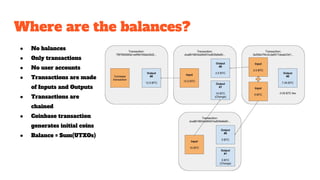
Where are the balances?
● No balances
● Only transactions
● No user accounts
● Transactions are made
of Inputs and Outputs
● Transactions are
chained
● Coinbase transaction
generates initial coins
● Balance = Sum(UTXOs)
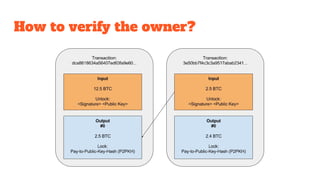
How to verify the owner?
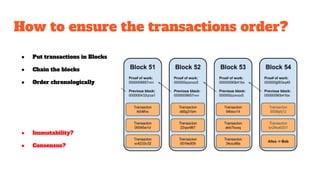
How to ensure the transactions order?
● Put transactions in Blocks
● Chain the blocks
● Order chronologically
● Immutability?
● Consensus?
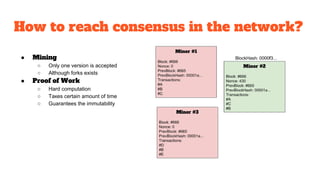
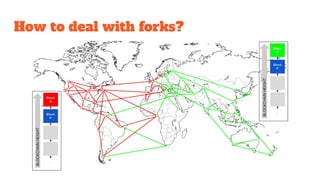
How to reach consensus in the network?
● Mining
○ Only one version is accepted
○ Although forks exists
● Proof of Work
○ Hard computation
○ Такеs certain amount of time
○ Guarantees the immutability
How to deal with forks?
Going Deep...
Cryptography
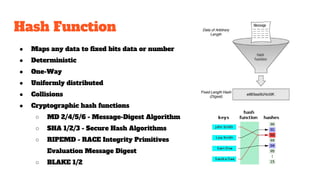
Hash Function
● Maps any data to fixed bits data or number
● Deterministic
● One-Way
● Uniformly distributed
● Collisions
● Cryptographic hash functions
○ MD 2/4/5/6 - Message-Digest Algorithm
○ SHA 1/2/3 - Secure Hash Algorithms
○ RIPEMD - RACE Integrity Primitives
Evaluation Message Digest
○ BLAKE 1/2
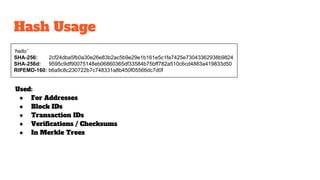
Hash Usage
‘hello’
SHA-256: 2cf24dba5fb0a30e26e83b2ac5b9e29e1b161e5c1fa7425e73043362938b9824
SHA-256d: 9595c9df90075148eb06860365df33584b75bff782a510c6cd4883a419833d50
RIPEMD-160: b6a9c8c230722b7c748331a8b450f05566dc7d0f
Used:
● For Addresses
● Block IDs
● Transaction IDs
● Verifications / Checksums
● In Merkle Trees
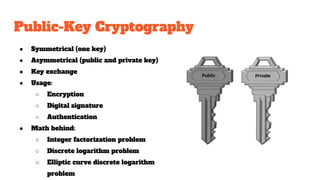
Public-Key Cryptography
● Symmetrical (one key)
● Asymmetrical (public and private key)
● Key exchange
● Usage:
○ Encryption
○ Digital signature
○ Authentication
● Math behind:
○ Integer factorization problem
○ Discrete logarithm problem
○ Elliptic curve discrete logarithm
problem
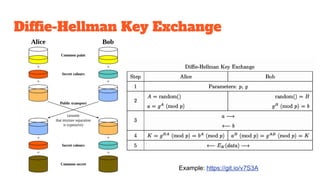
Diffie-Hellman Key Exchange
Example: https://git.io/v7S3A
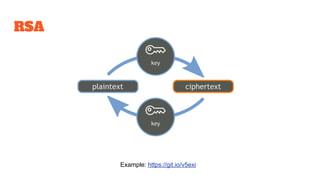
RSA
Example: https://git.io/v5exi
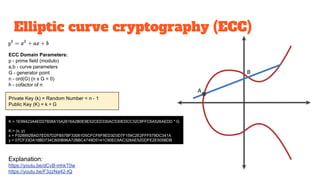
Elliptic curve cryptography (ECC)
Explanation:
https://youtu.be/dCvB-mhkT0w
https://youtu.be/F3zzNa42-tQ
ECC Domain Parameters:
p - prime field (modulo)
a,b - curve parameters
G - generator point
n - ord(G) (n x G = 0)
h - cofactor of n
Private Key (k) = Random Number < n - 1
Public Key (K) = k ∗ G
K = 1E99423A4ED27608A15A2616A2B0E9E52CED330AC530EDCC32C8FFC6A526AEDD * G
K = (x, y)
x = F028892BAD7ED57D2FB57BF33081D5CFCF6F9ED3D3D7F159C2E2FFF579DC341A
y = 07CF33DA18BD734C600B96A72BBC4749D5141C90EC8AC328AE52DDFE2E505BDB
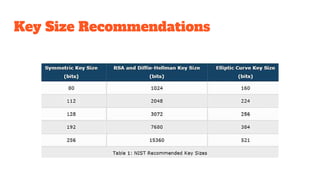
Key Size Recommendations
Security Risks
● Pool cracking - https://lbc.cryptoguru.org
● Quantum computers
● NSA backdoors in ECC?
● Solution: post quantum cryptography
○ NTRUEncrypt - based on the shortest vector problem in a lattice
○ More: https://en.wikipedia.org/wiki/Post-quantum_cryptography
Merkel Tree
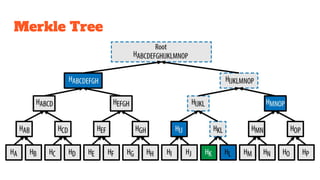
Merkle Tree
Keys &
Addresses
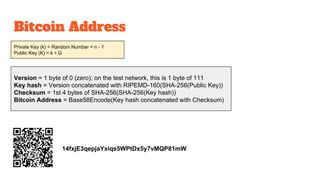
Bitcoin Address
Version = 1 byte of 0 (zero); on the test network, this is 1 byte of 111
Key hash = Version concatenated with RIPEMD-160(SHA-256(Public Key))
Checksum = 1st 4 bytes of SHA-256(SHA-256(Key hash))
Bitcoin Address = Base58Encode(Key hash concatenated with Checksum)
14fxjE3qepjaYxiqs5WPtDx5y7vMQP81mW
Private Key (k) = Random Number < n - 1
Public Key (K) = k ∗ G
Wallets
● Keep private keys
● Types
○ Nondeterministic (Random) Wallets - collection of random private keys
○ Deterministic (Seeded) Wallets - private keys are derived from a common seed
○ Brain Wallet - derived from a word or phrase which one can remember
○ Mnemonic Words - word sequence to represent seed of a deterministic wallet
○ Hierarchical Deterministic Wallets (HD Wallet) - tree structure where new keys can be
generated from any child branch (public key) without revealing the private key
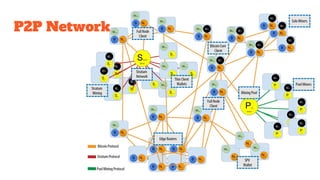
P2P Network
P2P Network
Node Types
● Reference Client (Bitcoin Core) - Wallet, Miner, Full Blockchain, Network Routing
● Full Blockchain Node - Full Blockchain, Network Routing
● Solo Miner - Miner, Full Blockchain, Network Routing
● Lightweight (SPV) wallet - Wallet, Network Routing
● Pool Protocol Servers - Connect the Bitcoin Network to other protocol
● Pool Mining Nodes - Miner, other protocol
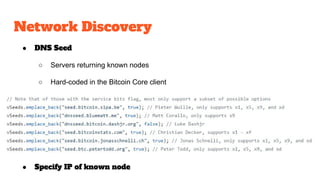
Network Discovery
● DNS Seed
○ Servers returning known nodes
○ Hard-coded in the Bitcoin Core client
● Specify IP of known node
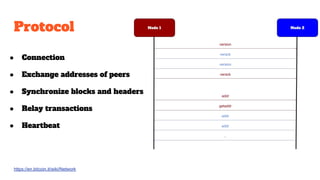
Protocol
● Connection
● Exchange addresses of peers
● Synchronize blocks and headers
● Relay transactions
● Heartbeat
https://en.bitcoin.it/wiki/Network
Messages
● version - Information about program version and block count. Exchanged when first connecting.
● verack - Sent in response to a version message to acknowledge that we are willing to connect.
● addr - List of one or more IP addresses and ports.
● inv - "I have these blocks/transactions: ..." Normally sent only when a new block or transaction is being relayed. This
is only a list, not the actual data.
● getdata - Request a single block or transaction by hash.
● getblocks - Request an inv of all blocks in a range.
● getheaders - Request a headers message containing all block headers in a range.
● tx - Send a transaction. This is sent only in response to a getdata request.
● block - Send a block. This is sent only in response to a getdata request.
● headers - Send up to 2,000 block headers. Non-generators can download the headers of blocks instead of entire
blocks.
● getaddr - Request an addr message containing a bunch of known-active peers (for bootstrapping).
● submitorder, checkorder, and reply - Used when performing an IP transaction.
● alert - Send a network alert.
● ping - Does nothing. Used to check that the connection is still online. A TCP error will occur if the connection has
died.
Blockchain
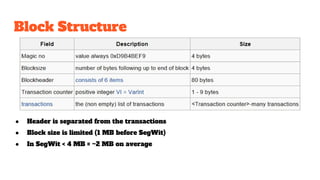
Block Structure
● Header is separated from the transactions
● Block size is limited (1 MB before SegWit)
● In SegWit < 4 MB = ~2 MB on average
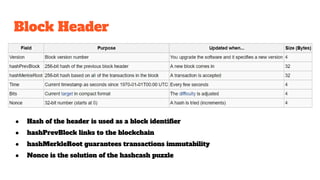
Block Header
● Hash of the header is used as a block identifier
● hashPrevBlock links to the blockchain
● hashMerkleRoot guarantees transactions immutability
● Nonce is the solution of the hashcash puzzle
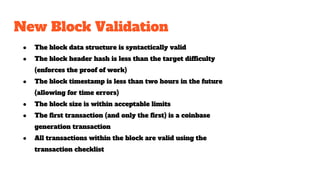
New Block Validation
● The block data structure is syntactically valid
● The block header hash is less than the target difficulty
(enforces the proof of work)
● The block timestamp is less than two hours in the future
(allowing for time errors)
● The block size is within acceptable limits
● The first transaction (and only the first) is a coinbase
generation transaction
● All transactions within the block are valid using the
transaction checklist
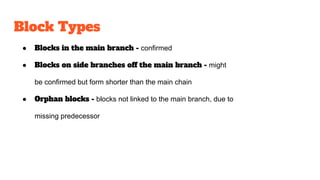
Block Types
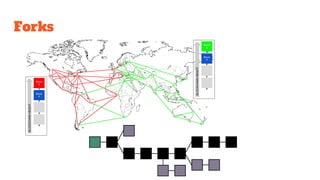
● Blocks in the main branch - confirmed
● Blocks on side branches off the main branch - might
be confirmed but form shorter than the main chain
● Orphan blocks - blocks not linked to the main branch, due to
missing predecessor
Forks
Transactions
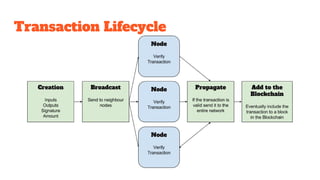
Transaction Lifecycle
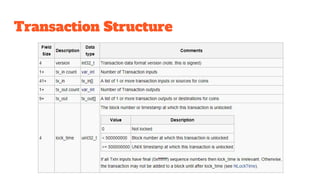
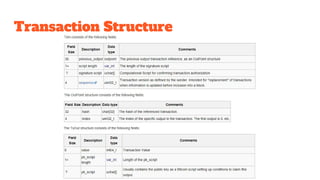
Transaction Structure
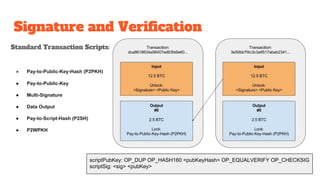
Signature and Verification
scriptPubKey: OP_DUP OP_HASH160 <pubKeyHash> OP_EQUALVERIFY OP_CHECKSIG
scriptSig: <sig> <pubKey>
Standard Transaction Scripts:
● Pay-to-Public-Key-Hash (P2PKH)
● Pay-to-Public-Key
● Multi-Signature
● Data Output
● Pay-to-Script-Hash (P2SH)
● P2WPKH
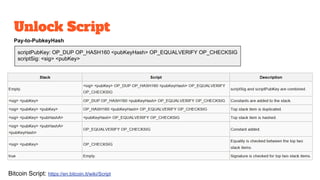
Unlock Script
Pay-to-PubkeyHash
scriptPubKey: OP_DUP OP_HASH160 <pubKeyHash> OP_EQUALVERIFY OP_CHECKSIG
scriptSig: <sig> <pubKey>
Bitcoin Script: https://en.bitcoin.it/wiki/Script
Mining
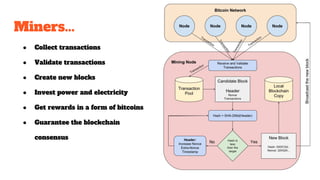
Miners...
● Collect transactions
● Validate transactions
● Create new blocks
● Invest power and electricity
● Get rewards in a form of bitcoins
● Guarantee the blockchain
consensus
Generation (Coinbase) Transaction
● Creates coins from nothing
● Used to award the miner
● Has no input (coinbase)
● Outputs the fee to the miner’s address
● #0 Block is the Genesis Block
The Times 03/Jan/2009 Chancellor on brink of second bailout for banks
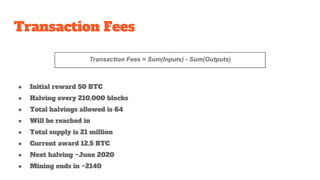
Transaction Fees
Transaction Fees = Sum(Inputs) - Sum(Outputs)
● Initial reward 50 BTC
● Halving every 210,000 blocks
● Total halvings allowed is 64
● Will be reached in
● Total supply is 21 million
● Current award 12.5 BTC
● Next halving ~June 2020
● Mining ends in ~2140
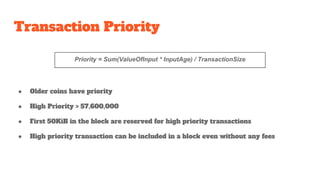
Transaction Priority
● Older coins have priority
● High Priority > 57,600,000
● First 50KiB in the block are reserved for high priority transactions
● High priority transaction can be included in a block even without any fees
Priority = Sum(ValueOfInput * InputAge) / TransactionSize
References
● Bitcoin Wiki, https://en.bitcoin.it/wiki/
● Mastering Bitcoin, Andreas M. Antonopoulos, O’Reilly Media
● Bitcoin.ORG, https://bitcoin.org
Final
by Galin Dinkov
https://www.linkedin.com/in/galindinkov/

Bitcoin Blockchain - Under the Hood

  • 1.
    Bitcoin Blockchain Under the Hood byGalin Dinkov https://www.linkedin.com/in/galindinkov/
  • 2.
  • 3.
    Motivation for BitcoinCreation ● The initial idea was to create decentralized secure, open, self-regulated digital money ● What was invented became something much bigger
  • 4.
  • 5.
  • 6.
    The Blockchain is… Ledger DateDescription Credit Debit Balance 2/20/2011 Alice to Bob -$10 $90 2/20/2011 Bob from Alice +$10 $10 3/20/2011 Bob to Eve -$5 $5
  • 7.
  • 8.
  • 9.
  • 10.
  • 11.
  • 12.
  • 13.
  • 14.
    I want tocreate digital money... ● Balances? ● Accounts? ● Transactions? ● Security? ● Immutability? ● Consensus?
  • 15.
  • 16.
    Where are thebalances? ● No balances ● Only transactions ● No user accounts ● Transactions are made of Inputs and Outputs ● Transactions are chained ● Coinbase transaction generates initial coins ● Balance = Sum(UTXOs)
  • 17.
    How to verifythe owner?
  • 18.
    How to ensurethe transactions order? ● Put transactions in Blocks ● Chain the blocks ● Order chronologically ● Immutability? ● Consensus?
  • 19.
    How to reachconsensus in the network? ● Mining ○ Only one version is accepted ○ Although forks exists ● Proof of Work ○ Hard computation ○ Такеs certain amount of time ○ Guarantees the immutability
  • 20.
    How to dealwith forks?
  • 21.
  • 22.
  • 23.
    Hash Function ● Mapsany data to fixed bits data or number ● Deterministic ● One-Way ● Uniformly distributed ● Collisions ● Cryptographic hash functions ○ MD 2/4/5/6 - Message-Digest Algorithm ○ SHA 1/2/3 - Secure Hash Algorithms ○ RIPEMD - RACE Integrity Primitives Evaluation Message Digest ○ BLAKE 1/2
  • 24.
    Hash Usage ‘hello’ SHA-256: 2cf24dba5fb0a30e26e83b2ac5b9e29e1b161e5c1fa7425e73043362938b9824 SHA-256d:9595c9df90075148eb06860365df33584b75bff782a510c6cd4883a419833d50 RIPEMD-160: b6a9c8c230722b7c748331a8b450f05566dc7d0f Used: ● For Addresses ● Block IDs ● Transaction IDs ● Verifications / Checksums ● In Merkle Trees
  • 25.
    Public-Key Cryptography ● Symmetrical(one key) ● Asymmetrical (public and private key) ● Key exchange ● Usage: ○ Encryption ○ Digital signature ○ Authentication ● Math behind: ○ Integer factorization problem ○ Discrete logarithm problem ○ Elliptic curve discrete logarithm problem
  • 26.
  • 27.
  • 28.
    Elliptic curve cryptography(ECC) Explanation: https://youtu.be/dCvB-mhkT0w https://youtu.be/F3zzNa42-tQ ECC Domain Parameters: p - prime field (modulo) a,b - curve parameters G - generator point n - ord(G) (n x G = 0) h - cofactor of n Private Key (k) = Random Number < n - 1 Public Key (K) = k ∗ G K = 1E99423A4ED27608A15A2616A2B0E9E52CED330AC530EDCC32C8FFC6A526AEDD * G K = (x, y) x = F028892BAD7ED57D2FB57BF33081D5CFCF6F9ED3D3D7F159C2E2FFF579DC341A y = 07CF33DA18BD734C600B96A72BBC4749D5141C90EC8AC328AE52DDFE2E505BDB
  • 29.
  • 30.
    Security Risks ● Poolcracking - https://lbc.cryptoguru.org ● Quantum computers ● NSA backdoors in ECC? ● Solution: post quantum cryptography ○ NTRUEncrypt - based on the shortest vector problem in a lattice ○ More: https://en.wikipedia.org/wiki/Post-quantum_cryptography
  • 31.
  • 32.
  • 33.
  • 34.
    Bitcoin Address Version =1 byte of 0 (zero); on the test network, this is 1 byte of 111 Key hash = Version concatenated with RIPEMD-160(SHA-256(Public Key)) Checksum = 1st 4 bytes of SHA-256(SHA-256(Key hash)) Bitcoin Address = Base58Encode(Key hash concatenated with Checksum) 14fxjE3qepjaYxiqs5WPtDx5y7vMQP81mW Private Key (k) = Random Number < n - 1 Public Key (K) = k ∗ G
  • 35.
    Wallets ● Keep privatekeys ● Types ○ Nondeterministic (Random) Wallets - collection of random private keys ○ Deterministic (Seeded) Wallets - private keys are derived from a common seed ○ Brain Wallet - derived from a word or phrase which one can remember ○ Mnemonic Words - word sequence to represent seed of a deterministic wallet ○ Hierarchical Deterministic Wallets (HD Wallet) - tree structure where new keys can be generated from any child branch (public key) without revealing the private key
  • 36.
  • 37.
  • 38.
    Node Types ● ReferenceClient (Bitcoin Core) - Wallet, Miner, Full Blockchain, Network Routing ● Full Blockchain Node - Full Blockchain, Network Routing ● Solo Miner - Miner, Full Blockchain, Network Routing ● Lightweight (SPV) wallet - Wallet, Network Routing ● Pool Protocol Servers - Connect the Bitcoin Network to other protocol ● Pool Mining Nodes - Miner, other protocol
  • 39.
    Network Discovery ● DNSSeed ○ Servers returning known nodes ○ Hard-coded in the Bitcoin Core client ● Specify IP of known node
  • 40.
    Protocol ● Connection ● Exchangeaddresses of peers ● Synchronize blocks and headers ● Relay transactions ● Heartbeat https://en.bitcoin.it/wiki/Network
  • 41.
    Messages ● version -Information about program version and block count. Exchanged when first connecting. ● verack - Sent in response to a version message to acknowledge that we are willing to connect. ● addr - List of one or more IP addresses and ports. ● inv - "I have these blocks/transactions: ..." Normally sent only when a new block or transaction is being relayed. This is only a list, not the actual data. ● getdata - Request a single block or transaction by hash. ● getblocks - Request an inv of all blocks in a range. ● getheaders - Request a headers message containing all block headers in a range. ● tx - Send a transaction. This is sent only in response to a getdata request. ● block - Send a block. This is sent only in response to a getdata request. ● headers - Send up to 2,000 block headers. Non-generators can download the headers of blocks instead of entire blocks. ● getaddr - Request an addr message containing a bunch of known-active peers (for bootstrapping). ● submitorder, checkorder, and reply - Used when performing an IP transaction. ● alert - Send a network alert. ● ping - Does nothing. Used to check that the connection is still online. A TCP error will occur if the connection has died.
  • 42.
  • 43.
    Block Structure ● Headeris separated from the transactions ● Block size is limited (1 MB before SegWit) ● In SegWit < 4 MB = ~2 MB on average
  • 44.
    Block Header ● Hashof the header is used as a block identifier ● hashPrevBlock links to the blockchain ● hashMerkleRoot guarantees transactions immutability ● Nonce is the solution of the hashcash puzzle
  • 45.
    New Block Validation ●The block data structure is syntactically valid ● The block header hash is less than the target difficulty (enforces the proof of work) ● The block timestamp is less than two hours in the future (allowing for time errors) ● The block size is within acceptable limits ● The first transaction (and only the first) is a coinbase generation transaction ● All transactions within the block are valid using the transaction checklist
  • 46.
    Block Types ● Blocksin the main branch - confirmed ● Blocks on side branches off the main branch - might be confirmed but form shorter than the main chain ● Orphan blocks - blocks not linked to the main branch, due to missing predecessor
  • 47.
  • 48.
  • 49.
  • 50.
  • 51.
  • 52.
    Signature and Verification scriptPubKey:OP_DUP OP_HASH160 <pubKeyHash> OP_EQUALVERIFY OP_CHECKSIG scriptSig: <sig> <pubKey> Standard Transaction Scripts: ● Pay-to-Public-Key-Hash (P2PKH) ● Pay-to-Public-Key ● Multi-Signature ● Data Output ● Pay-to-Script-Hash (P2SH) ● P2WPKH
  • 53.
    Unlock Script Pay-to-PubkeyHash scriptPubKey: OP_DUPOP_HASH160 <pubKeyHash> OP_EQUALVERIFY OP_CHECKSIG scriptSig: <sig> <pubKey> Bitcoin Script: https://en.bitcoin.it/wiki/Script
  • 54.
  • 55.
    Miners... ● Collect transactions ●Validate transactions ● Create new blocks ● Invest power and electricity ● Get rewards in a form of bitcoins ● Guarantee the blockchain consensus
  • 56.
    Generation (Coinbase) Transaction ●Creates coins from nothing ● Used to award the miner ● Has no input (coinbase) ● Outputs the fee to the miner’s address ● #0 Block is the Genesis Block The Times 03/Jan/2009 Chancellor on brink of second bailout for banks
  • 57.
    Transaction Fees Transaction Fees= Sum(Inputs) - Sum(Outputs) ● Initial reward 50 BTC ● Halving every 210,000 blocks ● Total halvings allowed is 64 ● Will be reached in ● Total supply is 21 million ● Current award 12.5 BTC ● Next halving ~June 2020 ● Mining ends in ~2140
  • 58.
    Transaction Priority ● Oldercoins have priority ● High Priority > 57,600,000 ● First 50KiB in the block are reserved for high priority transactions ● High priority transaction can be included in a block even without any fees Priority = Sum(ValueOfInput * InputAge) / TransactionSize
  • 59.
    References ● Bitcoin Wiki,https://en.bitcoin.it/wiki/ ● Mastering Bitcoin, Andreas M. Antonopoulos, O’Reilly Media ● Bitcoin.ORG, https://bitcoin.org
  • 60.