Brief history
What is blockchain ?
Evolution of blockchain
Industry consortia and
ecosystem
Blockchain - Critical
Operational Improvements
Blockchain in FINTECH
 Satheesh Kathamuthu
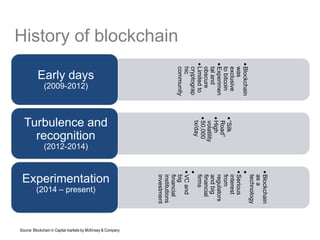
History of blockchain
Blockchain
was
exclusive
tobitcoin
Experimen
taland
obscure
Limitedto
cryptograp
hic
community
Early days
(2009-2012)
“Silk
Road”
High
volatility
50,000
tx/day
Turbulence and
recognition
(2012-2014)
Blockchain
asa
technology

Serious
interest
from
regulators
andbig
financial
firms

VCand
big
financial
institutions
investment
Experimentation
(2014 – present)
Source: Blockchain in Capital markets by McKinsey & Company
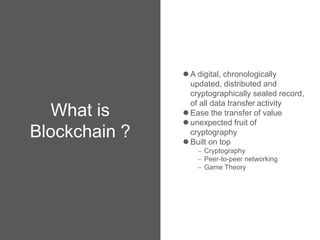
What is
Blockchain ?
 A digital, chronologically
updated, distributed and
cryptographically sealed record,
of all data transfer activity
 Ease the transfer of value
 unexpected fruit of
cryptography
 Built on top
 Cryptography
 Peer-to-peer networking
 Game Theory
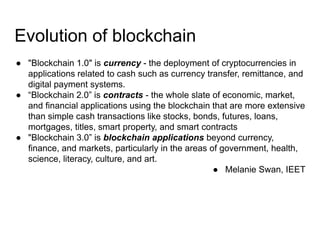
Evolution of blockchain
● "Blockchain 1.0" is currency - the deployment of cryptocurrencies in
applications related to cash such as currency transfer, remittance, and
digital payment systems.
● “Blockchain 2.0” is contracts - the whole slate of economic, market,
and financial applications using the blockchain that are more extensive
than simple cash transactions like stocks, bonds, futures, loans,
mortgages, titles, smart property, and smart contracts
● "Blockchain 3.0” is blockchain applications beyond currency,
finance, and markets, particularly in the areas of government, health,
science, literacy, culture, and art.
● Melanie Swan, IEET
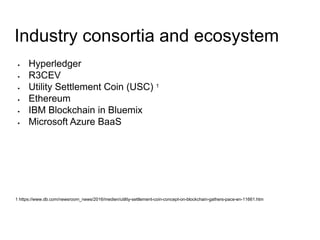
Industry consortia and ecosystem
 Hyperledger
 R3CEV
 Utility Settlement Coin (USC) 1
 Ethereum
 IBM Blockchain in Bluemix
 Microsoft Azure BaaS
1 https://www.db.com/newsroom_news/2016/medien/utility-settlement-coin-concept-on-blockchain-gathers-pace-en-11661.htm
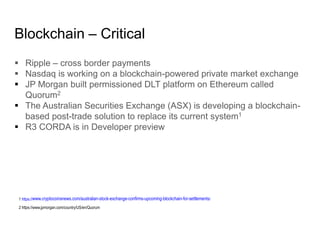
Blockchain – Critical
 Ripple – cross border payments
 Nasdaq is working on a blockchain-powered private market exchange
 JP Morgan built permissioned DLT platform on Ethereum called
Quorum2
 The Australian Securities Exchange (ASX) is developing a blockchain-
based post-trade solution to replace its current system1
 R3 CORDA is in Developer preview
1 https://www.cryptocoinsnews.com/australian-stock-exchange-confirms-upcoming-blockchain-for-settlements/
2 https://www.jpmorgan.com/country/US/en/Quorum
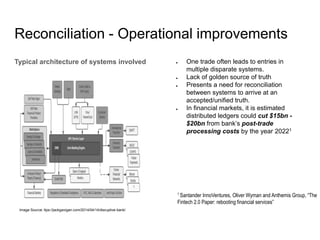
Reconciliation - Operational improvements
Typical architecture of systems involved ● One trade often leads to entries in
multiple disparate systems.
● Lack of golden source of truth
● Presents a need for reconciliation
between systems to arrive at an
accepted/unified truth.
● In financial markets, it is estimated
distributed ledgers could cut $15bn -
$20bn from bank’s post-trade
processing costs by the year 20221
Image Source: ttps://jackgavigan.com/2014/04/14/disruptive-bank/
1 Santander InnoVentures, Oliver Wyman and Anthemis Group, “The
Fintech 2.0 Paper: rebooting financial services”
Q&A
Thank you.
References
The FinTech 2.0 Paper - http://www.finextra.com/finextra-
downloads/newsdocs/The%20Fintech%202%200%20Paper.PDF
 Bitcoin and Cryptocurrency Technologies
http://bitcoinbook.cs.princeton.edu/
Blockchain: Blueprint for a New Economy - Melanie Swan
Blockchain in Capital markets by McKinsey & Company
Embracing Disruption – Tapping the Potential of Distributed Ledgers to
Improve the Post-Trade Landscape by DTCC

Blockchain_in_FINTECH

  • 1.
    Brief history What isblockchain ? Evolution of blockchain Industry consortia and ecosystem Blockchain - Critical Operational Improvements Blockchain in FINTECH  Satheesh Kathamuthu
  • 2.
    History of blockchain Blockchain was exclusive tobitcoin Experimen taland obscure Limitedto cryptograp hic community Earlydays (2009-2012) “Silk Road” High volatility 50,000 tx/day Turbulence and recognition (2012-2014) Blockchain asa technology  Serious interest from regulators andbig financial firms  VCand big financial institutions investment Experimentation (2014 – present) Source: Blockchain in Capital markets by McKinsey & Company
  • 3.
    What is Blockchain ? A digital, chronologically updated, distributed and cryptographically sealed record, of all data transfer activity  Ease the transfer of value  unexpected fruit of cryptography  Built on top  Cryptography  Peer-to-peer networking  Game Theory
  • 4.
    Evolution of blockchain ●"Blockchain 1.0" is currency - the deployment of cryptocurrencies in applications related to cash such as currency transfer, remittance, and digital payment systems. ● “Blockchain 2.0” is contracts - the whole slate of economic, market, and financial applications using the blockchain that are more extensive than simple cash transactions like stocks, bonds, futures, loans, mortgages, titles, smart property, and smart contracts ● "Blockchain 3.0” is blockchain applications beyond currency, finance, and markets, particularly in the areas of government, health, science, literacy, culture, and art. ● Melanie Swan, IEET
  • 5.
    Industry consortia andecosystem  Hyperledger  R3CEV  Utility Settlement Coin (USC) 1  Ethereum  IBM Blockchain in Bluemix  Microsoft Azure BaaS 1 https://www.db.com/newsroom_news/2016/medien/utility-settlement-coin-concept-on-blockchain-gathers-pace-en-11661.htm
  • 6.
    Blockchain – Critical Ripple – cross border payments  Nasdaq is working on a blockchain-powered private market exchange  JP Morgan built permissioned DLT platform on Ethereum called Quorum2  The Australian Securities Exchange (ASX) is developing a blockchain- based post-trade solution to replace its current system1  R3 CORDA is in Developer preview 1 https://www.cryptocoinsnews.com/australian-stock-exchange-confirms-upcoming-blockchain-for-settlements/ 2 https://www.jpmorgan.com/country/US/en/Quorum
  • 7.
    Reconciliation - Operationalimprovements Typical architecture of systems involved ● One trade often leads to entries in multiple disparate systems. ● Lack of golden source of truth ● Presents a need for reconciliation between systems to arrive at an accepted/unified truth. ● In financial markets, it is estimated distributed ledgers could cut $15bn - $20bn from bank’s post-trade processing costs by the year 20221 Image Source: ttps://jackgavigan.com/2014/04/14/disruptive-bank/ 1 Santander InnoVentures, Oliver Wyman and Anthemis Group, “The Fintech 2.0 Paper: rebooting financial services”
  • 8.
  • 9.
    References The FinTech 2.0Paper - http://www.finextra.com/finextra- downloads/newsdocs/The%20Fintech%202%200%20Paper.PDF  Bitcoin and Cryptocurrency Technologies http://bitcoinbook.cs.princeton.edu/ Blockchain: Blueprint for a New Economy - Melanie Swan Blockchain in Capital markets by McKinsey & Company Embracing Disruption – Tapping the Potential of Distributed Ledgers to Improve the Post-Trade Landscape by DTCC