Blockchain 101: An introduction to
Blockchain and how It powers shared
ownership of Smart Cities
Mike Cartwright, CTO
Ownership of Smart City Portals
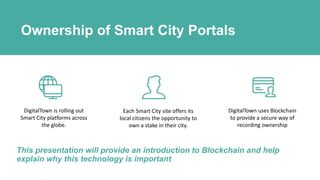
DigitalTown is rolling out
Smart City platforms across
the globe.
Each Smart City site offers its
local citizens the opportunity to
own a stake in their city.
DigitalTown uses Blockchain
to provide a secure way of
recording ownership
This presentation will provide an introduction to Blockchain and help
explain why this technology is important
Ownership of
Smart City
Portals
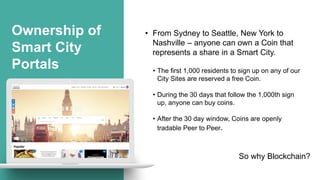
• From Sydney to Seattle, New York to
Nashville – anyone can own a Coin that
represents a share in a Smart City.
• The first 1,000 residents to sign up on any of our
City Sites are reserved a free Coin.
• During the 30 days that follow the 1,000th sign
up, anyone can buy coins.
• After the 30 day window, Coins are openly
tradable Peer to Peer.
So why Blockchain?
What is a
Blockchain? • Its hard to read anything tech related right
now without hearing the word Blockchain.
• Blockchain is a technology that allows two
people to trust each other without a third
party acting as the authority.
• Records are added to the chain in
sequence to provide a record of all
transactions from Day 0.
Why should you care?
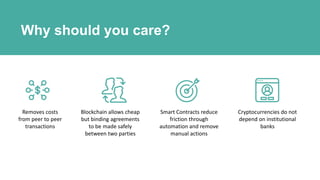
Removes costs
from peer to peer
transactions
Blockchain allows cheap
but binding agreements
to be made safely
between two parties
Smart Contracts reduce
friction through
automation and remove
manual actions
Cryptocurrencies do not
depend on institutional
banks
Think about a simple transaction
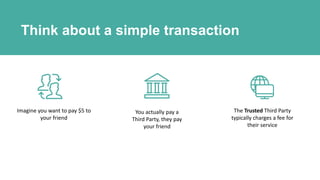
Imagine you want to pay $5 to
your friend
You actually pay a
Third Party, they pay
your friend
The Trusted Third Party
typically charges a fee for
their service
Block chain
uses the
concept of a
Distributed
Ledger
• For as long as banks have existed,
transactions are stored in a ledger.
• Blockchain uses something called a
‘Distributed Ledger’
2+2 = ?
4+4 = ?
No
middle-man
• Blockchain enables peer to peer
transactions to be done safely and securely
without the need for a Trusted Third Party.
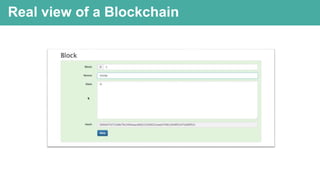
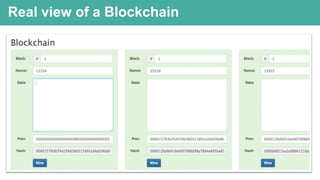
• It does this by creating a chain of blocks,
each block containing information about
transactions that took place ( a Ledger ).
• The Ledger is independently held and
verified by every participant in the network.
(a Distributed Ledger)
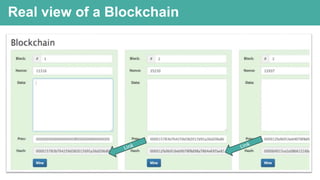
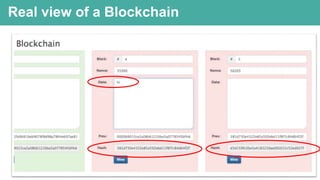
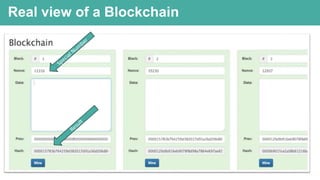
• Each block is connected to the previous
block by a code that is unique to that block
Real view of a Blockchain
Tamperproof • You can’t change anything that is
already in the chain without affecting
everything that follows it.
• Anyone can hold a copy of the entire
Blockchain if they wish.
• Every system holding a copy is called a
Node.
• Providing more than 50% agree on a
version of the chain, then the chain is
considered as correct.
Real view of a Blockchain
So what’s a
Bitcoin Miner?
• Remember when I mentioned each
Block knows about the Previous block?
• Before a Block is added to the chain
work needs to be done to find a special
number.
• Only when this special number is found
can a block be added.
• The people who mine for this number
are called Bitcoin Miners.
Real view of a Blockchain
Recap • Blockchains are contain data just like a
regular ledger, but with copies stored in
many places.
• Blockchains are Blocks of data connected
together in a sequence.
• The clever bit is that each block knows
about the block before – which means if you
change a block you would have to change
every block that follows in order to maintain
integrity.
• Majority rules
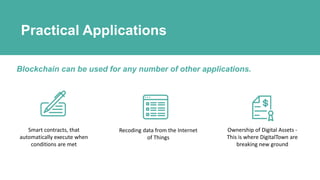
Practical Applications
Smart contracts, that
automatically execute when
conditions are met
Recoding data from the Internet
of Things
Ownership of Digital Assets -
This is where DigitalTown are
breaking new ground
Blockchain can be used for any number of other applications.
DigitalTowns
Blockchain
Solution • Starting next moth, thousands of Cities
will be given their own Blockchain to
manage shared Digital Ownership
• Our Open API provides the ability for
third parties to support the Transfer of
Ownership of Coins
Anyone can Buy or Sell
www.DigitalTown.com
Mike@DigitalTown.com
Thank you

Blockchain 101

  • 1.
    Blockchain 101: Anintroduction to Blockchain and how It powers shared ownership of Smart Cities Mike Cartwright, CTO
  • 2.
    Ownership of SmartCity Portals DigitalTown is rolling out Smart City platforms across the globe. Each Smart City site offers its local citizens the opportunity to own a stake in their city. DigitalTown uses Blockchain to provide a secure way of recording ownership This presentation will provide an introduction to Blockchain and help explain why this technology is important
  • 3.
    Ownership of Smart City Portals •From Sydney to Seattle, New York to Nashville – anyone can own a Coin that represents a share in a Smart City. • The first 1,000 residents to sign up on any of our City Sites are reserved a free Coin. • During the 30 days that follow the 1,000th sign up, anyone can buy coins. • After the 30 day window, Coins are openly tradable Peer to Peer. So why Blockchain?
  • 4.
    What is a Blockchain?• Its hard to read anything tech related right now without hearing the word Blockchain. • Blockchain is a technology that allows two people to trust each other without a third party acting as the authority. • Records are added to the chain in sequence to provide a record of all transactions from Day 0.
  • 5.
    Why should youcare? Removes costs from peer to peer transactions Blockchain allows cheap but binding agreements to be made safely between two parties Smart Contracts reduce friction through automation and remove manual actions Cryptocurrencies do not depend on institutional banks
  • 6.
    Think about asimple transaction Imagine you want to pay $5 to your friend You actually pay a Third Party, they pay your friend The Trusted Third Party typically charges a fee for their service
  • 7.
    Block chain uses the conceptof a Distributed Ledger • For as long as banks have existed, transactions are stored in a ledger. • Blockchain uses something called a ‘Distributed Ledger’ 2+2 = ? 4+4 = ?
  • 8.
    No middle-man • Blockchain enablespeer to peer transactions to be done safely and securely without the need for a Trusted Third Party. • It does this by creating a chain of blocks, each block containing information about transactions that took place ( a Ledger ). • The Ledger is independently held and verified by every participant in the network. (a Distributed Ledger) • Each block is connected to the previous block by a code that is unique to that block
  • 9.
    Real view ofa Blockchain
  • 10.
    Real view ofa Blockchain
  • 11.
    Real view ofa Blockchain
  • 12.
    Tamperproof • Youcan’t change anything that is already in the chain without affecting everything that follows it. • Anyone can hold a copy of the entire Blockchain if they wish. • Every system holding a copy is called a Node. • Providing more than 50% agree on a version of the chain, then the chain is considered as correct.
  • 13.
    Real view ofa Blockchain
  • 14.
    So what’s a BitcoinMiner? • Remember when I mentioned each Block knows about the Previous block? • Before a Block is added to the chain work needs to be done to find a special number. • Only when this special number is found can a block be added. • The people who mine for this number are called Bitcoin Miners.
  • 15.
    Real view ofa Blockchain
  • 16.
    Recap • Blockchainsare contain data just like a regular ledger, but with copies stored in many places. • Blockchains are Blocks of data connected together in a sequence. • The clever bit is that each block knows about the block before – which means if you change a block you would have to change every block that follows in order to maintain integrity. • Majority rules
  • 17.
    Practical Applications Smart contracts,that automatically execute when conditions are met Recoding data from the Internet of Things Ownership of Digital Assets - This is where DigitalTown are breaking new ground Blockchain can be used for any number of other applications.
  • 18.
    DigitalTowns Blockchain Solution • Startingnext moth, thousands of Cities will be given their own Blockchain to manage shared Digital Ownership • Our Open API provides the ability for third parties to support the Transfer of Ownership of Coins
  • 19.
  • 20.