Blockchain Technology:
Transforming the Digital
Landscape
Blockchain technology has emerged as a groundbreaking
innovation, revolutionizing the way we store, secure, and
exchange digital information. This transformative technology
holds the potential to disrupt industries, redefine financial
systems, and foster unprecedented transparency and trust in
a variety of applications. Explore the fascinating world of
blockchain and discover how it is shaping the future of our
digital landscape.
Understanding the Blockchain
Ecosystem
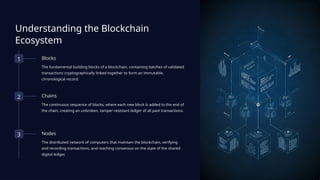
1 Blocks
The fundamental building blocks of a blockchain, containing batches of validated
transactions cryptographically linked together to form an immutable,
chronological record.
2 Chains
The continuous sequence of blocks, where each new block is added to the end of
the chain, creating an unbroken, tamper-resistant ledger of all past transactions.
3 Nodes
The distributed network of computers that maintain the blockchain, verifying
and recording transactions, and reaching consensus on the state of the shared
digital ledger.
Blockchain Consensus Mechanisms
Proof of Work (PoW)
In the PoW consensus
mechanism, miners compete to
solve complex cryptographic
puzzles, using computational
power to validate transactions
and add new blocks to the
chain. The first miner to solve
the puzzle is rewarded with
newly created cryptocurrency.
Proof of Stake (PoS)
The PoS consensus mechanism
relies on validators who hold a
certain amount of the
cryptocurrency to validate
transactions and add new
blocks. Validators are selected
based on their stake, and they
are rewarded for their
participation in maintaining the
network.
Comparison
PoW is more energy-intensive
but provides greater
decentralization, while PoS is
more energy-efficient but may
have concerns around
centralization. The choice of
consensus mechanism depends
on the specific requirements
and trade-offs of the blockchain
network.
Blockchain in
Cryptocurrencies Bitcoin and Altcoins
Bitcoin, the first and most well-known cryptocurrency, was built on blockchain technology.
Since then, numerous alternative cryptocurrencies (altcoins) have emerged, each with its
own unique features, use cases, and underlying blockchain protocols.
Digital Wallets
Cryptocurrency wallets, both software and hardware-based, allow users to store, send, and
receive digital assets securely. These wallets utilize the blockchain to track and manage
cryptocurrency transactions.
Cryptocurrency Exchanges
Cryptocurrency exchanges are digital platforms that enable the trading of
cryptocurrencies, allowing users to buy, sell, and exchange different digital assets. These
exchanges leverage blockchain technology to facilitate secure and transparent
transactions.
Adoption and Use Cases
Cryptocurrencies have seen growing adoption and are being used for a variety of
purposes, including cross-border payments, remittances, store of value, and even as a
medium of exchange in certain real-world transactions.
Blockchain and Smart Contracts
1 Smart Contract Definition
Smart contracts are self-executing digital
agreements that automatically enforce the
terms of a contract when predetermined
conditions are met, leveraging the transparency
and immutability of the blockchain.
2 Smart Contract Applications
Smart contracts have a wide range of
applications, including supply chain
management, financial services, real estate, and
even decentralized applications (dApps) that run
on blockchain networks.
3 Benefits of Smart Contracts
Smart contracts offer increased efficiency,
reduced transaction costs, improved
transparency, and enhanced trust, as they
eliminate the need for intermediaries and
manual intervention in various transactions and
processes.
4 Challenges and Limitations
While smart contracts have significant potential,
they also face challenges such as legal
recognition, regulatory compliance, and the
need for robust programming to ensure secure
and reliable execution.
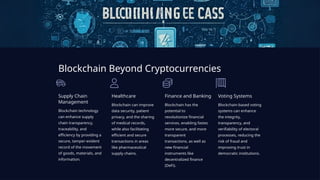
Blockchain Beyond Cryptocurrencies
Supply Chain
Management
Blockchain technology
can enhance supply
chain transparency,
traceability, and
efficiency by providing a
secure, tamper-evident
record of the movement
of goods, materials, and
information.
Healthcare
Blockchain can improve
data security, patient
privacy, and the sharing
of medical records,
while also facilitating
efficient and secure
transactions in areas
like pharmaceutical
supply chains.
Finance and Banking
Blockchain has the
potential to
revolutionize financial
services, enabling faster,
more secure, and more
transparent
transactions, as well as
new financial
instruments like
decentralized finance
(DeFi).
Voting Systems
Blockchain-based voting
systems can enhance
the integrity,
transparency, and
verifiability of electoral
processes, reducing the
risk of fraud and
improving trust in
democratic institutions.
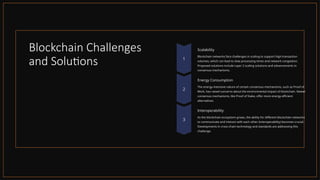
Blockchain Challenges
and Solutions
Scalability
Blockchain networks face challenges in scaling to support high transaction
volumes, which can lead to slow processing times and network congestion.
Proposed solutions include Layer 2 scaling solutions and advancements in
consensus mechanisms.
Energy Consumption
The energy-intensive nature of certain consensus mechanisms, such as Proof of
Work, has raised concerns about the environmental impact of blockchain. Newer
consensus mechanisms, like Proof of Stake, offer more energy-efficient
alternatives.
Interoperability
As the blockchain ecosystem grows, the ability for different blockchain networks
to communicate and interact with each other (interoperability) becomes crucial.
Developments in cross-chain technology and standards are addressing this
challenge.
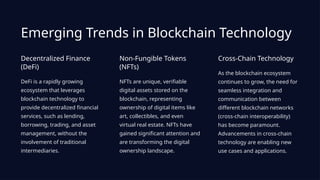
Emerging Trends in Blockchain Technology
Decentralized Finance
(DeFi)
DeFi is a rapidly growing
ecosystem that leverages
blockchain technology to
provide decentralized financial
services, such as lending,
borrowing, trading, and asset
management, without the
involvement of traditional
intermediaries.
Non-Fungible Tokens
(NFTs)
NFTs are unique, verifiable
digital assets stored on the
blockchain, representing
ownership of digital items like
art, collectibles, and even
virtual real estate. NFTs have
gained significant attention and
are transforming the digital
ownership landscape.
Cross-Chain Technology
As the blockchain ecosystem
continues to grow, the need for
seamless integration and
communication between
different blockchain networks
(cross-chain interoperability)
has become paramount.
Advancements in cross-chain
technology are enabling new
use cases and applications.
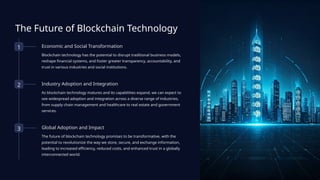
The Future of Blockchain Technology
1 Economic and Social Transformation
Blockchain technology has the potential to disrupt traditional business models,
reshape financial systems, and foster greater transparency, accountability, and
trust in various industries and social institutions.
2 Industry Adoption and Integration
As blockchain technology matures and its capabilities expand, we can expect to
see widespread adoption and integration across a diverse range of industries,
from supply chain management and healthcare to real estate and government
services.
3 Global Adoption and Impact
The future of blockchain technology promises to be transformative, with the
potential to revolutionize the way we store, secure, and exchange information,
leading to increased efficiency, reduced costs, and enhanced trust in a globally
interconnected world.
Conclusion:
Unlocking
the Potential
of Blockchain
As we have explored, blockchain technology is a
groundbreaking innovation that is reshaping the
digital landscape. From transforming the world of
cryptocurrencies to enabling new applications in
diverse industries, blockchain holds immense
potential to drive positive change and unlock
unprecedented opportunities. By understanding
the core principles, exploring the evolving
landscape, and addressing the challenges, we can
collectively harness the power of blockchain to
create a more secure, transparent, and equitable
digital future. The journey ahead is exciting, and
the possibilities are limitless. Let's continue to
explore and innovate, unlocking the full potential
of this transformative technology.

Introduction to Blockchain Techology.pptx

  • 1.
    Blockchain Technology: Transforming theDigital Landscape Blockchain technology has emerged as a groundbreaking innovation, revolutionizing the way we store, secure, and exchange digital information. This transformative technology holds the potential to disrupt industries, redefine financial systems, and foster unprecedented transparency and trust in a variety of applications. Explore the fascinating world of blockchain and discover how it is shaping the future of our digital landscape.
  • 2.
    Understanding the Blockchain Ecosystem 1Blocks The fundamental building blocks of a blockchain, containing batches of validated transactions cryptographically linked together to form an immutable, chronological record. 2 Chains The continuous sequence of blocks, where each new block is added to the end of the chain, creating an unbroken, tamper-resistant ledger of all past transactions. 3 Nodes The distributed network of computers that maintain the blockchain, verifying and recording transactions, and reaching consensus on the state of the shared digital ledger.
  • 3.
    Blockchain Consensus Mechanisms Proofof Work (PoW) In the PoW consensus mechanism, miners compete to solve complex cryptographic puzzles, using computational power to validate transactions and add new blocks to the chain. The first miner to solve the puzzle is rewarded with newly created cryptocurrency. Proof of Stake (PoS) The PoS consensus mechanism relies on validators who hold a certain amount of the cryptocurrency to validate transactions and add new blocks. Validators are selected based on their stake, and they are rewarded for their participation in maintaining the network. Comparison PoW is more energy-intensive but provides greater decentralization, while PoS is more energy-efficient but may have concerns around centralization. The choice of consensus mechanism depends on the specific requirements and trade-offs of the blockchain network.
  • 4.
    Blockchain in Cryptocurrencies Bitcoinand Altcoins Bitcoin, the first and most well-known cryptocurrency, was built on blockchain technology. Since then, numerous alternative cryptocurrencies (altcoins) have emerged, each with its own unique features, use cases, and underlying blockchain protocols. Digital Wallets Cryptocurrency wallets, both software and hardware-based, allow users to store, send, and receive digital assets securely. These wallets utilize the blockchain to track and manage cryptocurrency transactions. Cryptocurrency Exchanges Cryptocurrency exchanges are digital platforms that enable the trading of cryptocurrencies, allowing users to buy, sell, and exchange different digital assets. These exchanges leverage blockchain technology to facilitate secure and transparent transactions. Adoption and Use Cases Cryptocurrencies have seen growing adoption and are being used for a variety of purposes, including cross-border payments, remittances, store of value, and even as a medium of exchange in certain real-world transactions.
  • 5.
    Blockchain and SmartContracts 1 Smart Contract Definition Smart contracts are self-executing digital agreements that automatically enforce the terms of a contract when predetermined conditions are met, leveraging the transparency and immutability of the blockchain. 2 Smart Contract Applications Smart contracts have a wide range of applications, including supply chain management, financial services, real estate, and even decentralized applications (dApps) that run on blockchain networks. 3 Benefits of Smart Contracts Smart contracts offer increased efficiency, reduced transaction costs, improved transparency, and enhanced trust, as they eliminate the need for intermediaries and manual intervention in various transactions and processes. 4 Challenges and Limitations While smart contracts have significant potential, they also face challenges such as legal recognition, regulatory compliance, and the need for robust programming to ensure secure and reliable execution.
  • 6.
    Blockchain Beyond Cryptocurrencies SupplyChain Management Blockchain technology can enhance supply chain transparency, traceability, and efficiency by providing a secure, tamper-evident record of the movement of goods, materials, and information. Healthcare Blockchain can improve data security, patient privacy, and the sharing of medical records, while also facilitating efficient and secure transactions in areas like pharmaceutical supply chains. Finance and Banking Blockchain has the potential to revolutionize financial services, enabling faster, more secure, and more transparent transactions, as well as new financial instruments like decentralized finance (DeFi). Voting Systems Blockchain-based voting systems can enhance the integrity, transparency, and verifiability of electoral processes, reducing the risk of fraud and improving trust in democratic institutions.
  • 7.
    Blockchain Challenges and Solutions Scalability Blockchainnetworks face challenges in scaling to support high transaction volumes, which can lead to slow processing times and network congestion. Proposed solutions include Layer 2 scaling solutions and advancements in consensus mechanisms. Energy Consumption The energy-intensive nature of certain consensus mechanisms, such as Proof of Work, has raised concerns about the environmental impact of blockchain. Newer consensus mechanisms, like Proof of Stake, offer more energy-efficient alternatives. Interoperability As the blockchain ecosystem grows, the ability for different blockchain networks to communicate and interact with each other (interoperability) becomes crucial. Developments in cross-chain technology and standards are addressing this challenge.
  • 8.
    Emerging Trends inBlockchain Technology Decentralized Finance (DeFi) DeFi is a rapidly growing ecosystem that leverages blockchain technology to provide decentralized financial services, such as lending, borrowing, trading, and asset management, without the involvement of traditional intermediaries. Non-Fungible Tokens (NFTs) NFTs are unique, verifiable digital assets stored on the blockchain, representing ownership of digital items like art, collectibles, and even virtual real estate. NFTs have gained significant attention and are transforming the digital ownership landscape. Cross-Chain Technology As the blockchain ecosystem continues to grow, the need for seamless integration and communication between different blockchain networks (cross-chain interoperability) has become paramount. Advancements in cross-chain technology are enabling new use cases and applications.
  • 9.
    The Future ofBlockchain Technology 1 Economic and Social Transformation Blockchain technology has the potential to disrupt traditional business models, reshape financial systems, and foster greater transparency, accountability, and trust in various industries and social institutions. 2 Industry Adoption and Integration As blockchain technology matures and its capabilities expand, we can expect to see widespread adoption and integration across a diverse range of industries, from supply chain management and healthcare to real estate and government services. 3 Global Adoption and Impact The future of blockchain technology promises to be transformative, with the potential to revolutionize the way we store, secure, and exchange information, leading to increased efficiency, reduced costs, and enhanced trust in a globally interconnected world.
  • 10.
    Conclusion: Unlocking the Potential of Blockchain Aswe have explored, blockchain technology is a groundbreaking innovation that is reshaping the digital landscape. From transforming the world of cryptocurrencies to enabling new applications in diverse industries, blockchain holds immense potential to drive positive change and unlock unprecedented opportunities. By understanding the core principles, exploring the evolving landscape, and addressing the challenges, we can collectively harness the power of blockchain to create a more secure, transparent, and equitable digital future. The journey ahead is exciting, and the possibilities are limitless. Let's continue to explore and innovate, unlocking the full potential of this transformative technology.