
BLOCKCHAIN – FINTECH & BEYOND
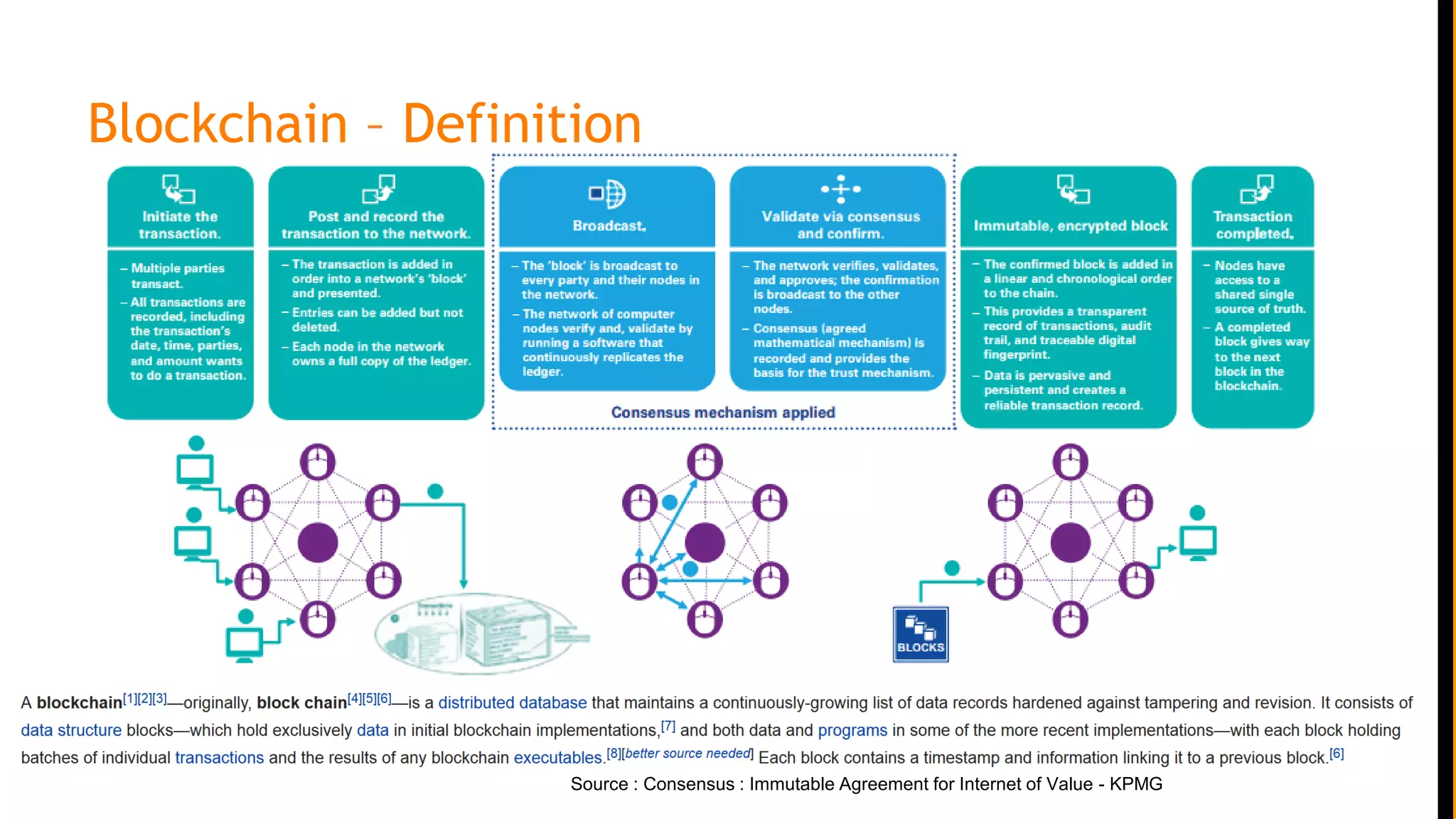
Blockchain – Definition
● Pseudonmity- The ability that
users are not easily identified
Source : Consensus : Immutable Agreement for Internet of Value - KPMG
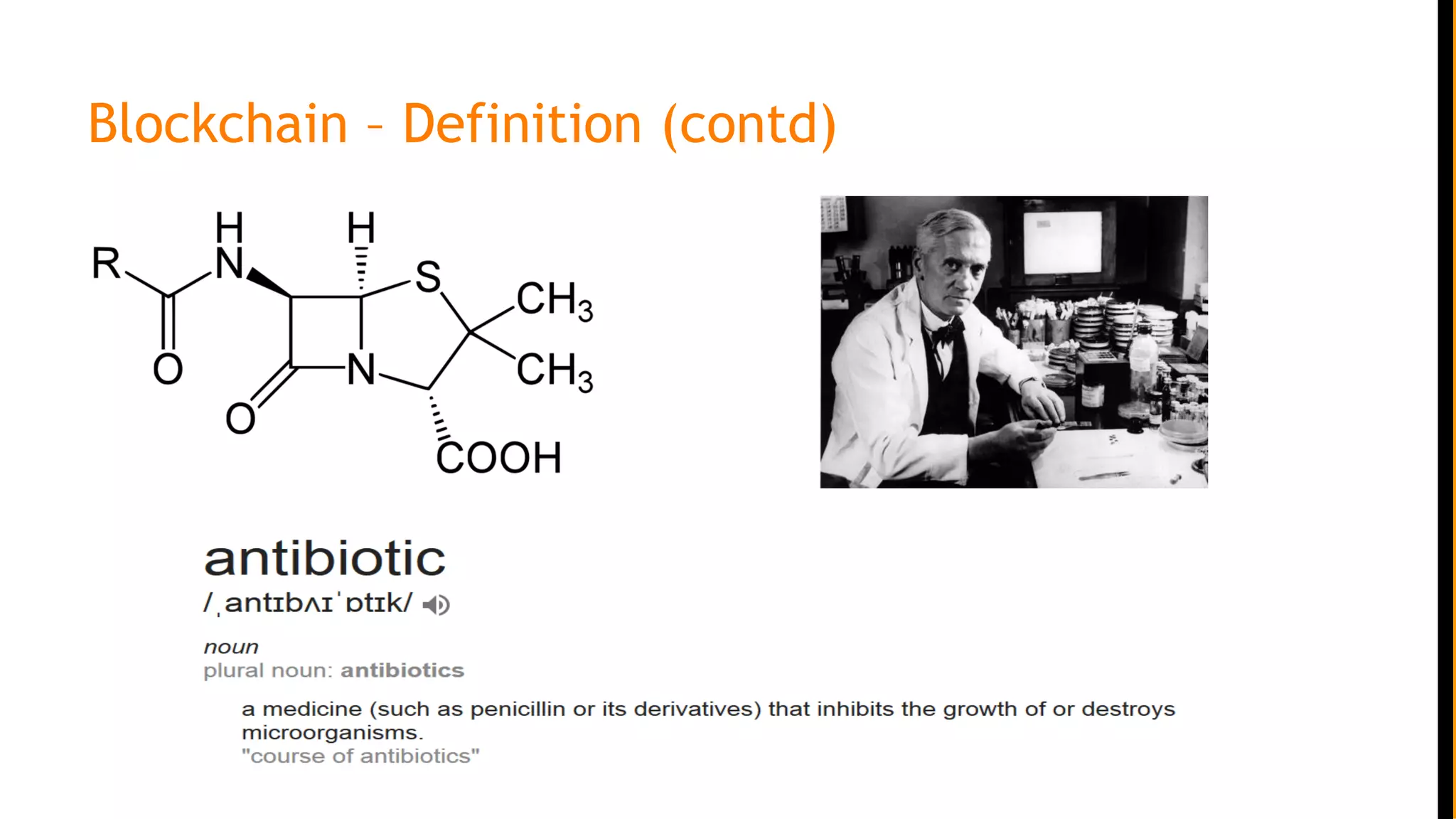
Blockchain – Definition (contd)
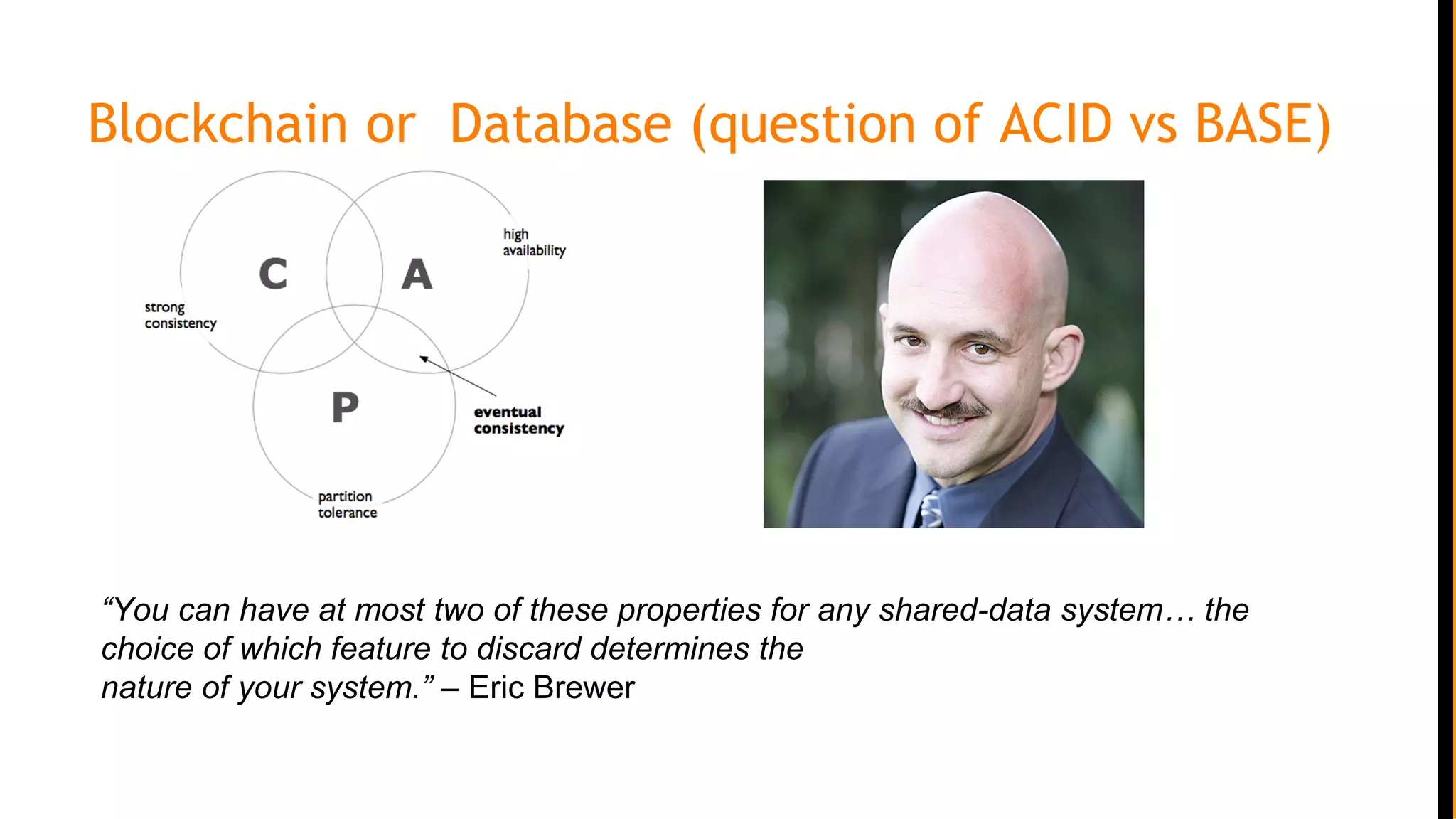
Blockchain or Database (question of ACID vs BASE)
“You can have at most two of these properties for any shared-data system… the
choice of which feature to discard determines the
nature of your system.” – Eric Brewer
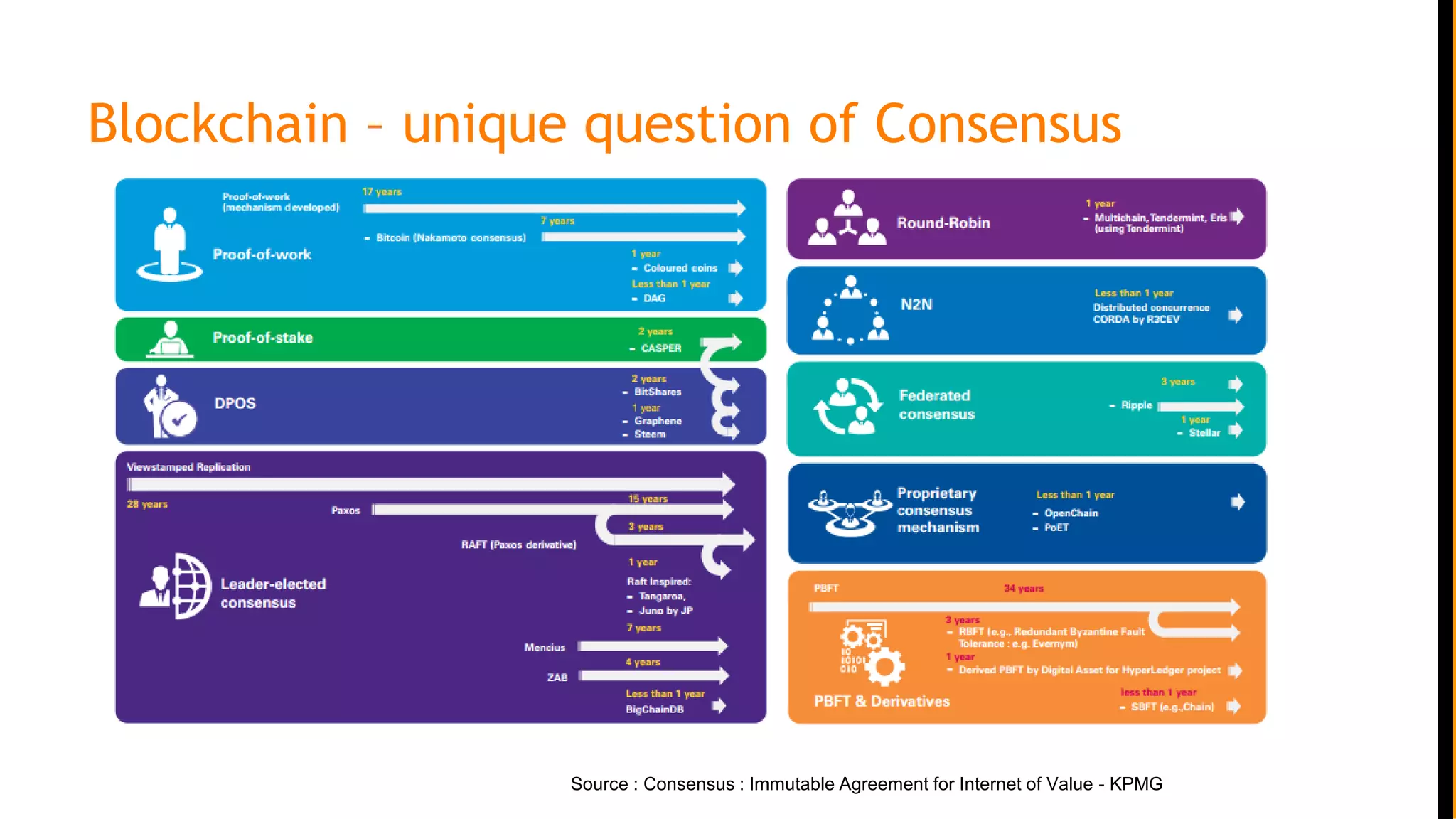
Blockchain – unique question of Consensus
Source : Consensus : Immutable Agreement for Internet of Value - KPMG
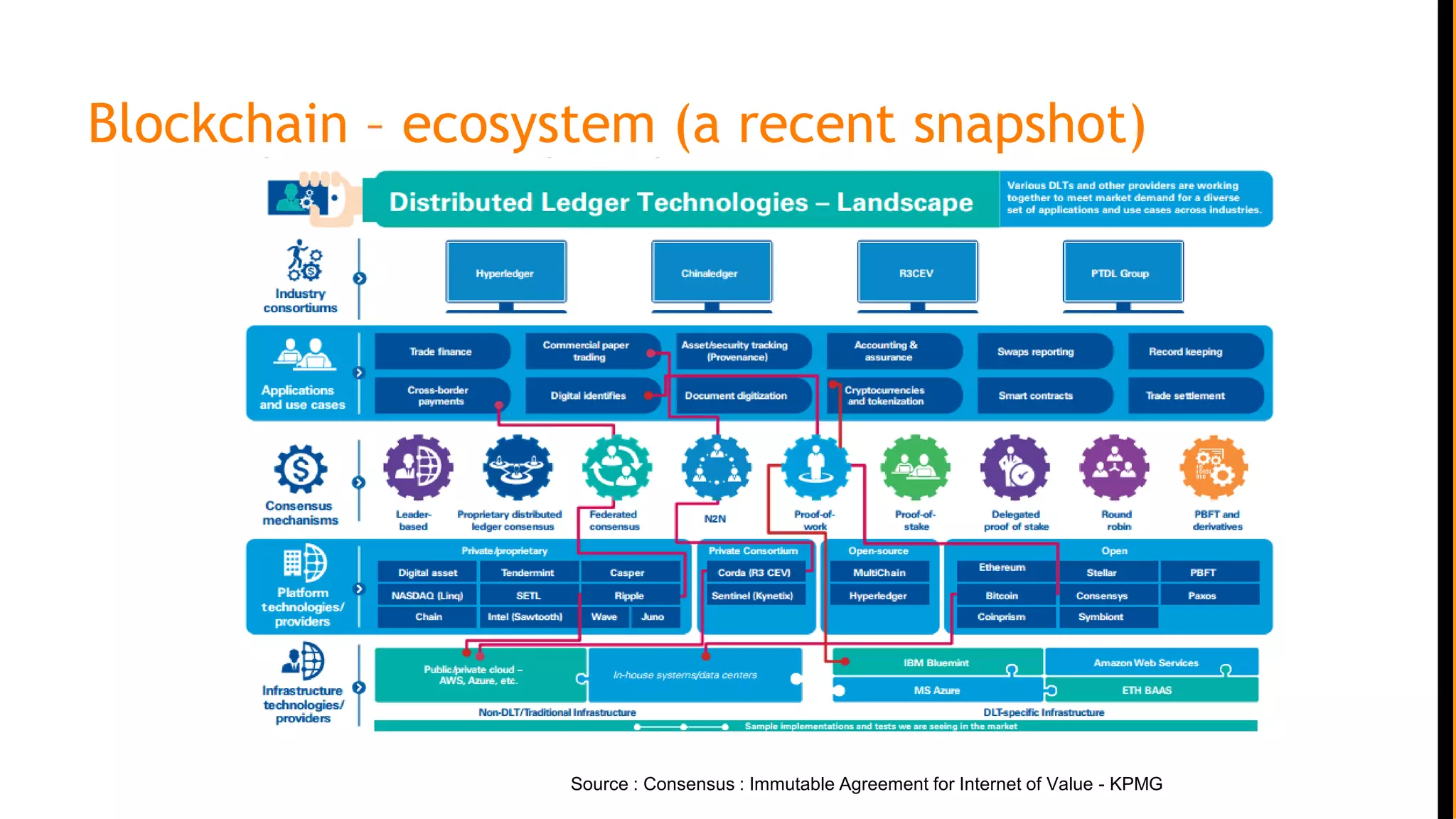
Blockchain – ecosystem (a recent snapshot)
Source : Consensus : Immutable Agreement for Internet of Value - KPMG
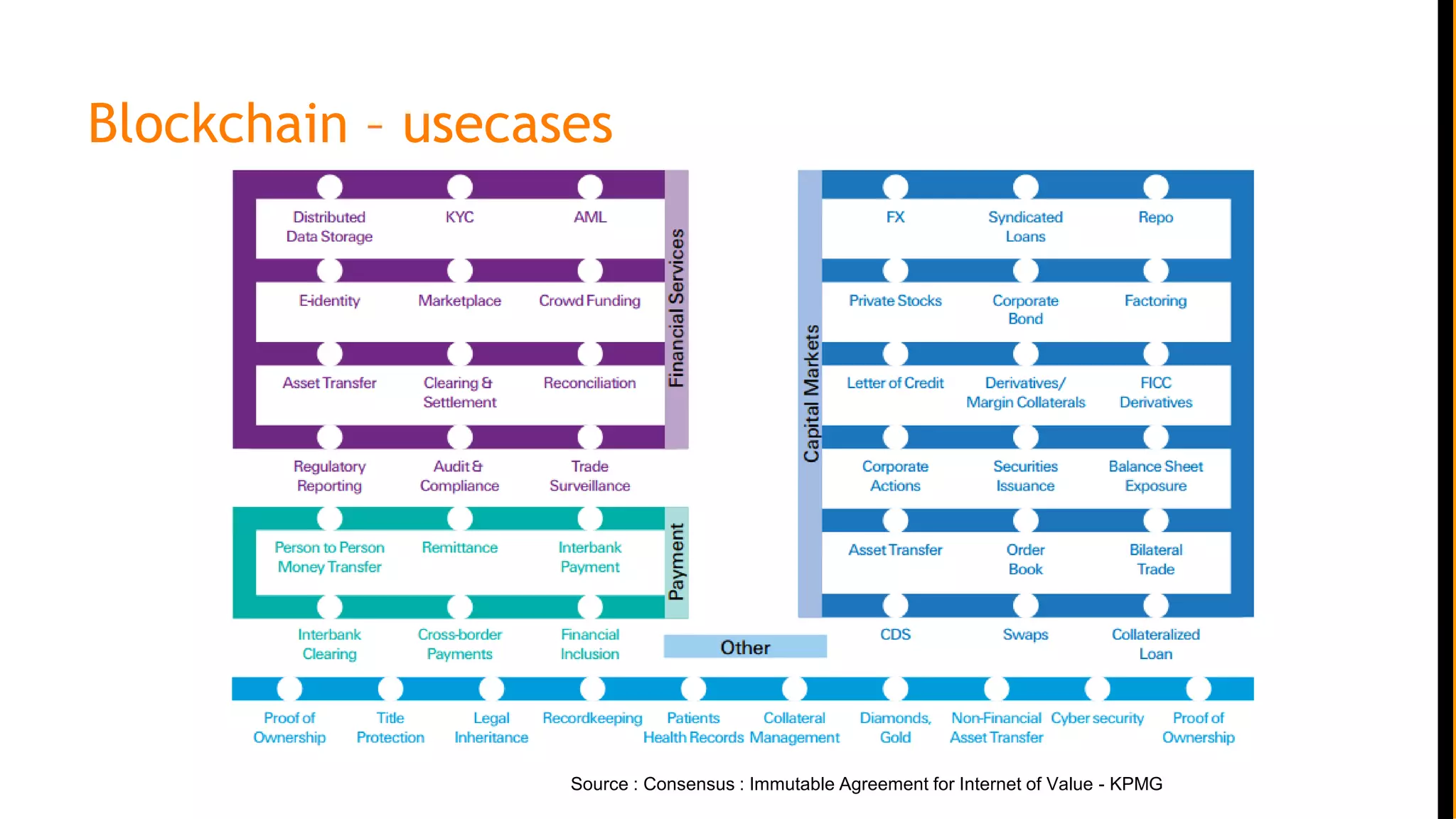
Blockchain – usecases
Source : Consensus : Immutable Agreement for Internet of Value - KPMG
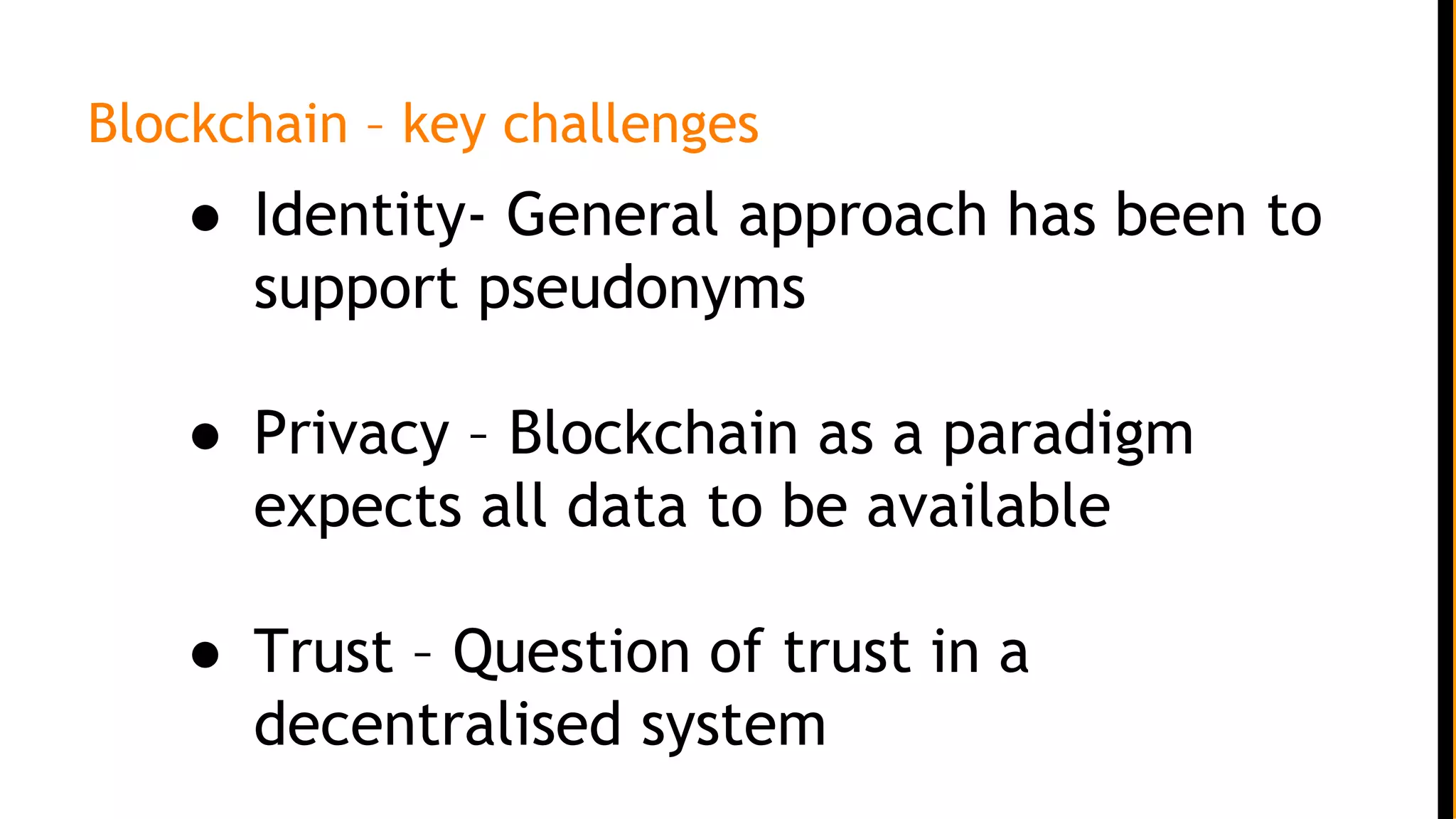
Blockchain – key challenges
● Identity- General approach has been to
support pseudonyms
● Privacy – Blockchain as a paradigm
expects all data to be available
● Trust – Question of trust in a
decentralised system
Privacy
● Permissioned Blockchain – having Blockchain
which has permission
● Homomorphic encryption – Allowing
operations with out revealing content
Homomorphic Encryption
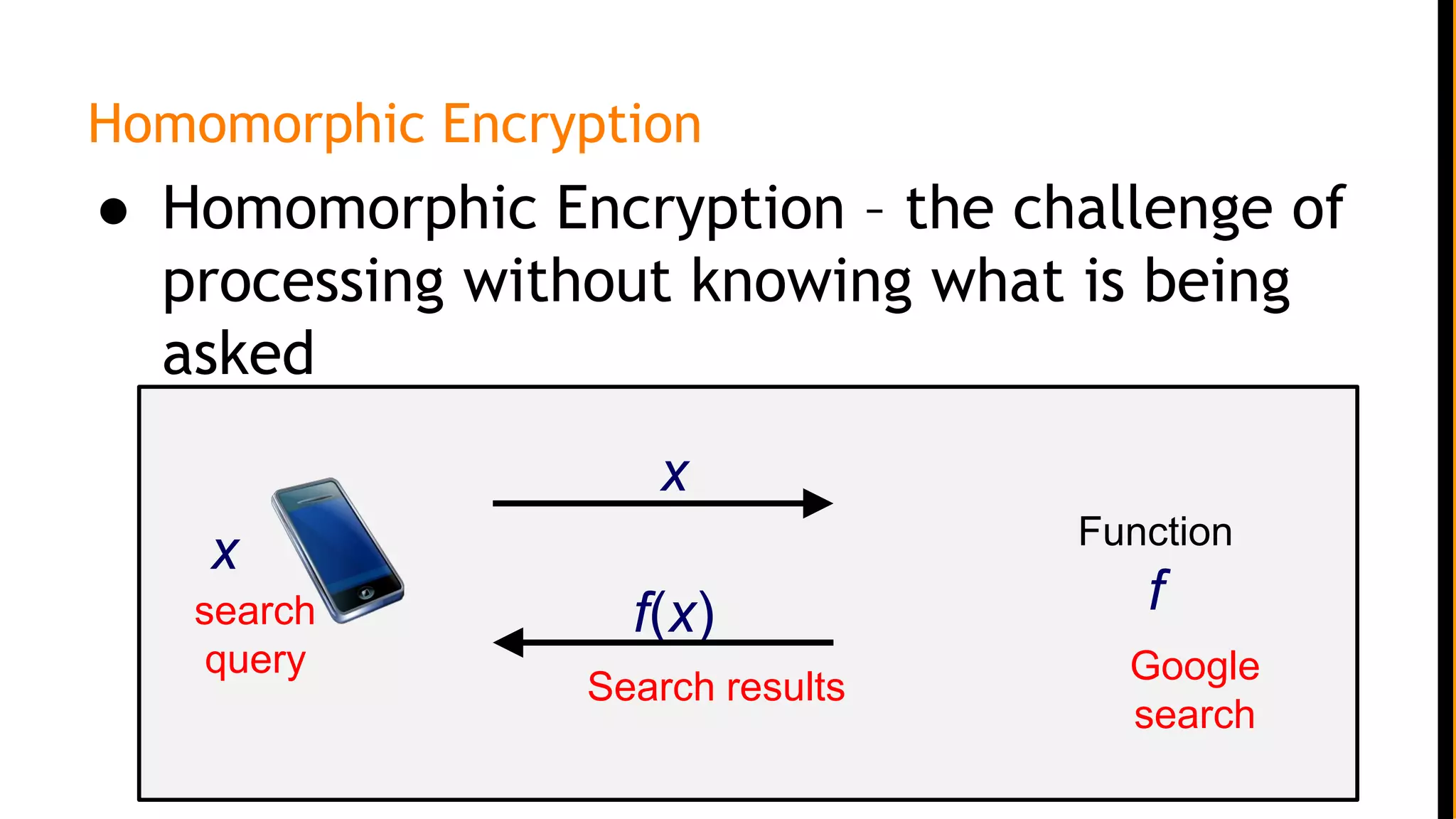
● Homomorphic Encryption – the challenge of
processing without knowing what is being
asked
Function
f
x
search
query Google
search
Search results
x
f(x)
Homomorphic Encryption
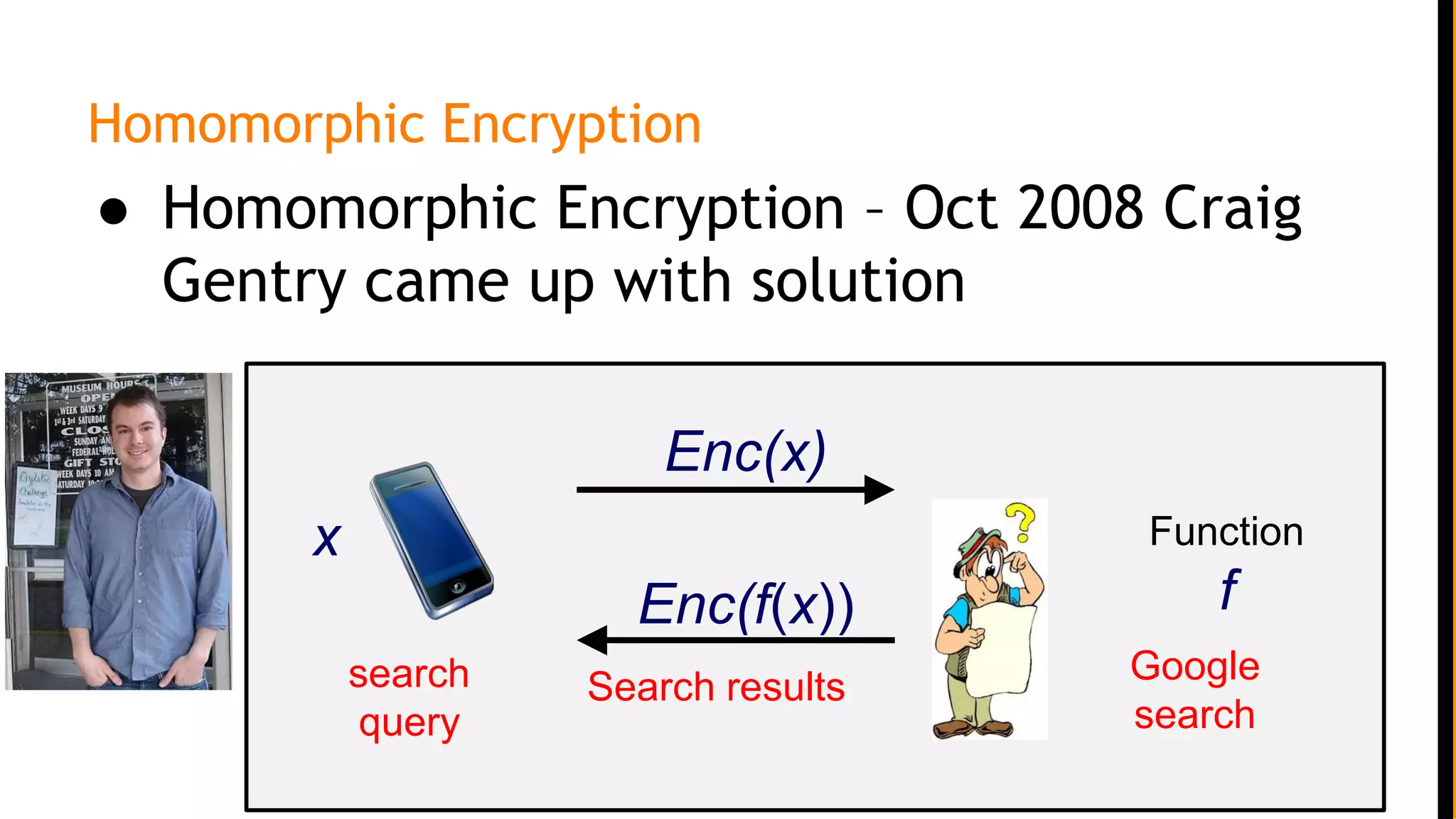
● Homomorphic Encryption – Oct 2008 Craig
Gentry came up with solution
Function
f
x
Enc(x)
Enc(f(x))
search
query
Search results
Google
search
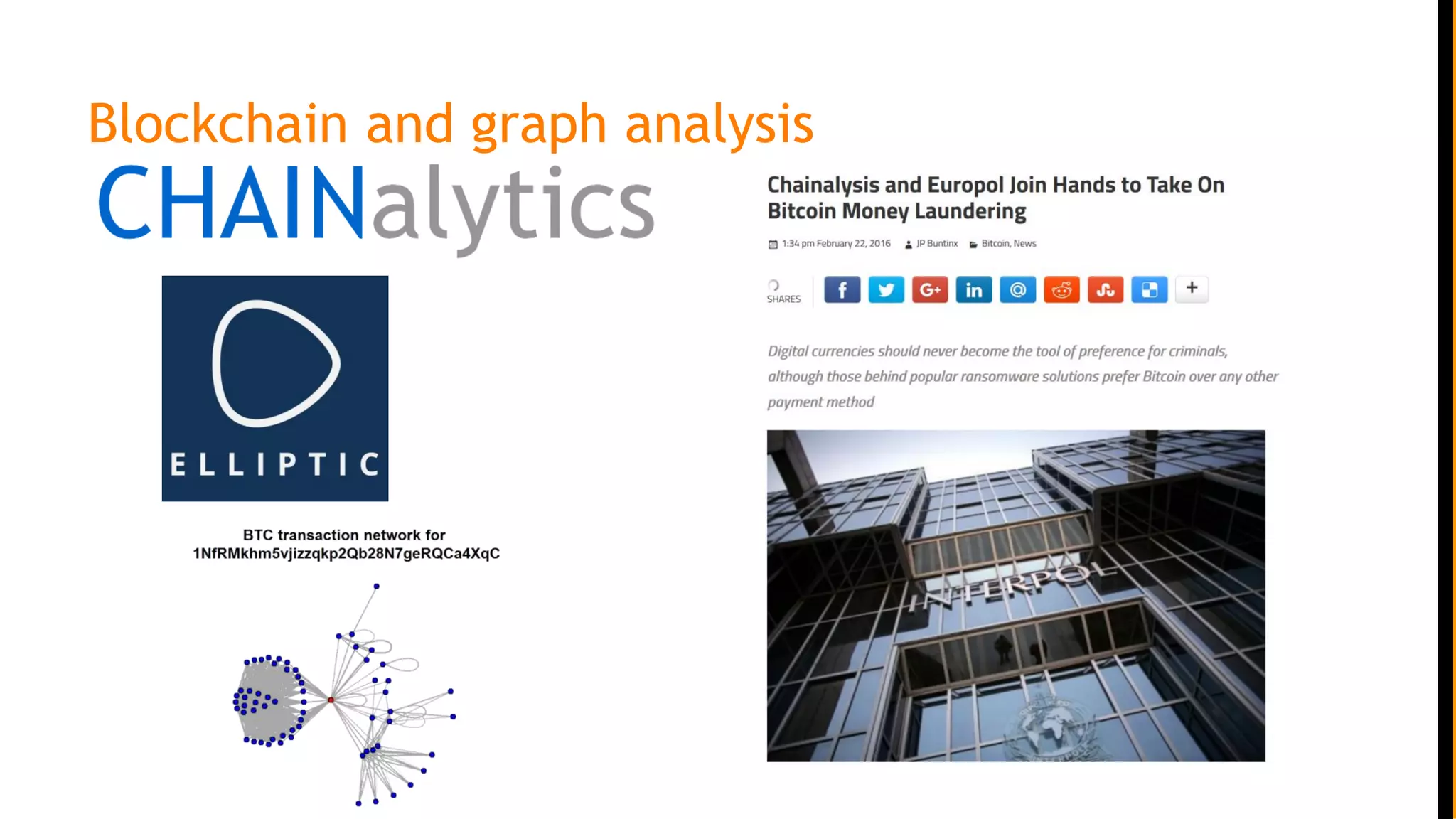
Blockchain and graph analysis
Identity
● Identity- General approach has been to
support pseudonyms
● Identity verification – strength of
verification of identity is as good as on
boarding
Smart Contracts
● “The basic idea behind smart contracts is that many kinds of
contractual clauses (such as collateral, bonding, delineation of
property rights, etc.) can be embedded in the hardware and
software we deal with, in such a way as to make breach of
contract expensive (if desired, sometimes prohibitively so) for
the breacher.”
● “Smart contracts combine protocols, user interfaces, and
promises expressed via those interfaces, to formalize and secure
relationships over public networks. This gives us new ways to
formalize the digital relationships which are far more functional
than their inanimate paper-based ancestors”
● “Smart contracts reduce mental and computational transaction
costs.”
– “Formalizing and Securing Relationships on Public Networks,” Nick Szabo
DISTRIBUTED AUTONOMOUS
ORGANISATIONS (DAOs)
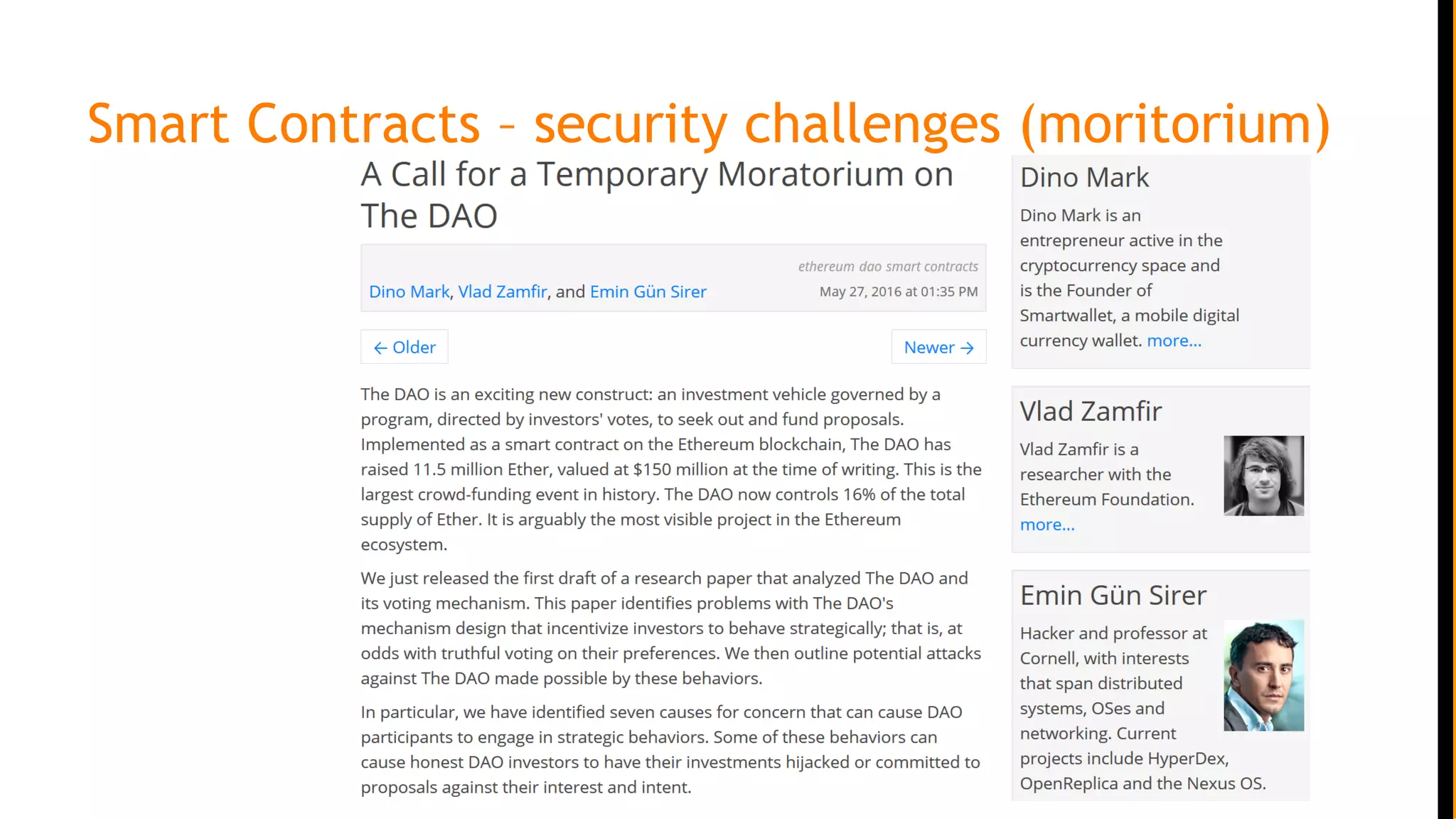
Smart Contracts – security challenges (moritorium)
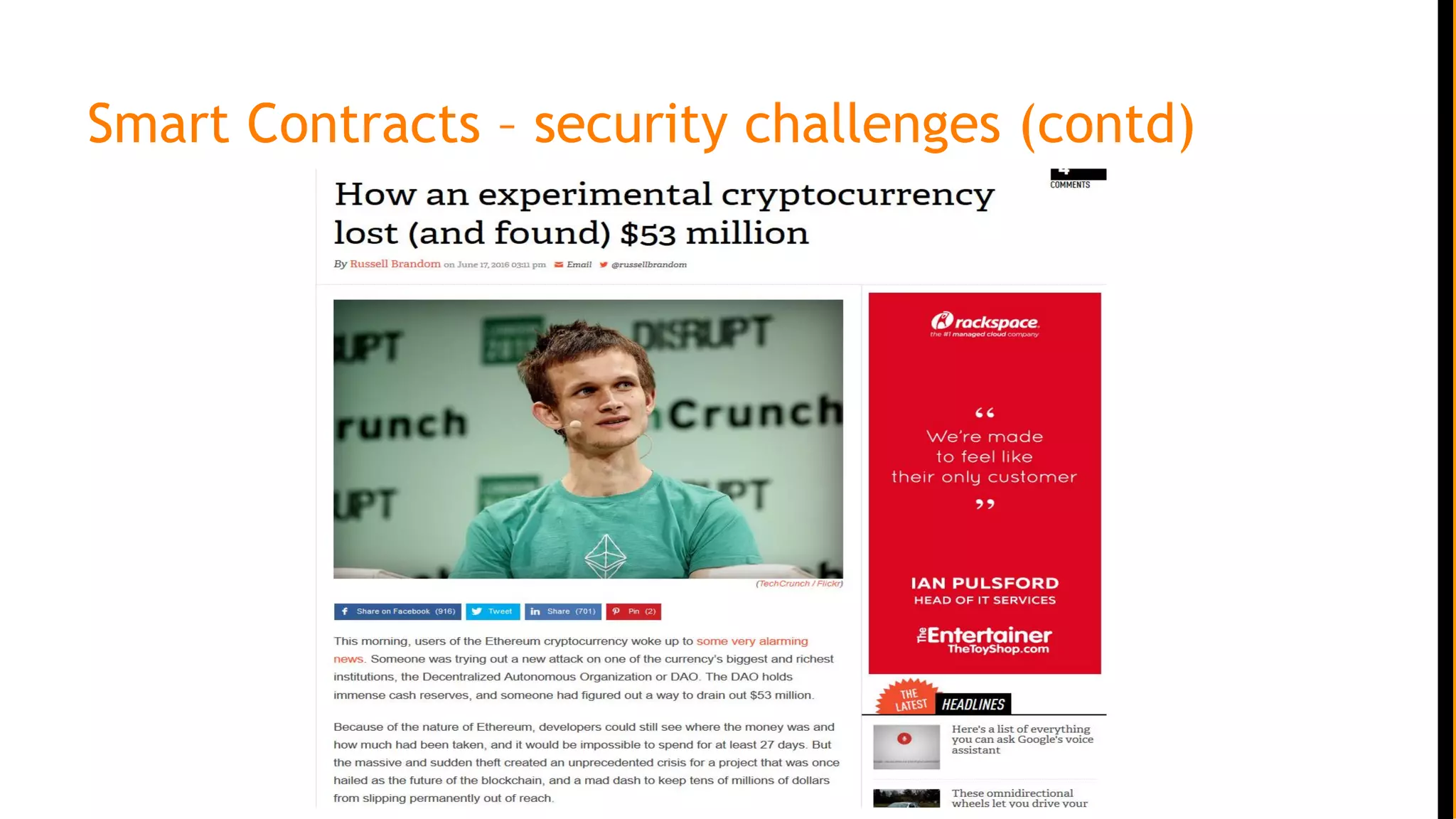
Smart Contracts – security challenges (contd)
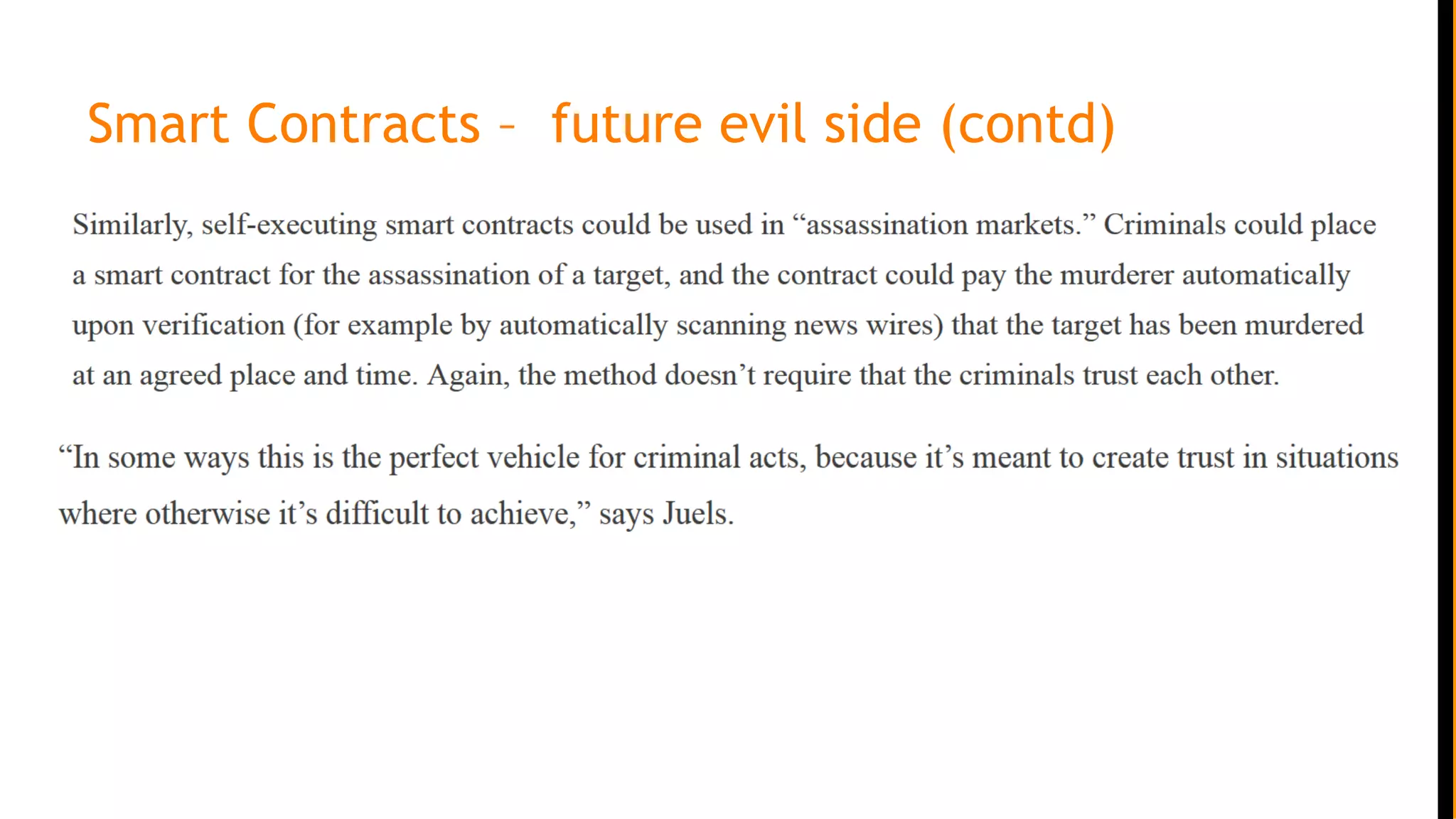
Smart Contracts – future evil side (contd)
Smart Contracts – future (evil side)
● Allows validation of conditions and
implement actions, whether legal or illegal
● Ransom smart contract – a smart contract
that would trigger an action if a ransom is
not paid
GIBSON
21
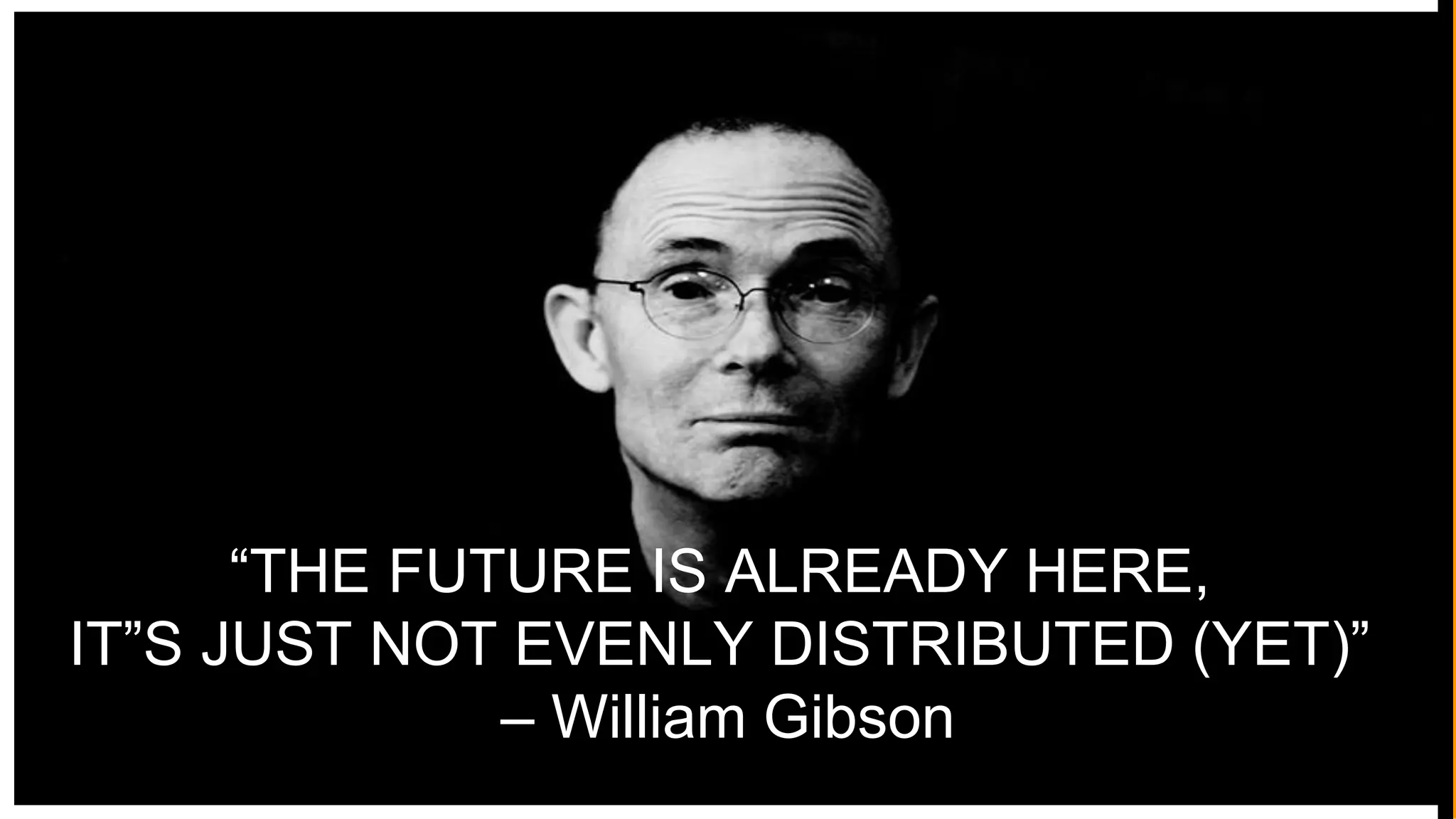
“THE FUTURE IS ALREADY HERE,
IT”S JUST NOT EVENLY DISTRIBUTED (YET)”
– William Gibson
Anish Mohammed
@anishmohammed
QUESTIONS
Blockchain – the real uses
International payments
Contracts
Transaction logs
Voting systems
Micro-transactions
Registries
Multi-signatory contracts
DACs
DAP
DAO
2
3
Distributed Censorship resistance
Distributed Identity verification
Decentralised Governance Services
Blockchain Dispute resolution
Futarchy
Genetic information storage
File storage
EMR
Crowdsourcing
Smart property
Bitcoin – Byzantine Agreements
● Anonymous Byzantine Agreements are
vulnerable to Sybil attacks
● Moderately-Hard Puzzles(a.k.a Proof-of-
Work) as anonymous identity tools were
proposed since mid 90s
● Finally, an approach was used(along with
pretty informal definition) by “Satoshi
Nakamoto”
Bitcoin/Blockchain – Proof of Stake
● Anonymous Byzantine Agreement with
internal tokens as identity tools
● No mining. Right to generate a block
depends on stake
● So a bunch of oracles (hit < target)
● Cumulative difficulty is the chain quality
measure(in a blocktree)
● E.g. Tendermint,Hyperledger,SCP
Bitcoin – Timeline
● Anonymous Byzantine Agreement with
internal tokens as identity tools
● No mining. Right to generate a block
depends on stake
● So a bunch of oracles (hit < target)
● Cumulative difficulty is the chain quality
measure(in a blocktree)
● E.g. Tendermint,Hyperledger,SCP
Bitcoin/Blockchain – Reading List
● Anonymous Byzantine Consensus from
Moderately-Hard Puzzles: A Model for Bitcoin
(A. Miller / J. LaViola)
● Research Perspectives and Challenges for
Bitcoinand Cryptocurrencies (J. Bonneau, A.
Miller et al)
● The Bitcoin Backbone Protocol: Analysis and
Applications
(https://eprint.iacr.org/2014/765.pdf )

Blockchain_FintechEvo_ver1.8_am

  • 1.
  • 2.
    Blockchain – Definition ●Pseudonmity- The ability that users are not easily identified Source : Consensus : Immutable Agreement for Internet of Value - KPMG
  • 3.
  • 4.
    Blockchain or Database(question of ACID vs BASE) “You can have at most two of these properties for any shared-data system… the choice of which feature to discard determines the nature of your system.” – Eric Brewer
  • 5.
    Blockchain – uniquequestion of Consensus Source : Consensus : Immutable Agreement for Internet of Value - KPMG
  • 6.
    Blockchain – ecosystem(a recent snapshot) Source : Consensus : Immutable Agreement for Internet of Value - KPMG
  • 7.
    Blockchain – usecases Source: Consensus : Immutable Agreement for Internet of Value - KPMG
  • 8.
    Blockchain – keychallenges ● Identity- General approach has been to support pseudonyms ● Privacy – Blockchain as a paradigm expects all data to be available ● Trust – Question of trust in a decentralised system
  • 9.
    Privacy ● Permissioned Blockchain– having Blockchain which has permission ● Homomorphic encryption – Allowing operations with out revealing content
  • 10.
    Homomorphic Encryption ● HomomorphicEncryption – the challenge of processing without knowing what is being asked Function f x search query Google search Search results x f(x)
  • 11.
    Homomorphic Encryption ● HomomorphicEncryption – Oct 2008 Craig Gentry came up with solution Function f x Enc(x) Enc(f(x)) search query Search results Google search
  • 12.
  • 13.
    Identity ● Identity- Generalapproach has been to support pseudonyms ● Identity verification – strength of verification of identity is as good as on boarding
  • 14.
    Smart Contracts ● “Thebasic idea behind smart contracts is that many kinds of contractual clauses (such as collateral, bonding, delineation of property rights, etc.) can be embedded in the hardware and software we deal with, in such a way as to make breach of contract expensive (if desired, sometimes prohibitively so) for the breacher.” ● “Smart contracts combine protocols, user interfaces, and promises expressed via those interfaces, to formalize and secure relationships over public networks. This gives us new ways to formalize the digital relationships which are far more functional than their inanimate paper-based ancestors” ● “Smart contracts reduce mental and computational transaction costs.” – “Formalizing and Securing Relationships on Public Networks,” Nick Szabo
  • 15.
  • 17.
    Smart Contracts –security challenges (moritorium)
  • 18.
    Smart Contracts –security challenges (contd)
  • 19.
    Smart Contracts –future evil side (contd)
  • 20.
    Smart Contracts –future (evil side) ● Allows validation of conditions and implement actions, whether legal or illegal ● Ransom smart contract – a smart contract that would trigger an action if a ransom is not paid
  • 21.
    GIBSON 21 “THE FUTURE ISALREADY HERE, IT”S JUST NOT EVENLY DISTRIBUTED (YET)” – William Gibson
  • 22.
  • 23.
    Blockchain – thereal uses International payments Contracts Transaction logs Voting systems Micro-transactions Registries Multi-signatory contracts DACs DAP DAO 2 3 Distributed Censorship resistance Distributed Identity verification Decentralised Governance Services Blockchain Dispute resolution Futarchy Genetic information storage File storage EMR Crowdsourcing Smart property
  • 24.
    Bitcoin – ByzantineAgreements ● Anonymous Byzantine Agreements are vulnerable to Sybil attacks ● Moderately-Hard Puzzles(a.k.a Proof-of- Work) as anonymous identity tools were proposed since mid 90s ● Finally, an approach was used(along with pretty informal definition) by “Satoshi Nakamoto”
  • 25.
    Bitcoin/Blockchain – Proofof Stake ● Anonymous Byzantine Agreement with internal tokens as identity tools ● No mining. Right to generate a block depends on stake ● So a bunch of oracles (hit < target) ● Cumulative difficulty is the chain quality measure(in a blocktree) ● E.g. Tendermint,Hyperledger,SCP
  • 26.
    Bitcoin – Timeline ●Anonymous Byzantine Agreement with internal tokens as identity tools ● No mining. Right to generate a block depends on stake ● So a bunch of oracles (hit < target) ● Cumulative difficulty is the chain quality measure(in a blocktree) ● E.g. Tendermint,Hyperledger,SCP
  • 27.
    Bitcoin/Blockchain – ReadingList ● Anonymous Byzantine Consensus from Moderately-Hard Puzzles: A Model for Bitcoin (A. Miller / J. LaViola) ● Research Perspectives and Challenges for Bitcoinand Cryptocurrencies (J. Bonneau, A. Miller et al) ● The Bitcoin Backbone Protocol: Analysis and Applications (https://eprint.iacr.org/2014/765.pdf )