@rmgarciap
Manuel Garcia
Director of Operations
@ Altoros
#HyperledgerArg
@rmgarciap
Agenda
❏ Blockchain
❏ Brief History & Intro
❏ Key Conpects
❏ When?
❏ Use cases
❏ Hyperledger Project
❏ What? Why?
❏ Introduction
❏ Current status
❏ Architecture
❏ Demo?
@rmgarciap
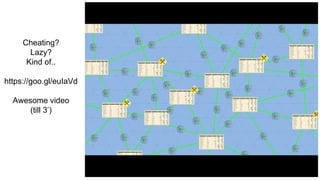
Cheating?
Lazy?
Kind of..
https://goo.gl/euIaVd
Awesome video
(till 3’)
@rmgarciap
Key Concepts
1. Bye bye Trusted Third Parties
2. Fully distributed unique “public” ledger
3. Transactions mathematically verified and persisted (time-stamped)
4. Consensus
Shared single source of truth
@rmgarciap
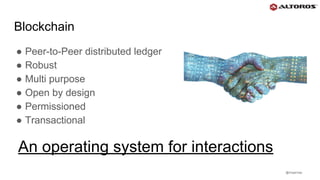
● Peer-to-Peer distributed ledger
● Robust
● Multi purpose
● Open by design
● Permissioned
● Transactional
Blockchain
An operating system for interactions
@rmgarciap
Blockchain - Interaction
When you want public records of
something that happened at some
point in time that is verifiable and not
in the control of any one entity
@rmgarciap
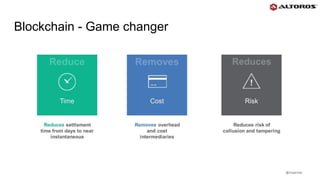
Blockchain - Game changer
@rmgarciap
Blockchain - Use Cases
● Of course: cryptocurrency
● Proof of ownership (physical and digital assets)
● Smart Contracts
● Financial transactions
● Certificates
● Proof of authenticity, existance
● Decentralized patient records
● Voting
@rmgarciap
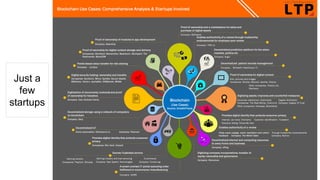
Just a
few
startups
@rmgarciap
@rmgarciap
"As with any early-stage, highly-complex technology that demonstrates the
ability to change the way we live our lives and conduct business, blockchain
demands a cross-industry, open source collaboration to advance the
technology for all."
— Jim Zemlin, Executive Director, Linux Foundation
Why Hyperledger?
@rmgarciap
@rmgarciap
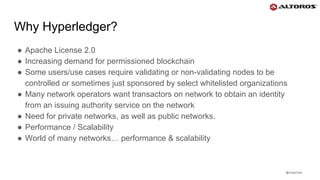
Why Hyperledger?
● Apache License 2.0
● Increasing demand for permissioned blockchain
● Some users/use cases require validating or non-validating nodes to be
controlled or sometimes just sponsored by select whitelisted organizations
● Many network operators want transactors on network to obtain an identity
from an issuing authority service on the network
● Need for private networks, as well as public networks.
● Performance / Scalability
● World of many networks… performance & scalability
@rmgarciap
@rmgarciap
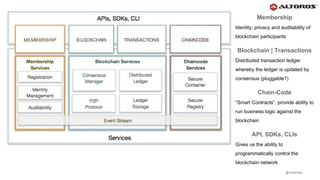
Membership
Identity, privacy and auditability of
blockchain participants
Blockchain | Transactions
Distributed transaction ledger
whereby the ledger is updated by
consensus (pluggable?)
Chain-Code
“Smart Contracts”, provide ability to
run business logic against the
blockchain
API, SDKs, CLIs
Gives us the ability to
programmatically control the
blockchain network
@rmgarciap
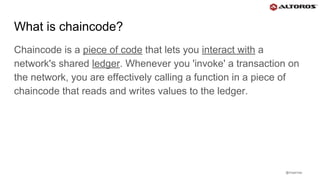
What is chaincode?
Chaincode is a piece of code that lets you interact with a
network's shared ledger. Whenever you 'invoke' a transaction on
the network, you are effectively calling a function in a piece of
chaincode that reads and writes values to the ledger.
@rmgarciap
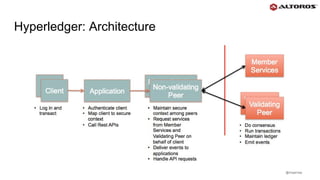
Hyperledger: Architecture
@rmgarciap
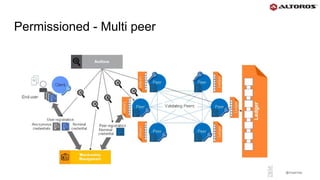
Permissioned - Multi peer
@rmgarciap
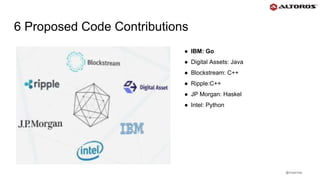
6 Proposed Code Contributions
● IBM: Go
● Digital Assets: Java
● Blockstream: C++
● Ripple:C++
● JP Morgan: Haskel
● Intel: Python
@rmgarciap
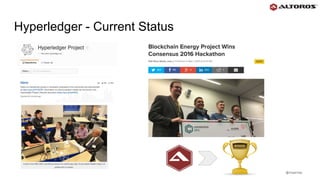
Hyperledger - Current Status
@rmgarciap
Time for a Demo?
@rmgarciap
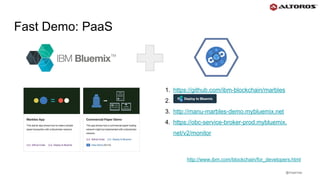
Fast Demo: PaaS
http://www.ibm.com/blockchain/for_developers.html
1. https://github.com/ibm-blockchain/marbles
2.
3. http://manu-marbles-demo.mybluemix.net
4. https://obc-service-broker-prod.mybluemix.
net/v2/monitor
@rmgarciap
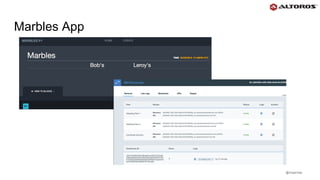
Marbles App
@rmgarciap
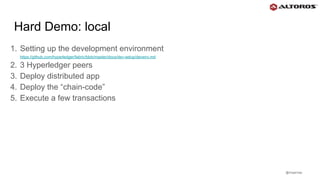
Hard Demo: local
1. Setting up the development environment
https://github.com/hyperledger/fabric/blob/master/docs/dev-setup/devenv.md
2. 3 Hyperledger peers
3. Deploy distributed app
4. Deploy the “chain-code”
5. Execute a few transactions
@rmgarciap
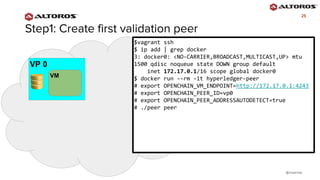
2525
VP 0
VM
$vagrant ssh
$ ip add | grep docker
3: docker0: <NO-CARRIER,BROADCAST,MULTICAST,UP> mtu
1500 qdisc noqueue state DOWN group default
inet 172.17.0.1/16 scope global docker0
$ docker run --rm -it hyperledger-peer
# export OPENCHAIN_VM_ENDPOINT=http://172.17.0.1:4243
# export OPENCHAIN_PEER_ID=vp0
# export OPENCHAIN_PEER_ADDRESSAUTODETECT=true
# ./peer peer
@rmgarciap
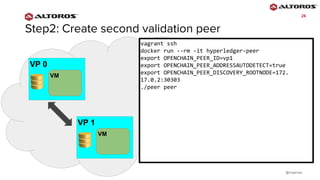
2626
VP 0
VM
VP 1
VM
vagrant ssh
docker run --rm -it hyperledger-peer
export OPENCHAIN_PEER_ID=vp1
export OPENCHAIN_PEER_ADDRESSAUTODETECT=true
export OPENCHAIN_PEER_DISCOVERY_ROOTNODE=172.
17.0.2:30303
./peer peer
@rmgarciap
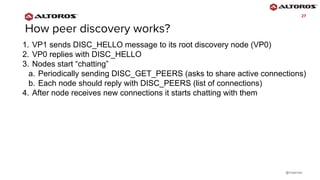
2727
1. VP1 sends DISC_HELLO message to its root discovery node (VP0)
2. VP0 replies with DISC_HELLO
3. Nodes start “chatting”
a. Periodically sending DISC_GET_PEERS (asks to share active connections)
b. Each node should reply with DISC_PEERS (list of connections)
4. After node receives new connections it starts chatting with them
@rmgarciap
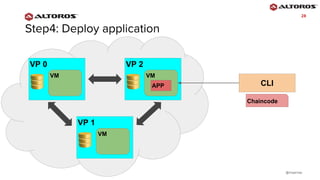
2828
VP 0
VM
VP 2
VM
APP
VP 1
VM
CLI
Chaincode
@rmgarciap
2929
vagrant ssh
cd $GOPATH/src/github.com/hyperledger/fabric/peer
CORE_PEER_ADDRESS=172.17.0.2:30303 ./peer chaincode deploy -p github.
com/hyperledger/fabric/examples/chaincode/go/chaincode_example02 -c '{"Function":"
init", "Args": ["a","100", "b", "200"]}'
Will return ChainCode_ID to be used in further steps
@rmgarciap
3030
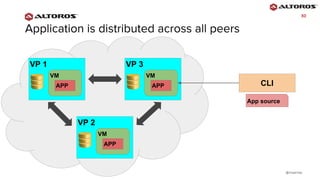
VP 1
VM
APP
VP 3
VM
APP
VP 2
VM
APP
CLI
App source
@rmgarciap
3131
cd $GOPATH/src/github.com/hyperledger/fabric/peer
CORE_PEER_ADDRESS=172.17.0.2:30303 ./peer chaincode invoke -n ChainCode_ID -c
'{"Function": "invoke", "Args": ["a", "b", "10"]}'
CORE_PEER_ADDRESS=172.17.0.2:30303 ./peer chaincode query -l golang -n ChainCode_ID -c
'{"Function": "query", "Args": ["a"]}'
@rmgarciap
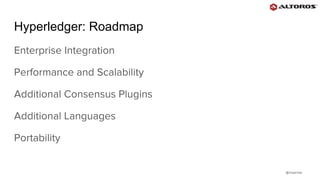
Hyperledger: Roadmap
@rmgarciap
manuel.garcia@altoros.com | @rmgarciap

Introduction to Blockchain and the Hyperledger Project