BlockChain
Technology
By Deep B. Akabari
200470107001
Semester-2
What is Blockchain Technology?
• Blockchain is a decentralized ledger of all transactions across a peer-to-peer
network. Using this technology, Participants can perform transactions without the
need for a central certifying authority. Potential applications include fund transfers,
settling trades, voting and many others.
• Business Networks benefit from connectivity – Connected customers, suppliers,
banks, partners.
• Wealth is generated by the flow of goods & services across business network.
• Anything that is capable of being owned or controlled to produce value, is an
asset.
• Two fundamental types of asset – Tangible, e.g., a house – Intangible e.g., a
mortgage.
How Transactions are done?
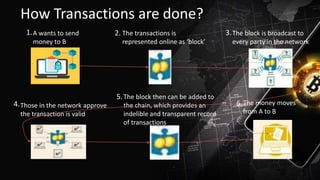
A wants to send
money to B
The transactions is
represented online as ‘block’
The block is broadcast to
every party in the network
Those in the network approve
the transaction is valid
The block then can be added to
the chain, which provides an
indelible and transparent record
of transactions
The money moves
from A to B
1. 2. 3.
4.
5.
6.
Blockchain Underpins Bitcoins…..
1. Is unregulated, censorship-resistant shadow currency.
2. Blockchain ensures “cash like” coin passing
• Unique
• Immutable
• Final
3. Bitcoin is the first Blockchain application.
4. Digital currencies different from cryptocurrency.
Uses of Blockchain
 BitPesa
It is a digital foreign exchange and payment platform for frontier
markets.
 Storj
It is a crypto currency and digital payment system and is also a
blockchain-based digital storage and data retrieval method.
 Riot Blockchain
Formerly a biotech company called Bioptix, the company rebranded
and is now listed on the NASDAQ exchange under ticker symbol RIOT,
making it the first purely Blockchain focused public US stock.
Continue….
 Golem
Golem is a global, open source, decentralized supercomputer that
anyone can access. It is made up of the combined power of users’
machines, from PC’s to entire data centers.
 Open Bazaar
It is one of the first marketplaces that accepts cryptocurrency for
transactions. Thick of it like a hybrid of eBay and Etsy that runs on
cryptocurrency and charges no fees.
 Chronicled
The coolest features allow for better supply chain control and
management and anti-fraud opportunities to protect brand integrity
around the world.
Advantages…
 Transparency
Users or developers have the opportunity to modify it as
they see fit. This makes blockchain a particularly secure
technology.
 Reduced transaction costs
Blockchain allows peer-to-peer and business-to-business
transactions to be completed without the need for a third
party. It means they can actually reduce costs to the user or
businesses over time.
Continue….
 Faster transaction settlements
Blockchain technology is working 24 hours a day, seven days a week,
meaning blockchain-based transactions process considerably more
quickly.
 Decentralization
Blockchain actually allows individual transactions to have their own
proof of validity and the authorization to enforce those constraints.
 User-controlled networks
Rather than having a third party run the show, Users and developers
are the ones who get to call the shots.
Applications
 Smart Contracts
The Project is a decentralized platform that runs smart
contracts: applications that run exactly as programmed
without any possibility of downtime, censorship, fraud or third
party interference.
 Cloud Storage
Simply using excess hard drive space, users could store the
traditional cloud 300 times over.
Continue….
 Supply-chain Communications & proof-of-Provenance
Most of the things we buy aren’t made by a single entity, but by
a chain of suppliers who sell their components(e.g., graphite for
pencils) to a company that assembles and markets the final
product.
 Paying Employees
payments made via Bitcoin can save both money and time for
employers and employees.
 Electronic Voting
Delegated proof of Stake(DPOS) is the fastest most efficient,
most decentralized and most flexible consensus model available.
Conclusion
 Blockchain is a shared, replicated ledger.
 IBM supports an open standards, open source, open
governance Blockchain.
 Blockchain can open up business networks by taking
out cost, improving efficiencies and increase
accessibility.
 Blockchain address an exciting and topical set of
business challenges, which cross every industry.
BlockChain Technology By Deep Akabari.pptx

BlockChain Technology By Deep Akabari.pptx

  • 1.
    BlockChain Technology By Deep B.Akabari 200470107001 Semester-2
  • 2.
    What is BlockchainTechnology? • Blockchain is a decentralized ledger of all transactions across a peer-to-peer network. Using this technology, Participants can perform transactions without the need for a central certifying authority. Potential applications include fund transfers, settling trades, voting and many others. • Business Networks benefit from connectivity – Connected customers, suppliers, banks, partners. • Wealth is generated by the flow of goods & services across business network. • Anything that is capable of being owned or controlled to produce value, is an asset. • Two fundamental types of asset – Tangible, e.g., a house – Intangible e.g., a mortgage.
  • 3.
    How Transactions aredone? A wants to send money to B The transactions is represented online as ‘block’ The block is broadcast to every party in the network Those in the network approve the transaction is valid The block then can be added to the chain, which provides an indelible and transparent record of transactions The money moves from A to B 1. 2. 3. 4. 5. 6.
  • 4.
    Blockchain Underpins Bitcoins….. 1.Is unregulated, censorship-resistant shadow currency. 2. Blockchain ensures “cash like” coin passing • Unique • Immutable • Final 3. Bitcoin is the first Blockchain application. 4. Digital currencies different from cryptocurrency.
  • 5.
    Uses of Blockchain BitPesa It is a digital foreign exchange and payment platform for frontier markets.  Storj It is a crypto currency and digital payment system and is also a blockchain-based digital storage and data retrieval method.  Riot Blockchain Formerly a biotech company called Bioptix, the company rebranded and is now listed on the NASDAQ exchange under ticker symbol RIOT, making it the first purely Blockchain focused public US stock.
  • 6.
    Continue….  Golem Golem isa global, open source, decentralized supercomputer that anyone can access. It is made up of the combined power of users’ machines, from PC’s to entire data centers.  Open Bazaar It is one of the first marketplaces that accepts cryptocurrency for transactions. Thick of it like a hybrid of eBay and Etsy that runs on cryptocurrency and charges no fees.  Chronicled The coolest features allow for better supply chain control and management and anti-fraud opportunities to protect brand integrity around the world.
  • 7.
    Advantages…  Transparency Users ordevelopers have the opportunity to modify it as they see fit. This makes blockchain a particularly secure technology.  Reduced transaction costs Blockchain allows peer-to-peer and business-to-business transactions to be completed without the need for a third party. It means they can actually reduce costs to the user or businesses over time.
  • 8.
    Continue….  Faster transactionsettlements Blockchain technology is working 24 hours a day, seven days a week, meaning blockchain-based transactions process considerably more quickly.  Decentralization Blockchain actually allows individual transactions to have their own proof of validity and the authorization to enforce those constraints.  User-controlled networks Rather than having a third party run the show, Users and developers are the ones who get to call the shots.
  • 9.
    Applications  Smart Contracts TheProject is a decentralized platform that runs smart contracts: applications that run exactly as programmed without any possibility of downtime, censorship, fraud or third party interference.  Cloud Storage Simply using excess hard drive space, users could store the traditional cloud 300 times over.
  • 10.
    Continue….  Supply-chain Communications& proof-of-Provenance Most of the things we buy aren’t made by a single entity, but by a chain of suppliers who sell their components(e.g., graphite for pencils) to a company that assembles and markets the final product.  Paying Employees payments made via Bitcoin can save both money and time for employers and employees.  Electronic Voting Delegated proof of Stake(DPOS) is the fastest most efficient, most decentralized and most flexible consensus model available.
  • 11.
    Conclusion  Blockchain isa shared, replicated ledger.  IBM supports an open standards, open source, open governance Blockchain.  Blockchain can open up business networks by taking out cost, improving efficiencies and increase accessibility.  Blockchain address an exciting and topical set of business challenges, which cross every industry.