Block-chains & Crypto Currencies
The Basics of decentralisation & cryptography - January 2018 Initio IKS
Jan Stanley Brown
Objectives and knowledge sharing
• What is blockchain? Why should we care?
• Cryptography: Shared secrets and the Blockchain
• Protocols: What’s in those blocks ?!
• Ethereum
• Bitcoin
• Hyperledger
What are block-chains ?
A blockchain is a shared ledger
Ledger:
An account book of final entry, in which business
transactions are recorded
A blockchain is an immutable database
Database:
A collection of information that is organized so
that it can easily be accessed, managed, and
updated.
A blockchain moves data around
Data:
Data is information that has been translated into a
form that is more convenient to move or process
(e.g. bits)
A blockchain is secure
Security:
Preventing unauthorized access, use, disclosure,
disruption, modification, inspection, recording or
destruction of information
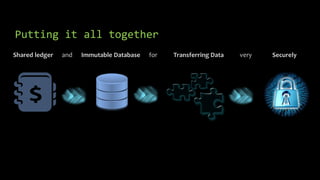
Putting it all together
Shared ledger and Immutable Database for Transferring Data very Securely
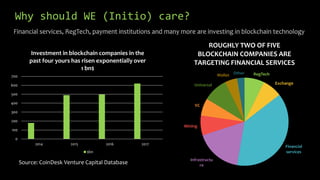
Why should WE (Initio) care?
Financial services, RegTech, payment institutions and many more are investing in blockchain technology
0
100
200
300
400
500
600
700
2014 2015 2016 2017
Investment in blockchain companies in the
past four yours has risen exponentially over
1 bn$
$bn
RegTech
Exchange
Financial
services
Infrastructu
re
Mining
VC
Universal
Wallet Other
ROUGHLY TWO OF FIVE
BLOCKCHAIN COMPANIES ARE
TARGETING FINANCIAL SERVICES
Source: CoinDesk Venture Capital Database
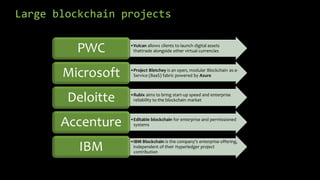
Large blockchain projects
•Vulcan allows clients to launch digital assets
thattrade alongside other virtual currenciesPWC
•Project Bletchey is an open, modular Blockchain as-a-
Service (BaaS) fabric powered by AzureMicrosoft
•Rubix aims to bring start-up speed and enterprise
reliability to the blockchain marketDeloitte
•Editable blockchain for enterprise and permissioned
systemsAccenture
•IBM Blockchain is the company’s enterprise offering,
independent of their Hyperledger project
contribution
IBM
Cryptography: Shared Secrets and the
Blockchain
What is cryptography?
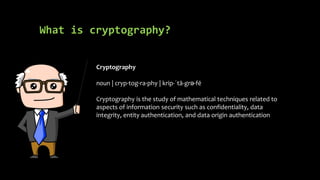
Cryptography
noun | cryp·tog·ra·phy | krip-ˈtä-grə-fē
Cryptography is the study of mathematical techniques related to
aspects of information security such as confidentiality, data
integrity, entity authentication, and data origin authentication
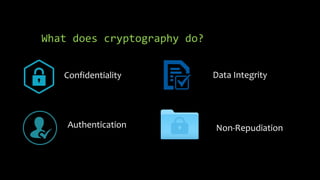
What does cryptography do?
Confidentiality Data Integrity
Authentication Non-Repudiation
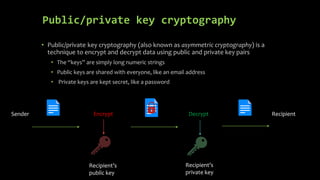
Public/private key cryptography
• Public/private key cryptography (also known as asymmetric cryptography) is a
technique to encrypt and decrypt data using public and private key pairs
• The “keys” are simply long numeric strings
• Public keys are shared with everyone, like an email address
• Private keys are kept secret, like a password
Sender Encrypt Decrypt Recipient
Recipient’s
public key
Recipient’s
private key
Cryptographic hashing
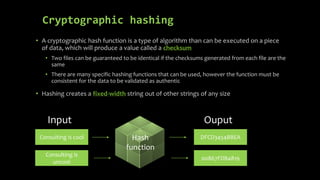
• A cryptographic hash function is a type of algorithm than can be executed on a piece
of data, which will produce a value called a checksum
• Two files can be guaranteed to be identical if the checksums generated from each file are the
same
• There are many specific hashing functions that can be used, however the function must be
consistent for the data to be validated as authentic
• Hashing creates a fixed-width string out of other strings of any size
Input Ouput
Consulting is cool
Consulting is
uncool
DFCD3454BBEA
00867FDB4819
Hash
function
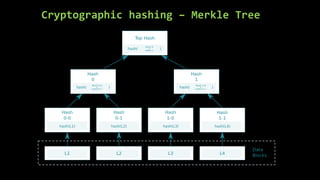
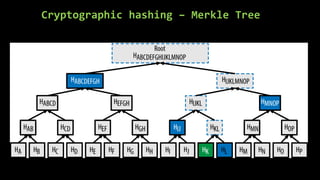
Cryptographic hashing – Merkle Tree
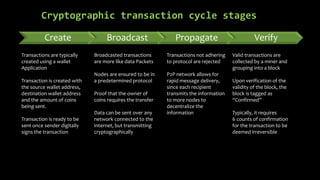
Cryptographic transaction cycle stages
Create Broadcast Propagate Verify
Transactions are typically
created using a wallet
Application
Transaction is created with
the source wallet address,
destination wallet address
and the amount of coins
being sent.
Transaction is ready to be
sent once sender digitally
signs the transaction
Broadcasted transactions
are more like data Packets
Nodes are ensured to be in
a predetermined protocol
Proof that the owner of
coins requires the transfer
Data can be sent over any
network connected to the
internet, but transmitting
cryptographically
Transactions not adhering
to protocol are rejected
P2P network allows for
rapid message delivery,
since each recipient
transmits the information
to more nodes to
decentralize the
information
Valid transactions are
collected by a miner and
grouping into a block
Upon verification of the
validity of the block, the
block is tagged as
“Confirmed”
Typically, it requires
6 counts of confirmation
for the transaction to be
deemed irreversible
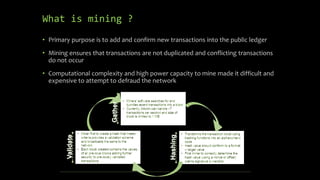
What is mining ?
• Primary purpose is to add and confirm new transactions into the public ledger
• Mining ensures that transactions are not duplicated and conflicting transactions
do not occur
• Computational complexity and high power capacity to mine made it difficult and
expensive to attempt to defraud the network
Protocols: What are the differences?
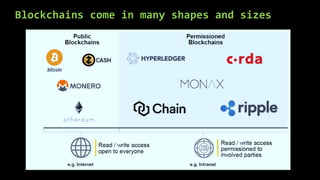
Blockchains come in many shapes and sizes
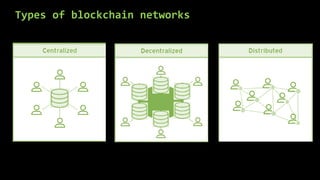
Types of blockchain networks
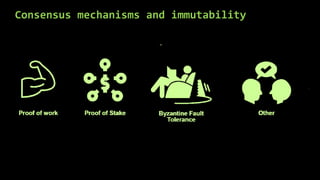
Consensus mechanisms and immutability
What is a protocol?
► A set of rules and requirements defining the standards, structures, and types of messages allowed over electronic
communication between two or more end points.
► The protocol defines what is required to send a transaction and what is required for those transactions to be validated.
► All users and nodes that connect to the network must use an accepted distribution of software that follows the rules
of the protocol in order to maintain consistency across the network and ensure its security.
► Transactions or blocks that do not conform to the predefined rules will be rejected.
► The protocol is not static – modifications to the protocol can be made. However, any changes require a consensus
based authentication.
Networks and nodes
The blockchain is an example of a network based upon a distributed ledger (blockchain technology). Specific data or
tokens can be transferred over these networks, made up of computers called “nodes.” To be broadcasted on the
network by the nodes, transactions must adhere to rules stipulated by the protocol.
► Decentralized
► No central authority to unilaterally control transactions and code execution
► Peer-to-peer (P2P)
► No central server to record all transaction, allowing for shared public access to the blockchain
► Consensus based authentication
► Transactions cannot be unilaterally approved - a majority of the network participants must
include the transaction in a block in order for it to be valid, thus reaching consensus.
This contrasts with traditional networks used by financial institutions and credit card companies
(such as VisaNet, ACH, etc.), which are typically:
► Centralized
► Controlled and maintained by one entity
Decentralized trust system
► Data application and settlement networks, which are based upon distributed ledgers, provide embedded trust
► Ability to rely on a distributed network of users rather than having to trust one single entity to
perform tasks
► This allows for the irrefutable proof that a transaction/contract/agreement/data has not been
duplicated or altered in the digital realm
► The embedded trust inherent in distributed ledgers is possible because the ledger is stored on a peer-to-peer
network of computers rather than through a central server. Any additions/changes made to the ledger must be
agreed upon by a majority of users, not unilaterally by a single user.
► As a result, services that traditionally require a trusted third party (such as fund transfers, contract verifications,
escrow, etc.) can now be performed with the speed and convenience of the digital realm, resulting in:
► A reduced dependence on centralized parties
► Low-cost, international transactions with near-instant settlement
► Irrefutable proof of ownership of digital assets / contracts / agreements
ETHEREUM
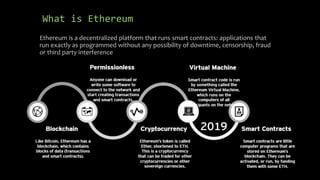
What is Ethereum
Ethereum is a decentralized platform that runs smart contracts: applications that
run exactly as programmed without any possibility of downtime, censorship, fraud
or third party interference
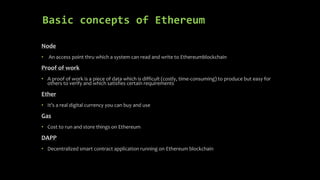
Basic concepts of Ethereum
Node
• An access point thru which a system can read and write to Ethereumblockchain
Proof of work
• A proof of work is a piece of data which is difficult (costly, time-consuming) to produce but easy for
others to verify and which satisfies certain requirements
Ether
• It’s a real digital currency you can buy and use
Gas
• Cost to run and store things on Ethereum
DAPP
• Decentralized smart contract application running on Ethereum blockchain
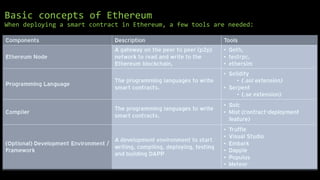
Basic concepts of Ethereum
When deploying a smart contract in Ethereum, a few tools are needed:
Bitcoin
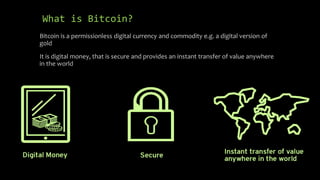
What is Bitcoin?
Bitcoin is a permissionless digital currency and commodity e.g. a digital version of
gold
It is digital money, that is secure and provides an instant transfer of value anywhere
in the world
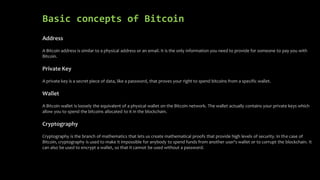
Basic concepts of Bitcoin
Address
A Bitcoin address is similar to a physical address or an email. It is the only information you need to provide for someone to pay you with
Bitcoin.
Private Key
A private key is a secret piece of data, like a password, that proves your right to spend bitcoins from a specific wallet.
Wallet
A Bitcoin wallet is loosely the equivalent of a physical wallet on the Bitcoin network. The wallet actually contains your private keys which
allow you to spend the bitcoins allocated to it in the blockchain.
Cryptography
Cryptography is the branch of mathematics that lets us create mathematical proofs that provide high levels of security. In the case of
Bitcoin, cryptography is used to make it impossible for anybody to spend funds from another user's wallet or to corrupt the blockchain. It
can also be used to encrypt a wallet, so that it cannot be used without a password.
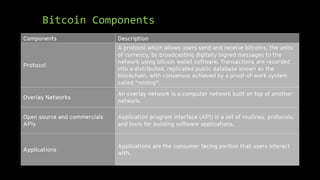
Bitcoin Components
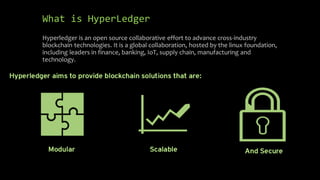
What is HyperLedger
Hyperledger is an open source collaborative effort to advance cross-industry
blockchain technologies. It is a global collaboration, hosted by the linux foundation,
including leaders in finance, banking, IoT, supply chain, manufacturing and
technology.
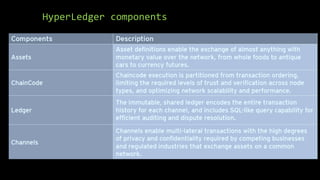
HyperLedger components

Block chains and crypto currencies - introduction

  • 1.
    Block-chains & CryptoCurrencies The Basics of decentralisation & cryptography - January 2018 Initio IKS Jan Stanley Brown
  • 2.
    Objectives and knowledgesharing • What is blockchain? Why should we care? • Cryptography: Shared secrets and the Blockchain • Protocols: What’s in those blocks ?! • Ethereum • Bitcoin • Hyperledger
  • 3.
  • 4.
    A blockchain isa shared ledger Ledger: An account book of final entry, in which business transactions are recorded
  • 5.
    A blockchain isan immutable database Database: A collection of information that is organized so that it can easily be accessed, managed, and updated.
  • 6.
    A blockchain movesdata around Data: Data is information that has been translated into a form that is more convenient to move or process (e.g. bits)
  • 7.
    A blockchain issecure Security: Preventing unauthorized access, use, disclosure, disruption, modification, inspection, recording or destruction of information
  • 8.
    Putting it alltogether Shared ledger and Immutable Database for Transferring Data very Securely
  • 9.
    Why should WE(Initio) care? Financial services, RegTech, payment institutions and many more are investing in blockchain technology 0 100 200 300 400 500 600 700 2014 2015 2016 2017 Investment in blockchain companies in the past four yours has risen exponentially over 1 bn$ $bn RegTech Exchange Financial services Infrastructu re Mining VC Universal Wallet Other ROUGHLY TWO OF FIVE BLOCKCHAIN COMPANIES ARE TARGETING FINANCIAL SERVICES Source: CoinDesk Venture Capital Database
  • 10.
    Large blockchain projects •Vulcanallows clients to launch digital assets thattrade alongside other virtual currenciesPWC •Project Bletchey is an open, modular Blockchain as-a- Service (BaaS) fabric powered by AzureMicrosoft •Rubix aims to bring start-up speed and enterprise reliability to the blockchain marketDeloitte •Editable blockchain for enterprise and permissioned systemsAccenture •IBM Blockchain is the company’s enterprise offering, independent of their Hyperledger project contribution IBM
  • 11.
    Cryptography: Shared Secretsand the Blockchain
  • 12.
    What is cryptography? Cryptography noun| cryp·tog·ra·phy | krip-ˈtä-grə-fē Cryptography is the study of mathematical techniques related to aspects of information security such as confidentiality, data integrity, entity authentication, and data origin authentication
  • 13.
    What does cryptographydo? Confidentiality Data Integrity Authentication Non-Repudiation
  • 14.
    Public/private key cryptography •Public/private key cryptography (also known as asymmetric cryptography) is a technique to encrypt and decrypt data using public and private key pairs • The “keys” are simply long numeric strings • Public keys are shared with everyone, like an email address • Private keys are kept secret, like a password Sender Encrypt Decrypt Recipient Recipient’s public key Recipient’s private key
  • 15.
    Cryptographic hashing • Acryptographic hash function is a type of algorithm than can be executed on a piece of data, which will produce a value called a checksum • Two files can be guaranteed to be identical if the checksums generated from each file are the same • There are many specific hashing functions that can be used, however the function must be consistent for the data to be validated as authentic • Hashing creates a fixed-width string out of other strings of any size Input Ouput Consulting is cool Consulting is uncool DFCD3454BBEA 00867FDB4819 Hash function
  • 16.
  • 17.
  • 18.
    Cryptographic transaction cyclestages Create Broadcast Propagate Verify Transactions are typically created using a wallet Application Transaction is created with the source wallet address, destination wallet address and the amount of coins being sent. Transaction is ready to be sent once sender digitally signs the transaction Broadcasted transactions are more like data Packets Nodes are ensured to be in a predetermined protocol Proof that the owner of coins requires the transfer Data can be sent over any network connected to the internet, but transmitting cryptographically Transactions not adhering to protocol are rejected P2P network allows for rapid message delivery, since each recipient transmits the information to more nodes to decentralize the information Valid transactions are collected by a miner and grouping into a block Upon verification of the validity of the block, the block is tagged as “Confirmed” Typically, it requires 6 counts of confirmation for the transaction to be deemed irreversible
  • 19.
    What is mining? • Primary purpose is to add and confirm new transactions into the public ledger • Mining ensures that transactions are not duplicated and conflicting transactions do not occur • Computational complexity and high power capacity to mine made it difficult and expensive to attempt to defraud the network
  • 20.
    Protocols: What arethe differences?
  • 21.
    Blockchains come inmany shapes and sizes
  • 22.
  • 23.
  • 24.
    What is aprotocol? ► A set of rules and requirements defining the standards, structures, and types of messages allowed over electronic communication between two or more end points. ► The protocol defines what is required to send a transaction and what is required for those transactions to be validated. ► All users and nodes that connect to the network must use an accepted distribution of software that follows the rules of the protocol in order to maintain consistency across the network and ensure its security. ► Transactions or blocks that do not conform to the predefined rules will be rejected. ► The protocol is not static – modifications to the protocol can be made. However, any changes require a consensus based authentication.
  • 25.
    Networks and nodes Theblockchain is an example of a network based upon a distributed ledger (blockchain technology). Specific data or tokens can be transferred over these networks, made up of computers called “nodes.” To be broadcasted on the network by the nodes, transactions must adhere to rules stipulated by the protocol. ► Decentralized ► No central authority to unilaterally control transactions and code execution ► Peer-to-peer (P2P) ► No central server to record all transaction, allowing for shared public access to the blockchain ► Consensus based authentication ► Transactions cannot be unilaterally approved - a majority of the network participants must include the transaction in a block in order for it to be valid, thus reaching consensus. This contrasts with traditional networks used by financial institutions and credit card companies (such as VisaNet, ACH, etc.), which are typically: ► Centralized ► Controlled and maintained by one entity
  • 26.
    Decentralized trust system ►Data application and settlement networks, which are based upon distributed ledgers, provide embedded trust ► Ability to rely on a distributed network of users rather than having to trust one single entity to perform tasks ► This allows for the irrefutable proof that a transaction/contract/agreement/data has not been duplicated or altered in the digital realm ► The embedded trust inherent in distributed ledgers is possible because the ledger is stored on a peer-to-peer network of computers rather than through a central server. Any additions/changes made to the ledger must be agreed upon by a majority of users, not unilaterally by a single user. ► As a result, services that traditionally require a trusted third party (such as fund transfers, contract verifications, escrow, etc.) can now be performed with the speed and convenience of the digital realm, resulting in: ► A reduced dependence on centralized parties ► Low-cost, international transactions with near-instant settlement ► Irrefutable proof of ownership of digital assets / contracts / agreements
  • 27.
  • 28.
    What is Ethereum Ethereumis a decentralized platform that runs smart contracts: applications that run exactly as programmed without any possibility of downtime, censorship, fraud or third party interference
  • 29.
    Basic concepts ofEthereum Node • An access point thru which a system can read and write to Ethereumblockchain Proof of work • A proof of work is a piece of data which is difficult (costly, time-consuming) to produce but easy for others to verify and which satisfies certain requirements Ether • It’s a real digital currency you can buy and use Gas • Cost to run and store things on Ethereum DAPP • Decentralized smart contract application running on Ethereum blockchain
  • 30.
    Basic concepts ofEthereum When deploying a smart contract in Ethereum, a few tools are needed:
  • 31.
  • 32.
    What is Bitcoin? Bitcoinis a permissionless digital currency and commodity e.g. a digital version of gold It is digital money, that is secure and provides an instant transfer of value anywhere in the world
  • 33.
    Basic concepts ofBitcoin Address A Bitcoin address is similar to a physical address or an email. It is the only information you need to provide for someone to pay you with Bitcoin. Private Key A private key is a secret piece of data, like a password, that proves your right to spend bitcoins from a specific wallet. Wallet A Bitcoin wallet is loosely the equivalent of a physical wallet on the Bitcoin network. The wallet actually contains your private keys which allow you to spend the bitcoins allocated to it in the blockchain. Cryptography Cryptography is the branch of mathematics that lets us create mathematical proofs that provide high levels of security. In the case of Bitcoin, cryptography is used to make it impossible for anybody to spend funds from another user's wallet or to corrupt the blockchain. It can also be used to encrypt a wallet, so that it cannot be used without a password.
  • 34.
  • 36.
    What is HyperLedger Hyperledgeris an open source collaborative effort to advance cross-industry blockchain technologies. It is a global collaboration, hosted by the linux foundation, including leaders in finance, banking, IoT, supply chain, manufacturing and technology.
  • 37.